LBBB
DR. ASWIN R. M.
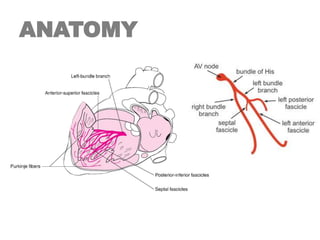
ANATOMY
BLOOD SUPPLY
• HIS BUNDLE – LAD + AV NODAL ARTERY
• PROXIMAL RBBB – LAD + AV NODAL ARTERY
• DISTAL RBBB – LAD
• LAF – LAD
• LPF – DUAL SUPPLY IN MOST CASES RCA+LCX
BUNDLE BRANCH BLOCKS
• Intrinsic impairment of conduction in the left or
right bundle branches or its branches
• Can be chronic or intermittent
• Can be rate dependent
• Can be present without cardiac disease
• Most often due to CAD or HTN causing ischemic or
degenerative changes
LBBB
• Considered as Bifascicular block
• Complete LBBB
– Disease in main LBB (predivisional)
– Or in both of its fascicles (postdivisional).
LBBB EPIDEMIOLOGY
• ~ 1 % (0.2 to 1.1 % in different populations)
• Incidence Increases with age
• Etiology Structural and functional
• Structural
– CAD
– ACS
– Cardiomyopathy
– SHTN
– Aortic valve disease
– Post cardiac surgery esp aortic root surgeries
• Functional
– Rate dependent BBB
LBBB
1. QRS duration greater than or equal to 120 ms in adults, greater than 100 ms in
children 4 to 16 years of age, and greater than 90 ms in children less than 4
years of age.
2. Broad notched or slurred R wave in leads I, aVL, V5, and V6 and an occasional
RS pattern in V5 and V6
3. Absent q waves in leads I, V5, and V6, but in the lead aVL, a narrow q wave
may be present in the absence of myocardial pathology.
4. R peak time greater than 60 ms in leads V5 and V6 but normal in leads V1, V2,
and V3, when small initial r waves can be discerned in the above leads.
5. ST and T waves usually opposite in direction to QRS.
6. Positive T wave in leads with upright QRS may be normal (positive
concordance).
7. Depressed ST segment and/or negative T wave in leads with negative QRS
(negative concordance) are abnormal
8. The appearance of LBBB may change the mean QRS axis in the frontal plane to
the right, to the left, or to a superior, in some cases in a rate-dependent
manner.
AHA/ACCF/HRS Recommendations for the Standardization and Interpretation of the Electrocardiogram
STRICT CRITERIA
• QRS ≥ 140 ms for men and ≥130 ms for women
• QS or rS in V1-V2
• Mid-QRS notching or slurring in ≥2 contiguous leads
INCOMPLETE LBBB
1. QRS duration between 110 and 119 ms in adults, between 90 and 100 ms
in children 8 to 16 years of age, and between 80 and 90 ms in children
less than 8 years of age.
2. R peak time greater than 60 ms in leads V4, V5, and V6.
3. Absence of q wave in leads I, V5, and V6.
MECHANISM
1. Slowed conduction through the LBBB
2. Enlargement of the left ventricle – prolongation of the QRS complex
that mimics incomplete LBBB (
3. LBB has multiple fascicles, involvement of few major fascicles but not
all.
AHA/ACCF/HRS Recommendations for the Standardization and Interpretation of the Electrocardiogram
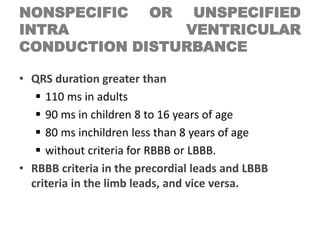
NONSPECIFIC OR UNSPECIFIED
INTRA VENTRICULAR
CONDUCTION DISTURBANCE
• QRS duration greater than
 110 ms in adults
 90 ms in children 8 to 16 years of age
 80 ms inchildren less than 8 years of age
 without criteria for RBBB or LBBB.
• RBBB criteria in the precordial leads and LBBB
criteria in the limb leads, and vice versa.
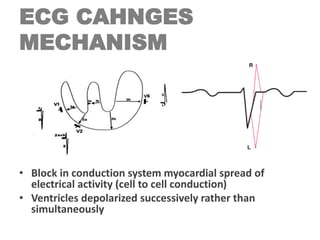
ECG CAHNGES
MECHANISM
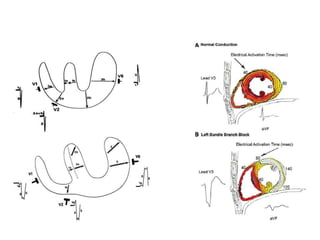
• Block in conduction system myocardial spread of
electrical activity (cell to cell conduction)
• Ventricles depolarized successively rather than
simultaneously
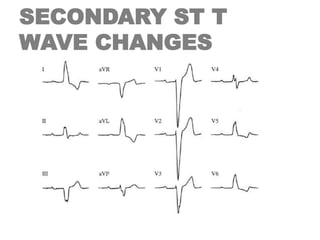
SECONDARY ST T
WAVE CHANGES
RATE DEPENDENT
BUNDLE BRANCH BLOCK
• Tachycardia or Bradycardia dependent BBB
• HR at which BBB manifests-critical HR
• Reproducible each time
• Tachycardia dependent BBB
– Phase 3 aberrancy
– When impulses are transmitted at a faster rate than the
ability to repolarize from prior impulse in that part of
conducting system.
• Bradycardia dependent BBB
– Phase 4 aberrancy
– Due to gradual loss in transmemebrane resting potential
from prolonged diastole ( subsequent excitation from a
much negative potential)
ASHMAN PHENOMENON
• Gouaux and Ashman in 1947
• Aberrant ventricular conduction due to a change in
QRS cycle length
• More often affects RBB(longer RP)
• In AF, when a relatively long cycle is followed by a
relatively short cycle, the beat with a short cycle
often has bundle-branch block morphology.
• Refractory period proportionate to R-R interval
• Will be diagnosed as VPC
EXERCISE INDUCED
LBBB
• 0.4%-0.5% of patients undergoing exercise tests.
• May not specifically indiates underlying CAD
• But many studies observed higher rates of mortality
in such patients.
LBBB CLINICAL
EXAMINATION
• Narrow or paradoxical splitting of 2nd heart sound
LBBB ECHO
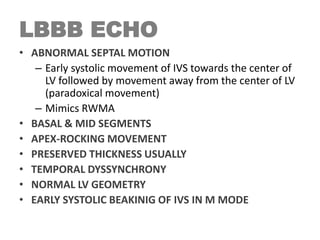
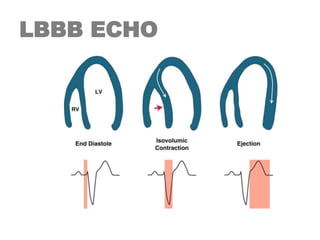
• ABNORMAL SEPTAL MOTION
– Early systolic movement of IVS towards the center of
LV followed by movement away from the center of LV
(paradoxical movement)
– Mimics RWMA
• BASAL & MID SEGMENTS
• APEX-ROCKING MOVEMENT
• PRESERVED THICKNESS USUALLY
• TEMPORAL DYSSYNCHRONY
• NORMAL LV GEOMETRY
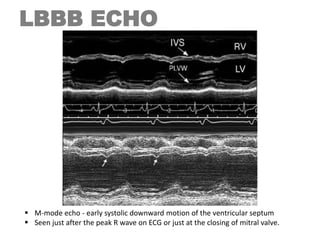
• EARLY SYSTOLIC BEAKINIG OF IVS IN M MODE
LBBB ECHO
LBBB ECHO
 M-mode echo - early systolic downward motion of the ventricular septum
 Seen just after the peak R wave on ECG or just at the closing of mitral valve.
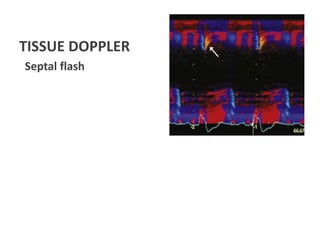
TISSUE DOPPLER
Septal flash
LBBB ECHO
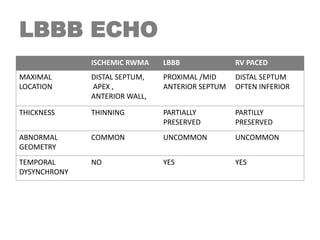
ISCHEMIC RWMA LBBB RV PACED
MAXIMAL
LOCATION
DISTAL SEPTUM,
APEX ,
ANTERIOR WALL,
PROXIMAL /MID
ANTERIOR SEPTUM
DISTAL SEPTUM
OFTEN INFERIOR
THICKNESS THINNING PARTIALLY
PRESERVED
PARTILLY
PRESERVED
ABNORMAL
GEOMETRY
COMMON UNCOMMON UNCOMMON
TEMPORAL
DYSYNCHRONY
NO YES YES
LBBB & MI
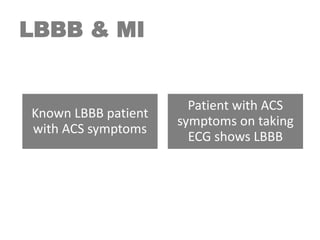
Known LBBB patient
with ACS symptoms
Patient with ACS
symptoms on taking
ECG shows LBBB
LBBB & MI
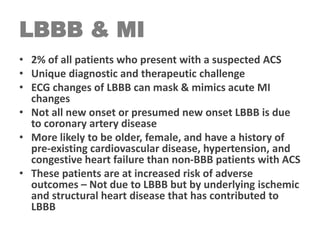
• 2% of all patients who present with a suspected ACS
• Unique diagnostic and therapeutic challenge
• ECG changes of LBBB can mask & mimics acute MI
changes
• Not all new onset or presumed new onset LBBB is due
to coronary artery disease
• More likely to be older, female, and have a history of
pre-existing cardiovascular disease, hypertension, and
congestive heart failure than non-BBB patients with ACS
• These patients are at increased risk of adverse
outcomes – Not due to LBBB but by underlying ischemic
and structural heart disease that has contributed to
LBBB
HOW TO APPROACH
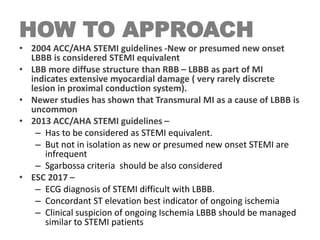
• 2004 ACC/AHA STEMI guidelines -New or presumed new onset
LBBB is considered STEMI equivalent
• LBB more diffuse structure than RBB – LBBB as part of MI
indicates extensive myocardial damage ( very rarely discrete
lesion in proximal conduction system).
• Newer studies has shown that Transmural MI as a cause of LBBB is
uncommon
• 2013 ACC/AHA STEMI guidelines –
– Has to be considered as STEMI equivalent.
– But not in isolation as new or presumed new onset STEMI are
infrequent
– Sgarbossa criteria should be also considered
• ESC 2017 –
– ECG diagnosis of STEMI difficult with LBBB.
– Concordant ST elevation best indicator of ongoing ischemia
– Clinical suspicion of ongoing Ischemia LBBB should be managed
similar to STEMI patients
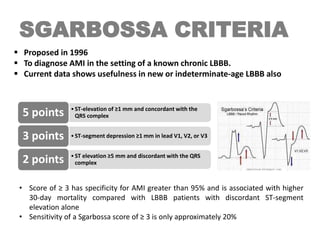
SGARBOSSA CRITERIA
•ST-elevation of ≥1 mm and concordant with the
QRS complex5 points
•ST-segment depression ≥1 mm in lead V1, V2, or V33 points
•ST elevation ≥5 mm and discordant with the QRS
complex2 points
 Proposed in 1996
 To diagnose AMI in the setting of a known chronic LBBB.
 Current data shows usefulness in new or indeterminate-age LBBB also
• Score of ≥ 3 has specificity for AMI greater than 95% and is associated with higher
30-day mortality compared with LBBB patients with discordant ST-segment
elevation alone
• Sensitivity of a Sgarbossa score of ≥ 3 is only approximately 20%
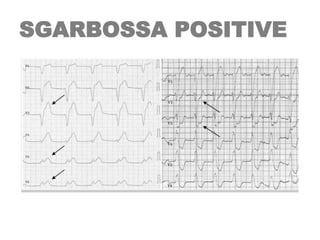
SGARBOSSA POSITIVE
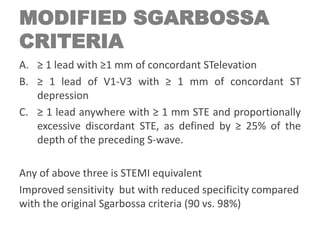
MODIFIED SGARBOSSA
CRITERIA
A. ≥ 1 lead with ≥1 mm of concordant STelevation
B. ≥ 1 lead of V1-V3 with ≥ 1 mm of concordant ST
depression
C. ≥ 1 lead anywhere with ≥ 1 mm STE and proportionally
excessive discordant STE, as defined by ≥ 25% of the
depth of the preceding S-wave.
Any of above three is STEMI equivalent
Improved sensitivity but with reduced specificity compared
with the original Sgarbossa criteria (90 vs. 98%)
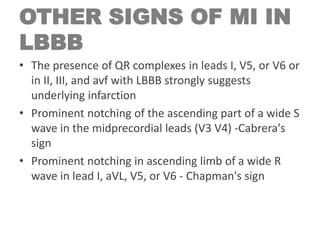
OTHER SIGNS OF MI IN
LBBB
• The presence of QR complexes in leads I, V5, or V6 or
in II, III, and avf with LBBB strongly suggests
underlying infarction
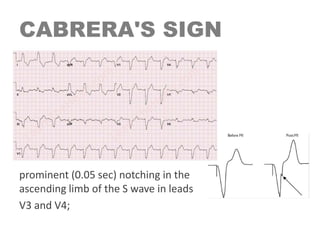
• Prominent notching of the ascending part of a wide S
wave in the midprecordial leads (V3 V4) -Cabrera's
sign
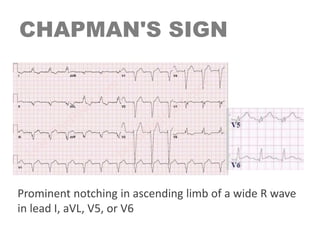
• Prominent notching in ascending limb of a wide R
wave in lead I, aVL, V5, or V6 - Chapman's sign
CABRERA'S SIGN
prominent (0.05 sec) notching in the
ascending limb of the S wave in leads
V3 and V4;
CHAPMAN'S SIGN
Prominent notching in ascending limb of a wide R wave
in lead I, aVL, V5, or V6
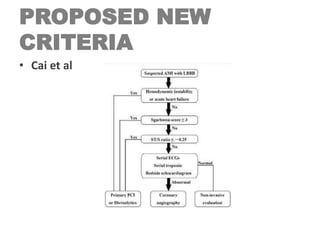
PROPOSED NEW
CRITERIA
• Cai et al
RADIONUCLEOTIDE
MYOCARDIAL PERFUSION
IMAGING
• Stress ECG not usefull in LBBB
• For evaluation of underlying CAD
• Both Excersise & Pharmacologic
• Excersise testing
– High incidence of false positive results in septal &
anteroseptal
– More apparent with tachycardia associated with
excersise
– Perfusion defects in the inferior and lateral zones are
not LBBB-related – signifies LCX or RCA disease
PHARMACOLOGIC
STRESS TESTING
• Preferred over exercise testing
• Dobutamine testing has same disadvantage as
exercise testing
• Should preferentially undergo Vasodilator
(dipyridamole or adenosine) radionuclide imaging
ACC/AHA/ASNC Guidelines for the Clinical Use of Cardiac Radionuclide Imaging
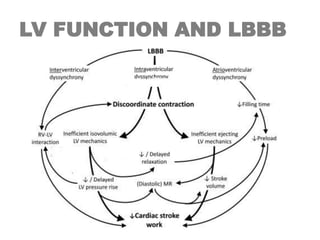
IMPACT ON LV FUNCTION
Normal heart, closely tuned electrical function – results
in a cordinated sequence of mechanical function results
in efficient
Biventricular filling,
contraction
Relaxation
& pump function
LBBB – Dysynchronous mechanical activity of different
part of heart
AV DYSYNCHRONY
• There is a delay between atrial and ventricular
contraction
• Reduced LV filling
– shortened ventricular filling time
– superimposition of atrial contraction on early passive
filling,
• The ratio between LV diastolic filling time and duration of
a complete cardiac cycle (A LV filling time of < 40%
cardiac cycle is indicative of A-V dys.)
• It can also be associated with late diastolic (presystolic)
mitral regurgitation (MR).
INTERVENTRICULAR
DYSSYNCHRONY
• Delay between RV and LV activation.
• RV contraction will precede LV contraction
• abnormal septal motion
• and a decreased LV Function
INTERVENTRICULAR
DYSSYNCHRONY
• Normal ventricular activation sequence is disrupted,
resulting in
• Dis cordinated contraction of the LV segments.
• Those LV wall segments, which contract early (ex septum),
do not contribute to the LV output,
• Late contracting segments do so at a higher wall stress – are
hypercontractile stretches the early contracting segments
• Asymmetric hypertrophy and assymetric LV dilatation
• MR worsens
– LV remodeling
– Presystolic regurgitation
– delayed contraction of papillary muscle rootattachments.
LV FUNCTION AND LBBB
INTRAVENTRICULAR
DYSYNCHRONY
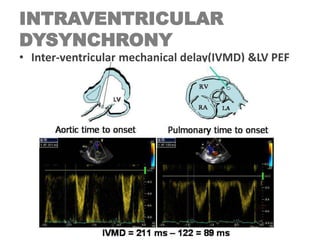
• Inter-ventricular mechanical delay(IVMD) &LV PEF
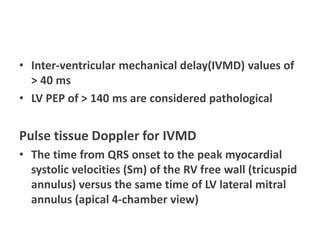
• Inter-ventricular mechanical delay(IVMD) values of
> 40 ms
• LV PEP of > 140 ms are considered pathological
Pulse tissue Doppler for IVMD
• The time from QRS onset to the peak myocardial
systolic velocities (Sm) of the RV free wall (tricuspid
annulus) versus the same time of LV lateral mitral
annulus (apical 4-chamber view)
INTRAVENTRICULAR
DYSYNCHRONY
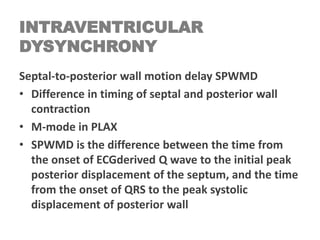
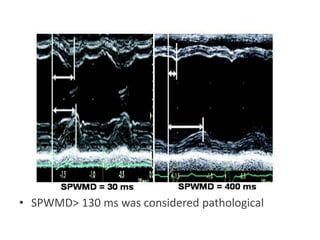
Septal-to-posterior wall motion delay SPWMD
• Difference in timing of septal and posterior wall
contraction
• M-mode in PLAX
• SPWMD is the difference between the time from
the onset of ECGderived Q wave to the initial peak
posterior displacement of the septum, and the time
from the onset of QRS to the peak systolic
displacement of posterior wall
• SPWMD> 130 ms was considered pathological
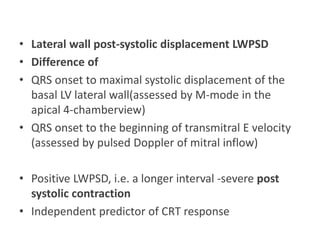
• Lateral wall post-systolic displacement LWPSD
• Difference of
• QRS onset to maximal systolic displacement of the
basal LV lateral wall(assessed by M-mode in the
apical 4-chamberview)
• QRS onset to the beginning of transmitral E velocity
(assessed by pulsed Doppler of mitral inflow)
• Positive LWPSD, i.e. a longer interval -severe post
systolic contraction
• Independent predictor of CRT response
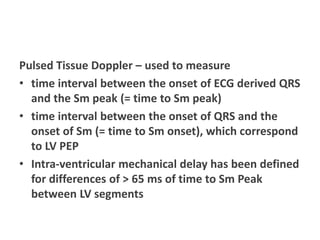
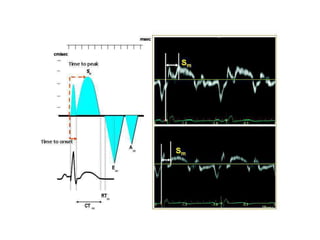
Pulsed Tissue Doppler – used to measure
• time interval between the onset of ECG derived QRS
and the Sm peak (= time to Sm peak)
• time interval between the onset of QRS and the
onset of Sm (= time to Sm onset), which correspond
to LV PEP
• Intra-ventricular mechanical delay has been defined
for differences of > 65 ms of time to Sm Peak
between LV segments
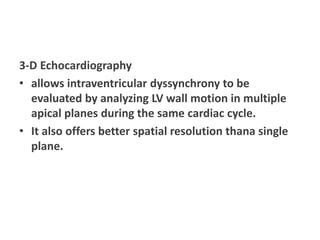
3-D Echocardiography
• allows intraventricular dyssynchrony to be
evaluated by analyzing LV wall motion in multiple
apical planes during the same cardiac cycle.
• It also offers better spatial resolution thana single
plane.
CRT IN LBBB
CRT or biventricular pacing aims at eliminating the
electrical dysynchrony
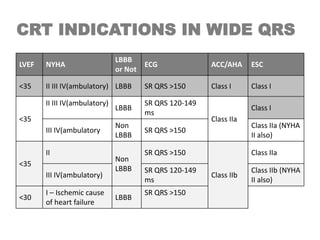
CRT INDICATIONS IN WIDE QRS
LVEF NYHA
LBBB
or Not
ECG ACC/AHA ESC
<35 II III IV(ambulatory) LBBB SR QRS >150 Class I Class I
<35
II III IV(ambulatory)
LBBB
SR QRS 120-149
ms
Class IIa
Class I
III IV(ambulatory
Non
LBBB
SR QRS >150
Class IIa (NYHA
II also)
<35
II
Non
LBBB
SR QRS >150
Class IIb
Class IIa
III IV(ambulatory)
SR QRS 120-149
ms
Class IIb (NYHA
II also)
<30
I – Ischemic cause
of heart failure
LBBB
SR QRS >150
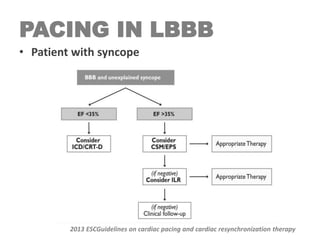
PACING IN LBBB
• Patient with syncope
2013 ESCGuidelines on cardiac pacing and cardiac resynchronization therapy
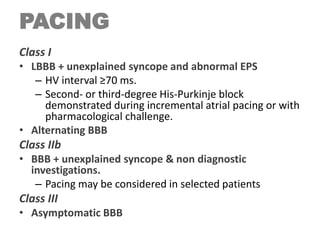
PACING
Class I
• LBBB + unexplained syncope and abnormal EPS
– HV interval ≥70 ms.
– Second- or third-degree His-Purkinje block
demonstrated during incremental atrial pacing or with
pharmacological challenge.
• Alternating BBB
Class IIb
• BBB + unexplained syncope & non diagnostic
investigations.
– Pacing may be considered in selected patients
Class III
• Asymptomatic BBB
THANK YOU

LBBB

  • 1.
  • 2.
  • 3.
    BLOOD SUPPLY • HISBUNDLE – LAD + AV NODAL ARTERY • PROXIMAL RBBB – LAD + AV NODAL ARTERY • DISTAL RBBB – LAD • LAF – LAD • LPF – DUAL SUPPLY IN MOST CASES RCA+LCX
  • 4.
    BUNDLE BRANCH BLOCKS •Intrinsic impairment of conduction in the left or right bundle branches or its branches • Can be chronic or intermittent • Can be rate dependent • Can be present without cardiac disease • Most often due to CAD or HTN causing ischemic or degenerative changes
  • 5.
    LBBB • Considered asBifascicular block • Complete LBBB – Disease in main LBB (predivisional) – Or in both of its fascicles (postdivisional).
  • 6.
    LBBB EPIDEMIOLOGY • ~1 % (0.2 to 1.1 % in different populations) • Incidence Increases with age • Etiology Structural and functional • Structural – CAD – ACS – Cardiomyopathy – SHTN – Aortic valve disease – Post cardiac surgery esp aortic root surgeries • Functional – Rate dependent BBB
  • 7.
    LBBB 1. QRS durationgreater than or equal to 120 ms in adults, greater than 100 ms in children 4 to 16 years of age, and greater than 90 ms in children less than 4 years of age. 2. Broad notched or slurred R wave in leads I, aVL, V5, and V6 and an occasional RS pattern in V5 and V6 3. Absent q waves in leads I, V5, and V6, but in the lead aVL, a narrow q wave may be present in the absence of myocardial pathology. 4. R peak time greater than 60 ms in leads V5 and V6 but normal in leads V1, V2, and V3, when small initial r waves can be discerned in the above leads. 5. ST and T waves usually opposite in direction to QRS. 6. Positive T wave in leads with upright QRS may be normal (positive concordance). 7. Depressed ST segment and/or negative T wave in leads with negative QRS (negative concordance) are abnormal 8. The appearance of LBBB may change the mean QRS axis in the frontal plane to the right, to the left, or to a superior, in some cases in a rate-dependent manner. AHA/ACCF/HRS Recommendations for the Standardization and Interpretation of the Electrocardiogram
  • 8.
    STRICT CRITERIA • QRS≥ 140 ms for men and ≥130 ms for women • QS or rS in V1-V2 • Mid-QRS notching or slurring in ≥2 contiguous leads
  • 9.
    INCOMPLETE LBBB 1. QRSduration between 110 and 119 ms in adults, between 90 and 100 ms in children 8 to 16 years of age, and between 80 and 90 ms in children less than 8 years of age. 2. R peak time greater than 60 ms in leads V4, V5, and V6. 3. Absence of q wave in leads I, V5, and V6. MECHANISM 1. Slowed conduction through the LBBB 2. Enlargement of the left ventricle – prolongation of the QRS complex that mimics incomplete LBBB ( 3. LBB has multiple fascicles, involvement of few major fascicles but not all. AHA/ACCF/HRS Recommendations for the Standardization and Interpretation of the Electrocardiogram
  • 10.
    NONSPECIFIC OR UNSPECIFIED INTRAVENTRICULAR CONDUCTION DISTURBANCE • QRS duration greater than  110 ms in adults  90 ms in children 8 to 16 years of age  80 ms inchildren less than 8 years of age  without criteria for RBBB or LBBB. • RBBB criteria in the precordial leads and LBBB criteria in the limb leads, and vice versa.
  • 11.
    ECG CAHNGES MECHANISM • Blockin conduction system myocardial spread of electrical activity (cell to cell conduction) • Ventricles depolarized successively rather than simultaneously
  • 13.
  • 14.
    RATE DEPENDENT BUNDLE BRANCHBLOCK • Tachycardia or Bradycardia dependent BBB • HR at which BBB manifests-critical HR • Reproducible each time • Tachycardia dependent BBB – Phase 3 aberrancy – When impulses are transmitted at a faster rate than the ability to repolarize from prior impulse in that part of conducting system. • Bradycardia dependent BBB – Phase 4 aberrancy – Due to gradual loss in transmemebrane resting potential from prolonged diastole ( subsequent excitation from a much negative potential)
  • 15.
    ASHMAN PHENOMENON • Gouauxand Ashman in 1947 • Aberrant ventricular conduction due to a change in QRS cycle length • More often affects RBB(longer RP) • In AF, when a relatively long cycle is followed by a relatively short cycle, the beat with a short cycle often has bundle-branch block morphology. • Refractory period proportionate to R-R interval • Will be diagnosed as VPC
  • 16.
    EXERCISE INDUCED LBBB • 0.4%-0.5%of patients undergoing exercise tests. • May not specifically indiates underlying CAD • But many studies observed higher rates of mortality in such patients.
  • 17.
    LBBB CLINICAL EXAMINATION • Narrowor paradoxical splitting of 2nd heart sound
  • 18.
    LBBB ECHO • ABNORMALSEPTAL MOTION – Early systolic movement of IVS towards the center of LV followed by movement away from the center of LV (paradoxical movement) – Mimics RWMA • BASAL & MID SEGMENTS • APEX-ROCKING MOVEMENT • PRESERVED THICKNESS USUALLY • TEMPORAL DYSSYNCHRONY • NORMAL LV GEOMETRY • EARLY SYSTOLIC BEAKINIG OF IVS IN M MODE
  • 19.
  • 20.
    LBBB ECHO  M-modeecho - early systolic downward motion of the ventricular septum  Seen just after the peak R wave on ECG or just at the closing of mitral valve.
  • 21.
  • 22.
    LBBB ECHO ISCHEMIC RWMALBBB RV PACED MAXIMAL LOCATION DISTAL SEPTUM, APEX , ANTERIOR WALL, PROXIMAL /MID ANTERIOR SEPTUM DISTAL SEPTUM OFTEN INFERIOR THICKNESS THINNING PARTIALLY PRESERVED PARTILLY PRESERVED ABNORMAL GEOMETRY COMMON UNCOMMON UNCOMMON TEMPORAL DYSYNCHRONY NO YES YES
  • 23.
    LBBB & MI KnownLBBB patient with ACS symptoms Patient with ACS symptoms on taking ECG shows LBBB
  • 24.
    LBBB & MI •2% of all patients who present with a suspected ACS • Unique diagnostic and therapeutic challenge • ECG changes of LBBB can mask & mimics acute MI changes • Not all new onset or presumed new onset LBBB is due to coronary artery disease • More likely to be older, female, and have a history of pre-existing cardiovascular disease, hypertension, and congestive heart failure than non-BBB patients with ACS • These patients are at increased risk of adverse outcomes – Not due to LBBB but by underlying ischemic and structural heart disease that has contributed to LBBB
  • 25.
    HOW TO APPROACH •2004 ACC/AHA STEMI guidelines -New or presumed new onset LBBB is considered STEMI equivalent • LBB more diffuse structure than RBB – LBBB as part of MI indicates extensive myocardial damage ( very rarely discrete lesion in proximal conduction system). • Newer studies has shown that Transmural MI as a cause of LBBB is uncommon • 2013 ACC/AHA STEMI guidelines – – Has to be considered as STEMI equivalent. – But not in isolation as new or presumed new onset STEMI are infrequent – Sgarbossa criteria should be also considered • ESC 2017 – – ECG diagnosis of STEMI difficult with LBBB. – Concordant ST elevation best indicator of ongoing ischemia – Clinical suspicion of ongoing Ischemia LBBB should be managed similar to STEMI patients
  • 26.
    SGARBOSSA CRITERIA •ST-elevation of≥1 mm and concordant with the QRS complex5 points •ST-segment depression ≥1 mm in lead V1, V2, or V33 points •ST elevation ≥5 mm and discordant with the QRS complex2 points  Proposed in 1996  To diagnose AMI in the setting of a known chronic LBBB.  Current data shows usefulness in new or indeterminate-age LBBB also • Score of ≥ 3 has specificity for AMI greater than 95% and is associated with higher 30-day mortality compared with LBBB patients with discordant ST-segment elevation alone • Sensitivity of a Sgarbossa score of ≥ 3 is only approximately 20%
  • 27.
  • 28.
    MODIFIED SGARBOSSA CRITERIA A. ≥1 lead with ≥1 mm of concordant STelevation B. ≥ 1 lead of V1-V3 with ≥ 1 mm of concordant ST depression C. ≥ 1 lead anywhere with ≥ 1 mm STE and proportionally excessive discordant STE, as defined by ≥ 25% of the depth of the preceding S-wave. Any of above three is STEMI equivalent Improved sensitivity but with reduced specificity compared with the original Sgarbossa criteria (90 vs. 98%)
  • 29.
    OTHER SIGNS OFMI IN LBBB • The presence of QR complexes in leads I, V5, or V6 or in II, III, and avf with LBBB strongly suggests underlying infarction • Prominent notching of the ascending part of a wide S wave in the midprecordial leads (V3 V4) -Cabrera's sign • Prominent notching in ascending limb of a wide R wave in lead I, aVL, V5, or V6 - Chapman's sign
  • 30.
    CABRERA'S SIGN prominent (0.05sec) notching in the ascending limb of the S wave in leads V3 and V4;
  • 31.
    CHAPMAN'S SIGN Prominent notchingin ascending limb of a wide R wave in lead I, aVL, V5, or V6
  • 32.
  • 33.
    RADIONUCLEOTIDE MYOCARDIAL PERFUSION IMAGING • StressECG not usefull in LBBB • For evaluation of underlying CAD • Both Excersise & Pharmacologic • Excersise testing – High incidence of false positive results in septal & anteroseptal – More apparent with tachycardia associated with excersise – Perfusion defects in the inferior and lateral zones are not LBBB-related – signifies LCX or RCA disease
  • 34.
    PHARMACOLOGIC STRESS TESTING • Preferredover exercise testing • Dobutamine testing has same disadvantage as exercise testing • Should preferentially undergo Vasodilator (dipyridamole or adenosine) radionuclide imaging ACC/AHA/ASNC Guidelines for the Clinical Use of Cardiac Radionuclide Imaging
  • 35.
    IMPACT ON LVFUNCTION Normal heart, closely tuned electrical function – results in a cordinated sequence of mechanical function results in efficient Biventricular filling, contraction Relaxation & pump function LBBB – Dysynchronous mechanical activity of different part of heart
  • 36.
    AV DYSYNCHRONY • Thereis a delay between atrial and ventricular contraction • Reduced LV filling – shortened ventricular filling time – superimposition of atrial contraction on early passive filling, • The ratio between LV diastolic filling time and duration of a complete cardiac cycle (A LV filling time of < 40% cardiac cycle is indicative of A-V dys.) • It can also be associated with late diastolic (presystolic) mitral regurgitation (MR).
  • 37.
    INTERVENTRICULAR DYSSYNCHRONY • Delay betweenRV and LV activation. • RV contraction will precede LV contraction • abnormal septal motion • and a decreased LV Function
  • 38.
    INTERVENTRICULAR DYSSYNCHRONY • Normal ventricularactivation sequence is disrupted, resulting in • Dis cordinated contraction of the LV segments. • Those LV wall segments, which contract early (ex septum), do not contribute to the LV output, • Late contracting segments do so at a higher wall stress – are hypercontractile stretches the early contracting segments • Asymmetric hypertrophy and assymetric LV dilatation • MR worsens – LV remodeling – Presystolic regurgitation – delayed contraction of papillary muscle rootattachments.
  • 39.
  • 40.
  • 41.
    • Inter-ventricular mechanicaldelay(IVMD) values of > 40 ms • LV PEP of > 140 ms are considered pathological Pulse tissue Doppler for IVMD • The time from QRS onset to the peak myocardial systolic velocities (Sm) of the RV free wall (tricuspid annulus) versus the same time of LV lateral mitral annulus (apical 4-chamber view)
  • 42.
    INTRAVENTRICULAR DYSYNCHRONY Septal-to-posterior wall motiondelay SPWMD • Difference in timing of septal and posterior wall contraction • M-mode in PLAX • SPWMD is the difference between the time from the onset of ECGderived Q wave to the initial peak posterior displacement of the septum, and the time from the onset of QRS to the peak systolic displacement of posterior wall
  • 43.
    • SPWMD> 130ms was considered pathological
  • 44.
    • Lateral wallpost-systolic displacement LWPSD • Difference of • QRS onset to maximal systolic displacement of the basal LV lateral wall(assessed by M-mode in the apical 4-chamberview) • QRS onset to the beginning of transmitral E velocity (assessed by pulsed Doppler of mitral inflow) • Positive LWPSD, i.e. a longer interval -severe post systolic contraction • Independent predictor of CRT response
  • 45.
    Pulsed Tissue Doppler– used to measure • time interval between the onset of ECG derived QRS and the Sm peak (= time to Sm peak) • time interval between the onset of QRS and the onset of Sm (= time to Sm onset), which correspond to LV PEP • Intra-ventricular mechanical delay has been defined for differences of > 65 ms of time to Sm Peak between LV segments
  • 47.
    3-D Echocardiography • allowsintraventricular dyssynchrony to be evaluated by analyzing LV wall motion in multiple apical planes during the same cardiac cycle. • It also offers better spatial resolution thana single plane.
  • 48.
    CRT IN LBBB CRTor biventricular pacing aims at eliminating the electrical dysynchrony
  • 49.
    CRT INDICATIONS INWIDE QRS LVEF NYHA LBBB or Not ECG ACC/AHA ESC <35 II III IV(ambulatory) LBBB SR QRS >150 Class I Class I <35 II III IV(ambulatory) LBBB SR QRS 120-149 ms Class IIa Class I III IV(ambulatory Non LBBB SR QRS >150 Class IIa (NYHA II also) <35 II Non LBBB SR QRS >150 Class IIb Class IIa III IV(ambulatory) SR QRS 120-149 ms Class IIb (NYHA II also) <30 I – Ischemic cause of heart failure LBBB SR QRS >150
  • 50.
    PACING IN LBBB •Patient with syncope 2013 ESCGuidelines on cardiac pacing and cardiac resynchronization therapy
  • 51.
    PACING Class I • LBBB+ unexplained syncope and abnormal EPS – HV interval ≥70 ms. – Second- or third-degree His-Purkinje block demonstrated during incremental atrial pacing or with pharmacological challenge. • Alternating BBB Class IIb • BBB + unexplained syncope & non diagnostic investigations. – Pacing may be considered in selected patients Class III • Asymptomatic BBB
  • 52.

Editor's Notes

  • #3 The anterior and posterior fascicles to the LBB are also designated superior and inferior, respectively, because these terms indicate their true anatomic positions. Under normal conditions, the electrical impulse from the His bundle passes through a narrow anterior fascicle, a broader early branching posterior fascicle, and a third septal segment composed of many branches originating from each of the fascicl
  • #12 Block of an entire bundle branch requires that its ventricle be activated by myocardial spread of electrical activity (cell to cell conduction) from the other ventricle, with prolongation of the overall QRS complex Ventricles depolarized successively rather than simultaneously Other conditions with succesive acvtivation of ventricles - VT ,ectopics , accessory pathway , ventricular pacing QRS complex is prolonged and the ST segment slopes into the T wave in the direction away from the ventricle in which the abnormality is located.
  • #13 Initial septal activation with LBBB typically occurs on the right (rather than on the left) septal surface, leading to right to left (rather than left to right) activation of the septum, so that normal septal q waves are absent. • Left ventricular activation then typically begins on the left septal surface, with a delay of 40 milliseconds or longer caused by slow transseptal spread from the right ventricular side of the septum. • The subsequent activation of the ventricular free wall is highly variable, depending on the type, location, and extent of the underlying cardiac disease. • Most commonly, the region of block is located anteriorly, and the lateral and posterolateral portions of the left ventricle are activated by wave fronts moving around the apex and across the inferior wall in a U-shaped pattern. When complete LBBB is present, however, the septum is activated from right to left (see Figs. 6.11B and 6.12C). This produces a small R wave followed by a large S wave or a large Q wave with no R wave in the right precordial leads (Vl and V2l and eliminates the normal Q waves in the leftwardoriented leads (leads V5-V6, I, aVL). However, it should be noted that patients with LBBB and an anterior myocardial infarction (Mil can have Q waves in leftward-oriented leads even with LBBB (see Chapter 12, Fig. 12.17B). The activation of the left ventricle then proceeds sequentially from the interventricular septum to the adjacent anterior and inferior walls, and then to the lateral free wall(see Figs. 6.11B and 6.12C).
  • #14 The discordant ST-T wave pattern is a reflection of the altered pattern of ventricular activation. • With LBBB, the right ventricle is activated and recovers earlier than the left, so recovery vectors are directed toward the right and away from the left ventricle. • Hence positive ST-T waves will be registered in leads over the right ventricle that show S waves and negative ones over the left ventricle with prominent R waves. • ST-T wave changes are prominent with LBBB. In most cases, the ST segment and T wave are discordant with the QRS complex. That is, the ST segment is depressed and the T wave is inverted in leads with positive QRS waves (e.g., leads I, aVL, V5, and V6), and the ST segment is elevated and the T wave is upright in leads with predominantly negative QRS complexes (e.g., leads V1 and V2). • These ST-T wave changes are referred to secondary ST-T abnormalities because they are generated by abnormalities in conduction • ST-segment elevation with tall, positive T waves frequently is seen in the right precordial leads with uncomplicated LBBB. • Secondary T wave inversions are characteristically seen in the lateral precordial leads. In BBB, the T wave is usually directed opposite to the latter portion of the QRS complex (e.g., in Fig. 6.17 A, the T wave in lead I is inverted and the latter part of the QRS complex is upright; in Fig. 6.17B, the T wave is upright and the latter part of the QllS complex is negative). One method of determining the clinical significance ofT-wave changes in BBB is to measure the angle between the axis of the T wave and that of the terminal part of the QRS complex. Obviously, if the two are oppositely directed (as they are with secondary T-wave changes}, the angle between them is wide and may approach 180 degrees. It has been proposed that if this angle is <110 degrees, myocardial disease is present. In Figure 6.17B, the angle is about 150 degrees, whereas in Figure 6.17C it is only a few degrees. This opposite polarity is the natural result of the depolarization-repolarization disturbance produced by the BBB and is therefore termed 11secon.dmy." Indeed, if the direction of the T wave is similar to that of the terminal part of the QRS complex (see Fig. 6.17C), it should be considered abnormal. Such T-wave changes are primary and imply myocardial disease. The diagnosis of MI in the presence of BBB is considered in Chapter 12.
  • #15 SVT Misatken as VT
  • #19 Isovolumetric contraction phase
  • #20 Isovolumetric contraction phase
  • #24 LBBB can mask or mimic MI. abnormal Q waves with infarction is dependent on a normal initial sequence of ventricular activatio• In addition, ECG patterns of LBBB, including low R wave amplitude in the midprecordial leads and ST-T wave changes, can mimic anterior infarct patterns. The diagnosis of infarction in the presence of LBBB is considerably more complicated and confusing, because LBBB alters the early and the late phases of ventricular depolarization and produces secondary ST-T changes. • These changes may mask and/or mimic myocardial infarction findings. • Infarction of the left ventricular free (or lateral) wall ordinarily results in abnormal Q waves in the midprecordial to lateral precordial leads (and selected limb leads). • However, the initial septal depolarization forces with LBBB are directed from right to left. These leftward forces produce an initial R wave in the midprecordial to lateraprecordial leads, usually masking the loss of electrical potential (Q waves) caused by the infarction. • Thereforeacute or chronic left ventricular free wall infarction by itself will not produce diagnostic Q waves in the presence of LBBB
  • #25 LBBB can mask or mimic MI. abnormal Q waves with infarction is dependent on a normal initial sequence of ventricular activatio• In addition, ECG patterns of LBBB, including low R wave amplitude in the midprecordial leads and ST-T wave changes, can mimic anterior infarct patterns. The diagnosis of infarction in the presence of LBBB is considerably more complicated and confusing, because LBBB alters the early and the late phases of ventricular depolarization and produces secondary ST-T changes. • These changes may mask and/or mimic myocardial infarction findings. • Infarction of the left ventricular free (or lateral) wall ordinarily results in abnormal Q waves in the midprecordial to lateral precordial leads (and selected limb leads). • However, the initial septal depolarization forces with LBBB are directed from right to left. These leftward forces produce an initial R wave in the midprecordial to lateraprecordial leads, usually masking the loss of electrical potential (Q waves) caused by the infarction. • Thereforeacute or chronic left ventricular free wall infarction by itself will not produce diagnostic Q waves in the presence of LBBB
  • #26 LBBB is more often a pre-existing marker of underlying structural heart disease; those with LBBB have increased risk for cardiovascular mortality, coronary artery disease, heart failure, and sudden cardiac death.3,4 The LBBB itself can be the result of an aging or fibrotic conduction system, chronic ischemic heart disease, left ventricular hypertrophy, adverse ventricular remodeling from congestive heart failure, or valvular heart disease.
  • #27 the diagnosis of MI in the setting of LBBB is especially challenging by ECG. Because left ventricular activation is delayed in LBBB and the initial septal activation is from right to left (opposite of the normal situation), septal Q waves indicative of an MI are absent. Additionally, secondary ST-T wave abnormalities that occur in LBBB obscure the recognition of injury currents in ischemia and infarction. The most widely accepted tools to aid in the diagnosis of MI in the presence of LBBB are the Sgarbossa criteria. Sgarbossa et al.1identified three ECG criteria that may improve the diagnosis of MI in patients with LBBB
  • #29 More diagnostic accuracy Criteria for excessive discordance was removed – large LV forces even in the absence of cad > 5 mm ST elevation can occcur
  • #40 Electrical dysynchrony is the intiating event but subsequently differential remodelleing and mechanical forces are the cause for the deterioration of LV function