Cardiac Arrhythmias
(Tachyarrhythmias)
PRESENTED BY –Dr.Anjul kumar singh
Moderator –Dr.Ganesh
Dr.Arvind
• Arrhythmia is defined as “Abnormality of cardiac rate, rhythm or conduction
which can be either lethal (sudden cardiac death), or symptomatic (syncope,
near syncope, dizziness, or palpitations) or asymptomatic”.
• Pathogenesis
1. Injury or damage (pathology) to the cardiac conduction systems.
2. Re-entry: It is a mechanism that may precipitate a wide variety of
supraventricular and ventricular arrhythmias.
3. Automaticity: Abnormal depolarization of atrial or ventricular muscle cell
during the periods of action potential can lead to arrhythmias.
4. Mutations in ion channels: Since these channels are mainly responsible for
depolarization, mutation can lead to arrhythmias.
5. Ectopic foci/ irritable foci
Classification of arrhythmias
Tachyarrhythmia
• The tachycardia can be classified based on the appearance of the QRS
complex as tachycardia
• narrow complex supraventricular tachycardia (SVT)
• wide complex tachycardia.
• Most wide complex (broad complex) tachycardias are ventricular in
origin
• Tachyarrhythmias are classified in two categories depending upon the
QRS complexes
• i. Narrow QRS complex (QRS<0.12)
• ii. Wide QRS complex (QRS>0.12)
Narrow QRS complex (QRS<0.12)
• a. Sinus tachycardia
• b. Atrial premature beat
• c. Atrial tachycardia
• d.Atrial flutter
• e.Atrial fibrillation (AF)
. Sinus tachycardia
• It is defined as an increase in the sinus rate of more than 100 beats/minute. Prolonged
tachycardia for long duration can induce ischaemia in coronary artery diseased
patients.
Causes:
• Anaemia because of blood loss
• Pain
• Inadequate anaesthesia
• Hypovolaemia
• Fever
• Hypercarbia
• Thyrotoxicosis/ thyroid crisis
• Cardiac failure with compensatory sinus tachycardia
• Catecholamines excess
Treatment
• Before pharmacological treatment for sinus tachycardia, precipitating factors
must be identified and corrected.
• Drug therapy required in patients with ischaemic heart disease who develop
ST segment changes to prevent further myocardial ischaemia.
• Beta-blockers as esmolol is preferred drug for managing its half-life of 10 min
with bolus dose of 500 mcg/kg over 1 min, followed by an infusion of 50-300
mcg/kg/min.
• If continuous use is required, it may be replaced by longer lasting cardio
selective drugs such as metoprolol in the dose of 5 to 10 mg given slowly
intravenously (IV) at 5 min interval to a total dose of 15 mg.
• Another drug can be used is propranolol 0.1 mg/kg.
Atrial premature beat
• It represents 10% of all intraoperative arrhythmias.
• On the ECG they appear as early and abnormal ‘P’ waves and are
usually but not always, followed by normal QRS complexes.
• The duration of QRS wave is normal but wide QRS wave may be
present due to aberrant ventricular conduction, which mimics
premature ventricular beat.
• Treatment is not normally required unless the ectopic beats provoke
more significant arrhythmias, where blockade may be effective.
Atrial tachycardia
• These arrhythmias are found in 6% of patients undergoing non cardiac surgery.
• It is non paroxysmal, narrow QRS rhythm with retrograde P waves and a rate
less than 70 beats/min.
• if faster usually less than 130 beats/min, it is termed as accelerated AV junctional
rhythm.
• Those arrhythmias can lead to fall in blood pressure upto 15% in patients without
cardiac disease and upto 30% in diseased heart.
• Usually no treatment is required; carotid sinus massage and verapamil are often
helpful in symptomatic patients.
• Intravenous adenosine in 6 to 12 mg doses is another alternative. Treatment with
class Ia, Ic or III drugs is usually successful e.g. disopyramide 2 mg/kg over 10 min.
Atrial flutter
• This is a rhythm disturbance that is usually associated with organic
ischaemic heart disease.
• The atrial rate varies between 280 and 350 /min but is usually around
300/ min
• ECG- : The ECG shows regular saw tooth-like atrial flutter waves
between QRST complexes.
• If they are not clearly visible,AV conduction may be transiently
impaired by carotid sinus massage or by the administration of AV
nodal blocking drugs such as verapamil
Treatment-
Treatment of an acute flutter is electrical cardioversion. Prophylaxis is
achieved with class Ia, Ic or III drugs in diseased heart patients.
Atrial fibrillation (AF)
• It accounts for more than 90% of supraventricular tachycardia (SVT) in the
perioperative setting.
Causes-
• a raised atrial pressure
• increased atrial muscle mass
• atrial fibrosis or inflammation
• infiltration of the atrium
• Rheumatic disease is often associated with cardiac causes such as mitral
valve disease, myocarditis and coronary artery disease.
• Systemic diseases include hyperthyroidism, pulmonary embolism and
electrolyte imbalance.
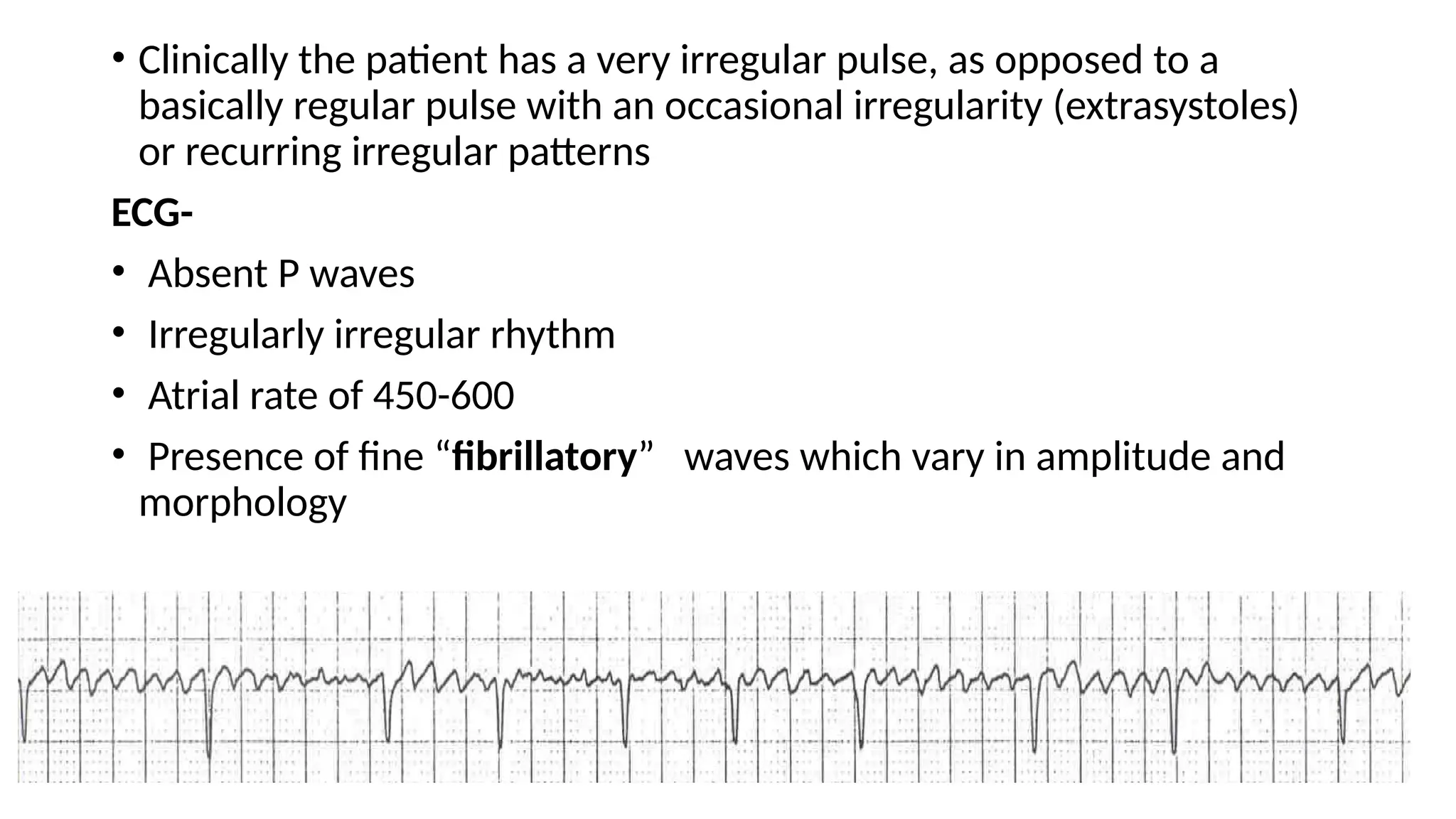
• Clinically the patient has a very irregular pulse, as opposed to a
basically regular pulse with an occasional irregularity (extrasystoles)
or recurring irregular patterns
ECG-
• Absent P waves
• Irregularly irregular rhythm
• Atrial rate of 450-600
• Presence of fine “fibrillatory” waves which vary in amplitude and
morphology
Management
• Electrical cardioversion (Synchronized cardioversion at 100 to 200 J is
indicated). It indicated to relieve symptoms of heart failure, to
improve cardiac output and to reduce the risk of arterial
thromboembolism.
• Drugs:- i.v. amiodarone, propafenone, ibutilide, diltiazem
Paroxysmal Supraventricular Tachycardia
(PSVT)
• A single reentrant ectopic focus fires in and around the AV node, all of
which are conducted normally to the ventricles (usually initiated by a PAC)
• QRS complexes are almost identical to the sinus beats
• Rate is usually between 150 and 250 beats per minute
• The rhythm is always REGULAR
• Possible symptoms: palpitations, angina, anxiety, syncope
• Prolonged runs of PSVT may result in atrial fibrillation or atrial flutter
• May be terminated by carotid massage
• Treatment: Adenosine, Ca++
Channel blockers
Rhythm usually
begins with PAC
Note REGULAR
rhythm in the
tachycardia
• AVRT (Atrio Ventricular Reentrant Tachycardia)
• AVNRT (Atrio Ventricular Nodal Reentrant Tachycardia)
Atrioventricular Nodal Reentrant Tachycardia
(AVNRT)
• Most common SVT (approximately 50 to 60%)
• Occurs more often in younger women
• pericarditis, previous myocardial infarction, or mitral valve prolapse
• Reentry caused by nodal pathways or tract
• Rate: 120 to 260 bpm
• Rhythm: regular, narrow QRS complex (< 120 msec); regular, wide QRS
complex (≥ 120 msec); may not see any P-wave activity
•Regular RR interval
•No P wave
• Narrow QRS complex
Atrioventricular Nodal
Reentrant Tachycardia
(AVNRT)
Atrioventricular Reentrant Tachycardia (AVRT)
• The second most common type of SVT.
• Patients with this arrhythmia typically present at a younger age than
those with AVNRT.
• This SVT is caused by accessory pathways (or bypass tracts) that
establishing a reentry circuit.
• occasionally comorbid with Wolff-Parkinson-White syndrome.
• Rate: 120 to 250 bpm
• Rhythm: regular, narrow QRS complex common
Wolff-Parkinson-White syndrome (WPW)
• (WPW) a pre- excitation syndrome is caused by the presence of an
abnormal accessory electrical conduction pathway between the atria
and the ventricles
• This is often congenital
• Signs and Symptoms*
• People with WPW are usually asymptomatic. However, the individual
may experience
• palpitations,
• dizziness,* shortness of breath,* syncope* sweating.
• Individuals with WPW have an accessory pathway that communicates
between the atria and the ventricles, in addition to the AV node.
• This pathway forms a bypass which enables supraventricular impulse
to bypass AV node, bundle of HIS and distal conducting system and so
activate or pre excite the ventricles.
• An Individual could have more than one accessory pathway.
• The most common accessory pathway is known as the Bundle of Kent
• This accessory pathway does not share the rate-slowing properties of
the AV node, and may conduct electrical activity at a significantly
higher rate than the AV node.
Wolff-Parkinson-White syndrome (WPW)
Wide QRS complex (QRS>0.12)
• Ventricular premature beat (VPB) / Ventricular extrasystole
• Ventricular tachycardia
• Ventricular fibrillation (VF)
• Torsades de pointes
Ventricular premature beat (VPB) /
Ventricular extrasystole
• VPB results from ectopic foci arising from below AV node and give rise
to wide (>0.12 sec) bizarre QRS complex.
• 15% of the observed arrhythmias, more common in anaesthetized
patients with pre existing cardiac disease.
• New onset of VPB, may occur in the presence of coronary artery
insufficiency, myocardial infarction, digitalis toxicity with hypokalemia
and hypoxaemia.
ECG-
• Premature beat has a broad (>0.125) and bizarre QRS complex
because it arises from an abnormal (ectopic) site in the ventricular
myocardium.
• Following the premature beat there is usually a complete
compensatory pause because the timing of sinus rhythm is not
induced by the premature beat.
Treatment-
• Underlying abnormalities in these patients should be corrected
immediately
• No treatment is generally required for isolated VPB in asymptomatic
and healthy patients.
• VPB with R on T phenomenon associated with haemodynamic
disturbance or convert to worse arrhythmias require prompt treatment.
• Lidocaine with an initial bolus dose of 1.5 mg/kg followed by infusion of
1 to 4 mg/min can be given. Other drugs from class I, II or III are used to
treat these types of arrhythmias.
Ventricular tachycardia
• Defined as three or more ventricular beats occurring at a rate of 120
bpm or more.
• It may be potentially life threatening.
• Usually there are clinical signs of atrioventricular dissociation i.e.
intermittent cannon 'a' waves and variable intensity of the first heart
sound
• ECG- Rapid ventricular rhythm with broad (often 0.14s or more),
abnormal QRS complexes.
• Dissociated P waves activity may be seen and have no fixed relation to
wide QRS complex.
Types
• Monomorphic
• QRS complexes all have same morphology
• Polymorphic
• QRS complexes have more than one morphology
• “Torsades de Pointes”
• “Twisting of the points”
• Usually > 200 bpm
• Susceptible if slow repolarization (long QT)
Monomorphic VT
Polymorphic VT
Treatment-
• If the cardiac output and the blood pressure are very depressed,
emergency DC cardioversion must be considered
• If the blood pressure and cardiac output are well maintained,
intravenous therapy with class I drugs is usually advised.
• First-line drug treatment consists of lidocaine (50-100 mg i.v. over 5
min) followed by a lidocaine infusion (2-4 mg/min i.v.).
• Patients with recurrent episodes or unresponsive to lidocaine, may
require therapy with procainamide (10-15 mg/kg loading dose
followed by an infusion of 2 to 6 mg/min)
• amiodarone in the dose of 150 mg IV over 10 minutes followed by an
infusion of 1 mg/min for 6 hours and 0.5 mg/min.
Torsades de pointes
• These arrhythmias are usually short in duration and spontaneously
revert to sinus rhythm. Occasionally it can change to VF.
• On ECG, it is characterized by rapid, irregular sharp complexes that
continuously change from an upright to an inverted position.
• Between spells of tachycardia the ECG shows a prolonged QT
interval; the corrected QT is equal to or greater than 0.44s.
•Typically initiated by a short-long-short interval
• Sinus rhythm of 50 beats per minute
• QT interval > 0.44s
• Risk Factors
• -Female gender
• -Hypokalemia
• -Hypomagnesemia
• -Bradycardia
• -Congestive Heart Failure
• -Concurrent Digoxin use.
Drugs causing
-Terbenafine
-Quinidine
-Procainamide
-Cisapride
-Erythromycin
Treatment:
The arrhythmia is treated as follows
1. Any electrolyte disturbance is corrected.
2. Causative drug and precipitating factors should be stopped and
removed.
3. Intravenous isoprenaline may be effective when QT prolongation is
acquired.
4. Blockade is advised if the QT prologation is congenital.
Ventricular fibrillation (VF)
• It is very rapid and irregular ventricular activation with no mechanical
effect.
• It is usually intiated from an ischaemic myocardium or an aberrant
foci (especially in acute perioperative myocardial infarction),
ventricular tachycardia or torsades de pointes.
• On ECG, there are no defined QRS complexes, shows shapeless rapid
oscillations and on pulse oximetry, there is acute fall in SpO2 because
of low or no cardiac output.
• Causes include myocardial ischaemia, hypoxaemia, electrolyte
imbalance and drug effects.
“coarse” ventricular fibrilation
“fine” ventricular fibrilation
Treatment-
Cardiopulmonary resuscitation must be performed as rapidly as possible.
Asynchronous external defibrillation should be performed using 200-
360J.
A precordial thump is occasionally effective in terminating VF, but should
be attempted only if a defibrillator is not available immediately.
Intravenous bretyium 5-10 mg/kg over 5 min can be useful on some
occasion.
Supporting pharmacological therapy such as lidocaine, amiodarone and
procainamide are used only to prevent recurrence of VF.
DC Cardioversion (electric shock)
Synchronized cardioversion is recommended to treat
• (1) unstable SVT due to reentry
• (2) unstable atrial flutter
• (3) unstable atrial fibrillation (120 J - 200 J with a biphasic waveform)
• (4) Unstable monomorphic (regular) VT monophasic or biphasic
waveform at initial energies of 100 J
• Cardioversion is not likely to be effective for treatment of
• Junctional tachycardia
• Ectopic or multifocal atrial tachycardia
Antiarrythmic Drug Classification
THANK YOU
Class I – blocker’s of fast Na+
channels
• Subclass IA
• Cause moderate Phase 0 depression
• Prolong repolarization
• Increased duration of action potential
• These are membrane-depressant drugs that reduce the rate of entry of
sodium into the cell.
• They may slow conduction, delay recovery or reduce the spontaneous
discharge rate of myocardial cells.
• Procainamide - increases refractory period
DOSE-
• Oral: 50 mg/kg/d in Three divided doses ;
• IM: 0.5—1.0 g 8hrly
• IV: 500–600 mg over 25–30 min then 2–6 mg/min
• Lesser vagolytic action , depression of contractility & fall in BP
• Metabolized by acetylation to N-acetyl procainamide which can
block K+ channels
• Doesn’t alter plasma digoxin levels
• Can cause SLE not recommended > 6 months
• Use: Monomorphic VT, WPW Syndrome
Disopyramide
• The recommended dose for most adults is 600 mg/day. Patients < 50 kg
may be given 400 mg/day.
• Both VA & SVA (Treatment and Prophylaxis)
• Orally & I.V
• more Negative inotropic and antimuscarinic effects
Class II drugs
• These antisympathetic drugs prevent the effects of catecholamines on
the action potential.
• Most are beta- adrenergic antagonists.
• Cardioselective Beta-blockers include metoprolol, atenolol, and
acebutalol.
Class III drugs
These prolong the action potential and do not affect sodium transport through the
membrane.
There are two major drugs in this class; amiodarone and sotalol. Sotalol is also a
beta-blocker.
Class IV drugs
• The non-dihydropyridine calcium antagonists that reduce the plateau
phase of the action potential are particularly effective at slowing
conduction in nodal tissue.
• Verapamil and diltiazem are the most important drugs in this group.
Cardiccccac Arrhythmias [Autosaved].pptx

Cardiccccac Arrhythmias [Autosaved].pptx

  • 1.
    Cardiac Arrhythmias (Tachyarrhythmias) PRESENTED BY–Dr.Anjul kumar singh Moderator –Dr.Ganesh Dr.Arvind
  • 2.
    • Arrhythmia isdefined as “Abnormality of cardiac rate, rhythm or conduction which can be either lethal (sudden cardiac death), or symptomatic (syncope, near syncope, dizziness, or palpitations) or asymptomatic”. • Pathogenesis 1. Injury or damage (pathology) to the cardiac conduction systems. 2. Re-entry: It is a mechanism that may precipitate a wide variety of supraventricular and ventricular arrhythmias. 3. Automaticity: Abnormal depolarization of atrial or ventricular muscle cell during the periods of action potential can lead to arrhythmias. 4. Mutations in ion channels: Since these channels are mainly responsible for depolarization, mutation can lead to arrhythmias. 5. Ectopic foci/ irritable foci
  • 3.
  • 4.
    Tachyarrhythmia • The tachycardiacan be classified based on the appearance of the QRS complex as tachycardia • narrow complex supraventricular tachycardia (SVT) • wide complex tachycardia. • Most wide complex (broad complex) tachycardias are ventricular in origin
  • 5.
    • Tachyarrhythmias areclassified in two categories depending upon the QRS complexes • i. Narrow QRS complex (QRS<0.12) • ii. Wide QRS complex (QRS>0.12)
  • 6.
    Narrow QRS complex(QRS<0.12) • a. Sinus tachycardia • b. Atrial premature beat • c. Atrial tachycardia • d.Atrial flutter • e.Atrial fibrillation (AF)
  • 7.
    . Sinus tachycardia •It is defined as an increase in the sinus rate of more than 100 beats/minute. Prolonged tachycardia for long duration can induce ischaemia in coronary artery diseased patients. Causes: • Anaemia because of blood loss • Pain • Inadequate anaesthesia • Hypovolaemia • Fever • Hypercarbia • Thyrotoxicosis/ thyroid crisis • Cardiac failure with compensatory sinus tachycardia • Catecholamines excess
  • 8.
    Treatment • Before pharmacologicaltreatment for sinus tachycardia, precipitating factors must be identified and corrected. • Drug therapy required in patients with ischaemic heart disease who develop ST segment changes to prevent further myocardial ischaemia. • Beta-blockers as esmolol is preferred drug for managing its half-life of 10 min with bolus dose of 500 mcg/kg over 1 min, followed by an infusion of 50-300 mcg/kg/min. • If continuous use is required, it may be replaced by longer lasting cardio selective drugs such as metoprolol in the dose of 5 to 10 mg given slowly intravenously (IV) at 5 min interval to a total dose of 15 mg. • Another drug can be used is propranolol 0.1 mg/kg.
  • 9.
    Atrial premature beat •It represents 10% of all intraoperative arrhythmias. • On the ECG they appear as early and abnormal ‘P’ waves and are usually but not always, followed by normal QRS complexes. • The duration of QRS wave is normal but wide QRS wave may be present due to aberrant ventricular conduction, which mimics premature ventricular beat. • Treatment is not normally required unless the ectopic beats provoke more significant arrhythmias, where blockade may be effective.
  • 11.
    Atrial tachycardia • Thesearrhythmias are found in 6% of patients undergoing non cardiac surgery. • It is non paroxysmal, narrow QRS rhythm with retrograde P waves and a rate less than 70 beats/min. • if faster usually less than 130 beats/min, it is termed as accelerated AV junctional rhythm. • Those arrhythmias can lead to fall in blood pressure upto 15% in patients without cardiac disease and upto 30% in diseased heart. • Usually no treatment is required; carotid sinus massage and verapamil are often helpful in symptomatic patients. • Intravenous adenosine in 6 to 12 mg doses is another alternative. Treatment with class Ia, Ic or III drugs is usually successful e.g. disopyramide 2 mg/kg over 10 min.
  • 13.
    Atrial flutter • Thisis a rhythm disturbance that is usually associated with organic ischaemic heart disease. • The atrial rate varies between 280 and 350 /min but is usually around 300/ min • ECG- : The ECG shows regular saw tooth-like atrial flutter waves between QRST complexes. • If they are not clearly visible,AV conduction may be transiently impaired by carotid sinus massage or by the administration of AV nodal blocking drugs such as verapamil
  • 14.
    Treatment- Treatment of anacute flutter is electrical cardioversion. Prophylaxis is achieved with class Ia, Ic or III drugs in diseased heart patients.
  • 15.
    Atrial fibrillation (AF) •It accounts for more than 90% of supraventricular tachycardia (SVT) in the perioperative setting. Causes- • a raised atrial pressure • increased atrial muscle mass • atrial fibrosis or inflammation • infiltration of the atrium • Rheumatic disease is often associated with cardiac causes such as mitral valve disease, myocarditis and coronary artery disease. • Systemic diseases include hyperthyroidism, pulmonary embolism and electrolyte imbalance.
  • 16.
    • Clinically thepatient has a very irregular pulse, as opposed to a basically regular pulse with an occasional irregularity (extrasystoles) or recurring irregular patterns ECG- • Absent P waves • Irregularly irregular rhythm • Atrial rate of 450-600 • Presence of fine “fibrillatory” waves which vary in amplitude and morphology
  • 18.
    Management • Electrical cardioversion(Synchronized cardioversion at 100 to 200 J is indicated). It indicated to relieve symptoms of heart failure, to improve cardiac output and to reduce the risk of arterial thromboembolism. • Drugs:- i.v. amiodarone, propafenone, ibutilide, diltiazem
  • 19.
    Paroxysmal Supraventricular Tachycardia (PSVT) •A single reentrant ectopic focus fires in and around the AV node, all of which are conducted normally to the ventricles (usually initiated by a PAC) • QRS complexes are almost identical to the sinus beats • Rate is usually between 150 and 250 beats per minute • The rhythm is always REGULAR • Possible symptoms: palpitations, angina, anxiety, syncope • Prolonged runs of PSVT may result in atrial fibrillation or atrial flutter • May be terminated by carotid massage • Treatment: Adenosine, Ca++ Channel blockers
  • 20.
    Rhythm usually begins withPAC Note REGULAR rhythm in the tachycardia • AVRT (Atrio Ventricular Reentrant Tachycardia) • AVNRT (Atrio Ventricular Nodal Reentrant Tachycardia)
  • 21.
    Atrioventricular Nodal ReentrantTachycardia (AVNRT) • Most common SVT (approximately 50 to 60%) • Occurs more often in younger women • pericarditis, previous myocardial infarction, or mitral valve prolapse • Reentry caused by nodal pathways or tract • Rate: 120 to 260 bpm • Rhythm: regular, narrow QRS complex (< 120 msec); regular, wide QRS complex (≥ 120 msec); may not see any P-wave activity
  • 22.
    •Regular RR interval •NoP wave • Narrow QRS complex Atrioventricular Nodal Reentrant Tachycardia (AVNRT)
  • 23.
    Atrioventricular Reentrant Tachycardia(AVRT) • The second most common type of SVT. • Patients with this arrhythmia typically present at a younger age than those with AVNRT. • This SVT is caused by accessory pathways (or bypass tracts) that establishing a reentry circuit. • occasionally comorbid with Wolff-Parkinson-White syndrome. • Rate: 120 to 250 bpm • Rhythm: regular, narrow QRS complex common
  • 24.
    Wolff-Parkinson-White syndrome (WPW) •(WPW) a pre- excitation syndrome is caused by the presence of an abnormal accessory electrical conduction pathway between the atria and the ventricles • This is often congenital • Signs and Symptoms* • People with WPW are usually asymptomatic. However, the individual may experience • palpitations, • dizziness,* shortness of breath,* syncope* sweating.
  • 25.
    • Individuals withWPW have an accessory pathway that communicates between the atria and the ventricles, in addition to the AV node. • This pathway forms a bypass which enables supraventricular impulse to bypass AV node, bundle of HIS and distal conducting system and so activate or pre excite the ventricles. • An Individual could have more than one accessory pathway. • The most common accessory pathway is known as the Bundle of Kent • This accessory pathway does not share the rate-slowing properties of the AV node, and may conduct electrical activity at a significantly higher rate than the AV node.
  • 26.
  • 27.
    Wide QRS complex(QRS>0.12) • Ventricular premature beat (VPB) / Ventricular extrasystole • Ventricular tachycardia • Ventricular fibrillation (VF) • Torsades de pointes
  • 28.
    Ventricular premature beat(VPB) / Ventricular extrasystole • VPB results from ectopic foci arising from below AV node and give rise to wide (>0.12 sec) bizarre QRS complex. • 15% of the observed arrhythmias, more common in anaesthetized patients with pre existing cardiac disease. • New onset of VPB, may occur in the presence of coronary artery insufficiency, myocardial infarction, digitalis toxicity with hypokalemia and hypoxaemia.
  • 29.
    ECG- • Premature beathas a broad (>0.125) and bizarre QRS complex because it arises from an abnormal (ectopic) site in the ventricular myocardium. • Following the premature beat there is usually a complete compensatory pause because the timing of sinus rhythm is not induced by the premature beat.
  • 30.
    Treatment- • Underlying abnormalitiesin these patients should be corrected immediately • No treatment is generally required for isolated VPB in asymptomatic and healthy patients. • VPB with R on T phenomenon associated with haemodynamic disturbance or convert to worse arrhythmias require prompt treatment. • Lidocaine with an initial bolus dose of 1.5 mg/kg followed by infusion of 1 to 4 mg/min can be given. Other drugs from class I, II or III are used to treat these types of arrhythmias.
  • 31.
    Ventricular tachycardia • Definedas three or more ventricular beats occurring at a rate of 120 bpm or more. • It may be potentially life threatening. • Usually there are clinical signs of atrioventricular dissociation i.e. intermittent cannon 'a' waves and variable intensity of the first heart sound • ECG- Rapid ventricular rhythm with broad (often 0.14s or more), abnormal QRS complexes. • Dissociated P waves activity may be seen and have no fixed relation to wide QRS complex.
  • 32.
    Types • Monomorphic • QRScomplexes all have same morphology • Polymorphic • QRS complexes have more than one morphology • “Torsades de Pointes” • “Twisting of the points” • Usually > 200 bpm • Susceptible if slow repolarization (long QT)
  • 33.
  • 34.
  • 36.
    Treatment- • If thecardiac output and the blood pressure are very depressed, emergency DC cardioversion must be considered • If the blood pressure and cardiac output are well maintained, intravenous therapy with class I drugs is usually advised. • First-line drug treatment consists of lidocaine (50-100 mg i.v. over 5 min) followed by a lidocaine infusion (2-4 mg/min i.v.). • Patients with recurrent episodes or unresponsive to lidocaine, may require therapy with procainamide (10-15 mg/kg loading dose followed by an infusion of 2 to 6 mg/min) • amiodarone in the dose of 150 mg IV over 10 minutes followed by an infusion of 1 mg/min for 6 hours and 0.5 mg/min.
  • 37.
    Torsades de pointes •These arrhythmias are usually short in duration and spontaneously revert to sinus rhythm. Occasionally it can change to VF. • On ECG, it is characterized by rapid, irregular sharp complexes that continuously change from an upright to an inverted position. • Between spells of tachycardia the ECG shows a prolonged QT interval; the corrected QT is equal to or greater than 0.44s.
  • 38.
    •Typically initiated bya short-long-short interval • Sinus rhythm of 50 beats per minute • QT interval > 0.44s
  • 39.
    • Risk Factors •-Female gender • -Hypokalemia • -Hypomagnesemia • -Bradycardia • -Congestive Heart Failure • -Concurrent Digoxin use. Drugs causing -Terbenafine -Quinidine -Procainamide -Cisapride -Erythromycin
  • 40.
    Treatment: The arrhythmia istreated as follows 1. Any electrolyte disturbance is corrected. 2. Causative drug and precipitating factors should be stopped and removed. 3. Intravenous isoprenaline may be effective when QT prolongation is acquired. 4. Blockade is advised if the QT prologation is congenital.
  • 41.
    Ventricular fibrillation (VF) •It is very rapid and irregular ventricular activation with no mechanical effect. • It is usually intiated from an ischaemic myocardium or an aberrant foci (especially in acute perioperative myocardial infarction), ventricular tachycardia or torsades de pointes. • On ECG, there are no defined QRS complexes, shows shapeless rapid oscillations and on pulse oximetry, there is acute fall in SpO2 because of low or no cardiac output. • Causes include myocardial ischaemia, hypoxaemia, electrolyte imbalance and drug effects.
  • 42.
  • 43.
    Treatment- Cardiopulmonary resuscitation mustbe performed as rapidly as possible. Asynchronous external defibrillation should be performed using 200- 360J. A precordial thump is occasionally effective in terminating VF, but should be attempted only if a defibrillator is not available immediately. Intravenous bretyium 5-10 mg/kg over 5 min can be useful on some occasion. Supporting pharmacological therapy such as lidocaine, amiodarone and procainamide are used only to prevent recurrence of VF.
  • 49.
    DC Cardioversion (electricshock) Synchronized cardioversion is recommended to treat • (1) unstable SVT due to reentry • (2) unstable atrial flutter • (3) unstable atrial fibrillation (120 J - 200 J with a biphasic waveform) • (4) Unstable monomorphic (regular) VT monophasic or biphasic waveform at initial energies of 100 J • Cardioversion is not likely to be effective for treatment of • Junctional tachycardia • Ectopic or multifocal atrial tachycardia
  • 50.
  • 53.
  • 60.
    Class I –blocker’s of fast Na+ channels • Subclass IA • Cause moderate Phase 0 depression • Prolong repolarization • Increased duration of action potential • These are membrane-depressant drugs that reduce the rate of entry of sodium into the cell. • They may slow conduction, delay recovery or reduce the spontaneous discharge rate of myocardial cells.
  • 61.
    • Procainamide -increases refractory period DOSE- • Oral: 50 mg/kg/d in Three divided doses ; • IM: 0.5—1.0 g 8hrly • IV: 500–600 mg over 25–30 min then 2–6 mg/min • Lesser vagolytic action , depression of contractility & fall in BP • Metabolized by acetylation to N-acetyl procainamide which can block K+ channels • Doesn’t alter plasma digoxin levels • Can cause SLE not recommended > 6 months • Use: Monomorphic VT, WPW Syndrome
  • 62.
    Disopyramide • The recommendeddose for most adults is 600 mg/day. Patients < 50 kg may be given 400 mg/day. • Both VA & SVA (Treatment and Prophylaxis) • Orally & I.V • more Negative inotropic and antimuscarinic effects
  • 63.
    Class II drugs •These antisympathetic drugs prevent the effects of catecholamines on the action potential. • Most are beta- adrenergic antagonists. • Cardioselective Beta-blockers include metoprolol, atenolol, and acebutalol. Class III drugs These prolong the action potential and do not affect sodium transport through the membrane. There are two major drugs in this class; amiodarone and sotalol. Sotalol is also a beta-blocker.
  • 64.
    Class IV drugs •The non-dihydropyridine calcium antagonists that reduce the plateau phase of the action potential are particularly effective at slowing conduction in nodal tissue. • Verapamil and diltiazem are the most important drugs in this group.