1.1 Introduction to Systems of Linear Equations

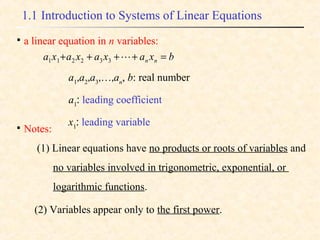
a linear equation in n variables:
332211 bxaxaxaxa nn =++++ 
a1
,a2
,a3
,…,an
, b: real number
a1
: leading coefficient
x1
: leading variable
Notes:
(1) Linear equations have no products or roots of variables and
no variables involved in trigonometric, exponential, or
logarithmic functions.
(2) Variables appear only to the first power.

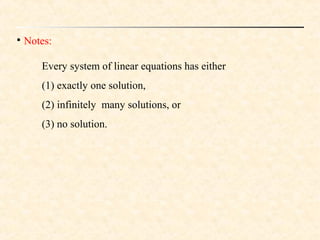
Notes:
Every system of linear equations has either
(1) exactly one solution,
(2) infinitely many solutions, or
(3) no solution.

Equivalent:
Two systems of linear equations are called equivalent
if they have precisely the same solution set.

Notes:
Each of the following operations on a system of linear
equations produces an equivalent system.
(1) Interchange two equations.
(2) Multiply an equation by a nonzero constant.
(3) Add a multiple of an equation to another equation.
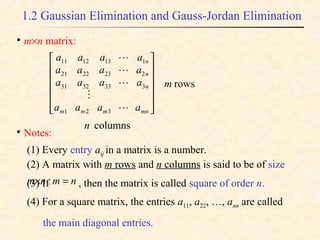
(4) For a square matrix, the entries a11, a22, …, ann are called
the main diagonal entries.
1.2 Gaussian Elimination and Gauss-Jordan Elimination

m×n matrix:












mnmmm
n
n
n
aaaa
aaaa
aaaa
aaaa





321
3333231
2232221
1131211
rowsm
columnsn
(3) If , then the matrix is called square of order n.nm =

Notes:
(1) Every entry aij in a matrix is a number.
(2) A matrix with m rows and n columns is said to be of size
m×n .

Ex 1: Matrix Size
]2[




00
00



 −
2
1
031








− 47
22
πe
11×
22×
41×
23×

Note:
One very common use of matrices is to represent a system
of linear equations.

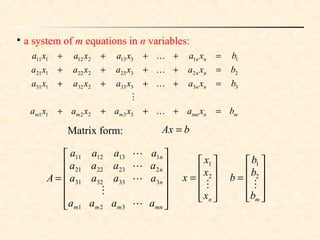
a system of m equations in n variables:
mnmnmmm
nn
nn
nn
bxaxaxaxa
bxaxaxaxa
bxaxaxaxa
bxaxaxaxa
=++++
=++++
=++++
=++++





332211
33333232131
22323222121
11313212111












=
mnmmm
n
n
n
aaaa
aaaa
aaaa
aaaa
A





321
3333231
2232221
1131211










=
mb
b
b
b

2
1










=
nx
x
x
x

2
1
bAx =Matrix form:

Augmented matrix:
][3
2
1
321
3333231
2232221
1131211
bA
b
b
b
b
aaaa
aaaa
aaaa
aaaa
mmnmmm
n
n
n
=

















A
aaaa
aaaa
aaaa
aaaa
mnmmm
n
n
n
=

















321
3333231
2232221
1131211

Coefficient matrix:

Elementary row operation:
jiij RRr ↔:(1) Interchange two rows.
ii
k
i RRkr →)(:)(
(2) Multiply a row by a nonzero constant.
jji
k
ij RRRkr →+)(:)(
(3) Add a multiple of a row to another row.

Row equivalent:
Two matrices are said to be row equivalent if one can be obtained
from the other by a finite sequence of elementary row operation.

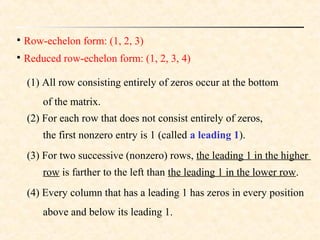
Row-echelon form: (1, 2, 3)
(1) All row consisting entirely of zeros occur at the bottom
of the matrix.
(2) For each row that does not consist entirely of zeros,
the first nonzero entry is 1 (called a leading 1).
(3) For two successive (nonzero) rows, the leading 1 in the higher
row is farther to the left than the leading 1 in the lower row.

Reduced row-echelon form: (1, 2, 3, 4)
(4) Every column that has a leading 1 has zeros in every position
above and below its leading 1.
form)echelon
-row(reduced
form)
echelon-(row

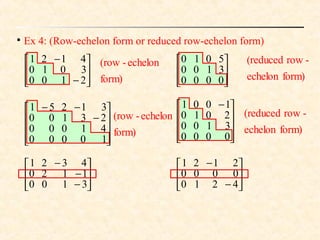
Ex 4: (Row-echelon form or reduced row-echelon form)








−
−
2100
3010
4121










−
−−
10000
41000
23100
31251








0000
3100
5010









 −
0000
3100
2010
1001








−
−
−
3100
1120
4321








−
−
4210
0000
2121
form)
echelon-(row
form)echelon
-row(reduced

Gaussian elimination:
The procedure for reducing a matrix to a row-echelon form.

Gauss-Jordan elimination:
The procedure for reducing a matrix to a reduced row-echelon
form.

Notes:
(1) Every matrix has an unique reduced row echelon
form.(2) A row-echelon form of a given matrix is not unique.
(Different sequences of row operations can produce
different row-echelon forms.)










−−
−
−
456542
1280200
28124682
12r
The first nonzero
column
Produce leading 1
Zeros elements below leading 1
leading 1
Produce leading 1
The first nonzero column

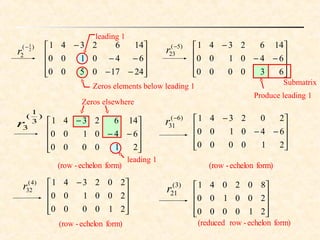
Ex: (Procedure of Gaussian elimination and Gauss-Jordan elimination)










−−
−
−
456542
28124682
1280200










−−
−
−
456542
1280200
1462341)(
1
2
1
r










−−
−
−
24170500
1280200
1462341)2(
13
−
r
Submatrix
Zeros elements below leading 1
Zeros elsewhere
leading 1
Produce leading 1
leading 1
form)echelon-(row










−−
−−
−
24170500
640100
1462341)(
2
2
1−
r










−−
−
630000
640100
1462341)5(
23
−
r










−−
−
210000
640100
1462341
)
3
1
(
3r
Submatrix
form)echelon-(row
form)echelon-row(reduced









 −
210000
200100
202341)4(
32r










210000
200100
802041)3(
21r










−−
−
210000
640100
202341)6(
31
−
r
form)echelon-(row

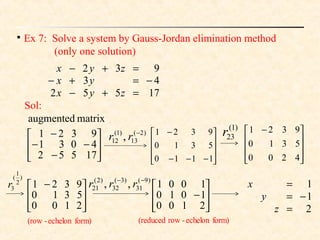
Ex 7: Solve a system by Gauss-Jordan elimination method
(only one solution)
17552
43
932
=+−
−=+−
=+−
zyx
yx
zyx
Sol:
matrixaugmented








−
−−
−
17552
4031
9321










−−−
−
1110
5310
9321)2(
13
)1(
12 , −
rr









 −
4200
5310
9321)1(
23r








−
2100
1010
1001)9(
31
)3(
32
)2(
21 ,, −−
rrr
2
1
1
=
−=
=
z
y
x
form)echelon-(row form)echelon-row(reduced







 −
2100
5310
9321
)
2
1
(
3r

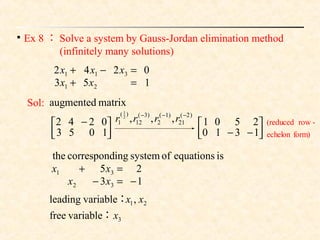
Ex 8 : Solve a system by Gauss-Jordan elimination method
(infinitely many solutions)
153
0242
21
311
=+
=−+
xx
xxx




−− 1310
2501
)2(
21
)1(
2
)3(
12
)(
1 ,,,2
1
−−−
rrrr
isequationsofsystemingcorrespondthe
13
25
32
31
−=−
=+
xx
xx
3
21
variablefree
,variableleading
x
xx
:
:
Sol:



 −
1053
0242
matrixaugmented
form)echelon
-row(reduced
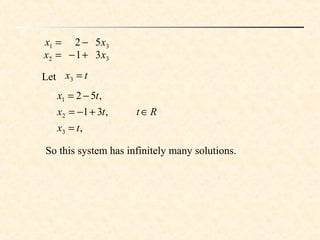
32
31
31
52
xx
xx
+−=
−=
Let tx =3
,
,31
,52
3
2
1
tx
Rttx
tx
=
∈+−=
−=
So this system has infinitely many solutions.

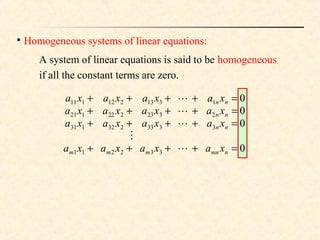
Homogeneous systems of linear equations:
A system of linear equations is said to be homogeneous
if all the constant terms are zero.
0
0
0
0
332211
3333232131
2323222121
1313212111
=++++
=++++
=++++
=++++
nmnmmm
nn
nn
nn
xaxaxaxa
xaxaxaxa
xaxaxaxa
xaxaxaxa






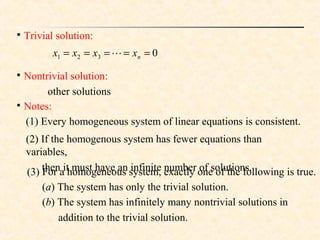
Trivial solution:

Nontrivial solution:
other solutions
0321 ===== nxxxx 

Notes:
(1) Every homogeneous system of linear equations is consistent.
(2) If the homogenous system has fewer equations than
variables,
then it must have an infinite number of solutions.(3) For a homogeneous system, exactly one of the following is true.
(a) The system has only the trivial solution.
(b) The system has infinitely many nontrivial solutions in
addition to the trivial solution.

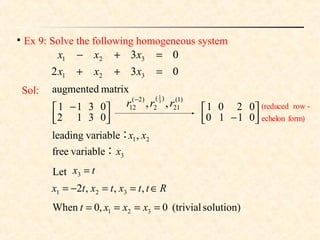
Ex 9: Solve the following homogeneous system
032
03
321
321
=++
=+−
xxx
xxx




− 0110
0201
)1(
21
)(
2
)2(
12 ,, 3
1
rrr −
Let tx =3
Rttxtxtx ∈==−= ,,,2 321
solution)(trivial0,0When 321 ==== xxxt
Sol:



 −
0312
0311
matrixaugmented
form)echelon
-row(reduced
3
21
variablefree
,variableleading
x
xx
:
:
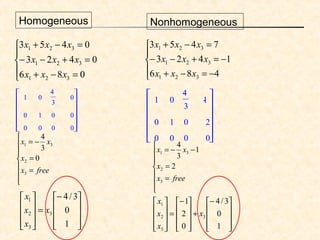
Homogeneous





=−+
=+−−
=−+
086
0423
0453
321
321
321
xxx
xxx
xxx
Nonhomogeneous





−=−+
−=+−−
=−+
486
1423
7453
321
321
321
xxx
xxx
xxx


















1 0
-4
3
0
0 1 0 0
0 0 0 0


















1 0
-4
3
-1
0 1 0 2
0 0 0 0







=
=
−=
freex
x
xx
3
2
31
0
3
4







=
=
−−=
freex
x
xx
3
2
31
2
1
3
4









−
=










1
0
3/4
3
3
2
1
x
x
x
x









−
+









−
=










1
0
3/4
0
2
1
3
3
2
1
x
x
x
x
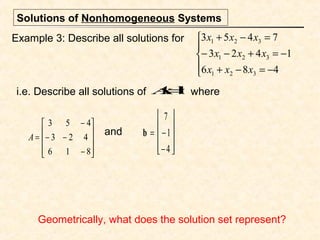
Example 3: Describe all solutions for





−=−+
−=+−−
=−+
486
1423
7453
321
321
321
xxx
xxx
xxx
Solutions of Nonhomogeneous Systems
i.e. Describe all solutions of whereAx=b










−
−−
−
=
816
423
453
A
and b =
7
−1
−4










Geometrically, what does the solution set represent?
System Of Linear Equations

System Of Linear Equations

  • 2.
    1.1 Introduction toSystems of Linear Equations  a linear equation in n variables: 332211 bxaxaxaxa nn =++++  a1 ,a2 ,a3 ,…,an , b: real number a1 : leading coefficient x1 : leading variable Notes: (1) Linear equations have no products or roots of variables and no variables involved in trigonometric, exponential, or logarithmic functions. (2) Variables appear only to the first power.
  • 3.
     Notes: Every system oflinear equations has either (1) exactly one solution, (2) infinitely many solutions, or (3) no solution.
  • 4.
     Equivalent: Two systems oflinear equations are called equivalent if they have precisely the same solution set.  Notes: Each of the following operations on a system of linear equations produces an equivalent system. (1) Interchange two equations. (2) Multiply an equation by a nonzero constant. (3) Add a multiple of an equation to another equation.
  • 5.
    (4) For asquare matrix, the entries a11, a22, …, ann are called the main diagonal entries. 1.2 Gaussian Elimination and Gauss-Jordan Elimination  m×n matrix:             mnmmm n n n aaaa aaaa aaaa aaaa      321 3333231 2232221 1131211 rowsm columnsn (3) If , then the matrix is called square of order n.nm =  Notes: (1) Every entry aij in a matrix is a number. (2) A matrix with m rows and n columns is said to be of size m×n .
  • 6.
     Ex 1: MatrixSize ]2[     00 00     − 2 1 031         − 47 22 πe 11× 22× 41× 23×  Note: One very common use of matrices is to represent a system of linear equations.
  • 7.
     a system ofm equations in n variables: mnmnmmm nn nn nn bxaxaxaxa bxaxaxaxa bxaxaxaxa bxaxaxaxa =++++ =++++ =++++ =++++      332211 33333232131 22323222121 11313212111             = mnmmm n n n aaaa aaaa aaaa aaaa A      321 3333231 2232221 1131211           = mb b b b  2 1           = nx x x x  2 1 bAx =Matrix form:
  • 8.
  • 9.
     Elementary row operation: jiijRRr ↔:(1) Interchange two rows. ii k i RRkr →)(:)( (2) Multiply a row by a nonzero constant. jji k ij RRRkr →+)(:)( (3) Add a multiple of a row to another row.  Row equivalent: Two matrices are said to be row equivalent if one can be obtained from the other by a finite sequence of elementary row operation.
  • 10.
     Row-echelon form: (1,2, 3) (1) All row consisting entirely of zeros occur at the bottom of the matrix. (2) For each row that does not consist entirely of zeros, the first nonzero entry is 1 (called a leading 1). (3) For two successive (nonzero) rows, the leading 1 in the higher row is farther to the left than the leading 1 in the lower row.  Reduced row-echelon form: (1, 2, 3, 4) (4) Every column that has a leading 1 has zeros in every position above and below its leading 1.
  • 11.
    form)echelon -row(reduced form) echelon-(row  Ex 4: (Row-echelonform or reduced row-echelon form)         − − 2100 3010 4121           − −− 10000 41000 23100 31251         0000 3100 5010           − 0000 3100 2010 1001         − − − 3100 1120 4321         − − 4210 0000 2121 form) echelon-(row form)echelon -row(reduced
  • 12.
     Gaussian elimination: The procedurefor reducing a matrix to a row-echelon form.  Gauss-Jordan elimination: The procedure for reducing a matrix to a reduced row-echelon form.  Notes: (1) Every matrix has an unique reduced row echelon form.(2) A row-echelon form of a given matrix is not unique. (Different sequences of row operations can produce different row-echelon forms.)
  • 13.
              −− − − 456542 1280200 28124682 12r The first nonzero column Produceleading 1 Zeros elements below leading 1 leading 1 Produce leading 1 The first nonzero column  Ex: (Procedure of Gaussian elimination and Gauss-Jordan elimination)           −− − − 456542 28124682 1280200           −− − − 456542 1280200 1462341)( 1 2 1 r           −− − − 24170500 1280200 1462341)2( 13 − r Submatrix
  • 14.
    Zeros elements belowleading 1 Zeros elsewhere leading 1 Produce leading 1 leading 1 form)echelon-(row           −− −− − 24170500 640100 1462341)( 2 2 1− r           −− − 630000 640100 1462341)5( 23 − r           −− − 210000 640100 1462341 ) 3 1 ( 3r Submatrix form)echelon-(row form)echelon-row(reduced           − 210000 200100 202341)4( 32r           210000 200100 802041)3( 21r           −− − 210000 640100 202341)6( 31 − r form)echelon-(row
  • 15.
     Ex 7: Solvea system by Gauss-Jordan elimination method (only one solution) 17552 43 932 =+− −=+− =+− zyx yx zyx Sol: matrixaugmented         − −− − 17552 4031 9321           −−− − 1110 5310 9321)2( 13 )1( 12 , − rr           − 4200 5310 9321)1( 23r         − 2100 1010 1001)9( 31 )3( 32 )2( 21 ,, −− rrr 2 1 1 = −= = z y x form)echelon-(row form)echelon-row(reduced         − 2100 5310 9321 ) 2 1 ( 3r
  • 16.
     Ex 8 :Solve a system by Gauss-Jordan elimination method (infinitely many solutions) 153 0242 21 311 =+ =−+ xx xxx     −− 1310 2501 )2( 21 )1( 2 )3( 12 )( 1 ,,,2 1 −−− rrrr isequationsofsystemingcorrespondthe 13 25 32 31 −=− =+ xx xx 3 21 variablefree ,variableleading x xx : : Sol:     − 1053 0242 matrixaugmented form)echelon -row(reduced
  • 17.
  • 18.
     Homogeneous systems oflinear equations: A system of linear equations is said to be homogeneous if all the constant terms are zero. 0 0 0 0 332211 3333232131 2323222121 1313212111 =++++ =++++ =++++ =++++ nmnmmm nn nn nn xaxaxaxa xaxaxaxa xaxaxaxa xaxaxaxa     
  • 19.
     Trivial solution:  Nontrivial solution: othersolutions 0321 ===== nxxxx   Notes: (1) Every homogeneous system of linear equations is consistent. (2) If the homogenous system has fewer equations than variables, then it must have an infinite number of solutions.(3) For a homogeneous system, exactly one of the following is true. (a) The system has only the trivial solution. (b) The system has infinitely many nontrivial solutions in addition to the trivial solution.
  • 20.
     Ex 9: Solvethe following homogeneous system 032 03 321 321 =++ =+− xxx xxx     − 0110 0201 )1( 21 )( 2 )2( 12 ,, 3 1 rrr − Let tx =3 Rttxtxtx ∈==−= ,,,2 321 solution)(trivial0,0When 321 ==== xxxt Sol:     − 0312 0311 matrixaugmented form)echelon -row(reduced 3 21 variablefree ,variableleading x xx : :
  • 21.
    Homogeneous      =−+ =+−− =−+ 086 0423 0453 321 321 321 xxx xxx xxx Nonhomogeneous      −=−+ −=+−− =−+ 486 1423 7453 321 321 321 xxx xxx xxx                   1 0 -4 3 0 0 10 0 0 0 0 0                   1 0 -4 3 -1 0 1 0 2 0 0 0 0        = = −= freex x xx 3 2 31 0 3 4        = = −−= freex x xx 3 2 31 2 1 3 4          − =           1 0 3/4 3 3 2 1 x x x x          − +          − =           1 0 3/4 0 2 1 3 3 2 1 x x x x
  • 22.
    Example 3: Describeall solutions for      −=−+ −=+−− =−+ 486 1423 7453 321 321 321 xxx xxx xxx Solutions of Nonhomogeneous Systems i.e. Describe all solutions of whereAx=b           − −− − = 816 423 453 A and b = 7 −1 −4           Geometrically, what does the solution set represent?