Polynomials
Index
Polynomial
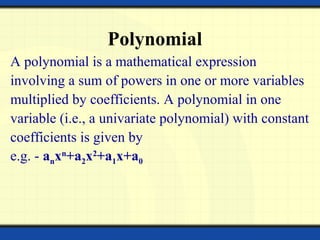
A polynomial is a mathematical expression
involving a sum of powers in one or more variables
multiplied by coefficients. A polynomial in one
variable (i.e., a univariate polynomial) with constant
coefficients is given by
e.g. - anxn
+a2x2
+a1x+a0
Polynomial Can Have
A polynomial can have:
Constants
Variables
Exponents
Coefficients
Constants
In mathematics, a constant is a non-
varying value, i.e. completely fixed or fixed
in the context of use. The term usually
occurs in opposition to variable (i.e.
variable quantity), which is a symbol that
stands for a value that may vary.
For e.g.
2x2
+11y-22=0, here -22 is a constant.
Variables
In mathematics, a variable is a value that
may change within the scope of a given
problem or set of operations. In contrast, a
constant is a value that remains unchanged,
though often unknown or undetermined.
For e.g.
10x2
+5y=2, here x and y are variable.
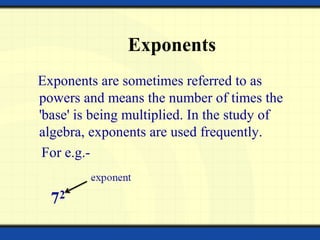
Exponents
Exponents are sometimes referred to as
powers and means the number of times the
'base' is being multiplied. In the study of
algebra, exponents are used frequently.
For e.g.-
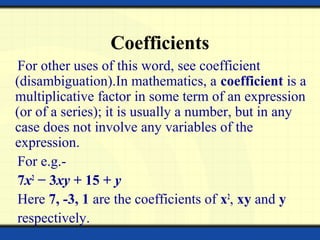
Coefficients
For other uses of this word, see coefficient
(disambiguation).In mathematics, a coefficient is a
multiplicative factor in some term of an expression
(or of a series); it is usually a number, but in any
case does not involve any variables of the
expression.
For e.g.-
7x2
− 3xy + 15 + y
Here 7, -3, 1 are the coefficients of x2
, xy and y
respectively.
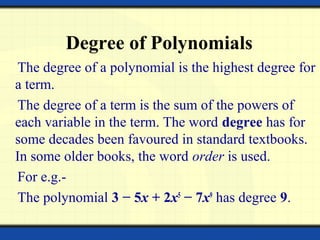
Degree of Polynomials
The degree of a polynomial is the highest degree for
a term.
The degree of a term is the sum of the powers of
each variable in the term. The word degree has for
some decades been favoured in standard textbooks.
In some older books, the word order is used.
For e.g.-
The polynomial 3 − 5x + 2x5
− 7x9
has degree 9.
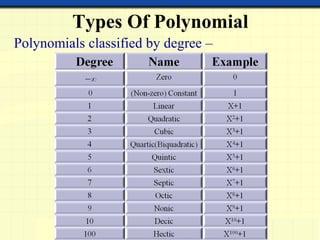
Types Of Polynomial
Polynomials classified by degree –
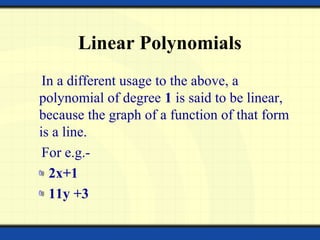
Linear Polynomials
In a different usage to the above, a
polynomial of degree 1 is said to be linear,
because the graph of a function of that form
is a line.
For e.g.-
2x+1
11y +3
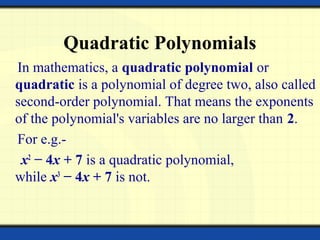
Quadratic Polynomials
In mathematics, a quadratic polynomial or
quadratic is a polynomial of degree two, also called
second-order polynomial. That means the exponents
of the polynomial's variables are no larger than 2.
For e.g.-
x2
− 4x + 7 is a quadratic polynomial,
while x3
− 4x + 7 is not.
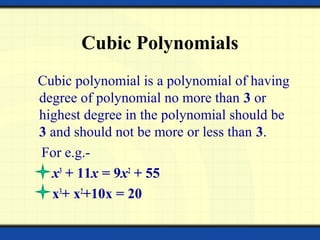
Cubic Polynomials
Cubic polynomial is a polynomial of having
degree of polynomial no more than 3 or
highest degree in the polynomial should be
3 and should not be more or less than 3.
For e.g.-
x3
+ 11x = 9x2
+ 55
x3
+ x2
+10x = 20
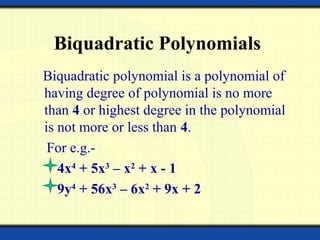
Biquadratic Polynomials
Biquadratic polynomial is a polynomial of
having degree of polynomial is no more
than 4 or highest degree in the polynomial
is not more or less than 4.
For e.g.-
4x4
+ 5x3
– x2
+ x - 1
9y4
+ 56x3
– 6x2
+ 9x + 2
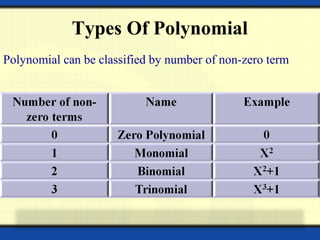
Types Of Polynomial
Polynomial can be classified by number of non-zero term
Zero Polynomials
The constant polynomial whose coefficients are all
equal to 0. The corresponding polynomial function
is the constant function with value 0, also called the
zero map. The degree of the zero polynomial is
undefined, but many authors conventionally set it
equal to -1 or ∞.
Monomial, Binomial & Trinomial
Monomial:-
A polynomial with one term.
E.g. - 5x3
, 8, and 4xy.
Binomial:-
A polynomial with two terms which are not like terms.
E.g. - 2x – 3, 3x5
+8x4
, and 2ab – 6a2
b5
.
Trinomial:-
A polynomial with three terms which are not like terms.
E.g. - x2
+ 2x - 3, 3x5
- 8x4
+ x3
, and a2
b + 13x + c.
LINEAR
EQUATION ON
TWO VARIABLES
A pair of linear equations in two variables is
said to form a system of simultaneous linear
equations.
For Example, 2x – 3y + 4 = 0
x + 7y – 1 = 0
Form a system of two linear equations in
variables x and y.
System of Equations or Simultaneous
Equations
The general form of a linear equation in two
variables x and y is
ax + by + c = 0 , a ≠ 0, b ≠ 0, where
a, b and c being real numbers.
A solution of such an equation is a pair of
values, one for x and the other for y, which
makes two sides of the equation equal.
Every linear equation in two variables has
infinitely many solutions which can be
represented on a certain line.
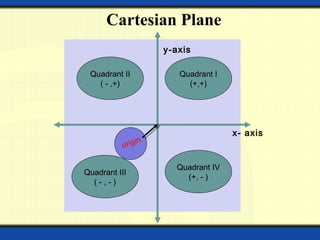
Cartesian Plane
x- axis
y-axis
Quadrant I
(+,+)
Quadrant II
( - ,+)
Quadrant IV
(+, - )
Quadrant III
( - , - )
origin
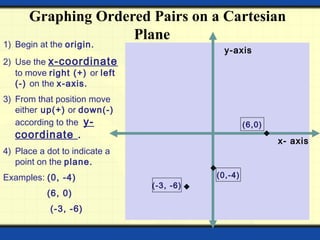
Graphing Ordered Pairs on a Cartesian
Plane
x- axis
y-axis
1) Begin at the origin.
2) Use the x-coordinate
to move right (+) or left
(-) on the x-axis.
3) From that position move
either up(+) or down(-)
according to the y-
coordinate .
4) Place a dot to indicate a
point on the plane.
Examples: (0, -4)
(6, 0)
(-3, -6)
(6,0)
(0,-4)
(-3, -6)
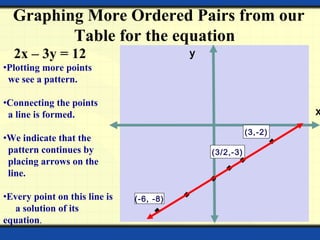
Graphing More Ordered Pairs from our
Table for the equation
x
y
(3,-2)
(3/2,-3)
(-6, -8)
2x – 3y = 12
•Plotting more points
we see a pattern.
•Connecting the points
a line is formed.
•We indicate that the
pattern continues by
placing arrows on the
line.
•Every point on this line is
a solution of its
equation.
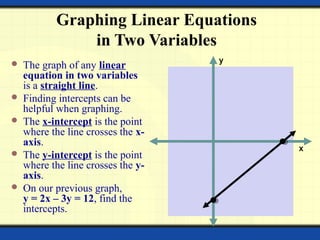
Graphing Linear Equations
in Two Variables
 The graph of any linear
equation in two variables
is a straight line.
 Finding intercepts can be
helpful when graphing.
 The x-intercept is the point
where the line crosses the x-
axis.
 The y-intercept is the point
where the line crosses the y-
axis.
 On our previous graph,
y = 2x – 3y = 12, find the
intercepts.
y
x
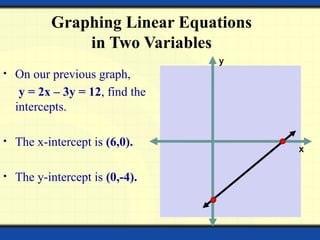
Graphing Linear Equations
in Two Variables
• On our previous graph,
y = 2x – 3y = 12, find the
intercepts.
• The x-intercept is (6,0).
• The y-intercept is (0,-4).
y
x
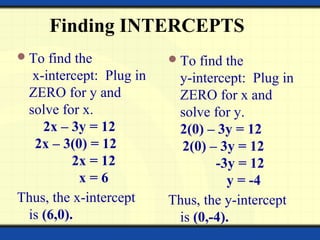
Finding INTERCEPTS
To find the
x-intercept: Plug in
ZERO for y and
solve for x.
2x – 3y = 12
2x – 3(0) = 12
2x = 12
x = 6
Thus, the x-intercept
is (6,0).
To find the
y-intercept: Plug in
ZERO for x and
solve for y.
2(0) – 3y = 12
2(0) – 3y = 12
-3y = 12
y = -4
Thus, the y-intercept
is (0,-4).
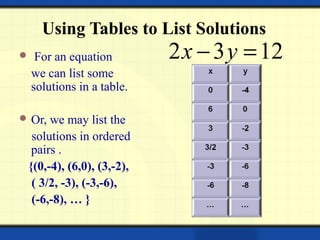
Using Tables to List Solutions
 For an equation
we can list some
solutions in a table.
 Or, we may list the
solutions in ordered
pairs .
{(0,-4), (6,0), (3,-2),
( 3/2, -3), (-3,-6),
(-6,-8), … }
2 3 12x y− =
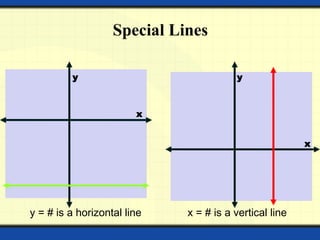
Special Lines
y = # is a horizontal line x = # is a vertical line
y
x
y
x
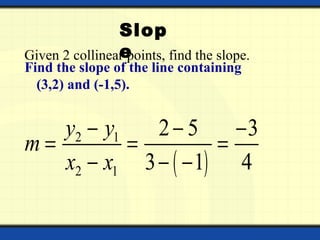
Given 2 collinear points, find the slope.
Find the slope of the line containing
(3,2) and (-1,5).
( )
2 1
2 1
2 5 3
3 1 4
y y
m
x x
− − −
= = =
− − −
Slop
e
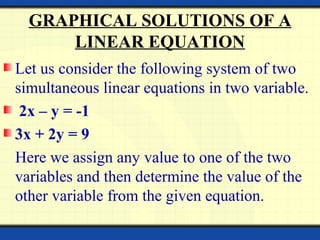
GRAPHICAL SOLUTIONS OF A
LINEAR EQUATION
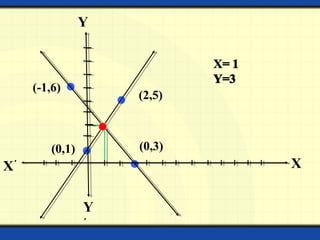
Let us consider the following system of two
simultaneous linear equations in two variable.
2x – y = -1
3x + 2y = 9
Here we assign any value to one of the two
variables and then determine the value of the
other variable from the given equation.
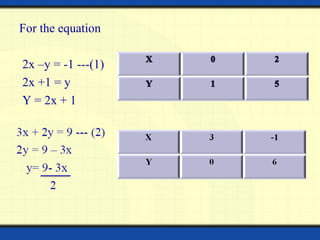
For the equation
2x –y = -1 ---(1)
2x +1 = y
Y = 2x + 1
XX´
Y
Y
´
(2,5)
(-1,6)
(0,3)(0,1)
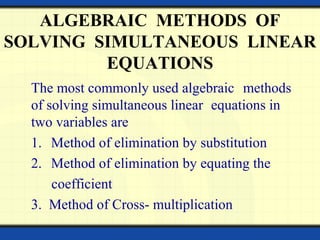
ALGEBRAIC METHODS OF
SOLVING SIMULTANEOUS LINEAR
EQUATIONS
The most commonly used algebraic methods
of solving simultaneous linear equations in
two variables are
1. Method of elimination by substitution
2. Method of elimination by equating the
coefficient
3. Method of Cross- multiplication
ELIMINATION BY SUBSTITUTION
STEPS:
Obtain the two equations. Let the equations be
a1x + b1y + c1 = 0 ----------- (I )
a2x + b2y + c2 = 0 ----------- (II)
Choose either of the two equations, say (I ) and find
the value of one variable , say ‘y’ in terms of x
Substitute the value of y, obtained in the previous
step in equation (II) to get an equation in x
SUBSTITUTION METHOD
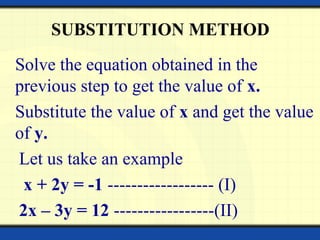
Solve the equation obtained in the
previous step to get the value of x.
Substitute the value of x and get the value
of y.
Let us take an example
x + 2y = -1 ------------------ (I)
2x – 3y = 12 -----------------(II)
SUBSTITUTION METHOD
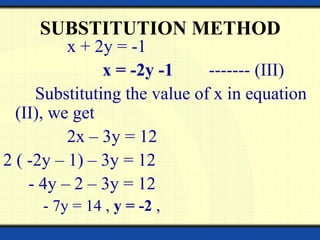
x + 2y = -1
x = -2y -1 ------- (III)
Substituting the value of x in equation
(II), we get
2x – 3y = 12
2 ( -2y – 1) – 3y = 12
- 4y – 2 – 3y = 12
- 7y = 14 , y = -2 ,
SUBSTITUTION METHOD
Putting the value of y in eq. (III), we get
x = - 2y -1
x = - 2 x (-2) – 1
x = 4 - 1
x = 3
Hence the solution of the equation is
( 3, - 2 )
ELIMINATION METHOD
In this method, we eliminate one of the two
variables to obtain an equation in one variable
which can easily be solved. Putting the value
of this variable in any of the given equations,
the value of the other variable can be obtained.
For example: we want to solve,
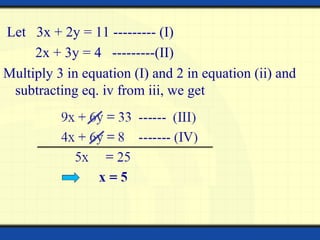
3x + 2y = 11
2x + 3y = 4
Let 3x + 2y = 11 --------- (I)
2x + 3y = 4 ---------(II)
Multiply 3 in equation (I) and 2 in equation (ii) and
subtracting eq. iv from iii, we get
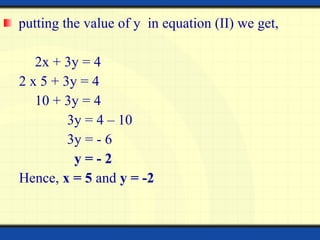
putting the value of y in equation (II) we get,
2x + 3y = 4
2 x 5 + 3y = 4
10 + 3y = 4
3y = 4 – 10
3y = - 6
y = - 2
Hence, x = 5 and y = -2
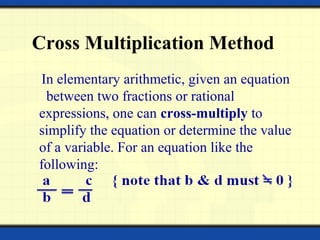
Cross Multiplication Method
In elementary arithmetic, given an equation
between two fractions or rational
expressions, one can cross-multiply to
simplify the equation or determine the value
of a variable. For an equation like the
following:
Cross Multiplication Method
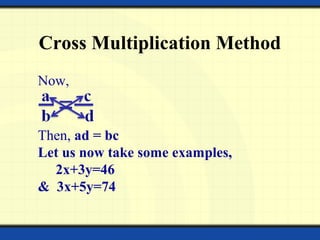
Now,
Then, ad = bc
Let us now take some examples,
2x+3y=46
& 3x+5y=74
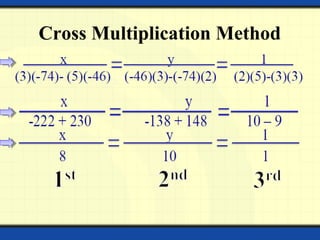
Cross Multiplication Method
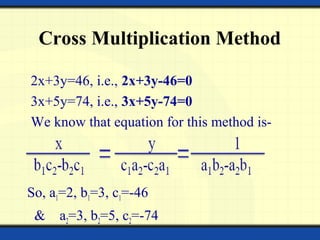
2x+3y=46, i.e., 2x+3y-46=0
3x+5y=74, i.e., 3x+5y-74=0
We know that equation for this method is-
So, a1=2, b1=3, c1=-46
& a2=3, b2=5, c2=-74
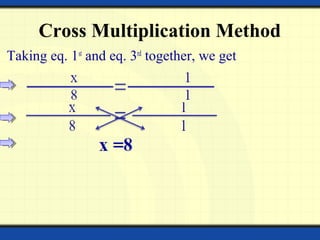
Cross Multiplication Method
Taking eq. 1st
and eq. 3rd
together, we get
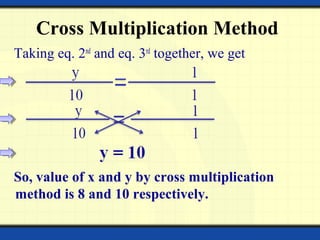
Cross Multiplication Method
Taking eq. 2nd
and eq. 3rd
together, we get
So, value of x and y by cross multiplication
method is 8 and 10 respectively.
Polynomials And Linear Equation of Two Variables

Polynomials And Linear Equation of Two Variables

  • 1.
  • 2.
  • 3.
    Polynomial A polynomial isa mathematical expression involving a sum of powers in one or more variables multiplied by coefficients. A polynomial in one variable (i.e., a univariate polynomial) with constant coefficients is given by e.g. - anxn +a2x2 +a1x+a0
  • 4.
    Polynomial Can Have Apolynomial can have: Constants Variables Exponents Coefficients
  • 5.
    Constants In mathematics, aconstant is a non- varying value, i.e. completely fixed or fixed in the context of use. The term usually occurs in opposition to variable (i.e. variable quantity), which is a symbol that stands for a value that may vary. For e.g. 2x2 +11y-22=0, here -22 is a constant.
  • 6.
    Variables In mathematics, avariable is a value that may change within the scope of a given problem or set of operations. In contrast, a constant is a value that remains unchanged, though often unknown or undetermined. For e.g. 10x2 +5y=2, here x and y are variable.
  • 7.
    Exponents Exponents are sometimesreferred to as powers and means the number of times the 'base' is being multiplied. In the study of algebra, exponents are used frequently. For e.g.-
  • 8.
    Coefficients For other usesof this word, see coefficient (disambiguation).In mathematics, a coefficient is a multiplicative factor in some term of an expression (or of a series); it is usually a number, but in any case does not involve any variables of the expression. For e.g.- 7x2 − 3xy + 15 + y Here 7, -3, 1 are the coefficients of x2 , xy and y respectively.
  • 9.
    Degree of Polynomials Thedegree of a polynomial is the highest degree for a term. The degree of a term is the sum of the powers of each variable in the term. The word degree has for some decades been favoured in standard textbooks. In some older books, the word order is used. For e.g.- The polynomial 3 − 5x + 2x5 − 7x9 has degree 9.
  • 10.
    Types Of Polynomial Polynomialsclassified by degree –
  • 11.
    Linear Polynomials In adifferent usage to the above, a polynomial of degree 1 is said to be linear, because the graph of a function of that form is a line. For e.g.- 2x+1 11y +3
  • 12.
    Quadratic Polynomials In mathematics,a quadratic polynomial or quadratic is a polynomial of degree two, also called second-order polynomial. That means the exponents of the polynomial's variables are no larger than 2. For e.g.- x2 − 4x + 7 is a quadratic polynomial, while x3 − 4x + 7 is not.
  • 13.
    Cubic Polynomials Cubic polynomialis a polynomial of having degree of polynomial no more than 3 or highest degree in the polynomial should be 3 and should not be more or less than 3. For e.g.- x3 + 11x = 9x2 + 55 x3 + x2 +10x = 20
  • 14.
    Biquadratic Polynomials Biquadratic polynomialis a polynomial of having degree of polynomial is no more than 4 or highest degree in the polynomial is not more or less than 4. For e.g.- 4x4 + 5x3 – x2 + x - 1 9y4 + 56x3 – 6x2 + 9x + 2
  • 15.
    Types Of Polynomial Polynomialcan be classified by number of non-zero term
  • 16.
    Zero Polynomials The constantpolynomial whose coefficients are all equal to 0. The corresponding polynomial function is the constant function with value 0, also called the zero map. The degree of the zero polynomial is undefined, but many authors conventionally set it equal to -1 or ∞.
  • 17.
    Monomial, Binomial &Trinomial Monomial:- A polynomial with one term. E.g. - 5x3 , 8, and 4xy. Binomial:- A polynomial with two terms which are not like terms. E.g. - 2x – 3, 3x5 +8x4 , and 2ab – 6a2 b5 . Trinomial:- A polynomial with three terms which are not like terms. E.g. - x2 + 2x - 3, 3x5 - 8x4 + x3 , and a2 b + 13x + c.
  • 18.
  • 19.
    A pair oflinear equations in two variables is said to form a system of simultaneous linear equations. For Example, 2x – 3y + 4 = 0 x + 7y – 1 = 0 Form a system of two linear equations in variables x and y. System of Equations or Simultaneous Equations
  • 20.
    The general formof a linear equation in two variables x and y is ax + by + c = 0 , a ≠ 0, b ≠ 0, where a, b and c being real numbers. A solution of such an equation is a pair of values, one for x and the other for y, which makes two sides of the equation equal. Every linear equation in two variables has infinitely many solutions which can be represented on a certain line.
  • 21.
    Cartesian Plane x- axis y-axis QuadrantI (+,+) Quadrant II ( - ,+) Quadrant IV (+, - ) Quadrant III ( - , - ) origin
  • 22.
    Graphing Ordered Pairson a Cartesian Plane x- axis y-axis 1) Begin at the origin. 2) Use the x-coordinate to move right (+) or left (-) on the x-axis. 3) From that position move either up(+) or down(-) according to the y- coordinate . 4) Place a dot to indicate a point on the plane. Examples: (0, -4) (6, 0) (-3, -6) (6,0) (0,-4) (-3, -6)
  • 23.
    Graphing More OrderedPairs from our Table for the equation x y (3,-2) (3/2,-3) (-6, -8) 2x – 3y = 12 •Plotting more points we see a pattern. •Connecting the points a line is formed. •We indicate that the pattern continues by placing arrows on the line. •Every point on this line is a solution of its equation.
  • 24.
    Graphing Linear Equations inTwo Variables  The graph of any linear equation in two variables is a straight line.  Finding intercepts can be helpful when graphing.  The x-intercept is the point where the line crosses the x- axis.  The y-intercept is the point where the line crosses the y- axis.  On our previous graph, y = 2x – 3y = 12, find the intercepts. y x
  • 25.
    Graphing Linear Equations inTwo Variables • On our previous graph, y = 2x – 3y = 12, find the intercepts. • The x-intercept is (6,0). • The y-intercept is (0,-4). y x
  • 26.
    Finding INTERCEPTS To findthe x-intercept: Plug in ZERO for y and solve for x. 2x – 3y = 12 2x – 3(0) = 12 2x = 12 x = 6 Thus, the x-intercept is (6,0). To find the y-intercept: Plug in ZERO for x and solve for y. 2(0) – 3y = 12 2(0) – 3y = 12 -3y = 12 y = -4 Thus, the y-intercept is (0,-4).
  • 27.
    Using Tables toList Solutions  For an equation we can list some solutions in a table.  Or, we may list the solutions in ordered pairs . {(0,-4), (6,0), (3,-2), ( 3/2, -3), (-3,-6), (-6,-8), … } 2 3 12x y− =
  • 28.
    Special Lines y =# is a horizontal line x = # is a vertical line y x y x
  • 29.
    Given 2 collinearpoints, find the slope. Find the slope of the line containing (3,2) and (-1,5). ( ) 2 1 2 1 2 5 3 3 1 4 y y m x x − − − = = = − − − Slop e
  • 30.
    GRAPHICAL SOLUTIONS OFA LINEAR EQUATION Let us consider the following system of two simultaneous linear equations in two variable. 2x – y = -1 3x + 2y = 9 Here we assign any value to one of the two variables and then determine the value of the other variable from the given equation.
  • 31.
    For the equation 2x–y = -1 ---(1) 2x +1 = y Y = 2x + 1
  • 32.
  • 33.
    ALGEBRAIC METHODS OF SOLVINGSIMULTANEOUS LINEAR EQUATIONS The most commonly used algebraic methods of solving simultaneous linear equations in two variables are 1. Method of elimination by substitution 2. Method of elimination by equating the coefficient 3. Method of Cross- multiplication
  • 34.
    ELIMINATION BY SUBSTITUTION STEPS: Obtainthe two equations. Let the equations be a1x + b1y + c1 = 0 ----------- (I ) a2x + b2y + c2 = 0 ----------- (II) Choose either of the two equations, say (I ) and find the value of one variable , say ‘y’ in terms of x Substitute the value of y, obtained in the previous step in equation (II) to get an equation in x
  • 35.
    SUBSTITUTION METHOD Solve theequation obtained in the previous step to get the value of x. Substitute the value of x and get the value of y. Let us take an example x + 2y = -1 ------------------ (I) 2x – 3y = 12 -----------------(II)
  • 36.
    SUBSTITUTION METHOD x +2y = -1 x = -2y -1 ------- (III) Substituting the value of x in equation (II), we get 2x – 3y = 12 2 ( -2y – 1) – 3y = 12 - 4y – 2 – 3y = 12 - 7y = 14 , y = -2 ,
  • 37.
    SUBSTITUTION METHOD Putting thevalue of y in eq. (III), we get x = - 2y -1 x = - 2 x (-2) – 1 x = 4 - 1 x = 3 Hence the solution of the equation is ( 3, - 2 )
  • 38.
    ELIMINATION METHOD In thismethod, we eliminate one of the two variables to obtain an equation in one variable which can easily be solved. Putting the value of this variable in any of the given equations, the value of the other variable can be obtained. For example: we want to solve, 3x + 2y = 11 2x + 3y = 4
  • 39.
    Let 3x +2y = 11 --------- (I) 2x + 3y = 4 ---------(II) Multiply 3 in equation (I) and 2 in equation (ii) and subtracting eq. iv from iii, we get
  • 40.
    putting the valueof y in equation (II) we get, 2x + 3y = 4 2 x 5 + 3y = 4 10 + 3y = 4 3y = 4 – 10 3y = - 6 y = - 2 Hence, x = 5 and y = -2
  • 41.
    Cross Multiplication Method Inelementary arithmetic, given an equation between two fractions or rational expressions, one can cross-multiply to simplify the equation or determine the value of a variable. For an equation like the following:
  • 42.
    Cross Multiplication Method Now, Then,ad = bc Let us now take some examples, 2x+3y=46 & 3x+5y=74
  • 43.
    Cross Multiplication Method 2x+3y=46,i.e., 2x+3y-46=0 3x+5y=74, i.e., 3x+5y-74=0 We know that equation for this method is- So, a1=2, b1=3, c1=-46 & a2=3, b2=5, c2=-74
  • 44.
  • 45.
    Cross Multiplication Method Takingeq. 1st and eq. 3rd together, we get
  • 46.
    Cross Multiplication Method Takingeq. 2nd and eq. 3rd together, we get So, value of x and y by cross multiplication method is 8 and 10 respectively.