Ch 7.8: Repeated Eigenvalues
We consider again a homogeneous system of n first order
linear equations with constant real coefficients x' = Ax.
If the eigenvalues r1,…, rn of A are real and different, then
there are n linearly independent eigenvectors ξ(1)
,…, ξ(n)
, and n
linearly independent solutions of the form
If some of the eigenvalues r1,…, rn are repeated, then there may
not be n corresponding linearly independent solutions of the
above form.
In this case, we will seek additional solutions that are products
of polynomials and exponential functions.
trnntr n
etet )()()1()1(
)(,,)( 1
ξxξx == 
Example 1: Direction Field (1 of 12)
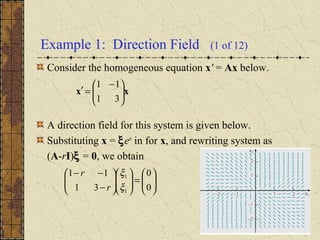
Consider the homogeneous equation x' = Ax below.
A direction field for this system is given below.
Substituting x = ξert
in for x, and rewriting system as
(A-rI)ξ = 0, we obtain
xx 




 −
=′
31
11






=











−
−−
0
0
31
11
1
1
ξ
ξ
r
r
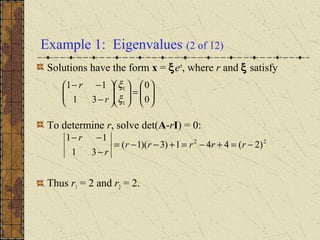
Example 1: Eigenvalues (2 of 12)
Solutions have the form x = ξert
, where r and ξ satisfy
To determine r, solve det(A-rI) = 0:
Thus r1 = 2 and r2 = 2.
22
)2(441)3)(1(
31
11
−=+−=+−−=
−
−−
rrrrr
r
r






=











−
−−
0
0
31
11
1
1
ξ
ξ
r
r
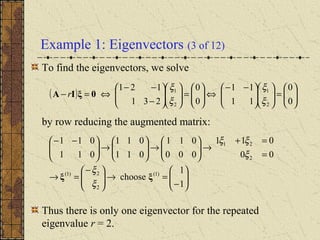
Example 1: Eigenvectors (3 of 12)
To find the eigenvectors, we solve
by row reducing the augmented matrix:
Thus there is only one eigenvector for the repeated
eigenvalue r = 2.
( ) 





=










 −−
⇔





=











−
−−
⇔=−
0
0
11
11
0
0
231
121
2
1
2
1
ξ
ξ
ξ
ξ
0ξIA r






−
=→




−
=→
=
=+
→





→





→




 −−
1
1
choose
00
011
000
011
011
011
011
011
)1(
2
2)1(
2
21
ξξ
ξ
ξ
ξ
ξξ
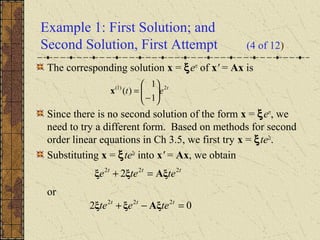
Example 1: First Solution; and
Second Solution, First Attempt (4 of 12)
The corresponding solution x = ξert
of x' = Ax is
Since there is no second solution of the form x = ξert
, we
need to try a different form. Based on methods for second
order linear equations in Ch 3.5, we first try x = ξte2t
.
Substituting x = ξte2t
into x' = Ax, we obtain
or
t
et 2)1(
1
1
)( 





−
=x
ttt
tetee 222
2 Aξξξ =+
02 222
=−+ ttt
teete Aξξξ
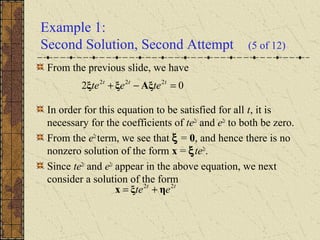
Example 1:
Second Solution, Second Attempt (5 of 12)
From the previous slide, we have
In order for this equation to be satisfied for all t, it is
necessary for the coefficients of te2t
and e2t
to both be zero.
From the e2t
term, we see that ξ = 0, and hence there is no
nonzero solution of the form x = ξte2t
.
Since te2t
and e2t
appear in the above equation, we next
consider a solution of the form
02 222
=−+ ttt
teete Aξξξ
tt
ete 22
ηξx +=
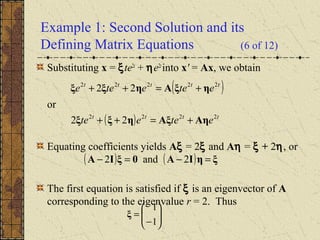
Example 1: Second Solution and its
Defining Matrix Equations (6 of 12)
Substituting x = ξte2t
+ ηe2t
into x' = Ax, we obtain
or
Equating coefficients yields Aξ = 2ξ and Aη = ξ + 2η, or
The first equation is satisfied if ξ is an eigenvector of A
corresponding to the eigenvalue r = 2. Thus
( )ttttt
eteetee 22222
22 ηξAηξξ +=++
( ) tttt
eteete 2222
22 AηAξηξξ +=++
( ) ( ) ξηIA0ξIA =−=− 2and2






−
=
1
1
ξ
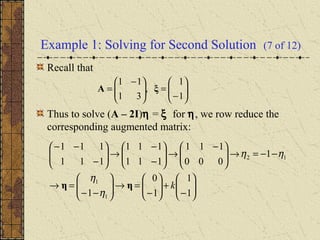
Example 1: Solving for Second Solution (7 of 12)
Recall that
Thus to solve (A – 2I)η = ξ for η, we row reduce the
corresponding augmented matrix:






−
+





−
=→





−−
=→
−−=→




 −
→





−
−
→





−
−−
1
1
1
0
1
1
000
111
111
111
111
111
1
1
12
kηη
η
η
ηη






−
=




 −
=
1
1
,
31
11
ξA
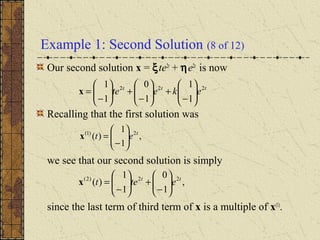
Example 1: Second Solution (8 of 12)
Our second solution x = ξte2t
+ ηe2t
is now
Recalling that the first solution was
we see that our second solution is simply
since the last term of third term of x is a multiple of x(1)
.
ttt
ekete 222
1
1
1
0
1
1






−
+





−
+





−
=x
,
1
1
)( 2)1( t
et 





−
=x
,
1
0
1
1
)( 22)2( tt
etet 





−
+





−
=x
Example 1: General Solution (9 of 12)
The two solutions of x' = Ax are
The Wronskian of these two solutions is
Thus x(1)
and x(2)
are fundamental solutions, and the general
solution of x' = Ax is
[ ] 0)(, 4
222
22
)2()1(
≠−=
−−
= t
ttt
tt
e
etee
tee
tW xx












−
+





−
+





−
=
+=
ttt
etecec
tctct
22
2
2
1
)2(
2
)1(
1
1
0
1
1
1
1
)()()( xxx
ttt
etetet 22)2(2)1(
1
0
1
1
)(,
1
1
)( 





−
+





−
=





−
= xx
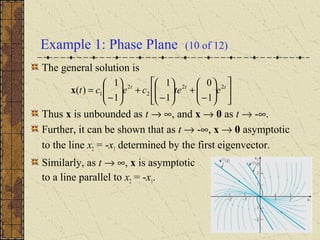
Example 1: Phase Plane (10 of 12)
The general solution is
Thus x is unbounded as t → ∞, and x → 0 as t → -∞.
Further, it can be shown that as t → -∞, x → 0 asymptotic
to the line x2 = -x1 determined by the first eigenvector.
Similarly, as t → ∞, x is asymptotic
to a line parallel to x2 = -x1.












−
+





−
+





−
= ttt
etecect 22
2
2
1
1
0
1
1
1
1
)(x
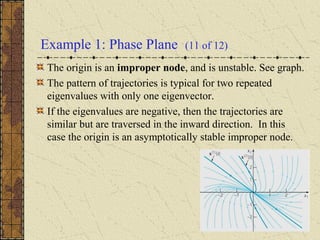
Example 1: Phase Plane (11 of 12)
The origin is an improper node, and is unstable. See graph.
The pattern of trajectories is typical for two repeated
eigenvalues with only one eigenvector.
If the eigenvalues are negative, then the trajectories are
similar but are traversed in the inward direction. In this
case the origin is an asymptotically stable improper node.
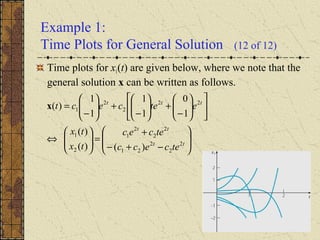
Example 1:
Time Plots for General Solution (12 of 12)
Time plots for x1(t) are given below, where we note that the
general solution x can be written as follows.








−+−
+
=





⇔












−
+





−
+





−
=
tt
tt
ttt
tececc
tecec
tx
tx
etecect
2
2
2
21
2
2
2
1
2
1
22
2
2
1
)()(
)(
1
0
1
1
1
1
)(x
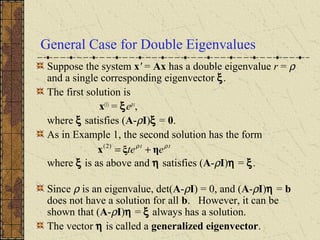
General Case for Double Eigenvalues
Suppose the system x' = Ax has a double eigenvalue r = ρ
and a single corresponding eigenvector ξ.
The first solution is
x(1)
= ξeρt
,
where ξ satisfies (A-ρI)ξ = 0.
As in Example 1, the second solution has the form
where ξ is as above and η satisfies (A-ρI)η = ξ.
Since ρ is an eigenvalue, det(A-ρI) = 0, and (A-ρI)η = b
does not have a solution for all b. However, it can be
shown that (A-ρI)η = ξ always has a solution.
The vector η is called a generalized eigenvector.
tt
ete ρρ
ηξx +=)2(
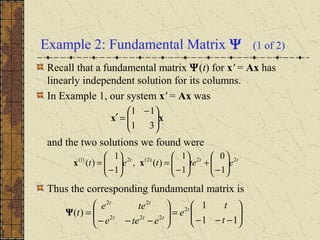
Example 2: Fundamental Matrix Ψ (1 of 2)
Recall that a fundamental matrix Ψ(t) for x' = Ax has
linearly independent solution for its columns.
In Example 1, our system x' = Ax was
and the two solutions we found were
Thus the corresponding fundamental matrix is






−−−
=







−−−
=
11
1
)( 2
222
22
t
t
e
etee
tee
t t
ttt
tt
Ψ
ttt
etetet 22)2(2)1(
1
0
1
1
)(,
1
1
)( 





−
+





−
=





−
= xx
xx 




 −
=′
31
11
Example 2: Fundamental Matrix Φ (2 of 2)
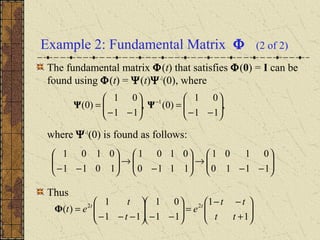
The fundamental matrix Φ(t) that satisfies Φ(0) = I can be
found using Φ(t) = Ψ(t)Ψ-1
(0), where
where Ψ-1
(0) is found as follows:
Thus
,
11
01
)0(,
11
01
)0( 1






−−
=





−−
= −
ΨΨ






−−
→





−
→





−− 1110
0101
1110
0101
1011
0101






+
−−
=





−−





−−−
=
1
1
11
01
11
1
)( 22
tt
tt
e
t
t
et tt
Φ
Jordan Forms
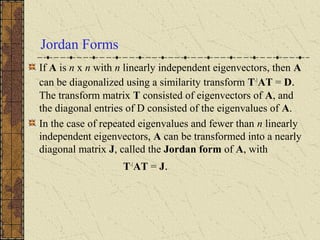
If A is n x n with n linearly independent eigenvectors, then A
can be diagonalized using a similarity transform T-1
AT = D.
The transform matrix T consisted of eigenvectors of A, and
the diagonal entries of D consisted of the eigenvalues of A.
In the case of repeated eigenvalues and fewer than n linearly
independent eigenvectors, A can be transformed into a nearly
diagonal matrix J, called the Jordan form of A, with
T-1
AT = J.
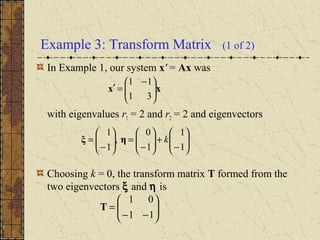
Example 3: Transform Matrix (1 of 2)
In Example 1, our system x' = Ax was
with eigenvalues r1 = 2 and r2 = 2 and eigenvectors
Choosing k = 0, the transform matrix T formed from the
two eigenvectors ξ and η is
xx 




 −
=′
31
11






−
+





−
=





−
=
1
1
1
0
,
1
1
kηξ






−−
=
11
01
T
Example 3: Jordan Form (2 of 2)
The Jordan form J of A is defined by T-1
AT = J.
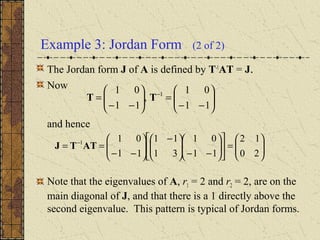
Now
and hence
Note that the eigenvalues of A, r1 = 2 and r2 = 2, are on the
main diagonal of J, and that there is a 1 directly above the
second eigenvalue. This pattern is typical of Jordan forms.






−−
=





−−
= −
11
01
,
11
01 1
TT






=











−−




 −






−−
== −
20
12
11
01
31
11
11
011
ATTJ

Ch07 8

  • 1.
    Ch 7.8: RepeatedEigenvalues We consider again a homogeneous system of n first order linear equations with constant real coefficients x' = Ax. If the eigenvalues r1,…, rn of A are real and different, then there are n linearly independent eigenvectors ξ(1) ,…, ξ(n) , and n linearly independent solutions of the form If some of the eigenvalues r1,…, rn are repeated, then there may not be n corresponding linearly independent solutions of the above form. In this case, we will seek additional solutions that are products of polynomials and exponential functions. trnntr n etet )()()1()1( )(,,)( 1 ξxξx == 
  • 2.
    Example 1: DirectionField (1 of 12) Consider the homogeneous equation x' = Ax below. A direction field for this system is given below. Substituting x = ξert in for x, and rewriting system as (A-rI)ξ = 0, we obtain xx       − =′ 31 11       =            − −− 0 0 31 11 1 1 ξ ξ r r
  • 3.
    Example 1: Eigenvalues(2 of 12) Solutions have the form x = ξert , where r and ξ satisfy To determine r, solve det(A-rI) = 0: Thus r1 = 2 and r2 = 2. 22 )2(441)3)(1( 31 11 −=+−=+−−= − −− rrrrr r r       =            − −− 0 0 31 11 1 1 ξ ξ r r
  • 4.
    Example 1: Eigenvectors(3 of 12) To find the eigenvectors, we solve by row reducing the augmented matrix: Thus there is only one eigenvector for the repeated eigenvalue r = 2. ( )       =            −− ⇔      =            − −− ⇔=− 0 0 11 11 0 0 231 121 2 1 2 1 ξ ξ ξ ξ 0ξIA r       − =→     − =→ = =+ →      →      →      −− 1 1 choose 00 011 000 011 011 011 011 011 )1( 2 2)1( 2 21 ξξ ξ ξ ξ ξξ
  • 5.
    Example 1: FirstSolution; and Second Solution, First Attempt (4 of 12) The corresponding solution x = ξert of x' = Ax is Since there is no second solution of the form x = ξert , we need to try a different form. Based on methods for second order linear equations in Ch 3.5, we first try x = ξte2t . Substituting x = ξte2t into x' = Ax, we obtain or t et 2)1( 1 1 )(       − =x ttt tetee 222 2 Aξξξ =+ 02 222 =−+ ttt teete Aξξξ
  • 6.
    Example 1: Second Solution,Second Attempt (5 of 12) From the previous slide, we have In order for this equation to be satisfied for all t, it is necessary for the coefficients of te2t and e2t to both be zero. From the e2t term, we see that ξ = 0, and hence there is no nonzero solution of the form x = ξte2t . Since te2t and e2t appear in the above equation, we next consider a solution of the form 02 222 =−+ ttt teete Aξξξ tt ete 22 ηξx +=
  • 7.
    Example 1: SecondSolution and its Defining Matrix Equations (6 of 12) Substituting x = ξte2t + ηe2t into x' = Ax, we obtain or Equating coefficients yields Aξ = 2ξ and Aη = ξ + 2η, or The first equation is satisfied if ξ is an eigenvector of A corresponding to the eigenvalue r = 2. Thus ( )ttttt eteetee 22222 22 ηξAηξξ +=++ ( ) tttt eteete 2222 22 AηAξηξξ +=++ ( ) ( ) ξηIA0ξIA =−=− 2and2       − = 1 1 ξ
  • 8.
    Example 1: Solvingfor Second Solution (7 of 12) Recall that Thus to solve (A – 2I)η = ξ for η, we row reduce the corresponding augmented matrix:       − +      − =→      −− =→ −−=→      − →      − − →      − −− 1 1 1 0 1 1 000 111 111 111 111 111 1 1 12 kηη η η ηη       − =      − = 1 1 , 31 11 ξA
  • 9.
    Example 1: SecondSolution (8 of 12) Our second solution x = ξte2t + ηe2t is now Recalling that the first solution was we see that our second solution is simply since the last term of third term of x is a multiple of x(1) . ttt ekete 222 1 1 1 0 1 1       − +      − +      − =x , 1 1 )( 2)1( t et       − =x , 1 0 1 1 )( 22)2( tt etet       − +      − =x
  • 10.
    Example 1: GeneralSolution (9 of 12) The two solutions of x' = Ax are The Wronskian of these two solutions is Thus x(1) and x(2) are fundamental solutions, and the general solution of x' = Ax is [ ] 0)(, 4 222 22 )2()1( ≠−= −− = t ttt tt e etee tee tW xx             − +      − +      − = += ttt etecec tctct 22 2 2 1 )2( 2 )1( 1 1 0 1 1 1 1 )()()( xxx ttt etetet 22)2(2)1( 1 0 1 1 )(, 1 1 )(       − +      − =      − = xx
  • 11.
    Example 1: PhasePlane (10 of 12) The general solution is Thus x is unbounded as t → ∞, and x → 0 as t → -∞. Further, it can be shown that as t → -∞, x → 0 asymptotic to the line x2 = -x1 determined by the first eigenvector. Similarly, as t → ∞, x is asymptotic to a line parallel to x2 = -x1.             − +      − +      − = ttt etecect 22 2 2 1 1 0 1 1 1 1 )(x
  • 12.
    Example 1: PhasePlane (11 of 12) The origin is an improper node, and is unstable. See graph. The pattern of trajectories is typical for two repeated eigenvalues with only one eigenvector. If the eigenvalues are negative, then the trajectories are similar but are traversed in the inward direction. In this case the origin is an asymptotically stable improper node.
  • 13.
    Example 1: Time Plotsfor General Solution (12 of 12) Time plots for x1(t) are given below, where we note that the general solution x can be written as follows.         −+− + =      ⇔             − +      − +      − = tt tt ttt tececc tecec tx tx etecect 2 2 2 21 2 2 2 1 2 1 22 2 2 1 )()( )( 1 0 1 1 1 1 )(x
  • 14.
    General Case forDouble Eigenvalues Suppose the system x' = Ax has a double eigenvalue r = ρ and a single corresponding eigenvector ξ. The first solution is x(1) = ξeρt , where ξ satisfies (A-ρI)ξ = 0. As in Example 1, the second solution has the form where ξ is as above and η satisfies (A-ρI)η = ξ. Since ρ is an eigenvalue, det(A-ρI) = 0, and (A-ρI)η = b does not have a solution for all b. However, it can be shown that (A-ρI)η = ξ always has a solution. The vector η is called a generalized eigenvector. tt ete ρρ ηξx +=)2(
  • 15.
    Example 2: FundamentalMatrix Ψ (1 of 2) Recall that a fundamental matrix Ψ(t) for x' = Ax has linearly independent solution for its columns. In Example 1, our system x' = Ax was and the two solutions we found were Thus the corresponding fundamental matrix is       −−− =        −−− = 11 1 )( 2 222 22 t t e etee tee t t ttt tt Ψ ttt etetet 22)2(2)1( 1 0 1 1 )(, 1 1 )(       − +      − =      − = xx xx       − =′ 31 11
  • 16.
    Example 2: FundamentalMatrix Φ (2 of 2) The fundamental matrix Φ(t) that satisfies Φ(0) = I can be found using Φ(t) = Ψ(t)Ψ-1 (0), where where Ψ-1 (0) is found as follows: Thus , 11 01 )0(, 11 01 )0( 1       −− =      −− = − ΨΨ       −− →      − →      −− 1110 0101 1110 0101 1011 0101       + −− =      −−      −−− = 1 1 11 01 11 1 )( 22 tt tt e t t et tt Φ
  • 17.
    Jordan Forms If Ais n x n with n linearly independent eigenvectors, then A can be diagonalized using a similarity transform T-1 AT = D. The transform matrix T consisted of eigenvectors of A, and the diagonal entries of D consisted of the eigenvalues of A. In the case of repeated eigenvalues and fewer than n linearly independent eigenvectors, A can be transformed into a nearly diagonal matrix J, called the Jordan form of A, with T-1 AT = J.
  • 18.
    Example 3: TransformMatrix (1 of 2) In Example 1, our system x' = Ax was with eigenvalues r1 = 2 and r2 = 2 and eigenvectors Choosing k = 0, the transform matrix T formed from the two eigenvectors ξ and η is xx       − =′ 31 11       − +      − =      − = 1 1 1 0 , 1 1 kηξ       −− = 11 01 T
  • 19.
    Example 3: JordanForm (2 of 2) The Jordan form J of A is defined by T-1 AT = J. Now and hence Note that the eigenvalues of A, r1 = 2 and r2 = 2, are on the main diagonal of J, and that there is a 1 directly above the second eigenvalue. This pattern is typical of Jordan forms.       −− =      −− = − 11 01 , 11 01 1 TT       =            −−      −       −− == − 20 12 11 01 31 11 11 011 ATTJ