Elementary Linear Algebra
Anton & Rorres, 9th Edition
Lecture Set – 01
Chapter 1:
Systems of Linear Equations & Matrices
3/1/2023 Elementary Linear Algorithm 2
Chapter Contents
 Introduction to System of Linear Equations
 Gaussian Elimination
 Matrices and Matrix Operations
 Inverses; Rules of Matrix Arithmetic
 Elementary Matrices and a Method for Finding A-1
 Further Results on Systems of Equations and Invertibility
 Diagonal, Triangular, and Symmetric Matrices
3/1/2023 Elementary Linear Algorithm 3
1-1 Linear Equations
 Any straight line in xy-plane can be represented
algebraically by an equation of the form:
a1x + a2y = b
 General form: Define a linear equation in the n variables
x1, x2, …, xn :
a1x1 + a2x2 + ··· + anxn = b
where a1, a2, …, an and b are real constants.
 The variables in a linear equation are sometimes called
unknowns.
3/1/2023 Elementary Linear Algorithm 4
1-1 Example 1 (Linear Equations)
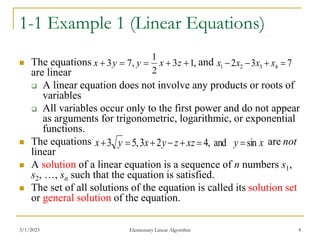
 The equations and
are linear
 A linear equation does not involve any products or roots of
variables
 All variables occur only to the first power and do not appear
as arguments for trigonometric, logarithmic, or exponential
functions.
 The equations are not
linear
 A solution of a linear equation is a sequence of n numbers s1,
s2, …, sn such that the equation is satisfied.
 The set of all solutions of the equation is called its solution set
or general solution of the equation.
,
1
3
2
1
,
7
3 



 z
x
y
y
x 7
3
2 4
3
2
1 


 x
x
x
x
x
y
xz
z
y
x
y
x sin
and
,
4
2
3
,
5
3 






3/1/2023 Elementary Linear Algorithm 5
1-1 Example 2 (Linear Equations)
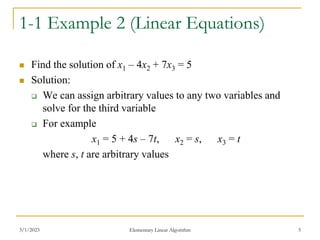
 Find the solution of x1 – 4x2 + 7x3 = 5
 Solution:
 We can assign arbitrary values to any two variables and
solve for the third variable
 For example
x1 = 5 + 4s – 7t, x2 = s, x3 = t
where s, t are arbitrary values
3/1/2023 Elementary Linear Algorithm 6
1-1 Linear Systems
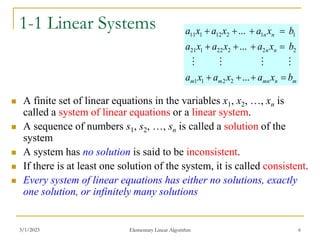
 A finite set of linear equations in the variables x1, x2, …, xn is
called a system of linear equations or a linear system.
 A sequence of numbers s1, s2, …, sn is called a solution of the
system
 A system has no solution is said to be inconsistent.
 If there is at least one solution of the system, it is called consistent.
 Every system of linear equations has either no solutions, exactly
one solution, or infinitely many solutions
m
n
mn
m
m
n
n
n
n
b
x
a
x
a
x
a
b
x
a
x
a
x
a
b
x
a
x
a
x
a












...
...
...
2
2
1
1
2
2
2
22
1
21
1
1
2
12
1
11




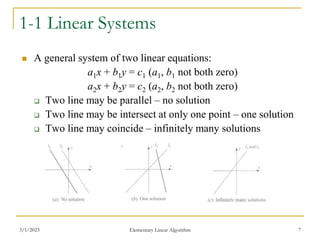
 A general system of two linear equations:
a1x + b1y = c1 (a1, b1 not both zero)
a2x + b2y = c2 (a2, b2 not both zero)
 Two line may be parallel – no solution
 Two line may be intersect at only one point – one solution
 Two line may coincide – infinitely many solutions
3/1/2023 Elementary Linear Algorithm 7
1-1 Linear Systems
3/1/2023 Elementary Linear Algorithm 8
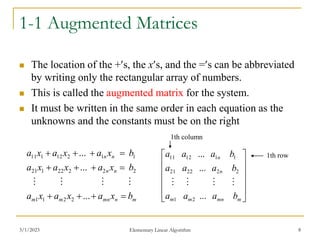
1-1 Augmented Matrices
 The location of the +s, the xs, and the =s can be abbreviated
by writing only the rectangular array of numbers.
 This is called the augmented matrix for the system.
 It must be written in the same order in each equation as the
unknowns and the constants must be on the right
m
n
mn
m
m
n
n
n
n
b
x
a
x
a
x
a
b
x
a
x
a
x
a
b
x
a
x
a
x
a












...
...
...
2
2
1
1
2
2
2
22
1
21
1
1
2
12
1
11
















m
mn
m
m
n
n
b
a
a
a
b
a
a
a
b
a
a
a
...
...
...
2
1
2
2
22
21
1
1
12
11




1th column
1th row
3/1/2023 Elementary Linear Algorithm 9
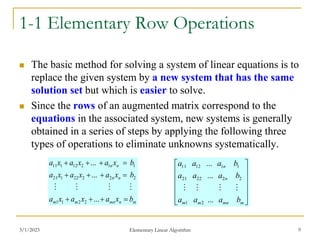
1-1 Elementary Row Operations
 The basic method for solving a system of linear equations is to
replace the given system by a new system that has the same
solution set but which is easier to solve.
 Since the rows of an augmented matrix correspond to the
equations in the associated system, new systems is generally
obtained in a series of steps by applying the following three
types of operations to eliminate unknowns systematically.
m
n
mn
m
m
n
n
n
n
b
x
a
x
a
x
a
b
x
a
x
a
x
a
b
x
a
x
a
x
a












...
...
...
2
2
1
1
2
2
2
22
1
21
1
1
2
12
1
11
















m
mn
m
m
n
n
b
a
a
a
b
a
a
a
b
a
a
a
...
...
...
2
1
2
2
22
21
1
1
12
11




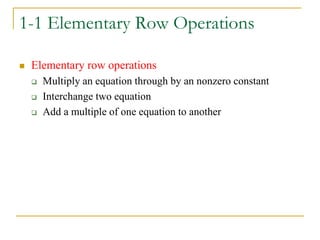
1-1 Elementary Row Operations
 Elementary row operations
 Multiply an equation through by an nonzero constant
 Interchange two equation
 Add a multiple of one equation to another
3/1/2023 Elementary Linear Algorithm 11
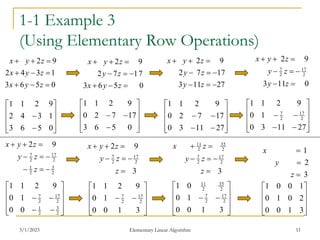
1-1 Example 3
(Using Elementary Row Operations)
0
5
6
3
7
1
7
2
9
2









z
y
x
z
y
z
y
x
0
5
6
3
1
3
4
2
9
2









z
y
x
z
y
x
z
y
x












0
5
6
3
1
3
4
2
9
2
1
1













0
5
6
3
17
7
2
0
9
2
1
1
0
11
3
9
2
2
17
2
7








z
y
z
y
z
y
x
27
11
3
17
7
2
9
2









z
y
z
y
z
y
x














27
11
3
0
17
7
2
0
9
2
1
1














27
11
3
0
1
0
9
2
1
1
2
17
2
7
3
9
2
2
17
2
7







z
z
y
z
y
x
2
3
2
1
2
17
2
7
9
2









z
z
y
z
y
x














2
3
2
1
2
17
2
7
0
0
1
0
9
2
1
1












3
1
0
0
1
0
9
2
1
1
2
17
2
7
3
2
1



z
y
x
3
2
17
2
7
2
35
2
11






z
z
y
z
x












3
1
0
0
1
0
0
1
2
17
2
7
2
35
2
11










3
1
0
0
2
0
1
0
1
0
0
1
3/1/2023 Elementary Linear Algorithm 12
Chapter Contents
 Introduction to System of Linear Equations
 Gaussian Elimination
 Matrices and Matrix Operations
 Inverses; Rules of Matrix Arithmetic
 Elementary Matrices and a Method for Finding A-1
 Further Results on Systems of Equations and Invertibility
 Diagonal, Triangular, and Symmetric Matrices
3/1/2023 Elementary Linear Algorithm 13
1-2 Echelon Forms
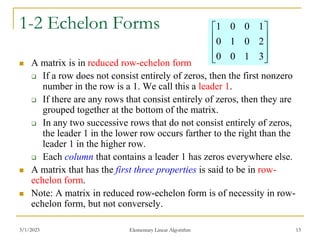
 A matrix is in reduced row-echelon form
 If a row does not consist entirely of zeros, then the first nonzero
number in the row is a 1. We call this a leader 1.
 If there are any rows that consist entirely of zeros, then they are
grouped together at the bottom of the matrix.
 In any two successive rows that do not consist entirely of zeros,
the leader 1 in the lower row occurs farther to the right than the
leader 1 in the higher row.
 Each column that contains a leader 1 has zeros everywhere else.
 A matrix that has the first three properties is said to be in row-
echelon form.
 Note: A matrix in reduced row-echelon form is of necessity in row-
echelon form, but not conversely.










3
1
0
0
2
0
1
0
1
0
0
1
3/1/2023 Elementary Linear Algorithm 14
1-2 Example 1
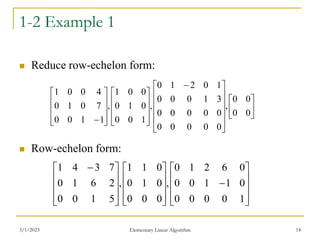
 Reduce row-echelon form:
 Row-echelon form:

















 





















0
0
0
0
,
0
0
0
0
0
0
0
0
0
0
3
1
0
0
0
1
0
2
1
0
,
1
0
0
0
1
0
0
0
1
,
1
1
0
0
7
0
1
0
4
0
0
1






























 
1
0
0
0
0
0
1
1
0
0
0
6
2
1
0
,
0
0
0
0
1
0
0
1
1
,
5
1
0
0
2
6
1
0
7
3
4
1
3/1/2023 Elementary Linear Algorithm 15
1-2 Example 2
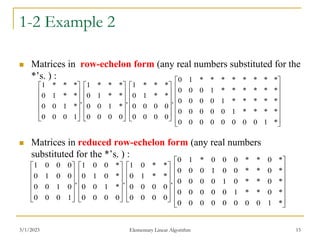
 Matrices in row-echelon form (any real numbers substituted for the
*’s. ) :
 Matrices in reduced row-echelon form (any real numbers
substituted for the *’s. ) :




















































*
1
0
0
0
0
0
0
0
0
*
0
*
*
1
0
0
0
0
0
*
0
*
*
0
1
0
0
0
0
*
0
*
*
0
0
1
0
0
0
*
0
*
*
0
0
0
*
1
0
,
0
0
0
0
0
0
0
0
*
*
1
0
*
*
0
1
,
0
0
0
0
*
1
0
0
*
0
1
0
*
0
0
1
,
1
0
0
0
0
1
0
0
0
0
1
0
0
0
0
1




















































*
1
0
0
0
0
0
0
0
0
*
*
*
*
1
0
0
0
0
0
*
*
*
*
*
1
0
0
0
0
*
*
*
*
*
*
1
0
0
0
*
*
*
*
*
*
*
*
1
0
,
0
0
0
0
0
0
0
0
*
*
1
0
*
*
*
1
,
0
0
0
0
*
1
0
0
*
*
1
0
*
*
*
1
,
1
0
0
0
*
1
0
0
*
*
1
0
*
*
*
1
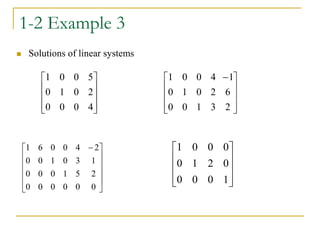
1-2 Example 3
 Solutions of linear systems










4
0
0
0
2
0
1
0
5
0
0
1










1
0
0
0
0
2
1
0
0
0
0
1









 
2
6
1
3
1
0
0
2
0
1
0
4
0
0
1











 
0
0
0
0
0
0
2
5
1
0
0
0
1
3
0
1
0
0
2
4
0
0
6
1
3/1/2023 Elementary Linear Algorithm 17
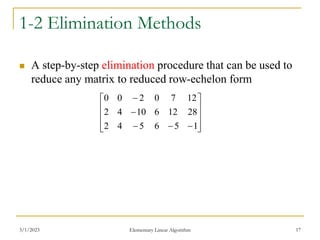
1-2 Elimination Methods
 A step-by-step elimination procedure that can be used to
reduce any matrix to reduced row-echelon form















1
5
6
5
4
2
28
12
6
10
4
2
12
7
0
2
0
0
3/1/2023 Elementary Linear Algorithm 18
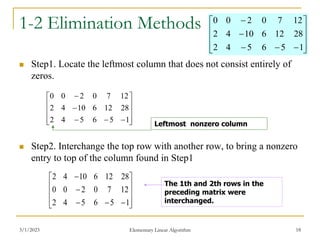
1-2 Elimination Methods
 Step1. Locate the leftmost column that does not consist entirely of
zeros.
 Step2. Interchange the top row with another row, to bring a nonzero
entry to top of the column found in Step1















1
5
6
5
4
2
28
12
6
10
4
2
12
7
0
2
0
0
Leftmost nonzero column















1
5
6
5
4
2
12
7
0
2
0
0
28
12
6
10
4
2
The 1th and 2th rows in the
preceding matrix were
interchanged.















1
5
6
5
4
2
28
12
6
10
4
2
12
7
0
2
0
0
3/1/2023 Elementary Linear Algorithm 19
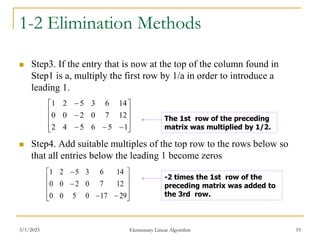
1-2 Elimination Methods
 Step3. If the entry that is now at the top of the column found in
Step1 is a, multiply the first row by 1/a in order to introduce a
leading 1.
 Step4. Add suitable multiples of the top row to the rows below so
that all entries below the leading 1 become zeros















1
5
6
5
4
2
12
7
0
2
0
0
14
6
3
5
2
1
The 1st row of the preceding
matrix was multiplied by 1/2.














29
17
0
5
0
0
12
7
0
2
0
0
14
6
3
5
2
1
-2 times the 1st row of the
preceding matrix was added to
the 3rd row.
3/1/2023 Elementary Linear Algorithm 20
1-2 Elimination Methods
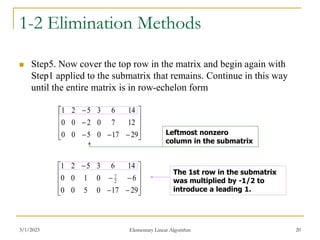
 Step5. Now cover the top row in the matrix and begin again with
Step1 applied to the submatrix that remains. Continue in this way
until the entire matrix is in row-echelon form















29
17
0
5
0
0
12
7
0
2
0
0
14
6
3
5
2
1
The 1st row in the submatrix
was multiplied by -1/2 to
introduce a leading 1.















29
17
0
5
0
0
6
0
1
0
0
14
6
3
5
2
1
2
7
Leftmost nonzero
column in the submatrix
3/1/2023 Elementary Linear Algorithm 21
1-2 Elimination Methods
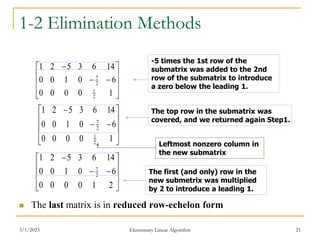
 The last matrix is in reduced row-echelon form













2
1
0
0
0
0
6
0
1
0
0
14
6
3
5
2
1
2
7
-5 times the 1st row of the
submatrix was added to the 2nd
row of the submatrix to introduce
a zero below the leading 1.













1
0
0
0
0
6
0
1
0
0
14
6
3
5
2
1
2
1
2
7













1
0
0
0
0
6
0
1
0
0
14
6
3
5
2
1
2
1
2
7
The top row in the submatrix was
covered, and we returned again Step1.
The first (and only) row in the
new submetrix was multiplied
by 2 to introduce a leading 1.
Leftmost nonzero column in
the new submatrix
3/1/2023 Elementary Linear Algorithm 22
1-2 Elimination Methods
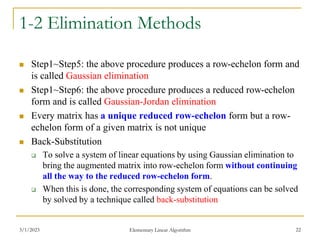
 Step1~Step5: the above procedure produces a row-echelon form and
is called Gaussian elimination
 Step1~Step6: the above procedure produces a reduced row-echelon
form and is called Gaussian-Jordan elimination
 Every matrix has a unique reduced row-echelon form but a row-
echelon form of a given matrix is not unique
 Back-Substitution
 To solve a system of linear equations by using Gaussian elimination to
bring the augmented matrix into row-echelon form without continuing
all the way to the reduced row-echelon form.
 When this is done, the corresponding system of equations can be solved
by solved by a technique called back-substitution
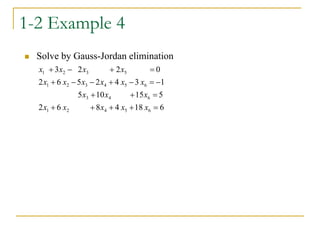
1-2 Example 4
 Solve by Gauss-Jordan elimination
6
18
4
8
6
2
5
15
10
5
1
3
4
2
5
6
2
0
2
2
3
6
5
4
2
1
6
4
3
6
5
4
3
2
1
5
3
2
1



















x
x
x
x
x
x
x
x
x
x
x
x
x
x
x
x
x
x
1-2 Example 5
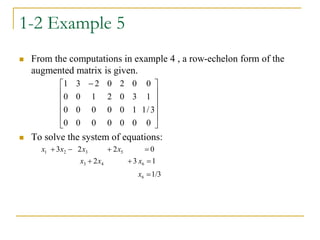
 From the computations in example 4 , a row-echelon form of the
augmented matrix is given.
 To solve the system of equations:











 
0
3
/
1
1
0
0
0
0
0
0
0
1
0
0
0
0
0
3
0
2
1
0
0
0
2
0
2
3
1
1/3
1
3
2
0
2
2
3
6
6
4
3
5
3
2
1








x
x
x
x
x
x
x
x
1-2 Example 6
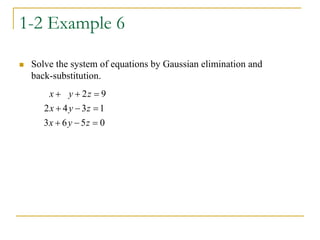
 Solve the system of equations by Gaussian elimination and
back-substitution.
0
5
6
3
1
3
4
2
9
2









z
y
x
z
y
x
z
y
x
3/1/2023 Elementary Linear Algorithm 26
1-2 Homogeneous Linear Systems
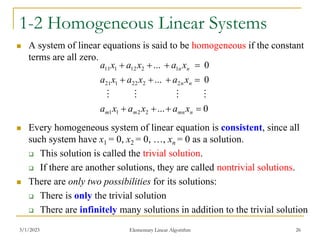
 A system of linear equations is said to be homogeneous if the constant
terms are all zero.
 Every homogeneous system of linear equation is consistent, since all
such system have x1 = 0, x2 = 0, …, xn = 0 as a solution.
 This solution is called the trivial solution.
 If there are another solutions, they are called nontrivial solutions.
 There are only two possibilities for its solutions:
 There is only the trivial solution
 There are infinitely many solutions in addition to the trivial solution
0
...
0
...
0
...
2
2
1
1
2
2
22
1
21
1
2
12
1
11












n
mn
m
m
n
n
n
n
x
a
x
a
x
a
x
a
x
a
x
a
x
a
x
a
x
a




3/1/2023 Elementary Linear Algorithm 27
1-2 Example 7
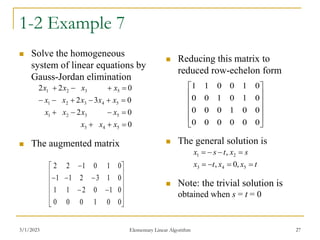
 Solve the homogeneous
system of linear equations by
Gauss-Jordan elimination
 The augmented matrix
 Reducing this matrix to
reduced row-echelon form
 The general solution is
 Note: the trivial solution is
obtained when s = t = 0
0
0
2
0
3
2
0
2
2
5
4
3
5
3
2
1
5
4
3
2
1
5
3
2
1

















x
x
x
x
x
x
x
x
x
x
x
x
x
x
x
x


















0
0
1
0
0
0
0
1
0
2
1
1
0
1
3
2
1
1
0
1
0
1
2
2












0
0
0
0
0
0
0
0
1
0
0
0
0
1
0
1
0
0
0
1
0
0
1
1
t
x
x
t
x
s
x
t
s
x








5
4
3
2
1
,
0
,
,
3/1/2023 Elementary Linear Algorithm 28
1-2 Example 7 (Gauss-Jordan Elimination)
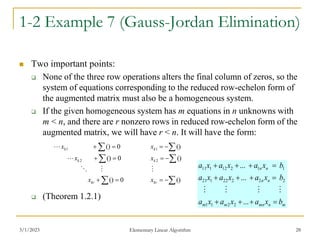
 Two important points:
 None of the three row operations alters the final column of zeros, so the
system of equations corresponding to the reduced row-echelon form of
the augmented matrix must also be a homogeneous system.
 If the given homogeneous system has m equations in n unknowns with
m < n, and there are r nonzero rows in reduced row-echelon form of the
augmented matrix, we will have r < n. It will have the form:
 (Theorem 1.2.1)
0
()
0
()
0
()
2
1









kr
k
k
x
x
x













()
()
()
2
1
kr
k
k
x
x
x

m
n
mn
m
m
n
n
n
n
b
x
a
x
a
x
a
b
x
a
x
a
x
a
b
x
a
x
a
x
a












...
...
...
2
2
1
1
2
2
2
22
1
21
1
1
2
12
1
11




3/1/2023 Elementary Linear Algorithm 29
Theorem 1.2.1
 A homogeneous system of linear equations with more
unknowns than equations has infinitely many solutions.
 Remark
 This theorem applies only to homogeneous system!
 A nonhomogeneous system with more unknowns than equations
need not be consistent; however, if the system is consistent, it
will have infinitely many solutions.
 e.g., two parallel planes in 3-space
3/1/2023 Elementary Linear Algorithm 30
Chapter Contents
 Introduction to System of Linear Equations
 Gaussian Elimination
 Matrices and Matrix Operations
 Inverses; Rules of Matrix Arithmetic
 Elementary Matrices and a Method for Finding A-1
 Further Results on Systems of Equations and Invertibility
 Diagonal, Triangular, and Symmetric Matrices
3/1/2023 Elementary Linear Algorithm 31
1-3 Definition and Notation
 A matrix is a rectangular array of numbers. The numbers
in the array are called the entries in the matrix
 A general mn matrix A is denoted as
 The entry that occurs in row i and column j of matrix A
will be denoted aij or Aij. If aij is real number, it is
common to be referred as scalars
 The preceding matrix can be written as [aij]mn or [aij]













mn
m
m
n
n
a
a
a
a
a
a
a
a
a
A
...
...
...
2
1
2
22
21
1
12
11



3/1/2023 Elementary Linear Algorithm 32
1-3 Definition
 Two matrices are defined to be equal if they have the
same size and their corresponding entries are equal
 If A = [aij] and B = [bij] have the same size, then A = B
if and only if aij = bij for all i and j
 If A and B are matrices of the same size, then the sum A +
B is the matrix obtained by adding the entries of B to the
corresponding entries of A.
1-3 Definition
 The difference A – B is the matrix obtained by subtracting
the entries of B from the corresponding entries of A
 If A is any matrix and c is any scalar, then the product cA
is the matrix obtained by multiplying each entry of the
matrix A by c. The matrix cA is said to be the scalar
multiple of A
 If A = [aij], then cAij = cAij = caij
3/1/2023 Elementary Linear Algorithm 34
1-3 Definitions
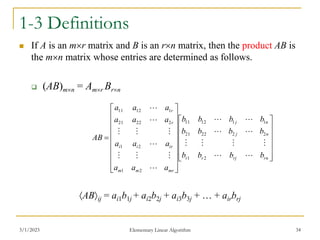
 If A is an mr matrix and B is an rn matrix, then the product AB is
the mn matrix whose entries are determined as follows.
 (AB)mn = Amr Brn
ABij = ai1b1j + ai2b2j + ai3b3j + … + airbrj



































rn
rj
r
r
n
j
n
j
mr
m
m
ir
i
i
r
r
b
b
b
b
b
b
b
b
b
b
b
b
a
a
a
a
a
a
a
a
a
a
a
a
AB




















2
1
2
2
22
21
1
1
12
11
2
1
2
1
2
22
21
1
12
11
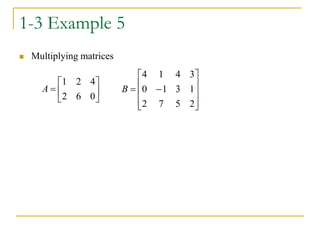
1-3 Example 5
 Multiplying matrices







0
6
2
4
2
1
A












2
5
7
2
1
3
1
0
3
4
1
4
B
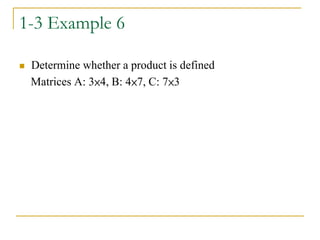
1-3 Example 6
 Determine whether a product is defined
Matrices A: 3×4, B: 4×7, C: 7×3
3/1/2023 Elementary Linear Algorithm 37
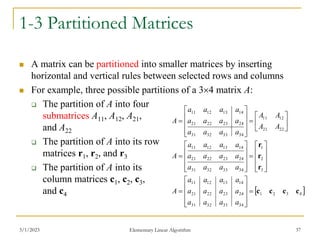
1-3 Partitioned Matrices
 A matrix can be partitioned into smaller matrices by inserting
horizontal and vertical rules between selected rows and columns
 For example, three possible partitions of a 34 matrix A:
 The partition of A into four
submatrices A11, A12, A21,
and A22
 The partition of A into its row
matrices r1, r2, and r3
 The partition of A into its
column matrices c1, c2, c3,
and c4  
4
3
2
1
34
33
32
31
24
23
22
21
14
13
12
11
3
2
1
34
33
32
31
24
23
22
21
14
13
12
11
22
21
12
11
34
33
32
31
24
23
22
21
14
13
12
11
c
c
c
c
r
r
r




















































a
a
a
a
a
a
a
a
a
a
a
a
A
a
a
a
a
a
a
a
a
a
a
a
a
A
A
A
A
A
a
a
a
a
a
a
a
a
a
a
a
a
A
3/1/2023 Elementary Linear Algorithm 38
1-3 Multiplication by Columns and by Rows
 It is possible to compute a particular row or column of a
matrix product AB without computing the entire product:
jth column matrix of AB = A[jth column matrix of B]
ith row matrix of AB = [ith row matrix of A]B
 If a1, a2, ..., am denote the row matrices of A and b1 ,b2, ...,bn
denote the column matrices of B,then
   




























B
B
B
B
AB
A
A
A
A
AB
m
m
n
n
a
a
a
a
a
a
b
b
b
b
b
b




2
1
2
1
2
1
2
1
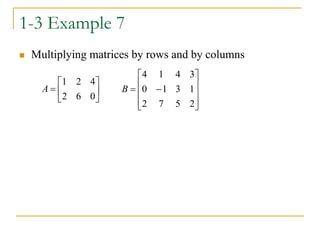
1-3 Example 7
 Multiplying matrices by rows and by columns







0
6
2
4
2
1
A












2
5
7
2
1
3
1
0
3
4
1
4
B
3/1/2023 Elementary Linear Algorithm 40
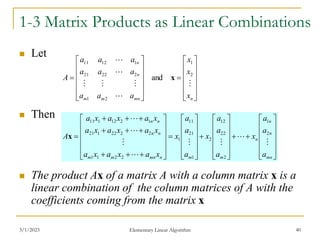
1-3 Matrix Products as Linear Combinations
 Let
 Then
 The product Ax of a matrix A with a column matrix x is a
linear combination of the column matrices of A with the
coefficients coming from the matrix x


























n
mn
m
m
n
n
x
x
x
a
a
a
a
a
a
a
a
a
A







2
1
2
1
2
22
21
1
12
11
and x






























































mn
n
n
n
m
m
n
mn
m
m
n
n
n
n
a
a
a
x
a
a
a
x
a
a
a
x
x
a
x
a
x
a
x
a
x
a
x
a
x
a
x
a
x
a
A








2
1
2
22
12
2
1
21
11
1
2
2
1
1
2
2
22
1
21
1
2
12
1
11
x
3/1/2023 Elementary Linear Algorithm 41
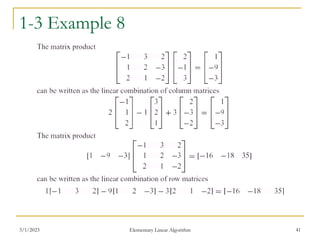
1-3 Example 8
3/1/2023 Elementary Linear Algorithm 42
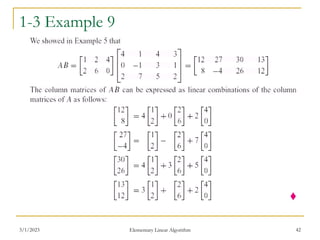
1-3 Example 9
3/1/2023 Elementary Linear Algorithm 43
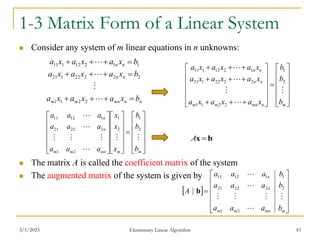
1-3 Matrix Form of a Linear System
 Consider any system of m linear equations in n unknowns:
 The matrix A is called the coefficient matrix of the system
 The augmented matrix of the system is given by





































m
m
mn
m
m
n
n
b
b
b
x
x
x
a
a
a
a
a
a
a
a
a








2
1
2
1
2
1
2
22
21
1
12
11
n
n
mn
m
m
n
n
n
n
b
x
a
x
a
x
a
b
x
a
x
a
x
a
b
x
a
x
a
x
a
















2
2
1
1
2
2
2
22
1
21
1
1
2
12
1
11


































m
n
mn
m
m
n
n
n
n
b
b
b
x
a
x
a
x
a
x
a
x
a
x
a
x
a
x
a
x
a





2
1
2
2
1
1
2
2
22
1
21
1
2
12
1
11
b
x 
A
 













m
mn
m
m
n
n
b
a
a
a
b
a
a
a
b
a
a
a
A







2
1
2
2
22
21
1
1
12
11
b
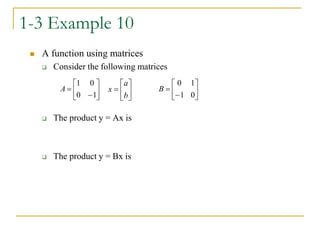
1-3 Example 10
 A function using matrices
 Consider the following matrices
 The product y = Ax is
 The product y = Bx is








1
0
0
1
A 






b
a
x 







0
1
1
0
B
3/1/2023 Elementary Linear Algorithm 45
1-3 Definitions
 If A is any mn matrix, then the transpose of A, denoted
by AT, is defined to be the nm matrix that results from
interchanging the rows and columns of A
 That is, the first column of AT is the first row of A, the second
column of AT is the second row of A, and so forth
 If A is a square matrix, then the trace of A , denoted by
tr(A), is defined to be the sum of the entries on the main
diagonal of A. The trace of A is undefined if A is not a
square matrix.
 For an nn matrix A = [aij], 


n
i
ii
a
A
1
)
(
tr
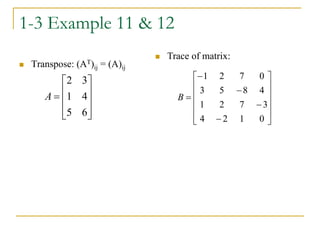
1-3 Example 11 & 12
 Transpose: (AT)ij = (A)ij











6
5
4
1
3
2
A
 Trace of matrix:

















0
1
2
4
3
7
2
1
4
8
5
3
0
7
2
1
B
3/1/2023 Elementary Linear Algorithm 47
Chapter Contents
 Introduction to System of Linear Equations
 Gaussian Elimination
 Matrices and Matrix Operations
 Inverses; Rules of Matrix Arithmetic
 Elementary Matrices and a Method for Finding A-1
 Further Results on Systems of Equations and Invertibility
 Diagonal, Triangular, and Symmetric Matrices
3/1/2023 Elementary Linear Algorithm 48
1-4 Properties of Matrix Operations
 For real numbers a and b ,we always have ab = ba, which
is called the commutative law for multiplication. For
matrices, however, AB and BA need not be equal.
 Equality can fail to hold for three reasons:
 The product AB is defined but BA is undefined.
 AB and BA are both defined but have different sizes.
 It is possible to have AB  BA even if both AB and BA are
defined and have the same size.
3/1/2023 Elementary Linear Algorithm 49
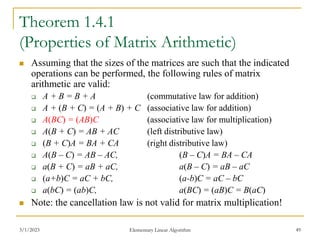
Theorem 1.4.1
(Properties of Matrix Arithmetic)
 Assuming that the sizes of the matrices are such that the indicated
operations can be performed, the following rules of matrix
arithmetic are valid:
 A + B = B + A (commutative law for addition)
 A + (B + C) = (A + B) + C (associative law for addition)
 A(BC) = (AB)C (associative law for multiplication)
 A(B + C) = AB + AC (left distributive law)
 (B + C)A = BA + CA (right distributive law)
 A(B – C) = AB – AC, (B – C)A = BA – CA
 a(B + C) = aB + aC, a(B – C) = aB – aC
 (a+b)C = aC + bC, (a-b)C = aC – bC
 a(bC) = (ab)C, a(BC) = (aB)C = B(aC)
 Note: the cancellation law is not valid for matrix multiplication!
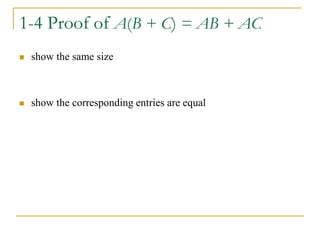
1-4 Proof of A(B + C) = AB + AC
 show the same size
 show the corresponding entries are equal
3/1/2023 Elementary Linear Algorithm 51
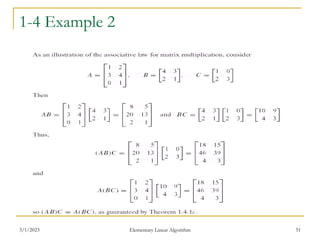
1-4 Example 2
3/1/2023 Elementary Linear Algorithm 52
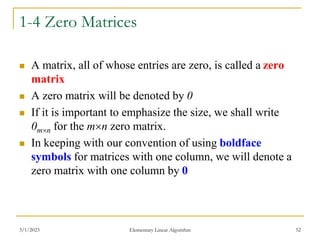
1-4 Zero Matrices
 A matrix, all of whose entries are zero, is called a zero
matrix
 A zero matrix will be denoted by 0
 If it is important to emphasize the size, we shall write
0mn for the mn zero matrix.
 In keeping with our convention of using boldface
symbols for matrices with one column, we will denote a
zero matrix with one column by 0
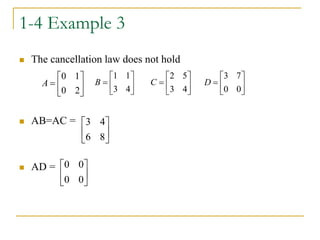
1-4 Example 3
 The cancellation law does not hold
 AB=AC =
 AD =







2
0
1
0
A 






4
3
1
1
B 






4
3
5
2
C 






0
0
7
3
D






8
6
4
3






0
0
0
0
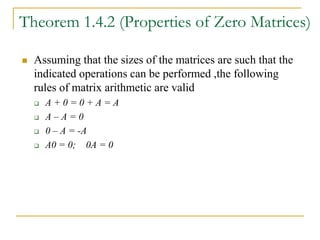
Theorem 1.4.2 (Properties of Zero Matrices)
 Assuming that the sizes of the matrices are such that the
indicated operations can be performed ,the following
rules of matrix arithmetic are valid
 A + 0 = 0 + A = A
 A – A = 0
 0 – A = -A
 A0 = 0; 0A = 0
3/1/2023 Elementary Linear Algorithm 55
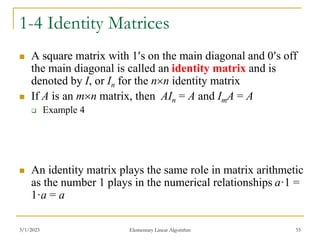
1-4 Identity Matrices
 A square matrix with 1s on the main diagonal and 0s off
the main diagonal is called an identity matrix and is
denoted by I, or In for the nn identity matrix
 If A is an mn matrix, then AIn = A and ImA = A
 Example 4
 An identity matrix plays the same role in matrix arithmetic
as the number 1 plays in the numerical relationships a·1 =
1·a = a
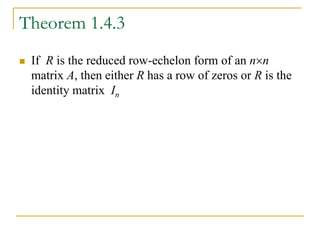
Theorem 1.4.3
 If R is the reduced row-echelon form of an nn
matrix A, then either R has a row of zeros or R is the
identity matrix In
3/1/2023 Elementary Linear Algorithm 57
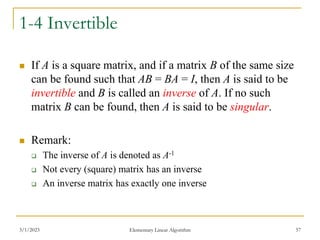
1-4 Invertible
 If A is a square matrix, and if a matrix B of the same size
can be found such that AB = BA = I, then A is said to be
invertible and B is called an inverse of A. If no such
matrix B can be found, then A is said to be singular.
 Remark:
 The inverse of A is denoted as A-1
 Not every (square) matrix has an inverse
 An inverse matrix has exactly one inverse
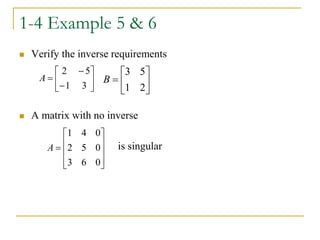
1-4 Example 5 & 6
 Verify the inverse requirements
 A matrix with no inverse
is singular









3
1
5
2
A 






2
1
5
3
B











0
6
3
0
5
2
0
4
1
A
3/1/2023 Elementary Linear Algorithm 59
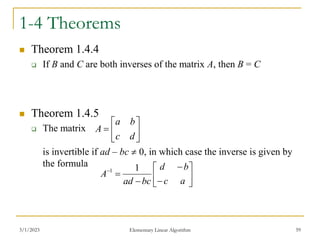
1-4 Theorems
 Theorem 1.4.4
 If B and C are both inverses of the matrix A, then B = C
 Theorem 1.4.5
 The matrix
is invertible if ad – bc  0, in which case the inverse is given by
the formula







d
c
b
a
A











a
c
b
d
bc
ad
A
1
1
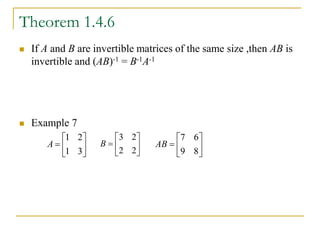
Theorem 1.4.6
 If A and B are invertible matrices of the same size ,then AB is
invertible and (AB)-1 = B-1A-1
 Example 7







3
1
2
1
A 






2
2
2
3
B 






8
9
6
7
AB
3/1/2023 Elementary Linear Algorithm 61
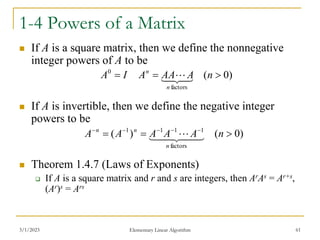
1-4 Powers of a Matrix
 If A is a square matrix, then we define the nonnegative
integer powers of A to be
 If A is invertible, then we define the negative integer
powers to be
 Theorem 1.4.7 (Laws of Exponents)
 If A is a square matrix and r and s are integers, then ArAs = Ar+s,
(Ar)s = Ars
)
0
(
factors
0


 n
A
AA
A
I
A
n
n




 
)
0
(
)
(
factors
1
1
1
1


 




n
A
A
A
A
A
n
n
n




 
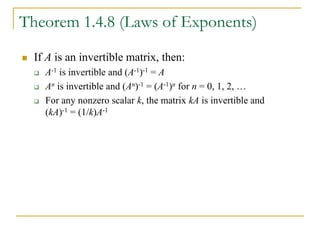
Theorem 1.4.8 (Laws of Exponents)
 If A is an invertible matrix, then:
 A-1 is invertible and (A-1)-1 = A
 An is invertible and (An)-1 = (A-1)n for n = 0, 1, 2, …
 For any nonzero scalar k, the matrix kA is invertible and
(kA)-1 = (1/k)A-1
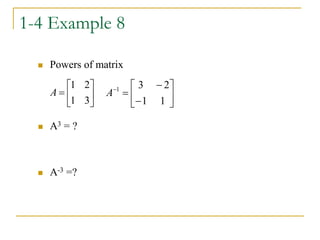
1-4 Example 8
 Powers of matrix
 A3 = ?
 A-3 =?







3
1
2
1
A 









1
1
2
3
1
A
3/1/2023 Elementary Linear Algorithm 64
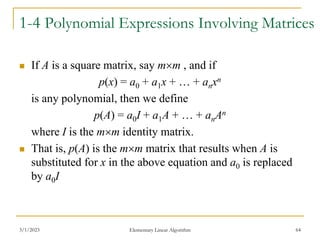
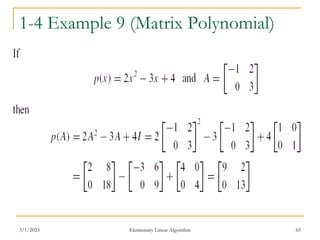
1-4 Polynomial Expressions Involving Matrices
 If A is a square matrix, say mm , and if
p(x) = a0 + a1x + … + anxn
is any polynomial, then we define
p(A) = a0I + a1A + … + anAn
where I is the mm identity matrix.
 That is, p(A) is the mm matrix that results when A is
substituted for x in the above equation and a0 is replaced
by a0I
3/1/2023 Elementary Linear Algorithm 65
1-4 Example 9 (Matrix Polynomial)
3/1/2023 Elementary Linear Algorithm 66
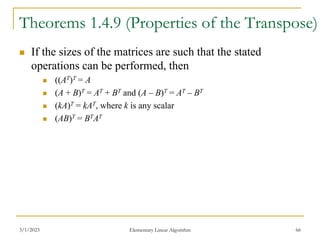
Theorems 1.4.9 (Properties of the Transpose)
 If the sizes of the matrices are such that the stated
operations can be performed, then
 ((AT)T = A
 (A + B)T = AT + BT and (A – B)T = AT – BT
 (kA)T = kAT, where k is any scalar
 (AB)T = BTAT
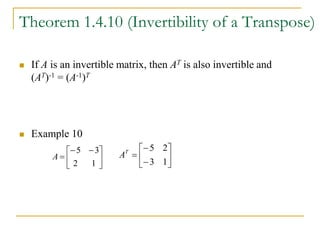
Theorem 1.4.10 (Invertibility of a Transpose)
 If A is an invertible matrix, then AT is also invertible and
(AT)-1 = (A-1)T
 Example 10





 


1
2
3
5
A 








1
3
2
5
T
A
3/1/2023 Elementary Linear Algorithm 68
Chapter Contents
 Introduction to System of Linear Equations
 Gaussian Elimination
 Matrices and Matrix Operations
 Inverses; Rules of Matrix Arithmetic
 Elementary Matrices and a Method for Finding A-1
 Further Results on Systems of Equations and Invertibility
 Diagonal, Triangular, and Symmetric Matrices
3/1/2023 Elementary Linear Algorithm 69
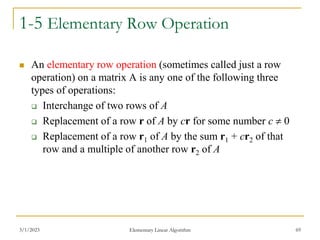
1-5 Elementary Row Operation
 An elementary row operation (sometimes called just a row
operation) on a matrix A is any one of the following three
types of operations:
 Interchange of two rows of A
 Replacement of a row r of A by cr for some number c  0
 Replacement of a row r1 of A by the sum r1 + cr2 of that
row and a multiple of another row r2 of A
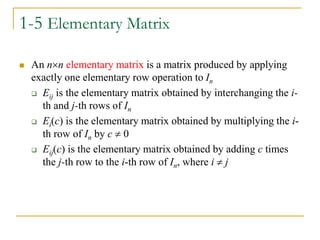
1-5 Elementary Matrix
 An nn elementary matrix is a matrix produced by applying
exactly one elementary row operation to In
 Eij is the elementary matrix obtained by interchanging the i-
th and j-th rows of In
 Ei(c) is the elementary matrix obtained by multiplying the i-
th row of In by c  0
 Eij(c) is the elementary matrix obtained by adding c times
the j-th row to the i-th row of In, where i  j
3/1/2023 Elementary Linear Algorithm 71
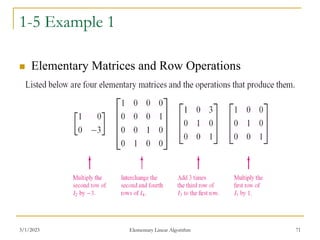
1-5 Example 1
 Elementary Matrices and Row Operations
3/1/2023 Elementary Linear Algorithm 72
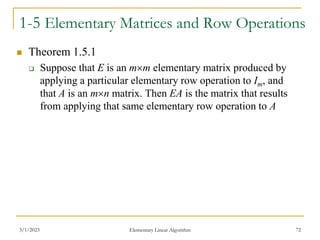
1-5 Elementary Matrices and Row Operations
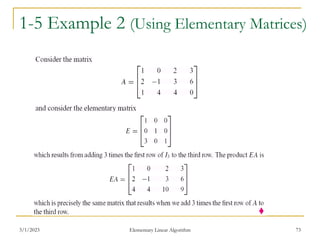
 Theorem 1.5.1
 Suppose that E is an mm elementary matrix produced by
applying a particular elementary row operation to Im, and
that A is an mn matrix. Then EA is the matrix that results
from applying that same elementary row operation to A
3/1/2023 Elementary Linear Algorithm 73
1-5 Example 2 (Using Elementary Matrices)
3/1/2023 Elementary Linear Algorithm 74
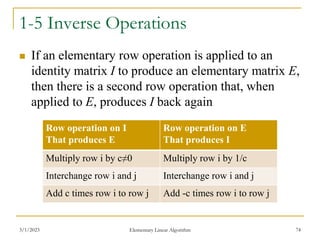
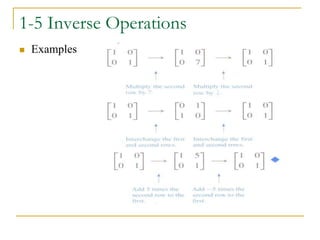
1-5 Inverse Operations
 If an elementary row operation is applied to an
identity matrix I to produce an elementary matrix E,
then there is a second row operation that, when
applied to E, produces I back again
Row operation on I
That produces E
Row operation on E
That produces I
Multiply row i by c≠0 Multiply row i by 1/c
Interchange row i and j Interchange row i and j
Add c times row i to row j Add -c times row i to row j
1-5 Inverse Operations
 Examples
3/1/2023 Elementary Linear Algorithm 76
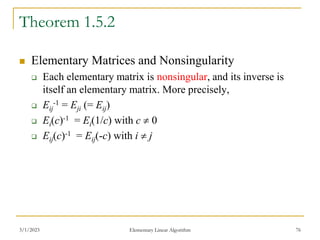
Theorem 1.5.2
 Elementary Matrices and Nonsingularity
 Each elementary matrix is nonsingular, and its inverse is
itself an elementary matrix. More precisely,
 Eij
-1 = Eji (= Eij)
 Ei(c)-1 = Ei(1/c) with c  0
 Eij(c)-1 = Eij(-c) with i  j
3/1/2023 Elementary Linear Algorithm 77
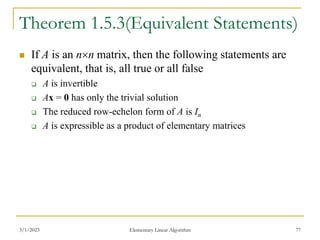
Theorem 1.5.3(Equivalent Statements)
 If A is an nn matrix, then the following statements are
equivalent, that is, all true or all false
 A is invertible
 Ax = 0 has only the trivial solution
 The reduced row-echelon form of A is In
 A is expressible as a product of elementary matrices
3/1/2023 Elementary Linear Algorithm 78
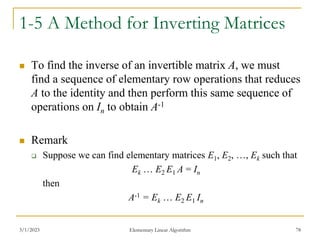
1-5 A Method for Inverting Matrices
 To find the inverse of an invertible matrix A, we must
find a sequence of elementary row operations that reduces
A to the identity and then perform this same sequence of
operations on In to obtain A-1
 Remark
 Suppose we can find elementary matrices E1, E2, …, Ek such that
Ek … E2 E1 A = In
then
A-1 = Ek … E2 E1 In
3/1/2023 Elementary Linear Algorithm 79
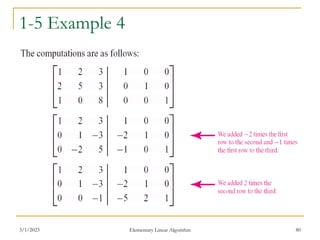
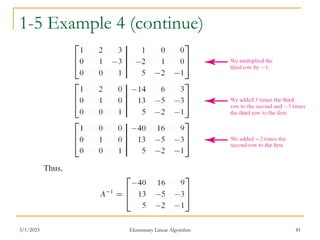
1-5 Example 4
(Using Row Operations to Find A-1)
 Find the inverse of
 Solution:
 To accomplish this we shall adjoin the identity matrix to the right
side of A, thereby producing a matrix of the form [A | I]
 We shall apply row operations to this matrix until the left side is
reduced to I; these operations will convert the right side to A-1, so
that the final matrix will have the form [I | A-1]











8
0
1
3
5
2
3
2
1
A
3/1/2023 Elementary Linear Algorithm 80
1-5 Example 4
3/1/2023 Elementary Linear Algorithm 81
1-5 Example 4 (continue)
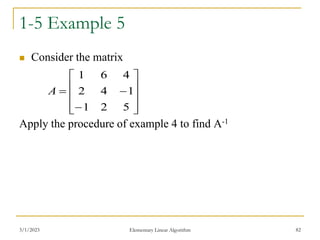
1-5 Example 5
 Consider the matrix
Apply the procedure of example 4 to find A-1
3/1/2023 Elementary Linear Algorithm 82













5
2
1
1
4
2
4
6
1
A
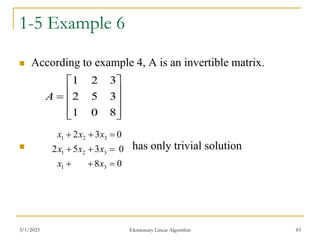
1-5 Example 6
 According to example 4, A is an invertible matrix.
 has only trivial solution
3/1/2023 Elementary Linear Algorithm 83











8
0
1
3
5
2
3
2
1
A
0
8
0
3
5
2
0
3
2
3
1
3
2
1
3
2
1









x
x
x
x
x
x
x
x
3/1/2023 Elementary Linear Algorithm 84
Chapter Contents
 Introduction to System of Linear Equations
 Gaussian Elimination
 Matrices and Matrix Operations
 Inverses; Rules of Matrix Arithmetic
 Elementary Matrices and a Method for Finding A-1
 Further Results on Systems of Equations and Invertibility
 Diagonal, Triangular, and Symmetric Matrices
3/1/2023 Elementary Linear Algorithm 85
Theorems 1.6.1
 Every system of linear equations has either no
solutions, exactly one solution, or in finitely many
solutions.
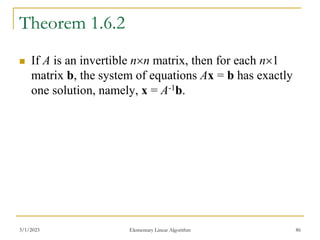
Theorem 1.6.2
 If A is an invertible nn matrix, then for each n1
matrix b, the system of equations Ax = b has exactly
one solution, namely, x = A-1b.
3/1/2023 Elementary Linear Algorithm 86
3/1/2023 Elementary Linear Algorithm 87
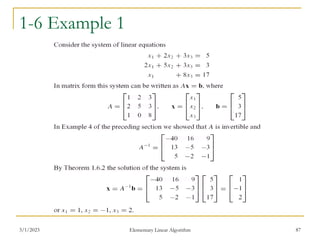
1-6 Example 1
3/1/2023 Elementary Linear Algorithm 88
1-6 Linear Systems
with a Common Coefficient Matrix
 To solve a sequence of linear systems, Ax = b1, Ax = b1, …,
Ax = bk, with common coefficient matrix A
 If A is invertible, then the solutions x1 = A-1b1, x2 = A-1b2 , …,
xk = A-1bk
 A more efficient method is to form the matrix [A|b1|b2|…|bk]
 By reducing it to reduced row-echelon form we can solve all k
systems at once by Gauss-Jordan elimination.
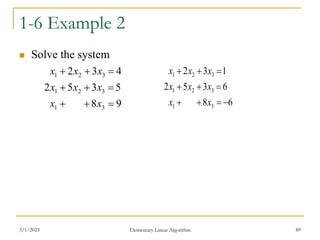
1-6 Example 2
 Solve the system
3/1/2023 Elementary Linear Algorithm 89
9
8
5
3
5
2
4
3
2
3
1
3
2
1
3
2
1









x
x
x
x
x
x
x
x
6
8
6
3
5
2
1
3
2
3
1
3
2
1
3
2
1










x
x
x
x
x
x
x
x
3/1/2023 Elementary Linear Algorithm 90
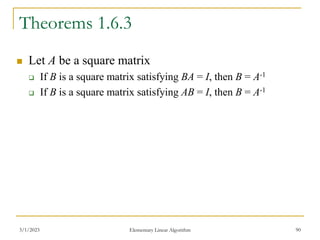
Theorems 1.6.3
 Let A be a square matrix
 If B is a square matrix satisfying BA = I, then B = A-1
 If B is a square matrix satisfying AB = I, then B = A-1
3/1/2023 Elementary Linear Algorithm 91
Theorem 1.6.4 (Equivalent Statements)
 If A is an nn matrix, then the following statements are
equivalent
 A is invertible
 Ax = 0 has only the trivial solution
 The reduced row-echelon form of A is In
 A is expressible as a product of elementary matrices
 Ax = b is consistent for every n×1 matrix b
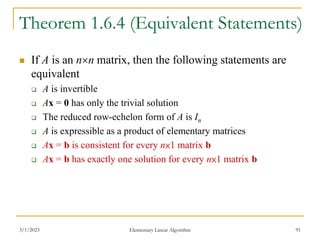
 Ax = b has exactly one solution for every n×1 matrix b
Theorem 1.6.5
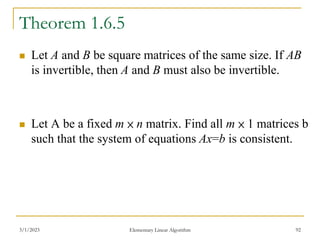
 Let A and B be square matrices of the same size. If AB
is invertible, then A and B must also be invertible.
 Let A be a fixed m × n matrix. Find all m × 1 matrices b
such that the system of equations Ax=b is consistent.
3/1/2023 Elementary Linear Algorithm 92
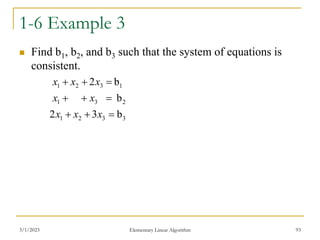
1-6 Example 3
 Find b1, b2, and b3 such that the system of equations is
consistent.
3/1/2023 Elementary Linear Algorithm 93
3
3
2
1
2
3
1
1
3
2
1
b
3
2
b
b
2









x
x
x
x
x
x
x
x
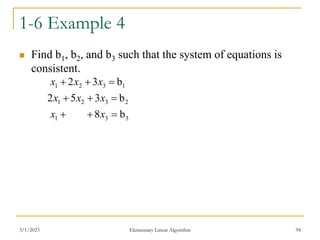
1-6 Example 4
 Find b1, b2, and b3 such that the system of equations is
consistent.
3/1/2023 Elementary Linear Algorithm 94
3
3
1
2
3
2
1
1
3
2
1
b
8
b
3
5
2
b
3
2









x
x
x
x
x
x
x
x
3/1/2023 Elementary Linear Algorithm 95
Chapter Contents
 Introduction to System of Linear Equations
 Gaussian Elimination
 Matrices and Matrix Operations
 Inverses; Rules of Matrix Arithmetic
 Elementary Matrices and a Method for Finding A-1
 Further Results on Systems of Equations and Invertibility
 Diagonal, Triangular, and Symmetric Matrices
3/1/2023 Elementary Linear Algorithm 96
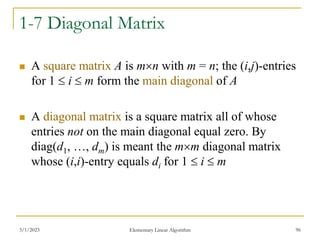
1-7 Diagonal Matrix
 A square matrix A is mn with m = n; the (i,j)-entries
for 1  i  m form the main diagonal of A
 A diagonal matrix is a square matrix all of whose
entries not on the main diagonal equal zero. By
diag(d1, …, dm) is meant the mm diagonal matrix
whose (i,i)-entry equals di for 1  i  m
3/1/2023 Elementary Linear Algorithm 97
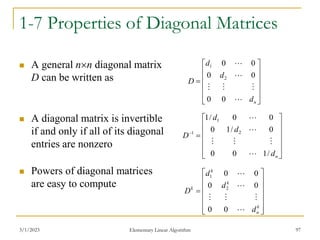
1-7 Properties of Diagonal Matrices
 A general nn diagonal matrix
D can be written as
 A diagonal matrix is invertible
if and only if all of its diagonal
entries are nonzero
 Powers of diagonal matrices
are easy to compute













n
d
d
d
D






0
0
0
0
0
0
2
1














n
d
d
d
D
/
1
0
0
0
/
1
0
0
0
/
1
2
1
1





















k
n
k
k
k
d
d
d
D






0
0
0
0
0
0
2
1
3/1/2023 Elementary Linear Algorithm 98
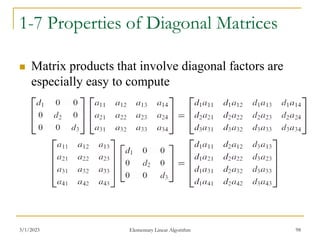
1-7 Properties of Diagonal Matrices
 Matrix products that involve diagonal factors are
especially easy to compute
1-7 Triangular Matrices
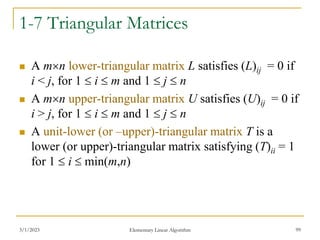
 A mn lower-triangular matrix L satisfies (L)ij = 0 if
i < j, for 1  i  m and 1  j  n
 A mn upper-triangular matrix U satisfies (U)ij = 0 if
i > j, for 1  i  m and 1  j  n
 A unit-lower (or –upper)-triangular matrix T is a
lower (or upper)-triangular matrix satisfying (T)ii = 1
for 1  i  min(m,n)
3/1/2023 Elementary Linear Algorithm 99
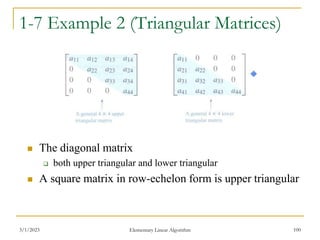
1-7 Example 2 (Triangular Matrices)
 The diagonal matrix
 both upper triangular and lower triangular
 A square matrix in row-echelon form is upper triangular
3/1/2023 Elementary Linear Algorithm 100
3/1/2023 Elementary Linear Algorithm 101
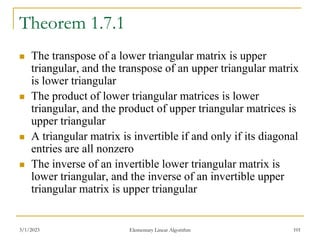
Theorem 1.7.1
 The transpose of a lower triangular matrix is upper
triangular, and the transpose of an upper triangular matrix
is lower triangular
 The product of lower triangular matrices is lower
triangular, and the product of upper triangular matrices is
upper triangular
 A triangular matrix is invertible if and only if its diagonal
entries are all nonzero
 The inverse of an invertible lower triangular matrix is
lower triangular, and the inverse of an invertible upper
triangular matrix is upper triangular
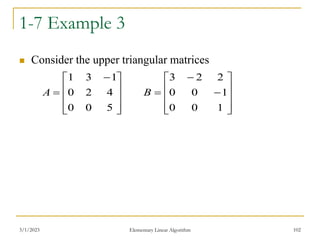
1-7 Example 3
 Consider the upper triangular matrices
3/1/2023 Elementary Linear Algorithm 102









 

5
0
0
4
2
0
1
3
1
A













1
0
0
1
0
0
2
2
3
B
3/1/2023 Elementary Linear Algorithm 103
1-7 Symmetric Matrices
 A (square) matrix A for which AT = A, so that Aij = Aji
for all i and j, is said to be symmetric.
 Example 4











7
0
5
0
3
4
5
4
1








7
3
3
7












4
3
2
1
0
0
0
0
0
0
0
0
0
0
0
0
d
d
d
d
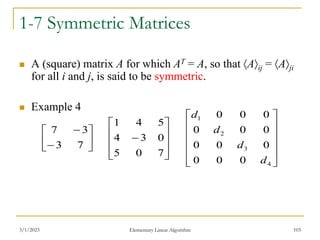
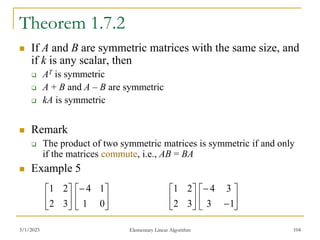
Theorem 1.7.2
 If A and B are symmetric matrices with the same size, and
if k is any scalar, then
 AT is symmetric
 A + B and A – B are symmetric
 kA is symmetric
 Remark
 The product of two symmetric matrices is symmetric if and only
if the matrices commute, i.e., AB = BA
 Example 5
3/1/2023 Elementary Linear Algorithm 104






3
2
2
1






0
1
1
4






3
2
2
1








1
3
3
4
3/1/2023 Elementary Linear Algorithm 105
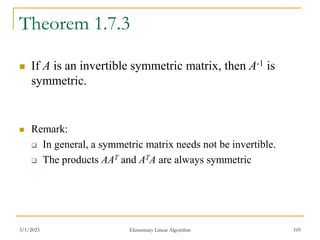
Theorem 1.7.3
 If A is an invertible symmetric matrix, then A-1 is
symmetric.
 Remark:
 In general, a symmetric matrix needs not be invertible.
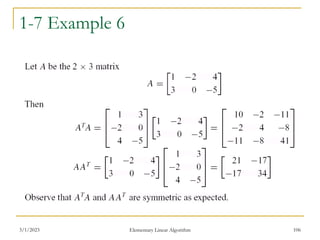
 The products AAT and ATA are always symmetric
3/1/2023 Elementary Linear Algorithm 106
1-7 Example 6
Theorem 1.7.4
 If A is an invertible matrix, then AAT and ATA are also
invertible
3/1/2023 Elementary Linear Algorithm 107

6640173.ppt

  • 1.
    Elementary Linear Algebra Anton& Rorres, 9th Edition Lecture Set – 01 Chapter 1: Systems of Linear Equations & Matrices
  • 2.
    3/1/2023 Elementary LinearAlgorithm 2 Chapter Contents  Introduction to System of Linear Equations  Gaussian Elimination  Matrices and Matrix Operations  Inverses; Rules of Matrix Arithmetic  Elementary Matrices and a Method for Finding A-1  Further Results on Systems of Equations and Invertibility  Diagonal, Triangular, and Symmetric Matrices
  • 3.
    3/1/2023 Elementary LinearAlgorithm 3 1-1 Linear Equations  Any straight line in xy-plane can be represented algebraically by an equation of the form: a1x + a2y = b  General form: Define a linear equation in the n variables x1, x2, …, xn : a1x1 + a2x2 + ··· + anxn = b where a1, a2, …, an and b are real constants.  The variables in a linear equation are sometimes called unknowns.
  • 4.
    3/1/2023 Elementary LinearAlgorithm 4 1-1 Example 1 (Linear Equations)  The equations and are linear  A linear equation does not involve any products or roots of variables  All variables occur only to the first power and do not appear as arguments for trigonometric, logarithmic, or exponential functions.  The equations are not linear  A solution of a linear equation is a sequence of n numbers s1, s2, …, sn such that the equation is satisfied.  The set of all solutions of the equation is called its solution set or general solution of the equation. , 1 3 2 1 , 7 3      z x y y x 7 3 2 4 3 2 1     x x x x x y xz z y x y x sin and , 4 2 3 , 5 3       
  • 5.
    3/1/2023 Elementary LinearAlgorithm 5 1-1 Example 2 (Linear Equations)  Find the solution of x1 – 4x2 + 7x3 = 5  Solution:  We can assign arbitrary values to any two variables and solve for the third variable  For example x1 = 5 + 4s – 7t, x2 = s, x3 = t where s, t are arbitrary values
  • 6.
    3/1/2023 Elementary LinearAlgorithm 6 1-1 Linear Systems  A finite set of linear equations in the variables x1, x2, …, xn is called a system of linear equations or a linear system.  A sequence of numbers s1, s2, …, sn is called a solution of the system  A system has no solution is said to be inconsistent.  If there is at least one solution of the system, it is called consistent.  Every system of linear equations has either no solutions, exactly one solution, or infinitely many solutions m n mn m m n n n n b x a x a x a b x a x a x a b x a x a x a             ... ... ... 2 2 1 1 2 2 2 22 1 21 1 1 2 12 1 11    
  • 7.
     A generalsystem of two linear equations: a1x + b1y = c1 (a1, b1 not both zero) a2x + b2y = c2 (a2, b2 not both zero)  Two line may be parallel – no solution  Two line may be intersect at only one point – one solution  Two line may coincide – infinitely many solutions 3/1/2023 Elementary Linear Algorithm 7 1-1 Linear Systems
  • 8.
    3/1/2023 Elementary LinearAlgorithm 8 1-1 Augmented Matrices  The location of the +s, the xs, and the =s can be abbreviated by writing only the rectangular array of numbers.  This is called the augmented matrix for the system.  It must be written in the same order in each equation as the unknowns and the constants must be on the right m n mn m m n n n n b x a x a x a b x a x a x a b x a x a x a             ... ... ... 2 2 1 1 2 2 2 22 1 21 1 1 2 12 1 11                 m mn m m n n b a a a b a a a b a a a ... ... ... 2 1 2 2 22 21 1 1 12 11     1th column 1th row
  • 9.
    3/1/2023 Elementary LinearAlgorithm 9 1-1 Elementary Row Operations  The basic method for solving a system of linear equations is to replace the given system by a new system that has the same solution set but which is easier to solve.  Since the rows of an augmented matrix correspond to the equations in the associated system, new systems is generally obtained in a series of steps by applying the following three types of operations to eliminate unknowns systematically. m n mn m m n n n n b x a x a x a b x a x a x a b x a x a x a             ... ... ... 2 2 1 1 2 2 2 22 1 21 1 1 2 12 1 11                 m mn m m n n b a a a b a a a b a a a ... ... ... 2 1 2 2 22 21 1 1 12 11    
  • 10.
    1-1 Elementary RowOperations  Elementary row operations  Multiply an equation through by an nonzero constant  Interchange two equation  Add a multiple of one equation to another
  • 11.
    3/1/2023 Elementary LinearAlgorithm 11 1-1 Example 3 (Using Elementary Row Operations) 0 5 6 3 7 1 7 2 9 2          z y x z y z y x 0 5 6 3 1 3 4 2 9 2          z y x z y x z y x             0 5 6 3 1 3 4 2 9 2 1 1              0 5 6 3 17 7 2 0 9 2 1 1 0 11 3 9 2 2 17 2 7         z y z y z y x 27 11 3 17 7 2 9 2          z y z y z y x               27 11 3 0 17 7 2 0 9 2 1 1               27 11 3 0 1 0 9 2 1 1 2 17 2 7 3 9 2 2 17 2 7        z z y z y x 2 3 2 1 2 17 2 7 9 2          z z y z y x               2 3 2 1 2 17 2 7 0 0 1 0 9 2 1 1             3 1 0 0 1 0 9 2 1 1 2 17 2 7 3 2 1    z y x 3 2 17 2 7 2 35 2 11       z z y z x             3 1 0 0 1 0 0 1 2 17 2 7 2 35 2 11           3 1 0 0 2 0 1 0 1 0 0 1
  • 12.
    3/1/2023 Elementary LinearAlgorithm 12 Chapter Contents  Introduction to System of Linear Equations  Gaussian Elimination  Matrices and Matrix Operations  Inverses; Rules of Matrix Arithmetic  Elementary Matrices and a Method for Finding A-1  Further Results on Systems of Equations and Invertibility  Diagonal, Triangular, and Symmetric Matrices
  • 13.
    3/1/2023 Elementary LinearAlgorithm 13 1-2 Echelon Forms  A matrix is in reduced row-echelon form  If a row does not consist entirely of zeros, then the first nonzero number in the row is a 1. We call this a leader 1.  If there are any rows that consist entirely of zeros, then they are grouped together at the bottom of the matrix.  In any two successive rows that do not consist entirely of zeros, the leader 1 in the lower row occurs farther to the right than the leader 1 in the higher row.  Each column that contains a leader 1 has zeros everywhere else.  A matrix that has the first three properties is said to be in row- echelon form.  Note: A matrix in reduced row-echelon form is of necessity in row- echelon form, but not conversely.           3 1 0 0 2 0 1 0 1 0 0 1
  • 14.
    3/1/2023 Elementary LinearAlgorithm 14 1-2 Example 1  Reduce row-echelon form:  Row-echelon form:                                         0 0 0 0 , 0 0 0 0 0 0 0 0 0 0 3 1 0 0 0 1 0 2 1 0 , 1 0 0 0 1 0 0 0 1 , 1 1 0 0 7 0 1 0 4 0 0 1                                 1 0 0 0 0 0 1 1 0 0 0 6 2 1 0 , 0 0 0 0 1 0 0 1 1 , 5 1 0 0 2 6 1 0 7 3 4 1
  • 15.
    3/1/2023 Elementary LinearAlgorithm 15 1-2 Example 2  Matrices in row-echelon form (any real numbers substituted for the *’s. ) :  Matrices in reduced row-echelon form (any real numbers substituted for the *’s. ) :                                                     * 1 0 0 0 0 0 0 0 0 * 0 * * 1 0 0 0 0 0 * 0 * * 0 1 0 0 0 0 * 0 * * 0 0 1 0 0 0 * 0 * * 0 0 0 * 1 0 , 0 0 0 0 0 0 0 0 * * 1 0 * * 0 1 , 0 0 0 0 * 1 0 0 * 0 1 0 * 0 0 1 , 1 0 0 0 0 1 0 0 0 0 1 0 0 0 0 1                                                     * 1 0 0 0 0 0 0 0 0 * * * * 1 0 0 0 0 0 * * * * * 1 0 0 0 0 * * * * * * 1 0 0 0 * * * * * * * * 1 0 , 0 0 0 0 0 0 0 0 * * 1 0 * * * 1 , 0 0 0 0 * 1 0 0 * * 1 0 * * * 1 , 1 0 0 0 * 1 0 0 * * 1 0 * * * 1
  • 16.
    1-2 Example 3 Solutions of linear systems           4 0 0 0 2 0 1 0 5 0 0 1           1 0 0 0 0 2 1 0 0 0 0 1            2 6 1 3 1 0 0 2 0 1 0 4 0 0 1              0 0 0 0 0 0 2 5 1 0 0 0 1 3 0 1 0 0 2 4 0 0 6 1
  • 17.
    3/1/2023 Elementary LinearAlgorithm 17 1-2 Elimination Methods  A step-by-step elimination procedure that can be used to reduce any matrix to reduced row-echelon form                1 5 6 5 4 2 28 12 6 10 4 2 12 7 0 2 0 0
  • 18.
    3/1/2023 Elementary LinearAlgorithm 18 1-2 Elimination Methods  Step1. Locate the leftmost column that does not consist entirely of zeros.  Step2. Interchange the top row with another row, to bring a nonzero entry to top of the column found in Step1                1 5 6 5 4 2 28 12 6 10 4 2 12 7 0 2 0 0 Leftmost nonzero column                1 5 6 5 4 2 12 7 0 2 0 0 28 12 6 10 4 2 The 1th and 2th rows in the preceding matrix were interchanged.                1 5 6 5 4 2 28 12 6 10 4 2 12 7 0 2 0 0
  • 19.
    3/1/2023 Elementary LinearAlgorithm 19 1-2 Elimination Methods  Step3. If the entry that is now at the top of the column found in Step1 is a, multiply the first row by 1/a in order to introduce a leading 1.  Step4. Add suitable multiples of the top row to the rows below so that all entries below the leading 1 become zeros                1 5 6 5 4 2 12 7 0 2 0 0 14 6 3 5 2 1 The 1st row of the preceding matrix was multiplied by 1/2.               29 17 0 5 0 0 12 7 0 2 0 0 14 6 3 5 2 1 -2 times the 1st row of the preceding matrix was added to the 3rd row.
  • 20.
    3/1/2023 Elementary LinearAlgorithm 20 1-2 Elimination Methods  Step5. Now cover the top row in the matrix and begin again with Step1 applied to the submatrix that remains. Continue in this way until the entire matrix is in row-echelon form                29 17 0 5 0 0 12 7 0 2 0 0 14 6 3 5 2 1 The 1st row in the submatrix was multiplied by -1/2 to introduce a leading 1.                29 17 0 5 0 0 6 0 1 0 0 14 6 3 5 2 1 2 7 Leftmost nonzero column in the submatrix
  • 21.
    3/1/2023 Elementary LinearAlgorithm 21 1-2 Elimination Methods  The last matrix is in reduced row-echelon form              2 1 0 0 0 0 6 0 1 0 0 14 6 3 5 2 1 2 7 -5 times the 1st row of the submatrix was added to the 2nd row of the submatrix to introduce a zero below the leading 1.              1 0 0 0 0 6 0 1 0 0 14 6 3 5 2 1 2 1 2 7              1 0 0 0 0 6 0 1 0 0 14 6 3 5 2 1 2 1 2 7 The top row in the submatrix was covered, and we returned again Step1. The first (and only) row in the new submetrix was multiplied by 2 to introduce a leading 1. Leftmost nonzero column in the new submatrix
  • 22.
    3/1/2023 Elementary LinearAlgorithm 22 1-2 Elimination Methods  Step1~Step5: the above procedure produces a row-echelon form and is called Gaussian elimination  Step1~Step6: the above procedure produces a reduced row-echelon form and is called Gaussian-Jordan elimination  Every matrix has a unique reduced row-echelon form but a row- echelon form of a given matrix is not unique  Back-Substitution  To solve a system of linear equations by using Gaussian elimination to bring the augmented matrix into row-echelon form without continuing all the way to the reduced row-echelon form.  When this is done, the corresponding system of equations can be solved by solved by a technique called back-substitution
  • 23.
    1-2 Example 4 Solve by Gauss-Jordan elimination 6 18 4 8 6 2 5 15 10 5 1 3 4 2 5 6 2 0 2 2 3 6 5 4 2 1 6 4 3 6 5 4 3 2 1 5 3 2 1                    x x x x x x x x x x x x x x x x x x
  • 24.
    1-2 Example 5 From the computations in example 4 , a row-echelon form of the augmented matrix is given.  To solve the system of equations:              0 3 / 1 1 0 0 0 0 0 0 0 1 0 0 0 0 0 3 0 2 1 0 0 0 2 0 2 3 1 1/3 1 3 2 0 2 2 3 6 6 4 3 5 3 2 1         x x x x x x x x
  • 25.
    1-2 Example 6 Solve the system of equations by Gaussian elimination and back-substitution. 0 5 6 3 1 3 4 2 9 2          z y x z y x z y x
  • 26.
    3/1/2023 Elementary LinearAlgorithm 26 1-2 Homogeneous Linear Systems  A system of linear equations is said to be homogeneous if the constant terms are all zero.  Every homogeneous system of linear equation is consistent, since all such system have x1 = 0, x2 = 0, …, xn = 0 as a solution.  This solution is called the trivial solution.  If there are another solutions, they are called nontrivial solutions.  There are only two possibilities for its solutions:  There is only the trivial solution  There are infinitely many solutions in addition to the trivial solution 0 ... 0 ... 0 ... 2 2 1 1 2 2 22 1 21 1 2 12 1 11             n mn m m n n n n x a x a x a x a x a x a x a x a x a    
  • 27.
    3/1/2023 Elementary LinearAlgorithm 27 1-2 Example 7  Solve the homogeneous system of linear equations by Gauss-Jordan elimination  The augmented matrix  Reducing this matrix to reduced row-echelon form  The general solution is  Note: the trivial solution is obtained when s = t = 0 0 0 2 0 3 2 0 2 2 5 4 3 5 3 2 1 5 4 3 2 1 5 3 2 1                  x x x x x x x x x x x x x x x x                   0 0 1 0 0 0 0 1 0 2 1 1 0 1 3 2 1 1 0 1 0 1 2 2             0 0 0 0 0 0 0 0 1 0 0 0 0 1 0 1 0 0 0 1 0 0 1 1 t x x t x s x t s x         5 4 3 2 1 , 0 , ,
  • 28.
    3/1/2023 Elementary LinearAlgorithm 28 1-2 Example 7 (Gauss-Jordan Elimination)  Two important points:  None of the three row operations alters the final column of zeros, so the system of equations corresponding to the reduced row-echelon form of the augmented matrix must also be a homogeneous system.  If the given homogeneous system has m equations in n unknowns with m < n, and there are r nonzero rows in reduced row-echelon form of the augmented matrix, we will have r < n. It will have the form:  (Theorem 1.2.1) 0 () 0 () 0 () 2 1          kr k k x x x              () () () 2 1 kr k k x x x  m n mn m m n n n n b x a x a x a b x a x a x a b x a x a x a             ... ... ... 2 2 1 1 2 2 2 22 1 21 1 1 2 12 1 11    
  • 29.
    3/1/2023 Elementary LinearAlgorithm 29 Theorem 1.2.1  A homogeneous system of linear equations with more unknowns than equations has infinitely many solutions.  Remark  This theorem applies only to homogeneous system!  A nonhomogeneous system with more unknowns than equations need not be consistent; however, if the system is consistent, it will have infinitely many solutions.  e.g., two parallel planes in 3-space
  • 30.
    3/1/2023 Elementary LinearAlgorithm 30 Chapter Contents  Introduction to System of Linear Equations  Gaussian Elimination  Matrices and Matrix Operations  Inverses; Rules of Matrix Arithmetic  Elementary Matrices and a Method for Finding A-1  Further Results on Systems of Equations and Invertibility  Diagonal, Triangular, and Symmetric Matrices
  • 31.
    3/1/2023 Elementary LinearAlgorithm 31 1-3 Definition and Notation  A matrix is a rectangular array of numbers. The numbers in the array are called the entries in the matrix  A general mn matrix A is denoted as  The entry that occurs in row i and column j of matrix A will be denoted aij or Aij. If aij is real number, it is common to be referred as scalars  The preceding matrix can be written as [aij]mn or [aij]              mn m m n n a a a a a a a a a A ... ... ... 2 1 2 22 21 1 12 11   
  • 32.
    3/1/2023 Elementary LinearAlgorithm 32 1-3 Definition  Two matrices are defined to be equal if they have the same size and their corresponding entries are equal  If A = [aij] and B = [bij] have the same size, then A = B if and only if aij = bij for all i and j  If A and B are matrices of the same size, then the sum A + B is the matrix obtained by adding the entries of B to the corresponding entries of A.
  • 33.
    1-3 Definition  Thedifference A – B is the matrix obtained by subtracting the entries of B from the corresponding entries of A  If A is any matrix and c is any scalar, then the product cA is the matrix obtained by multiplying each entry of the matrix A by c. The matrix cA is said to be the scalar multiple of A  If A = [aij], then cAij = cAij = caij
  • 34.
    3/1/2023 Elementary LinearAlgorithm 34 1-3 Definitions  If A is an mr matrix and B is an rn matrix, then the product AB is the mn matrix whose entries are determined as follows.  (AB)mn = Amr Brn ABij = ai1b1j + ai2b2j + ai3b3j + … + airbrj                                    rn rj r r n j n j mr m m ir i i r r b b b b b b b b b b b b a a a a a a a a a a a a AB                     2 1 2 2 22 21 1 1 12 11 2 1 2 1 2 22 21 1 12 11
  • 35.
    1-3 Example 5 Multiplying matrices        0 6 2 4 2 1 A             2 5 7 2 1 3 1 0 3 4 1 4 B
  • 36.
    1-3 Example 6 Determine whether a product is defined Matrices A: 3×4, B: 4×7, C: 7×3
  • 37.
    3/1/2023 Elementary LinearAlgorithm 37 1-3 Partitioned Matrices  A matrix can be partitioned into smaller matrices by inserting horizontal and vertical rules between selected rows and columns  For example, three possible partitions of a 34 matrix A:  The partition of A into four submatrices A11, A12, A21, and A22  The partition of A into its row matrices r1, r2, and r3  The partition of A into its column matrices c1, c2, c3, and c4   4 3 2 1 34 33 32 31 24 23 22 21 14 13 12 11 3 2 1 34 33 32 31 24 23 22 21 14 13 12 11 22 21 12 11 34 33 32 31 24 23 22 21 14 13 12 11 c c c c r r r                                                     a a a a a a a a a a a a A a a a a a a a a a a a a A A A A A a a a a a a a a a a a a A
  • 38.
    3/1/2023 Elementary LinearAlgorithm 38 1-3 Multiplication by Columns and by Rows  It is possible to compute a particular row or column of a matrix product AB without computing the entire product: jth column matrix of AB = A[jth column matrix of B] ith row matrix of AB = [ith row matrix of A]B  If a1, a2, ..., am denote the row matrices of A and b1 ,b2, ...,bn denote the column matrices of B,then                                 B B B B AB A A A A AB m m n n a a a a a a b b b b b b     2 1 2 1 2 1 2 1
  • 39.
    1-3 Example 7 Multiplying matrices by rows and by columns        0 6 2 4 2 1 A             2 5 7 2 1 3 1 0 3 4 1 4 B
  • 40.
    3/1/2023 Elementary LinearAlgorithm 40 1-3 Matrix Products as Linear Combinations  Let  Then  The product Ax of a matrix A with a column matrix x is a linear combination of the column matrices of A with the coefficients coming from the matrix x                           n mn m m n n x x x a a a a a a a a a A        2 1 2 1 2 22 21 1 12 11 and x                                                               mn n n n m m n mn m m n n n n a a a x a a a x a a a x x a x a x a x a x a x a x a x a x a A         2 1 2 22 12 2 1 21 11 1 2 2 1 1 2 2 22 1 21 1 2 12 1 11 x
  • 41.
    3/1/2023 Elementary LinearAlgorithm 41 1-3 Example 8
  • 42.
    3/1/2023 Elementary LinearAlgorithm 42 1-3 Example 9
  • 43.
    3/1/2023 Elementary LinearAlgorithm 43 1-3 Matrix Form of a Linear System  Consider any system of m linear equations in n unknowns:  The matrix A is called the coefficient matrix of the system  The augmented matrix of the system is given by                                      m m mn m m n n b b b x x x a a a a a a a a a         2 1 2 1 2 1 2 22 21 1 12 11 n n mn m m n n n n b x a x a x a b x a x a x a b x a x a x a                 2 2 1 1 2 2 2 22 1 21 1 1 2 12 1 11                                   m n mn m m n n n n b b b x a x a x a x a x a x a x a x a x a      2 1 2 2 1 1 2 2 22 1 21 1 2 12 1 11 b x  A                m mn m m n n b a a a b a a a b a a a A        2 1 2 2 22 21 1 1 12 11 b
  • 44.
    1-3 Example 10 A function using matrices  Consider the following matrices  The product y = Ax is  The product y = Bx is         1 0 0 1 A        b a x         0 1 1 0 B
  • 45.
    3/1/2023 Elementary LinearAlgorithm 45 1-3 Definitions  If A is any mn matrix, then the transpose of A, denoted by AT, is defined to be the nm matrix that results from interchanging the rows and columns of A  That is, the first column of AT is the first row of A, the second column of AT is the second row of A, and so forth  If A is a square matrix, then the trace of A , denoted by tr(A), is defined to be the sum of the entries on the main diagonal of A. The trace of A is undefined if A is not a square matrix.  For an nn matrix A = [aij],    n i ii a A 1 ) ( tr
  • 46.
    1-3 Example 11& 12  Transpose: (AT)ij = (A)ij            6 5 4 1 3 2 A  Trace of matrix:                  0 1 2 4 3 7 2 1 4 8 5 3 0 7 2 1 B
  • 47.
    3/1/2023 Elementary LinearAlgorithm 47 Chapter Contents  Introduction to System of Linear Equations  Gaussian Elimination  Matrices and Matrix Operations  Inverses; Rules of Matrix Arithmetic  Elementary Matrices and a Method for Finding A-1  Further Results on Systems of Equations and Invertibility  Diagonal, Triangular, and Symmetric Matrices
  • 48.
    3/1/2023 Elementary LinearAlgorithm 48 1-4 Properties of Matrix Operations  For real numbers a and b ,we always have ab = ba, which is called the commutative law for multiplication. For matrices, however, AB and BA need not be equal.  Equality can fail to hold for three reasons:  The product AB is defined but BA is undefined.  AB and BA are both defined but have different sizes.  It is possible to have AB  BA even if both AB and BA are defined and have the same size.
  • 49.
    3/1/2023 Elementary LinearAlgorithm 49 Theorem 1.4.1 (Properties of Matrix Arithmetic)  Assuming that the sizes of the matrices are such that the indicated operations can be performed, the following rules of matrix arithmetic are valid:  A + B = B + A (commutative law for addition)  A + (B + C) = (A + B) + C (associative law for addition)  A(BC) = (AB)C (associative law for multiplication)  A(B + C) = AB + AC (left distributive law)  (B + C)A = BA + CA (right distributive law)  A(B – C) = AB – AC, (B – C)A = BA – CA  a(B + C) = aB + aC, a(B – C) = aB – aC  (a+b)C = aC + bC, (a-b)C = aC – bC  a(bC) = (ab)C, a(BC) = (aB)C = B(aC)  Note: the cancellation law is not valid for matrix multiplication!
  • 50.
    1-4 Proof ofA(B + C) = AB + AC  show the same size  show the corresponding entries are equal
  • 51.
    3/1/2023 Elementary LinearAlgorithm 51 1-4 Example 2
  • 52.
    3/1/2023 Elementary LinearAlgorithm 52 1-4 Zero Matrices  A matrix, all of whose entries are zero, is called a zero matrix  A zero matrix will be denoted by 0  If it is important to emphasize the size, we shall write 0mn for the mn zero matrix.  In keeping with our convention of using boldface symbols for matrices with one column, we will denote a zero matrix with one column by 0
  • 53.
    1-4 Example 3 The cancellation law does not hold  AB=AC =  AD =        2 0 1 0 A        4 3 1 1 B        4 3 5 2 C        0 0 7 3 D       8 6 4 3       0 0 0 0
  • 54.
    Theorem 1.4.2 (Propertiesof Zero Matrices)  Assuming that the sizes of the matrices are such that the indicated operations can be performed ,the following rules of matrix arithmetic are valid  A + 0 = 0 + A = A  A – A = 0  0 – A = -A  A0 = 0; 0A = 0
  • 55.
    3/1/2023 Elementary LinearAlgorithm 55 1-4 Identity Matrices  A square matrix with 1s on the main diagonal and 0s off the main diagonal is called an identity matrix and is denoted by I, or In for the nn identity matrix  If A is an mn matrix, then AIn = A and ImA = A  Example 4  An identity matrix plays the same role in matrix arithmetic as the number 1 plays in the numerical relationships a·1 = 1·a = a
  • 56.
    Theorem 1.4.3  IfR is the reduced row-echelon form of an nn matrix A, then either R has a row of zeros or R is the identity matrix In
  • 57.
    3/1/2023 Elementary LinearAlgorithm 57 1-4 Invertible  If A is a square matrix, and if a matrix B of the same size can be found such that AB = BA = I, then A is said to be invertible and B is called an inverse of A. If no such matrix B can be found, then A is said to be singular.  Remark:  The inverse of A is denoted as A-1  Not every (square) matrix has an inverse  An inverse matrix has exactly one inverse
  • 58.
    1-4 Example 5& 6  Verify the inverse requirements  A matrix with no inverse is singular          3 1 5 2 A        2 1 5 3 B            0 6 3 0 5 2 0 4 1 A
  • 59.
    3/1/2023 Elementary LinearAlgorithm 59 1-4 Theorems  Theorem 1.4.4  If B and C are both inverses of the matrix A, then B = C  Theorem 1.4.5  The matrix is invertible if ad – bc  0, in which case the inverse is given by the formula        d c b a A            a c b d bc ad A 1 1
  • 60.
    Theorem 1.4.6  IfA and B are invertible matrices of the same size ,then AB is invertible and (AB)-1 = B-1A-1  Example 7        3 1 2 1 A        2 2 2 3 B        8 9 6 7 AB
  • 61.
    3/1/2023 Elementary LinearAlgorithm 61 1-4 Powers of a Matrix  If A is a square matrix, then we define the nonnegative integer powers of A to be  If A is invertible, then we define the negative integer powers to be  Theorem 1.4.7 (Laws of Exponents)  If A is a square matrix and r and s are integers, then ArAs = Ar+s, (Ar)s = Ars ) 0 ( factors 0    n A AA A I A n n       ) 0 ( ) ( factors 1 1 1 1         n A A A A A n n n      
  • 62.
    Theorem 1.4.8 (Lawsof Exponents)  If A is an invertible matrix, then:  A-1 is invertible and (A-1)-1 = A  An is invertible and (An)-1 = (A-1)n for n = 0, 1, 2, …  For any nonzero scalar k, the matrix kA is invertible and (kA)-1 = (1/k)A-1
  • 63.
    1-4 Example 8 Powers of matrix  A3 = ?  A-3 =?        3 1 2 1 A           1 1 2 3 1 A
  • 64.
    3/1/2023 Elementary LinearAlgorithm 64 1-4 Polynomial Expressions Involving Matrices  If A is a square matrix, say mm , and if p(x) = a0 + a1x + … + anxn is any polynomial, then we define p(A) = a0I + a1A + … + anAn where I is the mm identity matrix.  That is, p(A) is the mm matrix that results when A is substituted for x in the above equation and a0 is replaced by a0I
  • 65.
    3/1/2023 Elementary LinearAlgorithm 65 1-4 Example 9 (Matrix Polynomial)
  • 66.
    3/1/2023 Elementary LinearAlgorithm 66 Theorems 1.4.9 (Properties of the Transpose)  If the sizes of the matrices are such that the stated operations can be performed, then  ((AT)T = A  (A + B)T = AT + BT and (A – B)T = AT – BT  (kA)T = kAT, where k is any scalar  (AB)T = BTAT
  • 67.
    Theorem 1.4.10 (Invertibilityof a Transpose)  If A is an invertible matrix, then AT is also invertible and (AT)-1 = (A-1)T  Example 10          1 2 3 5 A          1 3 2 5 T A
  • 68.
    3/1/2023 Elementary LinearAlgorithm 68 Chapter Contents  Introduction to System of Linear Equations  Gaussian Elimination  Matrices and Matrix Operations  Inverses; Rules of Matrix Arithmetic  Elementary Matrices and a Method for Finding A-1  Further Results on Systems of Equations and Invertibility  Diagonal, Triangular, and Symmetric Matrices
  • 69.
    3/1/2023 Elementary LinearAlgorithm 69 1-5 Elementary Row Operation  An elementary row operation (sometimes called just a row operation) on a matrix A is any one of the following three types of operations:  Interchange of two rows of A  Replacement of a row r of A by cr for some number c  0  Replacement of a row r1 of A by the sum r1 + cr2 of that row and a multiple of another row r2 of A
  • 70.
    1-5 Elementary Matrix An nn elementary matrix is a matrix produced by applying exactly one elementary row operation to In  Eij is the elementary matrix obtained by interchanging the i- th and j-th rows of In  Ei(c) is the elementary matrix obtained by multiplying the i- th row of In by c  0  Eij(c) is the elementary matrix obtained by adding c times the j-th row to the i-th row of In, where i  j
  • 71.
    3/1/2023 Elementary LinearAlgorithm 71 1-5 Example 1  Elementary Matrices and Row Operations
  • 72.
    3/1/2023 Elementary LinearAlgorithm 72 1-5 Elementary Matrices and Row Operations  Theorem 1.5.1  Suppose that E is an mm elementary matrix produced by applying a particular elementary row operation to Im, and that A is an mn matrix. Then EA is the matrix that results from applying that same elementary row operation to A
  • 73.
    3/1/2023 Elementary LinearAlgorithm 73 1-5 Example 2 (Using Elementary Matrices)
  • 74.
    3/1/2023 Elementary LinearAlgorithm 74 1-5 Inverse Operations  If an elementary row operation is applied to an identity matrix I to produce an elementary matrix E, then there is a second row operation that, when applied to E, produces I back again Row operation on I That produces E Row operation on E That produces I Multiply row i by c≠0 Multiply row i by 1/c Interchange row i and j Interchange row i and j Add c times row i to row j Add -c times row i to row j
  • 75.
  • 76.
    3/1/2023 Elementary LinearAlgorithm 76 Theorem 1.5.2  Elementary Matrices and Nonsingularity  Each elementary matrix is nonsingular, and its inverse is itself an elementary matrix. More precisely,  Eij -1 = Eji (= Eij)  Ei(c)-1 = Ei(1/c) with c  0  Eij(c)-1 = Eij(-c) with i  j
  • 77.
    3/1/2023 Elementary LinearAlgorithm 77 Theorem 1.5.3(Equivalent Statements)  If A is an nn matrix, then the following statements are equivalent, that is, all true or all false  A is invertible  Ax = 0 has only the trivial solution  The reduced row-echelon form of A is In  A is expressible as a product of elementary matrices
  • 78.
    3/1/2023 Elementary LinearAlgorithm 78 1-5 A Method for Inverting Matrices  To find the inverse of an invertible matrix A, we must find a sequence of elementary row operations that reduces A to the identity and then perform this same sequence of operations on In to obtain A-1  Remark  Suppose we can find elementary matrices E1, E2, …, Ek such that Ek … E2 E1 A = In then A-1 = Ek … E2 E1 In
  • 79.
    3/1/2023 Elementary LinearAlgorithm 79 1-5 Example 4 (Using Row Operations to Find A-1)  Find the inverse of  Solution:  To accomplish this we shall adjoin the identity matrix to the right side of A, thereby producing a matrix of the form [A | I]  We shall apply row operations to this matrix until the left side is reduced to I; these operations will convert the right side to A-1, so that the final matrix will have the form [I | A-1]            8 0 1 3 5 2 3 2 1 A
  • 80.
    3/1/2023 Elementary LinearAlgorithm 80 1-5 Example 4
  • 81.
    3/1/2023 Elementary LinearAlgorithm 81 1-5 Example 4 (continue)
  • 82.
    1-5 Example 5 Consider the matrix Apply the procedure of example 4 to find A-1 3/1/2023 Elementary Linear Algorithm 82              5 2 1 1 4 2 4 6 1 A
  • 83.
    1-5 Example 6 According to example 4, A is an invertible matrix.  has only trivial solution 3/1/2023 Elementary Linear Algorithm 83            8 0 1 3 5 2 3 2 1 A 0 8 0 3 5 2 0 3 2 3 1 3 2 1 3 2 1          x x x x x x x x
  • 84.
    3/1/2023 Elementary LinearAlgorithm 84 Chapter Contents  Introduction to System of Linear Equations  Gaussian Elimination  Matrices and Matrix Operations  Inverses; Rules of Matrix Arithmetic  Elementary Matrices and a Method for Finding A-1  Further Results on Systems of Equations and Invertibility  Diagonal, Triangular, and Symmetric Matrices
  • 85.
    3/1/2023 Elementary LinearAlgorithm 85 Theorems 1.6.1  Every system of linear equations has either no solutions, exactly one solution, or in finitely many solutions.
  • 86.
    Theorem 1.6.2  IfA is an invertible nn matrix, then for each n1 matrix b, the system of equations Ax = b has exactly one solution, namely, x = A-1b. 3/1/2023 Elementary Linear Algorithm 86
  • 87.
    3/1/2023 Elementary LinearAlgorithm 87 1-6 Example 1
  • 88.
    3/1/2023 Elementary LinearAlgorithm 88 1-6 Linear Systems with a Common Coefficient Matrix  To solve a sequence of linear systems, Ax = b1, Ax = b1, …, Ax = bk, with common coefficient matrix A  If A is invertible, then the solutions x1 = A-1b1, x2 = A-1b2 , …, xk = A-1bk  A more efficient method is to form the matrix [A|b1|b2|…|bk]  By reducing it to reduced row-echelon form we can solve all k systems at once by Gauss-Jordan elimination.
  • 89.
    1-6 Example 2 Solve the system 3/1/2023 Elementary Linear Algorithm 89 9 8 5 3 5 2 4 3 2 3 1 3 2 1 3 2 1          x x x x x x x x 6 8 6 3 5 2 1 3 2 3 1 3 2 1 3 2 1           x x x x x x x x
  • 90.
    3/1/2023 Elementary LinearAlgorithm 90 Theorems 1.6.3  Let A be a square matrix  If B is a square matrix satisfying BA = I, then B = A-1  If B is a square matrix satisfying AB = I, then B = A-1
  • 91.
    3/1/2023 Elementary LinearAlgorithm 91 Theorem 1.6.4 (Equivalent Statements)  If A is an nn matrix, then the following statements are equivalent  A is invertible  Ax = 0 has only the trivial solution  The reduced row-echelon form of A is In  A is expressible as a product of elementary matrices  Ax = b is consistent for every n×1 matrix b  Ax = b has exactly one solution for every n×1 matrix b
  • 92.
    Theorem 1.6.5  LetA and B be square matrices of the same size. If AB is invertible, then A and B must also be invertible.  Let A be a fixed m × n matrix. Find all m × 1 matrices b such that the system of equations Ax=b is consistent. 3/1/2023 Elementary Linear Algorithm 92
  • 93.
    1-6 Example 3 Find b1, b2, and b3 such that the system of equations is consistent. 3/1/2023 Elementary Linear Algorithm 93 3 3 2 1 2 3 1 1 3 2 1 b 3 2 b b 2          x x x x x x x x
  • 94.
    1-6 Example 4 Find b1, b2, and b3 such that the system of equations is consistent. 3/1/2023 Elementary Linear Algorithm 94 3 3 1 2 3 2 1 1 3 2 1 b 8 b 3 5 2 b 3 2          x x x x x x x x
  • 95.
    3/1/2023 Elementary LinearAlgorithm 95 Chapter Contents  Introduction to System of Linear Equations  Gaussian Elimination  Matrices and Matrix Operations  Inverses; Rules of Matrix Arithmetic  Elementary Matrices and a Method for Finding A-1  Further Results on Systems of Equations and Invertibility  Diagonal, Triangular, and Symmetric Matrices
  • 96.
    3/1/2023 Elementary LinearAlgorithm 96 1-7 Diagonal Matrix  A square matrix A is mn with m = n; the (i,j)-entries for 1  i  m form the main diagonal of A  A diagonal matrix is a square matrix all of whose entries not on the main diagonal equal zero. By diag(d1, …, dm) is meant the mm diagonal matrix whose (i,i)-entry equals di for 1  i  m
  • 97.
    3/1/2023 Elementary LinearAlgorithm 97 1-7 Properties of Diagonal Matrices  A general nn diagonal matrix D can be written as  A diagonal matrix is invertible if and only if all of its diagonal entries are nonzero  Powers of diagonal matrices are easy to compute              n d d d D       0 0 0 0 0 0 2 1               n d d d D / 1 0 0 0 / 1 0 0 0 / 1 2 1 1                      k n k k k d d d D       0 0 0 0 0 0 2 1
  • 98.
    3/1/2023 Elementary LinearAlgorithm 98 1-7 Properties of Diagonal Matrices  Matrix products that involve diagonal factors are especially easy to compute
  • 99.
    1-7 Triangular Matrices A mn lower-triangular matrix L satisfies (L)ij = 0 if i < j, for 1  i  m and 1  j  n  A mn upper-triangular matrix U satisfies (U)ij = 0 if i > j, for 1  i  m and 1  j  n  A unit-lower (or –upper)-triangular matrix T is a lower (or upper)-triangular matrix satisfying (T)ii = 1 for 1  i  min(m,n) 3/1/2023 Elementary Linear Algorithm 99
  • 100.
    1-7 Example 2(Triangular Matrices)  The diagonal matrix  both upper triangular and lower triangular  A square matrix in row-echelon form is upper triangular 3/1/2023 Elementary Linear Algorithm 100
  • 101.
    3/1/2023 Elementary LinearAlgorithm 101 Theorem 1.7.1  The transpose of a lower triangular matrix is upper triangular, and the transpose of an upper triangular matrix is lower triangular  The product of lower triangular matrices is lower triangular, and the product of upper triangular matrices is upper triangular  A triangular matrix is invertible if and only if its diagonal entries are all nonzero  The inverse of an invertible lower triangular matrix is lower triangular, and the inverse of an invertible upper triangular matrix is upper triangular
  • 102.
    1-7 Example 3 Consider the upper triangular matrices 3/1/2023 Elementary Linear Algorithm 102             5 0 0 4 2 0 1 3 1 A              1 0 0 1 0 0 2 2 3 B
  • 103.
    3/1/2023 Elementary LinearAlgorithm 103 1-7 Symmetric Matrices  A (square) matrix A for which AT = A, so that Aij = Aji for all i and j, is said to be symmetric.  Example 4            7 0 5 0 3 4 5 4 1         7 3 3 7             4 3 2 1 0 0 0 0 0 0 0 0 0 0 0 0 d d d d
  • 104.
    Theorem 1.7.2  IfA and B are symmetric matrices with the same size, and if k is any scalar, then  AT is symmetric  A + B and A – B are symmetric  kA is symmetric  Remark  The product of two symmetric matrices is symmetric if and only if the matrices commute, i.e., AB = BA  Example 5 3/1/2023 Elementary Linear Algorithm 104       3 2 2 1       0 1 1 4       3 2 2 1         1 3 3 4
  • 105.
    3/1/2023 Elementary LinearAlgorithm 105 Theorem 1.7.3  If A is an invertible symmetric matrix, then A-1 is symmetric.  Remark:  In general, a symmetric matrix needs not be invertible.  The products AAT and ATA are always symmetric
  • 106.
    3/1/2023 Elementary LinearAlgorithm 106 1-7 Example 6
  • 107.
    Theorem 1.7.4  IfA is an invertible matrix, then AAT and ATA are also invertible 3/1/2023 Elementary Linear Algorithm 107