Vector Space
Hello!
History
History
1844
Harmann Grassman gave the
introduction of Vector space.
History
1888
Guiseppe Peano gave the
definition of vector spaces
and Linear Maps.
Vector Space
Vector Space
A Vector space V is a set that is
closed under finite vector addition
and scalar multiplication.
The set of all Integers is not a vector space.
1 ϵ V, ½ ϵ R
(½ ) (1) = ½ !ϵ V
It is not closed under scalar multiplication
The set of all second degree
polynomials is not a vector space
Let
P(x)=-X
Q(x)=2X+1
=>P(x)+Q(x)=X+1 ₵ V
It is not closed under scalar multiplication.
Axioms
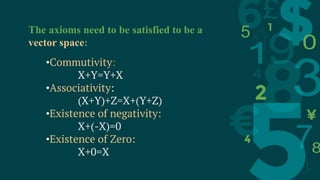
The axioms need to be satisfied to be a
vector space:
•Commutivity:
X+Y=Y+X
•Associativity:
(X+Y)+Z=X+(Y+Z)
•Existence of negativity:
X+(-X)=0
•Existence of Zero:
X+0=X
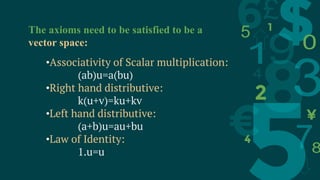
The axioms need to be satisfied to be a
vector space:
•Associativity of Scalar multiplication:
(ab)u=a(bu)
•Right hand distributive:
k(u+v)=ku+kv
•Left hand distributive:
(a+b)u=au+bu
•Law of Identity:
1.u=u
Subspace
Subspace
If W is a nonempty subset of a vector space V,
then W is a subspace of V
if and only if the following conditions hold.
Conditions
(1) If u and v are in W, then u+v is in W.
(2) If u is in W and c is any scalar, then cu is in W.
WBA 






10
01
222 ofsubspaceanotis  MW
Ex: The set of singular matrices is not a subspace of M2×2
Let W be the set of singular matrices of order 2. Show that
W is not a subspace of M2×2 with the standard operations.
WB,WA 












10
00
00
01Sol:
Linear Combination
Linear Combination
A vector v in a vector space V is called linear combination
of the vectors u1, u2, u3, uk in V if v can be written in the
form
v=c1u1+c2u2+…+ckuk
where c1c2,…,ck are scalars
123
12
1
321
21
31




ccc
cc
cc
Ex : Finding a linear combination
,,ofncombinatiolinearais(1,1,1)Prove
1,0,1)((0,1,2)(1,2,3)
321
321
vvvw
vvv


Sol: 332211(a) vvvw ccc 
       1,0,12,1,03,2,11,1,1 321  ccc
)23,2,( 3212131 ccccccc 









 

1123
1012
1101
   nEliminatioJordanGuass












0000
1210
1101
321
1
32 vvvw 
t
tctctc  321 ,21,1
(this system has infinitely many solutions)
Linear Dependence
&
Independence
Linear Dependence
Let a set of vectors S in a vector space V
S={v1,v2,…,vk}
c1v1+c2v2+…+ckvk=0
If the equations has only the trivial solution
(i.e. not all zeros) then S is called linearly dependent
Example
Let
a = [1 2 3 ] b = [ 4 5 6 ] c= [5 7 9]
Vector c is a linear combination of
vectors a and b, because c = a + b.
Therefore, vectors a, b, and c is linearly
dependent.
Linear Independence
Let a set of vectors S in a vector space V
S={v1,v2,…,vk}
c1v1+c2v2+…+ckvk=0
If the equations has only the trivial solution
(c1 = c2 =…= ck =0) then S is called linearly independent
Example
Let
a = [1 2 3 ] b = [ 4 5 6 ]
Vectors a and b are linearly
independent, because neither vector is
a scalar multiple of the other.
Basis
Basis
A set of vectors in a vector space V is called a basis if the
vectors are linearly independent and every vector in the
vector space is a linear combination of this set.
Condition
Let B denotes a subset of a vector space V.
Then, B is a basis if and only if
1. B is a minimal generating set of V
2. B is a maximal set of linearly independent
vectors.
Example
The vectors e1,e2,…, en are linearly
independent and generate Rn.
Therefore they form a basis for Rn
.
Dimension
Dimension
The number of rows and columns of a matrix,
written in the form rows×columns.
If matrix below has m rows and n columns, so
its dimensions are m×n. This is read aloud,
“m by n."
?
A = [ 1 2 3]
Dimension ?
Rank of Matrices
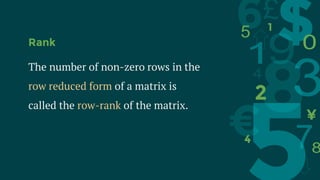
Rank
The number of non-zero rows in the
row reduced form of a matrix is
called the row-rank of the matrix.
Properties
1. The rank of an m x n matrix is
nonnegative integer and cannot
be greater than either m or n.
That is
rank(A) ≤ min(m,n)
Properties
2. If A is a square matrix (i.e. m=n) then
A is invertible if and if only if A has
full rank.
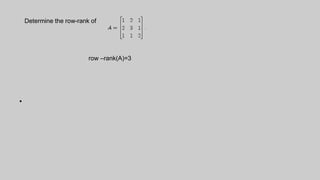
Determine the row-rank of
•
row –rank(A)=3
?
A= [1 2 0]
Rank ?
Any questions?
Thanks!

Vector space

  • 1.
  • 2.
  • 3.
  • 4.
    History 1844 Harmann Grassman gavethe introduction of Vector space.
  • 5.
    History 1888 Guiseppe Peano gavethe definition of vector spaces and Linear Maps.
  • 6.
  • 7.
    Vector Space A Vectorspace V is a set that is closed under finite vector addition and scalar multiplication.
  • 8.
    The set ofall Integers is not a vector space. 1 ϵ V, ½ ϵ R (½ ) (1) = ½ !ϵ V It is not closed under scalar multiplication
  • 9.
    The set ofall second degree polynomials is not a vector space Let P(x)=-X Q(x)=2X+1 =>P(x)+Q(x)=X+1 ₵ V It is not closed under scalar multiplication.
  • 10.
  • 11.
    The axioms needto be satisfied to be a vector space: •Commutivity: X+Y=Y+X •Associativity: (X+Y)+Z=X+(Y+Z) •Existence of negativity: X+(-X)=0 •Existence of Zero: X+0=X
  • 12.
    The axioms needto be satisfied to be a vector space: •Associativity of Scalar multiplication: (ab)u=a(bu) •Right hand distributive: k(u+v)=ku+kv •Left hand distributive: (a+b)u=au+bu •Law of Identity: 1.u=u
  • 13.
  • 14.
    Subspace If W isa nonempty subset of a vector space V, then W is a subspace of V if and only if the following conditions hold.
  • 15.
    Conditions (1) If uand v are in W, then u+v is in W. (2) If u is in W and c is any scalar, then cu is in W.
  • 16.
    WBA        10 01 222 ofsubspaceanotis MW Ex: The set of singular matrices is not a subspace of M2×2 Let W be the set of singular matrices of order 2. Show that W is not a subspace of M2×2 with the standard operations. WB,WA              10 00 00 01Sol:
  • 17.
  • 18.
    Linear Combination A vectorv in a vector space V is called linear combination of the vectors u1, u2, u3, uk in V if v can be written in the form v=c1u1+c2u2+…+ckuk where c1c2,…,ck are scalars
  • 19.
    123 12 1 321 21 31     ccc cc cc Ex : Findinga linear combination ,,ofncombinatiolinearais(1,1,1)Prove 1,0,1)((0,1,2)(1,2,3) 321 321 vvvw vvv   Sol: 332211(a) vvvw ccc         1,0,12,1,03,2,11,1,1 321  ccc )23,2,( 3212131 ccccccc 
  • 20.
                1123 1012 1101   nEliminatioJordanGuass             0000 1210 1101 321 1 32 vvvw  t tctctc  321 ,21,1 (this system has infinitely many solutions)
  • 21.
  • 22.
    Linear Dependence Let aset of vectors S in a vector space V S={v1,v2,…,vk} c1v1+c2v2+…+ckvk=0 If the equations has only the trivial solution (i.e. not all zeros) then S is called linearly dependent
  • 23.
    Example Let a = [12 3 ] b = [ 4 5 6 ] c= [5 7 9] Vector c is a linear combination of vectors a and b, because c = a + b. Therefore, vectors a, b, and c is linearly dependent.
  • 24.
    Linear Independence Let aset of vectors S in a vector space V S={v1,v2,…,vk} c1v1+c2v2+…+ckvk=0 If the equations has only the trivial solution (c1 = c2 =…= ck =0) then S is called linearly independent
  • 25.
    Example Let a = [12 3 ] b = [ 4 5 6 ] Vectors a and b are linearly independent, because neither vector is a scalar multiple of the other.
  • 26.
  • 27.
    Basis A set ofvectors in a vector space V is called a basis if the vectors are linearly independent and every vector in the vector space is a linear combination of this set.
  • 28.
    Condition Let B denotesa subset of a vector space V. Then, B is a basis if and only if 1. B is a minimal generating set of V 2. B is a maximal set of linearly independent vectors.
  • 29.
    Example The vectors e1,e2,…,en are linearly independent and generate Rn. Therefore they form a basis for Rn .
  • 30.
  • 31.
    Dimension The number ofrows and columns of a matrix, written in the form rows×columns. If matrix below has m rows and n columns, so its dimensions are m×n. This is read aloud, “m by n."
  • 32.
    ? A = [1 2 3] Dimension ?
  • 33.
  • 34.
    Rank The number ofnon-zero rows in the row reduced form of a matrix is called the row-rank of the matrix.
  • 35.
    Properties 1. The rankof an m x n matrix is nonnegative integer and cannot be greater than either m or n. That is rank(A) ≤ min(m,n)
  • 36.
    Properties 2. If Ais a square matrix (i.e. m=n) then A is invertible if and if only if A has full rank.
  • 37.
    Determine the row-rankof • row –rank(A)=3
  • 38.
    ? A= [1 20] Rank ?
  • 39.
  • 40.