SUBMITTED BY: SAAHIL R.
KSHATRIYA
ENROLLMENT NO.: 150120119164
BATCH: 3C1
SUBMITTED TO:
PROF. PRIYA JANI
7. UNIT STEP FUNCTION (OR
HEAVISIDE’S FUNCTION
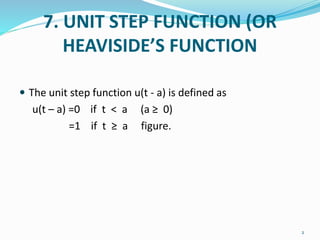
 The unit step function u(t - a) is defined as
u(t – a) =0 if t < a (a ≥ 0)
=1 if t ≥ a figure.
2
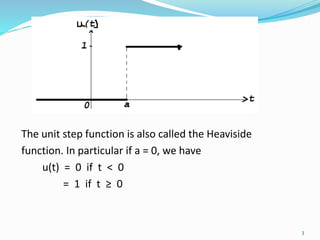
The unit step function is also called the Heaviside
function. In particular if a = 0, we have
u(t) = 0 if t < 0
= 1 if t ≥ 0
3
0
0
0
{u( )} . ( )
(0) (1)
1
st
st st
a
st
st as
a
L t a e u t a dt
e dt e dt
e
e dt e
s s


 
 
 
 
   
 
 
    

 

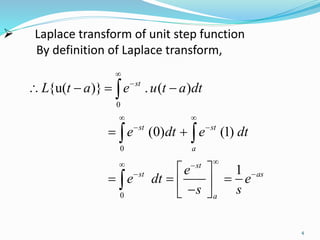
 Laplace transform of unit step function
By definition of Laplace transform,
4
1
1
1 1
{ ( )} { ( )}
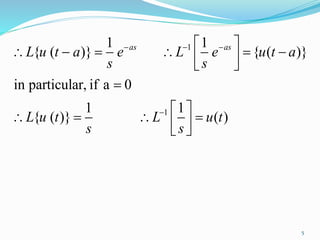
in particular, if a 0
1 1
{ ( )} ( )
as as
L u t a e L e u t a
s s
L u t L u t
s s
  

 
       

 
     
5
Example: find the laplace
transform of t2 u(t-2)
 solution:
 L[f(t) u(t-a)]= e-as L[f(t+a)]
 L [t2 u(t-2)] = e-2s L [(t+2)2 ]
 = e-2s L [t2 + 4t+4]
 = e-2s ( 2/s3 + 4/s2 + 4/s)
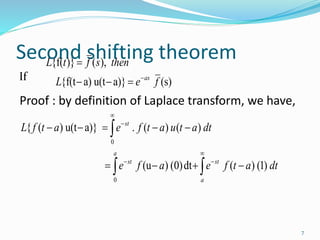
Second shifting theorem
If
7
0
0
{f( )} ( ),
{f(t a) u(t a)} (s)
{ ( ) u(t a)} . ( ) ( )
(u ) (0)dt ( ) (1)
as
st
a
st st
a
L t f s then
L e f
L f t a e f t a u t a dt
e f a e f t a dt




 

  
    
   

 
Proof : by definition of Laplace transform, we have,
( )
0
0
1
(u )) ,
(r)
(r) ( )
{ ( ) u(t a)} ( ) [ ( )]
[ ( )] ( ) ( )
st
a
s a r
as sr as
as as
as
e f a dt Substituting t a r
e f dr
e e f dr e f s
L f t a e f s e L f t
L e f s f t a u t a



 

  
 
 
   

 
    
   



8
.1: { ( ) ( )} [ ( )]
.2: [ ( )] [1. ( )] (1)
.3: [ ( ) ( )]
.4: [ ( ) { ( ) ( )] { ( )} { ( )}
as
as
as
as bs
as bs
Cor L f t u t a e L f t a
e
Cor L u t a L u t a e L
s
e e
Cor L u t a u t b
s
Cor L f t u t a u t b e L f t a e L f t b



 
 
  
    

   
      
(alternative form of second shifting theorem)
9
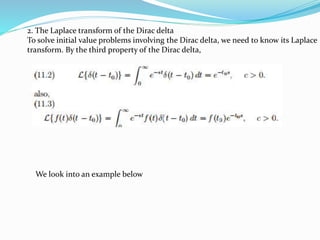
2. The Laplace transform of the Dirac delta
To solve initial value problems involving the Dirac delta, we need to know its Laplace
transform. By the third property of the Dirac delta,
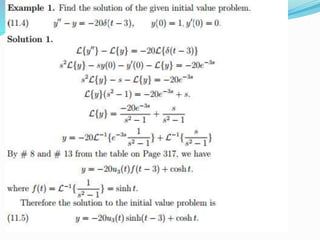
We look into an example below
12

Laplace transform: UNIT STEP FUNCTION, SECOND SHIFTING THEOREM, DIRAC DELTA FUNCTION

  • 1.
    SUBMITTED BY: SAAHILR. KSHATRIYA ENROLLMENT NO.: 150120119164 BATCH: 3C1 SUBMITTED TO: PROF. PRIYA JANI
  • 2.
    7. UNIT STEPFUNCTION (OR HEAVISIDE’S FUNCTION  The unit step function u(t - a) is defined as u(t – a) =0 if t < a (a ≥ 0) =1 if t ≥ a figure. 2
  • 3.
    The unit stepfunction is also called the Heaviside function. In particular if a = 0, we have u(t) = 0 if t < 0 = 1 if t ≥ 0 3
  • 4.
    0 0 0 {u( )} .( ) (0) (1) 1 st st st a st st as a L t a e u t a dt e dt e dt e e dt e s s                             Laplace transform of unit step function By definition of Laplace transform, 4
  • 5.
    1 1 1 1 { ()} { ( )} in particular, if a 0 1 1 { ( )} ( ) as as L u t a e L e u t a s s L u t L u t s s                        5
  • 6.
    Example: find thelaplace transform of t2 u(t-2)  solution:  L[f(t) u(t-a)]= e-as L[f(t+a)]  L [t2 u(t-2)] = e-2s L [(t+2)2 ]  = e-2s L [t2 + 4t+4]  = e-2s ( 2/s3 + 4/s2 + 4/s)
  • 7.
    Second shifting theorem If 7 0 0 {f()} ( ), {f(t a) u(t a)} (s) { ( ) u(t a)} . ( ) ( ) (u ) (0)dt ( ) (1) as st a st st a L t f s then L e f L f t a e f t a u t a dt e f a e f t a dt                       Proof : by definition of Laplace transform, we have,
  • 8.
    ( ) 0 0 1 (u )), (r) (r) ( ) { ( ) u(t a)} ( ) [ ( )] [ ( )] ( ) ( ) st a s a r as sr as as as as e f a dt Substituting t a r e f dr e e f dr e f s L f t a e f s e L f t L e f s f t a u t a                                 8
  • 9.
    .1: { () ( )} [ ( )] .2: [ ( )] [1. ( )] (1) .3: [ ( ) ( )] .4: [ ( ) { ( ) ( )] { ( )} { ( )} as as as as bs as bs Cor L f t u t a e L f t a e Cor L u t a L u t a e L s e e Cor L u t a u t b s Cor L f t u t a u t b e L f t a e L f t b                            (alternative form of second shifting theorem) 9
  • 10.
    2. The Laplacetransform of the Dirac delta To solve initial value problems involving the Dirac delta, we need to know its Laplace transform. By the third property of the Dirac delta, We look into an example below
  • 12.