Systems of Linear Equations 4-1  Systems of Linear Equations in Two Variables
4-1 Systems of Linear Equations in Two Variables Deciding whether an ordered pair is a solution of a linear system.   The solution set of a linear system of equations contains all ordered pairs that satisfy all the equations at the same time.  Example 1: Is the ordered pair a solution of the given system?   2x + y = -6 Substitute the ordered pair into each equation.   x + 3y = 2 Both equations must be satisfied. A) (-4, 2) B) (3, -12)‏ 2(-4) + 2 = -6 2(3) + (-12) = -6 (-4) + 3(2) = 2   (3) + 3(-12) = 2 -6 = -6   -6 = -6  2 = 2     -33     -6      Yes   No
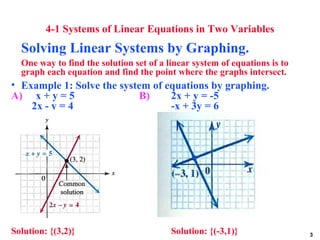
4-1 Systems of Linear Equations in Two Variables Solving Linear Systems by Graphing.   One way to find the solution set of a linear system of equations is to graph each equation and find the point where the graphs intersect.  Example 1: Solve the system of equations by graphing.   A)  x + y = 5 B)  2x + y = -5   2x - y = 4 -x + 3y = 6 Solution: {(3,2)} Solution: {(-3,1)}
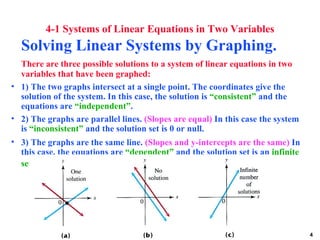
4-1 Systems of Linear Equations in Two Variables Solving Linear Systems by Graphing.   There are three possible solutions to a system of linear equations in two variables that have been graphed:  1) The two graphs intersect at a single point. The coordinates give the solution of the system. In this case, the solution is  “consistent”  and the equations are  “independent” . 2) The graphs are parallel lines.  (Slopes are equal)  In this case the system is  “inconsistent”  and the solution set is 0 or null. 3) The graphs are the same line.  (Slopes and y-intercepts are the same)  In this case, the equations are  “dependent”  and the solution set is an  infinite set   of ordered pairs.
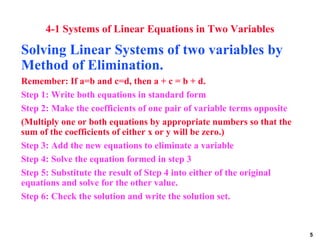
4-1 Systems of Linear Equations in Two Variables Solving Linear Systems of two variables by Method of Elimination.   Remember: If a=b and c=d, then a + c = b + d.  Step 1: Write both equations in standard form Step 2: Make the coefficients of one pair of variable terms opposite (Multiply one or both equations by appropriate numbers so that the sum of the coefficients of either x or y will be zero.)‏ Step 3: Add the new equations to eliminate a variable Step 4: Solve the equation formed in step 3 Step 5: Substitute the result of Step 4 into either of the original equations and solve for the other value. Step 6: Check the solution and write the solution set.
4-1 Systems of Linear Equations in Two Variables Solving Linear Systems of two variables by Method of Elimination.   Example 2: Solve the system :   2x + 3y = 19 Step 1: Both equations are in standard form   3x  - 7y = -6 Step 2: Choose the variable x to eliminate: Multiply the top equation by 3, the bottom equation by -2 3[2x + 3y = 19]  6x + 9y = 57   -2[3x - 7y  = -6]   -6x +14y = 12 Step 3: Add the new equations to eliminate a variable   0x + 23y = 69 Step 4: Solve the equation formed in step    y = 3 Step 5: Substitute the result of Step 4 into either of the original equations and solve for the other value. 2x + 3(3) = 19 2x = 10   x = 5 Solution Set: {(5,3)} Step 6: Check the solution and write the solution set.
4-1 Systems of Linear Equations in Two Variables Solving Linear Systems of two variables by Method of Elimination.   Example 3:  Solve the system :   2[2x - 3y = 1]    4x -  6y  =  2   -3[3x - 2y = 9]  -9x + 6y = -27 -5x + 0y = -25   x = 5 3(5) - 2y = 9   -2y = -6 Solution Set: {(5,3)}   y = 3
4-1 Systems of Linear Equations in Two Variables Solving Linear Systems of two variables by Method of Elimination.   Example 4:  Solve the system :   2x + y = 6   -8x - 4y = -24  4[2x + y = 6]    8x +  4y  = 24   -8x -4y = -24  -8x  -  4y = -24   0 = 0  True Solution Set: {(x,y)| 2x + y = 6}   Note: When a system has dependent equations and an infinite number of solutions, either equation can be used to produce the solution set. Answer is given in set-builder notation.
4-1 Systems of Linear Equations in Two Variables Solving Linear Systems of two variables by Method of Elimination.   Example 5:  Solve the system : 4x - 3y = 8   8x - 6y = 14  -2[4x - 3y = 8]  -8x +  6y  = -16   8x - 6y = 14    8x  -  6y  =  24   0 = 8  False Solution Set: 0 or null   Note: There are no ordered pairs that satisfy both equations. The lines are parallel. There is no solution.
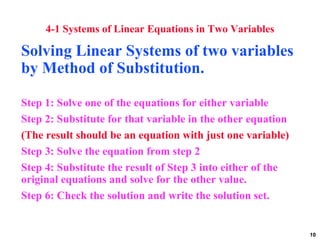
4-1 Systems of Linear Equations in Two Variables Solving Linear Systems of two variables by Method of Substitution.   Step 1: Solve one of the equations for either variable Step 2: Substitute for that variable in the other equation (The result should be an equation with just one variable)‏ Step 3: Solve the equation from step 2 Step 4: Substitute the result of Step 3 into either of the original equations and solve for the other value. Step 6: Check the solution and write the solution set.
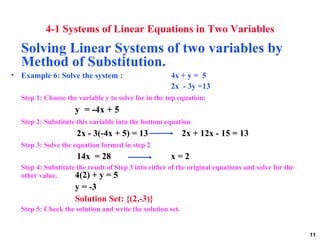
4-1 Systems of Linear Equations in Two Variables Solving Linear Systems of two variables by Method of Substitution.   Example 6: Solve the system :   4x + y =  5 2x  - 3y =13 Step 1: Choose the variable y to solve for in the top equation: y  = -4x + 5 Step 2: Substitute this variable into the bottom equation   2x - 3(-4x + 5) = 13  2x + 12x - 15 = 13 Step 3: Solve the equation formed in step 2    14x  = 28 x = 2 Step 4: Substitute the result of Step 3 into either of the original equations and solve for the other value. 4(2) + y = 5 y = -3 Solution Set: {(2,-3)} Step 5: Check the solution and write the solution set.
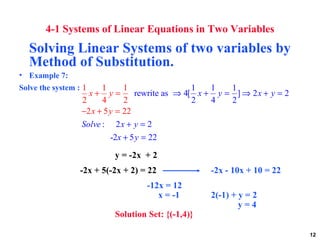
4-1 Systems of Linear Equations in Two Variables Solving Linear Systems of two variables by Method of Substitution.   Example 7:  Solve the system :     y = -2x  + 2    -2x + 5(-2x + 2) = 22  -2x - 10x + 10 = 22 -12x = 12   x = -1 2(-1) + y = 2   y = 4 Solution Set: {(-1,4)}

Systems of Linear Equations

  • 1.
    Systems of LinearEquations 4-1 Systems of Linear Equations in Two Variables
  • 2.
    4-1 Systems ofLinear Equations in Two Variables Deciding whether an ordered pair is a solution of a linear system. The solution set of a linear system of equations contains all ordered pairs that satisfy all the equations at the same time. Example 1: Is the ordered pair a solution of the given system? 2x + y = -6 Substitute the ordered pair into each equation. x + 3y = 2 Both equations must be satisfied. A) (-4, 2) B) (3, -12)‏ 2(-4) + 2 = -6 2(3) + (-12) = -6 (-4) + 3(2) = 2 (3) + 3(-12) = 2 -6 = -6 -6 = -6 2 = 2 -33  -6  Yes  No
  • 3.
    4-1 Systems ofLinear Equations in Two Variables Solving Linear Systems by Graphing. One way to find the solution set of a linear system of equations is to graph each equation and find the point where the graphs intersect. Example 1: Solve the system of equations by graphing. A) x + y = 5 B) 2x + y = -5 2x - y = 4 -x + 3y = 6 Solution: {(3,2)} Solution: {(-3,1)}
  • 4.
    4-1 Systems ofLinear Equations in Two Variables Solving Linear Systems by Graphing. There are three possible solutions to a system of linear equations in two variables that have been graphed: 1) The two graphs intersect at a single point. The coordinates give the solution of the system. In this case, the solution is “consistent” and the equations are “independent” . 2) The graphs are parallel lines. (Slopes are equal) In this case the system is “inconsistent” and the solution set is 0 or null. 3) The graphs are the same line. (Slopes and y-intercepts are the same) In this case, the equations are “dependent” and the solution set is an infinite set of ordered pairs.
  • 5.
    4-1 Systems ofLinear Equations in Two Variables Solving Linear Systems of two variables by Method of Elimination. Remember: If a=b and c=d, then a + c = b + d. Step 1: Write both equations in standard form Step 2: Make the coefficients of one pair of variable terms opposite (Multiply one or both equations by appropriate numbers so that the sum of the coefficients of either x or y will be zero.)‏ Step 3: Add the new equations to eliminate a variable Step 4: Solve the equation formed in step 3 Step 5: Substitute the result of Step 4 into either of the original equations and solve for the other value. Step 6: Check the solution and write the solution set.
  • 6.
    4-1 Systems ofLinear Equations in Two Variables Solving Linear Systems of two variables by Method of Elimination. Example 2: Solve the system : 2x + 3y = 19 Step 1: Both equations are in standard form 3x - 7y = -6 Step 2: Choose the variable x to eliminate: Multiply the top equation by 3, the bottom equation by -2 3[2x + 3y = 19] 6x + 9y = 57 -2[3x - 7y = -6] -6x +14y = 12 Step 3: Add the new equations to eliminate a variable 0x + 23y = 69 Step 4: Solve the equation formed in step y = 3 Step 5: Substitute the result of Step 4 into either of the original equations and solve for the other value. 2x + 3(3) = 19 2x = 10 x = 5 Solution Set: {(5,3)} Step 6: Check the solution and write the solution set.
  • 7.
    4-1 Systems ofLinear Equations in Two Variables Solving Linear Systems of two variables by Method of Elimination. Example 3: Solve the system : 2[2x - 3y = 1] 4x - 6y = 2 -3[3x - 2y = 9] -9x + 6y = -27 -5x + 0y = -25 x = 5 3(5) - 2y = 9 -2y = -6 Solution Set: {(5,3)} y = 3
  • 8.
    4-1 Systems ofLinear Equations in Two Variables Solving Linear Systems of two variables by Method of Elimination. Example 4: Solve the system : 2x + y = 6 -8x - 4y = -24 4[2x + y = 6] 8x + 4y = 24 -8x -4y = -24 -8x - 4y = -24 0 = 0 True Solution Set: {(x,y)| 2x + y = 6} Note: When a system has dependent equations and an infinite number of solutions, either equation can be used to produce the solution set. Answer is given in set-builder notation.
  • 9.
    4-1 Systems ofLinear Equations in Two Variables Solving Linear Systems of two variables by Method of Elimination. Example 5: Solve the system : 4x - 3y = 8 8x - 6y = 14 -2[4x - 3y = 8] -8x + 6y = -16 8x - 6y = 14 8x - 6y = 24 0 = 8 False Solution Set: 0 or null Note: There are no ordered pairs that satisfy both equations. The lines are parallel. There is no solution.
  • 10.
    4-1 Systems ofLinear Equations in Two Variables Solving Linear Systems of two variables by Method of Substitution. Step 1: Solve one of the equations for either variable Step 2: Substitute for that variable in the other equation (The result should be an equation with just one variable)‏ Step 3: Solve the equation from step 2 Step 4: Substitute the result of Step 3 into either of the original equations and solve for the other value. Step 6: Check the solution and write the solution set.
  • 11.
    4-1 Systems ofLinear Equations in Two Variables Solving Linear Systems of two variables by Method of Substitution. Example 6: Solve the system : 4x + y = 5 2x - 3y =13 Step 1: Choose the variable y to solve for in the top equation: y = -4x + 5 Step 2: Substitute this variable into the bottom equation 2x - 3(-4x + 5) = 13 2x + 12x - 15 = 13 Step 3: Solve the equation formed in step 2 14x = 28 x = 2 Step 4: Substitute the result of Step 3 into either of the original equations and solve for the other value. 4(2) + y = 5 y = -3 Solution Set: {(2,-3)} Step 5: Check the solution and write the solution set.
  • 12.
    4-1 Systems ofLinear Equations in Two Variables Solving Linear Systems of two variables by Method of Substitution. Example 7: Solve the system : y = -2x + 2 -2x + 5(-2x + 2) = 22 -2x - 10x + 10 = 22 -12x = 12 x = -1 2(-1) + y = 2 y = 4 Solution Set: {(-1,4)}