PREPARED BY:-
DHEERAJ KATARIA(007)
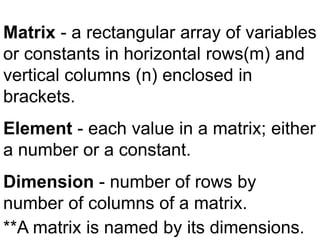
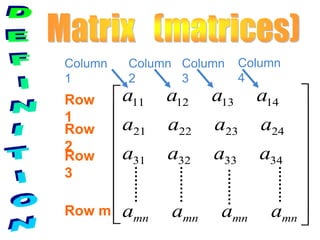
Matrix - a rectangular array of variables
or constants in horizontal rows(m) and
vertical columns (n) enclosed in
brackets.
Element - each value in a matrix; either
a number or a constant.
Dimension - number of rows by
number of columns of a matrix.
**A matrix is named by its dimensions.
11 12 13 14
21 22 23 24
31 32 33 34
mn mn mn mn
a a a a
a a a a
a a a a
a a a a







 
Row
1
Row
2
Row
3
Row m
Column
1
Column
2
Column
3
Column
4
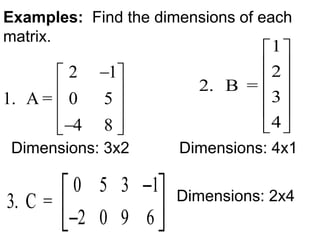
Examples: Find the dimensions of each
matrix.
1. A =
2 1
0 5
4 8










2. B =
1
2
3
4












0 5 3 1
3. C =
2 0 9 6

 
  
Dimensions: 3x2 Dimensions: 4x1
Dimensions: 2x4
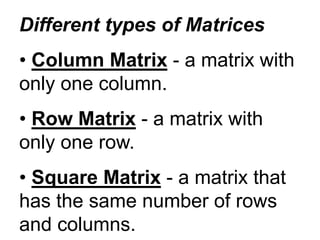
Different types of Matrices
• Column Matrix - a matrix with
only one column.
• Row Matrix - a matrix with
only one row.
• Square Matrix - a matrix that
has the same number of rows
and columns.
row
nmrows

















mnmmm
n
n
n
aaaa
a
a
a
aaa
aaa
aaa
A





321
3
2
1
333231
232221
131211
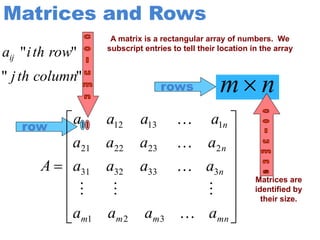
A matrix is a rectangular array of numbers. We
subscript entries to tell their location in the array
Matrices are
identified by
their size.
Matrices and Rows
""
""
columnthj
rowthiaij
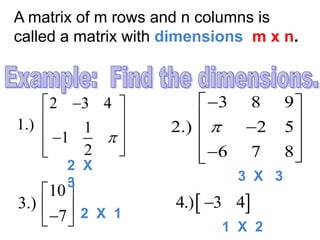
A matrix of m rows and n columns is
called a matrix with dimensions m x n.
2 3 4
1.) 1
1
2

  
 
 
 
3 8 9
2.) 2 5
6 7 8

 
  
  
10
3.)
7
 
  
 4.) 3 4
2 X
3 3 X 3
2 X 1
1 X 2
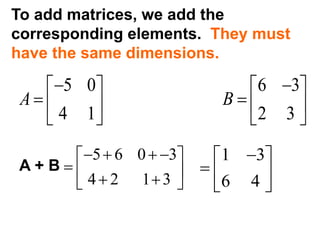
To add matrices, we add the
corresponding elements. They must
have the same dimensions.
5 0 6 3
4 1 2 3
A B
    
    
   
A + B
5 6 0 3
4 2 1 3
    
    
1 3
6 4
 
  
 
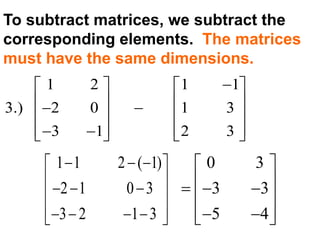
To subtract matrices, we subtract the
corresponding elements. The matrices
must have the same dimensions.
1 2 1 1
3.) 2 0 1 3
3 1 2 3
   
       
       
1 1 2 ( 1)
2 1 0 3
3 2 1 3
   
    
     
0 3
3 3
5 4
 
    
   
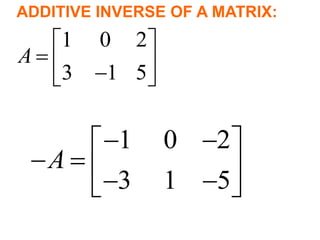
ADDITIVE INVERSE OF A MATRIX:
1 0 2
3 1 5
A
 
   
1 0 2
3 1 5
A
  
     
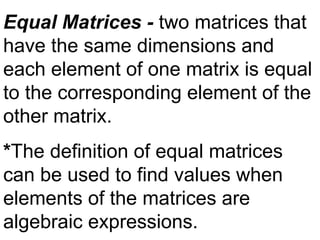
Equal Matrices - two matrices that
have the same dimensions and
each element of one matrix is equal
to the corresponding element of the
other matrix.
*The definition of equal matrices
can be used to find values when
elements of the matrices are
algebraic expressions.
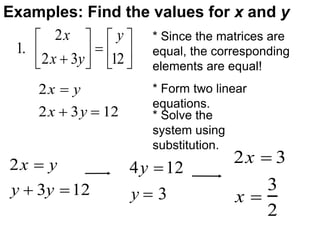
1.
2x
2x  3y






y
12






* Since the matrices are
equal, the corresponding
elements are equal!
* Form two linear
equations.
2x  y
2x  3y  12 * Solve the
system using
substitution.
Examples: Find the values for x and y
2x  y
y  3y 12
4y 12
y  3
2x  3
x 
3
2
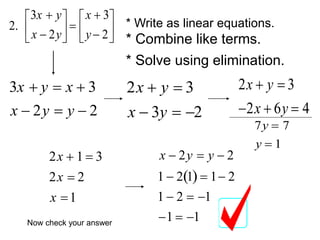
* Write as linear equations.2.
3x  y
x  2y






x  3
y 2






7y  7
y  1
2x  y  3
2x  6y  4
2x  1  3
2x  2
x 1
Now check your answer
* Combine like terms.
* Solve using elimination.
3x  y  x  3
x  2y  y  2
x  2y  y  2
1  2 1   1 2
1  2  1
1  1
2x  y  3
x  3y  2
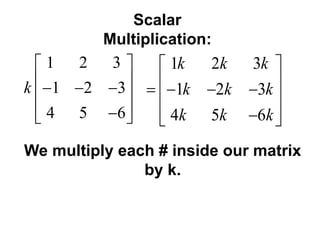
Scalar
Multiplication:
1 2 3
1 2 3
4 5 6
k
 
    
  
We multiply each # inside our matrix
by k.
1 2 3
1 2 3
4 5 6
k k k
k k k
k k k
 
     
  


























 
812
026
2
14
58
13
2
y
x














812
026
528
1143
2
y
x














812
026
56
043
2
y
x














812
026
21012
086
y
x
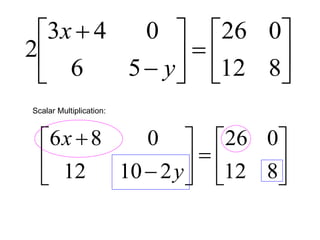
Scalar Multiplication:
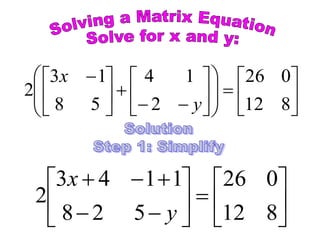
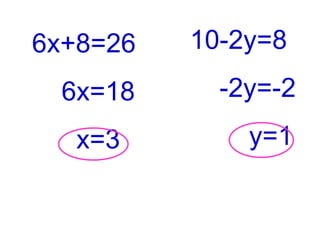
6x+8=26
6x=18
x=3
10-2y=8
-2y=-2
y=1
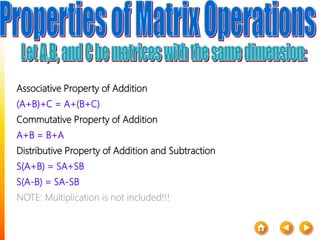
Associative Property of Addition
(A+B)+C = A+(B+C)
Commutative Property of Addition
A+B = B+A
Distributive Property of Addition and Subtraction
S(A+B) = SA+SB
S(A-B) = SA-SB
NOTE: Multiplication is not included!!!
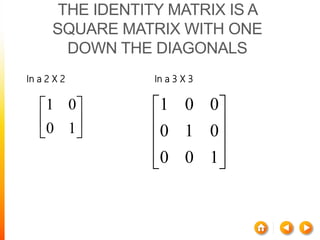
THE IDENTITY MATRIX IS A
SQUARE MATRIX WITH ONE
DOWN THE DIAGONALS
In a 2 X 2 In a 3 X 3






10
01










100
010
001
FINDING THE INVERSE OF A
MATRIX
THE MULTIPLICATIVE IDENTITY
The multiplicative identity for real numbers is the number 1. The property is:
In terms of matrices we need a matrix that can be multiplied by a matrix
(A) and give a product which is the same matrix (A).
If a is a real number, then a x 1 = 1 x a = a.
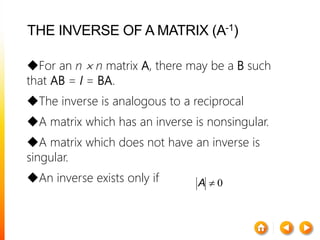
THE INVERSE OF A MATRIX (A-1)
For an n  n matrix A, there may be a B such
that AB = I = BA.
The inverse is analogous to a reciprocal
A matrix which has an inverse is nonsingular.
A matrix which does not have an inverse is
singular.
An inverse exists only if 0A
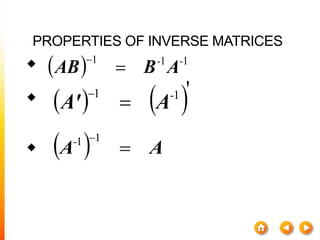
PROPERTIES OF INVERSE MATRICES



  111 --
ABAB 

   '11 -
AA' 

  AA 
11-
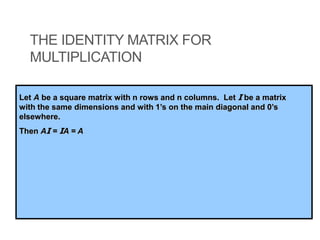
THE IDENTITY MATRIX FOR
MULTIPLICATION
Let A be a square matrix with n rows and n columns. Let I be a matrix
with the same dimensions and with 1’s on the main diagonal and 0’s
elsewhere.
Then AI = IA = A
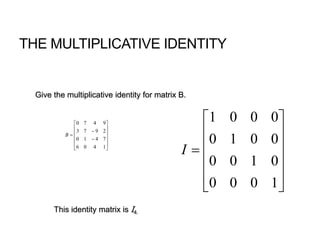
THE MULTIPLICATIVE IDENTITY















1406
7410
2973
9470
B













1000
0100
0010
0001
I
Give the multiplicative identity for matrix B.
This identity matrix is I4.
THE MULTIPLICATIVE INVERSE




























10
01
)3(1)1(2)2(1)1(2
)3(1)1(3)2(1)1(3
32
11
12
13
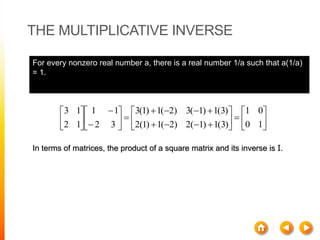
For every nonzero real number a, there is a real number 1/a such that a(1/a)
= 1.
In terms of matrices, the product of a square matrix and its inverse is I.
THE INVERSE OF A MATRIX
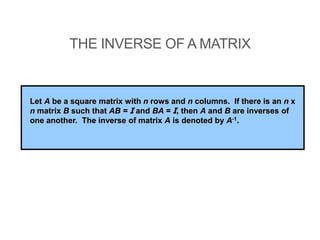
Let A be a square matrix with n rows and n columns. If there is an n x
n matrix B such that AB = I and BA = I, then A and B are inverses of
one another. The inverse of matrix A is denoted by A-1.
THE INVERSE OF A MATRIX















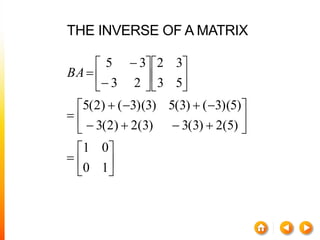
23
35
53
32
BandA
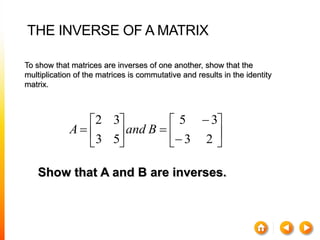
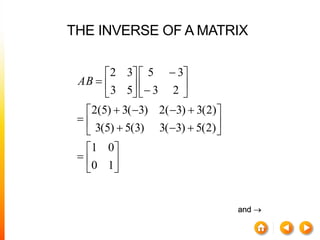
To show that matrices are inverses of one another, show that the
multiplication of the matrices is commutative and results in the identity
matrix.
Show that A and B are inverses.
THE INVERSE OF A MATRIX































10
01
)2(5)3(3)3(5)5(3
)2(3)3(2)3(3)5(2
23
35
53
32
AB
and 
THE INVERSE OF A MATRIX































10
01
)5(2)3(3)3(2)2(3
)5)(3()3(5)3)(3()2(5
53
32
23
35
BA
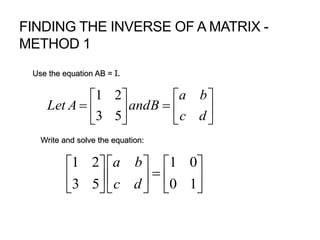
FINDING THE INVERSE OF A MATRIX -
METHOD 1













dc
ba
BandALet
53
21


















10
01
53
21
dc
ba
Use the equation AB = I.
Write and solve the equation:
INVERSES – METHOD 1, CONT.


















10
01
53
21
dc
ba














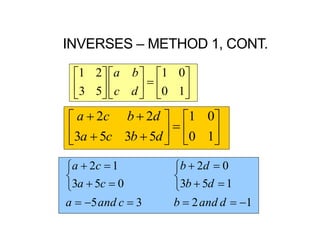
10
01
5353
22
dbca
dbca
1235
153
02
053
12











dandbcanda
db
db
ca
ca
INVERSES – METHOD 1, CONT.








13
25





























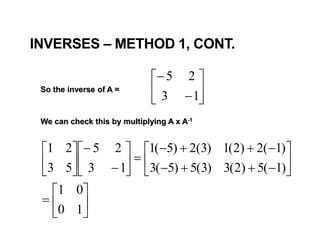
10
01
)1(5)2(3)3(5)5(3
)1(2)2(1)3(2)5(1
13
25
53
21
So the inverse of A =
We can check this by multiplying A x A-1
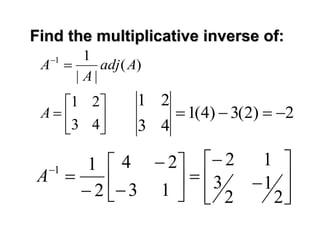
Find the multiplicative inverse of:







43
21
A




















2
1
2
3
12
13
24
2
11
A
2)2(3)4(1
43
21

)(
||
11
Aadj
A
A 
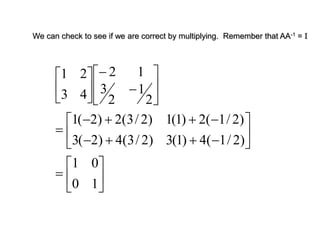
We can check to see if we are correct by multiplying. Remember that AA-1 = I






























10
01
)2/1(4)1(3)2/3(4)2(3
)2/1(2)1(1)2/3(2)2(1
2
1
2
3
12
43
21
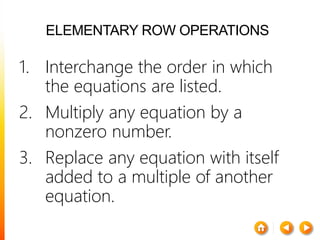
ELEMENTARY ROW OPERATIONS
1. Interchange the order in which
the equations are listed.
2. Multiply any equation by a
nonzero number.
3. Replace any equation with itself
added to a multiple of another
equation.
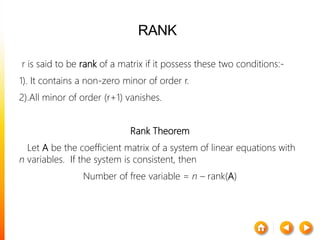
RANK
r is said to be rank of a matrix if it possess these two conditions:-
1). It contains a non-zero minor of order r.
2).All minor of order (r+1) vanishes.
Rank Theorem
Let A be the coefficient matrix of a system of linear equations with
n variables. If the system is consistent, then
Number of free variable = n – rank(A)
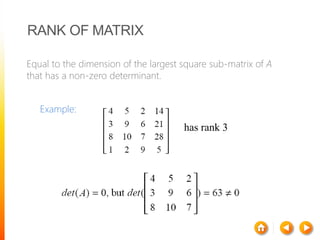
RANK OF MATRIX
Equal to the dimension of the largest square sub-matrix of A
that has a non-zero determinant.
Example:
has rank 3
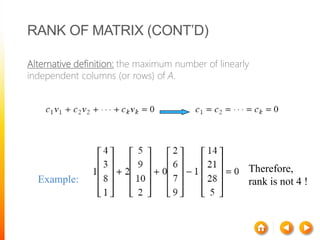
RANK OF MATRIX (CONT’D)
Alternative definition: the maximum number of linearly
independent columns (or rows) of A.
Therefore,
rank is not 4 !Example:
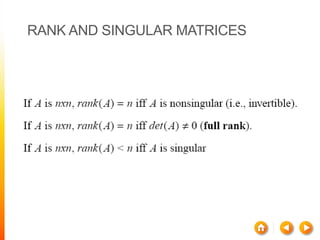
RANK AND SINGULAR MATRICES
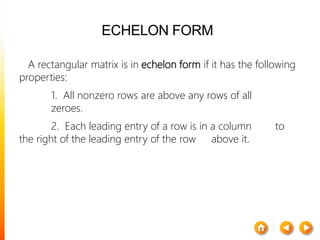
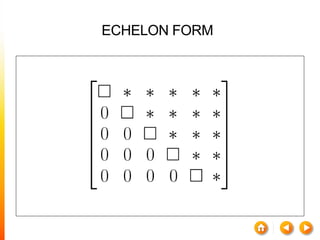
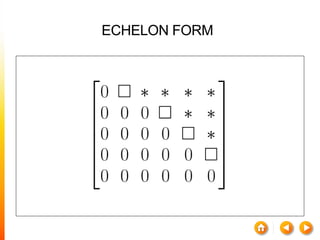
ECHELON FORM
A rectangular matrix is in echelon form if it has the following
properties:
1. All nonzero rows are above any rows of all
zeroes.
2. Each leading entry of a row is in a column to
the right of the leading entry of the row above it.
ECHELON FORM
ECHELON FORM
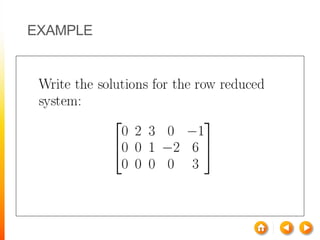
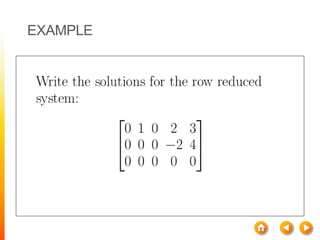
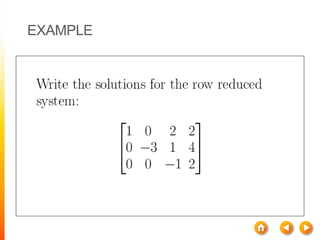
EXAMPLE
EXAMPLE
EXAMPLE
ECHELON FORM
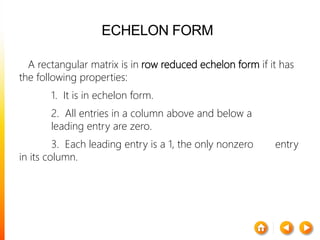
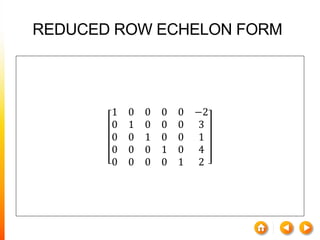
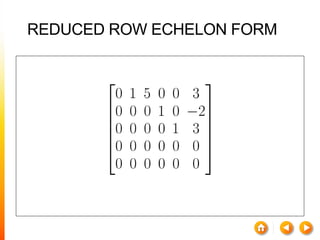
A rectangular matrix is in row reduced echelon form if it has
the following properties:
1. It is in echelon form.
2. All entries in a column above and below a
leading entry are zero.
3. Each leading entry is a 1, the only nonzero entry
in its column.
1 0 0 0 0 −2
0 1 0 0 0 3
0 0 1 0 0 1
0 0 0 1 0 4
0 0 0 0 1 2
REDUCED ROW ECHELON FORM
HOMOGENEOUS SYSTEM
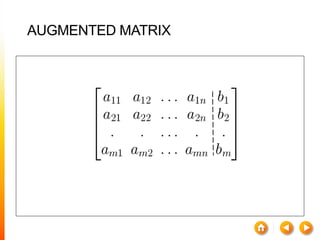
AUGMENTED MATRIX
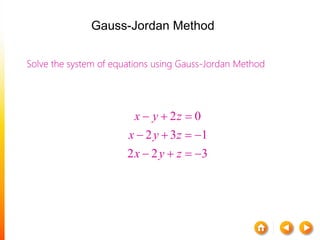
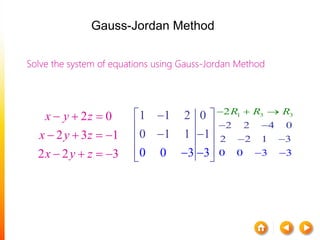
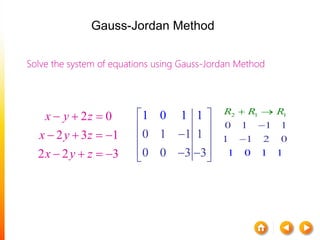
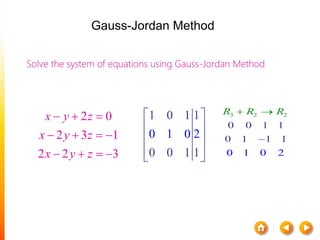
Solve the system of equations using Gauss-Jordan Method
2 0
2 3 1
2 2 3
x y z
x y z
x y z
  
   
   
Gauss-Jordan Method
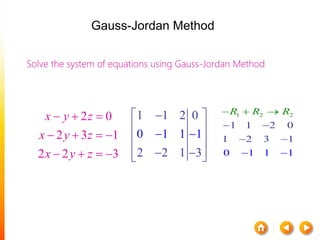
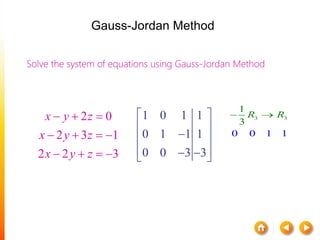
Solve the system of equations using Gauss-Jordan Method
2 0
2 3 1
2 2 3
x y z
x y z
x y z
  
   
   
1 2 2
1 1 2
0 1 1
0
1
1
2 3 1
R R R
 
 

 


0 1 1
1 1 2 0
2 3
1
2 1
 
 
 
 
   
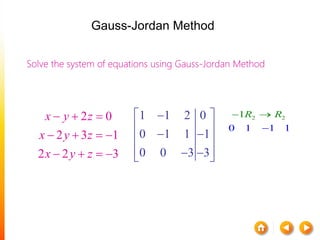
Gauss-Jordan Method
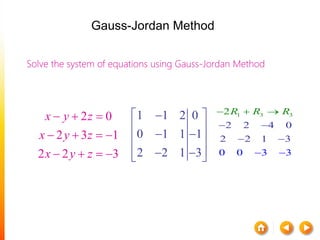
Solve the system of equations using Gauss-Jordan Method
2 0
2 3 1
2 2 3
x y z
x y z
x y z
  
   
   
1 1 2 0
0 1 1 1
2 2 1 3
 
 
  
   
1 3 3
2 2 4 0
2 2 1 3
3
2
0 0 3
R R R
 
 





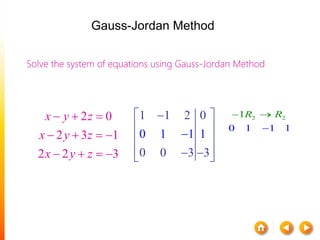
Gauss-Jordan Method
Solve the system of equations using Gauss-Jordan Method
2 0
2 3 1
2 2 3
x y z
x y z
x y z
  
   
   
1 3 3
2 2 4 0
2 2 1 3
3
2
0 0 3
R R R
 
 





0 0
1 1 2 0
0 1 1
3
1
3
 
 
 
  


Gauss-Jordan Method
Solve the system of equations using Gauss-Jordan Method
2 0
2 3 1
2 2 3
x y z
x y z
x y z
  
   
   
1 1 2 0
0 1 1 1
0 0 3 3
 
 
  
   
2 2
0
1
1 1 1
R R


Gauss-Jordan Method
Solve the system of equations using Gauss-Jordan Method
2 0
2 3 1
2 2 3
x y z
x y z
x y z
  
   
   
2 2
0
1
1 1 1
R R


0 1 1 1
1 1 2 0
0 0 3 3
 
 

 
 
 
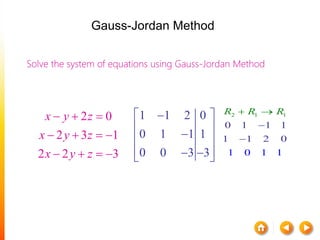
Gauss-Jordan Method
Solve the system of equations using Gauss-Jordan Method
2 0
2 3 1
2 2 3
x y z
x y z
x y z
  
   
   
1 1 2 0
0 1 1 1
0 0 3 3
 
 
 
   
2 1 1
0 1 1 1
1
1 0 1 1
1 2 0
R R R


 
Gauss-Jordan Method
Solve the system of equations using Gauss-Jordan Method
2 0
2 3 1
2 2 3
x y z
x y z
x y z
  
   
   
2 1 1
0 1 1 1
1
1 0 1 1
1 2 0
R R R


 
0 1 1 1
0 0 3 3
1 0 1 1 
 
 
   
Gauss-Jordan Method
Solve the system of equations using Gauss-Jordan Method
2 0
2 3 1
2 2 3
x y z
x y z
x y z
  
   
   
1 0 1 1
0 1 1 1
0 0 3 3
 
 
 
   
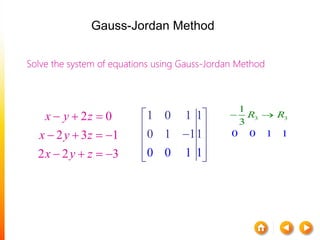
3 3
1
3
0 0 1 1
R R 
Gauss-Jordan Method
Solve the system of equations using Gauss-Jordan Method
2 0
2 3 1
2 2 3
x y z
x y z
x y z
  
   
   
3 3
1
3
0 0 1 1
R R 1 0 1 1
0 1 11
0 0 1 1
 
 
 
  
Gauss-Jordan Method
Solve the system of equations using Gauss-Jordan Method
2 0
2 3 1
2 2 3
x y z
x y z
x y z
  
   
   
1 0 1 1
0 1 11
0 0 1 1
 
 
 
  
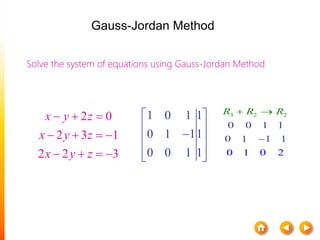
3 2 2
0 0 1 1
0 1 1
1
1
0 0 2
R R R


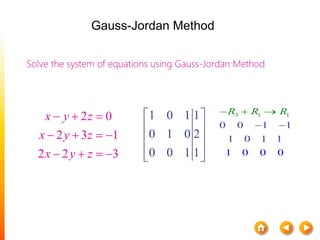
Gauss-Jordan Method
Solve the system of equations using Gauss-Jordan Method
2 0
2 3 1
2 2 3
x y z
x y z
x y z
  
   
   
3 2 2
0 0 1 1
0 1 1
1
1
0 0 2
R R R


1 0 1 1
0 0 1 1
0 1 0 2
 
 
 
  
Gauss-Jordan Method
Solve the system of equations using Gauss-Jordan Method
2 0
2 3 1
2 2 3
x y z
x y z
x y z
  
   
   
1 0 1 1
0 1 0 2
0 0 1 1
 
 
 
  
3 1 1
0
1 0
0 1
0 0
1
1 0 1 1
R R R
 
  
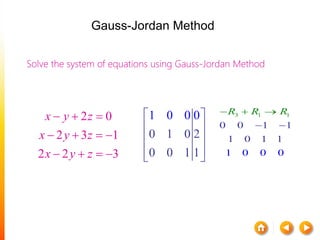
Gauss-Jordan Method
Solve the system of equations using Gauss-Jordan Method
2 0
2 3 1
2 2 3
x y z
x y z
x y z
  
   
   
3 1 1
0
1 0
0 1
0 0
1
1 0 1 1
R R R
 
  
0 1 0 2
0 0 1 1
1 0 0 0 
 
 
  
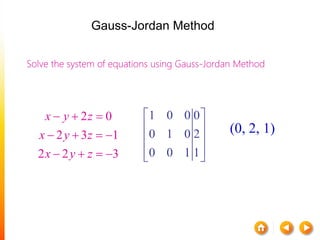
Gauss-Jordan Method
Solve the system of equations using Gauss-Jordan Method
2 0
2 3 1
2 2 3
x y z
x y z
x y z
  
   
   
1 0 0 0
0 1 0 2
0 0 1 1
 
 
 
  
(0, 2, 1)
Gauss-Jordan Method
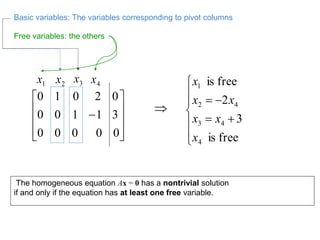
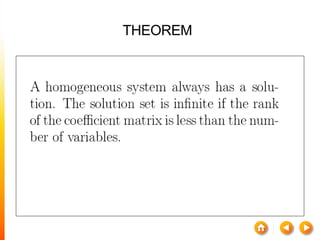
The homogeneous equation Ax = 0 has a nontrivial solution
if and only if the equation has at least one free variable.
Basic variables: The variables corresponding to pivot columns











00000
31100
02010
1x 2x 3x 4x
Free variables: the others









freeis
3
2
freeis
4
43
42
1
x
xx
xx
x

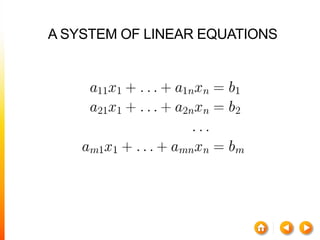
A SYSTEM OF LINEAR EQUATIONS
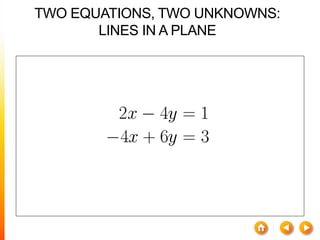
TWO EQUATIONS, TWO UNKNOWNS:
LINES IN A PLANE
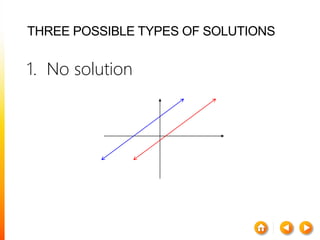
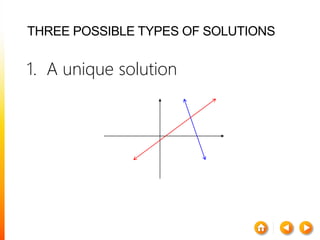
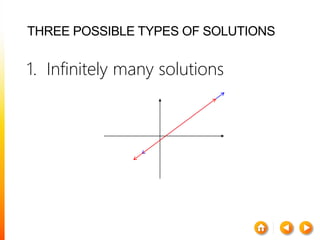
THREE POSSIBLE TYPES OF SOLUTIONS
1. No solution
THREE POSSIBLE TYPES OF SOLUTIONS
1. A unique solution
THREE POSSIBLE TYPES OF SOLUTIONS
1. Infinitely many solutions
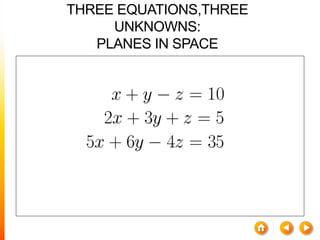
THREE EQUATIONS,THREE
UNKNOWNS:
PLANES IN SPACE
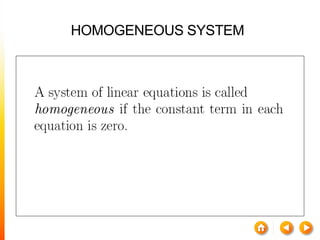
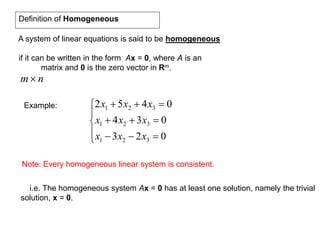
Definition of Homogeneous
A system of linear equations is said to be homogeneous
if it can be written in the form Ax = 0, where A is an
matrix and 0 is the zero vector in Rm.
nm
Example:








023
034
0452
321
321
321
xxx
xxx
xxx
Note: Every homogeneous linear system is consistent.
i.e. The homogeneous system Ax = 0 has at least one solution, namely the trivial
solution, x = 0.
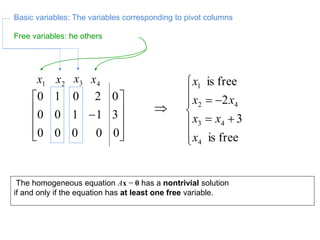
The homogeneous equation Ax = 0 has a nontrivial solution
if and only if the equation has at least one free variable.
Basic variables: The variables corresponding to pivot columns











00000
31100
02010
1x 2x 3x 4x
Free variables: he others









freeis
3
2
freeis
4
43
42
1
x
xx
xx
x

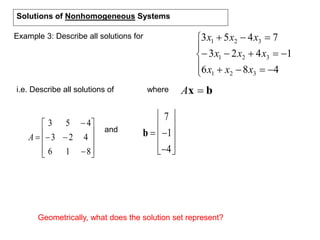
Example 3: Describe all solutions for








486
1423
7453
321
321
321
xxx
xxx
xxx
Solutions of Nonhomogeneous Systems
i.e. Describe all solutions of where

Ax  b














816
423
453
A
and

b 
7
1
4










Geometrically, what does the solution set represent?
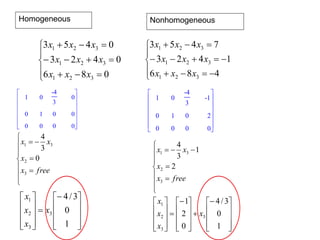
Homogeneous








086
0423
0453
321
321
321
xxx
xxx
xxx
Nonhomogeneous








486
1423
7453
321
321
321
xxx
xxx
xxx


















1 0
-4
3
0
0 1 0 0
0 0 0 0


















1 0
-4
3
-1
0 1 0 2
0 0 0 0










freex
x
xx
3
2
31
0
3
4










freex
x
xx
3
2
31
2
1
3
4





















1
0
3/4
3
3
2
1
x
x
x
x
































1
0
3/4
0
2
1
3
3
2
1
x
x
x
x
THEOREM
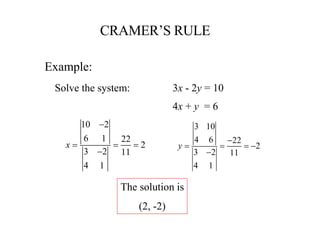
CRAMER’S RULE
Example:
Solve the system: 3x - 2y = 10
4x + y = 6
10 2
6 1 22
2
3 2 11
4 1
x

  

3 10
4 6 22
2
3 2 11
4 1
y

   

The solution is
(2, -2)
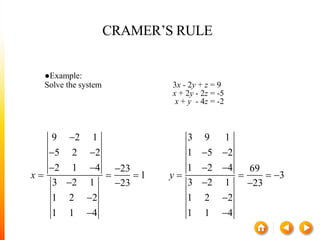
CRAMER’S RULE
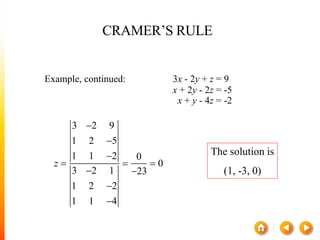
●Example:
Solve the system 3x - 2y + z = 9
x + 2y - 2z = -5
x + y - 4z = -2
x 
9 2 1
5 2 2
2 1 4
3 2 1
1 2 2
1 1 4

23
23
 1 y 
3 9 1
1 5 2
1 2 4
3 2 1
1 2 2
1 1 4

69
23
 3
CRAMER’S RULE
Example, continued: 3x - 2y + z = 9
x + 2y - 2z = -5
x + y - 4z = -2
z 
3 2 9
1 2 5
1 1 2
3 2 1
1 2 2
1 1 4

0
23
 0
The solution is
(1, -3, 0)
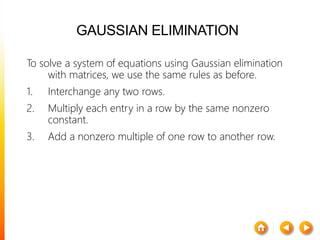
GAUSSIAN ELIMINATION
To solve a system of equations using Gaussian elimination
with matrices, we use the same rules as before.
1. Interchange any two rows.
2. Multiply each entry in a row by the same nonzero
constant.
3. Add a nonzero multiple of one row to another row.
A method to solve simultaneous linear
equations of the form [A][X]=[C]
Two steps
1. Forward Elimination
2. Back Substitution
FORWARD ELIMINATION
































735.0
21.96
8.106
7.000
56.18.40
1525
3
2
1
x
x
x































2.279
2.177
8.106
112144
1864
1525
3
2
1
x
x
x
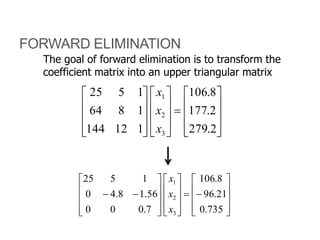
The goal of forward elimination is to transform the
coefficient matrix into an upper triangular matrix
FORWARD ELIMINATION
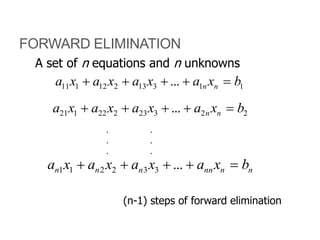
A set of n equations and n unknowns
11313212111 ... bxaxaxaxa nn 
22323222121 ... bxaxaxaxa nn 
nnnnnnn bxaxaxaxa  ...332211
. .
. .
. .
(n-1) steps of forward elimination
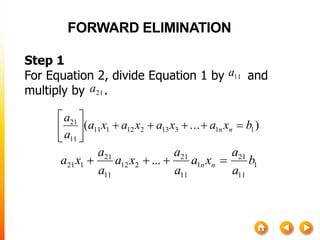
Step 1
For Equation 2, divide Equation 1 by and
multiply by .
)...( 11313212111
11
21
bxaxaxaxa
a
a
nn 





1
11
21
1
11
21
212
11
21
121 ... b
a
a
xa
a
a
xa
a
a
xa nn 
11a
21a
FORWARD ELIMINATION
FORWARD ELIMINATION
1
11
21
1
11
21
212
11
21
121 ... b
a
a
xa
a
a
xa
a
a
xa nn 
22323222121 ... bxaxaxaxa nn 
1
11
21
21
11
21
2212
11
21
22 ... b
a
a
bxa
a
a
axa
a
a
a nnn 












'
2
'
22
'
22 ... bxaxa nn 
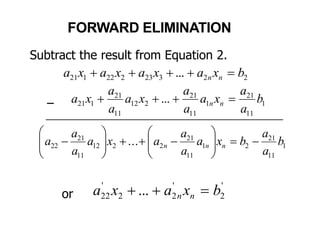
Subtract the result from Equation 2.
−
_________________________________________________
or
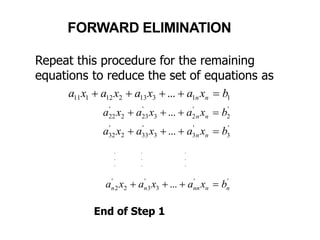
Repeat this procedure for the remaining
equations to reduce the set of equations as
11313212111 ... bxaxaxaxa nn 
'
2
'
23
'
232
'
22 ... bxaxaxa nn 
'
3
'
33
'
332
'
32 ... bxaxaxa nn 
''
3
'
32
'
2 ... nnnnnn bxaxaxa 
. . .
. . .
. . .
End of Step 1
FORWARD ELIMINATION
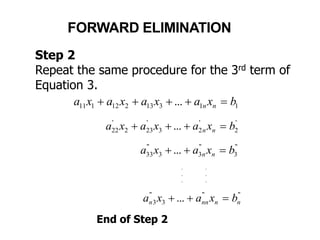
Step 2
Repeat the same procedure for the 3rd term of
Equation 3.
11313212111 ... bxaxaxaxa nn 
'
2
'
23
'
232
'
22 ... bxaxaxa nn 
"
3
"
33
"
33 ... bxaxa nn 
""
3
"
3 ... nnnnn bxaxa 
. .
. .
. .
End of Step 2
FORWARD ELIMINATION
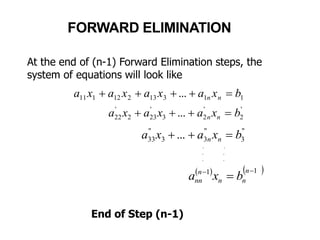
At the end of (n-1) Forward Elimination steps, the
system of equations will look like
'
2
'
23
'
232
'
22 ... bxaxaxa nn 
"
3
"
33
"
33 ... bxaxa nn 
   11 

n
nn
n
nn bxa
. .
. .
. .
11313212111 ... bxaxaxaxa nn 
End of Step (n-1)
FORWARD ELIMINATION
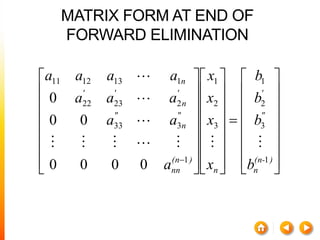
MATRIX FORM AT END OF
FORWARD ELIMINATION

















































 )(n-
n
"
'
n
)(n
nn
"
n
"
'
n
''
n
b
b
b
b
x
x
x
x
a
aa
aaa
aaaa
1
3
2
1
3
2
1
1
333
22322
1131211
0000
00
0




BACK SUBSTITUTION
































735.0
21.96
8.106
7.000
56.18.40
1525
3
2
1
x
x
x
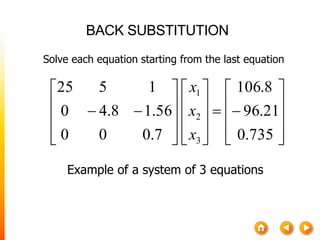
Solve each equation starting from the last equation
Example of a system of 3 equations
BACK SUBSTITUTION STARTING EQNS
'
2
'
23
'
232
'
22 ... bxaxaxa nn 
"
3
"
3
"
33 ... bxaxa nn 
   11 

n
nn
n
nn bxa
. .
. .
. .
11313212111 ... bxaxaxaxa nn 
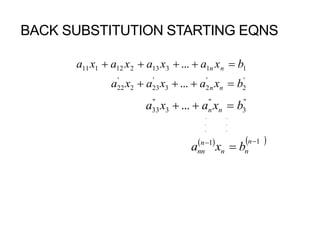
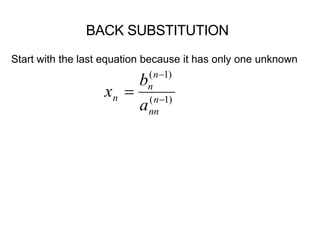
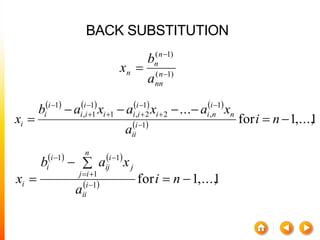
Start with the last equation because it has only one unknown
)1(
)1(


 n
nn
n
n
n
a
b
x
BACK SUBSTITUTION
       
  1,...,1for
...
1
1
,2
1
2,1
1
1,
1


 







ni
a
xaxaxab
x i
ii
n
i
nii
i
iii
i
ii
i
i
i
   
  1,...,1for1
1
11


 


ni
a
xab
x i
ii
n
ij
j
i
ij
i
i
i
)1(
)1(


 n
nn
n
n
n
a
b
x
BACK SUBSTITUTION
FORWARD ELIMINATION
NUMBER OF STEPS OF FORWARD
ELIMINATION
Number of steps of forward elimination is
(n1)(31)2
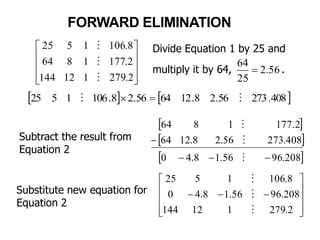
Divide Equation 1 by 25 and
multiply it by 64, .
.
   408.27356.28.126456.28.1061525  
 
 
 208.9656.18.40
408.27356.28.1264
177.21864















2.279112144
2.1771864
8.1061525














2.279112144
208.9656.18.40
8.1061525



56.2
25
64

Subtract the result from
Equation 2
Substitute new equation for
Equation 2
FORWARD ELIMINATION
FORWARD ELIMINATION: STEP 1 (CONT.)
.
   168.61576.58.2814476.58.1061525  











2.279112144
208.9656.18.40
8.1061525



 
 
 968.33576.48.160
168.61576.58.28144
279.2112144

















968.33576.48.160
208.9656.18.40
8.1061525



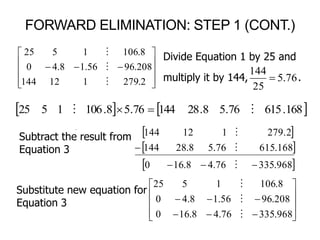
Divide Equation 1 by 25 and
multiply it by 144, .76.5
25
144

Subtract the result from
Equation 3
Substitute new equation for
Equation 3
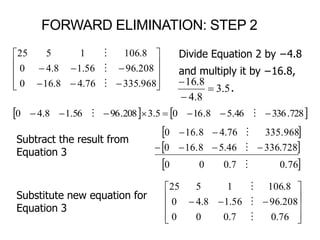
FORWARD ELIMINATION: STEP 2
   728.33646.58.1605.3208.9656.18.40  












968.33576.48.160
208.9656.18.40
8.1061525



 
 
 .7607.000
728.33646.516.80
335.96876.416.80
















76.07.000
208.9656.18.40
8.1061525



Divide Equation 2 by −4.8
and multiply it by −16.8,
.5.3
8.4
8.16



Subtract the result from
Equation 3
Substitute new equation for
Equation 3
BACK SUBSTITUTION
BACK SUBSTITUTION











































76.0
208.96
8.106
7.000
56.18.40
1525
7.07.000
2.9656.18.40
8.1061525
3
2
1
a
a
a



08571.1
7.0
76.0
76.07.0
3
3
3



a
a
a
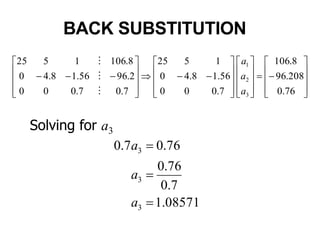
Solving for a3
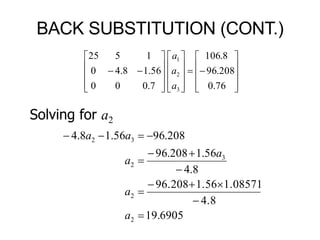
BACK SUBSTITUTION (CONT.)
Solving for a2
690519.
4.8
1.085711.5696.208
8.4
56.1208.96
208.9656.18.4
2
2
3
2
32








a
a
a
a
aa
































76.0
208.96
8.106
7.000
56.18.40
1525
3
2
1
a
a
a
BACK SUBSTITUTION (CONT.)
Solving for a1
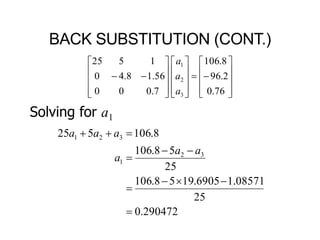
290472.0
25
08571.16905.1958.106
25
58.106
8.106525
32
1
321






aa
a
aaa
































76.0
2.96
8.106
7.000
56.18.40
1525
3
2
1
a
a
a
GAUSSIAN ELIMINATION
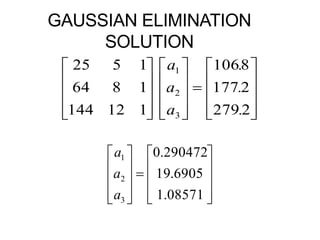
SOLUTION































2279
2177
8106
112144
1864
1525
3
2
1
.
.
.
a
a
a





















08571.1
6905.19
290472.0
3
2
1
a
a
a
THANK YOU

Matrix presentation By DHEERAJ KATARIA

  • 1.
  • 2.
    Matrix - arectangular array of variables or constants in horizontal rows(m) and vertical columns (n) enclosed in brackets. Element - each value in a matrix; either a number or a constant. Dimension - number of rows by number of columns of a matrix. **A matrix is named by its dimensions.
  • 3.
    11 12 1314 21 22 23 24 31 32 33 34 mn mn mn mn a a a a a a a a a a a a a a a a          Row 1 Row 2 Row 3 Row m Column 1 Column 2 Column 3 Column 4
  • 4.
    Examples: Find thedimensions of each matrix. 1. A = 2 1 0 5 4 8           2. B = 1 2 3 4             0 5 3 1 3. C = 2 0 9 6       Dimensions: 3x2 Dimensions: 4x1 Dimensions: 2x4
  • 5.
    Different types ofMatrices • Column Matrix - a matrix with only one column. • Row Matrix - a matrix with only one row. • Square Matrix - a matrix that has the same number of rows and columns.
  • 6.
    row nmrows                  mnmmm n n n aaaa a a a aaa aaa aaa A      321 3 2 1 333231 232221 131211 A matrix isa rectangular array of numbers. We subscript entries to tell their location in the array Matrices are identified by their size. Matrices and Rows "" "" columnthj rowthiaij
  • 7.
    A matrix ofm rows and n columns is called a matrix with dimensions m x n. 2 3 4 1.) 1 1 2           3 8 9 2.) 2 5 6 7 8          10 3.) 7       4.) 3 4 2 X 3 3 X 3 2 X 1 1 X 2
  • 8.
    To add matrices,we add the corresponding elements. They must have the same dimensions. 5 0 6 3 4 1 2 3 A B               A + B 5 6 0 3 4 2 1 3           1 3 6 4       
  • 9.
    To subtract matrices,we subtract the corresponding elements. The matrices must have the same dimensions. 1 2 1 1 3.) 2 0 1 3 3 1 2 3                     1 1 2 ( 1) 2 1 0 3 3 2 1 3                0 3 3 3 5 4           
  • 10.
    ADDITIVE INVERSE OFA MATRIX: 1 0 2 3 1 5 A       1 0 2 3 1 5 A         
  • 11.
    Equal Matrices -two matrices that have the same dimensions and each element of one matrix is equal to the corresponding element of the other matrix. *The definition of equal matrices can be used to find values when elements of the matrices are algebraic expressions.
  • 12.
    1. 2x 2x  3y       y 12       *Since the matrices are equal, the corresponding elements are equal! * Form two linear equations. 2x  y 2x  3y  12 * Solve the system using substitution. Examples: Find the values for x and y 2x  y y  3y 12 4y 12 y  3 2x  3 x  3 2
  • 13.
    * Write aslinear equations.2. 3x  y x  2y       x  3 y 2       7y  7 y  1 2x  y  3 2x  6y  4 2x  1  3 2x  2 x 1 Now check your answer * Combine like terms. * Solve using elimination. 3x  y  x  3 x  2y  y  2 x  2y  y  2 1  2 1   1 2 1  2  1 1  1 2x  y  3 x  3y  2
  • 14.
    Scalar Multiplication: 1 2 3 12 3 4 5 6 k           We multiply each # inside our matrix by k. 1 2 3 1 2 3 4 5 6 k k k k k k k k k           
  • 15.
  • 16.
  • 17.
  • 18.
    Associative Property ofAddition (A+B)+C = A+(B+C) Commutative Property of Addition A+B = B+A Distributive Property of Addition and Subtraction S(A+B) = SA+SB S(A-B) = SA-SB NOTE: Multiplication is not included!!!
  • 19.
    THE IDENTITY MATRIXIS A SQUARE MATRIX WITH ONE DOWN THE DIAGONALS In a 2 X 2 In a 3 X 3       10 01           100 010 001
  • 21.
  • 22.
    THE MULTIPLICATIVE IDENTITY Themultiplicative identity for real numbers is the number 1. The property is: In terms of matrices we need a matrix that can be multiplied by a matrix (A) and give a product which is the same matrix (A). If a is a real number, then a x 1 = 1 x a = a.
  • 23.
    THE INVERSE OFA MATRIX (A-1) For an n  n matrix A, there may be a B such that AB = I = BA. The inverse is analogous to a reciprocal A matrix which has an inverse is nonsingular. A matrix which does not have an inverse is singular. An inverse exists only if 0A
  • 24.
    PROPERTIES OF INVERSEMATRICES      111 -- ABAB      '11 - AA'     AA  11-
  • 25.
    THE IDENTITY MATRIXFOR MULTIPLICATION Let A be a square matrix with n rows and n columns. Let I be a matrix with the same dimensions and with 1’s on the main diagonal and 0’s elsewhere. Then AI = IA = A
  • 26.
  • 27.
    THE MULTIPLICATIVE INVERSE                             10 01 )3(1)1(2)2(1)1(2 )3(1)1(3)2(1)1(3 32 11 12 13 Forevery nonzero real number a, there is a real number 1/a such that a(1/a) = 1. In terms of matrices, the product of a square matrix and its inverse is I.
  • 28.
    THE INVERSE OFA MATRIX Let A be a square matrix with n rows and n columns. If there is an n x n matrix B such that AB = I and BA = I, then A and B are inverses of one another. The inverse of matrix A is denoted by A-1.
  • 29.
    THE INVERSE OFA MATRIX                23 35 53 32 BandA To show that matrices are inverses of one another, show that the multiplication of the matrices is commutative and results in the identity matrix. Show that A and B are inverses.
  • 30.
    THE INVERSE OFA MATRIX                                10 01 )2(5)3(3)3(5)5(3 )2(3)3(2)3(3)5(2 23 35 53 32 AB and 
  • 31.
    THE INVERSE OFA MATRIX                                10 01 )5(2)3(3)3(2)2(3 )5)(3()3(5)3)(3()2(5 53 32 23 35 BA
  • 32.
    FINDING THE INVERSEOF A MATRIX - METHOD 1              dc ba BandALet 53 21                   10 01 53 21 dc ba Use the equation AB = I. Write and solve the equation:
  • 33.
    INVERSES – METHOD1, CONT.                   10 01 53 21 dc ba               10 01 5353 22 dbca dbca 1235 153 02 053 12            dandbcanda db db ca ca
  • 34.
    INVERSES – METHOD1, CONT.         13 25                              10 01 )1(5)2(3)3(5)5(3 )1(2)2(1)3(2)5(1 13 25 53 21 So the inverse of A = We can check this by multiplying A x A-1
  • 35.
    Find the multiplicativeinverse of:        43 21 A                     2 1 2 3 12 13 24 2 11 A 2)2(3)4(1 43 21  )( || 11 Aadj A A 
  • 36.
    We can checkto see if we are correct by multiplying. Remember that AA-1 = I                               10 01 )2/1(4)1(3)2/3(4)2(3 )2/1(2)1(1)2/3(2)2(1 2 1 2 3 12 43 21
  • 37.
    ELEMENTARY ROW OPERATIONS 1.Interchange the order in which the equations are listed. 2. Multiply any equation by a nonzero number. 3. Replace any equation with itself added to a multiple of another equation.
  • 39.
    RANK r is saidto be rank of a matrix if it possess these two conditions:- 1). It contains a non-zero minor of order r. 2).All minor of order (r+1) vanishes. Rank Theorem Let A be the coefficient matrix of a system of linear equations with n variables. If the system is consistent, then Number of free variable = n – rank(A)
  • 40.
    RANK OF MATRIX Equalto the dimension of the largest square sub-matrix of A that has a non-zero determinant. Example: has rank 3
  • 41.
    RANK OF MATRIX(CONT’D) Alternative definition: the maximum number of linearly independent columns (or rows) of A. Therefore, rank is not 4 !Example:
  • 42.
  • 44.
    ECHELON FORM A rectangularmatrix is in echelon form if it has the following properties: 1. All nonzero rows are above any rows of all zeroes. 2. Each leading entry of a row is in a column to the right of the leading entry of the row above it.
  • 45.
  • 46.
  • 47.
  • 48.
  • 49.
  • 50.
    ECHELON FORM A rectangularmatrix is in row reduced echelon form if it has the following properties: 1. It is in echelon form. 2. All entries in a column above and below a leading entry are zero. 3. Each leading entry is a 1, the only nonzero entry in its column.
  • 51.
    1 0 00 0 −2 0 1 0 0 0 3 0 0 1 0 0 1 0 0 0 1 0 4 0 0 0 0 1 2 REDUCED ROW ECHELON FORM
  • 52.
  • 54.
  • 55.
  • 56.
    Solve the systemof equations using Gauss-Jordan Method 2 0 2 3 1 2 2 3 x y z x y z x y z            Gauss-Jordan Method
  • 57.
    Solve the systemof equations using Gauss-Jordan Method 2 0 2 3 1 2 2 3 x y z x y z x y z            1 2 2 1 1 2 0 1 1 0 1 1 2 3 1 R R R          0 1 1 1 1 2 0 2 3 1 2 1             Gauss-Jordan Method
  • 58.
    Solve the systemof equations using Gauss-Jordan Method 2 0 2 3 1 2 2 3 x y z x y z x y z            1 1 2 0 0 1 1 1 2 2 1 3            1 3 3 2 2 4 0 2 2 1 3 3 2 0 0 3 R R R          Gauss-Jordan Method
  • 59.
    Solve the systemof equations using Gauss-Jordan Method 2 0 2 3 1 2 2 3 x y z x y z x y z            1 3 3 2 2 4 0 2 2 1 3 3 2 0 0 3 R R R          0 0 1 1 2 0 0 1 1 3 1 3            Gauss-Jordan Method
  • 60.
    Solve the systemof equations using Gauss-Jordan Method 2 0 2 3 1 2 2 3 x y z x y z x y z            1 1 2 0 0 1 1 1 0 0 3 3            2 2 0 1 1 1 1 R R   Gauss-Jordan Method
  • 61.
    Solve the systemof equations using Gauss-Jordan Method 2 0 2 3 1 2 2 3 x y z x y z x y z            2 2 0 1 1 1 1 R R   0 1 1 1 1 1 2 0 0 0 3 3            Gauss-Jordan Method
  • 62.
    Solve the systemof equations using Gauss-Jordan Method 2 0 2 3 1 2 2 3 x y z x y z x y z            1 1 2 0 0 1 1 1 0 0 3 3           2 1 1 0 1 1 1 1 1 0 1 1 1 2 0 R R R     Gauss-Jordan Method
  • 63.
    Solve the systemof equations using Gauss-Jordan Method 2 0 2 3 1 2 2 3 x y z x y z x y z            2 1 1 0 1 1 1 1 1 0 1 1 1 2 0 R R R     0 1 1 1 0 0 3 3 1 0 1 1          Gauss-Jordan Method
  • 64.
    Solve the systemof equations using Gauss-Jordan Method 2 0 2 3 1 2 2 3 x y z x y z x y z            1 0 1 1 0 1 1 1 0 0 3 3           3 3 1 3 0 0 1 1 R R  Gauss-Jordan Method
  • 65.
    Solve the systemof equations using Gauss-Jordan Method 2 0 2 3 1 2 2 3 x y z x y z x y z            3 3 1 3 0 0 1 1 R R 1 0 1 1 0 1 11 0 0 1 1          Gauss-Jordan Method
  • 66.
    Solve the systemof equations using Gauss-Jordan Method 2 0 2 3 1 2 2 3 x y z x y z x y z            1 0 1 1 0 1 11 0 0 1 1          3 2 2 0 0 1 1 0 1 1 1 1 0 0 2 R R R   Gauss-Jordan Method
  • 67.
    Solve the systemof equations using Gauss-Jordan Method 2 0 2 3 1 2 2 3 x y z x y z x y z            3 2 2 0 0 1 1 0 1 1 1 1 0 0 2 R R R   1 0 1 1 0 0 1 1 0 1 0 2          Gauss-Jordan Method
  • 68.
    Solve the systemof equations using Gauss-Jordan Method 2 0 2 3 1 2 2 3 x y z x y z x y z            1 0 1 1 0 1 0 2 0 0 1 1          3 1 1 0 1 0 0 1 0 0 1 1 0 1 1 R R R      Gauss-Jordan Method
  • 69.
    Solve the systemof equations using Gauss-Jordan Method 2 0 2 3 1 2 2 3 x y z x y z x y z            3 1 1 0 1 0 0 1 0 0 1 1 0 1 1 R R R      0 1 0 2 0 0 1 1 1 0 0 0         Gauss-Jordan Method
  • 70.
    Solve the systemof equations using Gauss-Jordan Method 2 0 2 3 1 2 2 3 x y z x y z x y z            1 0 0 0 0 1 0 2 0 0 1 1          (0, 2, 1) Gauss-Jordan Method
  • 71.
    The homogeneous equationAx = 0 has a nontrivial solution if and only if the equation has at least one free variable. Basic variables: The variables corresponding to pivot columns            00000 31100 02010 1x 2x 3x 4x Free variables: the others          freeis 3 2 freeis 4 43 42 1 x xx xx x 
  • 73.
    A SYSTEM OFLINEAR EQUATIONS
  • 74.
    TWO EQUATIONS, TWOUNKNOWNS: LINES IN A PLANE
  • 75.
    THREE POSSIBLE TYPESOF SOLUTIONS 1. No solution
  • 76.
    THREE POSSIBLE TYPESOF SOLUTIONS 1. A unique solution
  • 77.
    THREE POSSIBLE TYPESOF SOLUTIONS 1. Infinitely many solutions
  • 78.
  • 80.
    Definition of Homogeneous Asystem of linear equations is said to be homogeneous if it can be written in the form Ax = 0, where A is an matrix and 0 is the zero vector in Rm. nm Example:         023 034 0452 321 321 321 xxx xxx xxx Note: Every homogeneous linear system is consistent. i.e. The homogeneous system Ax = 0 has at least one solution, namely the trivial solution, x = 0.
  • 81.
    The homogeneous equationAx = 0 has a nontrivial solution if and only if the equation has at least one free variable. Basic variables: The variables corresponding to pivot columns            00000 31100 02010 1x 2x 3x 4x Free variables: he others          freeis 3 2 freeis 4 43 42 1 x xx xx x 
  • 82.
    Example 3: Describeall solutions for         486 1423 7453 321 321 321 xxx xxx xxx Solutions of Nonhomogeneous Systems i.e. Describe all solutions of where  Ax  b               816 423 453 A and  b  7 1 4           Geometrically, what does the solution set represent?
  • 83.
    Homogeneous         086 0423 0453 321 321 321 xxx xxx xxx Nonhomogeneous         486 1423 7453 321 321 321 xxx xxx xxx                   1 0 -4 3 0 0 10 0 0 0 0 0                   1 0 -4 3 -1 0 1 0 2 0 0 0 0           freex x xx 3 2 31 0 3 4           freex x xx 3 2 31 2 1 3 4                      1 0 3/4 3 3 2 1 x x x x                                 1 0 3/4 0 2 1 3 3 2 1 x x x x
  • 84.
  • 85.
    CRAMER’S RULE Example: Solve thesystem: 3x - 2y = 10 4x + y = 6 10 2 6 1 22 2 3 2 11 4 1 x      3 10 4 6 22 2 3 2 11 4 1 y       The solution is (2, -2)
  • 86.
    CRAMER’S RULE ●Example: Solve thesystem 3x - 2y + z = 9 x + 2y - 2z = -5 x + y - 4z = -2 x  9 2 1 5 2 2 2 1 4 3 2 1 1 2 2 1 1 4  23 23  1 y  3 9 1 1 5 2 1 2 4 3 2 1 1 2 2 1 1 4  69 23  3
  • 87.
    CRAMER’S RULE Example, continued:3x - 2y + z = 9 x + 2y - 2z = -5 x + y - 4z = -2 z  3 2 9 1 2 5 1 1 2 3 2 1 1 2 2 1 1 4  0 23  0 The solution is (1, -3, 0)
  • 89.
    GAUSSIAN ELIMINATION To solvea system of equations using Gaussian elimination with matrices, we use the same rules as before. 1. Interchange any two rows. 2. Multiply each entry in a row by the same nonzero constant. 3. Add a nonzero multiple of one row to another row.
  • 90.
    A method tosolve simultaneous linear equations of the form [A][X]=[C] Two steps 1. Forward Elimination 2. Back Substitution
  • 91.
  • 92.
    FORWARD ELIMINATION A setof n equations and n unknowns 11313212111 ... bxaxaxaxa nn  22323222121 ... bxaxaxaxa nn  nnnnnnn bxaxaxaxa  ...332211 . . . . . . (n-1) steps of forward elimination
  • 93.
    Step 1 For Equation2, divide Equation 1 by and multiply by . )...( 11313212111 11 21 bxaxaxaxa a a nn       1 11 21 1 11 21 212 11 21 121 ... b a a xa a a xa a a xa nn  11a 21a FORWARD ELIMINATION
  • 94.
    FORWARD ELIMINATION 1 11 21 1 11 21 212 11 21 121 ...b a a xa a a xa a a xa nn  22323222121 ... bxaxaxaxa nn  1 11 21 21 11 21 2212 11 21 22 ... b a a bxa a a axa a a a nnn              ' 2 ' 22 ' 22 ... bxaxa nn  Subtract the result from Equation 2. − _________________________________________________ or
  • 95.
    Repeat this procedurefor the remaining equations to reduce the set of equations as 11313212111 ... bxaxaxaxa nn  ' 2 ' 23 ' 232 ' 22 ... bxaxaxa nn  ' 3 ' 33 ' 332 ' 32 ... bxaxaxa nn  '' 3 ' 32 ' 2 ... nnnnnn bxaxaxa  . . . . . . . . . End of Step 1 FORWARD ELIMINATION
  • 96.
    Step 2 Repeat thesame procedure for the 3rd term of Equation 3. 11313212111 ... bxaxaxaxa nn  ' 2 ' 23 ' 232 ' 22 ... bxaxaxa nn  " 3 " 33 " 33 ... bxaxa nn  "" 3 " 3 ... nnnnn bxaxa  . . . . . . End of Step 2 FORWARD ELIMINATION
  • 97.
    At the endof (n-1) Forward Elimination steps, the system of equations will look like ' 2 ' 23 ' 232 ' 22 ... bxaxaxa nn  " 3 " 33 " 33 ... bxaxa nn     11   n nn n nn bxa . . . . . . 11313212111 ... bxaxaxaxa nn  End of Step (n-1) FORWARD ELIMINATION
  • 98.
    MATRIX FORM ATEND OF FORWARD ELIMINATION                                                   )(n- n " ' n )(n nn " n " ' n '' n b b b b x x x x a aa aaa aaaa 1 3 2 1 3 2 1 1 333 22322 1131211 0000 00 0    
  • 99.
  • 100.
    BACK SUBSTITUTION STARTINGEQNS ' 2 ' 23 ' 232 ' 22 ... bxaxaxa nn  " 3 " 3 " 33 ... bxaxa nn     11   n nn n nn bxa . . . . . . 11313212111 ... bxaxaxaxa nn 
  • 101.
    Start with thelast equation because it has only one unknown )1( )1(    n nn n n n a b x BACK SUBSTITUTION
  • 102.
             1,...,1for ... 1 1 ,2 1 2,1 1 1, 1            ni a xaxaxab x i ii n i nii i iii i ii i i i       1,...,1for1 1 11       ni a xab x i ii n ij j i ij i i i )1( )1(    n nn n n n a b x BACK SUBSTITUTION
  • 103.
  • 104.
    NUMBER OF STEPSOF FORWARD ELIMINATION Number of steps of forward elimination is (n1)(31)2
  • 105.
    Divide Equation 1by 25 and multiply it by 64, . .    408.27356.28.126456.28.1061525        208.9656.18.40 408.27356.28.1264 177.21864                2.279112144 2.1771864 8.1061525               2.279112144 208.9656.18.40 8.1061525    56.2 25 64  Subtract the result from Equation 2 Substitute new equation for Equation 2 FORWARD ELIMINATION
  • 106.
    FORWARD ELIMINATION: STEP1 (CONT.) .    168.61576.58.2814476.58.1061525              2.279112144 208.9656.18.40 8.1061525         968.33576.48.160 168.61576.58.28144 279.2112144                  968.33576.48.160 208.9656.18.40 8.1061525    Divide Equation 1 by 25 and multiply it by 144, .76.5 25 144  Subtract the result from Equation 3 Substitute new equation for Equation 3
  • 107.
    FORWARD ELIMINATION: STEP2    728.33646.58.1605.3208.9656.18.40               968.33576.48.160 208.9656.18.40 8.1061525         .7607.000 728.33646.516.80 335.96876.416.80                 76.07.000 208.9656.18.40 8.1061525    Divide Equation 2 by −4.8 and multiply it by −16.8, .5.3 8.4 8.16    Subtract the result from Equation 3 Substitute new equation for Equation 3
  • 108.
  • 109.
  • 110.
    BACK SUBSTITUTION (CONT.) Solvingfor a2 690519. 4.8 1.085711.5696.208 8.4 56.1208.96 208.9656.18.4 2 2 3 2 32         a a a a aa                                 76.0 208.96 8.106 7.000 56.18.40 1525 3 2 1 a a a
  • 111.
    BACK SUBSTITUTION (CONT.) Solvingfor a1 290472.0 25 08571.16905.1958.106 25 58.106 8.106525 32 1 321       aa a aaa                                 76.0 2.96 8.106 7.000 56.18.40 1525 3 2 1 a a a
  • 112.
  • 113.