Introduction to Sexually
Transmitted Infections (STIs);
Syphilis
Definition
The sexually transmitted infections (STIs; earlier k/a
STDs or VDs) are a group of communicable infections /
diseases that are transmitted by sexual contact &
caused by a wide range of bacterial, viral, protozoal,
fungal agents & ectoparasites
Transformation in STIs
• List of pathogens which are sexually transmitted has
expanded from ‘5 classical’ venereal diseases (VDs)
to include more than 20 agents including viral
infections
• Shift to clinical syndromes associated with STIs
Classification of STI agents
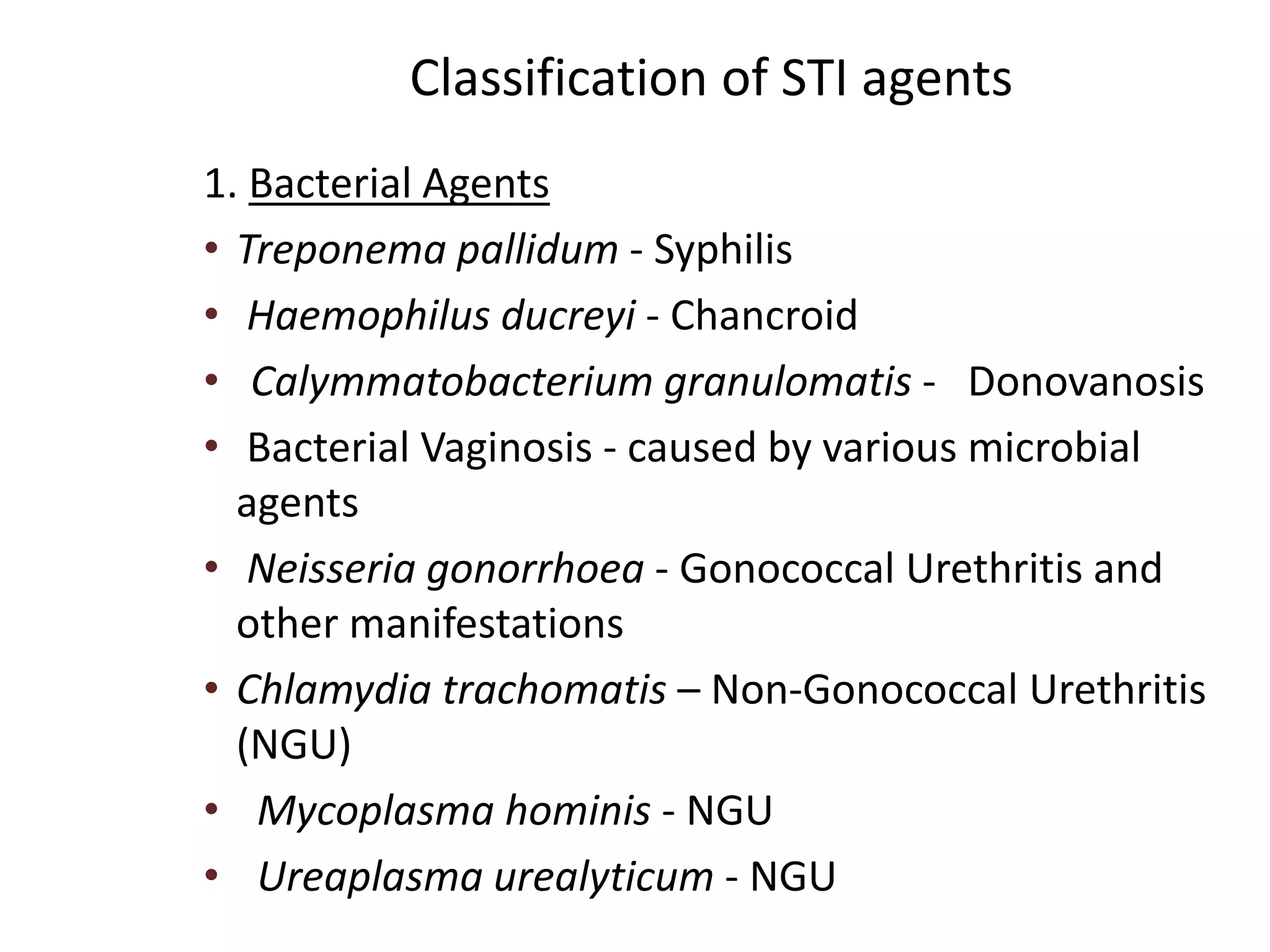
1. Bacterial Agents
• Treponema pallidum - Syphilis
• Haemophilus ducreyi - Chancroid
• Calymmatobacterium granulomatis - Donovanosis
• Bacterial Vaginosis - caused by various microbial
agents
• Neisseria gonorrhoea - Gonococcal Urethritis and
other manifestations
• Chlamydia trachomatis – Non-Gonococcal Urethritis
(NGU)
• Mycoplasma hominis - NGU
• Ureaplasma urealyticum - NGU
Classification of STI agents
2. Viral Agents
• Herpes simplex virus 2 or 1 (HSV 2 & 1) - Herpes
genitalis
• Hepatitis B virus
• Human Papilloma Virus - Warts
• Molluscum Contagiosum Virus- Molluscum
Contagiosum
• Human Immunodeficiency Virus (HIV) - AIDS
Classification of STI agents
3. Protozoal agents
• Entamoeba histolytica – Amoebiasis
• Giardia lamblia – Giardiasis
• Trichomonas vaginalis – Vaginitis
Classification of STI agents
4. Fungal agents
• Candida albicans - Candidal Vaginitis
5. Ectoparasites
• Phthirus pubis - Pediculosis
• Sarcoptes scabiei - Scabies
History
• General history (Demography)
• Contact of an STI
• Onset, character, periodicity, duration & relation to
sexual intercourse & urination
• Anogenital discharge / dysuria / hematuria
• Dyspareunia / pelvic pain
• Ulcers, lumps, rashes or itching
History
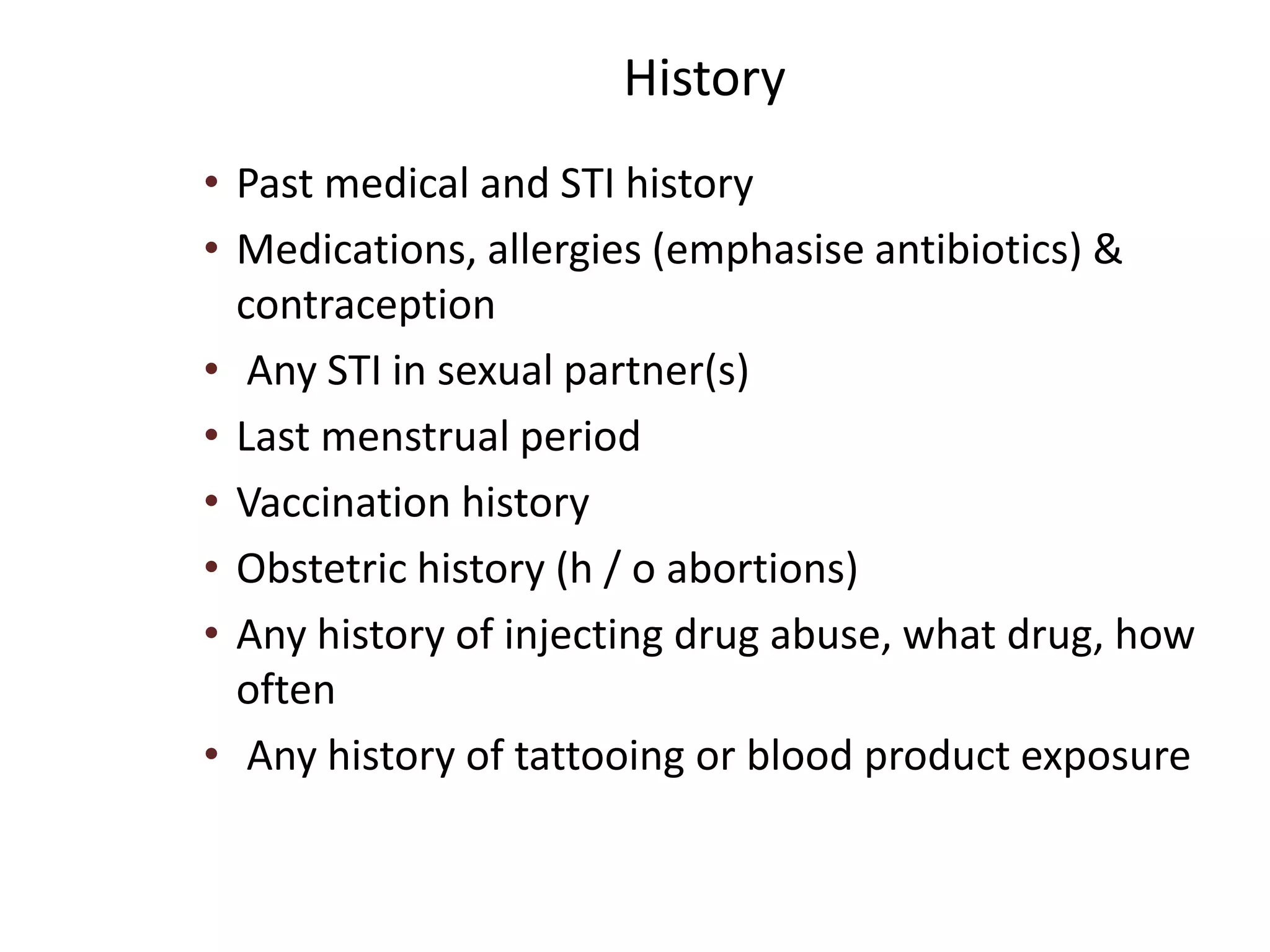
• Past medical and STI history
• Medications, allergies (emphasise antibiotics) &
contraception
• Any STI in sexual partner(s)
• Last menstrual period
• Vaccination history
• Obstetric history (h / o abortions)
• Any history of injecting drug abuse, what drug, how
often
• Any history of tattooing or blood product exposure
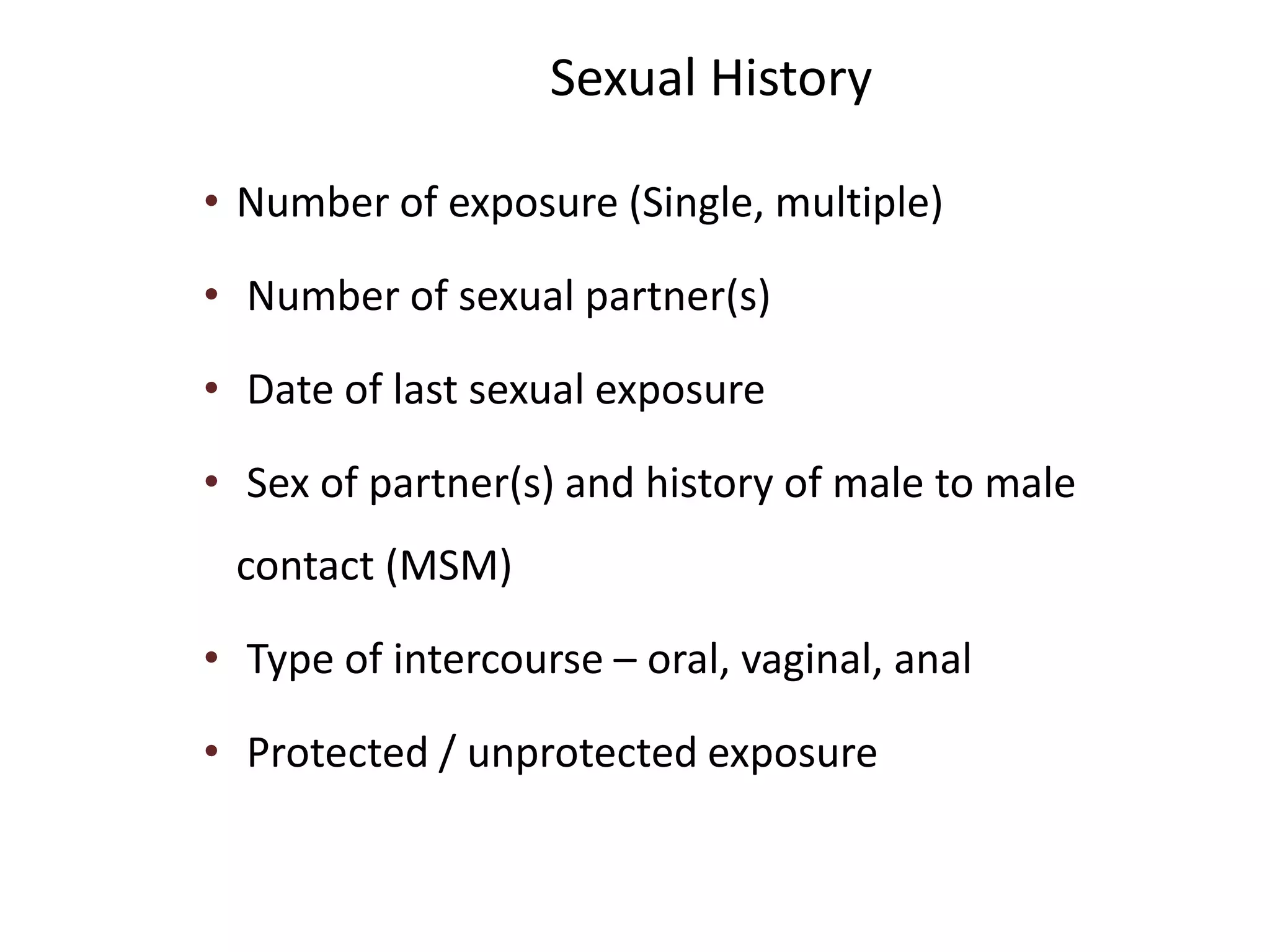
Sexual History
• Number of exposure (Single, multiple)
• Number of sexual partner(s)
• Date of last sexual exposure
• Sex of partner(s) and history of male to male
contact (MSM)
• Type of intercourse – oral, vaginal, anal
• Protected / unprotected exposure
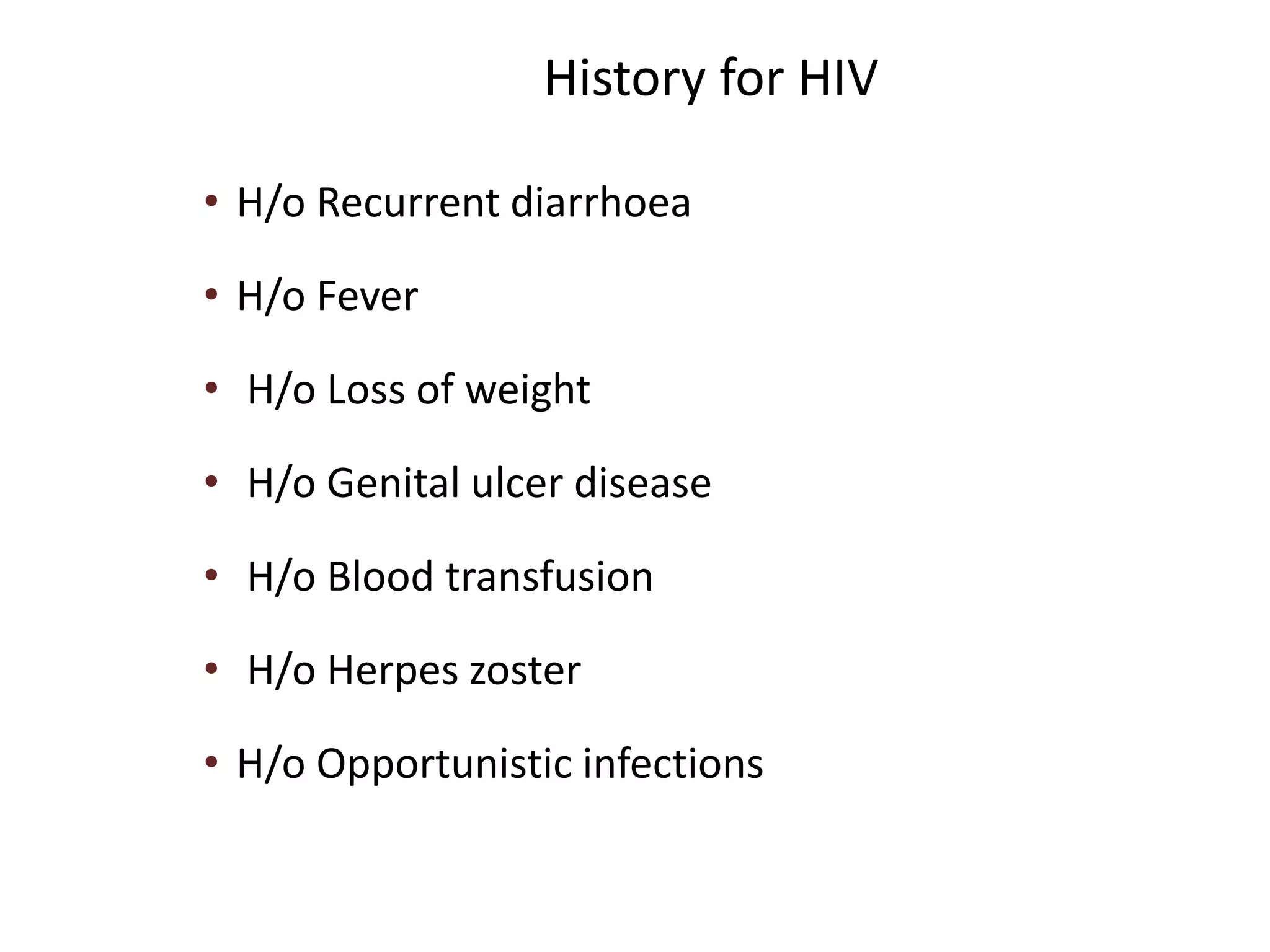
History for HIV
• H/o Recurrent diarrhoea
• H/o Fever
• H/o Loss of weight
• H/o Genital ulcer disease
• H/o Blood transfusion
• H/o Herpes zoster
• H/o Opportunistic infections
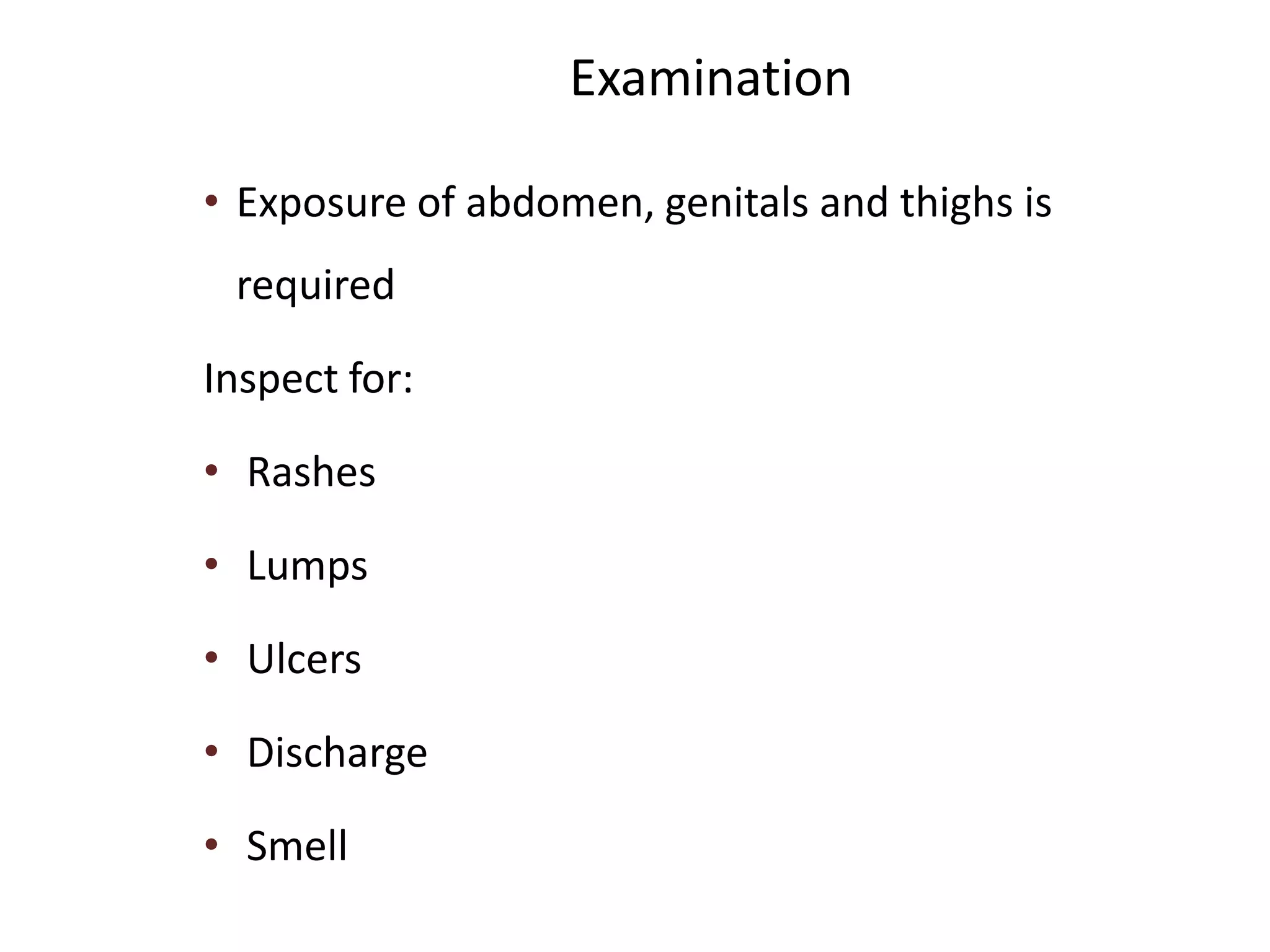
Examination
• Exposure of abdomen, genitals and thighs is
required
Inspect for:
• Rashes
• Lumps
• Ulcers
• Discharge
• Smell
Examination
Inspect for:
• Pubic hair for lice & nits
• Skin of the face, trunk, forearms, palms & the oral
mucosa
• Palpate: Lymph nodes
Examination - Men
Inspection:
• Penis
• External meatus
• Retracted foreskin
• Perianal area
• Lymph nodes examination
• Per-rectal (P / R) examination
• Palpation of scrotum & expression of any discharge
from the urethra.
• Proctoscopy
Examination - Women
Inspection:
• External genitalia
• Perineum
• Perianal area
• Lymph nodes examination
• Speculum examination of vagina & cervix
• Bimanual pelvic examination
• Oral cavity
Systemic Examination
• Cardiovascular
• Respiratory
• Gastrointestinal (liver, spleen)
• Central Nervous
• Urinary
• Musculoskeletal
Syphilis
• Caused by Treponema pallidum subsp. pallidum
• T. pallidum - a fine, motile, spiral organism,
measuring 6-15 μm in length & 0.09 to 0.18 μm in
thickness with characteristic motility
• It has regular spirals which helps in differentiating
from other non-pathogenic treponemes
• Cannot be grown on culture media
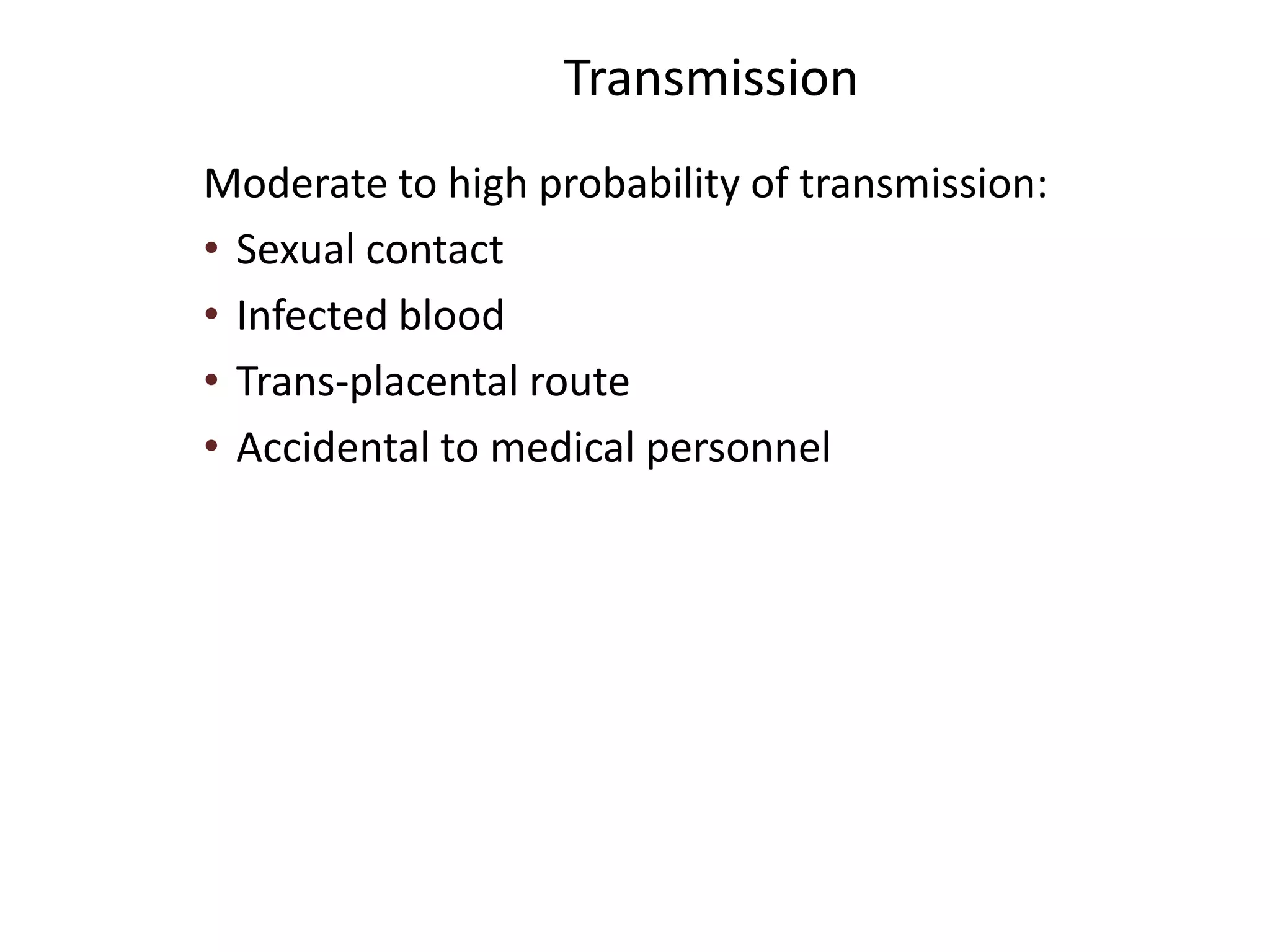
Transmission
Moderate to high probability of transmission:
• Sexual contact
• Infected blood
• Trans-placental route
• Accidental to medical personnel
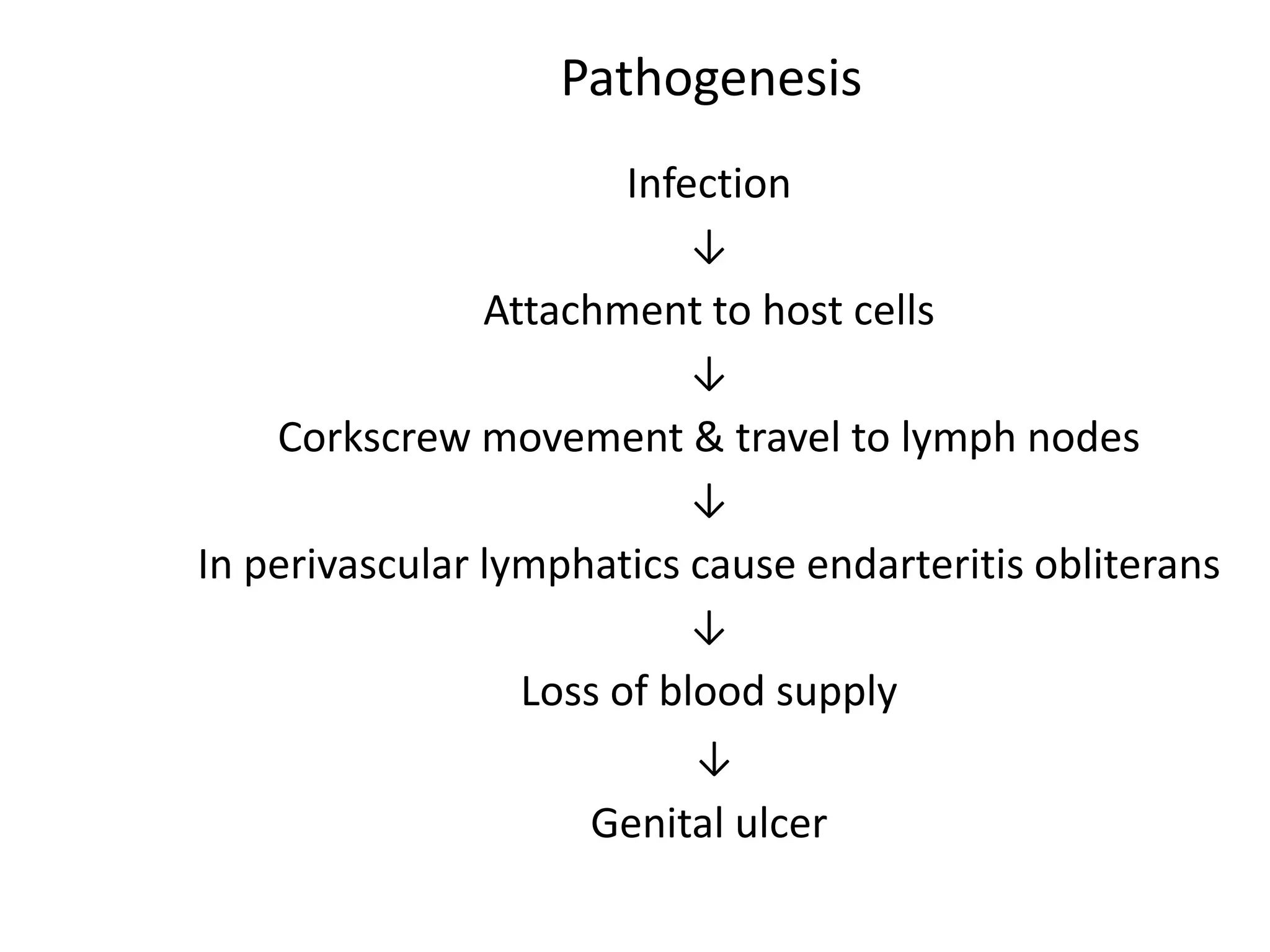
Pathogenesis
Infection
↓
Attachment to host cells
↓
Corkscrew movement & travel to lymph nodes
↓
In perivascular lymphatics cause endarteritis obliterans
↓
Loss of blood supply
↓
Genital ulcer
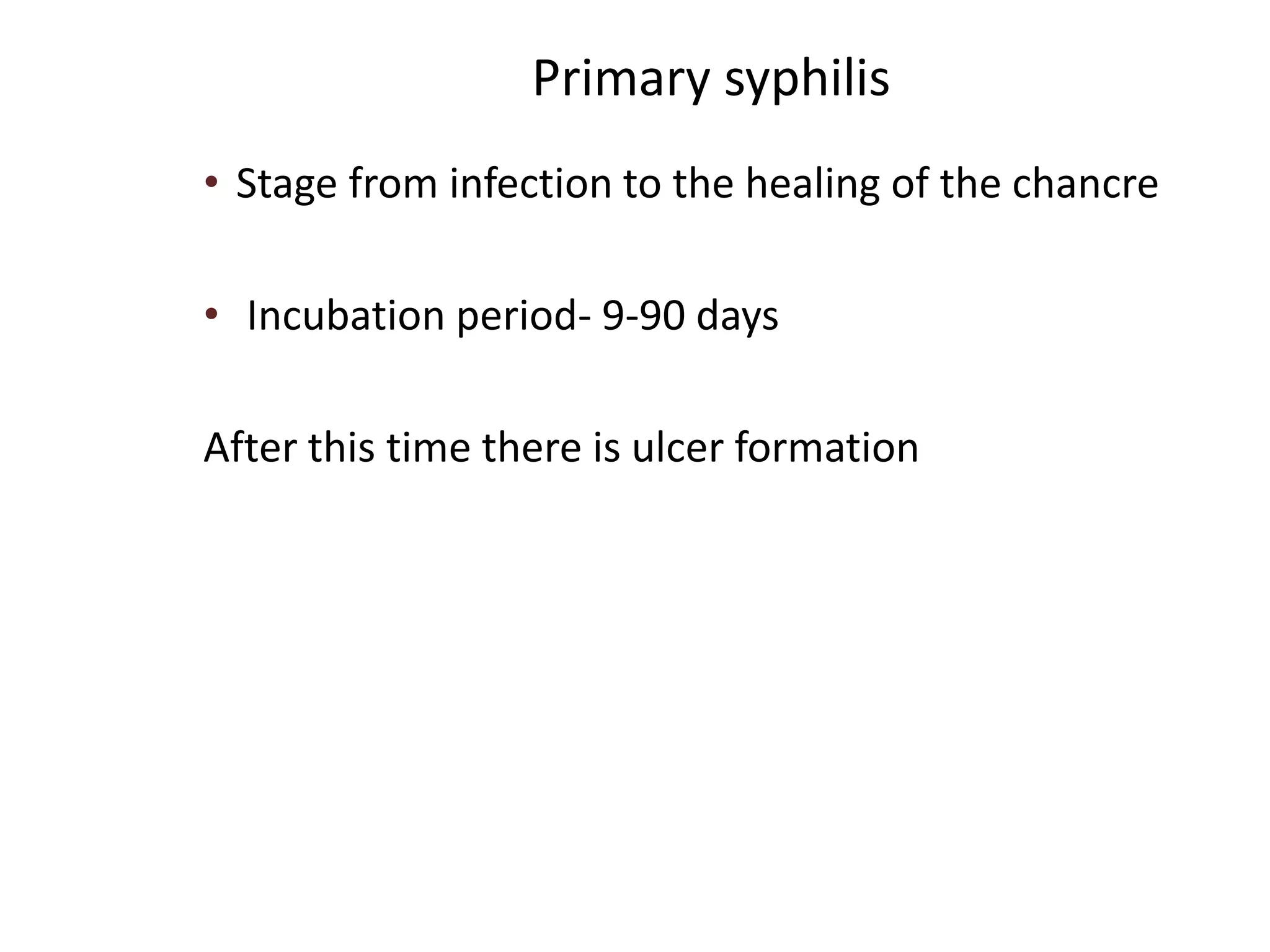
Primary syphilis
• Stage from infection to the healing of the chancre
• Incubation period- 9-90 days
After this time there is ulcer formation
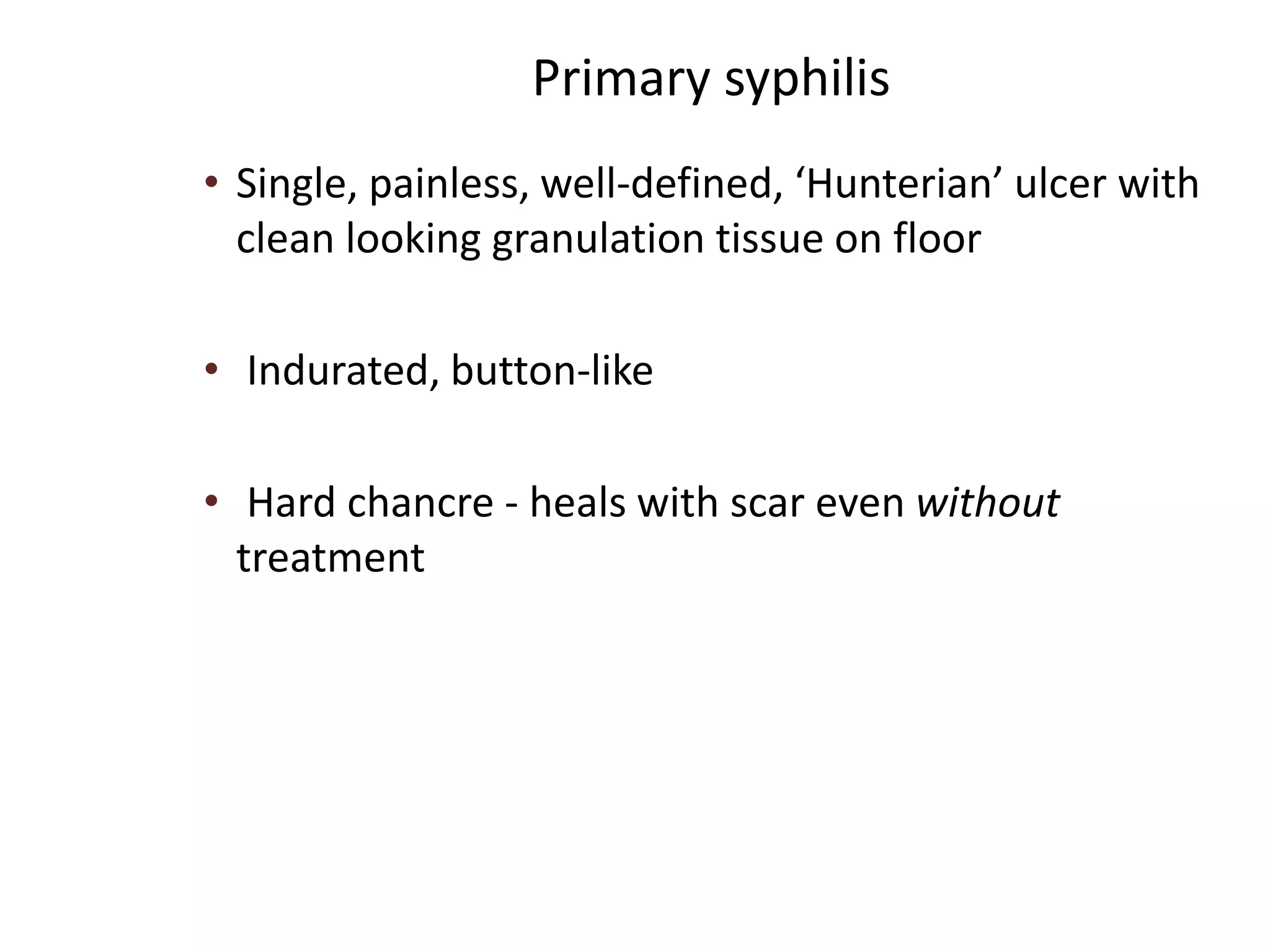
Primary syphilis
• Single, painless, well-defined, ‘Hunterian’ ulcer with
clean looking granulation tissue on floor
• Indurated, button-like
• Hard chancre - heals with scar even without
treatment
Primary syphilis
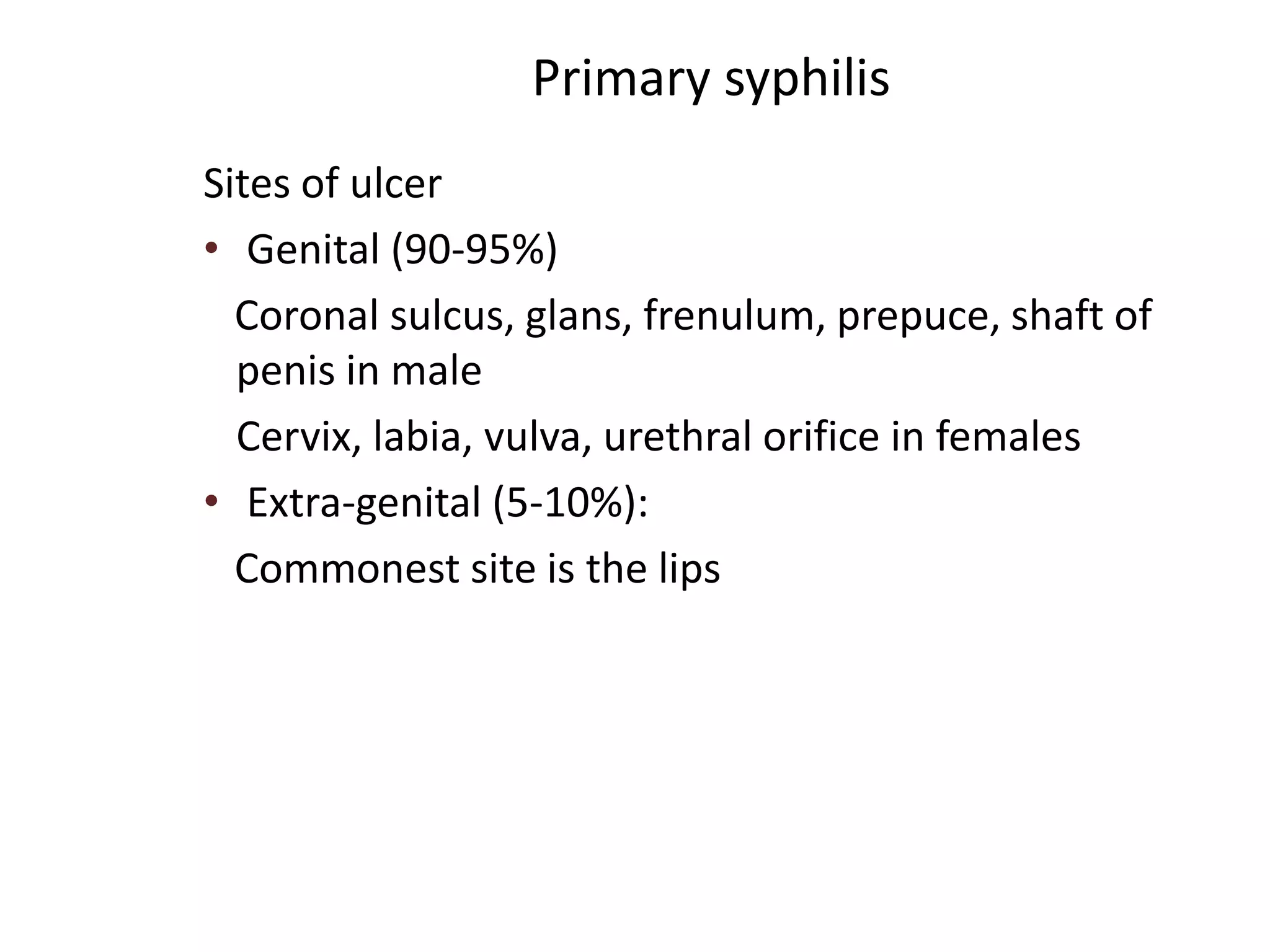
Sites of ulcer
• Genital (90-95%)
Coronal sulcus, glans, frenulum, prepuce, shaft of
penis in male
Cervix, labia, vulva, urethral orifice in females
• Extra-genital (5-10%):
Commonest site is the lips
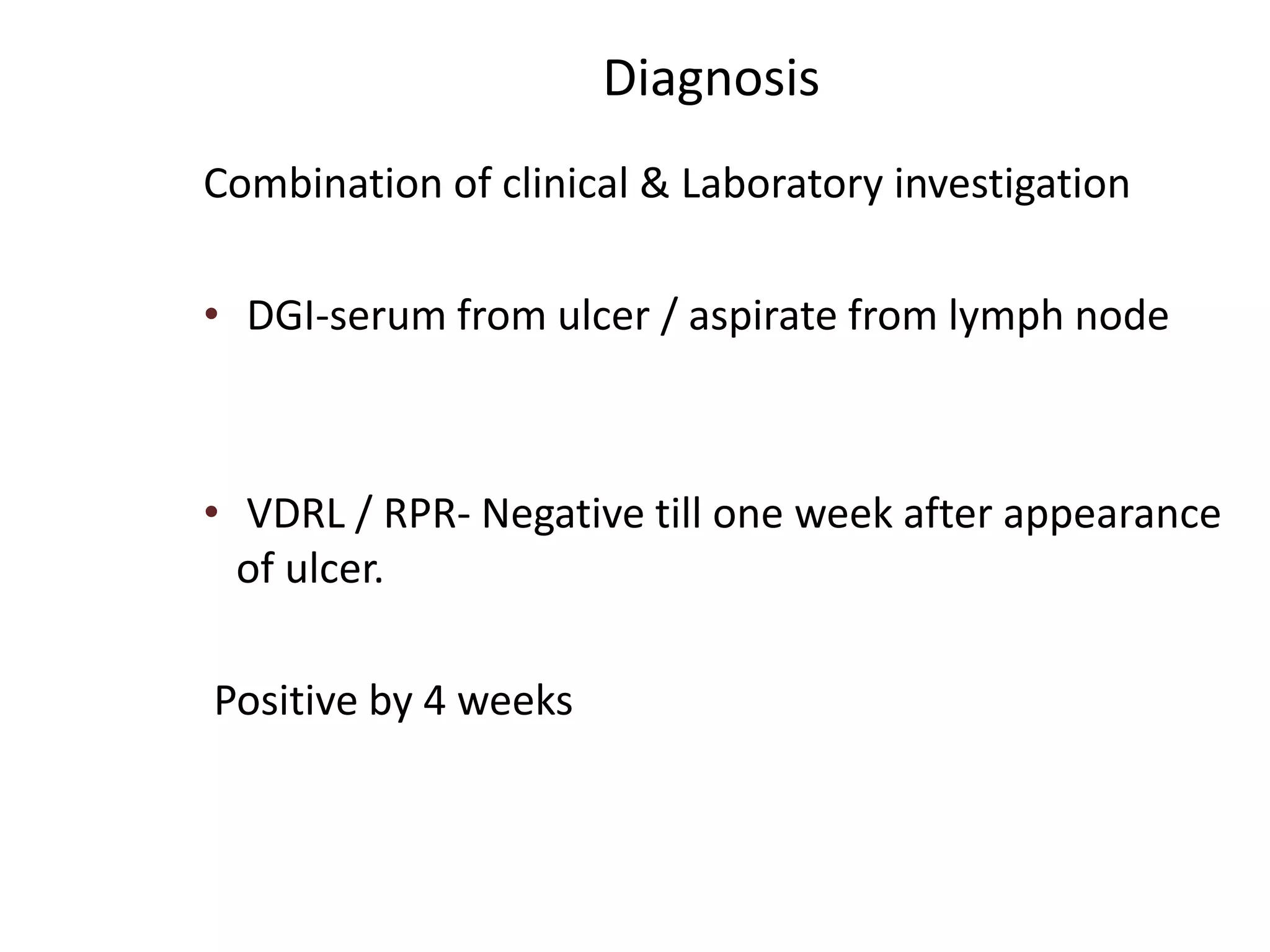
Diagnosis
Combination of clinical & Laboratory investigation
• DGI-serum from ulcer / aspirate from lymph node
• VDRL / RPR- Negative till one week after appearance
of ulcer.
Positive by 4 weeks
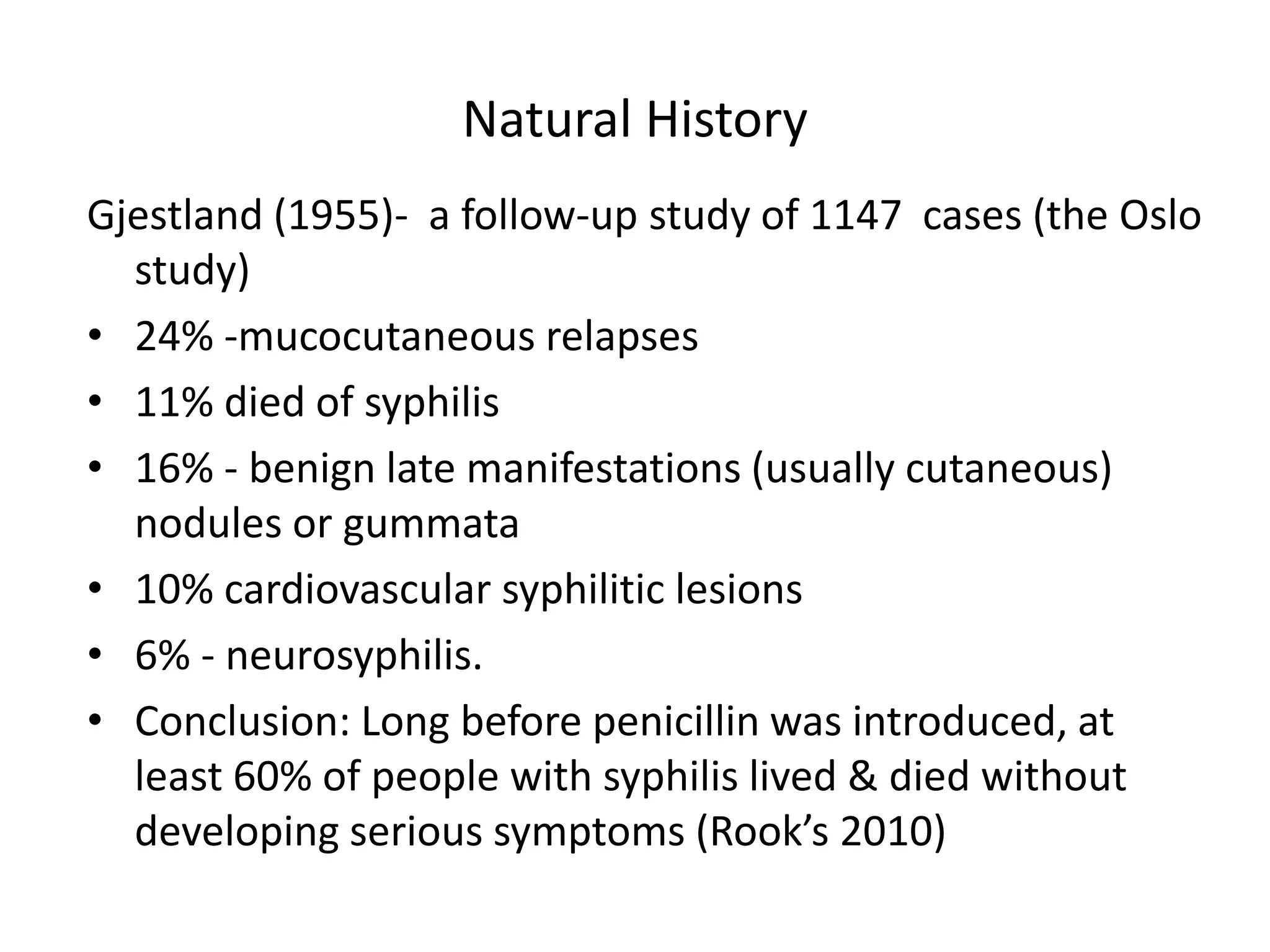
Natural History
Gjestland (1955)- a follow-up study of 1147 cases (the Oslo
study)
• 24% -mucocutaneous relapses
• 11% died of syphilis
• 16% - benign late manifestations (usually cutaneous)
nodules or gummata
• 10% cardiovascular syphilitic lesions
• 6% - neurosyphilis.
• Conclusion: Long before penicillin was introduced, at
least 60% of people with syphilis lived & died without
developing serious symptoms (Rook’s 2010)
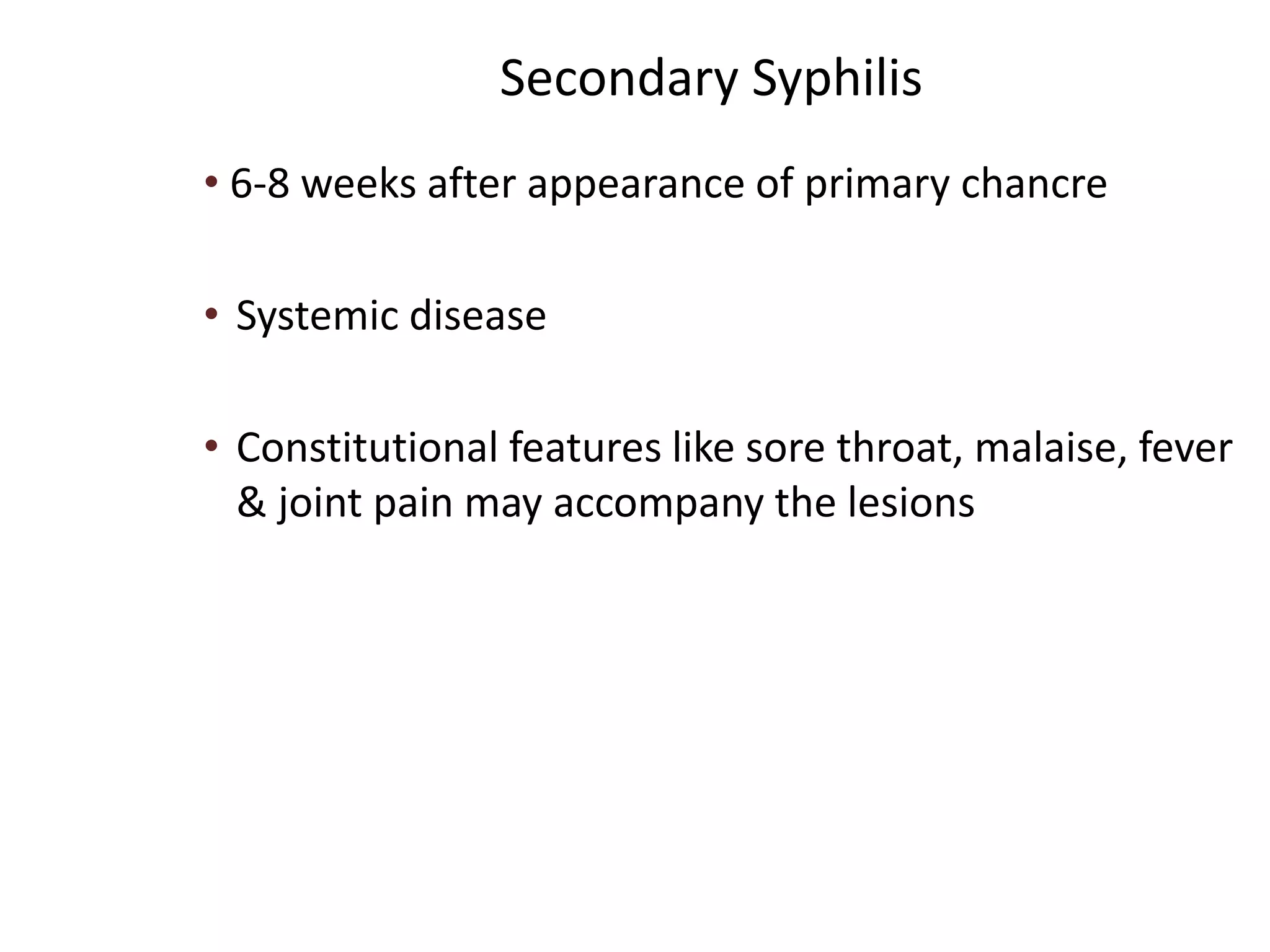
Secondary Syphilis
• 6-8 weeks after appearance of primary chancre
• Systemic disease
• Constitutional features like sore throat, malaise, fever
& joint pain may accompany the lesions
Secondary Syphilis
• Common signs are:
- Skin rash (75-100%)
- Lymphadenopathy (50-86%)
- Mucosal lesions (6-30%)
Secondary Syphilis
Cutaneous:
• Non-itchy lesions generally
• Macular, papular, nodular, pustular, annular lesions
may occur
• Condyloma lata
• Split papules at angles of mouth
• Corona veneris
• Moth eaten alopecia
• Mucosal lesions - mucous patches (snail-track ulcers)
• The ‘great-imitator’
Diagnosis
• VDRL / RPR - Almost always positive
- False negative (in some cases)
- False positive (in some cases)
• Specific tests: TPHA / TPPA may remain reactive
throughout the life
Latent syphilis
• Persistent seropositivity with clinical latency
• Following resolution of primary or secondary stage
latency occurs & continues as such in 60-70% of
patients
• Less than 2 years: Early
• More than 2 years: Late
Tertiary Syphilis
• After a period of latency of up to 20 years,
manifestations of late syphilis can occur
Cutaneous
Characteristic lesion is the gumma
• A deep granulomatous process involving the
epidermis secondarily
• Causes punched out ulcerative lesions with white
necrotic slough on the floor
• On lower leg, scalp, face, sternal area
Tertiary Syphilis
Cardio-vascular:
Develops 10-30 years after infection - so in middle / old
age; more in men
• Aortitis (ascending aorta)
• Aortic aneurysm  sudden death due to rupture
• Coronary ostial stenosis
Tertiary Syphilis
Neuro-syphilis:
• In any patient with syphilis, CSF lymphocytosis, an
elevated CSF protein level or a reactive VDRL test
would suggest neuro-syphilis & must be treated
• Asymptomatic neurosyphilis
• Meningeal neurosyphilis -usually has its onset during
secondary disease; characterized by symptoms of
headache, confusion, nausea & vomiting, neck
stiffness & photophobia. Cranial nerve palsies cause
unilateral or bilateral facial weakness &
sensorineural deafness
• Meningovascular syphilis - occurs most frequently
between 4 and 7 years after infection. The clinical
features of hemiparesis, seizures & aphasia reflect
multiple areas of infarction from diffuse arteritis.
• Gummatous neurosyphilis - results in features typical of a
intracranial space-occupying lesion.
• Parenchymatous syphilis : general paralysis (GPI) from
parenchymatous disease of the brain used to occur 10–
20 years after infection. The onset is insidious with subtle
deterioration in cognitive function & psychiatric
symptoms that mimic those of other mental disorders.
• Tabetic neurosyphilis was the most common form of
neurosyphilis in the pre-antibiotic era, with an onset 15–
25 years after primary infection. The most characteristic
symptom is of lightning pains- sudden paroxysms of
lancinating pain affecting the lower limbs.
• Other early symptoms include paraesthesia, progressive
ataxia, & bowel & bladder dysfunction.
Treatment of Syphilis & STIs
• CDC guidelines: updated regularly and reviewed
thoroughly every 4 years
• Others:
 WHO
 NACO
Syphilis treatment
Primary, Secondary, Early Latent
• Recommended regimen (CDC)
Inj. Benzathine Penicillin G,
2.4 million units IM stat after test dose
Treatment
Late Latent Syphilis
• Recommended regimen
Inj. Benzathine penicillin G 2.4 million units IM AST at
one week intervals x 3 doses
Neurosyphilis
• Recommended regimen
Aqueous crystalline penicillin G, 18-24 million units
daily administered as 3-4 million units IV every 4 hours
for 10-14 days
Alternative regimen for penicillin
allergic patients
• Doxycycline (100 mg) BD
• Erythromycin (500mg) QDS
• Tetracycline (500mg) QDS
Duration of treatment
• Early syphilis : 15 days
• Late syphilis : 30 days
• Pregnancy: Only penicillin G
• If patient allergic: desensitize
• CDC: Guidelines (Dr G. O. Wendel, Jr., et al. N Engl J
Med. 1985)
The Jarisch-Herxheimer reaction
• The Jarisch-Herxheimer reaction is an acute febrile
reaction frequently accompanied by headache, myalgia,
fever, & other symptoms that can occur within the first
24 hours after the initiation of any therapy for syphilis.
• Antipyretics can be used to manage symptoms
• The reaction might induce early labor or cause fetal
distress in pregnant women, but this should not prevent
or delay therapy
Thank you

introduction_stis_syphilis.ppt

  • 1.
    Introduction to Sexually TransmittedInfections (STIs); Syphilis
  • 2.
    Definition The sexually transmittedinfections (STIs; earlier k/a STDs or VDs) are a group of communicable infections / diseases that are transmitted by sexual contact & caused by a wide range of bacterial, viral, protozoal, fungal agents & ectoparasites
  • 3.
    Transformation in STIs •List of pathogens which are sexually transmitted has expanded from ‘5 classical’ venereal diseases (VDs) to include more than 20 agents including viral infections • Shift to clinical syndromes associated with STIs
  • 4.
    Classification of STIagents 1. Bacterial Agents • Treponema pallidum - Syphilis • Haemophilus ducreyi - Chancroid • Calymmatobacterium granulomatis - Donovanosis • Bacterial Vaginosis - caused by various microbial agents • Neisseria gonorrhoea - Gonococcal Urethritis and other manifestations • Chlamydia trachomatis – Non-Gonococcal Urethritis (NGU) • Mycoplasma hominis - NGU • Ureaplasma urealyticum - NGU
  • 5.
    Classification of STIagents 2. Viral Agents • Herpes simplex virus 2 or 1 (HSV 2 & 1) - Herpes genitalis • Hepatitis B virus • Human Papilloma Virus - Warts • Molluscum Contagiosum Virus- Molluscum Contagiosum • Human Immunodeficiency Virus (HIV) - AIDS
  • 6.
    Classification of STIagents 3. Protozoal agents • Entamoeba histolytica – Amoebiasis • Giardia lamblia – Giardiasis • Trichomonas vaginalis – Vaginitis
  • 7.
    Classification of STIagents 4. Fungal agents • Candida albicans - Candidal Vaginitis 5. Ectoparasites • Phthirus pubis - Pediculosis • Sarcoptes scabiei - Scabies
  • 8.
    History • General history(Demography) • Contact of an STI • Onset, character, periodicity, duration & relation to sexual intercourse & urination • Anogenital discharge / dysuria / hematuria • Dyspareunia / pelvic pain • Ulcers, lumps, rashes or itching
  • 9.
    History • Past medicaland STI history • Medications, allergies (emphasise antibiotics) & contraception • Any STI in sexual partner(s) • Last menstrual period • Vaccination history • Obstetric history (h / o abortions) • Any history of injecting drug abuse, what drug, how often • Any history of tattooing or blood product exposure
  • 10.
    Sexual History • Numberof exposure (Single, multiple) • Number of sexual partner(s) • Date of last sexual exposure • Sex of partner(s) and history of male to male contact (MSM) • Type of intercourse – oral, vaginal, anal • Protected / unprotected exposure
  • 11.
    History for HIV •H/o Recurrent diarrhoea • H/o Fever • H/o Loss of weight • H/o Genital ulcer disease • H/o Blood transfusion • H/o Herpes zoster • H/o Opportunistic infections
  • 12.
    Examination • Exposure ofabdomen, genitals and thighs is required Inspect for: • Rashes • Lumps • Ulcers • Discharge • Smell
  • 13.
    Examination Inspect for: • Pubichair for lice & nits • Skin of the face, trunk, forearms, palms & the oral mucosa • Palpate: Lymph nodes
  • 14.
    Examination - Men Inspection: •Penis • External meatus • Retracted foreskin • Perianal area • Lymph nodes examination • Per-rectal (P / R) examination • Palpation of scrotum & expression of any discharge from the urethra. • Proctoscopy
  • 15.
    Examination - Women Inspection: •External genitalia • Perineum • Perianal area • Lymph nodes examination • Speculum examination of vagina & cervix • Bimanual pelvic examination • Oral cavity
  • 16.
    Systemic Examination • Cardiovascular •Respiratory • Gastrointestinal (liver, spleen) • Central Nervous • Urinary • Musculoskeletal
  • 17.
    Syphilis • Caused byTreponema pallidum subsp. pallidum • T. pallidum - a fine, motile, spiral organism, measuring 6-15 μm in length & 0.09 to 0.18 μm in thickness with characteristic motility • It has regular spirals which helps in differentiating from other non-pathogenic treponemes • Cannot be grown on culture media
  • 18.
    Transmission Moderate to highprobability of transmission: • Sexual contact • Infected blood • Trans-placental route • Accidental to medical personnel
  • 19.
    Pathogenesis Infection ↓ Attachment to hostcells ↓ Corkscrew movement & travel to lymph nodes ↓ In perivascular lymphatics cause endarteritis obliterans ↓ Loss of blood supply ↓ Genital ulcer
  • 20.
    Primary syphilis • Stagefrom infection to the healing of the chancre • Incubation period- 9-90 days After this time there is ulcer formation
  • 21.
    Primary syphilis • Single,painless, well-defined, ‘Hunterian’ ulcer with clean looking granulation tissue on floor • Indurated, button-like • Hard chancre - heals with scar even without treatment
  • 22.
    Primary syphilis Sites ofulcer • Genital (90-95%) Coronal sulcus, glans, frenulum, prepuce, shaft of penis in male Cervix, labia, vulva, urethral orifice in females • Extra-genital (5-10%): Commonest site is the lips
  • 23.
    Diagnosis Combination of clinical& Laboratory investigation • DGI-serum from ulcer / aspirate from lymph node • VDRL / RPR- Negative till one week after appearance of ulcer. Positive by 4 weeks
  • 24.
    Natural History Gjestland (1955)-a follow-up study of 1147 cases (the Oslo study) • 24% -mucocutaneous relapses • 11% died of syphilis • 16% - benign late manifestations (usually cutaneous) nodules or gummata • 10% cardiovascular syphilitic lesions • 6% - neurosyphilis. • Conclusion: Long before penicillin was introduced, at least 60% of people with syphilis lived & died without developing serious symptoms (Rook’s 2010)
  • 25.
    Secondary Syphilis • 6-8weeks after appearance of primary chancre • Systemic disease • Constitutional features like sore throat, malaise, fever & joint pain may accompany the lesions
  • 26.
    Secondary Syphilis • Commonsigns are: - Skin rash (75-100%) - Lymphadenopathy (50-86%) - Mucosal lesions (6-30%)
  • 27.
    Secondary Syphilis Cutaneous: • Non-itchylesions generally • Macular, papular, nodular, pustular, annular lesions may occur • Condyloma lata • Split papules at angles of mouth • Corona veneris • Moth eaten alopecia • Mucosal lesions - mucous patches (snail-track ulcers) • The ‘great-imitator’
  • 28.
    Diagnosis • VDRL /RPR - Almost always positive - False negative (in some cases) - False positive (in some cases) • Specific tests: TPHA / TPPA may remain reactive throughout the life
  • 29.
    Latent syphilis • Persistentseropositivity with clinical latency • Following resolution of primary or secondary stage latency occurs & continues as such in 60-70% of patients • Less than 2 years: Early • More than 2 years: Late
  • 30.
    Tertiary Syphilis • Aftera period of latency of up to 20 years, manifestations of late syphilis can occur Cutaneous Characteristic lesion is the gumma • A deep granulomatous process involving the epidermis secondarily • Causes punched out ulcerative lesions with white necrotic slough on the floor • On lower leg, scalp, face, sternal area
  • 31.
    Tertiary Syphilis Cardio-vascular: Develops 10-30years after infection - so in middle / old age; more in men • Aortitis (ascending aorta) • Aortic aneurysm  sudden death due to rupture • Coronary ostial stenosis
  • 32.
    Tertiary Syphilis Neuro-syphilis: • Inany patient with syphilis, CSF lymphocytosis, an elevated CSF protein level or a reactive VDRL test would suggest neuro-syphilis & must be treated • Asymptomatic neurosyphilis • Meningeal neurosyphilis -usually has its onset during secondary disease; characterized by symptoms of headache, confusion, nausea & vomiting, neck stiffness & photophobia. Cranial nerve palsies cause unilateral or bilateral facial weakness & sensorineural deafness
  • 33.
    • Meningovascular syphilis- occurs most frequently between 4 and 7 years after infection. The clinical features of hemiparesis, seizures & aphasia reflect multiple areas of infarction from diffuse arteritis. • Gummatous neurosyphilis - results in features typical of a intracranial space-occupying lesion.
  • 34.
    • Parenchymatous syphilis: general paralysis (GPI) from parenchymatous disease of the brain used to occur 10– 20 years after infection. The onset is insidious with subtle deterioration in cognitive function & psychiatric symptoms that mimic those of other mental disorders.
  • 35.
    • Tabetic neurosyphiliswas the most common form of neurosyphilis in the pre-antibiotic era, with an onset 15– 25 years after primary infection. The most characteristic symptom is of lightning pains- sudden paroxysms of lancinating pain affecting the lower limbs. • Other early symptoms include paraesthesia, progressive ataxia, & bowel & bladder dysfunction.
  • 36.
    Treatment of Syphilis& STIs • CDC guidelines: updated regularly and reviewed thoroughly every 4 years • Others:  WHO  NACO
  • 37.
    Syphilis treatment Primary, Secondary,Early Latent • Recommended regimen (CDC) Inj. Benzathine Penicillin G, 2.4 million units IM stat after test dose
  • 38.
    Treatment Late Latent Syphilis •Recommended regimen Inj. Benzathine penicillin G 2.4 million units IM AST at one week intervals x 3 doses
  • 39.
    Neurosyphilis • Recommended regimen Aqueouscrystalline penicillin G, 18-24 million units daily administered as 3-4 million units IV every 4 hours for 10-14 days
  • 40.
    Alternative regimen forpenicillin allergic patients • Doxycycline (100 mg) BD • Erythromycin (500mg) QDS • Tetracycline (500mg) QDS Duration of treatment • Early syphilis : 15 days • Late syphilis : 30 days
  • 41.
    • Pregnancy: Onlypenicillin G • If patient allergic: desensitize
  • 42.
    • CDC: Guidelines(Dr G. O. Wendel, Jr., et al. N Engl J Med. 1985)
  • 43.
    The Jarisch-Herxheimer reaction •The Jarisch-Herxheimer reaction is an acute febrile reaction frequently accompanied by headache, myalgia, fever, & other symptoms that can occur within the first 24 hours after the initiation of any therapy for syphilis. • Antipyretics can be used to manage symptoms • The reaction might induce early labor or cause fetal distress in pregnant women, but this should not prevent or delay therapy
  • 44.