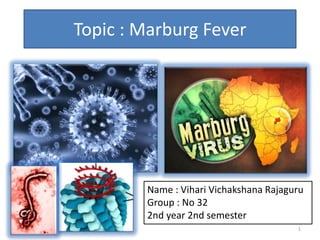
Topic : Marburg Fever
Name : Vihari Vichakshana Rajaguru
Group : No 32
2nd year 2nd semester
1
Introduction
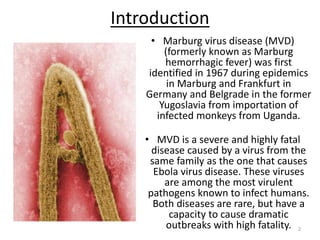
• Marburg virus disease (MVD)
(formerly known as Marburg
hemorrhagic fever) was first
identified in 1967 during epidemics
in Marburg and Frankfurt in
Germany and Belgrade in the former
Yugoslavia from importation of
infected monkeys from Uganda.
• MVD is a severe and highly fatal
disease caused by a virus from the
same family as the one that causes
Ebola virus disease. These viruses
are among the most virulent
pathogens known to infect humans.
Both diseases are rare, but have a
capacity to cause dramatic
outbreaks with high fatality. 2
History
• Illness caused by Marburg virus
begins abruptly, with severe
headache and severe malaise.
Many patients develop severe
hemorrhagic manifestations
between days 5 and 7, and fatal
cases usually have some form of
bleeding, often from multiple
sites.
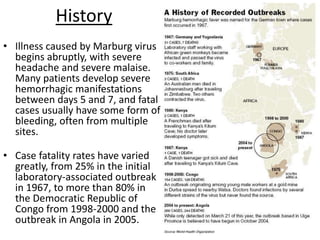
• Case fatality rates have varied
greatly, from 25% in the initial
laboratory-associated outbreak
in 1967, to more than 80% in
the Democratic Republic of
Congo from 1998-2000 and the
outbreak in Angola in 2005.
3
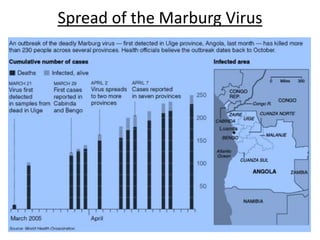
Spread of the Marburg Virus
4
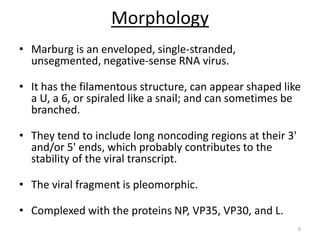
General Characteristics
5
• Order : Mononegavirales
• Family : Filoviradae
• Genus : Marburgvirus
• Species : Marburg
marburgvirus
• Synonyms : Marburg
disease, Marburg
hemorrhagic fever, African
hemorrhagic fever, and
green monkey disease.
( it has the same structural properties
as the Ebola virus)
Morphology
• Marburg is an enveloped, single-stranded,
unsegmented, negative-sense RNA virus.
• It has the filamentous structure, can appear shaped like
a U, a 6, or spiraled like a snail; and can sometimes be
branched.
• They tend to include long noncoding regions at their 3'
and/or 5' ends, which probably contributes to the
stability of the viral transcript.
• The viral fragment is pleomorphic.
• Complexed with the proteins NP, VP35, VP30, and L.
6
PATHOGENICITY/TOXICITY
• A rare, severe hemorrhagic fever in humans and non-
human primates characterized by a sudden onset with
high fever, chills, headache, myalgia, and maculopapular
rash, possibly followed by vomiting, chest pain, sore
throat, abdominal pain, and diarrhea.
• Symptoms become increasingly severe and may include
inflammation of the pancreas, jaundice, severe weight
loss, delirium, shock, liver failure, massive hemorrhage,
and multi-organ dysfunction. Marburg disease has a
fatality rate of approximately 25 %.
7
Vector
• The natural reservoir for the virus is
unknown. Epidemiologists have tested bats,
monkeys, spiders and ticks for the virus, but
were not able to acquire definitive
data. Common factors indicate that the
natural reservoir is part of rural Africa.
8
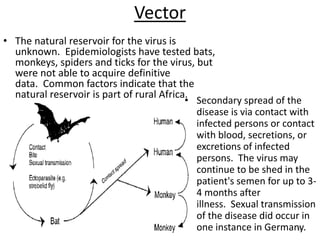
• Secondary spread of the
disease is via contact with
infected persons or contact
with blood, secretions, or
excretions of infected
persons. The virus may
continue to be shed in the
patient's semen for up to 3-
4 months after
illness. Sexual transmission
of the disease did occur in
one instance in Germany.
Mechanism
• As with Ebola, the exact mechanism of Marburg is
unknown. However, virion surface spikes are made soley of
large glycoprotein. It is presumed that, as with other
negative-strand RNA viruses, these surface spikes bind to
receptors on the host cell and mediate entry into susceptible
cells.
• The Marburg virus has 22 potential N-linked glycosylation
sites on its surface. Viral replication takes place in the
cytoplasm, and envelopment is the result of budding
preformed nucleocapsids. Systemically, the virus involves the
liver, lymphoid organs, and kidneys.
• Incubation period : Usually 5-7 days, but can range from 3-10
days.
9
10
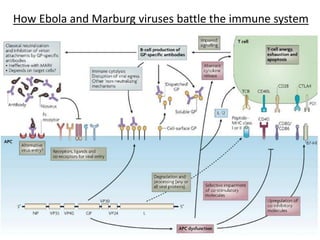
How Ebola and Marburg viruses battle the immune system
Symptoms
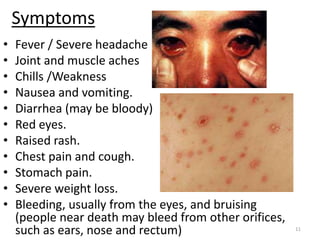
• Fever / Severe headache
• Joint and muscle aches
• Chills /Weakness
• Nausea and vomiting.
• Diarrhea (may be bloody)
• Red eyes.
• Raised rash.
• Chest pain and cough.
• Stomach pain.
• Severe weight loss.
• Bleeding, usually from the eyes, and bruising
(people near death may bleed from other orifices,
such as ears, nose and rectum) 11
Diagnosis
• For patients presenting with Marburg
symptoms, initial possible diagnoses can
include malaria and tyhpoid fever.
• As with Ebola, diagnosis of Marburg virus is
confirmed by IgG ELISA, although IgM ELISA can
be used to distinguish acute infections from old
infections. IFA results can be misleading.
• Electron microscopy is useful in diagnosing
filovirus infection, but does not help distinguish
Marburg from Ebola.
12
• Laboratory findings include:
- Maculopapular rash, which is distinctive of Marburg,
Ebola, dengue, and lassa.
- Reduction in the number of lymphocytes
(lymphopenia) and increased number of neutrophilic
leukocytes (neutrophilia).
- Thrombocytopenia and abnormal platelet
aggregation.
- Serum enzyme levels are elevated; AST is usually
higher than ALT.
- Alkaline phosphatase and bilirubin levels are usually
normal or only mildly elevated.
• Marburg virus can be clearly diagnosed from specimens
of deceased patients via immunohistochemistry, virus
isolation, or PCR (polymerase chain reaction) of blood or
tissue specimens.
13
Treatment & prevention
• Supportive therapy (there is no specific treatment for
Marburg hemorrhagic fever. However, the virus itself is
sensitive to lipid solvents, detergents, commercial
hypochlorite disinfectants, and phenolic disinfectants. The
virus can also be destroyed by ultraviolet and gamma
radiation.
• Vaccine. None. As with exposure to other filoviruses,
exposure to Marburg does not confer subsequent
immunity. The antibody response in convalescent patients
does not neutralize or protect against subsequent
infection by Marburg virus.
14
References :
i. http://www.cdc.gov/
Centers for Disease Control and Prevention (CDC). (2009). Imported case
of Marburg hemorrhagic fever - Colorado, 2008. MMWR.Morbidity and
Mortality Weekly Report, 58 (49), 1377-1381.
ii. Control of Communicable Diseases Manual (18th ed., pp. 180-182).
Washington, D.C.: American Public Health Association.
iii. World Health Organization. (2005). WHO update on current reported
Marburg cases in Angola. Retrieved 4/30, 2010 .
iv. Bausch, D. G., Sprecher, A. G., Jeffs, B., & Boumandouki, P. (2008).
Treatment of Marburg and Ebola hemorrhagic fevers: a strategy for
testing new drugs and vaccines under outbreak conditions. Antiviral
Research, 78 (1), 150-161.
15
Thank you !
16

Marburg disease

  • 1.
    Topic : MarburgFever Name : Vihari Vichakshana Rajaguru Group : No 32 2nd year 2nd semester 1
  • 2.
    Introduction • Marburg virusdisease (MVD) (formerly known as Marburg hemorrhagic fever) was first identified in 1967 during epidemics in Marburg and Frankfurt in Germany and Belgrade in the former Yugoslavia from importation of infected monkeys from Uganda. • MVD is a severe and highly fatal disease caused by a virus from the same family as the one that causes Ebola virus disease. These viruses are among the most virulent pathogens known to infect humans. Both diseases are rare, but have a capacity to cause dramatic outbreaks with high fatality. 2
  • 3.
    History • Illness causedby Marburg virus begins abruptly, with severe headache and severe malaise. Many patients develop severe hemorrhagic manifestations between days 5 and 7, and fatal cases usually have some form of bleeding, often from multiple sites. • Case fatality rates have varied greatly, from 25% in the initial laboratory-associated outbreak in 1967, to more than 80% in the Democratic Republic of Congo from 1998-2000 and the outbreak in Angola in 2005. 3
  • 4.
    Spread of theMarburg Virus 4
  • 5.
    General Characteristics 5 • Order: Mononegavirales • Family : Filoviradae • Genus : Marburgvirus • Species : Marburg marburgvirus • Synonyms : Marburg disease, Marburg hemorrhagic fever, African hemorrhagic fever, and green monkey disease. ( it has the same structural properties as the Ebola virus)
  • 6.
    Morphology • Marburg isan enveloped, single-stranded, unsegmented, negative-sense RNA virus. • It has the filamentous structure, can appear shaped like a U, a 6, or spiraled like a snail; and can sometimes be branched. • They tend to include long noncoding regions at their 3' and/or 5' ends, which probably contributes to the stability of the viral transcript. • The viral fragment is pleomorphic. • Complexed with the proteins NP, VP35, VP30, and L. 6
  • 7.
    PATHOGENICITY/TOXICITY • A rare,severe hemorrhagic fever in humans and non- human primates characterized by a sudden onset with high fever, chills, headache, myalgia, and maculopapular rash, possibly followed by vomiting, chest pain, sore throat, abdominal pain, and diarrhea. • Symptoms become increasingly severe and may include inflammation of the pancreas, jaundice, severe weight loss, delirium, shock, liver failure, massive hemorrhage, and multi-organ dysfunction. Marburg disease has a fatality rate of approximately 25 %. 7
  • 8.
    Vector • The naturalreservoir for the virus is unknown. Epidemiologists have tested bats, monkeys, spiders and ticks for the virus, but were not able to acquire definitive data. Common factors indicate that the natural reservoir is part of rural Africa. 8 • Secondary spread of the disease is via contact with infected persons or contact with blood, secretions, or excretions of infected persons. The virus may continue to be shed in the patient's semen for up to 3- 4 months after illness. Sexual transmission of the disease did occur in one instance in Germany.
  • 9.
    Mechanism • As withEbola, the exact mechanism of Marburg is unknown. However, virion surface spikes are made soley of large glycoprotein. It is presumed that, as with other negative-strand RNA viruses, these surface spikes bind to receptors on the host cell and mediate entry into susceptible cells. • The Marburg virus has 22 potential N-linked glycosylation sites on its surface. Viral replication takes place in the cytoplasm, and envelopment is the result of budding preformed nucleocapsids. Systemically, the virus involves the liver, lymphoid organs, and kidneys. • Incubation period : Usually 5-7 days, but can range from 3-10 days. 9
  • 10.
    10 How Ebola andMarburg viruses battle the immune system
  • 11.
    Symptoms • Fever /Severe headache • Joint and muscle aches • Chills /Weakness • Nausea and vomiting. • Diarrhea (may be bloody) • Red eyes. • Raised rash. • Chest pain and cough. • Stomach pain. • Severe weight loss. • Bleeding, usually from the eyes, and bruising (people near death may bleed from other orifices, such as ears, nose and rectum) 11
  • 12.
    Diagnosis • For patientspresenting with Marburg symptoms, initial possible diagnoses can include malaria and tyhpoid fever. • As with Ebola, diagnosis of Marburg virus is confirmed by IgG ELISA, although IgM ELISA can be used to distinguish acute infections from old infections. IFA results can be misleading. • Electron microscopy is useful in diagnosing filovirus infection, but does not help distinguish Marburg from Ebola. 12
  • 13.
    • Laboratory findingsinclude: - Maculopapular rash, which is distinctive of Marburg, Ebola, dengue, and lassa. - Reduction in the number of lymphocytes (lymphopenia) and increased number of neutrophilic leukocytes (neutrophilia). - Thrombocytopenia and abnormal platelet aggregation. - Serum enzyme levels are elevated; AST is usually higher than ALT. - Alkaline phosphatase and bilirubin levels are usually normal or only mildly elevated. • Marburg virus can be clearly diagnosed from specimens of deceased patients via immunohistochemistry, virus isolation, or PCR (polymerase chain reaction) of blood or tissue specimens. 13
  • 14.
    Treatment & prevention •Supportive therapy (there is no specific treatment for Marburg hemorrhagic fever. However, the virus itself is sensitive to lipid solvents, detergents, commercial hypochlorite disinfectants, and phenolic disinfectants. The virus can also be destroyed by ultraviolet and gamma radiation. • Vaccine. None. As with exposure to other filoviruses, exposure to Marburg does not confer subsequent immunity. The antibody response in convalescent patients does not neutralize or protect against subsequent infection by Marburg virus. 14
  • 15.
    References : i. http://www.cdc.gov/ Centersfor Disease Control and Prevention (CDC). (2009). Imported case of Marburg hemorrhagic fever - Colorado, 2008. MMWR.Morbidity and Mortality Weekly Report, 58 (49), 1377-1381. ii. Control of Communicable Diseases Manual (18th ed., pp. 180-182). Washington, D.C.: American Public Health Association. iii. World Health Organization. (2005). WHO update on current reported Marburg cases in Angola. Retrieved 4/30, 2010 . iv. Bausch, D. G., Sprecher, A. G., Jeffs, B., & Boumandouki, P. (2008). Treatment of Marburg and Ebola hemorrhagic fevers: a strategy for testing new drugs and vaccines under outbreak conditions. Antiviral Research, 78 (1), 150-161. 15
  • 16.

Editor's Notes

  • #3 Marburg is named after the German town in which some of the first cases were described.
  • #4 Malaise - a general feeling of discomfort, illness, or uneasiness whose exact cause is difficult to identify. hemorrhagic - a condition in which a person bleeds too much and cannot stop the flow of blood.
  • #5 Endemic areas appear to be Central and East Africa.  One particularly "fertile" area is on the border of Kenya and Uganda, in the Mt. Elgon region.  In particular, visitors to the Kitum cave on top of Mt. Elgon have contracted Marburg.  Marburg may also have a natural reservoir in Zimbabwe.
  • #7 The virus is classified as a biosafety level 4 agent because of its extreme pathogenicity and the lack of a vaccine or antiviral drug.
  • #9 In the laboratory, the virus displays some capability of infection through small-particle aerosols; however, airborne spread among humans has not been clearly demonstrated
  • #12 Maculopapular rash
  • #14 Virus isolation may also be performed but should only be done in a high containment laboratory with good laboratory practices.
  • #15 Mortality Rates.  The case fatality rate is approximately 25%. Experimental treatments are validated in non-human primates models, but have never been tried in humans. On Nov. 13, 2014, the Ministry of Health of Uganda declared Uganda free of Marburg virus