Sexually Transmitted
Diseases
What is a Sexually Transmitted
Infection or STI?
 STI’s are infections that are spread
from person to person through
intimate sexual contact.
 STI’s are dangerous because they are
easily spread and it is hard to tell just
by looking who has an STI.
 1 in 4 sexually active teens has an
STI.
STDs and Pregnancy
 It is important for pregnant women to be checked
for STDs.
 They can cause women to go into labor too early
and may complicate delivery.
 Many STDs can be passed from mother to baby
during pregnancy, childbirth, or after the baby is
born.
 STDs effects on babies can include stillbirth, low
birth weight, neurologic problems, blindness, liver
disease, and serious infection.
 But there are treatments to minimize these risks.
Treatment during pregnancy can cure some
STDs and lower the risk of passing the infection
to your baby.
Maternal-Fetal Transmission
Maternal-Infant Transmission
 HIV
 Herpes
 Gonorrhea
 Chlamydia
 Syphilis
5
STDs of Concern
 Actually, all of them
 “Sores” (ulcers)
◦ Syphilis
◦ Genital herpes (HSV-2, HSV-1)
◦ Others uncommon in the U.S.
 Lymphogranuloma venereum
 Chancroid
 Granuloma inguinale
Background
6
STDs of Concern (continued)
 “Drips” (discharges)
◦ Gonorrhea
◦ Chlamydia
◦ Nongonococcal urethritis / mucopurulent
cervicitis
◦ Trichomonas vaginitis / urethritis
◦ Candidiasis (vulvovaginal, less problems in men)
 Other major concerns
◦ Genital HPV (especially type 16, 18) and
Cervical Cancer
Background
7
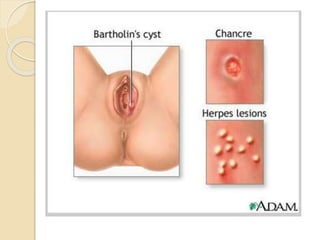
Genital Ulcer Diseases
 Painful
◦ Chancroid
◦ Genital herpes simplex
 Painless
◦ Syphilis
◦ Lymphogranuloma venereum
◦ Granuloma inguinale
Sores
SYPHILIS
9
Primary Syphilis - Clinical
Manifestations
 Incubation: 10-90 days (average 3 weeks)
 Chancre
◦ Early: macule/papule  erodes
◦ Late: clean based, painless, indurated ulcer with
smooth firm borders
◦ Unnoticed in 15-30% of patients
◦ Resolves in 1-5 weeks
◦ HIGHLY INFECTIOUS
Sores
10
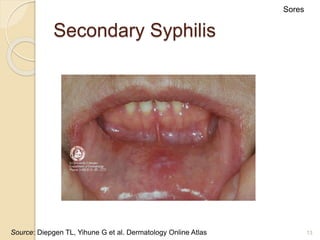
Secondary Syphilis - Clinical
Manifestations
 Represents hematogenous dissemination of
spirochetes
 Usually 2-8 weeks after chancre appears
 Findings:
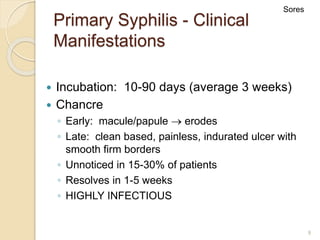
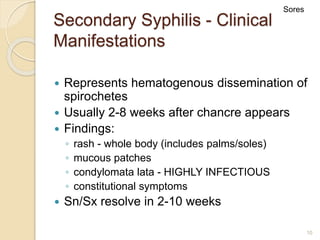
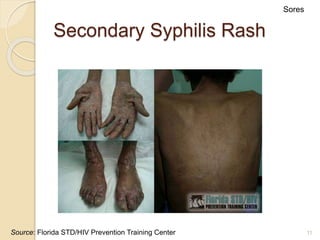
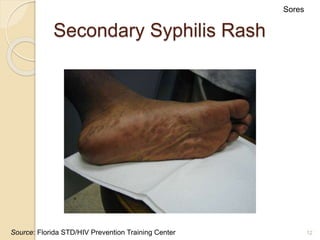
◦ rash - whole body (includes palms/soles)
◦ mucous patches
◦ condylomata lata - HIGHLY INFECTIOUS
◦ constitutional symptoms
 Sn/Sx resolve in 2-10 weeks
Sores
11
Secondary Syphilis Rash
Sores
Source: Florida STD/HIV Prevention Training Center
12
Secondary Syphilis Rash
Sores
Source: Florida STD/HIV Prevention Training Center
13
Secondary Syphilis
Sores
Source: Diepgen TL, Yihune G et al. Dermatology Online Atlas
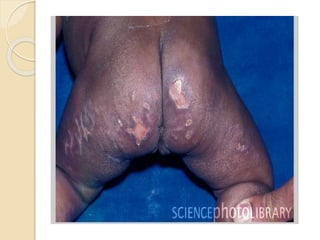
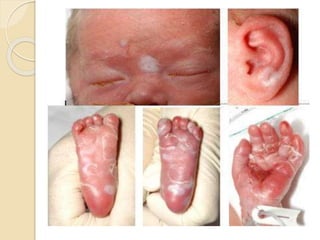
Congenital Syphilis
 About 400-500 cases a year
 Cause of stillbirth, neonatal death,
deafness, retardation, bony
deformities, seizures
 Rate down >50% by targeting specific
areas (e.g. prenatal care for uninsured
women in the South)
 The bacteria can be cleared, but the
damage is permanent
Diagnosis
• Venereal Disease Research Laboratory (VDRL)
and Rapid Plasminogen Reagent (RPR) tests.
•Dark field microscope
•Microhemagglutination assay for T.
pallidum (MHA-TP) and the fluorescent treponemal
antibody absorbed test (FTA-ABS)
Treatment
Long-acting penicillin injections have been very
effective in treating both early and late stage
syphilis. The treatment of neurosyphilis requires the
intravenous administration of penicillin. Alternative
treatments include oral doxycycline (Vibramycin,
Oracea, Adoxa, Atridox and others)
or tetracycline(Achromycin).
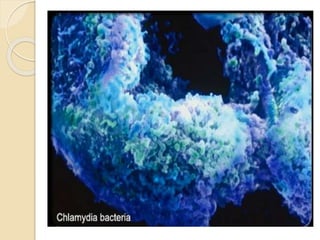
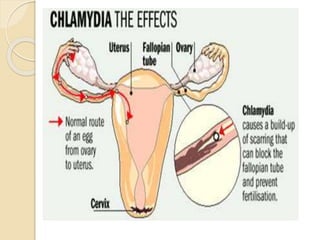
Chlamydia
Obligatory intracellular.
 ocular, respiratory, and reproductive tract infections.
 via sexual contact, although vertical transmission from a
mother to a newborn is also seen.
 infects the columnar epithelium of the endocervix, urethra,
endometrium, fallopian tubes, and the rectum.
Clinical symptoms
1. mucopurulent cervicitis : yellow discharge coming from a
swollen, red, friable cervix that bleeds easily .
2. acute urethritis and dysuria with minimal
frequency/urgency and a negative urine culture
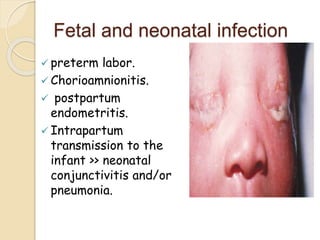
Fetal and neonatal infection
 preterm labor.
 Chorioamnionitis.
 postpartum
endometritis.
 Intrapartum
transmission to the
infant >> neonatal
conjunctivitis and/or
pneumonia.
Screening
>>Selective screening :
 at least annually on sexually active females <25
years old.
 risk factors (unmarried, multiple partners,
inconsistent use of barrier contraceptive
methods, previous history of any STI)
 all pregnant women
>30% of untreated chlamydial cervicitis will
progress to PID.
> Aggressive screening and appropriate early
treatment has been shown to decrease the
incidence of PID.
Diagonosis
 Antigen tests : chlamydiazyme test
 DNA hybridization tests and nucleic acid
amplification tests (PCR and ligase chain reaction)
 Urine culture or cervical swab
Treatment
 appropriate antibiotics ( azithromycin 1 g orally in
a single dose or doxycycline 100 mg twice a day for
7 days).
 (2) treatment of all sexual contacts within the
past 60 days prior to diagnosis.
 (3) testing for other STIs, including gonorrhea,
syphilis, hepatitis B, and HIV.
 (4) abstinence from sexual contact for 7 days
after last partner has started antibiotic therapy.
 (5) rescreening in 3 to 4 months to check for
reinfection is recommended.
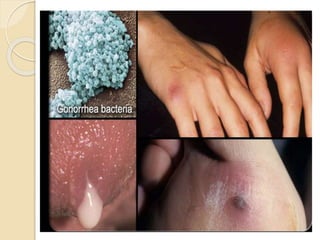
Gonorrhea
◦ Neisseria gonorrhea, Gram negative diplococci
: male-to-female transmission estimated at 80% to 90% compared
to an estimated 20% to 25% female-to-male transmission rate
after a single sexual encounter
Symptoms
primary site is endocervix :vaginal dischargefrequencydysuriaabdominal
painmenstrual abnormalities.
2)other local infections:
xx rectal→dischargetenesmusbleeding.
xx Oral-genital→pharyngeal gonorrhea(asymptomatic)sore
throatcervical adenitis.
xx Bartholin glands→abscess.
3)PID:
→ by spread to fallopian(salpingitis) then to pelvic cavity(peritonitis).
→complications:infertility and ectopic pregnancy.
4)DGI:
→bacteremia :fever,skin rashes,arthralgia,non-purulent
arthritis(hypersensitivity).
→then;endocarditis,meningitis,purulent arthritis.
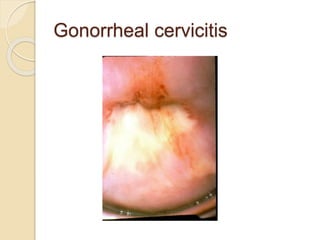
Gonorrheal cervicitis
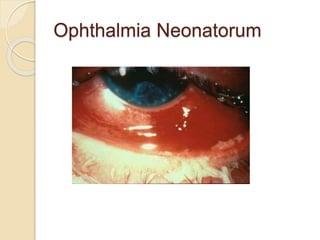
Ophthalmia Neonatorum
30
Diagnostic Methods
 Culture tests
 Non-culture tests
◦ Amplified tests (NAATs)
 Polymerase chain reaction (PCR) (Roche Amplicor)
 Transcription-mediated amplification (TMA) (Gen-Probe
Aptima)
 Strand displacement amplification (SDA) (Becton-Dickinson
BD ProbeTec ET)
◦ Non-amplified tests
 DNA probe (Gen-Probe PACE 2, Digene Hybrid Capture II)
◦ Gram stain
Diagnosis
31
Treatment
 Pregnant women should NOT be
treated with quinolones or
tetracyclines
 Treat with alternate cephalosporin
 If cephalosporin is not tolerated, treat
with spectinomycin 2 g IM once
Management
Herpes
33
Genital Herpes Simplex - Clinical
Manifestations
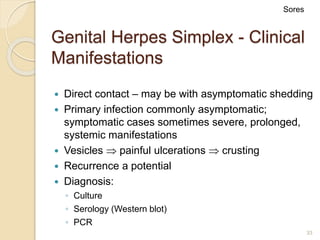
 Direct contact – may be with asymptomatic shedding
 Primary infection commonly asymptomatic;
symptomatic cases sometimes severe, prolonged,
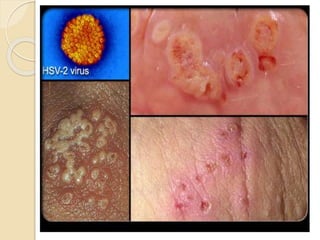
systemic manifestations
 Vesicles  painful ulcerations  crusting
 Recurrence a potential
 Diagnosis:
◦ Culture
◦ Serology (Western blot)
◦ PCR
Sores
35
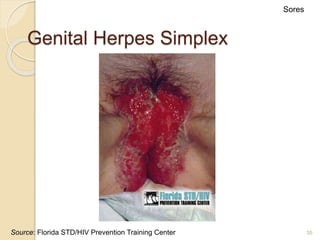
Genital Herpes Simplex
Sores
Source: Florida STD/HIV Prevention Training Center
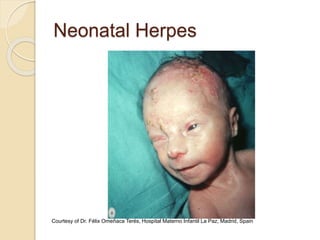
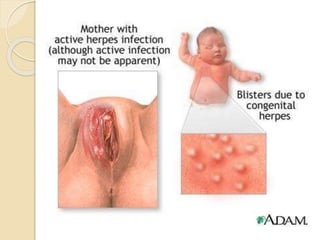
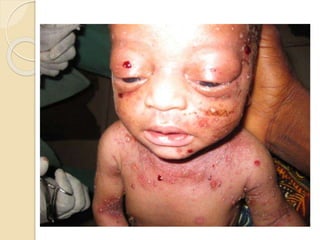
Neonatal Herpes
Courtesy of Dr. Félix Omeñaca Terés, Hospital Materno Infantil La Paz, Madrid, Spain
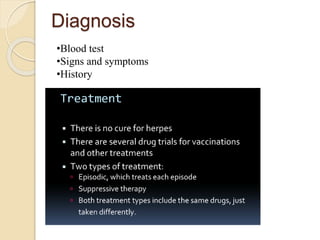
Diagnosis
•Blood test
•Signs and symptoms
•History
HIV and AIDS
HIV and AIDS
 AIDS is one of the most deadly
diseases in history.
 AIDS is caused by HIV (Human
immunodeficiency virus).
 HIV destroys the body’s defense
system (the immune system).
 Thousands of teens in the U.S.
become infected each year.
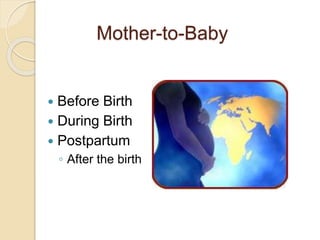
Mother-to-Baby
 Before Birth
 During Birth
 Postpartum
◦ After the birth
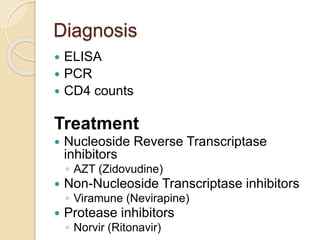
 ELISA
 PCR
 CD4 counts
Treatment
 Nucleoside Reverse Transcriptase
inhibitors
◦ AZT (Zidovudine)
 Non-Nucleoside Transcriptase inhibitors
◦ Viramune (Nevirapine)
 Protease inhibitors
◦ Norvir (Ritonavir)
Diagnosis

sexually transmitted disease

  • 1.
  • 2.
    What is aSexually Transmitted Infection or STI?  STI’s are infections that are spread from person to person through intimate sexual contact.  STI’s are dangerous because they are easily spread and it is hard to tell just by looking who has an STI.  1 in 4 sexually active teens has an STI.
  • 3.
    STDs and Pregnancy It is important for pregnant women to be checked for STDs.  They can cause women to go into labor too early and may complicate delivery.  Many STDs can be passed from mother to baby during pregnancy, childbirth, or after the baby is born.  STDs effects on babies can include stillbirth, low birth weight, neurologic problems, blindness, liver disease, and serious infection.  But there are treatments to minimize these risks. Treatment during pregnancy can cure some STDs and lower the risk of passing the infection to your baby.
  • 4.
    Maternal-Fetal Transmission Maternal-Infant Transmission HIV  Herpes  Gonorrhea  Chlamydia  Syphilis
  • 5.
    5 STDs of Concern Actually, all of them  “Sores” (ulcers) ◦ Syphilis ◦ Genital herpes (HSV-2, HSV-1) ◦ Others uncommon in the U.S.  Lymphogranuloma venereum  Chancroid  Granuloma inguinale Background
  • 6.
    6 STDs of Concern(continued)  “Drips” (discharges) ◦ Gonorrhea ◦ Chlamydia ◦ Nongonococcal urethritis / mucopurulent cervicitis ◦ Trichomonas vaginitis / urethritis ◦ Candidiasis (vulvovaginal, less problems in men)  Other major concerns ◦ Genital HPV (especially type 16, 18) and Cervical Cancer Background
  • 7.
    7 Genital Ulcer Diseases Painful ◦ Chancroid ◦ Genital herpes simplex  Painless ◦ Syphilis ◦ Lymphogranuloma venereum ◦ Granuloma inguinale Sores
  • 8.
  • 9.
    9 Primary Syphilis -Clinical Manifestations  Incubation: 10-90 days (average 3 weeks)  Chancre ◦ Early: macule/papule  erodes ◦ Late: clean based, painless, indurated ulcer with smooth firm borders ◦ Unnoticed in 15-30% of patients ◦ Resolves in 1-5 weeks ◦ HIGHLY INFECTIOUS Sores
  • 10.
    10 Secondary Syphilis -Clinical Manifestations  Represents hematogenous dissemination of spirochetes  Usually 2-8 weeks after chancre appears  Findings: ◦ rash - whole body (includes palms/soles) ◦ mucous patches ◦ condylomata lata - HIGHLY INFECTIOUS ◦ constitutional symptoms  Sn/Sx resolve in 2-10 weeks Sores
  • 11.
    11 Secondary Syphilis Rash Sores Source:Florida STD/HIV Prevention Training Center
  • 12.
    12 Secondary Syphilis Rash Sores Source:Florida STD/HIV Prevention Training Center
  • 13.
    13 Secondary Syphilis Sores Source: DiepgenTL, Yihune G et al. Dermatology Online Atlas
  • 14.
    Congenital Syphilis  About400-500 cases a year  Cause of stillbirth, neonatal death, deafness, retardation, bony deformities, seizures  Rate down >50% by targeting specific areas (e.g. prenatal care for uninsured women in the South)  The bacteria can be cleared, but the damage is permanent
  • 17.
    Diagnosis • Venereal DiseaseResearch Laboratory (VDRL) and Rapid Plasminogen Reagent (RPR) tests. •Dark field microscope •Microhemagglutination assay for T. pallidum (MHA-TP) and the fluorescent treponemal antibody absorbed test (FTA-ABS) Treatment Long-acting penicillin injections have been very effective in treating both early and late stage syphilis. The treatment of neurosyphilis requires the intravenous administration of penicillin. Alternative treatments include oral doxycycline (Vibramycin, Oracea, Adoxa, Atridox and others) or tetracycline(Achromycin).
  • 18.
  • 20.
    Obligatory intracellular.  ocular,respiratory, and reproductive tract infections.  via sexual contact, although vertical transmission from a mother to a newborn is also seen.  infects the columnar epithelium of the endocervix, urethra, endometrium, fallopian tubes, and the rectum. Clinical symptoms 1. mucopurulent cervicitis : yellow discharge coming from a swollen, red, friable cervix that bleeds easily . 2. acute urethritis and dysuria with minimal frequency/urgency and a negative urine culture
  • 22.
    Fetal and neonatalinfection  preterm labor.  Chorioamnionitis.  postpartum endometritis.  Intrapartum transmission to the infant >> neonatal conjunctivitis and/or pneumonia.
  • 23.
    Screening >>Selective screening : at least annually on sexually active females <25 years old.  risk factors (unmarried, multiple partners, inconsistent use of barrier contraceptive methods, previous history of any STI)  all pregnant women >30% of untreated chlamydial cervicitis will progress to PID. > Aggressive screening and appropriate early treatment has been shown to decrease the incidence of PID.
  • 24.
    Diagonosis  Antigen tests: chlamydiazyme test  DNA hybridization tests and nucleic acid amplification tests (PCR and ligase chain reaction)  Urine culture or cervical swab Treatment  appropriate antibiotics ( azithromycin 1 g orally in a single dose or doxycycline 100 mg twice a day for 7 days).  (2) treatment of all sexual contacts within the past 60 days prior to diagnosis.  (3) testing for other STIs, including gonorrhea, syphilis, hepatitis B, and HIV.  (4) abstinence from sexual contact for 7 days after last partner has started antibiotic therapy.  (5) rescreening in 3 to 4 months to check for reinfection is recommended.
  • 25.
  • 26.
    ◦ Neisseria gonorrhea,Gram negative diplococci : male-to-female transmission estimated at 80% to 90% compared to an estimated 20% to 25% female-to-male transmission rate after a single sexual encounter Symptoms primary site is endocervix :vaginal dischargefrequencydysuriaabdominal painmenstrual abnormalities. 2)other local infections: xx rectal→dischargetenesmusbleeding. xx Oral-genital→pharyngeal gonorrhea(asymptomatic)sore throatcervical adenitis. xx Bartholin glands→abscess. 3)PID: → by spread to fallopian(salpingitis) then to pelvic cavity(peritonitis). →complications:infertility and ectopic pregnancy. 4)DGI: →bacteremia :fever,skin rashes,arthralgia,non-purulent arthritis(hypersensitivity). →then;endocarditis,meningitis,purulent arthritis.
  • 28.
  • 29.
  • 30.
    30 Diagnostic Methods  Culturetests  Non-culture tests ◦ Amplified tests (NAATs)  Polymerase chain reaction (PCR) (Roche Amplicor)  Transcription-mediated amplification (TMA) (Gen-Probe Aptima)  Strand displacement amplification (SDA) (Becton-Dickinson BD ProbeTec ET) ◦ Non-amplified tests  DNA probe (Gen-Probe PACE 2, Digene Hybrid Capture II) ◦ Gram stain Diagnosis
  • 31.
    31 Treatment  Pregnant womenshould NOT be treated with quinolones or tetracyclines  Treat with alternate cephalosporin  If cephalosporin is not tolerated, treat with spectinomycin 2 g IM once Management
  • 32.
  • 33.
    33 Genital Herpes Simplex- Clinical Manifestations  Direct contact – may be with asymptomatic shedding  Primary infection commonly asymptomatic; symptomatic cases sometimes severe, prolonged, systemic manifestations  Vesicles  painful ulcerations  crusting  Recurrence a potential  Diagnosis: ◦ Culture ◦ Serology (Western blot) ◦ PCR Sores
  • 35.
    35 Genital Herpes Simplex Sores Source:Florida STD/HIV Prevention Training Center
  • 39.
    Neonatal Herpes Courtesy ofDr. Félix Omeñaca Terés, Hospital Materno Infantil La Paz, Madrid, Spain
  • 40.
  • 41.
  • 42.
    HIV and AIDS AIDS is one of the most deadly diseases in history.  AIDS is caused by HIV (Human immunodeficiency virus).  HIV destroys the body’s defense system (the immune system).  Thousands of teens in the U.S. become infected each year.
  • 43.
    Mother-to-Baby  Before Birth During Birth  Postpartum ◦ After the birth
  • 45.
     ELISA  PCR CD4 counts Treatment  Nucleoside Reverse Transcriptase inhibitors ◦ AZT (Zidovudine)  Non-Nucleoside Transcriptase inhibitors ◦ Viramune (Nevirapine)  Protease inhibitors ◦ Norvir (Ritonavir) Diagnosis