Syphilis
Learning Outcomes
1. List the sexually transmitted diseases
2. Know the aetiology of syphilis and its mode of transmission
3. Give classification of syphilis into congenital and acquired type
4. Understand congenital syphilis, its way of transmission, age affected, sub classification
and its important features.
5. Identify Primary, secondary and tertiary stages of acquired syphilis
6. Study sites, morphology and fate of each stage
7. Clinical presentation and the diagnosis of syphilis
8. Have a global idea about the acquired syphilis, its common sites, morphology,
infectivity, and complications of each stage.
Sexually Transmitted Diseases(STDs)
Infectious diseases transmitted by close sexual
contact include;
Bacterial: Gonorrhea and Lymphogranuloma
venereum
Spirochete: Syphilis
Viral: HBV, Genital Herpes, HPV and HIV
infection
Protozoal: E. histolytica and Trichomonas
Syphilis
A chronic venereal endemic infection in all parts of the world caused by;
Treponema pallidum
Routes of Transmission
Close sexual contact: from an active cutaneous or mucosal lesion in a
sexual partner in the early stage of (primary or secondary) syphilis to
uninfected partner
Transplacental: across the placenta from mother to fetus (congenital
Syphilis)
Blood products: risk is low
*Syphilis is common in HIV-infected patients and promotes transmission of HIV
*Syphilis cannot be contracted through toilet seats, daily activities, hot tubs, or
sharing eating utensils or clothing)
Pathogenesis
• Once inside the body, organisms rapidly spread to distant sites
by lymphatic's and blood stream
• After initial infection, a primary lesion (chancre) appears at the
point of entry
• Incubation period: 9 and 90 days (average 21)
• Systemic dissemination continues during this period
• Host immune response produce two types of antibodies; non-
treponemal and specific treponemal antibodies to treponemal
antigens
Syphilis
Syphilis is classified into:
A- Congenital syphilis
1. Infantile syphilis(with stillborn/live born infants)
2. Late congenital syphilis
B- Acquired syphilis
1. Primary
2. Secondary
3. Latent
4. Tertiary
Congenital Syphilis
• Maternal transmission from infected mother, during primary and
secondary stages of syphilis
• Placenta is enlarged, pale, edematous and reveals;
- Proliferative endarteritis of fetal vessels
- Villitis with mononuclear inflammatory infiltrate
- Villous immaturity
• Clinically congenital syphilis may be;
1. Infantile syphilis
2. Late congenital syphilis
Infantile Syphilis
Stillborn Infants; The most common manifestations are:
• Hepatomegaly, due to extramedullary hematopoiesis
• Bone abnormalities, inflammation and disruption of
osteochondral junction in long bones and bone resorption
of flat bones of skull
• Pneumonitis
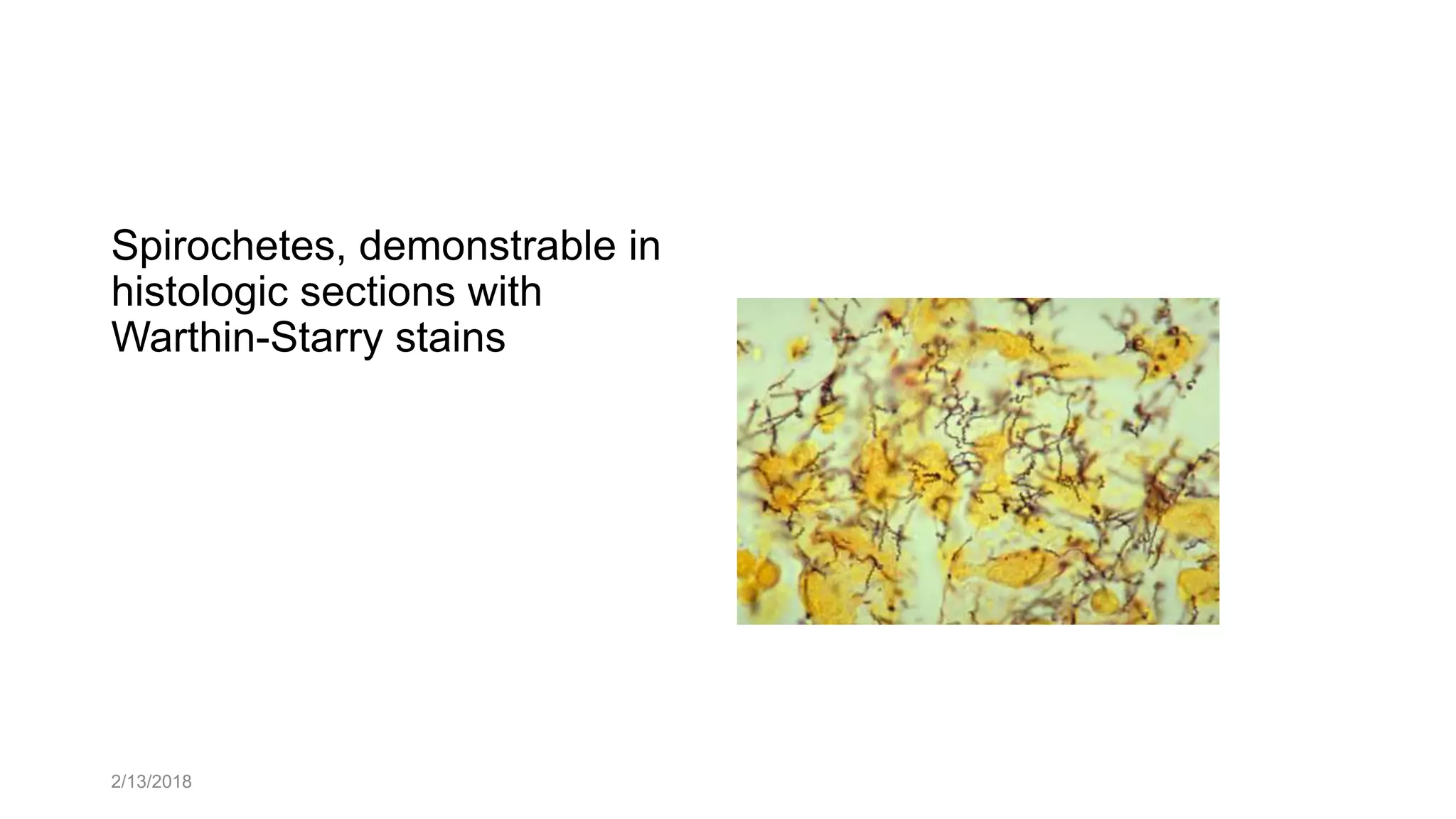
• Spirochetes are readily demonstrable in tissue sections
Live born infants; manifest at birth or within first few
months with;
• Chronic rhinitis
• Mucocutaneous lesions
• Visceral and skeletal changes as seen in stillborn infants
Late Congenital Syphilis
Untreated cong. syphilis of more than 2 years duration; classic manifestations
include;
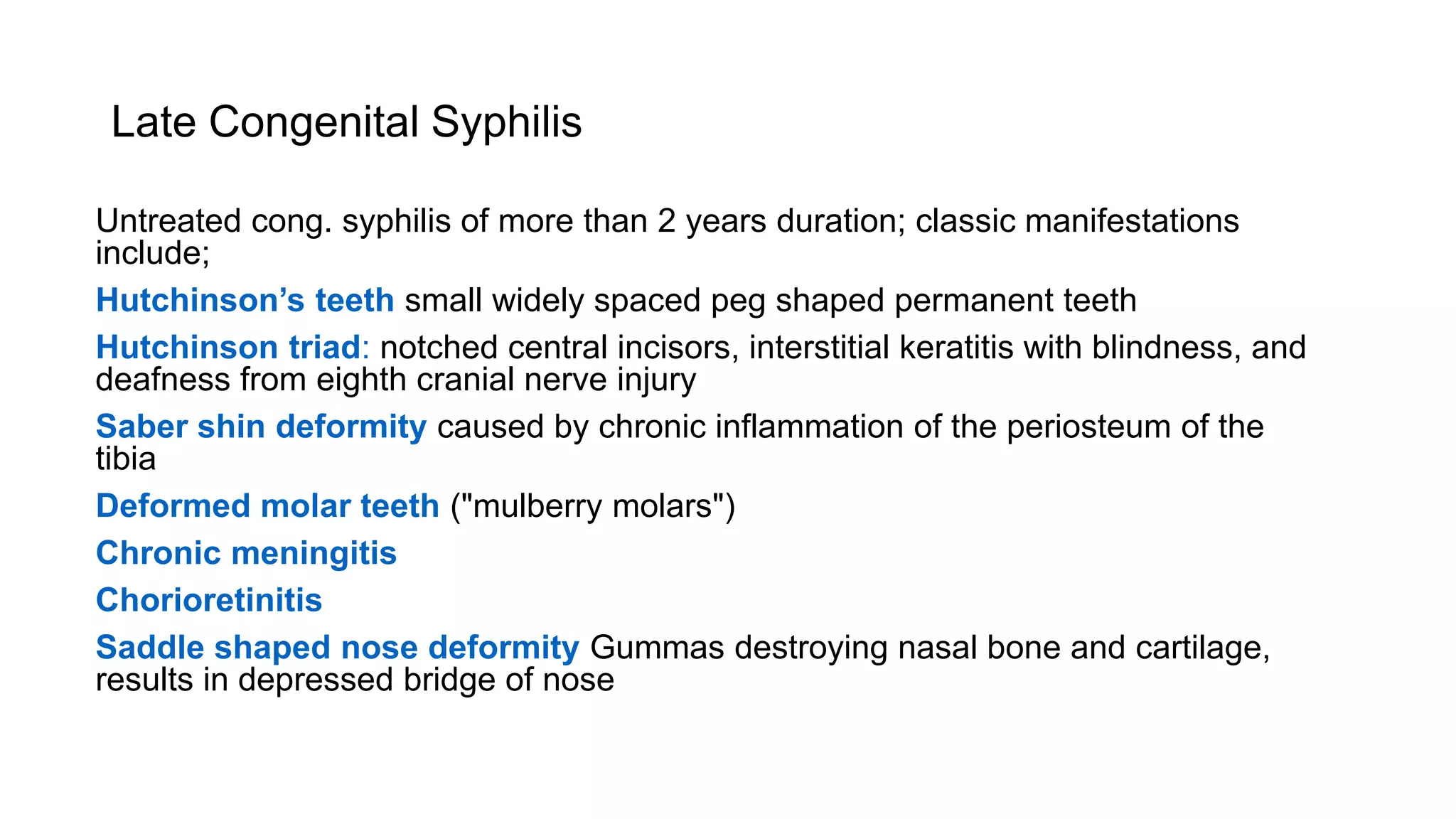
Hutchinson’s teeth small widely spaced peg shaped permanent teeth
Hutchinson triad: notched central incisors, interstitial keratitis with blindness, and
deafness from eighth cranial nerve injury
Saber shin deformity caused by chronic inflammation of the periosteum of the
tibia
Deformed molar teeth ("mulberry molars")
Chronic meningitis
Chorioretinitis
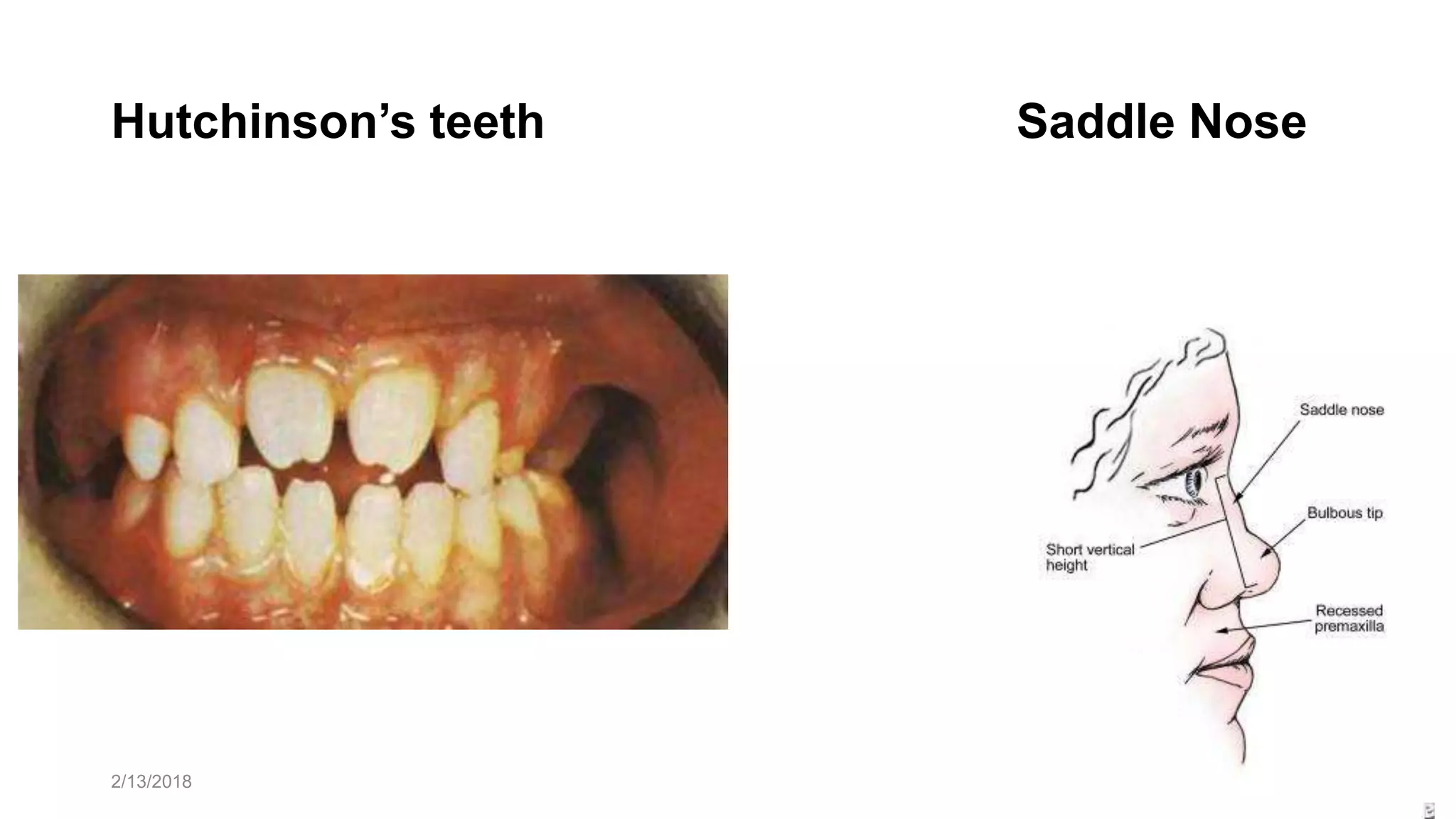
Saddle shaped nose deformity Gummas destroying nasal bone and cartilage,
results in depressed bridge of nose
Hutchinson’s teeth Saddle Nose
2/13/2018
Chorioretinitis
Acquired Syphilis
Primary stage syphilis
• After initial exposure macule to papule appear on the skin at site of
contact which finally progress to ulcer called chancre
• Chancre a single, firm, painless, non-itchy skin ulceration with a clean
base and sharp borders measuring 0.3 to 3.0 cm in size, the lesion may be
genital or extra genital
• Chancre resolves spontaneously over a period of 4 to 6 weeks and is
followed in approx. 25% of untreated patients by the development of
secondary syphilis
• Localized Lymphadenopathy frequent, occurs 7 to 10 days after chancre
formation
Primary Chancre of Syphilis
2/13/2018
Secondary Syphilis
Occurs approximately 4 to 10 weeks after the primary infection
and clinically presents with;
• Generalized lymphadenopathy
• Mucocutaneous lesions as maculopapular or condyloma lata
(flat raised lesions)
• Symmetrical, reddish-pink, non-itchy rash on the trunk and
extremities, including the palms and soles which may become
maculopapular or pustular
Mucocutaneous lesions of both primary and secondary syphilis contains
spirochetes and are highly infectious
Secondary Syphilis
Rash on chest, palms, foot Papules on back
2/13/2018
Condyloma lata
• Reddish-brown papular
lesions on the penis or
anogenital area can
coalesce into large elevated
plaques up to 2-3 cm in
diameter, known as
condylomata lata, a highly
infectious lesion
• Lesions usually progress
from red, painful, and
vesicular to “gun metal grey”
as the rash resolves
2/13/2018
Latent Syphilis
• The latent (hidden) stage of syphilis begins when primary and
secondary symptoms disappear
• Without treatment, the infected person will continue to
have syphilis infection in their body even though there are no
signs or symptoms and are contagieous
Tertiary Syphilis
About one-third untreated syphilis enter into tertiary phase and shows
symptomatic lesions over the next 5 to 20 years, which includes;
Benign tertiary syphilis; gummas in various sites like; bone, skin, mucus
membrane and viscera, in liver gumma and scarring of hepatic parenchyma
divides liver into large nodules called hepar lobatum
Neurosyphilis; Tabes dorsalis and General paresis (involving spinal cord &
brain)
Cardiovascular syphilis; Syphilitic aortitis
*Patients with late latent or tertiary syphilis are much less likely to be infectious
because spirochetes are rare in these gummas
Tertiary Syphilis
Gumma of Nose Liver; hepar lobatum
2/13/2018
Microscopy Features
• Proliferative endarteritis and
perivascular inflammatory
infiltrate rich in plasma cells,
endothelial hypertrophy and
proliferation, followed by intimal
fibrosis and narrowing of vessel
lumen with local ischemia and
necrosis
• Gumma shows a central zone of
coagulation necrosis surrounded
by a mixed inflammatory infiltrate
composed of lymphocytes,
plasma cells, epithelioid cells,
occasional giant cells, and a
peripheral zone of dense fibrous
tissue
Spirochetes, demonstrable in
histologic sections with
Warthin-Starry stains
2/13/2018
22
Diagnosis of Syphilis
Blood tests:
A. Non-treponemal tests
Like, Venereal Disease Research Laboratory (VDRL) test; Usually positive in early disease,
but may be negative in advanced disease, occasionally false positive, confirmation required
with Treponemal test
B. Treponemal tests
First tests to become positive and are useful for screening
Treponemal antibody tests usually become positive 2 to 5 weeks after the initial infection
and remain positive indefinitely
Cerebrospinal Fluid Examination:
Neurosyphilis is diagnosed by finding high numbers of lymphocytes and high protein levels
in the CSF
Direct testing of serous fluid from a chancre by:
Dark ground microscopy or Direct fluorescent antibody testing
Dark Field Microscopy
Immunofluorescence Syphilis
Chlamydia trachomatis
• A gram negative bacteria which can cause trachoma and
sexually transmitted diseases like Lymphogranuloma
venereum, urethritis, cervicitis, salpingitis
• Short incubation period of 2-5 days, about 50% of infected
males develops a primary genital lesion, a painless papule on
the penis which may ulcerate but usually heals within a few
days
• 1 and 4 weeks later patient develops an inguinal
lymphadenitis showing acute suppurative inflammation with
necrosis
• Chlamydial inclusions seen in the infected cell
Home Assignment
Q. How you will differentiate gumma of syphilis
from granuloma of tuberculosis.
2/13/2018
Learning Outcomes
1. The aetiology of syphilis and its way of transmission
will be discussed.
2. The classification of syphilis will be classified to
congenital and acquired.
3. The stages of acquired syphilis will be explained as
primary, secondary and tertiary syphilis.
4. The sites, morphology and fate of each stage will be
discussed.
5. The clinical presentation and the diagnosis of
syphilis will be given.
References
• Reading : Robbins Basic Pathology, 9th Edition
(2013), By: Kumar, Abbas, Aster
• Web Path
• WWW.fleshandbone.com
• WWW.studentconsult.com
Syphilis

Syphilis

  • 1.
  • 2.
    Learning Outcomes 1. Listthe sexually transmitted diseases 2. Know the aetiology of syphilis and its mode of transmission 3. Give classification of syphilis into congenital and acquired type 4. Understand congenital syphilis, its way of transmission, age affected, sub classification and its important features. 5. Identify Primary, secondary and tertiary stages of acquired syphilis 6. Study sites, morphology and fate of each stage 7. Clinical presentation and the diagnosis of syphilis 8. Have a global idea about the acquired syphilis, its common sites, morphology, infectivity, and complications of each stage.
  • 3.
    Sexually Transmitted Diseases(STDs) Infectiousdiseases transmitted by close sexual contact include; Bacterial: Gonorrhea and Lymphogranuloma venereum Spirochete: Syphilis Viral: HBV, Genital Herpes, HPV and HIV infection Protozoal: E. histolytica and Trichomonas
  • 4.
    Syphilis A chronic venerealendemic infection in all parts of the world caused by; Treponema pallidum Routes of Transmission Close sexual contact: from an active cutaneous or mucosal lesion in a sexual partner in the early stage of (primary or secondary) syphilis to uninfected partner Transplacental: across the placenta from mother to fetus (congenital Syphilis) Blood products: risk is low *Syphilis is common in HIV-infected patients and promotes transmission of HIV *Syphilis cannot be contracted through toilet seats, daily activities, hot tubs, or sharing eating utensils or clothing)
  • 5.
    Pathogenesis • Once insidethe body, organisms rapidly spread to distant sites by lymphatic's and blood stream • After initial infection, a primary lesion (chancre) appears at the point of entry • Incubation period: 9 and 90 days (average 21) • Systemic dissemination continues during this period • Host immune response produce two types of antibodies; non- treponemal and specific treponemal antibodies to treponemal antigens
  • 6.
    Syphilis Syphilis is classifiedinto: A- Congenital syphilis 1. Infantile syphilis(with stillborn/live born infants) 2. Late congenital syphilis B- Acquired syphilis 1. Primary 2. Secondary 3. Latent 4. Tertiary
  • 7.
    Congenital Syphilis • Maternaltransmission from infected mother, during primary and secondary stages of syphilis • Placenta is enlarged, pale, edematous and reveals; - Proliferative endarteritis of fetal vessels - Villitis with mononuclear inflammatory infiltrate - Villous immaturity • Clinically congenital syphilis may be; 1. Infantile syphilis 2. Late congenital syphilis
  • 8.
    Infantile Syphilis Stillborn Infants;The most common manifestations are: • Hepatomegaly, due to extramedullary hematopoiesis • Bone abnormalities, inflammation and disruption of osteochondral junction in long bones and bone resorption of flat bones of skull • Pneumonitis • Spirochetes are readily demonstrable in tissue sections Live born infants; manifest at birth or within first few months with; • Chronic rhinitis • Mucocutaneous lesions • Visceral and skeletal changes as seen in stillborn infants
  • 9.
    Late Congenital Syphilis Untreatedcong. syphilis of more than 2 years duration; classic manifestations include; Hutchinson’s teeth small widely spaced peg shaped permanent teeth Hutchinson triad: notched central incisors, interstitial keratitis with blindness, and deafness from eighth cranial nerve injury Saber shin deformity caused by chronic inflammation of the periosteum of the tibia Deformed molar teeth ("mulberry molars") Chronic meningitis Chorioretinitis Saddle shaped nose deformity Gummas destroying nasal bone and cartilage, results in depressed bridge of nose
  • 10.
  • 11.
  • 12.
    Acquired Syphilis Primary stagesyphilis • After initial exposure macule to papule appear on the skin at site of contact which finally progress to ulcer called chancre • Chancre a single, firm, painless, non-itchy skin ulceration with a clean base and sharp borders measuring 0.3 to 3.0 cm in size, the lesion may be genital or extra genital • Chancre resolves spontaneously over a period of 4 to 6 weeks and is followed in approx. 25% of untreated patients by the development of secondary syphilis • Localized Lymphadenopathy frequent, occurs 7 to 10 days after chancre formation
  • 13.
    Primary Chancre ofSyphilis 2/13/2018
  • 14.
    Secondary Syphilis Occurs approximately4 to 10 weeks after the primary infection and clinically presents with; • Generalized lymphadenopathy • Mucocutaneous lesions as maculopapular or condyloma lata (flat raised lesions) • Symmetrical, reddish-pink, non-itchy rash on the trunk and extremities, including the palms and soles which may become maculopapular or pustular Mucocutaneous lesions of both primary and secondary syphilis contains spirochetes and are highly infectious
  • 15.
    Secondary Syphilis Rash onchest, palms, foot Papules on back 2/13/2018
  • 16.
    Condyloma lata • Reddish-brownpapular lesions on the penis or anogenital area can coalesce into large elevated plaques up to 2-3 cm in diameter, known as condylomata lata, a highly infectious lesion • Lesions usually progress from red, painful, and vesicular to “gun metal grey” as the rash resolves 2/13/2018
  • 17.
    Latent Syphilis • Thelatent (hidden) stage of syphilis begins when primary and secondary symptoms disappear • Without treatment, the infected person will continue to have syphilis infection in their body even though there are no signs or symptoms and are contagieous
  • 18.
    Tertiary Syphilis About one-thirduntreated syphilis enter into tertiary phase and shows symptomatic lesions over the next 5 to 20 years, which includes; Benign tertiary syphilis; gummas in various sites like; bone, skin, mucus membrane and viscera, in liver gumma and scarring of hepatic parenchyma divides liver into large nodules called hepar lobatum Neurosyphilis; Tabes dorsalis and General paresis (involving spinal cord & brain) Cardiovascular syphilis; Syphilitic aortitis *Patients with late latent or tertiary syphilis are much less likely to be infectious because spirochetes are rare in these gummas
  • 19.
    Tertiary Syphilis Gumma ofNose Liver; hepar lobatum 2/13/2018
  • 20.
    Microscopy Features • Proliferativeendarteritis and perivascular inflammatory infiltrate rich in plasma cells, endothelial hypertrophy and proliferation, followed by intimal fibrosis and narrowing of vessel lumen with local ischemia and necrosis • Gumma shows a central zone of coagulation necrosis surrounded by a mixed inflammatory infiltrate composed of lymphocytes, plasma cells, epithelioid cells, occasional giant cells, and a peripheral zone of dense fibrous tissue
  • 21.
    Spirochetes, demonstrable in histologicsections with Warthin-Starry stains 2/13/2018
  • 22.
  • 23.
    Diagnosis of Syphilis Bloodtests: A. Non-treponemal tests Like, Venereal Disease Research Laboratory (VDRL) test; Usually positive in early disease, but may be negative in advanced disease, occasionally false positive, confirmation required with Treponemal test B. Treponemal tests First tests to become positive and are useful for screening Treponemal antibody tests usually become positive 2 to 5 weeks after the initial infection and remain positive indefinitely Cerebrospinal Fluid Examination: Neurosyphilis is diagnosed by finding high numbers of lymphocytes and high protein levels in the CSF Direct testing of serous fluid from a chancre by: Dark ground microscopy or Direct fluorescent antibody testing
  • 24.
  • 25.
  • 26.
    Chlamydia trachomatis • Agram negative bacteria which can cause trachoma and sexually transmitted diseases like Lymphogranuloma venereum, urethritis, cervicitis, salpingitis • Short incubation period of 2-5 days, about 50% of infected males develops a primary genital lesion, a painless papule on the penis which may ulcerate but usually heals within a few days • 1 and 4 weeks later patient develops an inguinal lymphadenitis showing acute suppurative inflammation with necrosis • Chlamydial inclusions seen in the infected cell
  • 27.
    Home Assignment Q. Howyou will differentiate gumma of syphilis from granuloma of tuberculosis. 2/13/2018
  • 28.
    Learning Outcomes 1. Theaetiology of syphilis and its way of transmission will be discussed. 2. The classification of syphilis will be classified to congenital and acquired. 3. The stages of acquired syphilis will be explained as primary, secondary and tertiary syphilis. 4. The sites, morphology and fate of each stage will be discussed. 5. The clinical presentation and the diagnosis of syphilis will be given.
  • 29.
    References • Reading :Robbins Basic Pathology, 9th Edition (2013), By: Kumar, Abbas, Aster • Web Path • WWW.fleshandbone.com • WWW.studentconsult.com

Editor's Notes

  • #5 A chronic venereal infection caused by;  Treponema pallidum (spirochete) and is endemic infection in all parts of the world