




SYPHILIS
SEXUALLY TRANSMITTED DISEASES
(STDs)
 Group of communicable diseases transmitted by sexual contact.
Caused by a wide range of bacterial, viral ,protozoal and fungal agents and
ectoparasites.
Previously known as veneral diseases.
Various STD’s:
1. Syphilis
2. Gonorrhea
3. HIV/AIDS.
SYPHILIS
Causative organism: caused by spirochetes- TREPONEMA PALLIDUM
Word derived from the name of the mythological handsome boy ,syphilus who was
cursed by Greek God Apollo with the disease.
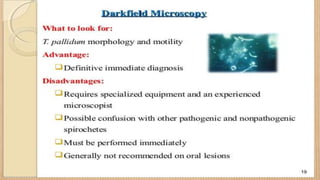
T.pallidum- a coiled spiral filament 10 µm long that moves actively in fresh
preparations
 The organism is rapidly destroyed by heat, cold,& antiseptics.
 The organism cant be stained by the usual methods & can be seen in the exudates &
tissues by:
 Dark ground illumination in fresh preparations
 Fluorescent antibody technique
 PCR as a research method
Epidemiology
Infected 12 million people in 1999 .
90% of cases in the developing world.
 Affects 700,000 - 1.6 million pregnancies a year.
 Spontaneous abortions, stillbirths, and congenital syphilis.
Sub-Saharan Africa -20% of perinatal deaths.
 Since 2000, rates of syphilis have been increasing in the US, UK, Australia and Europe
primarily among men who have sex with men.
Due to unsafe sexual practices.
 Syphilis increases the risk of HIV transmission and co-infection is common.
 Untreated it has a mortality of 8% to 58% with a greater death rate in males.
 19th and 20th century-less severe symptoms, due to widespread availability of effective
treatment and decreasing virulence of the spirochete.
 With early treatment few complications
MODE OF TRANSMISSION
Sexual intercourse resulting in lesions on glans penis, vulvovaginal & cervix
Intimate person-to-person contact with lesions on lips, tongues or fingers
Transfusion of infected blood
 Materno-foetal transmission in congenital syphilis if mother is infected
PATHOPHYSIOLOGY OF SYPHILIS:
• Progresses through 4 stages: primary, secondary, latent and tertiary stages.
Stages get progressively worse if left untreated highly contagious potentially fatal not
all people show visible signs disease at the beginning.
• PRIMARY STAGE:
 • A small painless ulcer like sore called a chancre appears at the site of initial
infection.
 • Chancre usually appears 2-3 weeks after the initial infection a rash near the chancre
may also appear.
• The chancre may go unnoticed because of the mouth, anus, vagina, or throat.
 • Usually disappears in 4-6 weeks without treatment the bacteria is still multiplying
in the body contagiously.
• SECONDARY STAGE:
 Begins a few weeks to months after chancre heals.
 Rash with flat and raised patches frequently on palms, soles, can be anywhere on body.
 Lesions in the mouth, vagina, penis, mucus patches.
 Fever
 Swollen glands
 Loss of appetite
 Fatigue
 Aches and pains in bones or joints
 Patchy hair loss
 Chancre still present in some cases , bacteria has spread to the blood most contagious stage resolves in
2-6 weeks without treatment.
• LATENT STAGE:
 Characterized by the lack of symptoms no symptoms may appear for months or years.
 Syphilis is still alive in the body bacteria starts to damage the internal organs; like brain, heart, sexual
organs and damage can go unnoticed until the next stage.
TERTIARY STAGE:
 Occurs many years later, 5 to 50 years after secondary stage symptoms disappear.
 Characterized by paralysis, gradual blindness, deterioration of the brain, loss of co-
ordination, shooting pains and health.
 Gummatous syphilis-destructive lesions of bones, skin or live
 Cardiovascular syphilis-severs damage to heart and blood vessels, inflammation of
the aorta, heart disease.
 Neuro syphilis-nervous system disorders; brain, eye, spinal cord, auditory system.
Brain- can cause paralysis, blindness, dementia or insanity.
• CONGENITAL SYPHILIS:
 During the secondary stage the infection can be transferred to the baby.
 If the mother is not treated during pregnancy it cause deformations, or possibly death.
Tested after birth; if the baby has syphilis it is treated right away
Neurosyphilis may manifest as:
 Meningovascular syphilis affecting chiefly the meninges.
 Tabes dorsalis affecting the spinal cord.
 General paresis affecting the brain.
Major morphological features are:
Saddle shaped nose deformity due to destruction of bridge of nose
The characteristic Hutchinson’s teeth which are small widely spaced, peg-shaped
permanent teeth.
Mucocutaneous lesions of acquired secondary syphilis
Bony lesions like epiphysitis and periostitis
Interstitial keratitis with corneal opacity
Diffuse fibrosis in liver and interstitial fibrosis of lungs
One of the most serious consequence of congenital syphilis –neurological damage
with mental retardation
Signs and symptoms
• Signs & symptoms of syphilis vary depending in which of the four
stages (primary, secondary, tertiary, latent) it is present:
• Common symptoms are:
 Fever, Malaise, Sore throat, Rashes, Head ache
 Lymphadenopathy
 Mucous patches, Perforation of palate.
 Alopecia, Weight loss
 In severe conditions it causes mental retardation, shuffle walk e.t.c.
B Pharmacy.pptx
B Pharmacy.pptx
B Pharmacy.pptx
B Pharmacy.pptx
B Pharmacy.pptx
B Pharmacy.pptx
B Pharmacy.pptx
B Pharmacy.pptx
B Pharmacy.pptx
B Pharmacy.pptx
B Pharmacy.pptx
B Pharmacy.pptx
B Pharmacy.pptx

B Pharmacy.pptx

  • 1.
  • 2.
    SEXUALLY TRANSMITTED DISEASES (STDs) Group of communicable diseases transmitted by sexual contact. Caused by a wide range of bacterial, viral ,protozoal and fungal agents and ectoparasites. Previously known as veneral diseases. Various STD’s: 1. Syphilis 2. Gonorrhea 3. HIV/AIDS.
  • 3.
    SYPHILIS Causative organism: causedby spirochetes- TREPONEMA PALLIDUM Word derived from the name of the mythological handsome boy ,syphilus who was cursed by Greek God Apollo with the disease. T.pallidum- a coiled spiral filament 10 µm long that moves actively in fresh preparations  The organism is rapidly destroyed by heat, cold,& antiseptics.  The organism cant be stained by the usual methods & can be seen in the exudates & tissues by:  Dark ground illumination in fresh preparations  Fluorescent antibody technique  PCR as a research method
  • 4.
    Epidemiology Infected 12 millionpeople in 1999 . 90% of cases in the developing world.  Affects 700,000 - 1.6 million pregnancies a year.  Spontaneous abortions, stillbirths, and congenital syphilis. Sub-Saharan Africa -20% of perinatal deaths.  Since 2000, rates of syphilis have been increasing in the US, UK, Australia and Europe primarily among men who have sex with men. Due to unsafe sexual practices.  Syphilis increases the risk of HIV transmission and co-infection is common.  Untreated it has a mortality of 8% to 58% with a greater death rate in males.  19th and 20th century-less severe symptoms, due to widespread availability of effective treatment and decreasing virulence of the spirochete.  With early treatment few complications
  • 5.
    MODE OF TRANSMISSION Sexualintercourse resulting in lesions on glans penis, vulvovaginal & cervix Intimate person-to-person contact with lesions on lips, tongues or fingers Transfusion of infected blood  Materno-foetal transmission in congenital syphilis if mother is infected
  • 6.
    PATHOPHYSIOLOGY OF SYPHILIS: •Progresses through 4 stages: primary, secondary, latent and tertiary stages. Stages get progressively worse if left untreated highly contagious potentially fatal not all people show visible signs disease at the beginning. • PRIMARY STAGE:  • A small painless ulcer like sore called a chancre appears at the site of initial infection.  • Chancre usually appears 2-3 weeks after the initial infection a rash near the chancre may also appear. • The chancre may go unnoticed because of the mouth, anus, vagina, or throat.  • Usually disappears in 4-6 weeks without treatment the bacteria is still multiplying in the body contagiously.
  • 7.
    • SECONDARY STAGE: Begins a few weeks to months after chancre heals.  Rash with flat and raised patches frequently on palms, soles, can be anywhere on body.  Lesions in the mouth, vagina, penis, mucus patches.  Fever  Swollen glands  Loss of appetite  Fatigue  Aches and pains in bones or joints  Patchy hair loss  Chancre still present in some cases , bacteria has spread to the blood most contagious stage resolves in 2-6 weeks without treatment. • LATENT STAGE:  Characterized by the lack of symptoms no symptoms may appear for months or years.  Syphilis is still alive in the body bacteria starts to damage the internal organs; like brain, heart, sexual organs and damage can go unnoticed until the next stage.
  • 8.
    TERTIARY STAGE:  Occursmany years later, 5 to 50 years after secondary stage symptoms disappear.  Characterized by paralysis, gradual blindness, deterioration of the brain, loss of co- ordination, shooting pains and health.  Gummatous syphilis-destructive lesions of bones, skin or live  Cardiovascular syphilis-severs damage to heart and blood vessels, inflammation of the aorta, heart disease.  Neuro syphilis-nervous system disorders; brain, eye, spinal cord, auditory system. Brain- can cause paralysis, blindness, dementia or insanity. • CONGENITAL SYPHILIS:  During the secondary stage the infection can be transferred to the baby.  If the mother is not treated during pregnancy it cause deformations, or possibly death. Tested after birth; if the baby has syphilis it is treated right away
  • 9.
    Neurosyphilis may manifestas:  Meningovascular syphilis affecting chiefly the meninges.  Tabes dorsalis affecting the spinal cord.  General paresis affecting the brain. Major morphological features are: Saddle shaped nose deformity due to destruction of bridge of nose The characteristic Hutchinson’s teeth which are small widely spaced, peg-shaped permanent teeth. Mucocutaneous lesions of acquired secondary syphilis Bony lesions like epiphysitis and periostitis Interstitial keratitis with corneal opacity Diffuse fibrosis in liver and interstitial fibrosis of lungs One of the most serious consequence of congenital syphilis –neurological damage with mental retardation
  • 10.
    Signs and symptoms •Signs & symptoms of syphilis vary depending in which of the four stages (primary, secondary, tertiary, latent) it is present: • Common symptoms are:  Fever, Malaise, Sore throat, Rashes, Head ache  Lymphadenopathy  Mucous patches, Perforation of palate.  Alopecia, Weight loss  In severe conditions it causes mental retardation, shuffle walk e.t.c.