The lecture of Assistant Professor
Ann Kakabadze
Tracheostomy
Tracheostomy - is a surgical procedure
which consists of making an incision on
the anterior aspect of the neck and
opening a direct airway through an incision
in the trachea (windpipe)
Indications:
•Airway obstruction
Facial trauma
Head and neck cancers
Angioedema
Laryngeal dysfunction
Foreign body
Inflammatory conditions, neoplasms,
Obstructive sleep apnea
• The patient may be in a coma, or need a
ventilator to pump air into the lungs for a long
period of time
• Pulmonary Ventilation
• Pulmonary Toilet
Tracheostomy Tubes
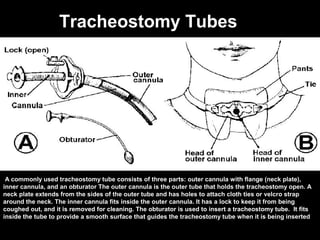
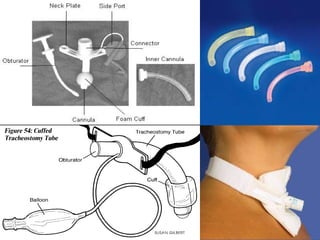
A commonly used tracheostomy tube consists of three parts: outer cannula with flange (neck plate),
inner cannula, and an obturator The outer cannula is the outer tube that holds the tracheostomy open. A
neck plate extends from the sides of the outer tube and has holes to attach cloth ties or velcro strap
around the neck. The inner cannula fits inside the outer cannula. It has a lock to keep it from being
coughed out, and it is removed for cleaning. The obturator is used to insert a tracheostomy tube. It fits
inside the tube to provide a smooth surface that guides the tracheostomy tube when it is being inserted
Emergency tracheotomy:
when a person with a throat obstruction is not able to
breathe at all-no gasping sounds, no coughing-and only
after you have attempted to perform the Heimlich maneuver
three times without dislodging the obstruction
What you will need
•A first aid kit, if available
•A razor blade or very sharp knife
•A straw (two would be better) or a ballpoint pen with the
inside (ink-filled tube) removed. If neither a straw nor a pen
is available, use stiff paper or cardboard rolled into a tube.
Good first aid kits may contain "trache" tubes
Find the indentation between
the Adam's apple and the
Cricoid cartilage.
Make a half-inch horizontal
incision about one half inch
deep.
Pinch the incision or insert
your finger inside the slit to
open it
Insert your tube into the
incision, roughly one-half to
one inch deep
Nonemergency tracheotomy:
Upper Tracheostomy
Middle Tracheostomy
Inferior Tracheostomy
Types of tracheostomy:
1- Upper tracheostomy;
In the 1st and 2nd tracheal rings above
the isthmus of the thyroid gland
2- Middle tracheostorny;
In the 3rd and 4th trachea rings behind
the isthmus (operation of choice).
3- Inferior tracheostomy
in the 5th and 6th rings below the
isthmus.
1
2
3
4
5
6
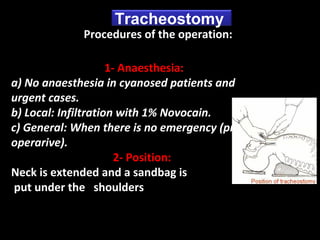
Procedures of the operation:
Tracheostomy
1- Anaesthesia:
a) No anaesthesia in cyanosed patients and
urgent cases.
b) Local: Infiltration with 1% Novocain.
c) General: When there is no emergency (pre-
operarive).
2- Position:
Neck is extended and a sandbag is
put under the shoulders
3- Incision:
a) Midline incision from the lower border of
the thyroid to the manubrium sterni
b) Cut the skin, superficial fascia, platysma
and the deep fascia connecting the
pretracheal muscles (sternohyoid and
sternothyroid) of the two sides.
c) Separate the pretracheal muscles of both
sides by a retractor .
Tracheostom
y
Procedures of the operation:
4- The thyroid isthmus is divided between
2 kochers, transfixed by catgut to prevent
bleeding and leak of thyroxin and then
retracted.
5- Expose the trachea and inject 1/2 c.c
surface anaesthetic (pantrocaine 1%) in the
trachea to diminish the cough reflex
Tracheostom
y
Procedures of the operation:
6- Fix the trachea and elevate it by a cricoid hook.
7- Open the trachea by an incision or by removal
of a circular part of the 3rd
and 4th rings.
8- Insert a suitable tracheostomy tube
9- Close the wound after ligating the bleeding
vessels
Tracheostom
y
Procedures of the operation:
Compliation of tracheostomy tube
Proper size
in position
Long tube causing
Injury of
esophagus
Long curve
causing
injury of both
oesophagus
& trachea.
Small tube causing
slipping out
&
surgical
emphysema
of neck.
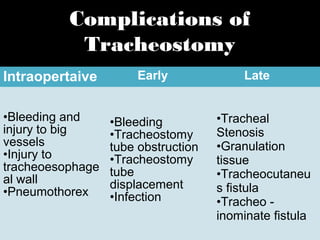
Intraopertaive Early Late
•Bleeding and
injury to big
vessels
•Injury to
tracheoesophage
al wall
•Pneumothorex
•Bleeding
•Tracheostomy
tube obstruction
•Tracheostomy
tube
displacement
•Infection
•Tracheal
Stenosis
•Granulation
tissue
•Tracheocutaneu
s fistula
•Tracheo -
inominate fistula
Complications of
Tracheostomy
The risks associated with
tracheotomies are higher in the
following groups of patients
 Children, especially newborns and infants
 Smokers
 Alcoholics
 Obese adults
 Persons over 60
 Persons with chronic diseases or
respiratory infections
 Persons taking muscle relaxants ,
sleeping medications, tranquilizers, or
cortisone
•
Aftercare
Postoperative care
 A chest x ray is often
taken
 prescribe antibiotics to
reduce the risk of
infection
Home care
 patient and his or her
family members will
learn how clearing it
 Warm compresses can
be used to relieve pain
at the incision site
 The patient is advised
to keep the area dry
 It is recommended that
the patient wear a loose
scarf over the opening
when going outside
Tracheostomy

Tracheostomy

  • 1.
    The lecture ofAssistant Professor Ann Kakabadze Tracheostomy
  • 8.
    Tracheostomy - isa surgical procedure which consists of making an incision on the anterior aspect of the neck and opening a direct airway through an incision in the trachea (windpipe)
  • 9.
    Indications: •Airway obstruction Facial trauma Headand neck cancers Angioedema Laryngeal dysfunction Foreign body Inflammatory conditions, neoplasms, Obstructive sleep apnea • The patient may be in a coma, or need a ventilator to pump air into the lungs for a long period of time • Pulmonary Ventilation • Pulmonary Toilet
  • 10.
    Tracheostomy Tubes A commonlyused tracheostomy tube consists of three parts: outer cannula with flange (neck plate), inner cannula, and an obturator The outer cannula is the outer tube that holds the tracheostomy open. A neck plate extends from the sides of the outer tube and has holes to attach cloth ties or velcro strap around the neck. The inner cannula fits inside the outer cannula. It has a lock to keep it from being coughed out, and it is removed for cleaning. The obturator is used to insert a tracheostomy tube. It fits inside the tube to provide a smooth surface that guides the tracheostomy tube when it is being inserted
  • 12.
    Emergency tracheotomy: when aperson with a throat obstruction is not able to breathe at all-no gasping sounds, no coughing-and only after you have attempted to perform the Heimlich maneuver three times without dislodging the obstruction What you will need •A first aid kit, if available •A razor blade or very sharp knife •A straw (two would be better) or a ballpoint pen with the inside (ink-filled tube) removed. If neither a straw nor a pen is available, use stiff paper or cardboard rolled into a tube. Good first aid kits may contain "trache" tubes
  • 13.
    Find the indentationbetween the Adam's apple and the Cricoid cartilage. Make a half-inch horizontal incision about one half inch deep. Pinch the incision or insert your finger inside the slit to open it Insert your tube into the incision, roughly one-half to one inch deep
  • 14.
    Nonemergency tracheotomy: Upper Tracheostomy MiddleTracheostomy Inferior Tracheostomy
  • 15.
    Types of tracheostomy: 1-Upper tracheostomy; In the 1st and 2nd tracheal rings above the isthmus of the thyroid gland 2- Middle tracheostorny; In the 3rd and 4th trachea rings behind the isthmus (operation of choice). 3- Inferior tracheostomy in the 5th and 6th rings below the isthmus. 1 2 3 4 5 6
  • 16.
    Procedures of theoperation: Tracheostomy 1- Anaesthesia: a) No anaesthesia in cyanosed patients and urgent cases. b) Local: Infiltration with 1% Novocain. c) General: When there is no emergency (pre- operarive). 2- Position: Neck is extended and a sandbag is put under the shoulders
  • 17.
    3- Incision: a) Midlineincision from the lower border of the thyroid to the manubrium sterni b) Cut the skin, superficial fascia, platysma and the deep fascia connecting the pretracheal muscles (sternohyoid and sternothyroid) of the two sides. c) Separate the pretracheal muscles of both sides by a retractor . Tracheostom y Procedures of the operation:
  • 18.
    4- The thyroidisthmus is divided between 2 kochers, transfixed by catgut to prevent bleeding and leak of thyroxin and then retracted. 5- Expose the trachea and inject 1/2 c.c surface anaesthetic (pantrocaine 1%) in the trachea to diminish the cough reflex Tracheostom y Procedures of the operation:
  • 19.
    6- Fix thetrachea and elevate it by a cricoid hook. 7- Open the trachea by an incision or by removal of a circular part of the 3rd and 4th rings. 8- Insert a suitable tracheostomy tube 9- Close the wound after ligating the bleeding vessels Tracheostom y Procedures of the operation:
  • 23.
    Compliation of tracheostomytube Proper size in position Long tube causing Injury of esophagus Long curve causing injury of both oesophagus & trachea. Small tube causing slipping out & surgical emphysema of neck.
  • 24.
    Intraopertaive Early Late •Bleedingand injury to big vessels •Injury to tracheoesophage al wall •Pneumothorex •Bleeding •Tracheostomy tube obstruction •Tracheostomy tube displacement •Infection •Tracheal Stenosis •Granulation tissue •Tracheocutaneu s fistula •Tracheo - inominate fistula Complications of Tracheostomy
  • 25.
    The risks associatedwith tracheotomies are higher in the following groups of patients  Children, especially newborns and infants  Smokers  Alcoholics  Obese adults  Persons over 60  Persons with chronic diseases or respiratory infections  Persons taking muscle relaxants , sleeping medications, tranquilizers, or cortisone •
  • 26.
    Aftercare Postoperative care  Achest x ray is often taken  prescribe antibiotics to reduce the risk of infection Home care  patient and his or her family members will learn how clearing it  Warm compresses can be used to relieve pain at the incision site  The patient is advised to keep the area dry  It is recommended that the patient wear a loose scarf over the opening when going outside