SYPHILIS
DR. VINIT KUMAR
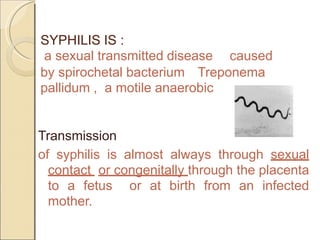
SYPHILIS IS :
a sexual transmitted disease caused
by spirochetal bacterium Treponema
pallidum , a motile anaerobic
Transmission
of syphilis is almost always through sexual
contact or congenitally through the placenta
to a fetus or at birth from an infected
mother.
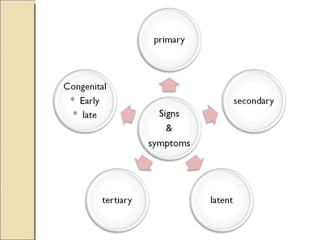
Different
manifestations occur
depending on the
stage of the disease
Ophthalmic manifestations of
syphilis
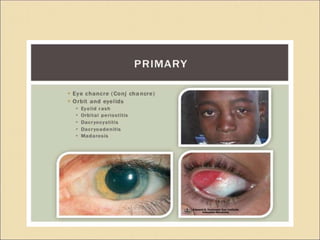
• Primary Syphilis:
it’s the first stage after infection
1. painless & localized ulcer with
rolled edge (chancres).
2. single or multiple.
3. appear 2-3 weeks after contact.
4. most common site are cervix ,
vagina , vulva , anus and mouth.
5. regional L.N become enlarged.
.
PRIMARY SYPHILIS
(The Chancre)
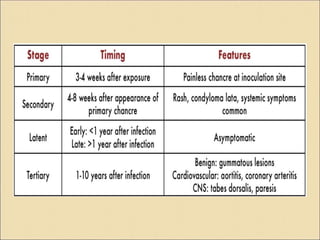
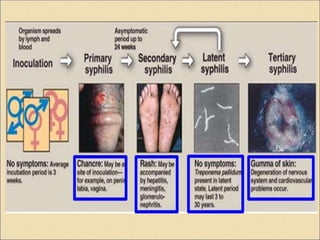
 Incubation period 9-90 days, usually ~21 days.
 Develops at site of contact/inoculation.
 Classically: single, painless, clean-based,
indurated ulcer, with firm, raised borders.
Atypical presentations may
occur.
 Mostly anogenital, but may occur at any site
(tongue, pharynx, lips, fingers, nipples, etc...)
 Non-tender regional adenopathy
 Very infectious.
 May be darkfield positive but serologically
negative.
 Untreated, heals in several weeks, leaving a faint scar.
SECONDARY SYPHILIS
(Cont.)
 The skin rash:
◦ Diffuse,
◦ often with a superficial scale (papulosquamous).
◦ May leave residual pigmentation or depigmentation.
 Condylomata Lata:
◦ Formed by coalescence of large, pale, flat-topped papules.
◦ Occur in warm, moist areas such as the perineum.
◦ Highly infectious.
 Mucosal lesions:
~ 30% of secondary syphilis patients develop mucous patch
(slightly raised, oval area covered by a grayish white
membrane, with a pink base that does not bleed).
◦ Highly infectious
 Secondary Syphilis:
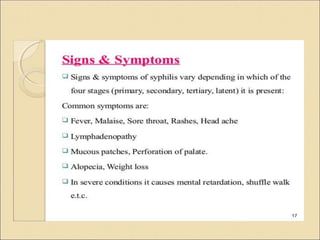
1. Systemic
2. 1-6 months after contact
3. fever, malaise, general adenopathy and
non-
itchy maculopapular skin rash “money
spot” .
4. involve the palms of the hands and the
soles
of the feet.
5. Mucous patches and linear (snail track)
ulcers
SECONDARY SYPHILIS
 Seen 6 wks to 6 mos after primary chancre
 Usually w diffuse non-pruritic, indurated rash,
including palms & soles.
 May also cause:
◦ Fever, malaise, headache, sore throat,
myalgia, arthralgia, generalized
lymphadenopathy
◦ Hepatitis (10%)
◦ Renal: an immune complex type of nephropathy
with transient nephrotic syndrome
◦ Iritis or an anterior uveitis
◦ Bone: periostitis
◦ CSF pleocytosis in 10 - 30% (but,
symptomatic meningitis is seen in <1%)
SECONDARY
SYPHILISDifferential diagnosis
 The rash may be confused with
◦ Pityriasis rosea (usually has a herald patch and lesions seen
along lines of skin cleavage)
◦ Drug eruptions
◦ Acute febrile exanthems
◦ Psoriasis
◦ Lichen planus
◦ Scabies
 The mucous patch may be confused with oral
thrush.
 Malaise, sore throat, generalized adenopathy,
hepatitis, & rash may be confused with infectious
mononucleosis.
 Fortunately, the serologic tests for syphilis are positive
in 99% of secondary syphilis pts.
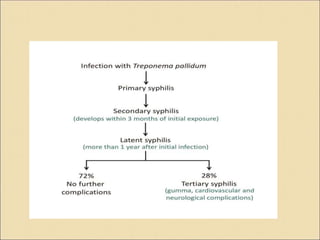
LATENT SYPHILIS
Positive syphilisserology without
clinical signs of syphilis (& has
normal CSF).
◦ It begins with the end of secondary syphilis and
may last for a lifetime.
◦ Pt may or may not have a h/o primary or secondary
syphilis.
◦ Diseases known to cause occasional false-positive
nontreponemal test reactions for syphilis, such as
systemic lupus erythematosus (SLE), and
congenital syphilis must be excluded before the
diagnosis of latent syphilis can be made.
 Is divided into early and late latency.
LATENT SYPHILIS (cont.)
(
◦
◦
◦
◦
Early latent:
The first year after the resolution of primary
or secondary lesions, or
A reactive serologic test for syphilis in an
asymptomatic individual who has had a
negative serologic test within the
preceding year.
Infectious.
2. Late latent:
Usually not infectious, except for the
pregnant woman, who may transmit
infection to her fetus.
LATENT SYPHILIS
‘Tertiary Syphilis’



Is the destructive stage of the disease.
Lesions develop in skin, bone, & visceral organs (any
organ). The main types are:
◦
◦
◦
Late benign
(gummatous)
Cardiovascular &
Neurosyphilis



Can be crippling and life threatening
Blindness, deafness, deformity, lack of coordination,
paralysis, dementia may occur
It is usually very slowly progressive, barring certain
neurologic syndromes which may develop suddenly due
to endarteritis and thrombosis in the CNS
Late syphilis is noninfectious.
LATENT SYPHILIS
Positivesyphilisserologywithout clinical
signs of syphilis (& has normal
CSF).
◦ It begins with the end of secondary syphilis and may
last for a lifetime.
◦ Pt may or may not have a h/o primary or
secondary syphilis.◦ Diseas
es
known to cause occasional false-
positivenontreponemal test reactions for syphilis, such as
systemic lupus erythematosus (SLE), and congenital
syphilis must be excluded before the diagnosis of
latent syphilis can be made.
 Is divided into early and late latency.
Latent syphilis
Absent of symptoms or physical finding.
13 proceed to tertiary.
Tertiary syphilis
6. Ocurre 1-10 years after infection
7. gummas: ulcerative nodule in the skin,
bone and nervous system as a result of
hypersensitivity reactions.
8. Systemic manifestation: CVS, CNS and
bone
Congenital
Syphilis Mode of transmission:
-trans placental passage from infected
mother
- at birth
 Congenital infection is associated with
several adverse outcomes including:-congenital anomalies
-miscarriages or death
of
-low birth wt
-premature
birth baby
Congenital
Syphilis Early:
-skin lesions ,
maculopapular
tissue
-Lymphadenopathy
-
Hepatosplenomegal
y
-failure to thrive
-jaundice , anemia
- osteochondritis
 Late:
-gummatous ulcers
-bony prominence
of forehead
-Saddle nose
-Short maxilla
-keratitis, 8 nerve
deafness and
dental
deformities
Preventio
n
Treatment
The first-choice treatment for all
manifestations of syphilis is penicillin.
Parenteral penicillin G is the only therapy
with documented effect during
pregnancy.
Non-pregnant individuals who have
severe allergic reactions to penicillin
may be effectively treated with oral
tetracycline or doxycycline
THANX

Std syphilis- (1)

  • 1.
  • 2.
    SYPHILIS IS : asexual transmitted disease caused by spirochetal bacterium Treponema pallidum , a motile anaerobic Transmission of syphilis is almost always through sexual contact or congenitally through the placenta to a fetus or at birth from an infected mother.
  • 3.
  • 11.
  • 13.
    • Primary Syphilis: it’sthe first stage after infection 1. painless & localized ulcer with rolled edge (chancres). 2. single or multiple. 3. appear 2-3 weeks after contact. 4. most common site are cervix , vagina , vulva , anus and mouth. 5. regional L.N become enlarged. .
  • 14.
    PRIMARY SYPHILIS (The Chancre) Incubation period 9-90 days, usually ~21 days.  Develops at site of contact/inoculation.  Classically: single, painless, clean-based, indurated ulcer, with firm, raised borders. Atypical presentations may occur.  Mostly anogenital, but may occur at any site (tongue, pharynx, lips, fingers, nipples, etc...)  Non-tender regional adenopathy  Very infectious.  May be darkfield positive but serologically negative.  Untreated, heals in several weeks, leaving a faint scar.
  • 15.
    SECONDARY SYPHILIS (Cont.)  Theskin rash: ◦ Diffuse, ◦ often with a superficial scale (papulosquamous). ◦ May leave residual pigmentation or depigmentation.  Condylomata Lata: ◦ Formed by coalescence of large, pale, flat-topped papules. ◦ Occur in warm, moist areas such as the perineum. ◦ Highly infectious.  Mucosal lesions: ~ 30% of secondary syphilis patients develop mucous patch (slightly raised, oval area covered by a grayish white membrane, with a pink base that does not bleed). ◦ Highly infectious
  • 16.
     Secondary Syphilis: 1.Systemic 2. 1-6 months after contact 3. fever, malaise, general adenopathy and non- itchy maculopapular skin rash “money spot” . 4. involve the palms of the hands and the soles of the feet. 5. Mucous patches and linear (snail track) ulcers
  • 17.
    SECONDARY SYPHILIS  Seen6 wks to 6 mos after primary chancre  Usually w diffuse non-pruritic, indurated rash, including palms & soles.  May also cause: ◦ Fever, malaise, headache, sore throat, myalgia, arthralgia, generalized lymphadenopathy ◦ Hepatitis (10%) ◦ Renal: an immune complex type of nephropathy with transient nephrotic syndrome ◦ Iritis or an anterior uveitis ◦ Bone: periostitis ◦ CSF pleocytosis in 10 - 30% (but, symptomatic meningitis is seen in <1%)
  • 18.
    SECONDARY SYPHILISDifferential diagnosis  Therash may be confused with ◦ Pityriasis rosea (usually has a herald patch and lesions seen along lines of skin cleavage) ◦ Drug eruptions ◦ Acute febrile exanthems ◦ Psoriasis ◦ Lichen planus ◦ Scabies  The mucous patch may be confused with oral thrush.  Malaise, sore throat, generalized adenopathy, hepatitis, & rash may be confused with infectious mononucleosis.  Fortunately, the serologic tests for syphilis are positive in 99% of secondary syphilis pts.
  • 19.
    LATENT SYPHILIS Positive syphilisserologywithout clinical signs of syphilis (& has normal CSF). ◦ It begins with the end of secondary syphilis and may last for a lifetime. ◦ Pt may or may not have a h/o primary or secondary syphilis. ◦ Diseases known to cause occasional false-positive nontreponemal test reactions for syphilis, such as systemic lupus erythematosus (SLE), and congenital syphilis must be excluded before the diagnosis of latent syphilis can be made.  Is divided into early and late latency.
  • 20.
    LATENT SYPHILIS (cont.) ( ◦ ◦ ◦ ◦ Earlylatent: The first year after the resolution of primary or secondary lesions, or A reactive serologic test for syphilis in an asymptomatic individual who has had a negative serologic test within the preceding year. Infectious. 2. Late latent: Usually not infectious, except for the pregnant woman, who may transmit infection to her fetus.
  • 21.
    LATENT SYPHILIS ‘Tertiary Syphilis’    Isthe destructive stage of the disease. Lesions develop in skin, bone, & visceral organs (any organ). The main types are: ◦ ◦ ◦ Late benign (gummatous) Cardiovascular & Neurosyphilis    Can be crippling and life threatening Blindness, deafness, deformity, lack of coordination, paralysis, dementia may occur It is usually very slowly progressive, barring certain neurologic syndromes which may develop suddenly due to endarteritis and thrombosis in the CNS Late syphilis is noninfectious.
  • 22.
    LATENT SYPHILIS Positivesyphilisserologywithout clinical signsof syphilis (& has normal CSF). ◦ It begins with the end of secondary syphilis and may last for a lifetime. ◦ Pt may or may not have a h/o primary or secondary syphilis.◦ Diseas es known to cause occasional false- positivenontreponemal test reactions for syphilis, such as systemic lupus erythematosus (SLE), and congenital syphilis must be excluded before the diagnosis of latent syphilis can be made.  Is divided into early and late latency.
  • 23.
    Latent syphilis Absent ofsymptoms or physical finding. 13 proceed to tertiary. Tertiary syphilis 6. Ocurre 1-10 years after infection 7. gummas: ulcerative nodule in the skin, bone and nervous system as a result of hypersensitivity reactions. 8. Systemic manifestation: CVS, CNS and bone
  • 24.
    Congenital Syphilis Mode oftransmission: -trans placental passage from infected mother - at birth  Congenital infection is associated with several adverse outcomes including:-congenital anomalies -miscarriages or death of -low birth wt -premature birth baby
  • 25.
    Congenital Syphilis Early: -skin lesions, maculopapular tissue -Lymphadenopathy - Hepatosplenomegal y -failure to thrive -jaundice , anemia - osteochondritis  Late: -gummatous ulcers -bony prominence of forehead -Saddle nose -Short maxilla -keratitis, 8 nerve deafness and dental deformities
  • 26.
    Preventio n Treatment The first-choice treatmentfor all manifestations of syphilis is penicillin. Parenteral penicillin G is the only therapy with documented effect during pregnancy. Non-pregnant individuals who have severe allergic reactions to penicillin may be effectively treated with oral tetracycline or doxycycline
  • 27.