The generaTreponema belong to the
“spirochetes”.
Treponemes are relatively short, slender
spirochetes with fine spirals and pointed
ends.
Treponemes cause following diseases:-
Veneral syphilis – Tpallidum
Endemic syphilis –Tpallidum
Yaws - Tpertenue
Pinta - Tcarateum
Treponema pallidum.
Described in 1905 by Schaudinn and
Hoffman, Hamburg.
sexual; maternal-fetal, blood transfusion and
rarely by other means of both transmitting
and getting infected with HIV.
Morphology:
 It is a thin, delicate, actively motile
spirochete with tapering ends & about
10µm long & 0.1 – 0.2µm wide.
It can be seen on fresh primary or secondary
lesions by darkfield microscopy or fluorescent
antibody techniques.
Have axial filaments, which are otherwise similar
to bacterial flagella.
Filaments enable movement of bacterium by
rotating in place.
It can be stained by silver impregnation
methods. Fontana’s method is useful fir
staining films & Levaditis method for tissue
sections.
Penetration:
T. pallidum enters the body via skin and
mucous membranes through abrasions during
sexual contact.
Also transmitted transplacentally.
Dissemination:
Travels via the lymphatic system to regional
lymph nodes and then throughout the body
via the blood stream.
Invasion of the CNS can occur during any stage
of syphilis.
 The bacteria multiply at
the initial entry site
forming a chancre, which
is painless, avascular,
ulcerated lesion and
most frequently on the
external genitalia, but it
may occur on the cervix,
perianal area, in the
mouth or anal canal.
BY three means :-
 Person to person via vaginal, anal, or oral
sex through direct contact with a syphilis
chancre.
Person to person during foreplay, even
when there is no penetrative sex (much less
common).
Pregnant mother with syphilis to fetus.
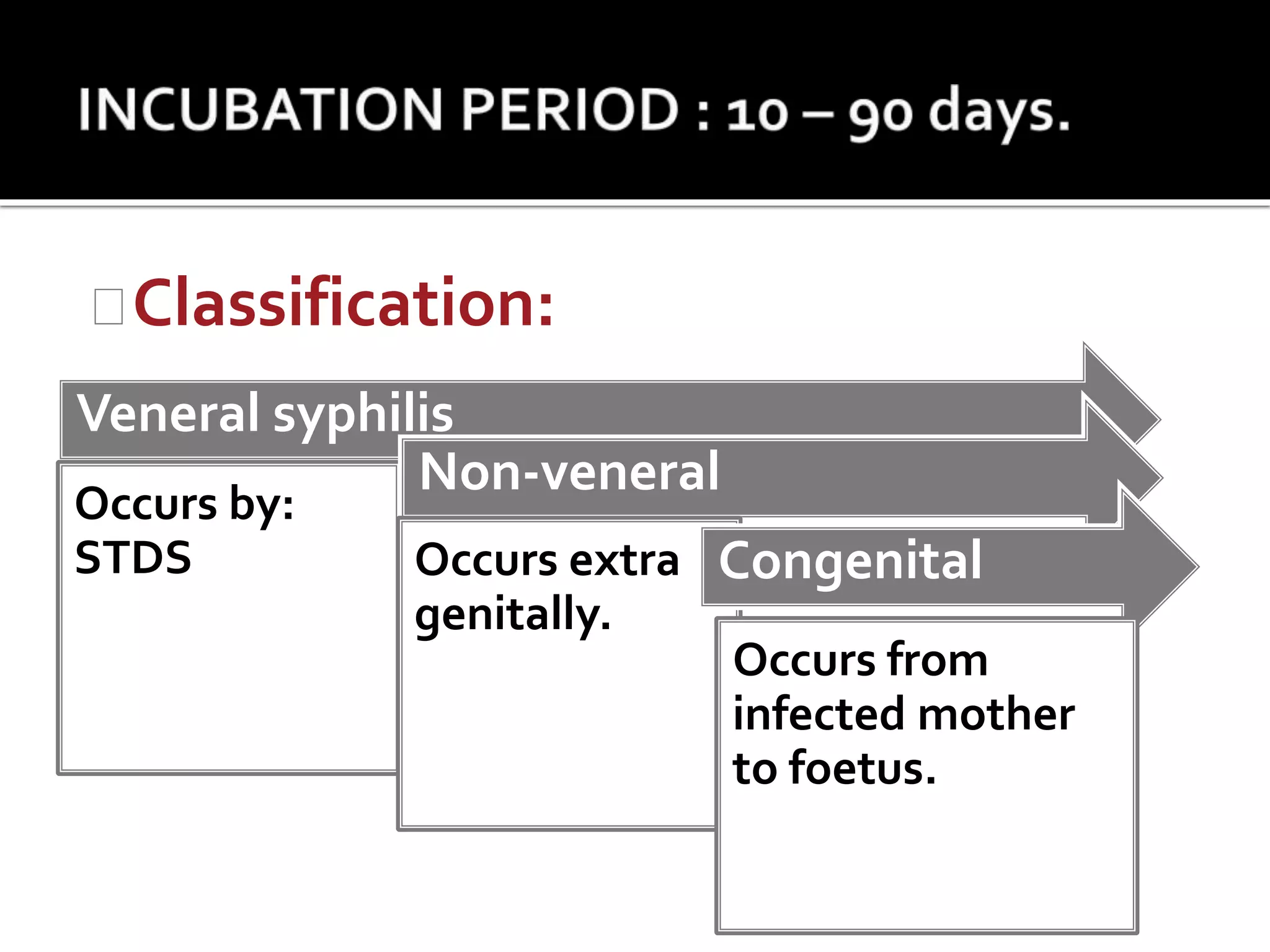
Classification:
Veneral syphilis
Occurs by:
STDS
Non-veneral
Occurs extra
genitally.
Congenital
Occurs from
infected mother
to foetus.
Congenital syphilis
usually occurs
following vertical
transmission ofT.
pallidum from the
infected mother to
the fetus in utero, but
neonates may also be
infected during
passage through the
infected birth canal at
delivery.
The clinical manifestations falls into 3 stages:-
The primary lesion in
syphilis is formation of
chancre at site of entry
of spirochete.
The chancre covered
by thick, glairy
exudate rich in
spirochetes.
Regional lymph nodes
are swollen, discrete,
rubbery & non-tender. Pennile chancre
Chancre heals within 10 – 40 days without
treatment leaving a thin scar.
In highly infected persons multiple chancres
are seen.
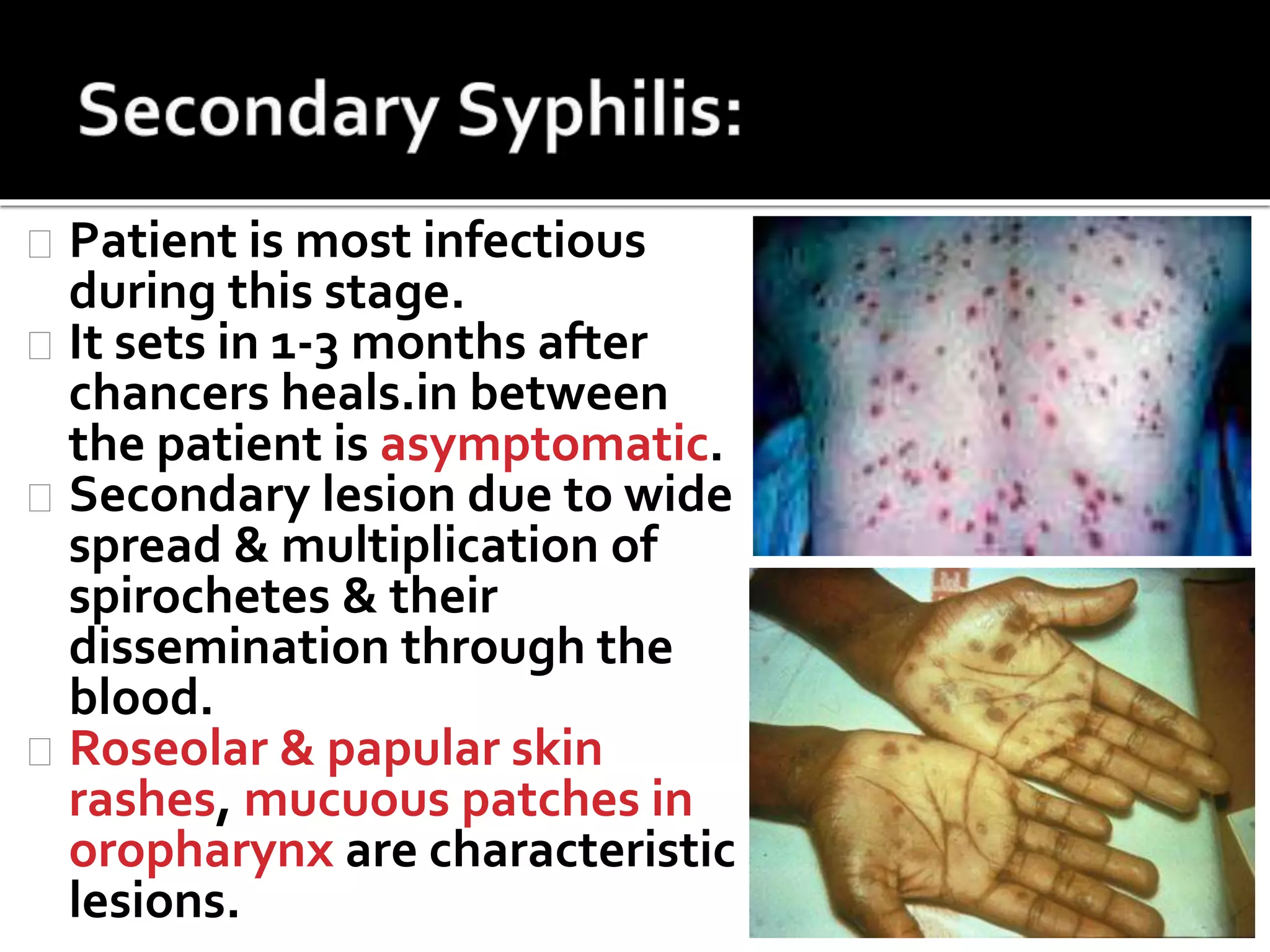
Patient is most infectious
during this stage.
It sets in 1-3 months after
chancers heals.in between
the patient is asymptomatic.
Secondary lesion due to wide
spread & multiplication of
spirochetes & their
dissemination through the
blood.
Roseolar & papular skin
rashes, mucuous patches in
oropharynx are characteristic
lesions.
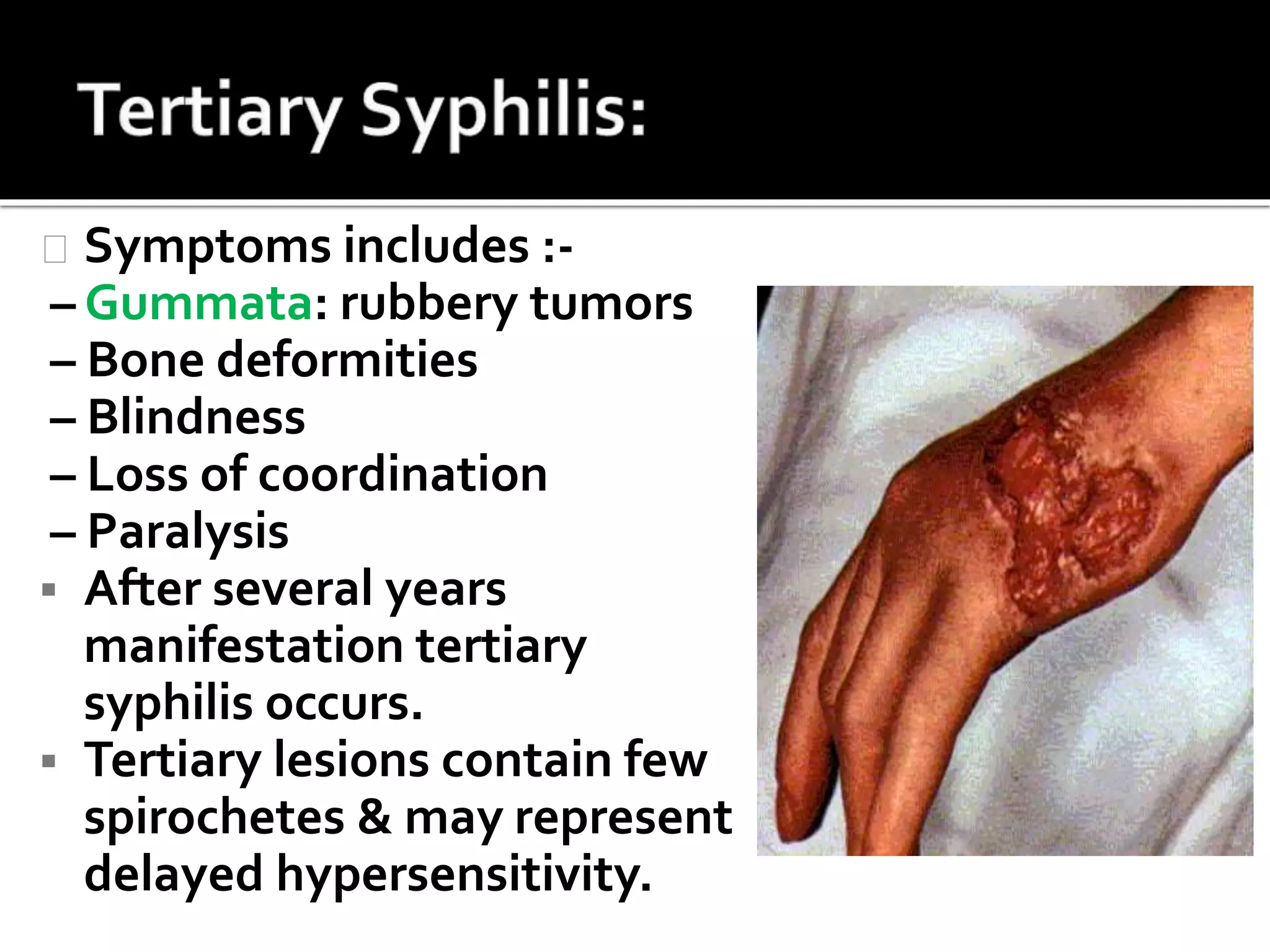
Symptoms includes :-
– Gummata: rubbery tumors
– Bone deformities
– Blindness
– Loss of coordination
– Paralysis
 After several years
manifestation tertiary
syphilis occurs.
 Tertiary lesions contain few
spirochetes & may represent
delayed hypersensitivity.
In few cases , neurological manifestations
such as general paralysis develop several
decades after initial infection & known as
Quaternary (or) late syphilis.
Treponemes demonstrated under Dark
background microscopy, Direct flourescent
antibody staining(DFA-TP),in tissue by
Silver impregnation method & immuno
flourescence staining.
Serological tests:
1.VDRLTEST:
 Used to detect antibodies in CSF or in
sample of blood.
In this test antigen used is cardiolipin
collected from beefs heart.
Serum+1 drop of freshly prepared
cardiolipin antigen observed under
microscope presence of clumps indicate +ve
test & uniformly distributed crystals shows
–ve test.
 This test useful in detecting early syphilis.
It is almost similar toVDRL test but finely
divided carbon particles are added to
cardiolipin antigen.
 It is newer blood test that checks antibodies
towards the organism that cause syphilis.
TREATMENT:
 Penicillin is the only antibiotic used in
treatment of syphilis.
 In early cases 2.4 million units of benzathine
penicillin G used , for late syphilis this
repeated for 3 weeks.
Those patients allergic to penicillin are
given:
 Ceftriaxone
 Doxycycline
 Tetracycline These given to treat
 Azithromycin early syphilis.
ThankYouThankYou

Syphilis

  • 2.
    The generaTreponema belongto the “spirochetes”. Treponemes are relatively short, slender spirochetes with fine spirals and pointed ends. Treponemes cause following diseases:- Veneral syphilis – Tpallidum Endemic syphilis –Tpallidum Yaws - Tpertenue Pinta - Tcarateum
  • 3.
    Treponema pallidum. Described in1905 by Schaudinn and Hoffman, Hamburg.
  • 4.
    sexual; maternal-fetal, bloodtransfusion and rarely by other means of both transmitting and getting infected with HIV. Morphology:  It is a thin, delicate, actively motile spirochete with tapering ends & about 10µm long & 0.1 – 0.2µm wide.
  • 5.
    It can beseen on fresh primary or secondary lesions by darkfield microscopy or fluorescent antibody techniques. Have axial filaments, which are otherwise similar to bacterial flagella. Filaments enable movement of bacterium by rotating in place.
  • 6.
    It can bestained by silver impregnation methods. Fontana’s method is useful fir staining films & Levaditis method for tissue sections.
  • 7.
    Penetration: T. pallidum entersthe body via skin and mucous membranes through abrasions during sexual contact. Also transmitted transplacentally. Dissemination: Travels via the lymphatic system to regional lymph nodes and then throughout the body via the blood stream. Invasion of the CNS can occur during any stage of syphilis.
  • 8.
     The bacteriamultiply at the initial entry site forming a chancre, which is painless, avascular, ulcerated lesion and most frequently on the external genitalia, but it may occur on the cervix, perianal area, in the mouth or anal canal.
  • 9.
    BY three means:-  Person to person via vaginal, anal, or oral sex through direct contact with a syphilis chancre. Person to person during foreplay, even when there is no penetrative sex (much less common). Pregnant mother with syphilis to fetus.
  • 10.
    Classification: Veneral syphilis Occurs by: STDS Non-veneral Occursextra genitally. Congenital Occurs from infected mother to foetus.
  • 11.
    Congenital syphilis usually occurs followingvertical transmission ofT. pallidum from the infected mother to the fetus in utero, but neonates may also be infected during passage through the infected birth canal at delivery.
  • 13.
    The clinical manifestationsfalls into 3 stages:-
  • 14.
    The primary lesionin syphilis is formation of chancre at site of entry of spirochete. The chancre covered by thick, glairy exudate rich in spirochetes. Regional lymph nodes are swollen, discrete, rubbery & non-tender. Pennile chancre
  • 15.
    Chancre heals within10 – 40 days without treatment leaving a thin scar. In highly infected persons multiple chancres are seen.
  • 16.
    Patient is mostinfectious during this stage. It sets in 1-3 months after chancers heals.in between the patient is asymptomatic. Secondary lesion due to wide spread & multiplication of spirochetes & their dissemination through the blood. Roseolar & papular skin rashes, mucuous patches in oropharynx are characteristic lesions.
  • 17.
    Symptoms includes :- –Gummata: rubbery tumors – Bone deformities – Blindness – Loss of coordination – Paralysis  After several years manifestation tertiary syphilis occurs.  Tertiary lesions contain few spirochetes & may represent delayed hypersensitivity.
  • 18.
    In few cases, neurological manifestations such as general paralysis develop several decades after initial infection & known as Quaternary (or) late syphilis.
  • 19.
    Treponemes demonstrated underDark background microscopy, Direct flourescent antibody staining(DFA-TP),in tissue by Silver impregnation method & immuno flourescence staining. Serological tests: 1.VDRLTEST:  Used to detect antibodies in CSF or in sample of blood.
  • 20.
    In this testantigen used is cardiolipin collected from beefs heart. Serum+1 drop of freshly prepared cardiolipin antigen observed under microscope presence of clumps indicate +ve test & uniformly distributed crystals shows –ve test.  This test useful in detecting early syphilis.
  • 21.
    It is almostsimilar toVDRL test but finely divided carbon particles are added to cardiolipin antigen.
  • 22.
     It isnewer blood test that checks antibodies towards the organism that cause syphilis. TREATMENT:  Penicillin is the only antibiotic used in treatment of syphilis.  In early cases 2.4 million units of benzathine penicillin G used , for late syphilis this repeated for 3 weeks.
  • 23.
    Those patients allergicto penicillin are given:  Ceftriaxone  Doxycycline  Tetracycline These given to treat  Azithromycin early syphilis.
  • 24.