By
Dr. VARUGHESE GEORGE
Department of Pathology
1
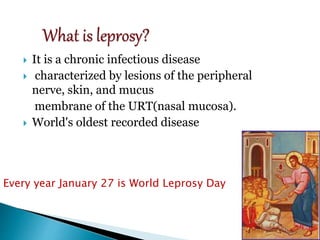
 It is a chronic infectious disease
 characterized by lesions of the peripheral
nerve, skin, and mucus
membrane of the URT(nasal mucosa).
 World's oldest recorded disease
Every year January 27 is World Leprosy Day
3
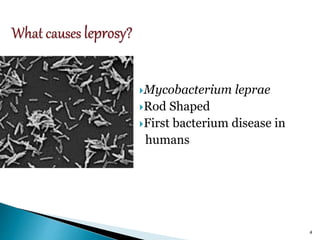
Mycobacterium leprae
Rod Shaped
First bacterium disease in
humans
4
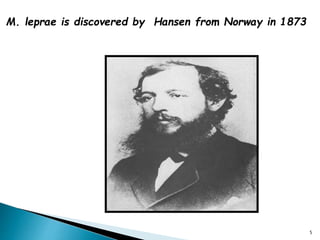
M. leprae is discovered by Hansen from Norway in 1873
5
 Leprosy develops slowly from 6 months up to
40 yrs
 Results in skin lesions and deformities, most
often affecting the cooler places on the body
( for example: eyes, nose, earlobes, hands,
feet, and testicles) that can be very disfiguring.
6
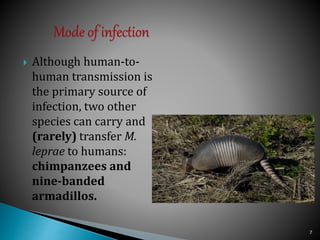
 Although human-to-
human transmission is
the primary source of
infection, two other
species can carry and
(rarely) transfer M.
leprae to humans:
chimpanzees and
nine-banded
armadillos.
7
The spread of leprosy is believed to be via nasal
discharge (Droplet infection).
Every 1 cc of nasal secretion contains 1- 2millions lepra bacilli
1. Residence in an endemic area.
2. Poverty (malnutrition).
3. Contact with affected armadillo.
4. Immunity
9
 The incubation period range from 3 -5 years.
 Males appear to be twice common than females.
 Bimodal age (10-14 years & 35-44 years).
 Children are more susceptible to disease.
10
11
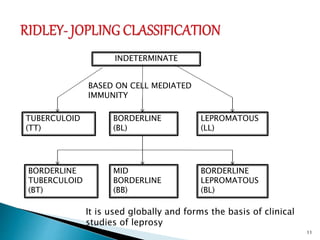
INDETERMINATE
TUBERCULOID
(TT)
BORDERLINE
(BL)
LEPROMATOUS
(LL)
BORDERLINE
TUBERCULOID
(BT)
MID
BORDERLINE
(BB)
BORDERLINE
LEPROMATOUS
(BL)
BASED ON CELL MEDIATED
IMMUNITY
It is used globally and forms the basis of clinical
studies of leprosy
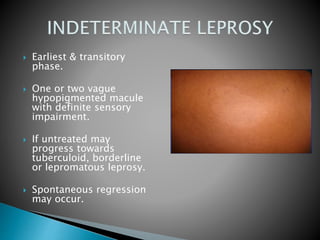
 Earliest & transitory
phase.
 One or two vague
hypopigmented macule
with definite sensory
impairment.
 If untreated may
progress towards
tuberculoid, borderline
or lepromatous leprosy.
 Spontaneous regression
may occur.
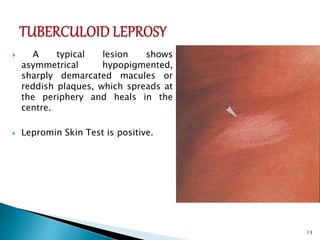
 A typical lesion shows
asymmetrical hypopigmented,
sharply demarcated macules or
reddish plaques, which spreads at
the periphery and heals in the
centre.
 Lepromin Skin Test is positive.
13
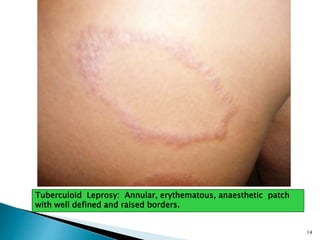
Tuberculoid Leprosy: Annular, erythematous, anaesthetic patch
with well defined and raised borders.
14
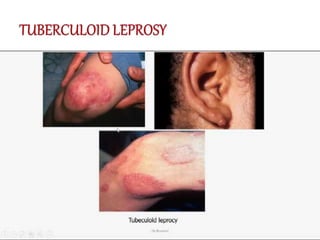
TUBERCULOID LEPROSY
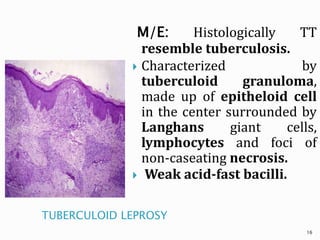
M/E: Histologically TT
resemble tuberculosis.
 Characterized by
tuberculoid granuloma,
made up of epitheloid cell
in the center surrounded by
Langhans giant cells,
lymphocytes and foci of
non-caseating necrosis.
 Weak acid-fast bacilli.
16
 Lepromatous leprosy involves:
◦ the skin,
◦ peripheral nerves,
◦ anterior chamber of the eye,
◦ upper airways (down to the larynx),
◦ testes,
◦ hands and feet.
 The vital organs and CNS are rarely affected,
presumably because the core temperature is
too high for growth of M. leprae.
17
 Lepromatous lesions contain large
aggregates of lipid-laden macrophages
(lepra cells), often filled with masses
(“globi”) of acid-fast bacilli.
 Because of the abundant bacteria,
lepromatous leprosy is referred to as
“multibacillary”.
 Lepromin skin test is negative.
18
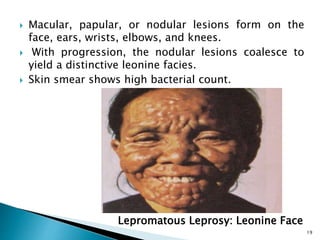
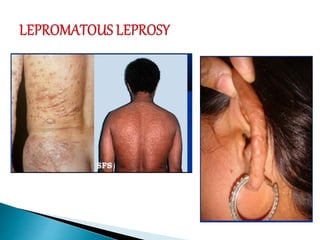
 Macular, papular, or nodular lesions form on the
face, ears, wrists, elbows, and knees.
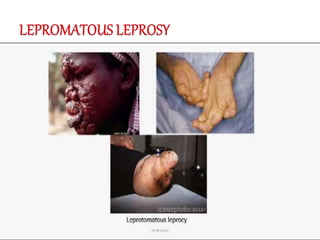
 With progression, the nodular lesions coalesce to
yield a distinctive leonine facies.
 Skin smear shows high bacterial count.
19
Lepromatous Leprosy: Leonine Face
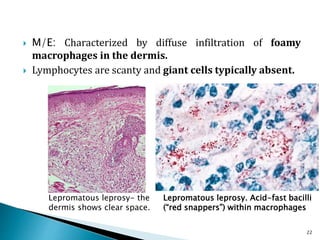
 M/E: Characterized by diffuse infiltration of foamy
macrophages in the dermis.
 Lymphocytes are scanty and giant cells typically absent.
22
Lepromatous leprosy. Acid-fast bacilli
(“red snappers”) within macrophages
Lepromatous leprosy- the
dermis shows clear space.
23
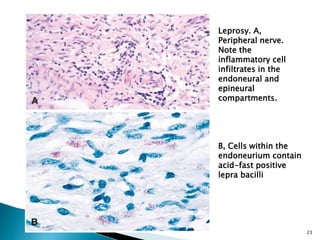
Leprosy. A,
Peripheral nerve.
Note the
inflammatory cell
infiltrates in the
endoneural and
epineural
compartments.
B, Cells within the
endoneurium contain
acid-fast positive
lepra bacilli
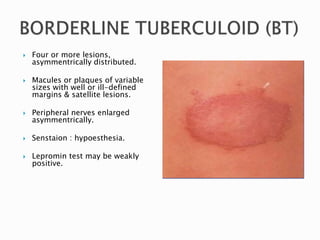
 Four or more lesions,
asymmentrically distributed.
 Macules or plaques of variable
sizes with well or ill-defined
margins & satellite lesions.
 Peripheral nerves enlarged
asymmentrically.
 Senstaion : hypoesthesia.
 Lepromin test may be weakly
positive.
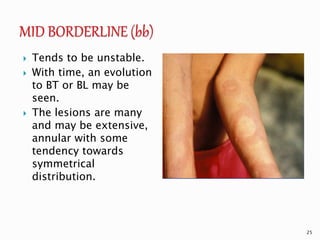
 Tends to be unstable.
 With time, an evolution
to BT or BL may be
seen.
 The lesions are many
and may be extensive,
annular with some
tendency towards
symmetrical
distribution.
25
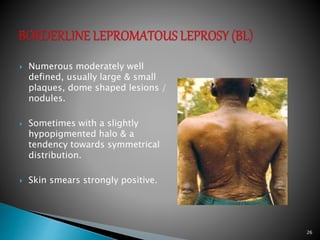
 Numerous moderately well
defined, usually large & small
plaques, dome shaped lesions /
nodules.
 Sometimes with a slightly
hypopigmented halo & a
tendency towards symmetrical
distribution.
 Skin smears strongly positive.
26
 Procedure to Lepromin Skin Test
A tiny sample of leprosy antigen is injected
under the skin, usually in the forearm.
The skin gets pushed up, forming a small bump.
This is an indication that the antigen has been
injected to the correct depth.
The site of the injection is marked, and is
examined for reaction,
• first after 3 days(early reaction-Fernandez
reaction:-redness and induration) and
• then again after 21 days(late reaction-
Mitsuda reaction:-nodule>5mm).
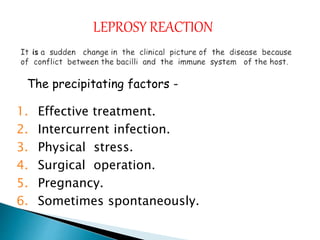
The precipitating factors -
1. Effective treatment.
2. Intercurrent infection.
3. Physical stress.
4. Surgical operation.
5. Pregnancy.
6. Sometimes spontaneously.
LEPROSY REACTION
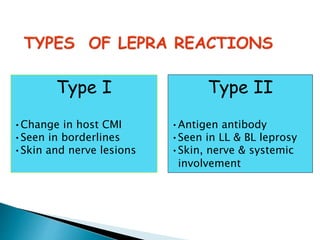
Type I
•Change in host CMI
•Seen in borderlines
•Skin and nerve lesions
Type II
•Antigen antibody
•Seen in LL & BL leprosy
•Skin, nerve & systemic
involvement
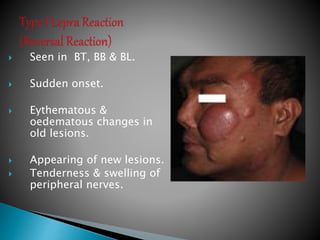
 Seen in BT, BB & BL.
 Sudden onset.
 Eythematous &
oedematous changes in
old lesions.
 Appearing of new lesions.
 Tenderness & swelling of
peripheral nerves.
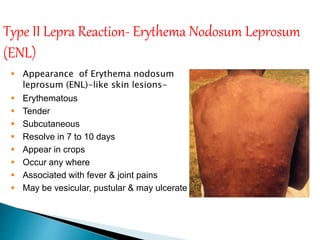
Type II Lepra Reaction- Erythema Nodosum Leprosum
(ENL)
 Appearance of Erythema nodosum
leprosum (ENL)-like skin lesions-
 Erythematous
 Tender
 Subcutaneous
 Resolve in 7 to 10 days
 Appear in crops
 Occur any where
 Associated with fever & joint pains
 May be vesicular, pustular & may ulcerate
 Skin Scrapings
Samples from the skin are obtained from
the edge of the lesion, which is smeared on
the slide and stained with Fite- Faraco
technique to demonstrate the bacilli.
 Biopsy
Useful in classification & definitive diagnosis
32
 Contractures, paralyses, and
autoamputation of fingers or toes may
ensue.
 Facial nerve involvement can lead to
paralysis of the eyelids, with keratitis and
corneal ulcerations.
33
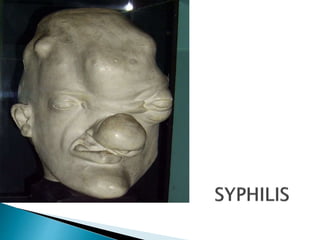
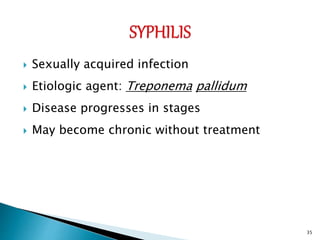
 Sexually acquired infection
 Etiologic agent: Treponema pallidum
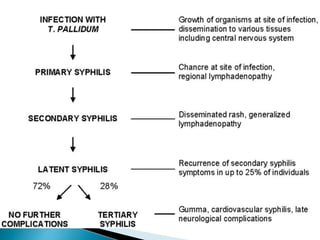
 Disease progresses in stages
 May become chronic without treatment
35
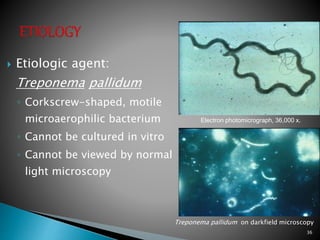
 Etiologic agent:
Treponema pallidum
◦ Corkscrew-shaped, motile
microaerophilic bacterium
◦ Cannot be cultured in vitro
◦ Cannot be viewed by normal
light microscopy
36
Treponema pallidum on darkfield microscopy
Electron photomicrograph, 36,000 x.
37
 Penetration:
◦ T. pallidum enters the body via skin and mucous
membranes through abrasions during sexual
contact
◦ Also transmitted transplacentally
 Dissemination:
◦ Travels via the lymphatic system to regional
lymph nodes and then throughout the body via
the blood stream
◦ Invasion of the CNS can occur during any stage of
syphilis
Pathogenesis
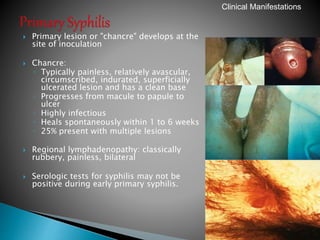
 Primary lesion or "chancre" develops at the
site of inoculation
 Chancre:
◦ Typically painless, relatively avascular,
circumscribed, indurated, superficially
ulcerated lesion and has a clean base
◦ Progresses from macule to papule to
ulcer
◦ Highly infectious
◦ Heals spontaneously within 1 to 6 weeks
◦ 25% present with multiple lesions
 Regional lymphadenopathy: classically
rubbery, painless, bilateral
 Serologic tests for syphilis may not be
positive during early primary syphilis.
39
Clinical Manifestations
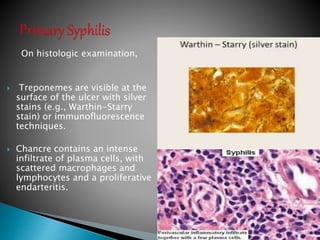
On histologic examination,
 Treponemes are visible at the
surface of the ulcer with silver
stains (e.g., Warthin-Starry
stain) or immunofluorescence
techniques.
 Chancre contains an intense
infiltrate of plasma cells, with
scattered macrophages and
lymphocytes and a proliferative
endarteritis.
40
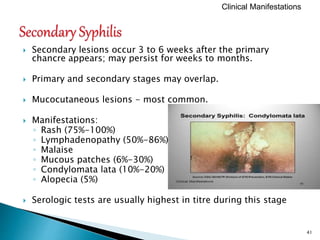
 Secondary lesions occur 3 to 6 weeks after the primary
chancre appears; may persist for weeks to months.
 Primary and secondary stages may overlap.
 Mucocutaneous lesions - most common.
 Manifestations:
◦ Rash (75%-100%)
◦ Lymphadenopathy (50%-86%)
◦ Malaise
◦ Mucous patches (6%-30%)
◦ Condylomata lata (10%-20%)
◦ Alopecia (5%)
 Serologic tests are usually highest in titre during this stage
41
Clinical Manifestations
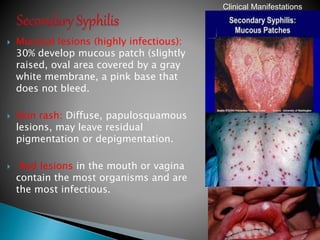
 Mucosal lesions (highly infectious):
30% develop mucous patch (slightly
raised, oval area covered by a gray
white membrane, a pink base that
does not bleed.
 Skin rash: Diffuse, papulosquamous
lesions, may leave residual
pigmentation or depigmentation.
 Red lesions in the mouth or vagina
contain the most organisms and are
the most infectious.
42
Clinical Manifestations
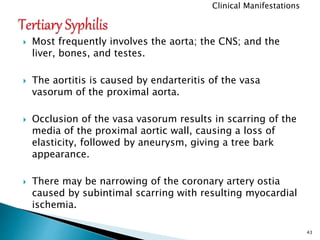
 Most frequently involves the aorta; the CNS; and the
liver, bones, and testes.
 The aortitis is caused by endarteritis of the vasa
vasorum of the proximal aorta.
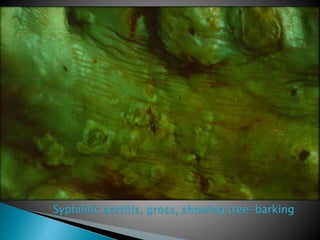
 Occlusion of the vasa vasorum results in scarring of the
media of the proximal aortic wall, causing a loss of
elasticity, followed by aneurysm, giving a tree bark
appearance.
 There may be narrowing of the coronary artery ostia
caused by subintimal scarring with resulting myocardial
ischemia.
43
Clinical Manifestations
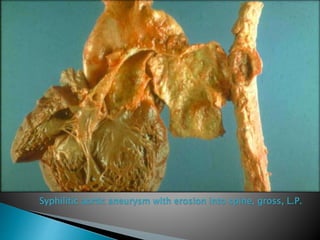
Syphilitic aortitis, gross, showing tree-barking
Syphilitic aortic aneurysm with erosion into spine, gross, L.P.
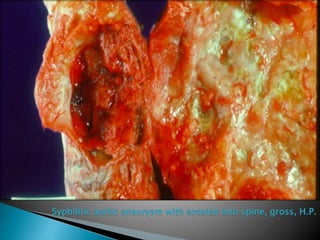
Syphilitic aortic aneurysm with erosion into spine, gross, H.P.
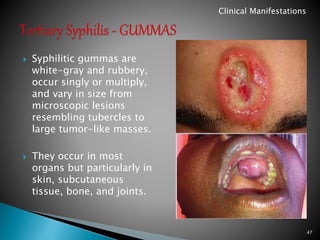
 Syphilitic gummas are
white-gray and rubbery,
occur singly or multiply,
and vary in size from
microscopic lesions
resembling tubercles to
large tumor-like masses.
 They occur in most
organs but particularly in
skin, subcutaneous
tissue, bone, and joints.
47
Clinical Manifestations
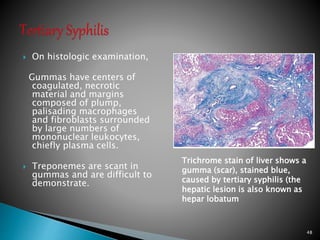
 On histologic examination,
Gummas have centers of
coagulated, necrotic
material and margins
composed of plump,
palisading macrophages
and fibroblasts surrounded
by large numbers of
mononuclear leukocytes,
chiefly plasma cells.
 Treponemes are scant in
gummas and are difficult to
demonstrate.
48
Trichrome stain of liver shows a
gumma (scar), stained blue,
caused by tertiary syphilis (the
hepatic lesion is also known as
hepar lobatum
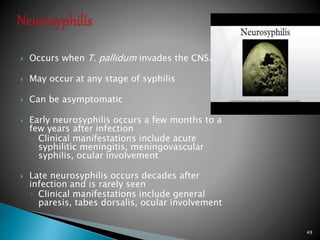
 Occurs when T. pallidum invades the CNS.
 May occur at any stage of syphilis
 Can be asymptomatic
 Early neurosyphilis occurs a few months to a
few years after infection
◦ Clinical manifestations include acute
syphilitic meningitis, meningovascular
syphilis, ocular involvement
 Late neurosyphilis occurs decades after
infection and is rarely seen
◦ Clinical manifestations include general
paresis, tabes dorsalis, ocular involvement
49
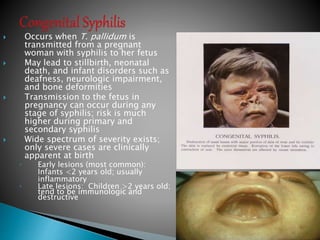
 Occurs when T. pallidum is
transmitted from a pregnant
woman with syphilis to her fetus
 May lead to stillbirth, neonatal
death, and infant disorders such as
deafness, neurologic impairment,
and bone deformities
 Transmission to the fetus in
pregnancy can occur during any
stage of syphilis; risk is much
higher during primary and
secondary syphilis
 Wide spectrum of severity exists;
only severe cases are clinically
apparent at birth
◦ Early lesions (most common):
Infants <2 years old; usually
inflammatory
◦ Late lesions: Children >2 years old;
tend to be immunologic and
destructive
50
51
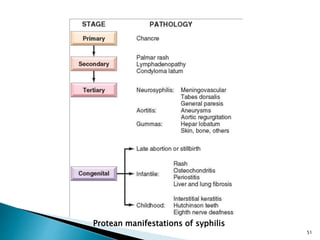
Protean manifestations of syphilis
52
 Principles
◦ Measure antibody directed against a cardiolipin-
lecithin-cholesterol antigen
◦ Not specific for T. pallidum
◦ Titers usually correlate with disease activity and
results are reported quantitatively
◦ May be reactive for life
 Non treponemal tests include
◦ VDRL,
◦ Rapid Plasma Reagin test
Diagnosis
53
 Principles
◦ Measure antibody directed against T. pallidum
antigens
◦ Qualitative
◦ Usually reactive for life
 Treponemal tests include
◦ TP-hemaglutination assay,
◦ Flourescent treponemal Ab test,
◦ Enzyme Immuno Assay
Diagnosis
54

Leprosy & syphilis

  • 1.
  • 3.
     It isa chronic infectious disease  characterized by lesions of the peripheral nerve, skin, and mucus membrane of the URT(nasal mucosa).  World's oldest recorded disease Every year January 27 is World Leprosy Day 3
  • 4.
  • 5.
    M. leprae isdiscovered by Hansen from Norway in 1873 5
  • 6.
     Leprosy developsslowly from 6 months up to 40 yrs  Results in skin lesions and deformities, most often affecting the cooler places on the body ( for example: eyes, nose, earlobes, hands, feet, and testicles) that can be very disfiguring. 6
  • 7.
     Although human-to- humantransmission is the primary source of infection, two other species can carry and (rarely) transfer M. leprae to humans: chimpanzees and nine-banded armadillos. 7
  • 8.
    The spread ofleprosy is believed to be via nasal discharge (Droplet infection). Every 1 cc of nasal secretion contains 1- 2millions lepra bacilli
  • 9.
    1. Residence inan endemic area. 2. Poverty (malnutrition). 3. Contact with affected armadillo. 4. Immunity 9
  • 10.
     The incubationperiod range from 3 -5 years.  Males appear to be twice common than females.  Bimodal age (10-14 years & 35-44 years).  Children are more susceptible to disease. 10
  • 11.
  • 12.
     Earliest &transitory phase.  One or two vague hypopigmented macule with definite sensory impairment.  If untreated may progress towards tuberculoid, borderline or lepromatous leprosy.  Spontaneous regression may occur.
  • 13.
     A typicallesion shows asymmetrical hypopigmented, sharply demarcated macules or reddish plaques, which spreads at the periphery and heals in the centre.  Lepromin Skin Test is positive. 13
  • 14.
    Tuberculoid Leprosy: Annular,erythematous, anaesthetic patch with well defined and raised borders. 14
  • 16.
    TUBERCULOID LEPROSY M/E: HistologicallyTT resemble tuberculosis.  Characterized by tuberculoid granuloma, made up of epitheloid cell in the center surrounded by Langhans giant cells, lymphocytes and foci of non-caseating necrosis.  Weak acid-fast bacilli. 16
  • 17.
     Lepromatous leprosyinvolves: ◦ the skin, ◦ peripheral nerves, ◦ anterior chamber of the eye, ◦ upper airways (down to the larynx), ◦ testes, ◦ hands and feet.  The vital organs and CNS are rarely affected, presumably because the core temperature is too high for growth of M. leprae. 17
  • 18.
     Lepromatous lesionscontain large aggregates of lipid-laden macrophages (lepra cells), often filled with masses (“globi”) of acid-fast bacilli.  Because of the abundant bacteria, lepromatous leprosy is referred to as “multibacillary”.  Lepromin skin test is negative. 18
  • 19.
     Macular, papular,or nodular lesions form on the face, ears, wrists, elbows, and knees.  With progression, the nodular lesions coalesce to yield a distinctive leonine facies.  Skin smear shows high bacterial count. 19 Lepromatous Leprosy: Leonine Face
  • 22.
     M/E: Characterizedby diffuse infiltration of foamy macrophages in the dermis.  Lymphocytes are scanty and giant cells typically absent. 22 Lepromatous leprosy. Acid-fast bacilli (“red snappers”) within macrophages Lepromatous leprosy- the dermis shows clear space.
  • 23.
    23 Leprosy. A, Peripheral nerve. Notethe inflammatory cell infiltrates in the endoneural and epineural compartments. B, Cells within the endoneurium contain acid-fast positive lepra bacilli
  • 24.
     Four ormore lesions, asymmentrically distributed.  Macules or plaques of variable sizes with well or ill-defined margins & satellite lesions.  Peripheral nerves enlarged asymmentrically.  Senstaion : hypoesthesia.  Lepromin test may be weakly positive.
  • 25.
     Tends tobe unstable.  With time, an evolution to BT or BL may be seen.  The lesions are many and may be extensive, annular with some tendency towards symmetrical distribution. 25
  • 26.
     Numerous moderatelywell defined, usually large & small plaques, dome shaped lesions / nodules.  Sometimes with a slightly hypopigmented halo & a tendency towards symmetrical distribution.  Skin smears strongly positive. 26
  • 27.
     Procedure toLepromin Skin Test A tiny sample of leprosy antigen is injected under the skin, usually in the forearm. The skin gets pushed up, forming a small bump. This is an indication that the antigen has been injected to the correct depth. The site of the injection is marked, and is examined for reaction, • first after 3 days(early reaction-Fernandez reaction:-redness and induration) and • then again after 21 days(late reaction- Mitsuda reaction:-nodule>5mm).
  • 28.
    The precipitating factors- 1. Effective treatment. 2. Intercurrent infection. 3. Physical stress. 4. Surgical operation. 5. Pregnancy. 6. Sometimes spontaneously. LEPROSY REACTION
  • 29.
    Type I •Change inhost CMI •Seen in borderlines •Skin and nerve lesions Type II •Antigen antibody •Seen in LL & BL leprosy •Skin, nerve & systemic involvement
  • 30.
     Seen inBT, BB & BL.  Sudden onset.  Eythematous & oedematous changes in old lesions.  Appearing of new lesions.  Tenderness & swelling of peripheral nerves.
  • 31.
    Type II LepraReaction- Erythema Nodosum Leprosum (ENL)  Appearance of Erythema nodosum leprosum (ENL)-like skin lesions-  Erythematous  Tender  Subcutaneous  Resolve in 7 to 10 days  Appear in crops  Occur any where  Associated with fever & joint pains  May be vesicular, pustular & may ulcerate
  • 32.
     Skin Scrapings Samplesfrom the skin are obtained from the edge of the lesion, which is smeared on the slide and stained with Fite- Faraco technique to demonstrate the bacilli.  Biopsy Useful in classification & definitive diagnosis 32
  • 33.
     Contractures, paralyses,and autoamputation of fingers or toes may ensue.  Facial nerve involvement can lead to paralysis of the eyelids, with keratitis and corneal ulcerations. 33
  • 35.
     Sexually acquiredinfection  Etiologic agent: Treponema pallidum  Disease progresses in stages  May become chronic without treatment 35
  • 36.
     Etiologic agent: Treponemapallidum ◦ Corkscrew-shaped, motile microaerophilic bacterium ◦ Cannot be cultured in vitro ◦ Cannot be viewed by normal light microscopy 36 Treponema pallidum on darkfield microscopy Electron photomicrograph, 36,000 x.
  • 37.
    37  Penetration: ◦ T.pallidum enters the body via skin and mucous membranes through abrasions during sexual contact ◦ Also transmitted transplacentally  Dissemination: ◦ Travels via the lymphatic system to regional lymph nodes and then throughout the body via the blood stream ◦ Invasion of the CNS can occur during any stage of syphilis Pathogenesis
  • 39.
     Primary lesionor "chancre" develops at the site of inoculation  Chancre: ◦ Typically painless, relatively avascular, circumscribed, indurated, superficially ulcerated lesion and has a clean base ◦ Progresses from macule to papule to ulcer ◦ Highly infectious ◦ Heals spontaneously within 1 to 6 weeks ◦ 25% present with multiple lesions  Regional lymphadenopathy: classically rubbery, painless, bilateral  Serologic tests for syphilis may not be positive during early primary syphilis. 39 Clinical Manifestations
  • 40.
    On histologic examination, Treponemes are visible at the surface of the ulcer with silver stains (e.g., Warthin-Starry stain) or immunofluorescence techniques.  Chancre contains an intense infiltrate of plasma cells, with scattered macrophages and lymphocytes and a proliferative endarteritis. 40
  • 41.
     Secondary lesionsoccur 3 to 6 weeks after the primary chancre appears; may persist for weeks to months.  Primary and secondary stages may overlap.  Mucocutaneous lesions - most common.  Manifestations: ◦ Rash (75%-100%) ◦ Lymphadenopathy (50%-86%) ◦ Malaise ◦ Mucous patches (6%-30%) ◦ Condylomata lata (10%-20%) ◦ Alopecia (5%)  Serologic tests are usually highest in titre during this stage 41 Clinical Manifestations
  • 42.
     Mucosal lesions(highly infectious): 30% develop mucous patch (slightly raised, oval area covered by a gray white membrane, a pink base that does not bleed.  Skin rash: Diffuse, papulosquamous lesions, may leave residual pigmentation or depigmentation.  Red lesions in the mouth or vagina contain the most organisms and are the most infectious. 42 Clinical Manifestations
  • 43.
     Most frequentlyinvolves the aorta; the CNS; and the liver, bones, and testes.  The aortitis is caused by endarteritis of the vasa vasorum of the proximal aorta.  Occlusion of the vasa vasorum results in scarring of the media of the proximal aortic wall, causing a loss of elasticity, followed by aneurysm, giving a tree bark appearance.  There may be narrowing of the coronary artery ostia caused by subintimal scarring with resulting myocardial ischemia. 43 Clinical Manifestations
  • 44.
    Syphilitic aortitis, gross,showing tree-barking
  • 45.
    Syphilitic aortic aneurysmwith erosion into spine, gross, L.P.
  • 46.
    Syphilitic aortic aneurysmwith erosion into spine, gross, H.P.
  • 47.
     Syphilitic gummasare white-gray and rubbery, occur singly or multiply, and vary in size from microscopic lesions resembling tubercles to large tumor-like masses.  They occur in most organs but particularly in skin, subcutaneous tissue, bone, and joints. 47 Clinical Manifestations
  • 48.
     On histologicexamination, Gummas have centers of coagulated, necrotic material and margins composed of plump, palisading macrophages and fibroblasts surrounded by large numbers of mononuclear leukocytes, chiefly plasma cells.  Treponemes are scant in gummas and are difficult to demonstrate. 48 Trichrome stain of liver shows a gumma (scar), stained blue, caused by tertiary syphilis (the hepatic lesion is also known as hepar lobatum
  • 49.
     Occurs whenT. pallidum invades the CNS.  May occur at any stage of syphilis  Can be asymptomatic  Early neurosyphilis occurs a few months to a few years after infection ◦ Clinical manifestations include acute syphilitic meningitis, meningovascular syphilis, ocular involvement  Late neurosyphilis occurs decades after infection and is rarely seen ◦ Clinical manifestations include general paresis, tabes dorsalis, ocular involvement 49
  • 50.
     Occurs whenT. pallidum is transmitted from a pregnant woman with syphilis to her fetus  May lead to stillbirth, neonatal death, and infant disorders such as deafness, neurologic impairment, and bone deformities  Transmission to the fetus in pregnancy can occur during any stage of syphilis; risk is much higher during primary and secondary syphilis  Wide spectrum of severity exists; only severe cases are clinically apparent at birth ◦ Early lesions (most common): Infants <2 years old; usually inflammatory ◦ Late lesions: Children >2 years old; tend to be immunologic and destructive 50
  • 51.
  • 52.
    52  Principles ◦ Measureantibody directed against a cardiolipin- lecithin-cholesterol antigen ◦ Not specific for T. pallidum ◦ Titers usually correlate with disease activity and results are reported quantitatively ◦ May be reactive for life  Non treponemal tests include ◦ VDRL, ◦ Rapid Plasma Reagin test Diagnosis
  • 53.
    53  Principles ◦ Measureantibody directed against T. pallidum antigens ◦ Qualitative ◦ Usually reactive for life  Treponemal tests include ◦ TP-hemaglutination assay, ◦ Flourescent treponemal Ab test, ◦ Enzyme Immuno Assay Diagnosis
  • 54.