YoucaN
Hot and cold working
YoucaN
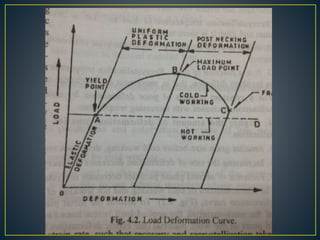
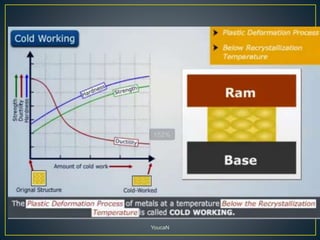
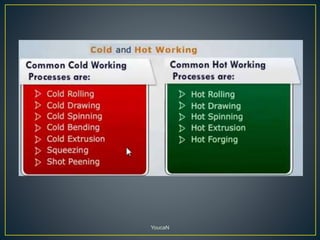
Cold working: Plastic deformation process of a metals at a temperature below the
recrystallization temperature is called cold working.
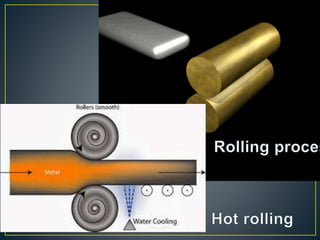
Hot working: Plastic deformation process of a metals at a temperature above the
recrystallization temperature is called hot working.
YoucaN
YoucaN
YoucaN
YoucaN
YoucaN
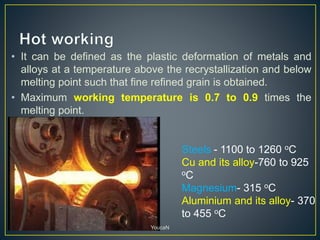
• It can be defined as the plastic deformation of metals and
alloys at a temperature above the recrystallization and below
melting point such that fine refined grain is obtained.
• Maximum working temperature is 0.7 to 0.9 times the
melting point.
Steels - 1100 to 1260 oC
Cu and its alloy-760 to 925
oC
Magnesium- 315 oC
Aluminium and its alloy- 370
to 455 oC
YoucaN
YoucaN
YoucaN
YoucaN
YoucaN
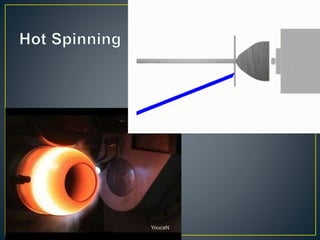
• Metal spinning, also known as spin forming or
spinning or metal turning most commonly, is a
metalworking process by which a disc or tube of metal is
rotated at high speed and formed into an axially
symmetric part. Spinning can be performed by hand or by
a CNC lathe.
YoucaN
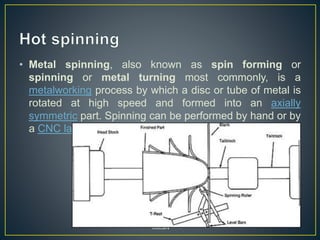
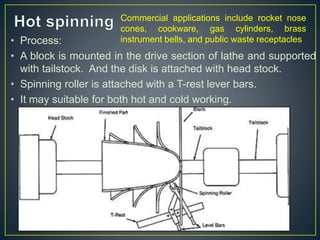
• Process:
• A block is mounted in the drive section of lathe and supported
with tailstock. And the disk is attached with head stock.
• Spinning roller is attached with a T-rest lever bars.
• It may suitable for both hot and cold working.
YoucaN
Commercial applications include rocket nose
cones, cookware, gas cylinders, brass
instrument bells, and public waste receptacles
• Lower working force is enough to give shape.
• Very dramatic shape change is possible.
• Properties such as strength, ductility and toughness is
improved.
• Density increases by removing voids.
• Desired shape can be easily obtained under plastic
deformation.
• Effect of impurities can be reduced.
• Good grain structure.
• Atoms in same direction leads to better strength.
YoucaN
• Process takes place at higher temperature that Is above
7300 C, So special protection of machines is necessary
other wise machine and tool life is minimum.
• Handling cost is high.
• Automation is difficult one.
• If the die or the tool wears the surface finish also affects.
• While the objects cools form its recrystallisation
temperature, due to shrinkage of the parts dimension may
vary.
YoucaN
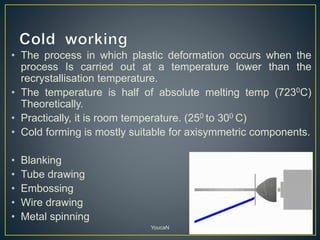
• The process in which plastic deformation occurs when the
process Is carried out at a temperature lower than the
recrystallisation temperature.
• The temperature is half of absolute melting temp (7230C)
Theoretically.
• Practically, it is room temperature. (250 to 300 C)
• Cold forming is mostly suitable for axisymmetric components.
• Blanking
• Tube drawing
• Embossing
• Wire drawing
• Metal spinning
YoucaN
• Low and medium carbon steels
• Low alloy steels
• Copper and light alloy such as aluminium,
magnesium, titanium.
YoucaN
• Widely applied as a forming process for steel.
• Cold working is done at room temperature, so no oxidation
and scaling of work material occurs.
• Excellent surface finish, which reduces the secondary
machining process.
• High dimensional accuracy.
• Highly suitable for mass production and automation,
because of low working temperature.
YoucaN
• Strength of the metal is high, so large forces are needed for
deformation.
• Complex shapes cannot be formed.
• Tool must be specially designed, so high tool cost.
• Stress formation in the metal during cold working is higher.
So this requires stress relieving.
YoucaN
• It depends on the Chemical composition (percentage of
carbon or alloying) of the material.
• The maximum limit is usually 0.45% of carbon for steels in
cold extrusion &1.6% for cold forging.
• Larger Grain size is easy for cold working.
YoucaN
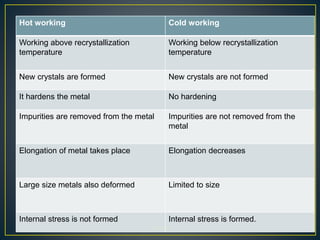
Hot working Cold working
Working above recrystallization
temperature
Working below recrystallization
temperature
New crystals are formed New crystals are not formed
It hardens the metal No hardening
Impurities are removed from the metal Impurities are not removed from the
metal
Elongation of metal takes place Elongation decreases
Large size metals also deformed Limited to size
Internal stress is not formed Internal stress is formed.
YoucaN
YoucaN
Upsetting:
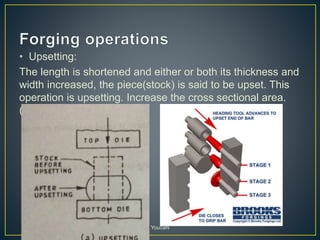
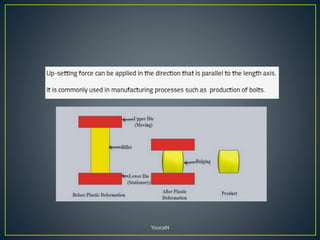
• Upsetting:
The length is shortened and either or both its thickness and
width increased, the piece(stock) is said to be upset. This
operation is upsetting. Increase the cross sectional area.
(bolt manufacturing)
YoucaN
YoucaN
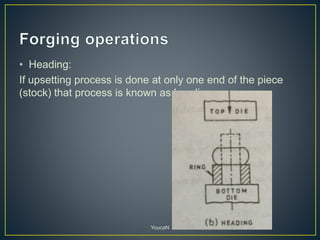
• Heading:
If upsetting process is done at only one end of the piece
(stock) that process is known as heading.
YoucaN
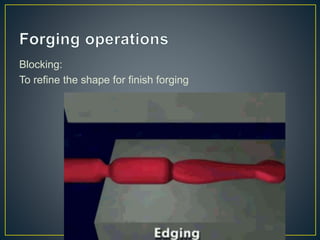
Blocking:
To refine the shape for finish forging
YoucaN
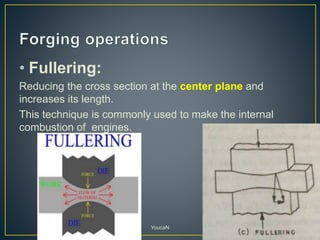
• Fullering:
Reducing the cross section at the center plane and
increases its length.
This technique is commonly used to make the internal
combustion of engines.
YoucaN
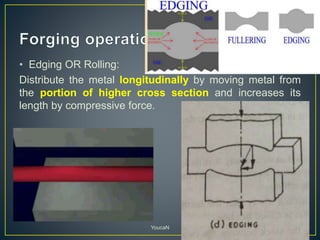
• Edging OR Rolling:
Distribute the metal longitudinally by moving metal from
the portion of higher cross section and increases its
length by compressive force.
YoucaN
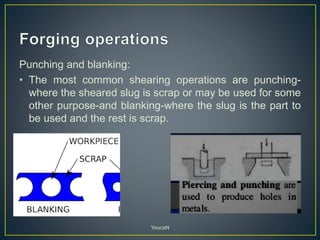
Punching and blanking:
• The most common shearing operations are punching-
where the sheared slug is scrap or may be used for some
other purpose-and blanking-where the slug is the part to
be used and the rest is scrap.
YoucaN
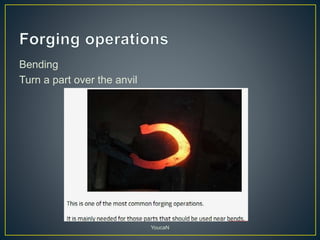
Bending
Turn a part over the anvil
YoucaN
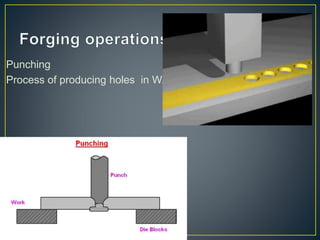
Punching
Process of producing holes in W/P
YoucaN
YoucaN
YoucaN
YoucaN
Why aluminum is
highly recommended
in most industries for
forging?
• Dig it with the following 5 points:
1. High strength to weight ratio.
• This makes it a perfect choice for a number of applications such
as automotive, wheels, airframes and panels.
2. Superior corrosion resistance
• Aluminum forged parts do corrode, even when they’re subjected
to most adverse weather conditions.
• This is the main reason why they are used in the petrochemical
and marine industries. In fact, most fasteners in these industries
are manufactured from aluminum.
3. Wear resistance and durability
• This makes it a perfect choice for most automotive industry
applications.
4. It is a versatile metal that be manufactured with a wide range
of metal forging processes.
5. Its soft compared to other materials such as iron. This
reduces the production cost.
YoucaN
YoucaN
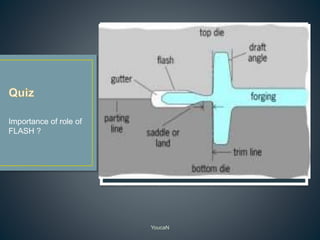
Importance of role of
FLASH ?
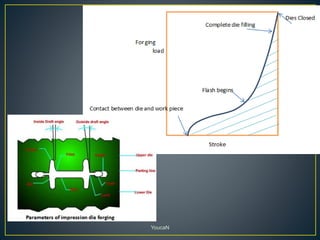
• A small gap between the dies called flash gutter is
provided so that the excess metal can flow into the
gutter and form a flash. Flash has got a very important
role during deformation of the work piece inside the die
cavity. Due to high length to thickness ratio of the flash
gutter, friction in the gap is very high.
• Due to this the material in the flash gap is subjected to
high pressure. There is high resistance to flow. This in
turn promotes effective filling of the die cavity. In hot
forging, the flash cools faster as a result of it being
smaller in size. This enhances the resistance of the flash
material to deformation resistance.
• Flash is subsequently trimmed off in order to obtain the
required dimensions on the forged part. Often multiple
steps are required in closed die forging.
• Flash is to be properly designed so that the metal could
flow and fill the intricate parts of the die cavity. A thin flash
with larger width requires higher forging loads.YoucaN
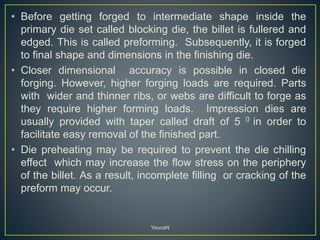
• Before getting forged to intermediate shape inside the
primary die set called blocking die, the billet is fullered and
edged. This is called preforming. Subsequently, it is forged
to final shape and dimensions in the finishing die.
• Closer dimensional accuracy is possible in closed die
forging. However, higher forging loads are required. Parts
with wider and thinner ribs, or webs are difficult to forge as
they require higher forming loads. Impression dies are
usually provided with taper called draft of 5 0 in order to
facilitate easy removal of the finished part.
• Die preheating may be required to prevent the die chilling
effect which may increase the flow stress on the periphery
of the billet. As a result, incomplete filling or cracking of the
preform may occur.
YoucaN
YoucaN
YoucaN
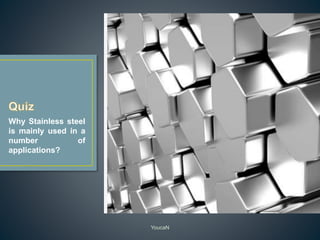
Why Stainless steel
is mainly used in a
number of
applications?
1. The forged stainless steel parts can withstand sanitizing and
frequent cleaning; this is one of the main reasons why it is
used in the food processing and medical equipment.
2. Highly resistant to corrosion; this is the main reason why it
is used in petrochemical, marine and chemical industries,
especially in pumps. These parts can withstand prolonged
exposure to corrosive environment.
3. The forged parts have high resistance to heat. This makes
it a perfect choice for furnace, heat sinks and ovens.
4. They guarantee high wear and high performance. This
explains the reason why they are used for landing gears and
motor components.
5. The forged parts have high stability and strength. This
makes it a perfect choice for most structural components.
• In short, stainless steel is one of the most popular materials
used to manufacture a number of industrial parts. This is
because having some of the best physical and chemical
properties
YoucaN
YoucaN
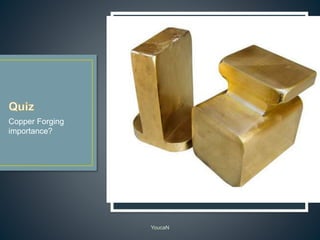
Copper Forging
importance?
• Copper and its alloys used in a number of industrial
applications.
• This is due to its excellent electrical and heat conductivity
properties.
• It is known for its non-magnetic, corrosion resistance,
machinability, ductility, malleability and wear resistance.
• Forged copper parts are a perfect choice in applications where
there’s higher temperatures and at a higher load.
• Again, the parts can withstand high stress without unexpected
failures.
In most cases, Forged copper parts are highly recommended.
Reasons:
• Electrical assemblies and transmission lines such as caps,
connectors and fittings
• Electronic components such as connectors, heat sinks, etc
• Plumbing components such as impellers and valve
components.
• Gaskets and seals, especially those that are used in highYoucaN
YoucaN

Hot and cold working

  • 1.
  • 2.
    YoucaN Cold working: Plasticdeformation process of a metals at a temperature below the recrystallization temperature is called cold working. Hot working: Plastic deformation process of a metals at a temperature above the recrystallization temperature is called hot working.
  • 3.
  • 4.
  • 5.
  • 6.
  • 7.
  • 8.
    • It canbe defined as the plastic deformation of metals and alloys at a temperature above the recrystallization and below melting point such that fine refined grain is obtained. • Maximum working temperature is 0.7 to 0.9 times the melting point. Steels - 1100 to 1260 oC Cu and its alloy-760 to 925 oC Magnesium- 315 oC Aluminium and its alloy- 370 to 455 oC YoucaN
  • 9.
  • 10.
  • 11.
  • 12.
  • 13.
    • Metal spinning,also known as spin forming or spinning or metal turning most commonly, is a metalworking process by which a disc or tube of metal is rotated at high speed and formed into an axially symmetric part. Spinning can be performed by hand or by a CNC lathe. YoucaN
  • 14.
    • Process: • Ablock is mounted in the drive section of lathe and supported with tailstock. And the disk is attached with head stock. • Spinning roller is attached with a T-rest lever bars. • It may suitable for both hot and cold working. YoucaN Commercial applications include rocket nose cones, cookware, gas cylinders, brass instrument bells, and public waste receptacles
  • 15.
    • Lower workingforce is enough to give shape. • Very dramatic shape change is possible. • Properties such as strength, ductility and toughness is improved. • Density increases by removing voids. • Desired shape can be easily obtained under plastic deformation. • Effect of impurities can be reduced. • Good grain structure. • Atoms in same direction leads to better strength. YoucaN
  • 16.
    • Process takesplace at higher temperature that Is above 7300 C, So special protection of machines is necessary other wise machine and tool life is minimum. • Handling cost is high. • Automation is difficult one. • If the die or the tool wears the surface finish also affects. • While the objects cools form its recrystallisation temperature, due to shrinkage of the parts dimension may vary. YoucaN
  • 17.
    • The processin which plastic deformation occurs when the process Is carried out at a temperature lower than the recrystallisation temperature. • The temperature is half of absolute melting temp (7230C) Theoretically. • Practically, it is room temperature. (250 to 300 C) • Cold forming is mostly suitable for axisymmetric components. • Blanking • Tube drawing • Embossing • Wire drawing • Metal spinning YoucaN
  • 18.
    • Low andmedium carbon steels • Low alloy steels • Copper and light alloy such as aluminium, magnesium, titanium. YoucaN
  • 19.
    • Widely appliedas a forming process for steel. • Cold working is done at room temperature, so no oxidation and scaling of work material occurs. • Excellent surface finish, which reduces the secondary machining process. • High dimensional accuracy. • Highly suitable for mass production and automation, because of low working temperature. YoucaN
  • 20.
    • Strength ofthe metal is high, so large forces are needed for deformation. • Complex shapes cannot be formed. • Tool must be specially designed, so high tool cost. • Stress formation in the metal during cold working is higher. So this requires stress relieving. YoucaN
  • 21.
    • It dependson the Chemical composition (percentage of carbon or alloying) of the material. • The maximum limit is usually 0.45% of carbon for steels in cold extrusion &1.6% for cold forging. • Larger Grain size is easy for cold working. YoucaN
  • 22.
    Hot working Coldworking Working above recrystallization temperature Working below recrystallization temperature New crystals are formed New crystals are not formed It hardens the metal No hardening Impurities are removed from the metal Impurities are not removed from the metal Elongation of metal takes place Elongation decreases Large size metals also deformed Limited to size Internal stress is not formed Internal stress is formed. YoucaN
  • 23.
  • 24.
    • Upsetting: The lengthis shortened and either or both its thickness and width increased, the piece(stock) is said to be upset. This operation is upsetting. Increase the cross sectional area. (bolt manufacturing) YoucaN
  • 25.
  • 26.
    • Heading: If upsettingprocess is done at only one end of the piece (stock) that process is known as heading. YoucaN
  • 27.
    Blocking: To refine theshape for finish forging YoucaN
  • 28.
    • Fullering: Reducing thecross section at the center plane and increases its length. This technique is commonly used to make the internal combustion of engines. YoucaN
  • 29.
    • Edging ORRolling: Distribute the metal longitudinally by moving metal from the portion of higher cross section and increases its length by compressive force. YoucaN
  • 30.
    Punching and blanking: •The most common shearing operations are punching- where the sheared slug is scrap or may be used for some other purpose-and blanking-where the slug is the part to be used and the rest is scrap. YoucaN
  • 31.
    Bending Turn a partover the anvil YoucaN
  • 32.
    Punching Process of producingholes in W/P YoucaN
  • 33.
  • 34.
  • 35.
    YoucaN Why aluminum is highlyrecommended in most industries for forging?
  • 36.
    • Dig itwith the following 5 points: 1. High strength to weight ratio. • This makes it a perfect choice for a number of applications such as automotive, wheels, airframes and panels. 2. Superior corrosion resistance • Aluminum forged parts do corrode, even when they’re subjected to most adverse weather conditions. • This is the main reason why they are used in the petrochemical and marine industries. In fact, most fasteners in these industries are manufactured from aluminum. 3. Wear resistance and durability • This makes it a perfect choice for most automotive industry applications. 4. It is a versatile metal that be manufactured with a wide range of metal forging processes. 5. Its soft compared to other materials such as iron. This reduces the production cost. YoucaN
  • 37.
  • 38.
    • A smallgap between the dies called flash gutter is provided so that the excess metal can flow into the gutter and form a flash. Flash has got a very important role during deformation of the work piece inside the die cavity. Due to high length to thickness ratio of the flash gutter, friction in the gap is very high. • Due to this the material in the flash gap is subjected to high pressure. There is high resistance to flow. This in turn promotes effective filling of the die cavity. In hot forging, the flash cools faster as a result of it being smaller in size. This enhances the resistance of the flash material to deformation resistance. • Flash is subsequently trimmed off in order to obtain the required dimensions on the forged part. Often multiple steps are required in closed die forging. • Flash is to be properly designed so that the metal could flow and fill the intricate parts of the die cavity. A thin flash with larger width requires higher forging loads.YoucaN
  • 39.
    • Before gettingforged to intermediate shape inside the primary die set called blocking die, the billet is fullered and edged. This is called preforming. Subsequently, it is forged to final shape and dimensions in the finishing die. • Closer dimensional accuracy is possible in closed die forging. However, higher forging loads are required. Parts with wider and thinner ribs, or webs are difficult to forge as they require higher forming loads. Impression dies are usually provided with taper called draft of 5 0 in order to facilitate easy removal of the finished part. • Die preheating may be required to prevent the die chilling effect which may increase the flow stress on the periphery of the billet. As a result, incomplete filling or cracking of the preform may occur. YoucaN
  • 40.
  • 41.
    YoucaN Why Stainless steel ismainly used in a number of applications?
  • 42.
    1. The forgedstainless steel parts can withstand sanitizing and frequent cleaning; this is one of the main reasons why it is used in the food processing and medical equipment. 2. Highly resistant to corrosion; this is the main reason why it is used in petrochemical, marine and chemical industries, especially in pumps. These parts can withstand prolonged exposure to corrosive environment. 3. The forged parts have high resistance to heat. This makes it a perfect choice for furnace, heat sinks and ovens. 4. They guarantee high wear and high performance. This explains the reason why they are used for landing gears and motor components. 5. The forged parts have high stability and strength. This makes it a perfect choice for most structural components. • In short, stainless steel is one of the most popular materials used to manufacture a number of industrial parts. This is because having some of the best physical and chemical properties YoucaN
  • 43.
  • 44.
    • Copper andits alloys used in a number of industrial applications. • This is due to its excellent electrical and heat conductivity properties. • It is known for its non-magnetic, corrosion resistance, machinability, ductility, malleability and wear resistance. • Forged copper parts are a perfect choice in applications where there’s higher temperatures and at a higher load. • Again, the parts can withstand high stress without unexpected failures. In most cases, Forged copper parts are highly recommended. Reasons: • Electrical assemblies and transmission lines such as caps, connectors and fittings • Electronic components such as connectors, heat sinks, etc • Plumbing components such as impellers and valve components. • Gaskets and seals, especially those that are used in highYoucaN
  • 45.