Electrochemical grinding (ECG)
- Prof. SAVAN FEFAR
Electrochemical grinding (ECG)
Prof. SAVAN FEFAR
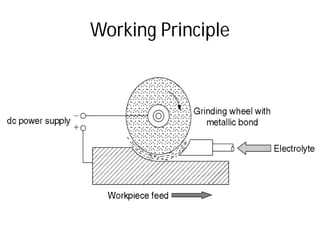
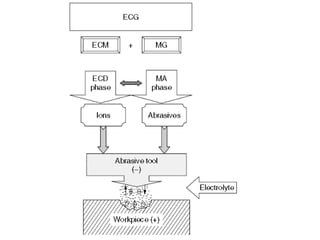
• The process is similar to
cathode is a specially constructed grinding
wheel instead of a cathodic shaped
• The insulating abrasive material (diamond or
aluminum oxide) of the grinding wheel is set
in a conductive bonding
• the wheel is a rotating cathodic tool with
abrasive particles on its periphery.
• Electrolyte flow, usually NaNO3, is provided
for ECD (Electro chemical dissolution).
similar to ECM except that the
cathode is a specially constructed grinding
of a cathodic shaped tool.
The insulating abrasive material (diamond or
the grinding wheel is set
in a conductive bonding material.
the wheel is a rotating cathodic tool with
abrasive particles on its periphery.
Electrolyte flow, usually NaNO3, is provided
for ECD (Electro chemical dissolution).
Working PrincipleWorking Principle
• The wheel rotates at a surface
m/s, while current ratings
• When a gap voltage of
between the cathodic
anodic workpiece, a current
to 240 A/cm2 is created.
• The current density depends on the material
being machined, the gap width, and the applied
voltage
surface speed of 20 to 35
ratings are from 50 to 300 A.
of 4 to 40 V is applied
grinding wheel and the
current density of about 120
.
The current density depends on the material
, the gap width, and the applied
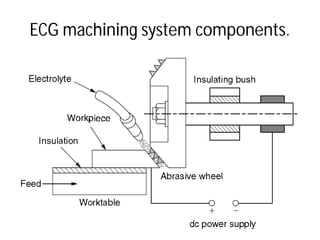
ECG machining system components.ECG machining system components.
MRR
• Material is mainly removed by ECD, while the
MA of the abrasive grits accounts for an
additional 5 to 10 percent of the total material
removal.
• Removal rates by ECG are 4 times faster than
by conventional grinding, and
produces burr-free parts that are unstressed
• The volumetric removal rate (VRR) is typically
1600 mm3/min.
MRR
Material is mainly removed by ECD, while the
MA of the abrasive grits accounts for an
additional 5 to 10 percent of the total material
rates by ECG are 4 times faster than
grinding, and ECG always
free parts that are unstressed.
removal rate (VRR) is typically
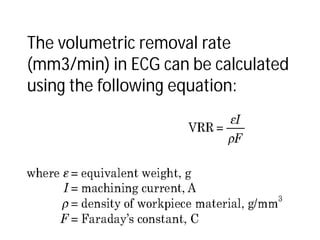
The volumetric removal rate
(mm3/min) in ECG can be calculated
using the following equation:
The volumetric removal rate
(mm3/min) in ECG can be calculated
using the following equation:
• In the machining zone there is an area of
simultaneous ECD and MA of the
surface, where the gap width is less than the
height of the grain part projecting over the
binder.
• Another area of pure electrochemical removal
where the abrasive grains do not touch the
workpiece surface exists at the entry and exit
sides of the wheel.
In the machining zone there is an area of
simultaneous ECD and MA of the workpiece
surface, where the gap width is less than the
height of the grain part projecting over the
Another area of pure electrochemical removal
where the abrasive grains do not touch the
surface exists at the entry and exit
• Machining conditions at which the MA
disappears depend on the electrical
parameters, electrochemical
of the material in a given electrolyte, and
grinding wheel features especially grain
size and height.
• Generally slow feed rates produce larger
overcut, poor surface finish, and wider
tolerances, while excessive wheel wear
occurs as a result of a feed rate that is too
fast.
Machining conditions at which the MA
disappears depend on the electrical
parameters, electrochemical machinability
of the material in a given electrolyte, and
grinding wheel features especially grain
Generally slow feed rates produce larger
overcut, poor surface finish, and wider
tolerances, while excessive wheel wear
occurs as a result of a feed rate that is too
Accuracy and surface quality
• Traditional grinding removes metal by
abrasion, leaving tolerances of about
mm and creating heat and stresses that make
grinding thin stock very difficult. In ECG
however a production tolerance of
is easily obtainable
• The ability to hold closer tolerances depends
upon the current, electrolyte flow, feed rate,
and metallurgy of the workpiece
Accuracy and surface quality
Traditional grinding removes metal by
abrasion, leaving tolerances of about ±0.003
mm and creating heat and stresses that make
grinding thin stock very difficult. In ECG
however a production tolerance of ±0.025 mm
The ability to hold closer tolerances depends
upon the current, electrolyte flow, feed rate,
workpiece itself.
• ECG can grind thin material of 1.02 mm, which
normally warp by the heat and pressure of the
conventional grinding thus making closer
tolerances difficult to achieve.
• The main drawback of ECG is the loss of
accuracy when the inside corners are ground.
Because of the electric field effect, radii better
than 0.25 to 0.375 mm can seldom be
achieved
ECG can grind thin material of 1.02 mm, which
normally warp by the heat and pressure of the
conventional grinding thus making closer
tolerances difficult to achieve.
The main drawback of ECG is the loss of
accuracy when the inside corners are ground.
Because of the electric field effect, radii better
than 0.25 to 0.375 mm can seldom be
Applications
• Machining parts made from difficult
such as sintered
carbides, creep-resisting (Inconel
titanium alloys, and metallic composites.
• Applications similar to milling, grinding, cutting off,
sawing, and tool and cutter sharpening.
• Production of tungsten carbide cutting tools, fragile
parts, and thin walled
tubes.
• Producing specimens for metal fatigue and tensile tests.
• Machining of carbides and a variety of high
alloys.
Applications
Machining parts made from difficult-to-cut materials,
Inconel, Nimonic) alloys,
titanium alloys, and metallic composites.
Applications similar to milling, grinding, cutting off,
sawing, and tool and cutter sharpening.
Production of tungsten carbide cutting tools, fragile
Producing specimens for metal fatigue and tensile tests.
Machining of carbides and a variety of high-strength
Advantages
• Absence of work hardening
• Elimination of grinding burrs
• Absence of distortion of thin fragile or
thermosensitive parts
• Good surface quality
• Production of narrow tolerances
• Longer grinding wheel life
Advantages
Absence of work hardening
Elimination of grinding burrs
Absence of distortion of thin fragile or
Production of narrow tolerances
Longer grinding wheel life
Disadvantages
• Higher capital cost than conventional
machines
• Process limited to electrically conductive
materials
• Corrosive nature of electrolyte
• Requires disposal and filtering of
electrolyte
Disadvantages
Higher capital cost than conventional
Process limited to electrically conductive
Corrosive nature of electrolyte
Requires disposal and filtering of

Electrochemical grinding (ecg)

  • 1.
    Electrochemical grinding (ECG) -Prof. SAVAN FEFAR Electrochemical grinding (ECG) Prof. SAVAN FEFAR
  • 2.
    • The processis similar to cathode is a specially constructed grinding wheel instead of a cathodic shaped • The insulating abrasive material (diamond or aluminum oxide) of the grinding wheel is set in a conductive bonding • the wheel is a rotating cathodic tool with abrasive particles on its periphery. • Electrolyte flow, usually NaNO3, is provided for ECD (Electro chemical dissolution). similar to ECM except that the cathode is a specially constructed grinding of a cathodic shaped tool. The insulating abrasive material (diamond or the grinding wheel is set in a conductive bonding material. the wheel is a rotating cathodic tool with abrasive particles on its periphery. Electrolyte flow, usually NaNO3, is provided for ECD (Electro chemical dissolution).
  • 3.
  • 4.
    • The wheelrotates at a surface m/s, while current ratings • When a gap voltage of between the cathodic anodic workpiece, a current to 240 A/cm2 is created. • The current density depends on the material being machined, the gap width, and the applied voltage surface speed of 20 to 35 ratings are from 50 to 300 A. of 4 to 40 V is applied grinding wheel and the current density of about 120 . The current density depends on the material , the gap width, and the applied
  • 5.
    ECG machining systemcomponents.ECG machining system components.
  • 6.
    MRR • Material ismainly removed by ECD, while the MA of the abrasive grits accounts for an additional 5 to 10 percent of the total material removal. • Removal rates by ECG are 4 times faster than by conventional grinding, and produces burr-free parts that are unstressed • The volumetric removal rate (VRR) is typically 1600 mm3/min. MRR Material is mainly removed by ECD, while the MA of the abrasive grits accounts for an additional 5 to 10 percent of the total material rates by ECG are 4 times faster than grinding, and ECG always free parts that are unstressed. removal rate (VRR) is typically
  • 7.
    The volumetric removalrate (mm3/min) in ECG can be calculated using the following equation: The volumetric removal rate (mm3/min) in ECG can be calculated using the following equation:
  • 9.
    • In themachining zone there is an area of simultaneous ECD and MA of the surface, where the gap width is less than the height of the grain part projecting over the binder. • Another area of pure electrochemical removal where the abrasive grains do not touch the workpiece surface exists at the entry and exit sides of the wheel. In the machining zone there is an area of simultaneous ECD and MA of the workpiece surface, where the gap width is less than the height of the grain part projecting over the Another area of pure electrochemical removal where the abrasive grains do not touch the surface exists at the entry and exit
  • 10.
    • Machining conditionsat which the MA disappears depend on the electrical parameters, electrochemical of the material in a given electrolyte, and grinding wheel features especially grain size and height. • Generally slow feed rates produce larger overcut, poor surface finish, and wider tolerances, while excessive wheel wear occurs as a result of a feed rate that is too fast. Machining conditions at which the MA disappears depend on the electrical parameters, electrochemical machinability of the material in a given electrolyte, and grinding wheel features especially grain Generally slow feed rates produce larger overcut, poor surface finish, and wider tolerances, while excessive wheel wear occurs as a result of a feed rate that is too
  • 11.
    Accuracy and surfacequality • Traditional grinding removes metal by abrasion, leaving tolerances of about mm and creating heat and stresses that make grinding thin stock very difficult. In ECG however a production tolerance of is easily obtainable • The ability to hold closer tolerances depends upon the current, electrolyte flow, feed rate, and metallurgy of the workpiece Accuracy and surface quality Traditional grinding removes metal by abrasion, leaving tolerances of about ±0.003 mm and creating heat and stresses that make grinding thin stock very difficult. In ECG however a production tolerance of ±0.025 mm The ability to hold closer tolerances depends upon the current, electrolyte flow, feed rate, workpiece itself.
  • 12.
    • ECG cangrind thin material of 1.02 mm, which normally warp by the heat and pressure of the conventional grinding thus making closer tolerances difficult to achieve. • The main drawback of ECG is the loss of accuracy when the inside corners are ground. Because of the electric field effect, radii better than 0.25 to 0.375 mm can seldom be achieved ECG can grind thin material of 1.02 mm, which normally warp by the heat and pressure of the conventional grinding thus making closer tolerances difficult to achieve. The main drawback of ECG is the loss of accuracy when the inside corners are ground. Because of the electric field effect, radii better than 0.25 to 0.375 mm can seldom be
  • 13.
    Applications • Machining partsmade from difficult such as sintered carbides, creep-resisting (Inconel titanium alloys, and metallic composites. • Applications similar to milling, grinding, cutting off, sawing, and tool and cutter sharpening. • Production of tungsten carbide cutting tools, fragile parts, and thin walled tubes. • Producing specimens for metal fatigue and tensile tests. • Machining of carbides and a variety of high alloys. Applications Machining parts made from difficult-to-cut materials, Inconel, Nimonic) alloys, titanium alloys, and metallic composites. Applications similar to milling, grinding, cutting off, sawing, and tool and cutter sharpening. Production of tungsten carbide cutting tools, fragile Producing specimens for metal fatigue and tensile tests. Machining of carbides and a variety of high-strength
  • 14.
    Advantages • Absence ofwork hardening • Elimination of grinding burrs • Absence of distortion of thin fragile or thermosensitive parts • Good surface quality • Production of narrow tolerances • Longer grinding wheel life Advantages Absence of work hardening Elimination of grinding burrs Absence of distortion of thin fragile or Production of narrow tolerances Longer grinding wheel life
  • 15.
    Disadvantages • Higher capitalcost than conventional machines • Process limited to electrically conductive materials • Corrosive nature of electrolyte • Requires disposal and filtering of electrolyte Disadvantages Higher capital cost than conventional Process limited to electrically conductive Corrosive nature of electrolyte Requires disposal and filtering of