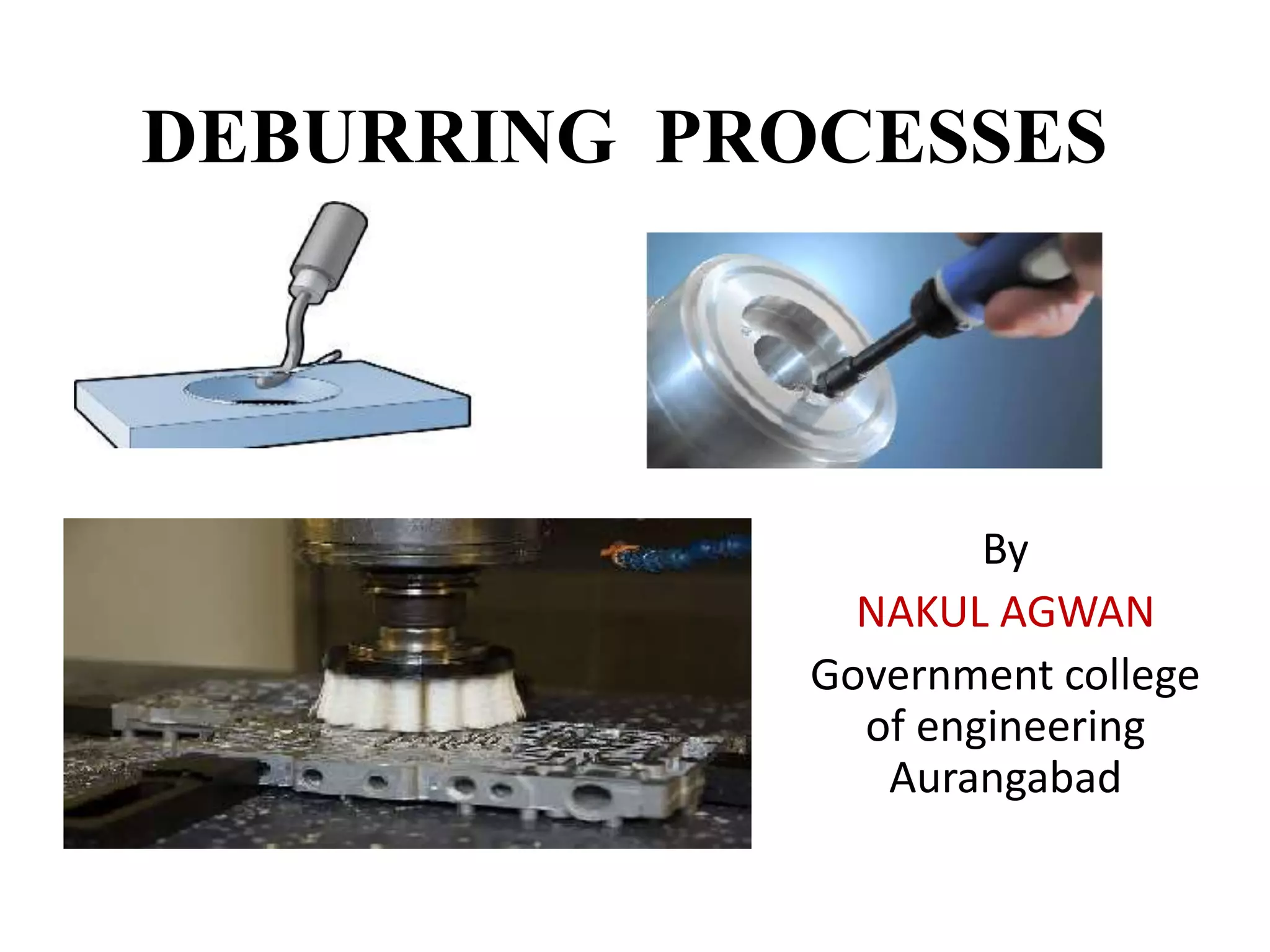
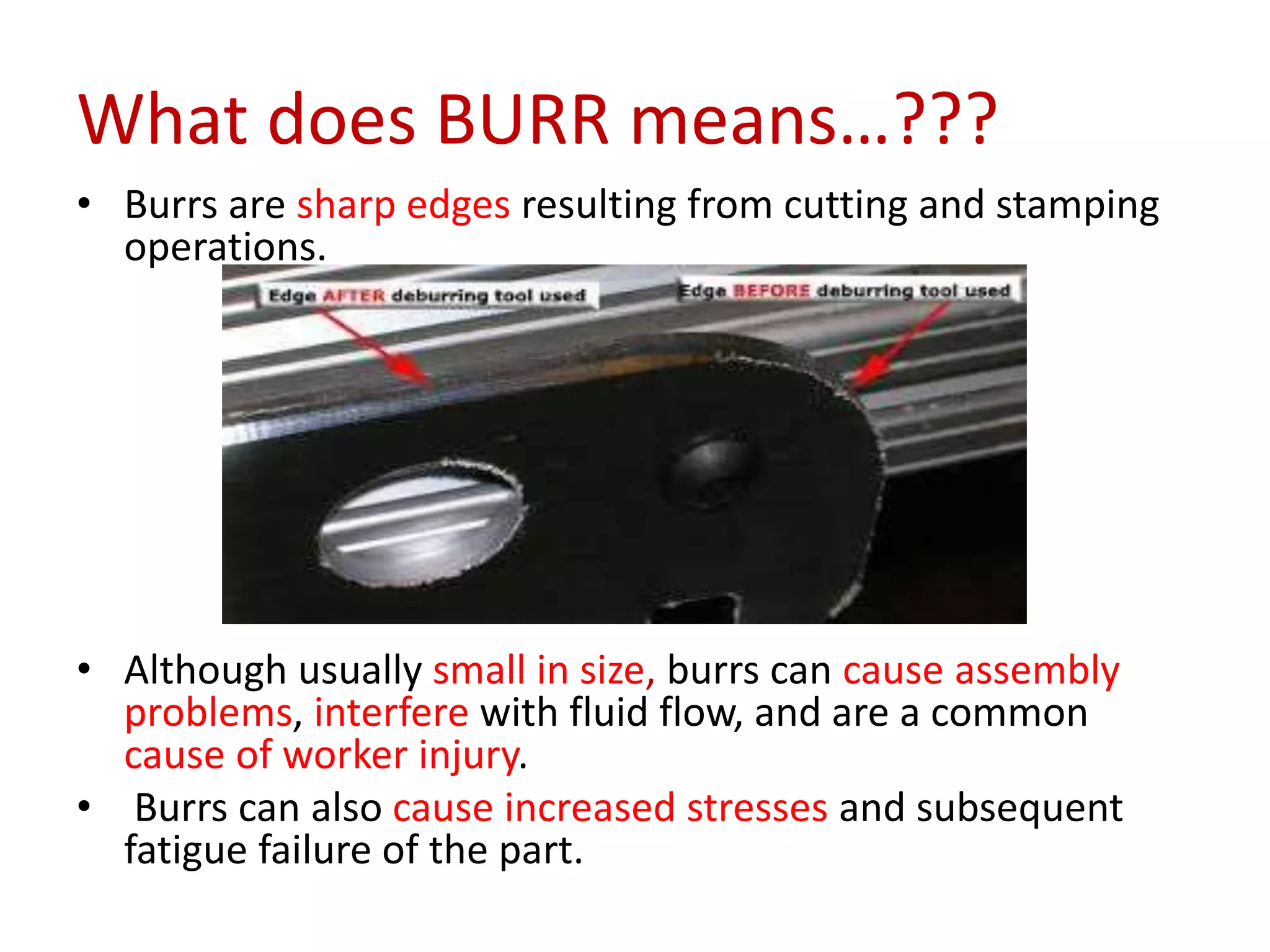
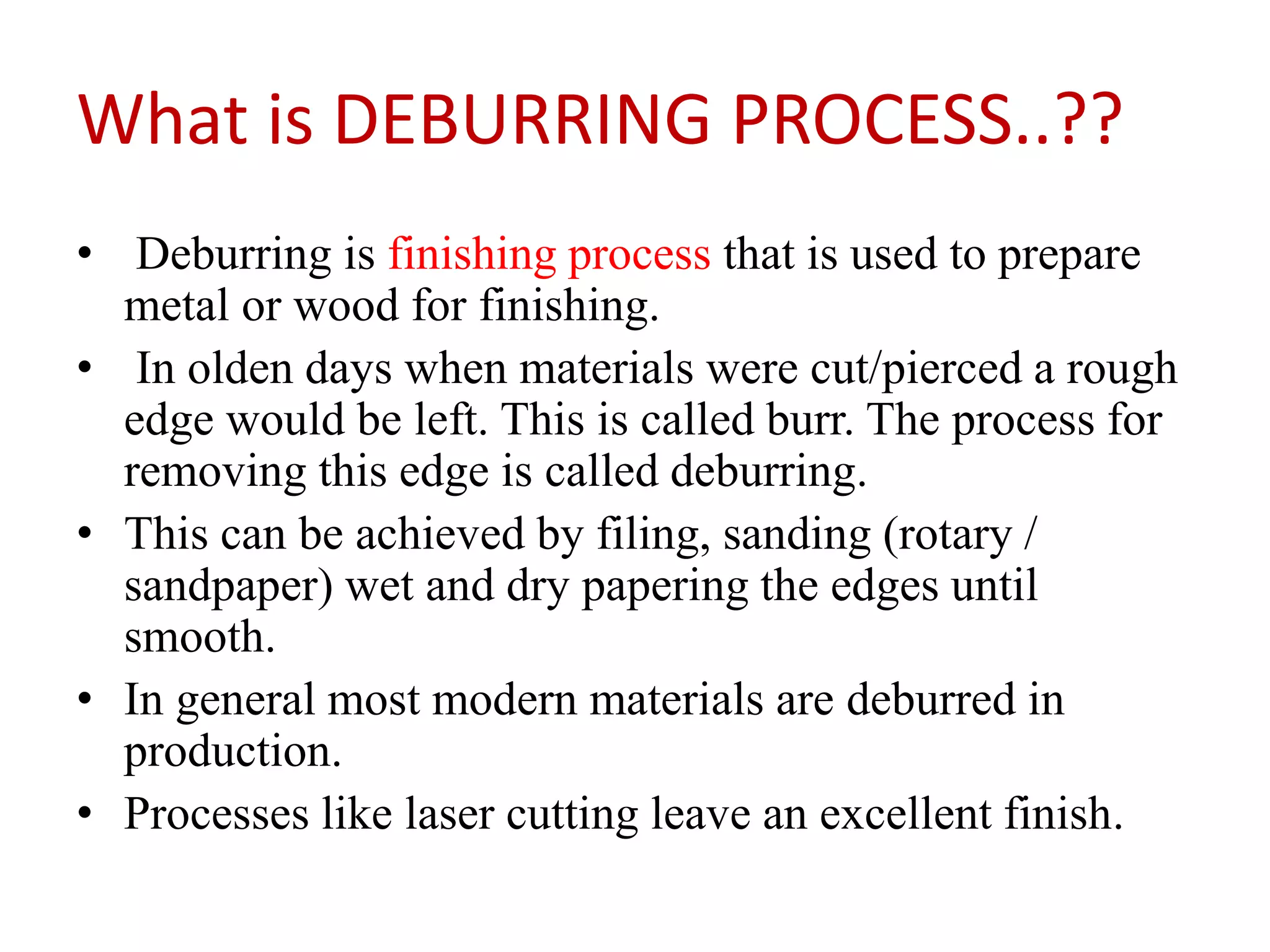
DEBURRING PROCESSES
By
NAKUL AGWAN
Government college
of engineering
Aurangabad
What does BURR means…???
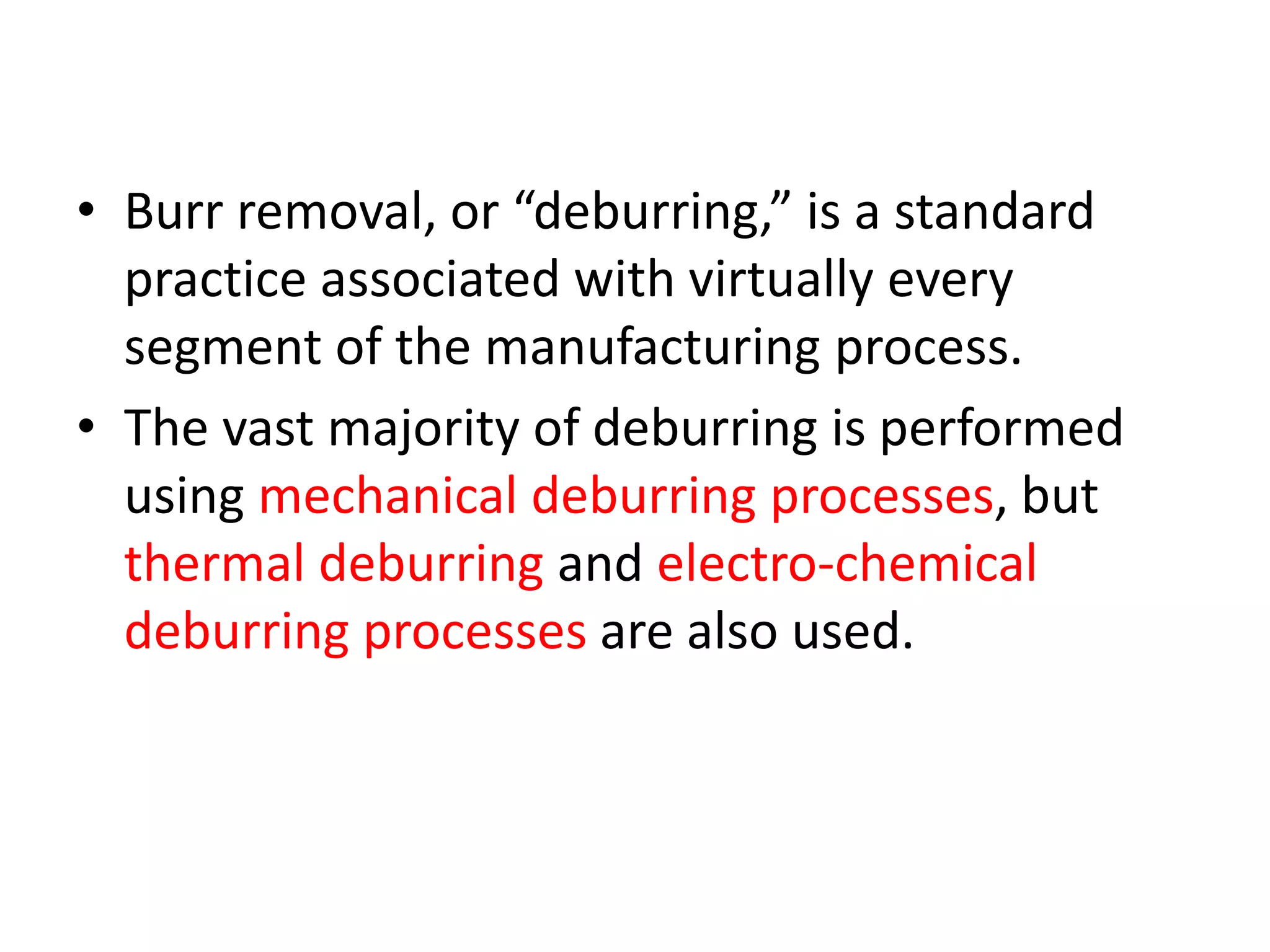
• Burrs are sharp edges resulting from cutting and stamping
operations.
• Although usually small in size, burrs can cause assembly
problems, interfere with fluid flow, and are a common
cause of worker injury.
• Burrs can also cause increased stresses and subsequent
fatigue failure of the part.
What is DEBURRING PROCESS..??
• Deburring is finishing process that is used to prepare
metal or wood for finishing.
• In olden days when materials were cut/pierced a rough
edge would be left. This is called burr. The process for
removing this edge is called deburring.
• This can be achieved by filing, sanding (rotary /
sandpaper) wet and dry papering the edges until
smooth.
• In general most modern materials are deburred in
production.
• Processes like laser cutting leave an excellent finish.
• Burr removal, or “deburring,” is a standard
practice associated with virtually every
segment of the manufacturing process.
• The vast majority of deburring is performed
using mechanical deburring processes, but
thermal deburring and electro-chemical
deburring processes are also used.
Mechanical Deburring Processes
Mechanical deburring encompasses many types
of processes, including:
1] cutting processes
2] power brushing
3]bonded abrasive finishing
4] mass finishing
5] abrasive blasting
6]abrasive flow deburring
1] Cutting Processes
Cutting processes encompass a variety of manual and mechanized
cutting tools for deburring, such as:
• drills
• reamers
• rotary and flat files
• knives and scrapers
• brushes and stones
• bonded abrasive papers, belts and wheels
• mechanical edgers
• numerically controlled machining centers with deburring tools
• Cutting processes are flexible in application
and require only a small capital investment.
• However, achieving piece to piece precision
and consistency can be difficult.
• In high production situations a variety of
mechanized tools and systems can be
employed which can improve consistency and
dimensional accuracy.
2] Power Brushing
• Power brushing is both a fast and relatively low cost
deburring method.
• Brushes are made of metal filaments or wire and
may also be of non-metallic or synthetic materials.
•
• Common metal filament brushes can be of
high strength and stainless steel as well as
brass, copper, nickel, and other alloys.
• A common synthetic brush material is nylon.
• Brushes come in a variety of shapes and sizes
for numerous applications.
• Power brush aggressiveness depends on
filament diameter, free length configuration,
the texture, density, and brittle material type,
wheel width, brush velocity, and workpiece
contact
3] Bonded Abrasive Finishing
• Bonded abrasive finishing, also known as
sanding, is found in most manufacturing
facilities. Bonded abrasive products include
sheets, belts, pads, disks, and wheels.
• The most common abrasives used include
aluminum oxides, silicon carbide, or zirconia
compounds.
• These abrasives range in size and grade from
course to exceptionally fine for various
applications
4] Mass Finishing
• Mass finishing allows for the mechanical finishing of many parts
simultaneously.
• In addition to deburring, mass finishing may also be used to
descale, brighten, and polish parts.
• Mass deburring is considered a 'loose-abrasive'
method in which batches of parts are vibrated or
tumbled in specifically designed tubs or barrels
along with an abrasive media.
• Deburring media may be produced from organic,
and preformed metallic, ceramic, or resin-bonded
plastic materials. Preformed media ranges in a
variety of sizes and shapes. In addition to the
media, mass finishing usually employs water or
other water-soluble compounds.
5] Abrasive Blasting
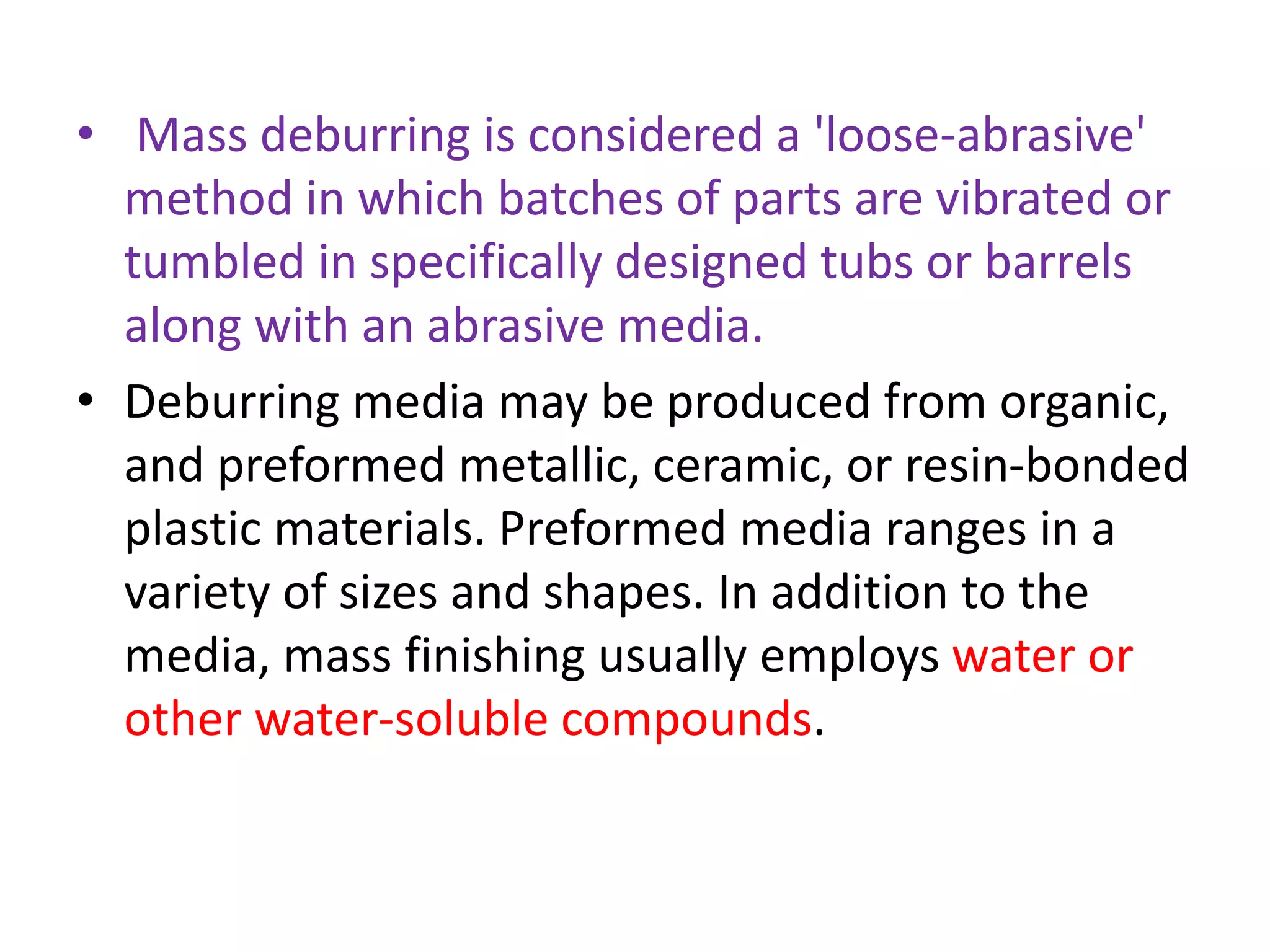
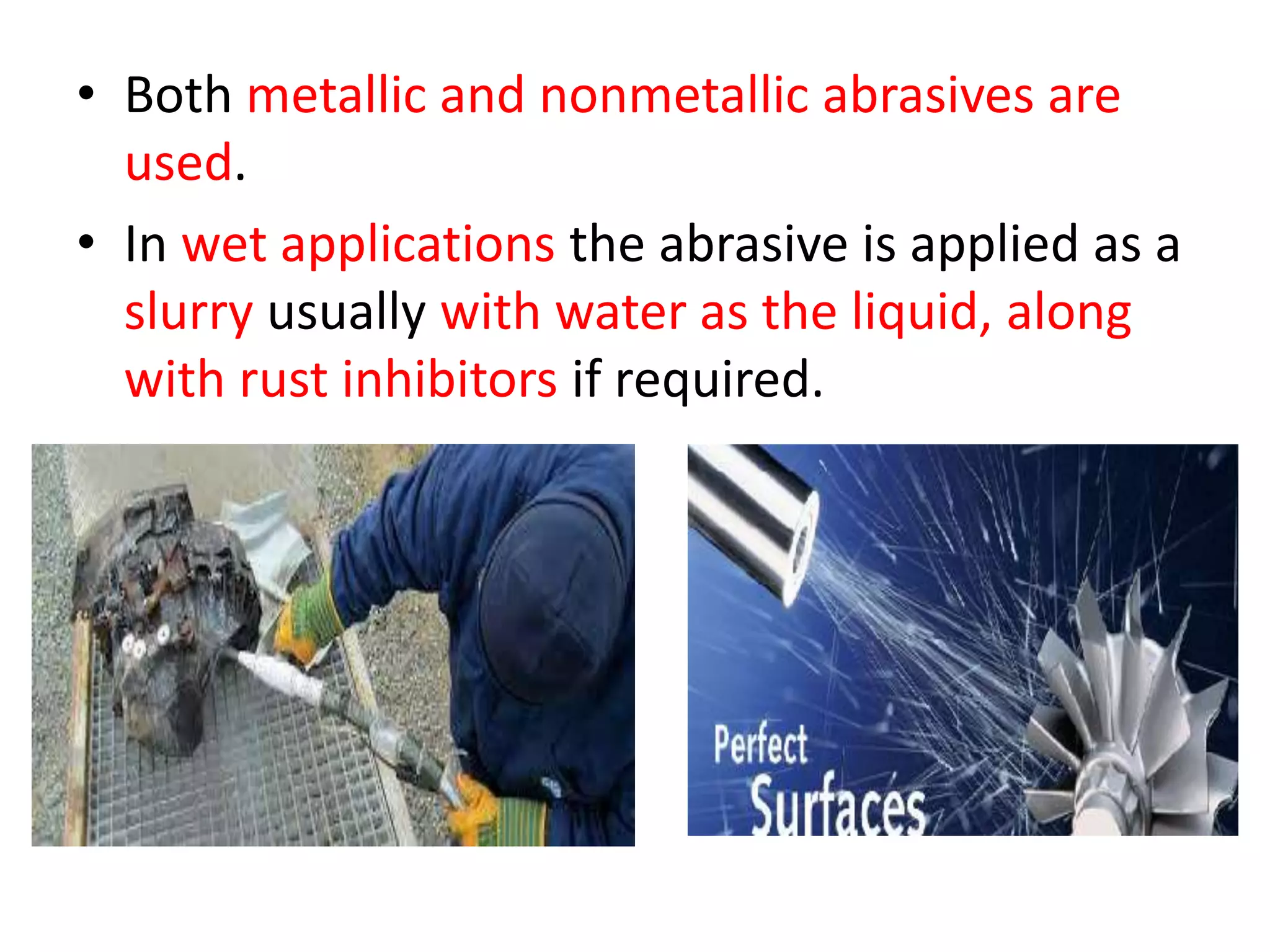
• Abrasive blasting can be done either wet or
dry
• The stream of abrasive material, propelled by
air pressure, can be focused on a specific area
or applied fan-like to an entire part or part
surface.
• Both metallic and nonmetallic abrasives are
used.
• In wet applications the abrasive is applied as a
slurry usually with water as the liquid, along
with rust inhibitors if required.
6] Abrasive Flow Deburring
• Abrasive flow deburring involves the extrusion of
semi-solid material impregnated with abrasives
through holes and openings in hydraulically
clamped workpieces.
• Extrusion pressure can range from 100 to 3200
PSI.
• The most common abrasive media used is silicon
carbide in a polymer carrier.
• Other abrasives include boron carbide, alumina,
and diamond
Thermal and Electro-Chemical
Deburring
• Thermal and electro-chemical deburring,
although not as commonly used as the
mechanical processes,
• But are important because they can deburr
parts quickly including difficult to reach
internal part surfaces.
• Thermal energy deburring takes place in a
chamber filled with oxygen and a combustible
gas, usually natural gas.
• This gas is ignited producing intense heat
which vaporizes the burrs and other sharp
corners.
• A resulting oxide residue is subsequently
removed using a mild acid or during any
additional finishing process, such as heat
treating.
• In the electro-chemical deburring process burrs are
dissolved by the action of a neutral-salt electrolyte
flowing through the gap between the tool or cathode
and the workpiece which is the anode.
• This is a very fast, precision process.
• The amount of material removed is proportional to
the amount of time and levels of current applied.
• The dissolved metal, in the form of hydroxides, is
carried away by the controlled flow of the electrolyte,
which is then filtered for reuse.
• Electro-chemical electrodes are made of copper-
tungsten.
• The workpiece areas not being deburred are insulated
by a non-conductive material.
THANK YOU

Deburring processes

  • 1.
    DEBURRING PROCESSES By NAKUL AGWAN Governmentcollege of engineering Aurangabad
  • 2.
    What does BURRmeans…??? • Burrs are sharp edges resulting from cutting and stamping operations. • Although usually small in size, burrs can cause assembly problems, interfere with fluid flow, and are a common cause of worker injury. • Burrs can also cause increased stresses and subsequent fatigue failure of the part.
  • 3.
    What is DEBURRINGPROCESS..?? • Deburring is finishing process that is used to prepare metal or wood for finishing. • In olden days when materials were cut/pierced a rough edge would be left. This is called burr. The process for removing this edge is called deburring. • This can be achieved by filing, sanding (rotary / sandpaper) wet and dry papering the edges until smooth. • In general most modern materials are deburred in production. • Processes like laser cutting leave an excellent finish.
  • 4.
    • Burr removal,or “deburring,” is a standard practice associated with virtually every segment of the manufacturing process. • The vast majority of deburring is performed using mechanical deburring processes, but thermal deburring and electro-chemical deburring processes are also used.
  • 5.
    Mechanical Deburring Processes Mechanicaldeburring encompasses many types of processes, including: 1] cutting processes 2] power brushing 3]bonded abrasive finishing 4] mass finishing 5] abrasive blasting 6]abrasive flow deburring
  • 6.
    1] Cutting Processes Cuttingprocesses encompass a variety of manual and mechanized cutting tools for deburring, such as: • drills • reamers • rotary and flat files • knives and scrapers • brushes and stones • bonded abrasive papers, belts and wheels • mechanical edgers • numerically controlled machining centers with deburring tools
  • 7.
    • Cutting processesare flexible in application and require only a small capital investment. • However, achieving piece to piece precision and consistency can be difficult. • In high production situations a variety of mechanized tools and systems can be employed which can improve consistency and dimensional accuracy.
  • 8.
    2] Power Brushing •Power brushing is both a fast and relatively low cost deburring method. • Brushes are made of metal filaments or wire and may also be of non-metallic or synthetic materials. •
  • 9.
    • Common metalfilament brushes can be of high strength and stainless steel as well as brass, copper, nickel, and other alloys. • A common synthetic brush material is nylon. • Brushes come in a variety of shapes and sizes for numerous applications. • Power brush aggressiveness depends on filament diameter, free length configuration, the texture, density, and brittle material type, wheel width, brush velocity, and workpiece contact
  • 10.
    3] Bonded AbrasiveFinishing • Bonded abrasive finishing, also known as sanding, is found in most manufacturing facilities. Bonded abrasive products include sheets, belts, pads, disks, and wheels. • The most common abrasives used include aluminum oxides, silicon carbide, or zirconia compounds. • These abrasives range in size and grade from course to exceptionally fine for various applications
  • 11.
    4] Mass Finishing •Mass finishing allows for the mechanical finishing of many parts simultaneously. • In addition to deburring, mass finishing may also be used to descale, brighten, and polish parts.
  • 12.
    • Mass deburringis considered a 'loose-abrasive' method in which batches of parts are vibrated or tumbled in specifically designed tubs or barrels along with an abrasive media. • Deburring media may be produced from organic, and preformed metallic, ceramic, or resin-bonded plastic materials. Preformed media ranges in a variety of sizes and shapes. In addition to the media, mass finishing usually employs water or other water-soluble compounds.
  • 13.
    5] Abrasive Blasting •Abrasive blasting can be done either wet or dry • The stream of abrasive material, propelled by air pressure, can be focused on a specific area or applied fan-like to an entire part or part surface.
  • 14.
    • Both metallicand nonmetallic abrasives are used. • In wet applications the abrasive is applied as a slurry usually with water as the liquid, along with rust inhibitors if required.
  • 15.
    6] Abrasive FlowDeburring • Abrasive flow deburring involves the extrusion of semi-solid material impregnated with abrasives through holes and openings in hydraulically clamped workpieces. • Extrusion pressure can range from 100 to 3200 PSI. • The most common abrasive media used is silicon carbide in a polymer carrier. • Other abrasives include boron carbide, alumina, and diamond
  • 16.
    Thermal and Electro-Chemical Deburring •Thermal and electro-chemical deburring, although not as commonly used as the mechanical processes, • But are important because they can deburr parts quickly including difficult to reach internal part surfaces.
  • 17.
    • Thermal energydeburring takes place in a chamber filled with oxygen and a combustible gas, usually natural gas. • This gas is ignited producing intense heat which vaporizes the burrs and other sharp corners. • A resulting oxide residue is subsequently removed using a mild acid or during any additional finishing process, such as heat treating.
  • 18.
    • In theelectro-chemical deburring process burrs are dissolved by the action of a neutral-salt electrolyte flowing through the gap between the tool or cathode and the workpiece which is the anode. • This is a very fast, precision process. • The amount of material removed is proportional to the amount of time and levels of current applied. • The dissolved metal, in the form of hydroxides, is carried away by the controlled flow of the electrolyte, which is then filtered for reuse. • Electro-chemical electrodes are made of copper- tungsten. • The workpiece areas not being deburred are insulated by a non-conductive material.
  • 19.