Honing
• Honing is an abrasive machining process that produces a
precision surface on a metal work piece by scrubbing an
abrasive stone against it along a controlled path.
• Honing is primarily used to improve the geometric form of a
surface, but may also improve the surface texture.
The surface of a honed
workpiece
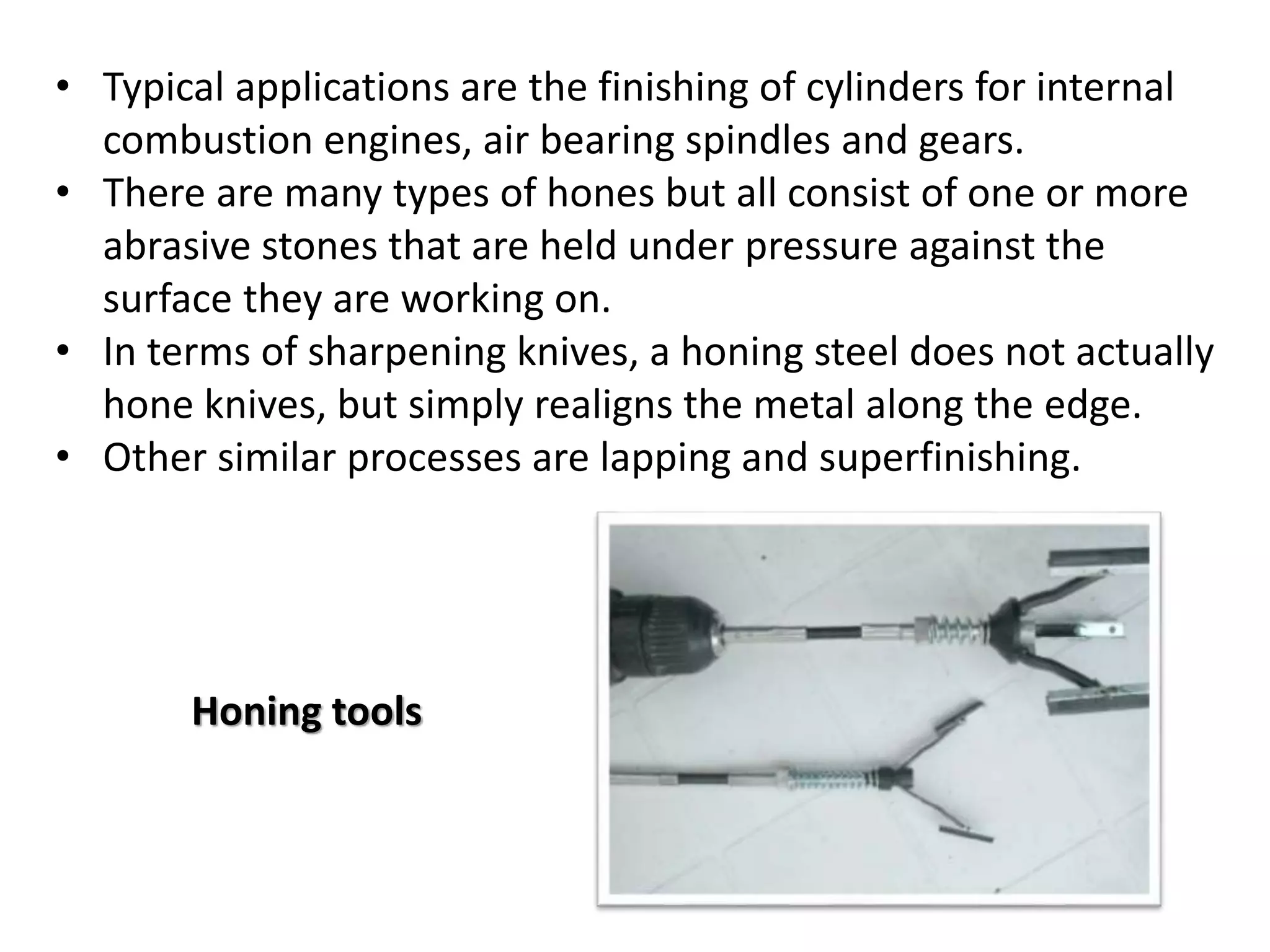
• Typical applications are the finishing of cylinders for internal
combustion engines, air bearing spindles and gears.
• There are many types of hones but all consist of one or more
abrasive stones that are held under pressure against the
surface they are working on.
• In terms of sharpening knives, a honing steel does not actually
hone knives, but simply realigns the metal along the edge.
• Other similar processes are lapping and superfinishing.
Honing tools
Honing stones
• Honing uses a special tool, called a honing stone or a hone, to
achieve a precision surface.
• The hone is composed of abrasive grains that are bound
together with an adhesive.
• Generally, honing grains are irregularly shaped and about 10 to
50 micrometers in diameter (300 to 1,500 mesh grit).
• Smaller grain sizes produce a smoother surface on the
workpiece.
• A honing stone is similar to a grinding wheel in many ways, but
honing stones are usually more friable so that they conform to
the shape of the workpiece as they wear in.
• To counteract their friability, honing stones may be treated
with wax or sulfur to improve life; wax is usually preferred for
environmental reasons.
Process Mechanics
• In grinding, the wheel follows a simple path. For example, in
plunge grinding a shaft, the wheel moves in towards the axis of
the part, grinds it, and then moves back out.
• Since each slice of the wheel repeatedly contacts the same slice of
the workpiece, any inaccuracies in the geometric shape of the
grinding wheel will be transferred onto the part.
• Therefore, the accuracy of the finished workpiece geometry is
limited to the accuracy of the truing dresser.
• The accuracy becomes even worse as
the grind wheel wears, so truing must
occur periodically to reshape it.
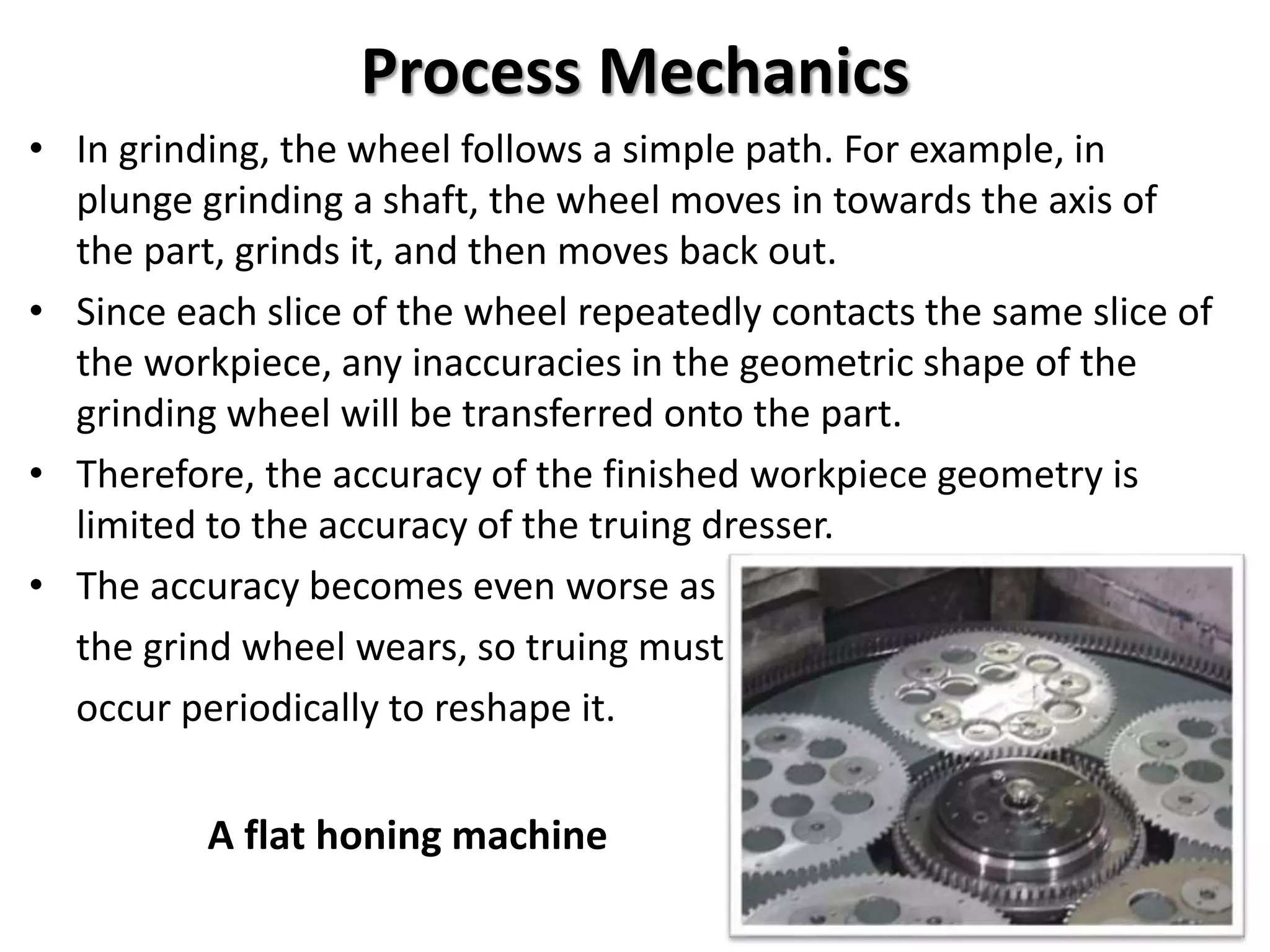
A flat honing machine
Performance advantages of honed
Surface
• The flexible honing tool is a relatively inexpensive honing
process. This tool produces a controlled surface condition
unobtainable by any other method.
• It involves finish, geometry and metallurgical structure. A high
percentage plateau free of cut, torn and folded metal is
produced.
• The flexible hone is a resilient, flexible honing tool with a soft
cutting action.
• The abrasive globules each have independent suspension that
assures the tool to be self-centering, self-aligning to the bore,
and self-compensating for wear.
Lapping
• Lapping is a machining process, in which two surfaces are
rubbed together with an abrasive between them, by hand
movement or using a machine.
• This can take two forms. The first type of lapping involves
rubbing a brittle material such as glass against a surface such as
iron or glass itself with an abrasive such as aluminum oxide,
jeweller's rouge, optician's rouge, emery, silicon carbide,
diamond, etc., between them.
• This produces microscopic conchoidal fractures as the abrasive
rolls about between the two surfaces and removes material
from both.
• The other form of lapping involves a softer material such
as pitch or a ceramic for the lap, which is "charged" with
the abrasive.
• The lap is then used to cut a harder material the workpiece. The
abrasive embeds within the softer material, which holds it and
permits it to score across and cut the harder material.
• Taken to a finer limit, this will produce a polished surface such
as with a polishing cloth on an automobile, or a polishing cloth
or polishing pitch upon glass or steel.
Small lapping plate
made of cast iron
• Taken to the ultimate limit, with the aid of accurate
interferometry and specialized polishing machines or skilled
hand polishing, lensmakers can produce surfaces that are flat to
better than 30 nanometers.
• In operation, the rings stay in one location as the lapping plate
rotates beneath them. In this machine, a small slurry pump can
be seen at the side, this pump feeds abrasive slurry onto the
rotating lapping plate.
• When there is a requirement to lap very small specimens (from
3" down to a few millimetres), a lapping jig can be used to hold
the material while it is lapped (see Image 3, Lapping machine
and retention jig).
• A jig allows precise control of the orientation of the specimen to
the lapping plate and fine adjustment of the load applied to the
specimen during the material removal process.
• Due to the dimensions of such small samples, traditional loads
and weights are too heavy as they would destroy delicate
materials.
Operation
Accuracy & surface roughness
• Lapping can be used to obtain a specific surface roughness; it is
also used to obtain very accurate surfaces, usually very flat
surfaces. Surface roughness and surface flatness are two quite
different concepts.
• A typical range of surface roughness that can be obtained
without resorting to special equipment would fall in the range
of 1 to 30 units Ra (average roughness), usually microinches.
Lapping machine and retention jigSmall lapping machine
Electroplating
• Electroplating is a process that uses electric current to reduce
dissolved metal cations so that they form a thin coherent metal
coating on an electrode.
• The term is also used for electrical oxidation of anions onto a
solid substrate, as in the formation silver chloride on silver wire
to make silver/silver-chloride electrodes.
• Electroplating is primarily used to change the surface properties
of an object (e.g. abrasion and wear resistance, corrosion
protection, lubricity, aesthetic qualities, etc.), but may also be
used to build up thickness on undersized parts or to form
objects by electroforming.
• The process used in electroplating is called electrodeposition. It
is analogous to a galvanic cell acting in reverse. The part to be
plated is the cathode of the circuit. In one technique, the anode
is made of the metal to be plated on the part.
Process
• The cations associate with the anions in the solution. These
cations are reduced at the cathode to deposit in the metallic,
zero valence state.
• For example, for copper plating, in an acid solution, copper is
oxidized at the anode to Cu2+ by losing two electrons. The
Cu2+associates with the anion SO42− in the solution to form
copper sulfate.
• At the cathode, the Cu2+ is reduced to metallic copper by gaining
two electrons. The result is
the effective transfer of copper from
the anode source to a plate covering
the cathode.
• The plating is most commonly a
single metallic element, not an alloy.
Copper electroplating machine for layering PCBs
Electrochemical deposition is generally used for the growth of
metals and conducting metal oxides because of the following
advantages:
• The thickness and morphology of the nanostructure can be
precisely controlled by adjusting the electrochemical
parameters.
• Relatively uniform and compact deposits
can be synthesized in template-based
structures.
• Higher deposition rates are obtained, and
the equipment is inexpensive due to the
non-requirements of either a high vacuum
or a high reaction temperature.
Electrochemical deposition
Electroplating of a metal (Me) with copper
in a copper sulfate bath
Thank You

Honing, Lapping & Electroplating

  • 1.
    Honing • Honing isan abrasive machining process that produces a precision surface on a metal work piece by scrubbing an abrasive stone against it along a controlled path. • Honing is primarily used to improve the geometric form of a surface, but may also improve the surface texture. The surface of a honed workpiece
  • 2.
    • Typical applicationsare the finishing of cylinders for internal combustion engines, air bearing spindles and gears. • There are many types of hones but all consist of one or more abrasive stones that are held under pressure against the surface they are working on. • In terms of sharpening knives, a honing steel does not actually hone knives, but simply realigns the metal along the edge. • Other similar processes are lapping and superfinishing. Honing tools
  • 3.
    Honing stones • Honinguses a special tool, called a honing stone or a hone, to achieve a precision surface. • The hone is composed of abrasive grains that are bound together with an adhesive. • Generally, honing grains are irregularly shaped and about 10 to 50 micrometers in diameter (300 to 1,500 mesh grit). • Smaller grain sizes produce a smoother surface on the workpiece. • A honing stone is similar to a grinding wheel in many ways, but honing stones are usually more friable so that they conform to the shape of the workpiece as they wear in. • To counteract their friability, honing stones may be treated with wax or sulfur to improve life; wax is usually preferred for environmental reasons.
  • 4.
    Process Mechanics • Ingrinding, the wheel follows a simple path. For example, in plunge grinding a shaft, the wheel moves in towards the axis of the part, grinds it, and then moves back out. • Since each slice of the wheel repeatedly contacts the same slice of the workpiece, any inaccuracies in the geometric shape of the grinding wheel will be transferred onto the part. • Therefore, the accuracy of the finished workpiece geometry is limited to the accuracy of the truing dresser. • The accuracy becomes even worse as the grind wheel wears, so truing must occur periodically to reshape it. A flat honing machine
  • 5.
    Performance advantages ofhoned Surface • The flexible honing tool is a relatively inexpensive honing process. This tool produces a controlled surface condition unobtainable by any other method. • It involves finish, geometry and metallurgical structure. A high percentage plateau free of cut, torn and folded metal is produced. • The flexible hone is a resilient, flexible honing tool with a soft cutting action. • The abrasive globules each have independent suspension that assures the tool to be self-centering, self-aligning to the bore, and self-compensating for wear.
  • 6.
    Lapping • Lapping isa machining process, in which two surfaces are rubbed together with an abrasive between them, by hand movement or using a machine. • This can take two forms. The first type of lapping involves rubbing a brittle material such as glass against a surface such as iron or glass itself with an abrasive such as aluminum oxide, jeweller's rouge, optician's rouge, emery, silicon carbide, diamond, etc., between them. • This produces microscopic conchoidal fractures as the abrasive rolls about between the two surfaces and removes material from both. • The other form of lapping involves a softer material such as pitch or a ceramic for the lap, which is "charged" with the abrasive.
  • 7.
    • The lapis then used to cut a harder material the workpiece. The abrasive embeds within the softer material, which holds it and permits it to score across and cut the harder material. • Taken to a finer limit, this will produce a polished surface such as with a polishing cloth on an automobile, or a polishing cloth or polishing pitch upon glass or steel. Small lapping plate made of cast iron • Taken to the ultimate limit, with the aid of accurate interferometry and specialized polishing machines or skilled hand polishing, lensmakers can produce surfaces that are flat to better than 30 nanometers.
  • 8.
    • In operation,the rings stay in one location as the lapping plate rotates beneath them. In this machine, a small slurry pump can be seen at the side, this pump feeds abrasive slurry onto the rotating lapping plate. • When there is a requirement to lap very small specimens (from 3" down to a few millimetres), a lapping jig can be used to hold the material while it is lapped (see Image 3, Lapping machine and retention jig). • A jig allows precise control of the orientation of the specimen to the lapping plate and fine adjustment of the load applied to the specimen during the material removal process. • Due to the dimensions of such small samples, traditional loads and weights are too heavy as they would destroy delicate materials. Operation
  • 9.
    Accuracy & surfaceroughness • Lapping can be used to obtain a specific surface roughness; it is also used to obtain very accurate surfaces, usually very flat surfaces. Surface roughness and surface flatness are two quite different concepts. • A typical range of surface roughness that can be obtained without resorting to special equipment would fall in the range of 1 to 30 units Ra (average roughness), usually microinches. Lapping machine and retention jigSmall lapping machine
  • 10.
    Electroplating • Electroplating isa process that uses electric current to reduce dissolved metal cations so that they form a thin coherent metal coating on an electrode. • The term is also used for electrical oxidation of anions onto a solid substrate, as in the formation silver chloride on silver wire to make silver/silver-chloride electrodes. • Electroplating is primarily used to change the surface properties of an object (e.g. abrasion and wear resistance, corrosion protection, lubricity, aesthetic qualities, etc.), but may also be used to build up thickness on undersized parts or to form objects by electroforming. • The process used in electroplating is called electrodeposition. It is analogous to a galvanic cell acting in reverse. The part to be plated is the cathode of the circuit. In one technique, the anode is made of the metal to be plated on the part.
  • 11.
    Process • The cationsassociate with the anions in the solution. These cations are reduced at the cathode to deposit in the metallic, zero valence state. • For example, for copper plating, in an acid solution, copper is oxidized at the anode to Cu2+ by losing two electrons. The Cu2+associates with the anion SO42− in the solution to form copper sulfate. • At the cathode, the Cu2+ is reduced to metallic copper by gaining two electrons. The result is the effective transfer of copper from the anode source to a plate covering the cathode. • The plating is most commonly a single metallic element, not an alloy. Copper electroplating machine for layering PCBs
  • 12.
    Electrochemical deposition isgenerally used for the growth of metals and conducting metal oxides because of the following advantages: • The thickness and morphology of the nanostructure can be precisely controlled by adjusting the electrochemical parameters. • Relatively uniform and compact deposits can be synthesized in template-based structures. • Higher deposition rates are obtained, and the equipment is inexpensive due to the non-requirements of either a high vacuum or a high reaction temperature. Electrochemical deposition Electroplating of a metal (Me) with copper in a copper sulfate bath
  • 13.