40 CFR 261.4(b)(6)

@DanielsTraining

1

EXCLUSIONS FROM
REGULATION AS
HAZARDOUS WASTE
One presentation in a series that briefly explains
the Federal exclusions from full regulation for
certain materials under the Resource
Conservation and Recovery Act (RCRA).

This presentation: 40 CFR 261.4(b)(6):
Trivalent Chromium Wastes
40 CFR 261.4(b)(6)

@DanielsTraining

2

PRESENTED BY:
Daniels Training Services
815.821.1550
www.DanielsTraining.com
Info@DanielsTraining.com

A different kind of training.
40 CFR 261.4(b)(6)

@DanielsTraining

3

40 CFR 261.4(b)
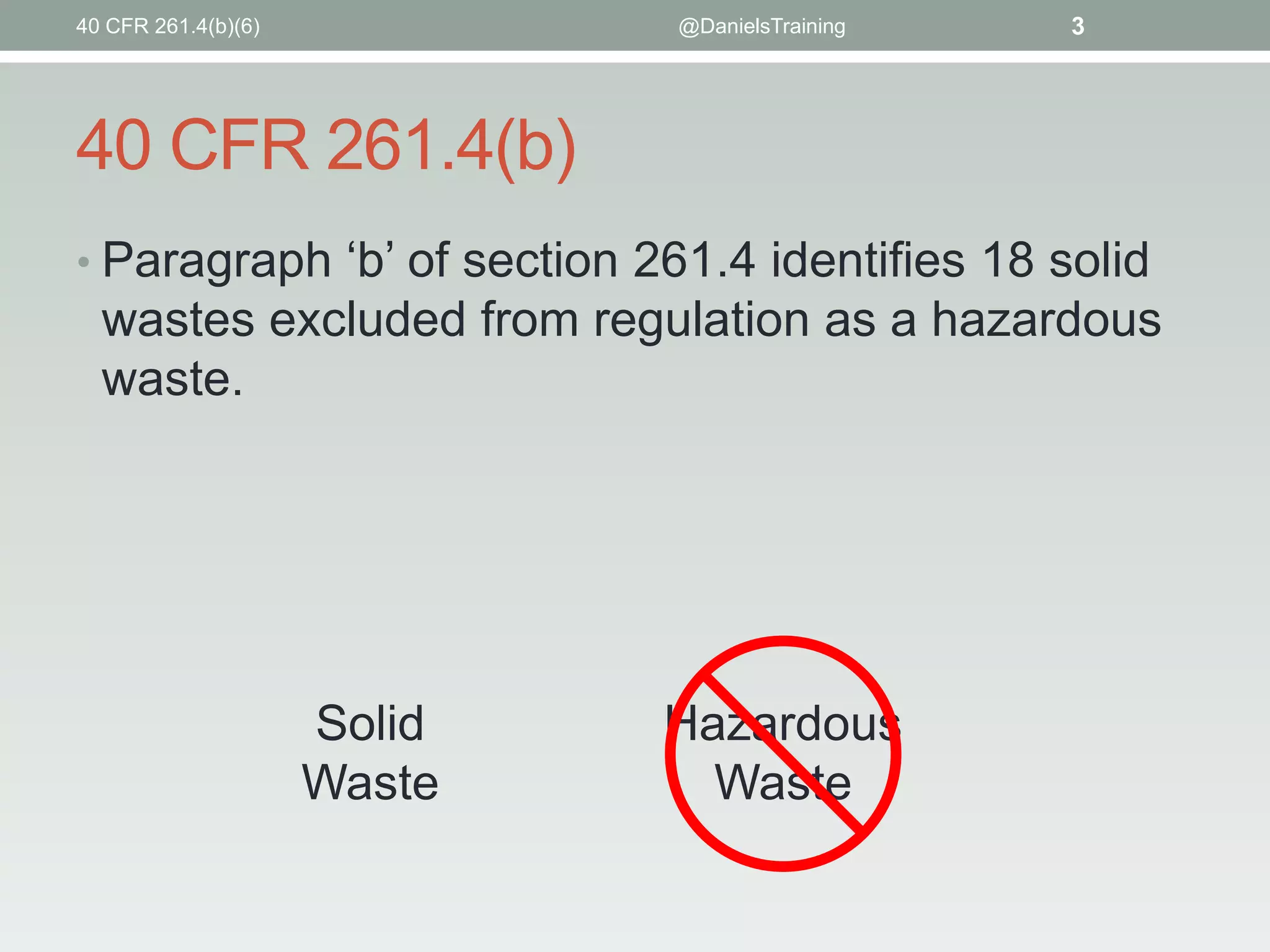
• Paragraph „b‟ of section 261.4 identifies 18 solid

wastes excluded from regulation as a hazardous
waste.

Solid
Waste

Hazardous
Waste
40 CFR 261.4(b)(6)

@DanielsTraining

4

Trivalent Chromium Wastes
“The element chromium exists in two
forms, hexavalent and trivalent. EPA determined
that while hexavalent chromium poses enough of a
threat to merit regulation as a characteristic
hazardous waste, trivalent chromium does not.
Therefore, to prevent unnecessary regulation, EPA
excluded, from the definition of hazardous
waste, trivalent chromium-bearing hazardous
wastes from certain leather tanning, shoe
manufacturing, and leather manufacturing
industries.”
2011 RCRA Orientation Manual
40 CFR 261.4(b)(6)

@DanielsTraining

5

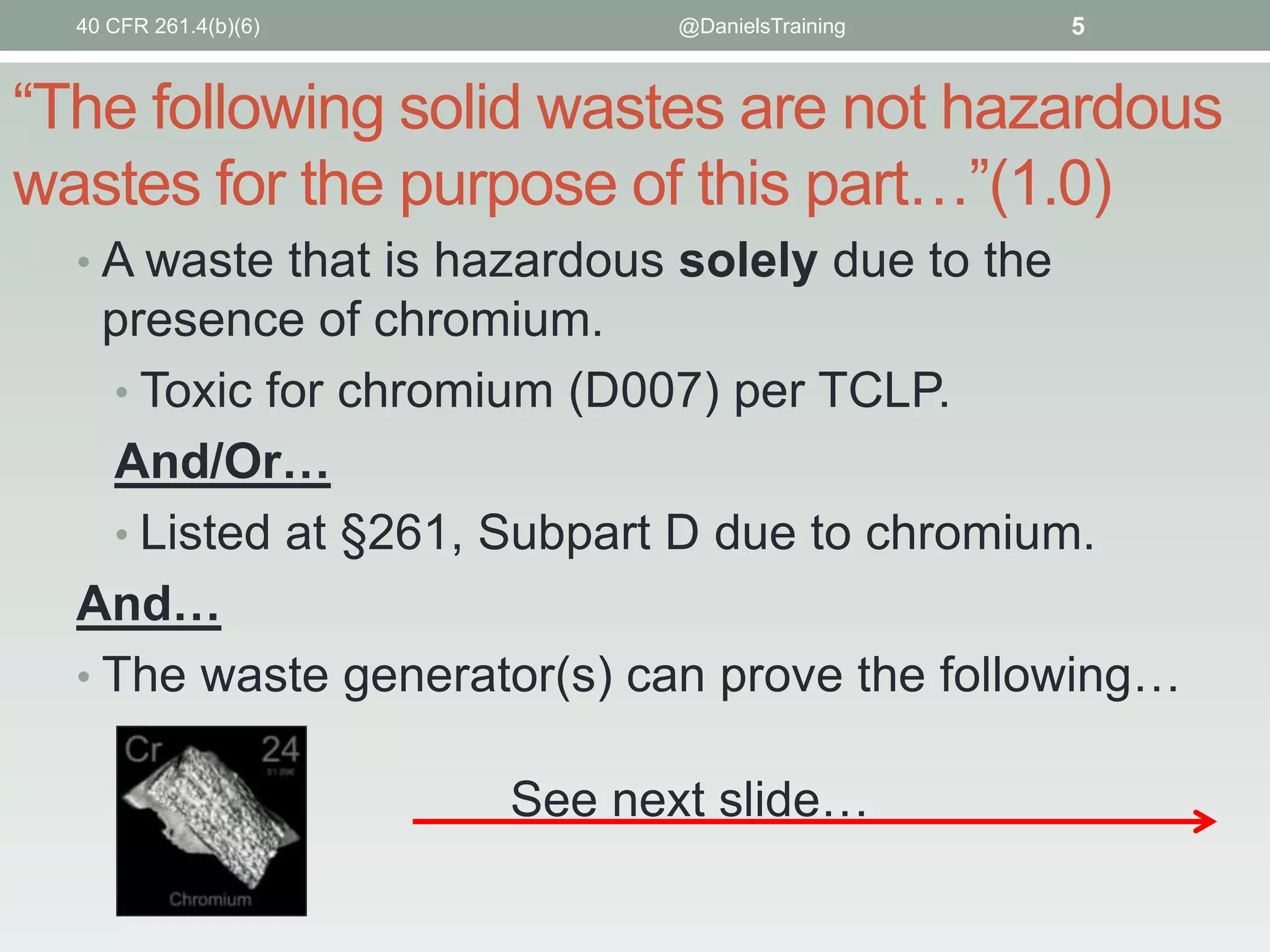
“The following solid wastes are not hazardous
wastes for the purpose of this part…”(1.0)
• A waste that is hazardous solely due to the

presence of chromium.
• Toxic for chromium (D007) per TCLP.
And/Or…
• Listed at §261, Subpart D due to chromium.
And…
• The waste generator(s) can prove the following…
See next slide…
40 CFR 261.4(b)(6)

@DanielsTraining

6

“The following solid wastes are not hazardous
wastes for the purpose of this part…” (2.0)
1. Chromium in waste is exclusively (or nearly

exclusively) trivalent chromium.
And…
2. The source of the waste uses trivalent
chromium exclusively (or nearly exclusively).
And…
3. The source does not generate hexavalent
chromium.
And…
4. Waste is typically & frequently managed in nonoxidizing environments.
40 CFR 261.4(b)(6)

@DanielsTraining

7

“The following solid wastes are not hazardous
wastes for the purpose of this part…” (3.0)
• The USEPA has identified the following specific

wastes as subject to this exclusion.
If…
• They do not exhibit a characteristic of hazardous
waste other than the toxicity characteristic for
chromium (D007).
40 CFR 261.4(b)(6)

@DanielsTraining

8

“The following solid wastes are not hazardous
wastes for the purpose of this part…” (3.1)
• From specified sub-categories (refer to the

regulations) of the leather tanning & finishing
industry:
• Chrome (blue) trimmings.
• Chrome (blue) shavings.
• Buffing dust.
• Sewer screenings.
• Wastewater treatment sludges.
40 CFR 261.4(b)(6)

@DanielsTraining

9

“The following solid wastes are not hazardous
wastes for the purpose of this part…” (3.2)
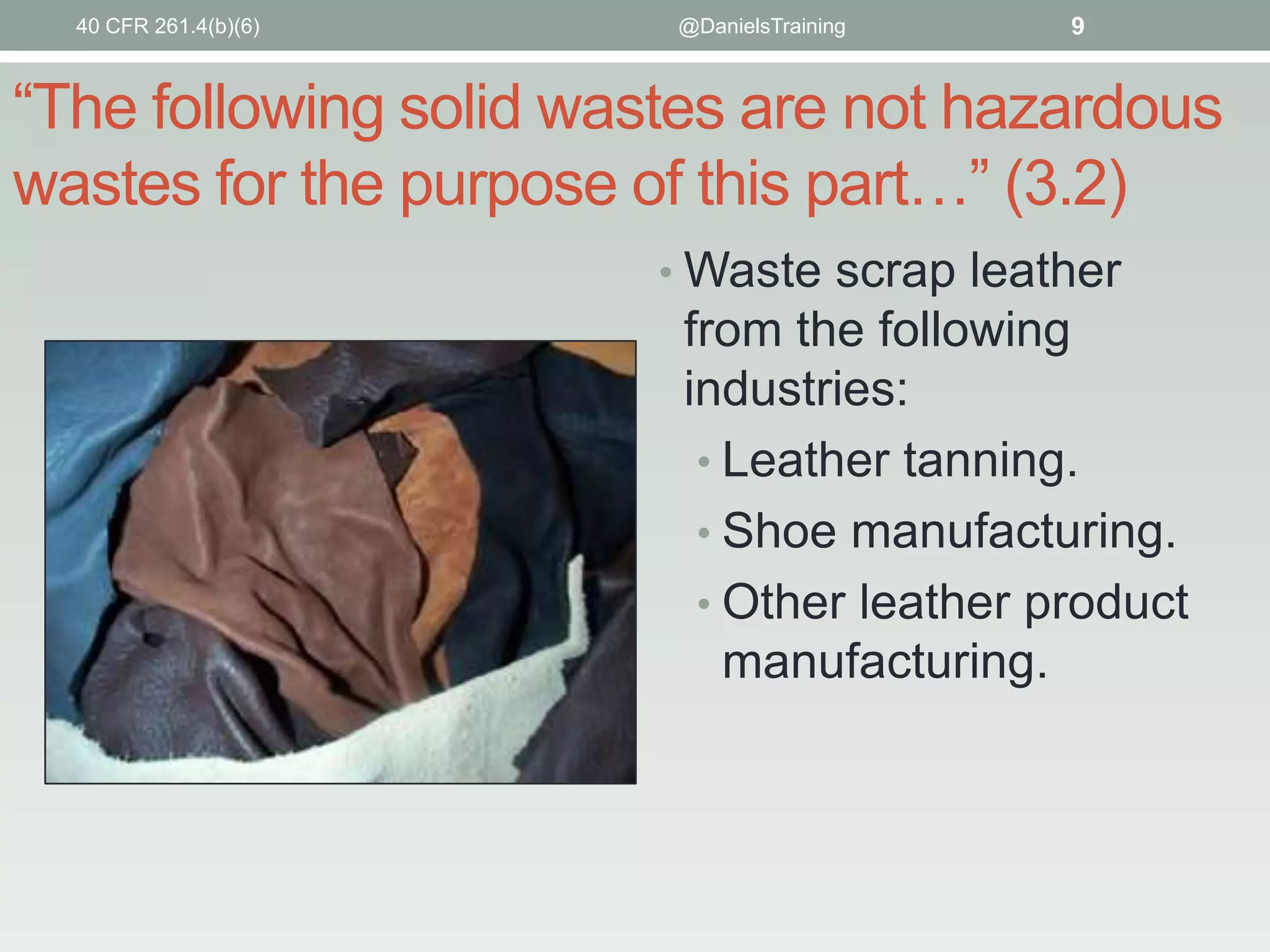
• Waste scrap leather

from the following
industries:
• Leather tanning.
• Shoe manufacturing.
• Other leather product
manufacturing.
40 CFR 261.4(b)(6)

@DanielsTraining

10

“The following solid wastes are not hazardous
wastes for the purpose of this part…” (3.3)
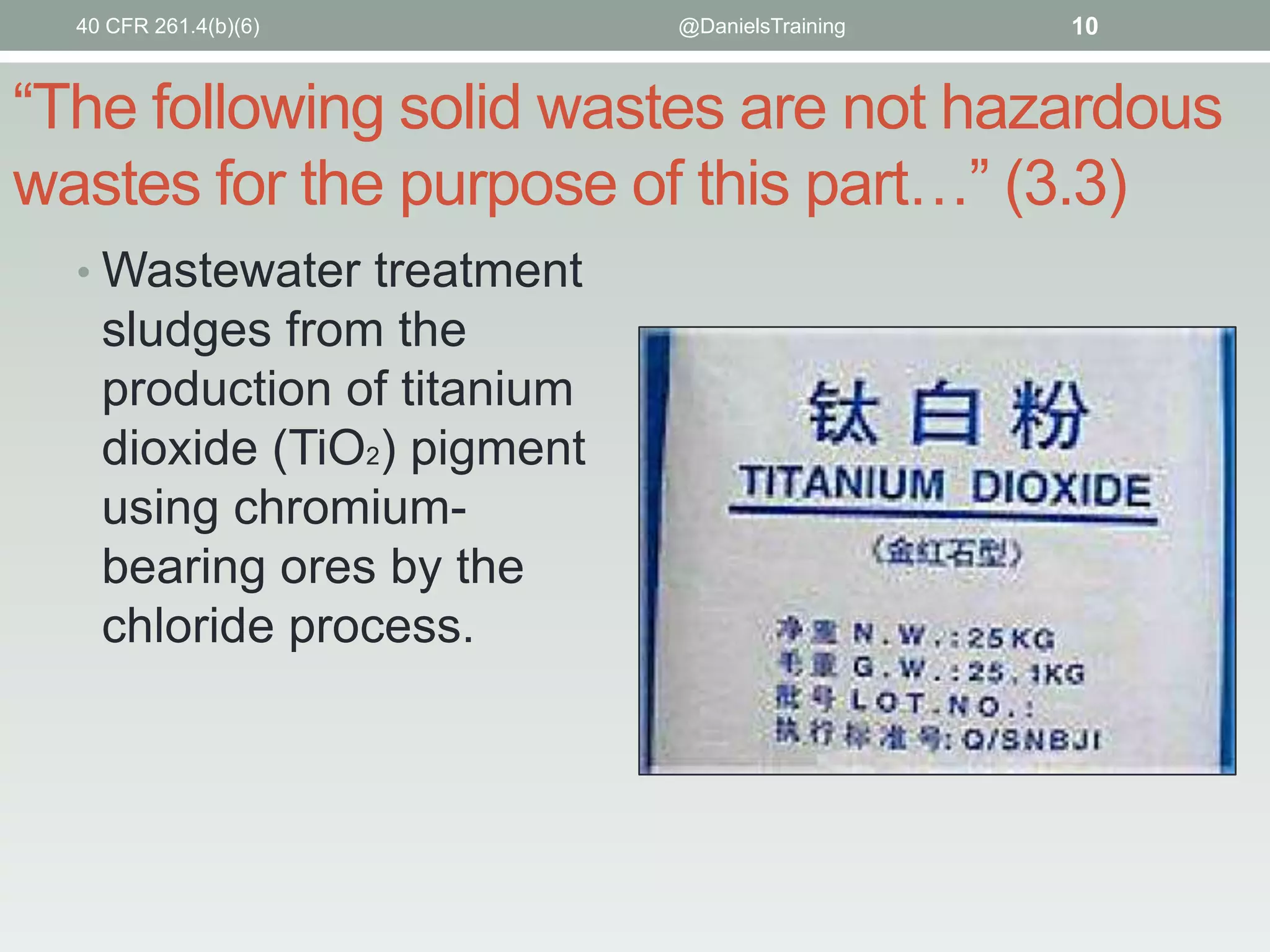
• Wastewater treatment

sludges from the
production of titanium
dioxide (TiO2) pigment
using chromiumbearing ores by the
chloride process.
40 CFR 261.4(b)(6)

@DanielsTraining

11

More to Consider (1)…
• What is TCLP?

• The Toxicity Characteristic Leachate

Procedure.
• USEPA-approved test method for hazardous
waste determination.
• Mimics landfill conditions to create an extract
from a waste similar to leachate generated from
landfills.
• Concentration of pollutant (eg. chromium) in
extract is compared to regulatory levels at 40
CFR 261.24.
40 CFR 261.4(b)(6)

@DanielsTraining

12

More to Consider (2)…
• If a chromium-bearing

hazardous waste is not
specifically identified
by its name and
source at 40 CFR
261.4(b)(6)(ii), refer to
slides 7-10 of this
presentation, then it
can not take
advantage of this
exclusion.

RO14655
40 CFR 261.4(b)(6)

@DanielsTraining

13

More to Consider (2)…
“Chromium occurs in the environment primarily in
two valence states, trivalent chromium (Cr III) and
hexavalent chromium (Cr VI). Exposure may
occur from natural or industrial sources of
chromium. Chromium III is much less toxic than
chromium (VI). The respiratory tract is also the
major target organ for chromium (III)
toxicity, similar to chromium (VI). Chromium (III) is
an essential element in humans. The body can
detoxify some amount of chromium (VI) to
chromium (III).” More…
40 CFR 261.4(b)(6)

@DanielsTraining

More to Consider (3)…
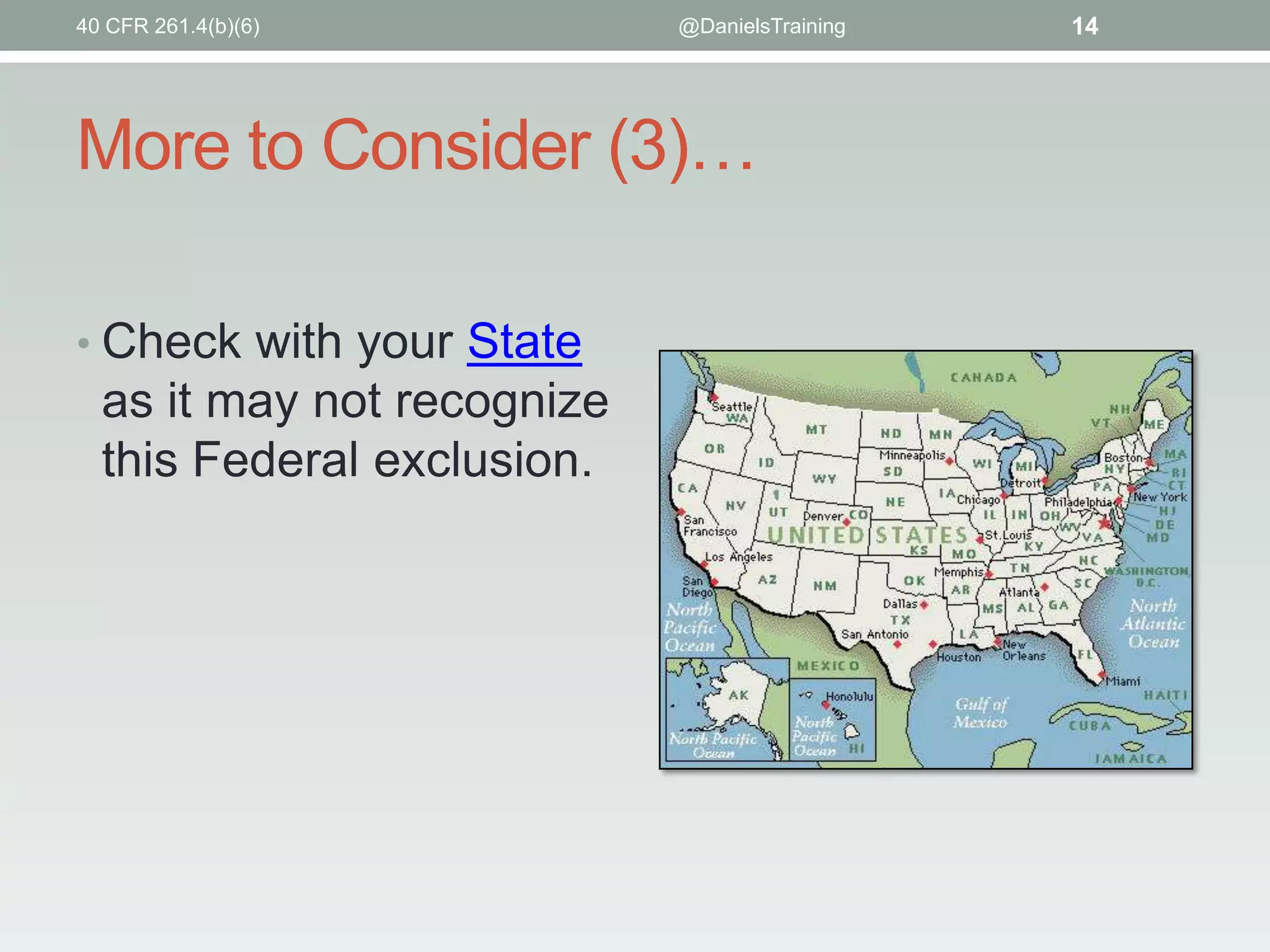
• Check with your State

as it may not recognize
this Federal exclusion.

14
40 CFR 261.4(b)(6)

@DanielsTraining

15

40 CFR 261.4(b)(6) Verbatim:
(b)Solid wastes which are not hazardous wastes. The
following solid wastes are not hazardous wastes:
…

(6) (i) Wastes which fail the test for the Toxicity
Characteristic because chromium is present or are
listed in subpart D due to the presence of
chromium, which do not fail the test for the Toxicity
Characteristic for any other constituent or are not
listed due to the presence of any other constituent,
and which do not fail the test for any other
characteristic, if it is shown by a waste generator
or by waste generators that:
40 CFR 261.4(b)(6)

@DanielsTraining

16

40 CFR 261.4(b)(6) Verbatim (continued):
(A) The chromium in the waste is exclusively (or
nearly exclusively) trivalent chromium; and
(B) The waste is generated from an industrial
process which uses trivalent chromium exclusively
(or nearly exclusively) and the process does not
generate hexavalent chromium; and
(C) The waste is typically and frequently managed
in non-oxidizing environments.
40 CFR 261.4(b)(6)

@DanielsTraining

17

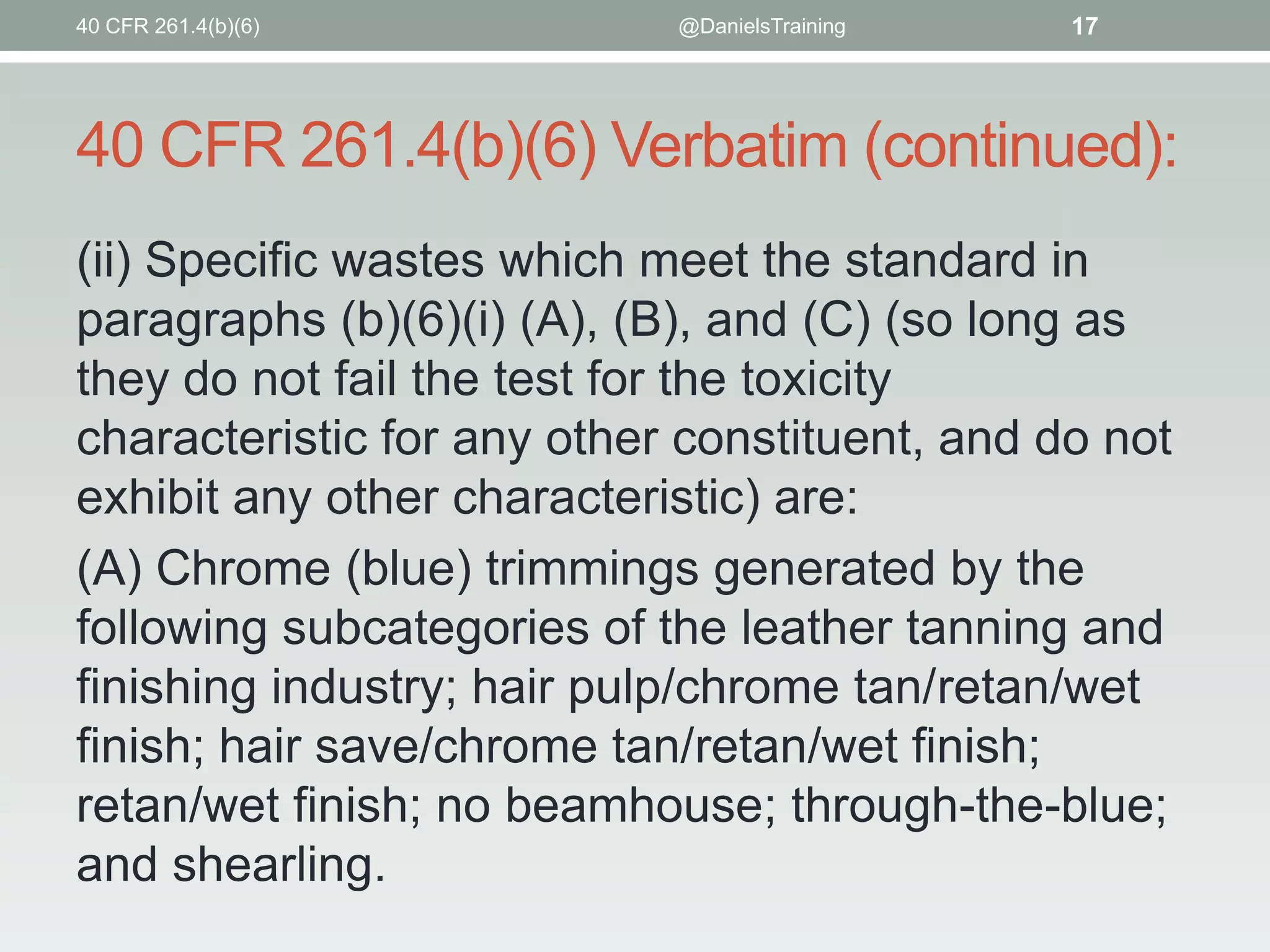
40 CFR 261.4(b)(6) Verbatim (continued):
(ii) Specific wastes which meet the standard in
paragraphs (b)(6)(i) (A), (B), and (C) (so long as
they do not fail the test for the toxicity
characteristic for any other constituent, and do not
exhibit any other characteristic) are:
(A) Chrome (blue) trimmings generated by the
following subcategories of the leather tanning and
finishing industry; hair pulp/chrome tan/retan/wet
finish; hair save/chrome tan/retan/wet finish;
retan/wet finish; no beamhouse; through-the-blue;
and shearling.
40 CFR 261.4(b)(6)

@DanielsTraining

18

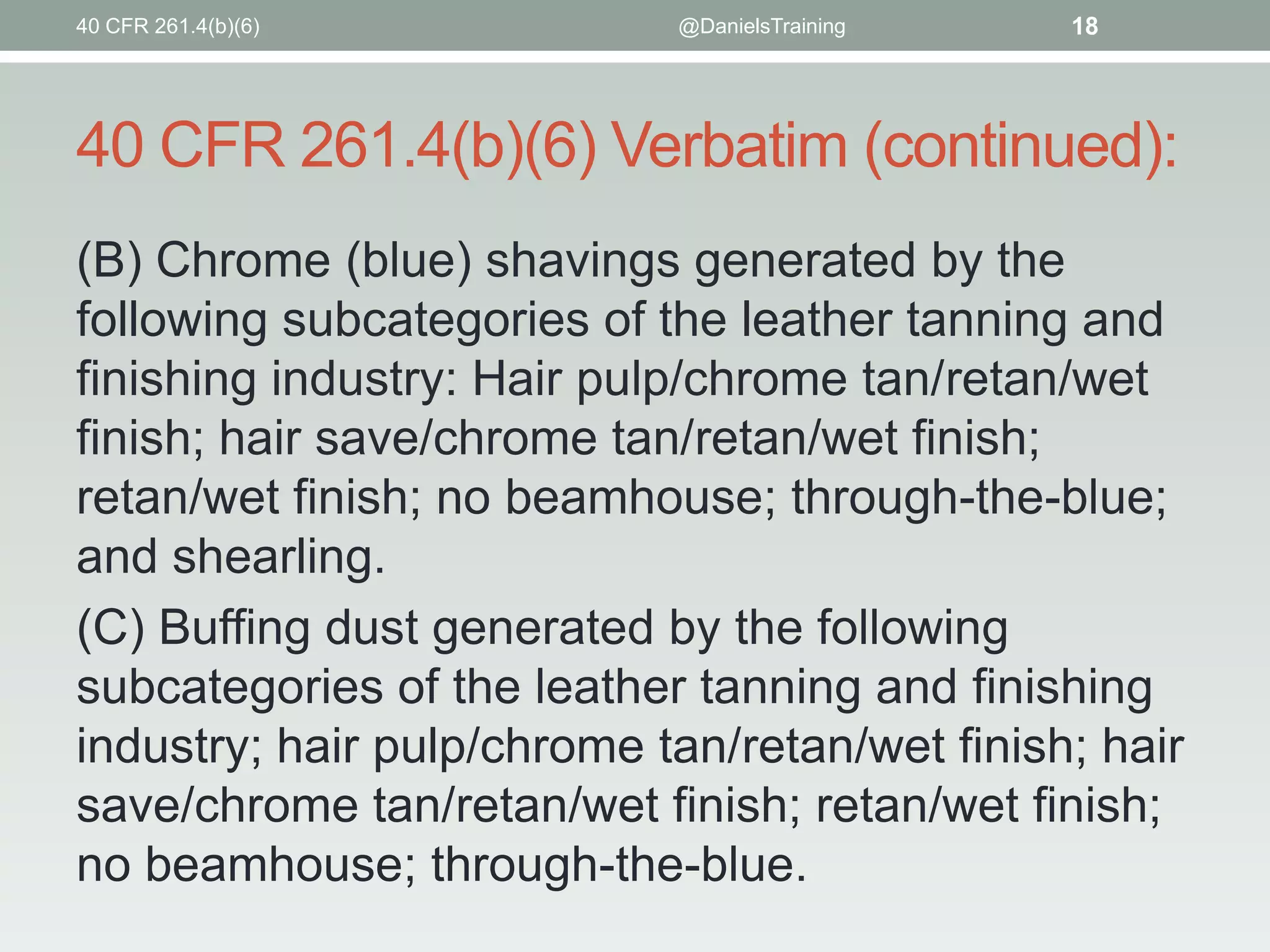
40 CFR 261.4(b)(6) Verbatim (continued):
(B) Chrome (blue) shavings generated by the
following subcategories of the leather tanning and
finishing industry: Hair pulp/chrome tan/retan/wet
finish; hair save/chrome tan/retan/wet finish;
retan/wet finish; no beamhouse; through-the-blue;
and shearling.
(C) Buffing dust generated by the following
subcategories of the leather tanning and finishing
industry; hair pulp/chrome tan/retan/wet finish; hair
save/chrome tan/retan/wet finish; retan/wet finish;
no beamhouse; through-the-blue.
40 CFR 261.4(b)(6)

@DanielsTraining

19

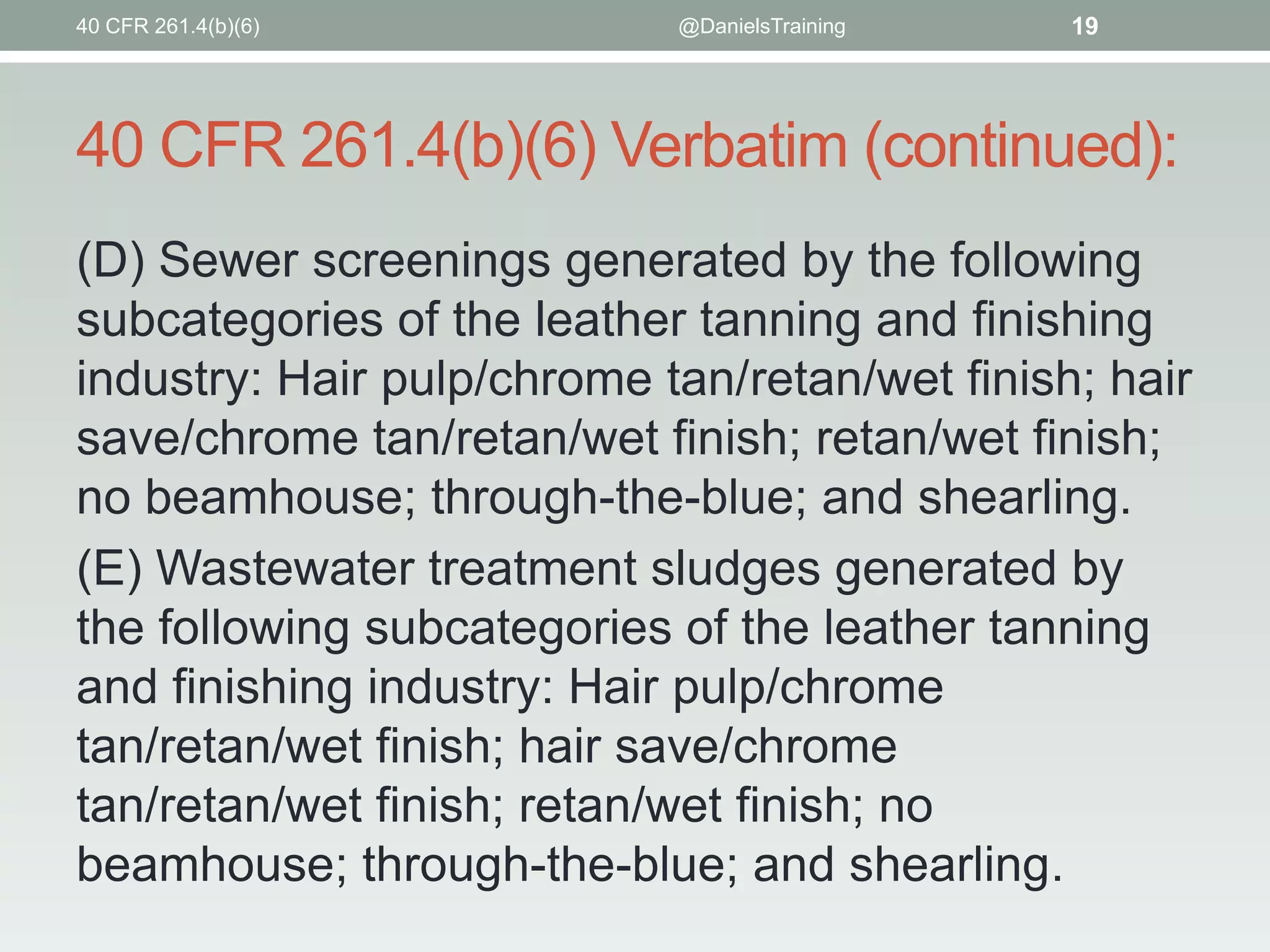
40 CFR 261.4(b)(6) Verbatim (continued):
(D) Sewer screenings generated by the following
subcategories of the leather tanning and finishing
industry: Hair pulp/chrome tan/retan/wet finish; hair
save/chrome tan/retan/wet finish; retan/wet finish;
no beamhouse; through-the-blue; and shearling.
(E) Wastewater treatment sludges generated by
the following subcategories of the leather tanning
and finishing industry: Hair pulp/chrome
tan/retan/wet finish; hair save/chrome
tan/retan/wet finish; retan/wet finish; no
beamhouse; through-the-blue; and shearling.
40 CFR 261.4(b)(6)

@DanielsTraining

20

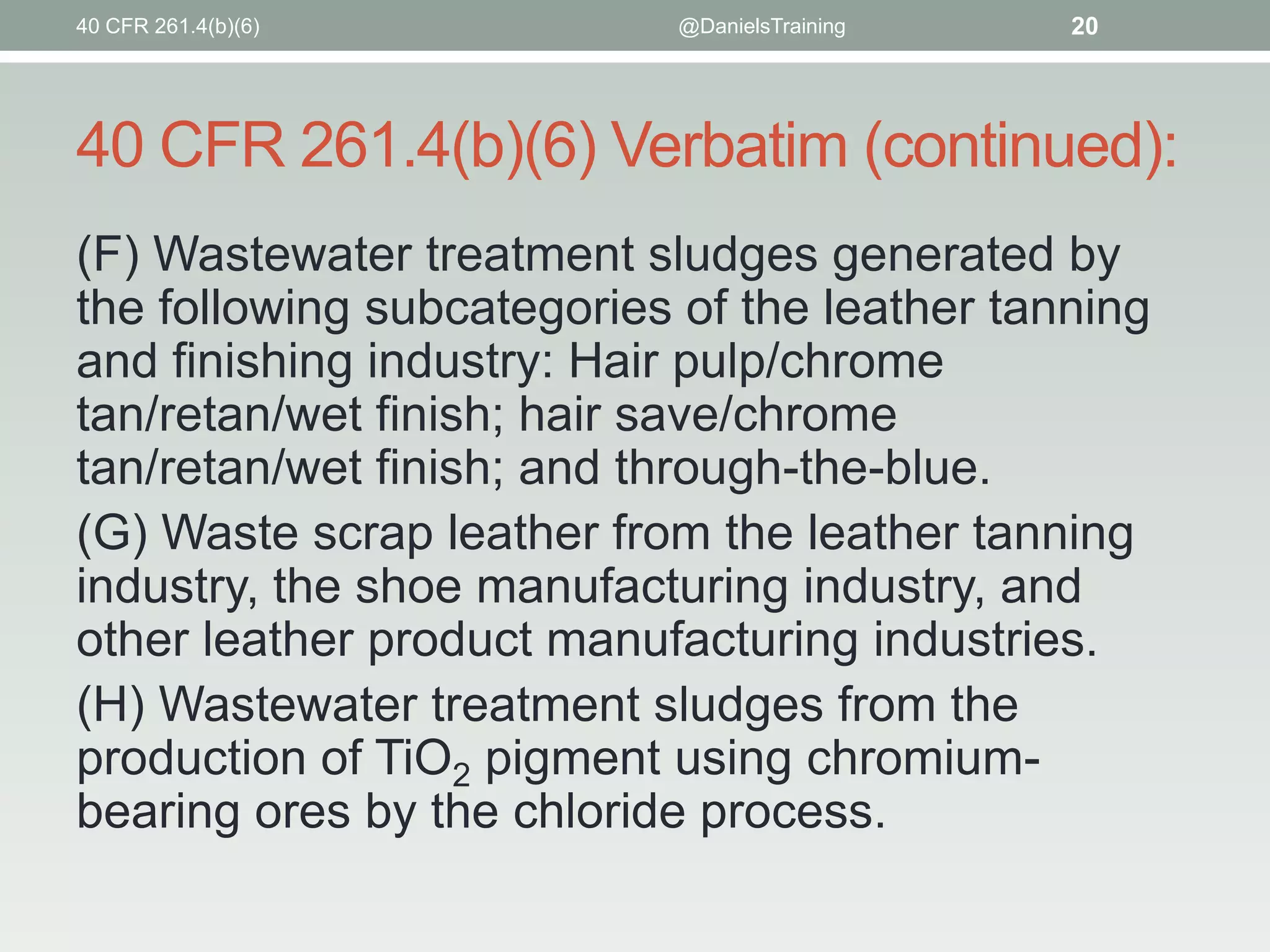
40 CFR 261.4(b)(6) Verbatim (continued):
(F) Wastewater treatment sludges generated by
the following subcategories of the leather tanning
and finishing industry: Hair pulp/chrome
tan/retan/wet finish; hair save/chrome
tan/retan/wet finish; and through-the-blue.
(G) Waste scrap leather from the leather tanning
industry, the shoe manufacturing industry, and
other leather product manufacturing industries.
(H) Wastewater treatment sludges from the
production of TiO2 pigment using chromiumbearing ores by the chloride process.
40 CFR 261.4(b)(6)

@DanielsTraining

21

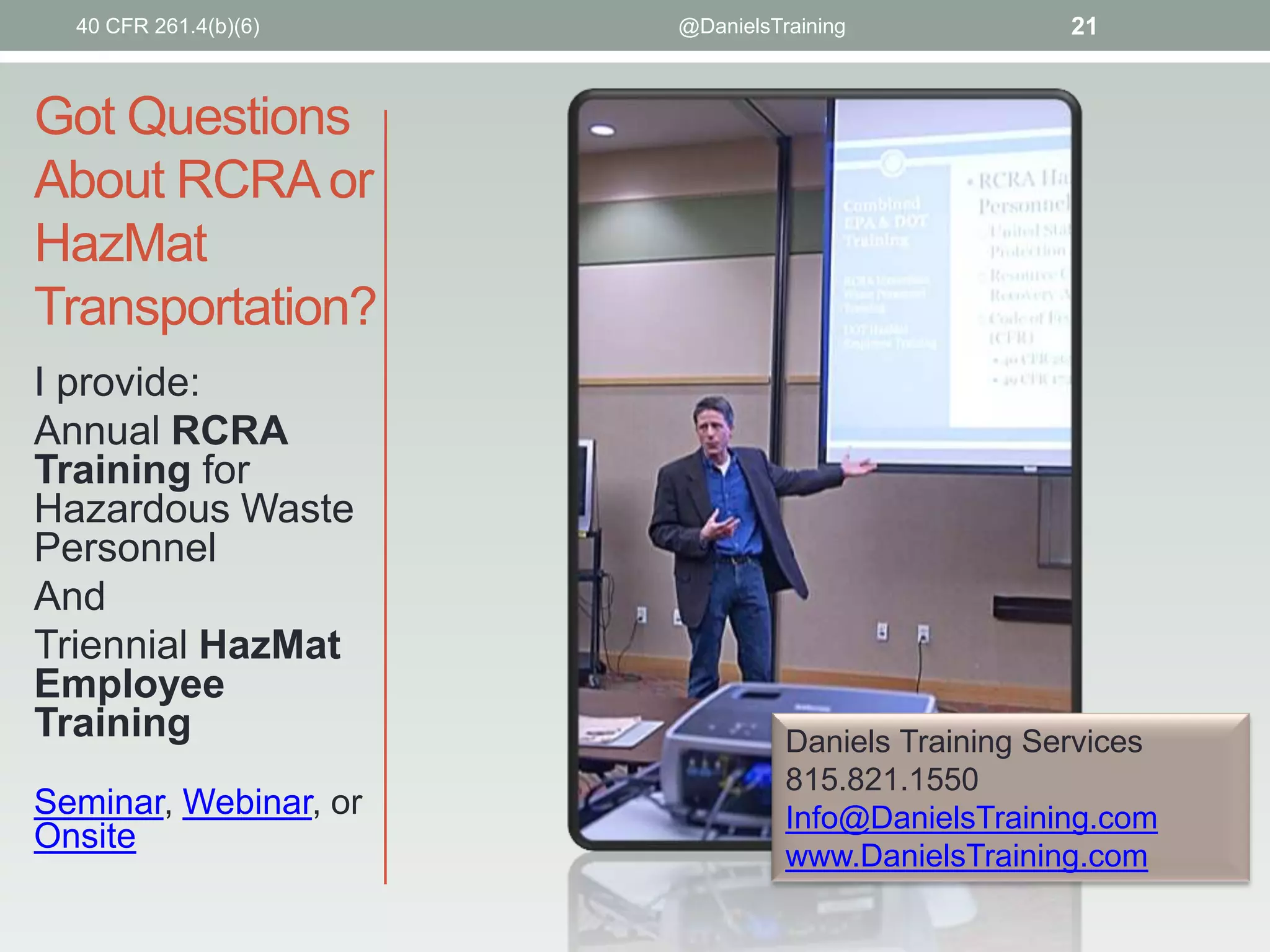
Got Questions
About RCRA or
HazMat
Transportation?
I provide:
Annual RCRA
Training for
Hazardous Waste
Personnel
And
Triennial HazMat
Employee
Training
Seminar, Webinar, or
Onsite

Daniels Training Services
815.821.1550
Info@DanielsTraining.com
www.DanielsTraining.com

40 cfr 261.4(b)(6) The RCRA Exclusion From Hazardous Waste for Trivalent Chromium Waste

  • 1.
    40 CFR 261.4(b)(6) @DanielsTraining 1 EXCLUSIONSFROM REGULATION AS HAZARDOUS WASTE One presentation in a series that briefly explains the Federal exclusions from full regulation for certain materials under the Resource Conservation and Recovery Act (RCRA). This presentation: 40 CFR 261.4(b)(6): Trivalent Chromium Wastes
  • 2.
    40 CFR 261.4(b)(6) @DanielsTraining 2 PRESENTEDBY: Daniels Training Services 815.821.1550 www.DanielsTraining.com Info@DanielsTraining.com A different kind of training.
  • 3.
    40 CFR 261.4(b)(6) @DanielsTraining 3 40CFR 261.4(b) • Paragraph „b‟ of section 261.4 identifies 18 solid wastes excluded from regulation as a hazardous waste. Solid Waste Hazardous Waste
  • 4.
    40 CFR 261.4(b)(6) @DanielsTraining 4 TrivalentChromium Wastes “The element chromium exists in two forms, hexavalent and trivalent. EPA determined that while hexavalent chromium poses enough of a threat to merit regulation as a characteristic hazardous waste, trivalent chromium does not. Therefore, to prevent unnecessary regulation, EPA excluded, from the definition of hazardous waste, trivalent chromium-bearing hazardous wastes from certain leather tanning, shoe manufacturing, and leather manufacturing industries.” 2011 RCRA Orientation Manual
  • 5.
    40 CFR 261.4(b)(6) @DanielsTraining 5 “Thefollowing solid wastes are not hazardous wastes for the purpose of this part…”(1.0) • A waste that is hazardous solely due to the presence of chromium. • Toxic for chromium (D007) per TCLP. And/Or… • Listed at §261, Subpart D due to chromium. And… • The waste generator(s) can prove the following… See next slide…
  • 6.
    40 CFR 261.4(b)(6) @DanielsTraining 6 “Thefollowing solid wastes are not hazardous wastes for the purpose of this part…” (2.0) 1. Chromium in waste is exclusively (or nearly exclusively) trivalent chromium. And… 2. The source of the waste uses trivalent chromium exclusively (or nearly exclusively). And… 3. The source does not generate hexavalent chromium. And… 4. Waste is typically & frequently managed in nonoxidizing environments.
  • 7.
    40 CFR 261.4(b)(6) @DanielsTraining 7 “Thefollowing solid wastes are not hazardous wastes for the purpose of this part…” (3.0) • The USEPA has identified the following specific wastes as subject to this exclusion. If… • They do not exhibit a characteristic of hazardous waste other than the toxicity characteristic for chromium (D007).
  • 8.
    40 CFR 261.4(b)(6) @DanielsTraining 8 “Thefollowing solid wastes are not hazardous wastes for the purpose of this part…” (3.1) • From specified sub-categories (refer to the regulations) of the leather tanning & finishing industry: • Chrome (blue) trimmings. • Chrome (blue) shavings. • Buffing dust. • Sewer screenings. • Wastewater treatment sludges.
  • 9.
    40 CFR 261.4(b)(6) @DanielsTraining 9 “Thefollowing solid wastes are not hazardous wastes for the purpose of this part…” (3.2) • Waste scrap leather from the following industries: • Leather tanning. • Shoe manufacturing. • Other leather product manufacturing.
  • 10.
    40 CFR 261.4(b)(6) @DanielsTraining 10 “Thefollowing solid wastes are not hazardous wastes for the purpose of this part…” (3.3) • Wastewater treatment sludges from the production of titanium dioxide (TiO2) pigment using chromiumbearing ores by the chloride process.
  • 11.
    40 CFR 261.4(b)(6) @DanielsTraining 11 Moreto Consider (1)… • What is TCLP? • The Toxicity Characteristic Leachate Procedure. • USEPA-approved test method for hazardous waste determination. • Mimics landfill conditions to create an extract from a waste similar to leachate generated from landfills. • Concentration of pollutant (eg. chromium) in extract is compared to regulatory levels at 40 CFR 261.24.
  • 12.
    40 CFR 261.4(b)(6) @DanielsTraining 12 Moreto Consider (2)… • If a chromium-bearing hazardous waste is not specifically identified by its name and source at 40 CFR 261.4(b)(6)(ii), refer to slides 7-10 of this presentation, then it can not take advantage of this exclusion. RO14655
  • 13.
    40 CFR 261.4(b)(6) @DanielsTraining 13 Moreto Consider (2)… “Chromium occurs in the environment primarily in two valence states, trivalent chromium (Cr III) and hexavalent chromium (Cr VI). Exposure may occur from natural or industrial sources of chromium. Chromium III is much less toxic than chromium (VI). The respiratory tract is also the major target organ for chromium (III) toxicity, similar to chromium (VI). Chromium (III) is an essential element in humans. The body can detoxify some amount of chromium (VI) to chromium (III).” More…
  • 14.
    40 CFR 261.4(b)(6) @DanielsTraining Moreto Consider (3)… • Check with your State as it may not recognize this Federal exclusion. 14
  • 15.
    40 CFR 261.4(b)(6) @DanielsTraining 15 40CFR 261.4(b)(6) Verbatim: (b)Solid wastes which are not hazardous wastes. The following solid wastes are not hazardous wastes: … (6) (i) Wastes which fail the test for the Toxicity Characteristic because chromium is present or are listed in subpart D due to the presence of chromium, which do not fail the test for the Toxicity Characteristic for any other constituent or are not listed due to the presence of any other constituent, and which do not fail the test for any other characteristic, if it is shown by a waste generator or by waste generators that:
  • 16.
    40 CFR 261.4(b)(6) @DanielsTraining 16 40CFR 261.4(b)(6) Verbatim (continued): (A) The chromium in the waste is exclusively (or nearly exclusively) trivalent chromium; and (B) The waste is generated from an industrial process which uses trivalent chromium exclusively (or nearly exclusively) and the process does not generate hexavalent chromium; and (C) The waste is typically and frequently managed in non-oxidizing environments.
  • 17.
    40 CFR 261.4(b)(6) @DanielsTraining 17 40CFR 261.4(b)(6) Verbatim (continued): (ii) Specific wastes which meet the standard in paragraphs (b)(6)(i) (A), (B), and (C) (so long as they do not fail the test for the toxicity characteristic for any other constituent, and do not exhibit any other characteristic) are: (A) Chrome (blue) trimmings generated by the following subcategories of the leather tanning and finishing industry; hair pulp/chrome tan/retan/wet finish; hair save/chrome tan/retan/wet finish; retan/wet finish; no beamhouse; through-the-blue; and shearling.
  • 18.
    40 CFR 261.4(b)(6) @DanielsTraining 18 40CFR 261.4(b)(6) Verbatim (continued): (B) Chrome (blue) shavings generated by the following subcategories of the leather tanning and finishing industry: Hair pulp/chrome tan/retan/wet finish; hair save/chrome tan/retan/wet finish; retan/wet finish; no beamhouse; through-the-blue; and shearling. (C) Buffing dust generated by the following subcategories of the leather tanning and finishing industry; hair pulp/chrome tan/retan/wet finish; hair save/chrome tan/retan/wet finish; retan/wet finish; no beamhouse; through-the-blue.
  • 19.
    40 CFR 261.4(b)(6) @DanielsTraining 19 40CFR 261.4(b)(6) Verbatim (continued): (D) Sewer screenings generated by the following subcategories of the leather tanning and finishing industry: Hair pulp/chrome tan/retan/wet finish; hair save/chrome tan/retan/wet finish; retan/wet finish; no beamhouse; through-the-blue; and shearling. (E) Wastewater treatment sludges generated by the following subcategories of the leather tanning and finishing industry: Hair pulp/chrome tan/retan/wet finish; hair save/chrome tan/retan/wet finish; retan/wet finish; no beamhouse; through-the-blue; and shearling.
  • 20.
    40 CFR 261.4(b)(6) @DanielsTraining 20 40CFR 261.4(b)(6) Verbatim (continued): (F) Wastewater treatment sludges generated by the following subcategories of the leather tanning and finishing industry: Hair pulp/chrome tan/retan/wet finish; hair save/chrome tan/retan/wet finish; and through-the-blue. (G) Waste scrap leather from the leather tanning industry, the shoe manufacturing industry, and other leather product manufacturing industries. (H) Wastewater treatment sludges from the production of TiO2 pigment using chromiumbearing ores by the chloride process.
  • 21.
    40 CFR 261.4(b)(6) @DanielsTraining 21 GotQuestions About RCRA or HazMat Transportation? I provide: Annual RCRA Training for Hazardous Waste Personnel And Triennial HazMat Employee Training Seminar, Webinar, or Onsite Daniels Training Services 815.821.1550 Info@DanielsTraining.com www.DanielsTraining.com

Editor's Notes

  • #2 The Trivalent Chromium Wastes Exclusion from Regulation as a Hazardous Waste40 CFR 261.4(b)(6) excludes Trivalent Chromium Waste, a solid waste,from regulation as a hazardous waste if the requirements of the regulations are met. This presentation briefly summarizes the requirements of this RCRA exclusion from regulation.