Manufacturing Technology
Grinding
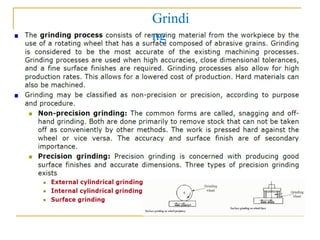
Grindingis a surface finishing operation where very thin layer of material is removed
in the form of fine dust particles. (thickness 0.25-0.5mm)
Grinding can be defined as a material removal process by the abrasive action
between rotating abrasive wheel & the work piece.
Grinding machine is a power operated machine tool where, the work piece is fed
against a constantly rotating abrasive wheel which is also called as Grinding wheel
so that a thin layer of material is removed from the work piece.
Fig. illustrates the cutting action of abrasive grits of disc type grinding wheel
similar to cutting action of teeth of the cutter in slab milling.
4.
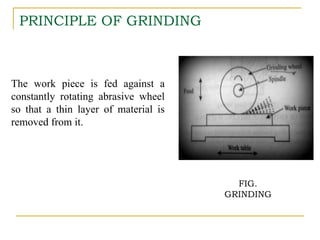
PRINCIPLE OF GRINDING
Thework piece is fed against a
constantly rotating abrasive wheel
so that a thin layer of material is
removed from it.
FIG.
GRINDING
Manufacturing Technology
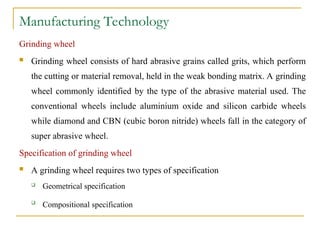
Grinding wheel
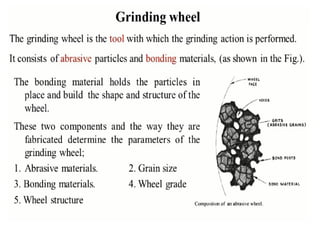
Grinding wheel consists of hard abrasive grains called grits, which perform
the cutting or material removal, held in the weak bonding matrix. A grinding
wheel commonly identified by the type of the abrasive material used. The
conventional wheels include aluminium oxide and silicon carbide wheels
while diamond and CBN (cubic boron nitride) wheels fall in the category of
super abrasive wheel.
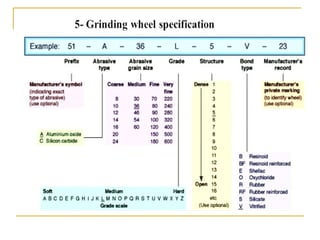
Specification of grinding wheel
A grinding wheel requires two types of specification
Geometrical specification
Compositional specification
ABRASIVES
Abrasives: Theseare the mineral materials
employed for sharpening, grinding &
polishing operations.
Abrasives are classified as natural &
artificial.
Natural Abrasives: Emery, Corundum,
Diamond etc,.
Artificial Abrasives: Silicon Carbide(SiC),
Aluminum Oxide(Al2O3), Cubic Boron
Nitride(CBN) etc,.
16.
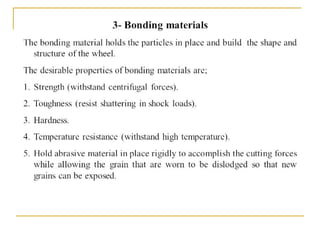
Bonding materials &Process
Vitrified Process: Abrasive+ Fed spar & clay,
heated at higher temperatures in kilns.75-80%
of grinding wheels are made by this process.
Silicate Process: Abrasive+ Silicate of soda.
Baked @ 260°C for 20 to 80 Hrs.
Elastic Process: Abrasives + Shellac. Baked
@150°C for few hours.
Vulcanite or Rubber Process: Abrasive+ Pure
rubber+ Sulphur.
17.
Manufacturing Technology
Grinding Machines
Grinding Machines are also regarded as machine tools. A distinguishing feature of
grinding machines is the rotating abrasive tool.
Grinding machine is employed to obtain high accuracy along with very high class of
surface finish on the work piece. However, advent of new generation of grinding
wheels and grinding machines, characterized by their rigidity, power and speed
enables one to go for high efficiency deep grinding (often called as abrasive milling)
of not only hardened material but also ductile materials.
Conventional grinding machines can be broadly classified as:
Surface grinding machine
Cylindrical grinding machine
Center less grinding
18.
Manufacturing Technology
Surface grinding
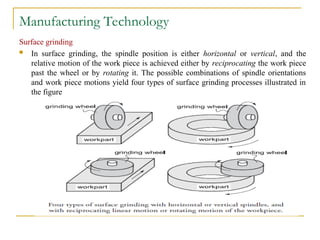
In surface grinding, the spindle position is either horizontal or vertical, and the
relative motion of the work piece is achieved either by reciprocating the work piece
past the wheel or by rotating it. The possible combinations of spindle orientations
and work piece motions yield four types of surface grinding processes illustrated in
the figure
Manufacturing Technology
Surface grindingmachine
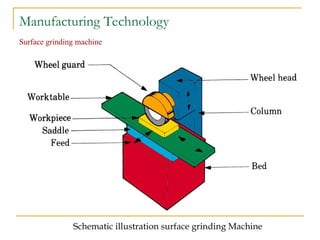
This machine may be similar to a milling machine used mainly to grind flat surface.
However, some types of surface grinders are also capable of producing contour
surface with formed grinding wheel.
A: rotation of grinding wheel B: reciprocation of worktable C: transverse feed D: down feed
Horizontal Grinding Machine Vertical Grinding Machine
21.
Manufacturing Technology
Cylindrical grinding
In this operation, the external or internal cylindrical surface of a work piece are
ground. In external cylindrical grinding (also center-type grinding) the work piece
rotates and reciprocates along its axis, although for large and long work parts the
grinding wheel reciprocates. The work piece is held between two centers & and the
rotating grinding wheel is fed against it.
In internal cylindrical grinding, a small wheel grinds the inside diameter of the part.
The work piece is held in a rotating chuck in the headstock and the wheel rotates at
very high rotational speed. In this operation, the work piece rotates and the grinding
wheel reciprocates.
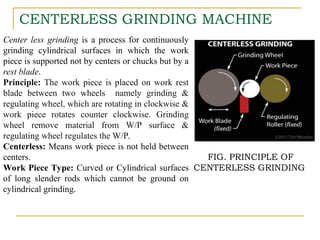
CENTERLESS GRINDING MACHINE
FIG.PRINCIPLE OF
CENTERLESS GRINDING
Center less grinding is a process for continuously
grinding cylindrical surfaces in which the work
piece is supported not by centers or chucks but by a
rest blade.
Principle: The work piece is placed on work rest
blade between two wheels namely grinding &
regulating wheel, which are rotating in clockwise &
work piece rotates counter clockwise. Grinding
wheel remove material from W/P surface &
regulating wheel regulates the W/P.
Centerless: Means work piece is not held between
centers.
Work Piece Type: Curved or Cylindrical surfaces
of long slender rods which cannot be ground on
cylindrical grinding.
24.
Manufacturing Technology
Finishing Operation
To ensure reliable performance and prolonged service life of modern
machinery, its components require to be manufactured not only with high
dimensional and geometrical accuracy but also with high surface finish.
The surface finish has a vital role in influencing functional characteristics
like wear resistance, fatigue strength, corrosion resistance and power loss
due to friction.
The finishing operations are assigned as the last operations in the single part
production cycle usually after the conventional or abrasive machining
operations, but also after net shape processes such as powder metallurgy,
cold flash less forging, etc.
Manufacturing Technology
Lapping
Inlapping, instead of a bonded abrasive tool, oil-based fluid suspension of
very small free abrasive grains (aluminum oxide and silicon carbide, with
typical grit sizes between 300 and 600) called a lapping compound is applied
between the work piece and the lapping tool.
The lapping tool is called a lap, which is made of soft materials like copper,
lead or wood. The lap has the reverse of the desired shape of the work part.
To accomplish the process, the lap is pressed against the work and moved
back and forth over the surface.
Lapping is sometimes performed by hand, but lapping machines accomplish
the process with greater consistency and efficiency.
27.
Manufacturing Technology
Lapping
Lappingis regarded as the oldest method of obtaining a fine finish.
Lapping is basically an abrasive process in which loose abrasives function
as cutting points finding momentary support from the laps. Material
removal in lapping usually ranges from .003 to .03 mm but many reach
0.08 to 0.1mm in certain cases.
The cutting mechanism in lapping is that the abrasives become embedded
in the lap surface, and the cutting action is very similar to grinding, but a
concurrent cutting action of the free abrasive particles in the fluid cannot
be excluded.
Lapping is used to produce optical lenses, metallic bearing surfaces, gages,
and other parts requiring very good finishes and extreme accuracy.
28.
Manufacturing Technology
Characteristics oflapping process:
Use of loose abrasive between lap and the work piece
Usually lap and work piece are not positively driven but are guided in
contact with each other
Relative motion between the lap and the work should change continuously
so that path of the abrasive grains of the lap is not repeated on the work
piece.
Manufacturing Technology
Lapping
Figure(a) Schematic illustration of the lapping process. (b) Production lapping on
flat surfaces.(c) Production lapping on cylindrical surfaces.
31.
Manufacturing Technology
Polishing
Polishingis a finishing operation to improve the surface finish by means of a
polishing wheel made of fabrics or leather and rotating at high speed. The abrasive
grains are glued to the outside periphery of the polishing wheel. Polishing operations
are often accomplished manually.
Buffing
Buffing is a finishing operation similar to polishing, in which abrasive grains are not
glued to the wheel but are contained in a buffing compound that is pressed into the
outside surface of the buffing wheel while it rotates. As in polishing, the abrasive
particles must be periodically replenished.
As in polishing, buffing is usually done manually, although machines have been
designed to perform the process automatically.
Buffing wheels are made of discs of linen, cotton, broad cloth and canvas
Manufacturing Technology
Honing
Honingis a finishing process, in which a tool called hone carries out a
combined rotary and reciprocating motion while the work piece does not
perform any working motion. Most honing is done on internal cylindrical
surface, such as automobile cylindrical walls.
The honing stones are held against the work piece with controlled light
pressure. The honing head is not guided externally but, instead, floats in the
hole, being guided by the work surface
It is desired that
honing stones should not leave the work surface
stroke length must cover the entire work length.
35.
Manufacturing Technology
Honing
Honingis a finishing process performed by a honing tool, which contains a
set of three to a dozen and more bonded abrasive sticks. The sticks are
equally spaced about the periphery of the honing tool. They are held against
the work surface with controlled light pressure, usually exercised by small
springs.
The honing tool is given a complex rotational and oscillatory axial motion,
which combine to produce a crosshatched lay pattern of very low surface
roughness
Honing tool
Manufacturing Technology
Super finishing
Super finishing is a micro finishing process that produces a controlled surface
condition on parts which is not obtainable by any other method. The operation which
is also called ‘micro stoning’ consist of scrubbing a stone against a surface to
produce a fine quality metal finish.
The process consists of removing chatter marks and fragmented or smear metal from
the surface of dimensionally finished parts. As much as 0.03 to 0.05 mm of stock can
be efficiently removed with some production applications, the process becomes most
economical if the metal removal is limited to 0.005 mm