Methods for Removal of Chromium
       from Wastewater


             Presentation by
              Arvind Gupta
         M.Tech (CH), Third Sem.
           Roll No. 09201101
             NIT Jalandhar
Background Information
• Chromium is a metal that exists in several oxidation or valence states,
    ranging from chromium (-II) to chromium (+VI).

• Chromium compounds are very stable in the trivalent state and occur
    naturally in this state in ores such as ferrochromite, or chromite ore.

• Chrome III is an essential nutrient for maintaining blood glucose levels

• The hexavalent, Cr(VI) or chromate, is the second most stable state. It
    rarely occurs naturally.


                               Arvind Gupta, M. Tech Chemical
5/12/2010                                                                     2
                                        Engineering
What is Hexavalent Chromium?

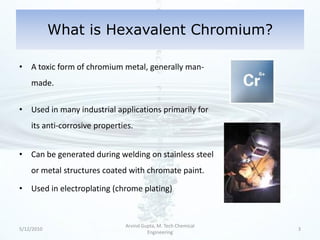
• A toxic form of chromium metal, generally man-
    made.

• Used in many industrial applications primarily for
    its anti-corrosive properties.


• Can be generated during welding on stainless steel
    or metal structures coated with chromate paint.

• Used in electroplating (chrome plating)


                               Arvind Gupta, M. Tech Chemical
5/12/2010                                                       3
                                        Engineering
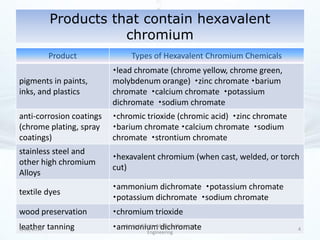
Products that contain hexavalent
                       chromium
            Product            Types of Hexavalent Chromium Chemicals
                          lead chromate (chrome yellow, chrome green,
pigments in paints,       molybdenum orange) zinc chromate barium
inks, and plastics        chromate calcium chromate potassium
                          dichromate sodium chromate
anti-corrosion coatings   chromic trioxide (chromic acid) zinc chromate
(chrome plating, spray    barium chromate calcium chromate sodium
coatings)                 chromate strontium chromate
stainless steel and
                          hexavalent chromium (when cast, welded, or torch
other high chromium
                          cut)
Alloys
                          ammonium dichromate potassium chromate
textile dyes
                          potassium dichromate sodium chromate
wood preservation         chromium trioxide
leather tanning
5/12/2010                 ammoniumM. Tech Chemical
                             Arvind Gupta, dichromate
                                      Engineering
                                                                            4
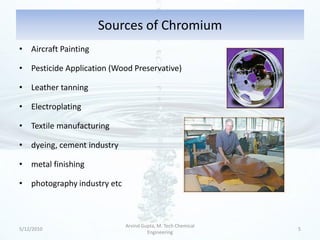
Sources of Chromium
• Aircraft Painting

• Pesticide Application (Wood Preservative)

• Leather tanning

• Electroplating

• Textile manufacturing

• dyeing, cement industry

• metal finishing

• photography industry etc


                             Arvind Gupta, M. Tech Chemical
5/12/2010                                                     5
                                      Engineering
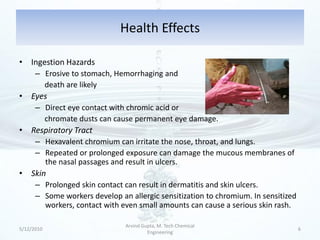
Health Effects

• Ingestion Hazards
      – Erosive to stomach, Hemorrhaging and
        death are likely
• Eyes
      – Direct eye contact with chromic acid or
        chromate dusts can cause permanent eye damage.
• Respiratory Tract
      – Hexavalent chromium can irritate the nose, throat, and lungs.
      – Repeated or prolonged exposure can damage the mucous membranes of
        the nasal passages and result in ulcers.
• Skin
      – Prolonged skin contact can result in dermatitis and skin ulcers.
      – Some workers develop an allergic sensitization to chromium. In sensitized
        workers, contact with even small amounts can cause a serious skin rash.

                               Arvind Gupta, M. Tech Chemical
5/12/2010                                                                           6
                                        Engineering
Continue…..
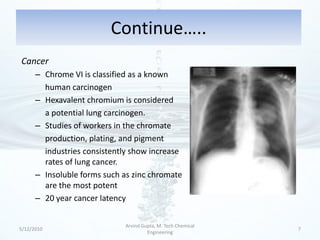
Cancer
      – Chrome VI is classified as a known
        human carcinogen
      – Hexavalent chromium is considered
        a potential lung carcinogen.
      – Studies of workers in the chromate
        production, plating, and pigment
        industries consistently show increase
        rates of lung cancer.
      – Insoluble forms such as zinc chromate
        are the most potent
      – 20 year cancer latency

                             Arvind Gupta, M. Tech Chemical
5/12/2010                                                     7
                                      Engineering
Chromium Removal Methods

• Chemical Precipitation
• Adsorption and Biosorption
• Reverse Osmosis
• Ion Exchange
• Electrodialysis
• Photo-catalysis etc.
                    Arvind Gupta, M. Tech Chemical
5/12/2010                                            8
                             Engineering
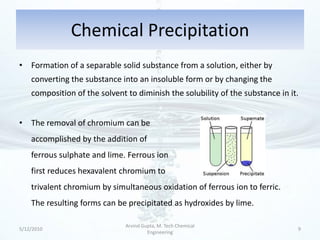
Chemical Precipitation
• Formation of a separable solid substance from a solution, either by
    converting the substance into an insoluble form or by changing the
    composition of the solvent to diminish the solubility of the substance in it.


• The removal of chromium can be
    accomplished by the addition of
    ferrous sulphate and lime. Ferrous ion
    first reduces hexavalent chromium to
    trivalent chromium by simultaneous oxidation of ferrous ion to ferric.
    The resulting forms can be precipitated as hydroxides by lime.

                               Arvind Gupta, M. Tech Chemical
5/12/2010                                                                       9
                                        Engineering
Continue…
Chromium is precipitated as hydroxide:


                           Cr3+ + (OH) - → Cr (OH) 3.


• The process requires addition of other chemicals, which finally leads to
    the generation of a high water content sludge, the disposal of which is
    cost intensive.
• its efficiency is affected by low pH and the presence of other salts (ions).
• and is ineffective in removal of the metal ions at low concentration.

                              Arvind Gupta, M. Tech Chemical
5/12/2010                                                                        10
                                       Engineering
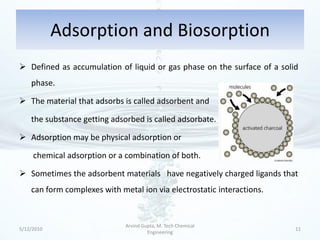
Adsorption and Biosorption
 Defined as accumulation of liquid or gas phase on the surface of a solid
    phase.

 The material that adsorbs is called adsorbent and

    the substance getting adsorbed is called adsorbate.

 Adsorption may be physical adsorption or

     chemical adsorption or a combination of both.

 Sometimes the adsorbent materials have negatively charged ligands that
    can form complexes with metal ion via electrostatic interactions.


                              Arvind Gupta, M. Tech Chemical
5/12/2010                                                                11
                                       Engineering
Continue…
• If we have to remove soluble material from the solution phase, but the
    material is neither volatile nor biodegradable, we often employ adsorption
    processes.

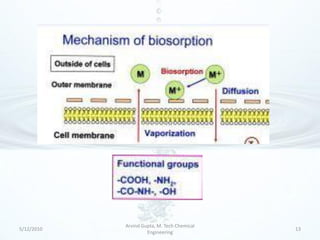
• Biosorption is a property of certain types of inactive, dead, microbial
    biomass to bind and concentrate heavy metals from even very dilute
    aqueous solutions.

•    It is particularly the cell wall structure of certain algae, fungi and bacteria
    which was found responsible for this phenomenon.


                                Arvind Gupta, M. Tech Chemical
5/12/2010                                                                          12
                                         Engineering
Arvind Gupta, M. Tech Chemical
5/12/2010                                    13
                     Engineering
Continue…

• The advantages of biosorption process are
    that these are cost effective, technically
    feasible and eco-friendly.

• This method suffers from low adsorption

     capacity and less intensity of biosorption.

                     Arvind Gupta, M. Tech Chemical
5/12/2010                                             14
                              Engineering
Reverse osmosis
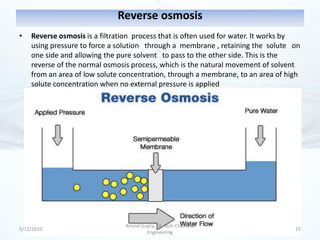
•   Reverse osmosis is a filtration process that is often used for water. It works by
    using pressure to force a solution through a membrane , retaining the solute on
    one side and allowing the pure solvent to pass to the other side. This is the
    reverse of the normal osmosis process, which is the natural movement of solvent
    from an area of low solute concentration, through a membrane, to an area of high
    solute concentration when no external pressure is applied


                                Arvind Gupta, M. Tech Chemical
5/12/2010                                                                          15
                                         Engineering
How Reverse Osmosis Works
• A semi permeable membrane, like the membrane of a cell wall or a
   bladder, is selective about what it allows to pass through, and what it
   prevents from passing. These membranes in general pass water very easily
   because of its small molecular size; but also prevent many other
   contaminants from passing by trapping them. Water will typically be
   present on both sides of the membrane, with each side having a different
   concentration of dissolved minerals. Since the water with the less
   concentrated solution seeks to dilute the more concentrated solution,
   water will pass through the membrane from the lower concentration side
   to the greater concentration side. Eventually, osmotic pressure will
   counter the diffusion process exactly, and an equilibrium will form.
                               Arvind Gupta, M. Tech Chemical
 5/12/2010                                                                    16
                                        Engineering
Continue…
 The semi permeable membrane can be fabricated by a variety of materials
    in a way to support a high trans membrane pressure. Generally
    membranes made up of polyamide are used for the treatment of
    chromium containing effluent.
 The reverse osmosis technique has been successfully used in the
    treatment of electroplating rinse waters, not only to meet effluent
    discharge standards, but also to recover concentrated metal salt solutions
    for reuse.
 Its main demerits are high priced equipment and/or expensive monitoring
    system, high energy requirement, sludge generation.


                              Arvind Gupta, M. Tech Chemical
5/12/2010                                                                    17
                                       Engineering
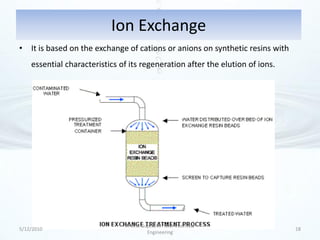
Ion Exchange
• It is based on the exchange of cations or anions on synthetic resins with
    essential characteristics of its regeneration after the elution of ions.


                               Arvind Gupta, M. Tech Chemical
5/12/2010                                                                      18
                                        Engineering
Continue…
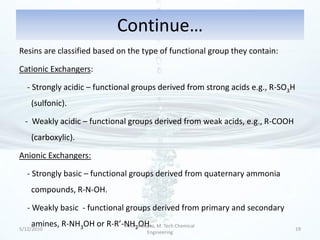
Resins are classified based on the type of functional group they contain:

Cationic Exchangers:

   - Strongly acidic – functional groups derived from strong acids e.g., R-SO3H
    (sulfonic).

  - Weakly acidic – functional groups derived from weak acids, e.g., R-COOH
    (carboxylic).

Anionic Exchangers:

   - Strongly basic – functional groups derived from quaternary ammonia
    compounds, R-N-OH.

   - Weakly basic - functional groups derived from primary and secondary
    amines, R-NH3OH or R-R’-NH2OH. M. Tech Chemical
5/12/2010
                            Arvind Gupta,
                                                                                  19
                                     Engineering
Continue….
• About 100% removal of Cr (VI) was achieved in the studies.

• Its advantages over other processes are the recovery of the metal’s value,

    high selectivity, less sludge volume produced and the ability to meet strict

    discharge specifications.

• Its limitations are and high operating costs compared to other treatment

    systems.

• There can be incomplete removal of the chromium from the salt solution


                                Arvind Gupta, M. Tech Chemical
5/12/2010                                                                      20
                                         Engineering
Electrodialysis (ED)
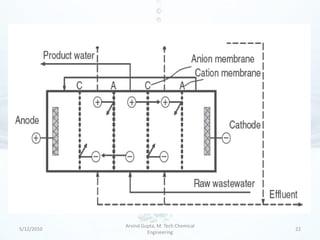
•    Electrodialysis is an electro membrane process in which ions are

    transported through ion permeable membranes from one solution to

    another under the influence of a potential gradient.

• The electrical charges on the ions allow them to be driven through the

    membranes fabricated from ion exchange polymers.

• Applying a voltage between two end electrodes generates the potential

    field required for this. Since the membranes used in electro dialysis have

    the ability to selectively transport ions having positive or negative charges.


                               Arvind Gupta, M. Tech Chemical
5/12/2010                                                                        21
                                        Engineering
Arvind Gupta, M. Tech Chemical
5/12/2010                                    22
                     Engineering
Continue…
 • The ion permeable membranes used in electro dialysis are essentially

     sheets of ion-exchange resins. They usually also contain other polymers

     to improve mechanical strength and flexibility.

 • The resin component of a cation-exchange membrane would have

     negatively charged groups (e.g., -SO3-) chemically attached to the

     polymer chains (e.g. styrene/divinylbenzene copolymers).

 • polymer chains forms anion permeable membranes, which are selective

     to transport of negative ions, because the fixed -NR3+ groups repel

     positive ions.

                              Arvind Gupta, M. Tech Chemical
5/12/2010                                                                      23
                                       Engineering
Continue….
• the recovery percentage of Chromium is quite good, the chromium
    concentration is not high enough to be recycled to the tanning process.

• Other problems with electrodialysis are high capital and operating costs
    involved and the requirement of highly trained human resources.

• The fouling and scaling of membranes is another drawback which can be
    controlled to an extent by employing flushing step.


                              Arvind Gupta, M. Tech Chemical
5/12/2010                                                                     24
                                       Engineering
Photo-catalysis
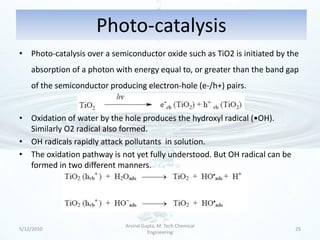
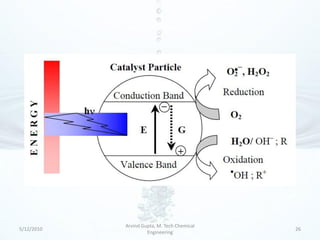
• Photo-catalysis over a semiconductor oxide such as TiO2 is initiated by the
    absorption of a photon with energy equal to, or greater than the band gap
    of the semiconductor producing electron-hole (e-/h+) pairs.


• Oxidation of water by the hole produces the hydroxyl radical (•OH).
  Similarly O2 radical also formed.
• OH radicals rapidly attack pollutants in solution.
• The oxidation pathway is not yet fully understood. But OH radical can be
  formed in two different manners.


                             Arvind Gupta, M. Tech Chemical
5/12/2010                                                                    25
                                      Engineering
Arvind Gupta, M. Tech Chemical
5/12/2010                                    26
                     Engineering
Continue…
• Cr (VI) will be reduced to Cr (III).

• And precipitated out.

• Photo-catalysis has large capability for the removal of trace metals.

• The drawback of this method is that of being slow compared with
    traditional methods but it has the advantage not leaving toxic by product
    or sludge to be disposed.


                                Arvind Gupta, M. Tech Chemical
5/12/2010                                                                       27
                                         Engineering
Conclusion
•   Each methods has its own merits and limitations. The versatility, simplicity, cost

    effectiveness and technical feasibility are a few factors that must be considered

    while selecting a particular method.

•   High cost and technical complications are the problem associated with Reverse

    osmosis and electrodialysis.

•   Ion exchange is also comparatively costly whereas chemical precipitation leads

    to sludge generation and involve high capital costs.

•   Photo-catalysis process is still in the development stage.

•   Adsorption and biosorption are found to be technically uncomplicated as well as

    economical but the desorption studies on the adsorbents need to be carried out

    before going for large scale Arvind Gupta, M. Tech Chemical
                                 applications.
5/12/2010                                                                           28
                                             Engineering
References
•   F. Gode and E. Pehlivan, “Removal of chromium from aqueous solutions using
    Lewatit S 100: The effect of pH, time, metal concentration and temperature”,
    Journal of Hazardous Materials, vol. 2, no.136, pp.330-337, 2006
•   A. Cassano, E. Drioli1v, R. Molinaril, and C. Bertolutti, ” Quality improvement of
    recycled chromium in the tanning operation by membrane processes”,
    Desalination, vol.108, pp.193-203, 1996.
•   B.H. Hintermeyer, N.A. Lacour, A.Perezpadilla, and E.L.Tavani,, 2008,”Separation of
    the chromium(III) present in a tanning waste water by means of precipitation,
    reverse osmosis and adsorption” Latin American Applied Research, vol.38, pp.63-
    71, 2008
•   G.R.R Bernnardo, R.M Jose Rene and A.D.T Catalina,” Chromium (III) uptake by
    agro- waste Biosorbents:Chemical characterisation, sorption-desorption studies
    and mechanism", Journal of Hhazardous Materials, vol. 170, no.2-3, pp.:845-854,
    2009
•   Radwan A. Al-Rasheed, water treatment by heterogeneous photo-catalysis as
    overview Presented at 4th SWCC Acquired Experience Symposium held in Jeddah,
    2005.
                                 Arvind Gupta, M. Tech Chemical
5/12/2010                                                                             29
                                          Engineering
Thank You…


              Arvind Gupta, M. Tech Chemical
5/12/2010                                      30
                       Engineering

Methods for removal of chromium

  • 1.
    Methods for Removalof Chromium from Wastewater Presentation by Arvind Gupta M.Tech (CH), Third Sem. Roll No. 09201101 NIT Jalandhar
  • 2.
    Background Information • Chromiumis a metal that exists in several oxidation or valence states, ranging from chromium (-II) to chromium (+VI). • Chromium compounds are very stable in the trivalent state and occur naturally in this state in ores such as ferrochromite, or chromite ore. • Chrome III is an essential nutrient for maintaining blood glucose levels • The hexavalent, Cr(VI) or chromate, is the second most stable state. It rarely occurs naturally. Arvind Gupta, M. Tech Chemical 5/12/2010 2 Engineering
  • 3.
    What is HexavalentChromium? • A toxic form of chromium metal, generally man- made. • Used in many industrial applications primarily for its anti-corrosive properties. • Can be generated during welding on stainless steel or metal structures coated with chromate paint. • Used in electroplating (chrome plating) Arvind Gupta, M. Tech Chemical 5/12/2010 3 Engineering
  • 4.
    Products that containhexavalent chromium Product Types of Hexavalent Chromium Chemicals lead chromate (chrome yellow, chrome green, pigments in paints, molybdenum orange) zinc chromate barium inks, and plastics chromate calcium chromate potassium dichromate sodium chromate anti-corrosion coatings chromic trioxide (chromic acid) zinc chromate (chrome plating, spray barium chromate calcium chromate sodium coatings) chromate strontium chromate stainless steel and hexavalent chromium (when cast, welded, or torch other high chromium cut) Alloys ammonium dichromate potassium chromate textile dyes potassium dichromate sodium chromate wood preservation chromium trioxide leather tanning 5/12/2010 ammoniumM. Tech Chemical Arvind Gupta, dichromate Engineering 4
  • 5.
    Sources of Chromium •Aircraft Painting • Pesticide Application (Wood Preservative) • Leather tanning • Electroplating • Textile manufacturing • dyeing, cement industry • metal finishing • photography industry etc Arvind Gupta, M. Tech Chemical 5/12/2010 5 Engineering
  • 6.
    Health Effects • IngestionHazards – Erosive to stomach, Hemorrhaging and death are likely • Eyes – Direct eye contact with chromic acid or chromate dusts can cause permanent eye damage. • Respiratory Tract – Hexavalent chromium can irritate the nose, throat, and lungs. – Repeated or prolonged exposure can damage the mucous membranes of the nasal passages and result in ulcers. • Skin – Prolonged skin contact can result in dermatitis and skin ulcers. – Some workers develop an allergic sensitization to chromium. In sensitized workers, contact with even small amounts can cause a serious skin rash. Arvind Gupta, M. Tech Chemical 5/12/2010 6 Engineering
  • 7.
    Continue….. Cancer – Chrome VI is classified as a known human carcinogen – Hexavalent chromium is considered a potential lung carcinogen. – Studies of workers in the chromate production, plating, and pigment industries consistently show increase rates of lung cancer. – Insoluble forms such as zinc chromate are the most potent – 20 year cancer latency Arvind Gupta, M. Tech Chemical 5/12/2010 7 Engineering
  • 8.
    Chromium Removal Methods •Chemical Precipitation • Adsorption and Biosorption • Reverse Osmosis • Ion Exchange • Electrodialysis • Photo-catalysis etc. Arvind Gupta, M. Tech Chemical 5/12/2010 8 Engineering
  • 9.
    Chemical Precipitation • Formationof a separable solid substance from a solution, either by converting the substance into an insoluble form or by changing the composition of the solvent to diminish the solubility of the substance in it. • The removal of chromium can be accomplished by the addition of ferrous sulphate and lime. Ferrous ion first reduces hexavalent chromium to trivalent chromium by simultaneous oxidation of ferrous ion to ferric. The resulting forms can be precipitated as hydroxides by lime. Arvind Gupta, M. Tech Chemical 5/12/2010 9 Engineering
  • 10.
    Continue… Chromium is precipitatedas hydroxide: Cr3+ + (OH) - → Cr (OH) 3. • The process requires addition of other chemicals, which finally leads to the generation of a high water content sludge, the disposal of which is cost intensive. • its efficiency is affected by low pH and the presence of other salts (ions). • and is ineffective in removal of the metal ions at low concentration. Arvind Gupta, M. Tech Chemical 5/12/2010 10 Engineering
  • 11.
    Adsorption and Biosorption Defined as accumulation of liquid or gas phase on the surface of a solid phase.  The material that adsorbs is called adsorbent and the substance getting adsorbed is called adsorbate.  Adsorption may be physical adsorption or chemical adsorption or a combination of both.  Sometimes the adsorbent materials have negatively charged ligands that can form complexes with metal ion via electrostatic interactions. Arvind Gupta, M. Tech Chemical 5/12/2010 11 Engineering
  • 12.
    Continue… • If wehave to remove soluble material from the solution phase, but the material is neither volatile nor biodegradable, we often employ adsorption processes. • Biosorption is a property of certain types of inactive, dead, microbial biomass to bind and concentrate heavy metals from even very dilute aqueous solutions. • It is particularly the cell wall structure of certain algae, fungi and bacteria which was found responsible for this phenomenon. Arvind Gupta, M. Tech Chemical 5/12/2010 12 Engineering
  • 13.
    Arvind Gupta, M.Tech Chemical 5/12/2010 13 Engineering
  • 14.
    Continue… • The advantagesof biosorption process are that these are cost effective, technically feasible and eco-friendly. • This method suffers from low adsorption capacity and less intensity of biosorption. Arvind Gupta, M. Tech Chemical 5/12/2010 14 Engineering
  • 15.
    Reverse osmosis • Reverse osmosis is a filtration process that is often used for water. It works by using pressure to force a solution through a membrane , retaining the solute on one side and allowing the pure solvent to pass to the other side. This is the reverse of the normal osmosis process, which is the natural movement of solvent from an area of low solute concentration, through a membrane, to an area of high solute concentration when no external pressure is applied Arvind Gupta, M. Tech Chemical 5/12/2010 15 Engineering
  • 16.
    How Reverse OsmosisWorks • A semi permeable membrane, like the membrane of a cell wall or a bladder, is selective about what it allows to pass through, and what it prevents from passing. These membranes in general pass water very easily because of its small molecular size; but also prevent many other contaminants from passing by trapping them. Water will typically be present on both sides of the membrane, with each side having a different concentration of dissolved minerals. Since the water with the less concentrated solution seeks to dilute the more concentrated solution, water will pass through the membrane from the lower concentration side to the greater concentration side. Eventually, osmotic pressure will counter the diffusion process exactly, and an equilibrium will form. Arvind Gupta, M. Tech Chemical 5/12/2010 16 Engineering
  • 17.
    Continue…  The semipermeable membrane can be fabricated by a variety of materials in a way to support a high trans membrane pressure. Generally membranes made up of polyamide are used for the treatment of chromium containing effluent.  The reverse osmosis technique has been successfully used in the treatment of electroplating rinse waters, not only to meet effluent discharge standards, but also to recover concentrated metal salt solutions for reuse.  Its main demerits are high priced equipment and/or expensive monitoring system, high energy requirement, sludge generation. Arvind Gupta, M. Tech Chemical 5/12/2010 17 Engineering
  • 18.
    Ion Exchange • Itis based on the exchange of cations or anions on synthetic resins with essential characteristics of its regeneration after the elution of ions. Arvind Gupta, M. Tech Chemical 5/12/2010 18 Engineering
  • 19.
    Continue… Resins are classifiedbased on the type of functional group they contain: Cationic Exchangers: - Strongly acidic – functional groups derived from strong acids e.g., R-SO3H (sulfonic). - Weakly acidic – functional groups derived from weak acids, e.g., R-COOH (carboxylic). Anionic Exchangers: - Strongly basic – functional groups derived from quaternary ammonia compounds, R-N-OH. - Weakly basic - functional groups derived from primary and secondary amines, R-NH3OH or R-R’-NH2OH. M. Tech Chemical 5/12/2010 Arvind Gupta, 19 Engineering
  • 20.
    Continue…. • About 100%removal of Cr (VI) was achieved in the studies. • Its advantages over other processes are the recovery of the metal’s value, high selectivity, less sludge volume produced and the ability to meet strict discharge specifications. • Its limitations are and high operating costs compared to other treatment systems. • There can be incomplete removal of the chromium from the salt solution Arvind Gupta, M. Tech Chemical 5/12/2010 20 Engineering
  • 21.
    Electrodialysis (ED) • Electrodialysis is an electro membrane process in which ions are transported through ion permeable membranes from one solution to another under the influence of a potential gradient. • The electrical charges on the ions allow them to be driven through the membranes fabricated from ion exchange polymers. • Applying a voltage between two end electrodes generates the potential field required for this. Since the membranes used in electro dialysis have the ability to selectively transport ions having positive or negative charges. Arvind Gupta, M. Tech Chemical 5/12/2010 21 Engineering
  • 22.
    Arvind Gupta, M.Tech Chemical 5/12/2010 22 Engineering
  • 23.
    Continue… • Theion permeable membranes used in electro dialysis are essentially sheets of ion-exchange resins. They usually also contain other polymers to improve mechanical strength and flexibility. • The resin component of a cation-exchange membrane would have negatively charged groups (e.g., -SO3-) chemically attached to the polymer chains (e.g. styrene/divinylbenzene copolymers). • polymer chains forms anion permeable membranes, which are selective to transport of negative ions, because the fixed -NR3+ groups repel positive ions. Arvind Gupta, M. Tech Chemical 5/12/2010 23 Engineering
  • 24.
    Continue…. • the recoverypercentage of Chromium is quite good, the chromium concentration is not high enough to be recycled to the tanning process. • Other problems with electrodialysis are high capital and operating costs involved and the requirement of highly trained human resources. • The fouling and scaling of membranes is another drawback which can be controlled to an extent by employing flushing step. Arvind Gupta, M. Tech Chemical 5/12/2010 24 Engineering
  • 25.
    Photo-catalysis • Photo-catalysis overa semiconductor oxide such as TiO2 is initiated by the absorption of a photon with energy equal to, or greater than the band gap of the semiconductor producing electron-hole (e-/h+) pairs. • Oxidation of water by the hole produces the hydroxyl radical (•OH). Similarly O2 radical also formed. • OH radicals rapidly attack pollutants in solution. • The oxidation pathway is not yet fully understood. But OH radical can be formed in two different manners. Arvind Gupta, M. Tech Chemical 5/12/2010 25 Engineering
  • 26.
    Arvind Gupta, M.Tech Chemical 5/12/2010 26 Engineering
  • 27.
    Continue… • Cr (VI)will be reduced to Cr (III). • And precipitated out. • Photo-catalysis has large capability for the removal of trace metals. • The drawback of this method is that of being slow compared with traditional methods but it has the advantage not leaving toxic by product or sludge to be disposed. Arvind Gupta, M. Tech Chemical 5/12/2010 27 Engineering
  • 28.
    Conclusion • Each methods has its own merits and limitations. The versatility, simplicity, cost effectiveness and technical feasibility are a few factors that must be considered while selecting a particular method. • High cost and technical complications are the problem associated with Reverse osmosis and electrodialysis. • Ion exchange is also comparatively costly whereas chemical precipitation leads to sludge generation and involve high capital costs. • Photo-catalysis process is still in the development stage. • Adsorption and biosorption are found to be technically uncomplicated as well as economical but the desorption studies on the adsorbents need to be carried out before going for large scale Arvind Gupta, M. Tech Chemical applications. 5/12/2010 28 Engineering
  • 29.
    References • F. Gode and E. Pehlivan, “Removal of chromium from aqueous solutions using Lewatit S 100: The effect of pH, time, metal concentration and temperature”, Journal of Hazardous Materials, vol. 2, no.136, pp.330-337, 2006 • A. Cassano, E. Drioli1v, R. Molinaril, and C. Bertolutti, ” Quality improvement of recycled chromium in the tanning operation by membrane processes”, Desalination, vol.108, pp.193-203, 1996. • B.H. Hintermeyer, N.A. Lacour, A.Perezpadilla, and E.L.Tavani,, 2008,”Separation of the chromium(III) present in a tanning waste water by means of precipitation, reverse osmosis and adsorption” Latin American Applied Research, vol.38, pp.63- 71, 2008 • G.R.R Bernnardo, R.M Jose Rene and A.D.T Catalina,” Chromium (III) uptake by agro- waste Biosorbents:Chemical characterisation, sorption-desorption studies and mechanism", Journal of Hhazardous Materials, vol. 170, no.2-3, pp.:845-854, 2009 • Radwan A. Al-Rasheed, water treatment by heterogeneous photo-catalysis as overview Presented at 4th SWCC Acquired Experience Symposium held in Jeddah, 2005. Arvind Gupta, M. Tech Chemical 5/12/2010 29 Engineering
  • 30.
    Thank You… Arvind Gupta, M. Tech Chemical 5/12/2010 30 Engineering