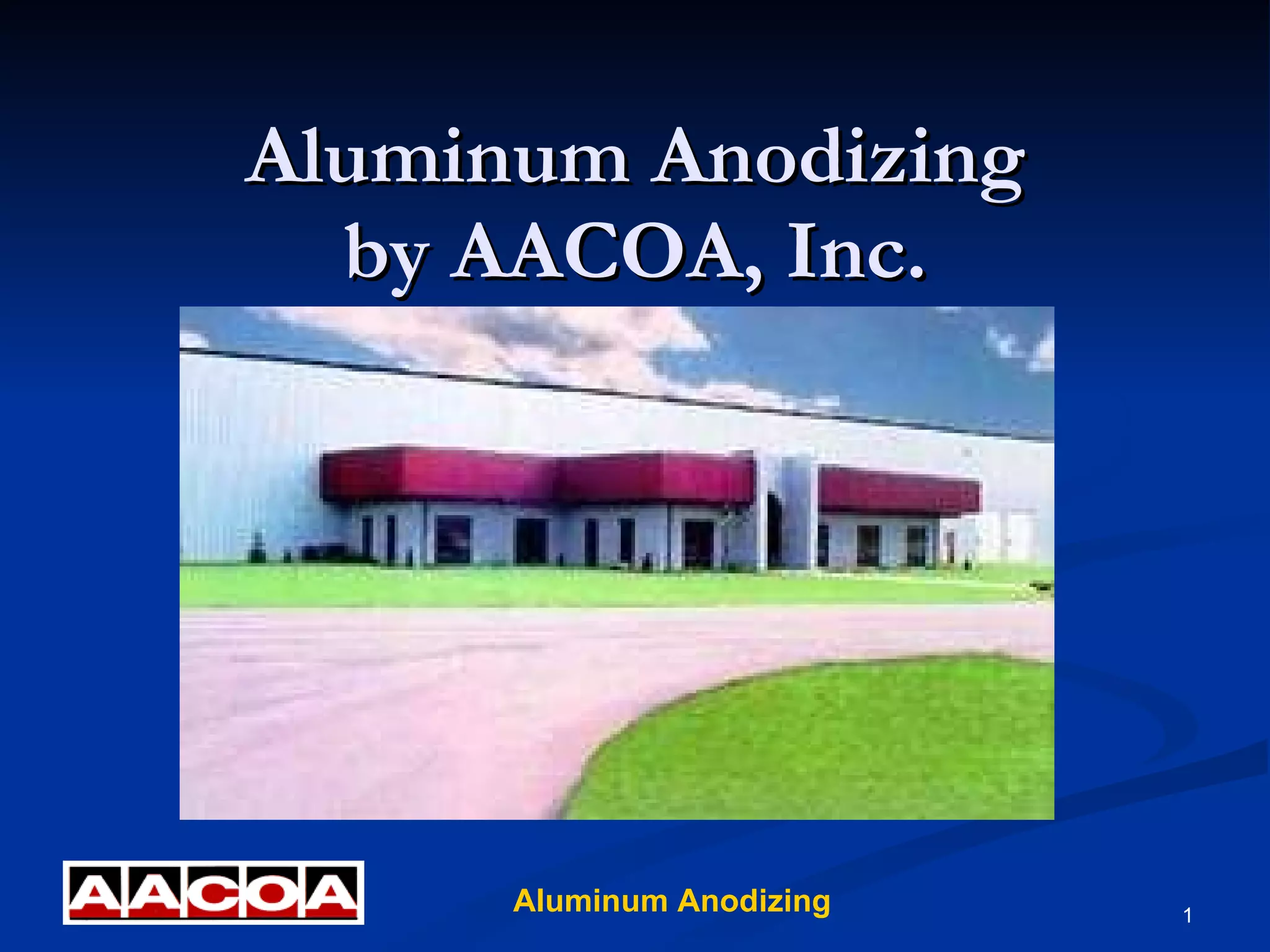
Aluminum Anodizing by AACOA, Inc.
Aluminum is “rusted” artificially and uniformly Electricity and Chemicals required electrical current passes through aluminum immersed in an acid solution What is Anodizing? It is an electrochemical oxidation of the aluminum surface to produce a stable film of aluminum oxide (Al 2 O 3 ).
Abrasion Resistance only diamond is harder Corrosion Resistance withstands salt spray and CASS testing Thermal Resistance aluminum substrate will melt before the coating Electrical Resistance 800 V required to pass a current through 1 mil of coating Porous allows for the coloring and sealing of the coating Anodic Coating Properties
Common Process Steps 1. Racking 2. Cleaning 3. Etching 4. Desmutting 5. Anodizing 6. Coloring 7. Sealing 8. Unracking 9. Packing 10. Lab Testing
Racking Provides a secure connection for transportation of the parts through the various chemical solutions Provides a secure connection for the flow of electricity through each individual part Allows for uniformity and consistency of current flow from part to part
Clean, Etch, and Desmut Cleaning - heated, nonetching alkaline cleaner (10 min) removal of most shop residues and fabrication oils no removal of adhesives, greases, or buffing compounds Etching - heated sodium hydroxide (0-20 min) roughens the surface to provide a matte finish limited success at obscuring scratches, die lines, and bearing marks removal of aluminum 0-2.5 mil (0-65 microns) per side Desmutting - ambient acid bath (1-5 min) removes etch smut resulting from alloying constituents
Anodizing Immersion in chilled 10% (v/v) sulfuric acid bath DC current applied at densities of 8-20 amps/ft 2 Time varies based on coating thickness (10-60 minutes) Barrier layer formed first to a 0.0005 mil thickness Coating builds to a 1.0 mil (25.4   m) max. thickness Pores develop as the acid solution dissolves the coating 250 - 500 billion pores per square inch Part dimensions increase as the coating is 40% penetration and 60% build-up from the pre-anodized surface
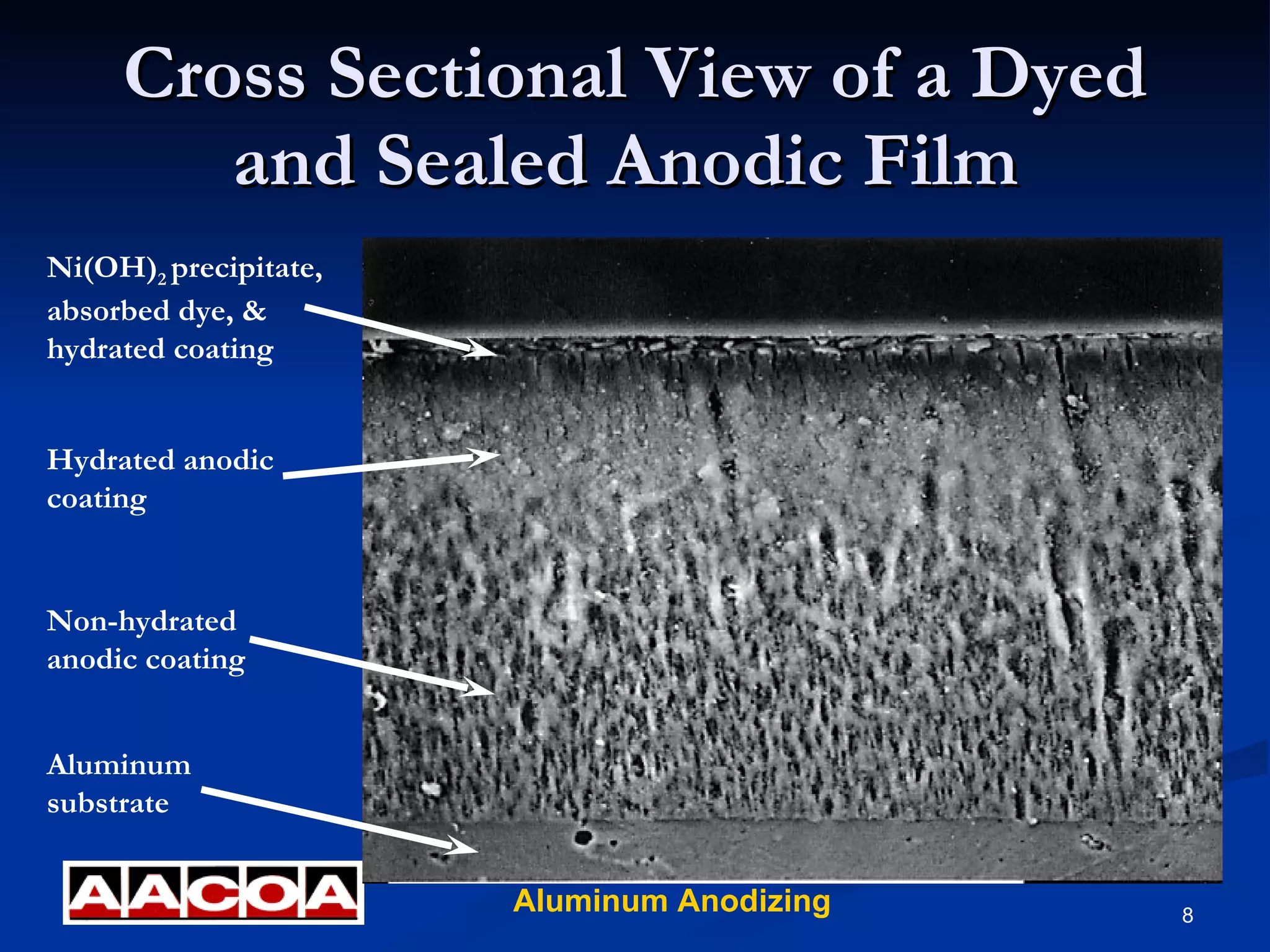
Cross Sectional View of a Dyed and Sealed Anodic Film  Aluminum substrate Non-hydrated anodic coating Hydrated anodic coating Ni(OH) 2  precipitate, absorbed dye, & hydrated coating
Clear Hardcoat Absorptive dye Uptake of organic or inorganic molecules Electrolytic Two-step Tin Deposition Cobalt Deposition Other Integral Color Overdye Types of Anodic Finish
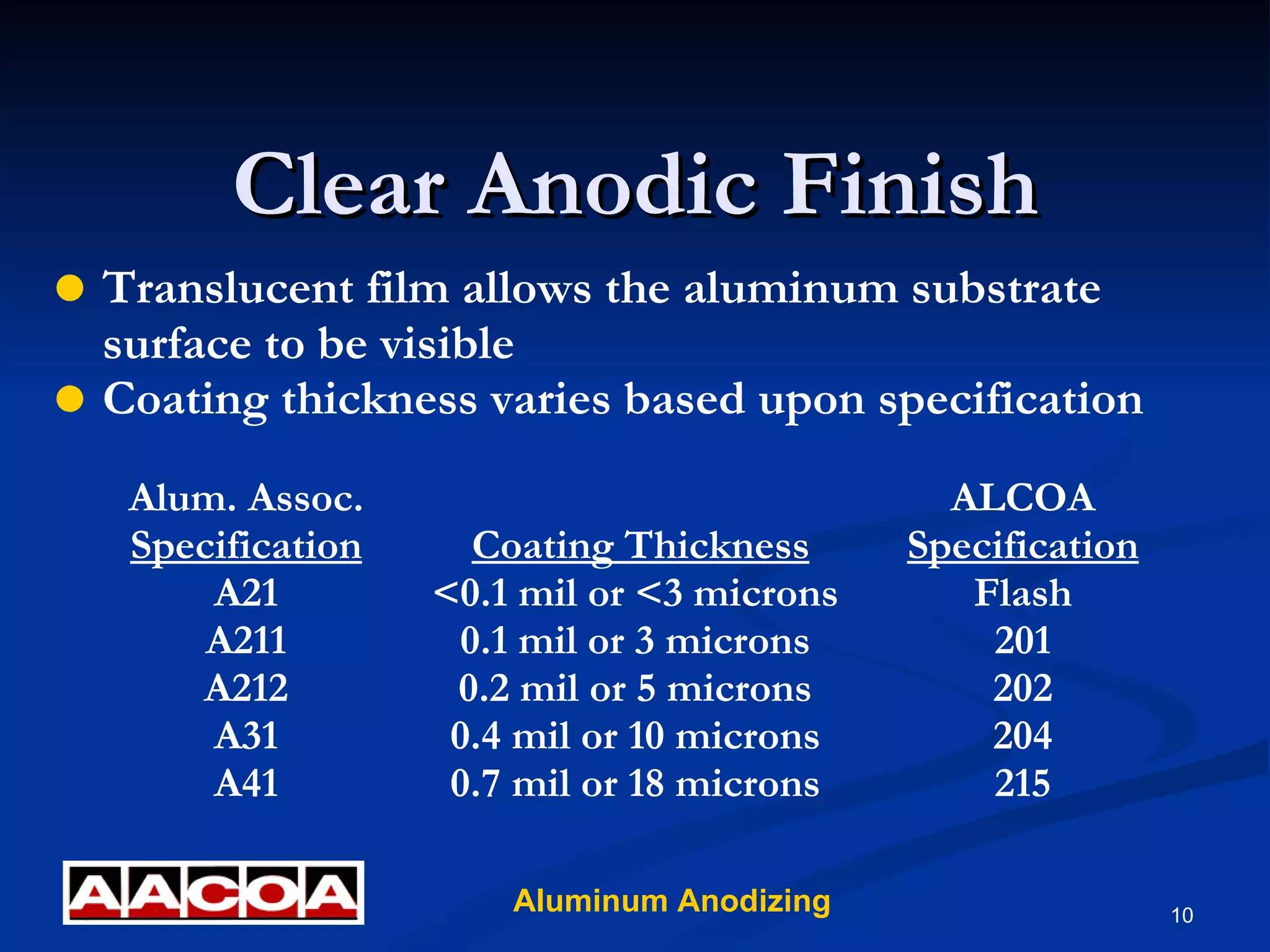
Clear Anodic Finish Translucent film allows the aluminum substrate surface to be visible Coating thickness varies based upon specification Alum. Assoc. ALCOA Specification   Coating Thickness Specification A21 <0.1 mil or <3 microns Flash A211 0.1 mil or 3 microns 201 A212 0.2 mil or 5 microns 202 A31 0.4 mil or 10 microns 204 A41 0.7 mil or 18 microns 215
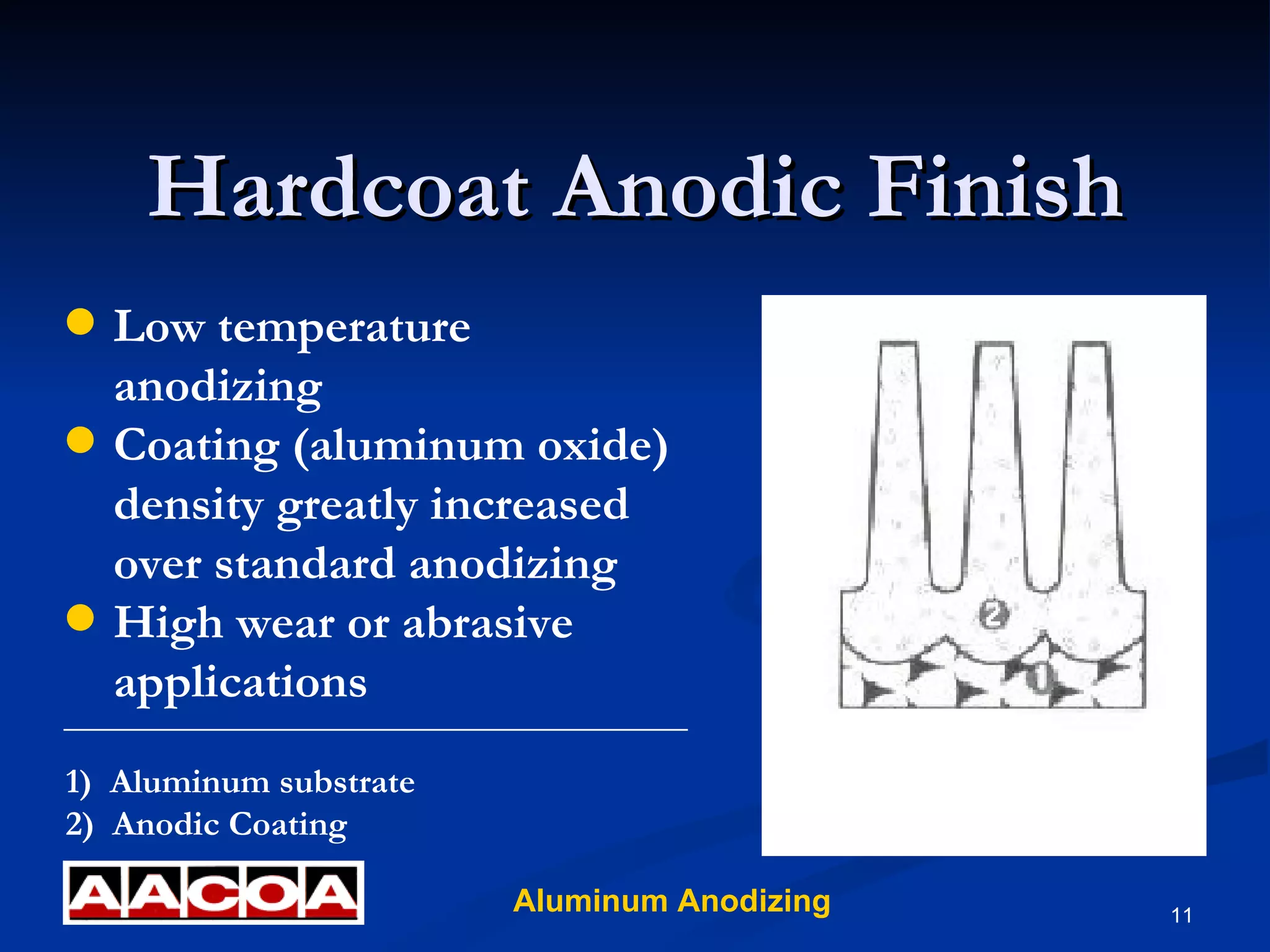
Hardcoat Anodic Finish Low temperature anodizing Coating (aluminum oxide) density greatly increased over standard anodizing High wear or abrasive applications 1)  Aluminum substrate 2)  Anodic Coating
Dyed Anodic Finish Absorption of either organic or inorganic molecules into the pores of the coating (2-30 min) Limitless range of colors Typically less fade resistance than other colored anodic finishes 1)  Aluminum substrate 2)  Anodic Coating 3)  Organic/Inorganic Dyestuffs
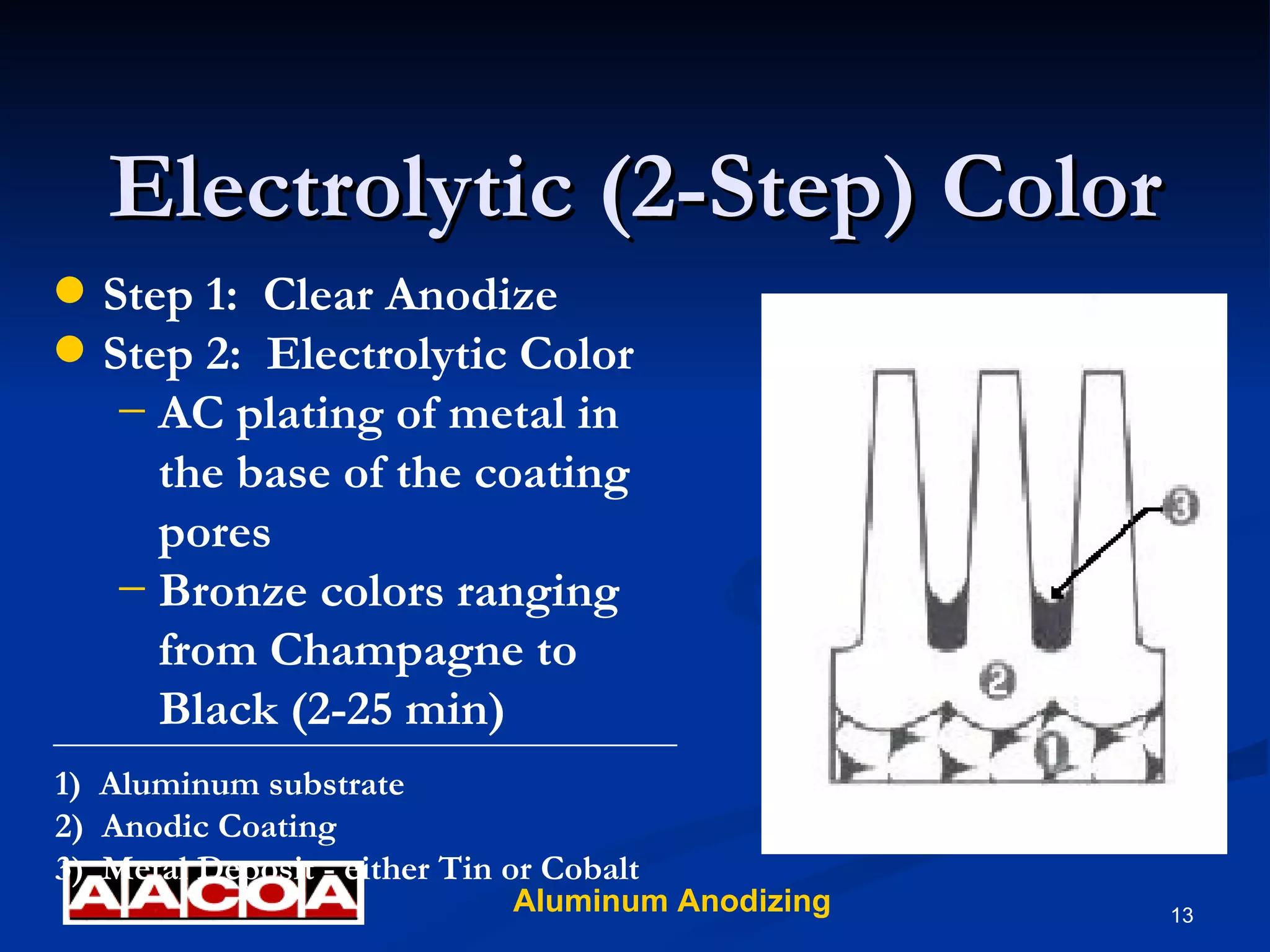
Electrolytic (2-Step) Color Step 1:  Clear Anodize Step 2:  Electrolytic Color AC plating of metal in the base of the coating pores Bronze colors ranging from Champagne to Black (2-25 min) 1)  Aluminum substrate 2)  Anodic Coating 3)  Metal Deposit - either Tin or Cobalt
Sealing Unsealed - Excellent base for paint and adhesives Hydrothermal Seal - 200-205 F (15-60 min) Temperature drives coating hydration causing coating expansion to squeeze shut the pores at the surface Mid-Temperature Seal with Metal Salts - 180 F (15 min) Deposition of metal salts in pores and some sealing by hydration Room Temperature Seal - 90 F (15 min) Creation of a “super molecule” at the surface consisting of coating, metal salts, and fluoride Prone to causing green tints or a fuzzy surface
Unracking and Packing Unracking - First Inspection Point Appearance Coating Thickness Seal Quality Packing - Second Inspection Point and Packaging Type Size Materials
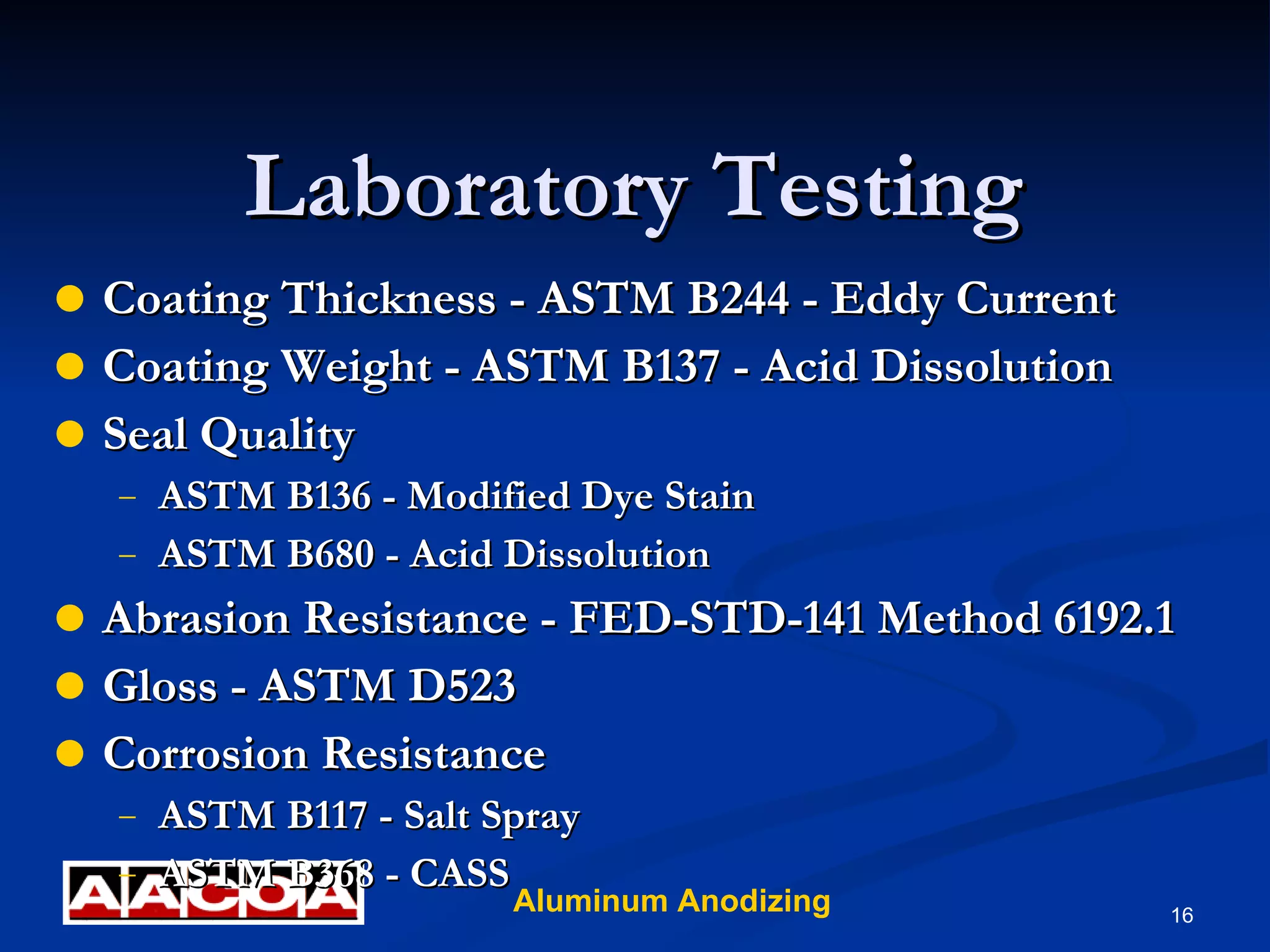
Laboratory Testing Coating Thickness - ASTM B244 - Eddy Current Coating Weight - ASTM B137 - Acid Dissolution Seal Quality ASTM B136 - Modified Dye Stain ASTM B680 - Acid Dissolution Abrasion Resistance - FED-STD-141 Method 6192.1 Gloss - ASTM D523 Corrosion Resistance ASTM B117 - Salt Spray ASTM B368 - CASS
Advantages of Anodizing Highly durable Inexpensive to produce and maintain Won’t chip, flake, peel or chalk Maintains metallic appearance of aluminum Environmentally friendly  No VOC’s No heavy metals Byproducts aid municipal wastewater treatment facilities to separate solids and neutralize pH
Maintenance Anodizing:  The Renewable Finish Accumulated dirt and stains can be removed with a mild detergent applied with an abrasive cleaning technique AAMA 609.1 Voluntary Guide for Cleaning and Maintenance of Architectural Anodized Aluminum
Metallurgical Factors Alloy and temper selections Mixed alloys - various products Extrusion, sheet, forming, casting Extrusion defects Hot spots, corrosion, die lines, bearing marks
Specifying Anodizing Aluminum Association Designation System for Aluminum Finishes Example:  AAM12C22A31 where AA = Aluminum Association where M = Mechanical finish where C = Chemical pretreatment where A = Anodic coating process
AACOA, Inc. Anodizing Facility 2551 C.R. 10 W. Elkhart, IN 46514 Phone: 574.262.4685 Fax: 574.262.3439 www.aacoa.com Extrusion Facility 2005 Mayflower Road Niles, MI 49120 Phone: 269.697.6063 Fax: 269.697.6061

Aluminum Anodizing

  • 1.
  • 2.
    Aluminum is “rusted”artificially and uniformly Electricity and Chemicals required electrical current passes through aluminum immersed in an acid solution What is Anodizing? It is an electrochemical oxidation of the aluminum surface to produce a stable film of aluminum oxide (Al 2 O 3 ).
  • 3.
    Abrasion Resistance onlydiamond is harder Corrosion Resistance withstands salt spray and CASS testing Thermal Resistance aluminum substrate will melt before the coating Electrical Resistance 800 V required to pass a current through 1 mil of coating Porous allows for the coloring and sealing of the coating Anodic Coating Properties
  • 4.
    Common Process Steps1. Racking 2. Cleaning 3. Etching 4. Desmutting 5. Anodizing 6. Coloring 7. Sealing 8. Unracking 9. Packing 10. Lab Testing
  • 5.
    Racking Provides asecure connection for transportation of the parts through the various chemical solutions Provides a secure connection for the flow of electricity through each individual part Allows for uniformity and consistency of current flow from part to part
  • 6.
    Clean, Etch, andDesmut Cleaning - heated, nonetching alkaline cleaner (10 min) removal of most shop residues and fabrication oils no removal of adhesives, greases, or buffing compounds Etching - heated sodium hydroxide (0-20 min) roughens the surface to provide a matte finish limited success at obscuring scratches, die lines, and bearing marks removal of aluminum 0-2.5 mil (0-65 microns) per side Desmutting - ambient acid bath (1-5 min) removes etch smut resulting from alloying constituents
  • 7.
    Anodizing Immersion inchilled 10% (v/v) sulfuric acid bath DC current applied at densities of 8-20 amps/ft 2 Time varies based on coating thickness (10-60 minutes) Barrier layer formed first to a 0.0005 mil thickness Coating builds to a 1.0 mil (25.4  m) max. thickness Pores develop as the acid solution dissolves the coating 250 - 500 billion pores per square inch Part dimensions increase as the coating is 40% penetration and 60% build-up from the pre-anodized surface
  • 8.
    Cross Sectional Viewof a Dyed and Sealed Anodic Film Aluminum substrate Non-hydrated anodic coating Hydrated anodic coating Ni(OH) 2 precipitate, absorbed dye, & hydrated coating
  • 9.
    Clear Hardcoat Absorptivedye Uptake of organic or inorganic molecules Electrolytic Two-step Tin Deposition Cobalt Deposition Other Integral Color Overdye Types of Anodic Finish
  • 10.
    Clear Anodic FinishTranslucent film allows the aluminum substrate surface to be visible Coating thickness varies based upon specification Alum. Assoc. ALCOA Specification Coating Thickness Specification A21 <0.1 mil or <3 microns Flash A211 0.1 mil or 3 microns 201 A212 0.2 mil or 5 microns 202 A31 0.4 mil or 10 microns 204 A41 0.7 mil or 18 microns 215
  • 11.
    Hardcoat Anodic FinishLow temperature anodizing Coating (aluminum oxide) density greatly increased over standard anodizing High wear or abrasive applications 1) Aluminum substrate 2) Anodic Coating
  • 12.
    Dyed Anodic FinishAbsorption of either organic or inorganic molecules into the pores of the coating (2-30 min) Limitless range of colors Typically less fade resistance than other colored anodic finishes 1) Aluminum substrate 2) Anodic Coating 3) Organic/Inorganic Dyestuffs
  • 13.
    Electrolytic (2-Step) ColorStep 1: Clear Anodize Step 2: Electrolytic Color AC plating of metal in the base of the coating pores Bronze colors ranging from Champagne to Black (2-25 min) 1) Aluminum substrate 2) Anodic Coating 3) Metal Deposit - either Tin or Cobalt
  • 14.
    Sealing Unsealed -Excellent base for paint and adhesives Hydrothermal Seal - 200-205 F (15-60 min) Temperature drives coating hydration causing coating expansion to squeeze shut the pores at the surface Mid-Temperature Seal with Metal Salts - 180 F (15 min) Deposition of metal salts in pores and some sealing by hydration Room Temperature Seal - 90 F (15 min) Creation of a “super molecule” at the surface consisting of coating, metal salts, and fluoride Prone to causing green tints or a fuzzy surface
  • 15.
    Unracking and PackingUnracking - First Inspection Point Appearance Coating Thickness Seal Quality Packing - Second Inspection Point and Packaging Type Size Materials
  • 16.
    Laboratory Testing CoatingThickness - ASTM B244 - Eddy Current Coating Weight - ASTM B137 - Acid Dissolution Seal Quality ASTM B136 - Modified Dye Stain ASTM B680 - Acid Dissolution Abrasion Resistance - FED-STD-141 Method 6192.1 Gloss - ASTM D523 Corrosion Resistance ASTM B117 - Salt Spray ASTM B368 - CASS
  • 17.
    Advantages of AnodizingHighly durable Inexpensive to produce and maintain Won’t chip, flake, peel or chalk Maintains metallic appearance of aluminum Environmentally friendly No VOC’s No heavy metals Byproducts aid municipal wastewater treatment facilities to separate solids and neutralize pH
  • 18.
    Maintenance Anodizing: The Renewable Finish Accumulated dirt and stains can be removed with a mild detergent applied with an abrasive cleaning technique AAMA 609.1 Voluntary Guide for Cleaning and Maintenance of Architectural Anodized Aluminum
  • 19.
    Metallurgical Factors Alloyand temper selections Mixed alloys - various products Extrusion, sheet, forming, casting Extrusion defects Hot spots, corrosion, die lines, bearing marks
  • 20.
    Specifying Anodizing AluminumAssociation Designation System for Aluminum Finishes Example: AAM12C22A31 where AA = Aluminum Association where M = Mechanical finish where C = Chemical pretreatment where A = Anodic coating process
  • 21.
    AACOA, Inc. AnodizingFacility 2551 C.R. 10 W. Elkhart, IN 46514 Phone: 574.262.4685 Fax: 574.262.3439 www.aacoa.com Extrusion Facility 2005 Mayflower Road Niles, MI 49120 Phone: 269.697.6063 Fax: 269.697.6061