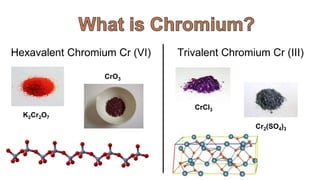
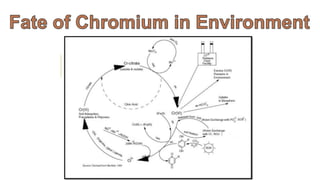
Hexavalent Chromium Cr (VI) Trivalent Chromium Cr (III)
K2Cr2O7
CrO3
CrCl3
Cr2(SO4)3
1. Cr (VI) detected in 3342/5477
wells tested
2. Los Angeles [Cr6+] > 10 μg/L
3. 2104 CA to limit Cr6+ to 10 ppb
4. Hinkley, CA had Cr6+ levels
of 31.8 ppb
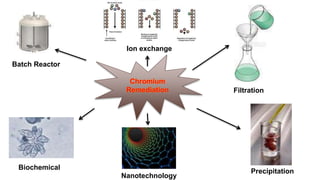
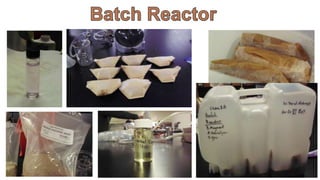
Batch Reactor
Biochemical
Nanotechnology
Precipitation
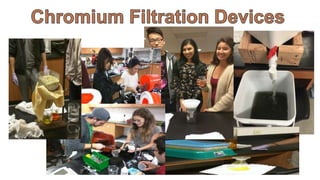
Filtration
Ion exchange
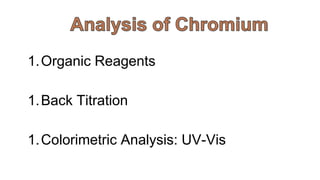
1.Organic Reagents
1.Back Titration
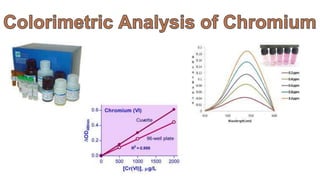
1.Colorimetric Analysis: UV-Vis
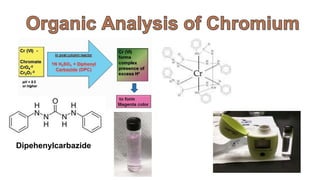
Dipehenylcarbazide
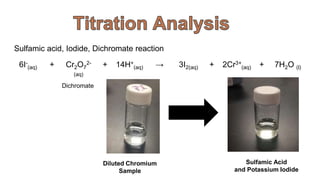
Sulfamic acid, Iodide, Dichromate reaction
6I-
(aq) + Cr2O7
2-
(aq)
+ 14H+
(aq) → 3I2(aq) + 2Cr3+
(aq) + 7H2O (l)
Dichromate
Diluted Chromium
Sample
Sulfamic Acid
and Potassium Iodide
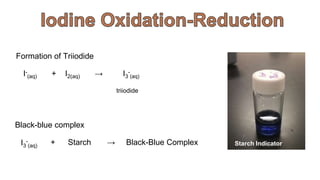
Formation of Triiodide
I-
(aq) + I2(aq) → I3
-
(aq)
triiodide
Black-blue complex
I3
-
(aq) + Starch → Black-Blue Complex Starch Indicator
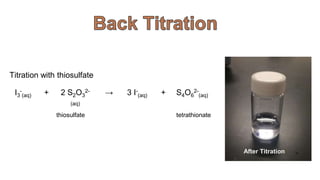
Titration with thiosulfate
I3
-
(aq) + 2 S2O3
2-
(aq)
→ 3 I-
(aq) + S4O6
2-
(aq)
thiosulfate tetrathionate
After Titration
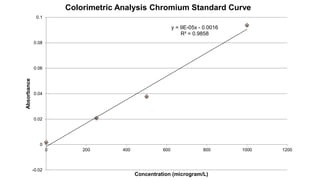
y = 9E-05x - 0.0016
R² = 0.9858
-0.02
0
0.02
0.04
0.06
0.08
0.1
0 200 400 600 800 1000 1200
Absorbance
Concentration (microgram/L)
Colorimetric Analysis Chromium Standard Curve
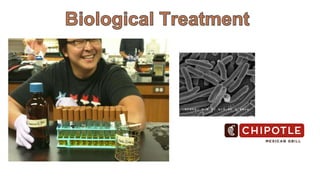
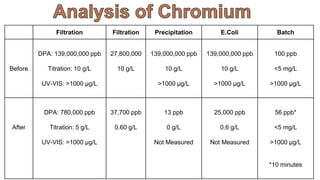
Filtration Filtration Precipitation E.Coli Batch
Before
DPA: 139,000,000 ppb
Titration: 10 g/L
UV-VIS: >1000 μg/L
27,800,000
10 g/L
139,000,000 ppb
10 g/L
>1000 μg/L
139,000,000 ppb
10 g/L
>1000 μg/L
100 ppb
<5 mg/L
>1000 μg/L
After
DPA: 780,000 ppb
Titration: 5 g/L
UV-VIS: >1000 μg/L
37,700 ppb
0.60 g/L
13 ppb
0 g/L
Not Measured
25,000 ppb
0.6 g/L
Not Measured
56 ppb*
<5 mg/L
>1000 μg/L
*10 minutes
Cal Poly Pomona
Dr. Monica Palomo
Dr. Ali Sharbat
Lucas Townsend
Kahao Lim
SHINE
Dr. Graciela Matrajit
Brian Rucci
Kristine Schroeder
Pasadena City College
Dr. Veronica Jaramillo
Rafik Nazarpoor
Phu Nguyen

Chromium ppt

  • 2.
    Hexavalent Chromium Cr(VI) Trivalent Chromium Cr (III) K2Cr2O7 CrO3 CrCl3 Cr2(SO4)3
  • 4.
    1. Cr (VI)detected in 3342/5477 wells tested 2. Los Angeles [Cr6+] > 10 μg/L 3. 2104 CA to limit Cr6+ to 10 ppb 4. Hinkley, CA had Cr6+ levels of 31.8 ppb
  • 7.
  • 12.
  • 13.
  • 14.
    Sulfamic acid, Iodide,Dichromate reaction 6I- (aq) + Cr2O7 2- (aq) + 14H+ (aq) → 3I2(aq) + 2Cr3+ (aq) + 7H2O (l) Dichromate Diluted Chromium Sample Sulfamic Acid and Potassium Iodide
  • 15.
    Formation of Triiodide I- (aq)+ I2(aq) → I3 - (aq) triiodide Black-blue complex I3 - (aq) + Starch → Black-Blue Complex Starch Indicator
  • 16.
    Titration with thiosulfate I3 - (aq)+ 2 S2O3 2- (aq) → 3 I- (aq) + S4O6 2- (aq) thiosulfate tetrathionate After Titration
  • 18.
    y = 9E-05x- 0.0016 R² = 0.9858 -0.02 0 0.02 0.04 0.06 0.08 0.1 0 200 400 600 800 1000 1200 Absorbance Concentration (microgram/L) Colorimetric Analysis Chromium Standard Curve
  • 20.
    Filtration Filtration PrecipitationE.Coli Batch Before DPA: 139,000,000 ppb Titration: 10 g/L UV-VIS: >1000 μg/L 27,800,000 10 g/L 139,000,000 ppb 10 g/L >1000 μg/L 139,000,000 ppb 10 g/L >1000 μg/L 100 ppb <5 mg/L >1000 μg/L After DPA: 780,000 ppb Titration: 5 g/L UV-VIS: >1000 μg/L 37,700 ppb 0.60 g/L 13 ppb 0 g/L Not Measured 25,000 ppb 0.6 g/L Not Measured 56 ppb* <5 mg/L >1000 μg/L *10 minutes
  • 22.
    Cal Poly Pomona Dr.Monica Palomo Dr. Ali Sharbat Lucas Townsend Kahao Lim SHINE Dr. Graciela Matrajit Brian Rucci Kristine Schroeder Pasadena City College Dr. Veronica Jaramillo Rafik Nazarpoor Phu Nguyen

Editor's Notes

  • #11 Methods: 1) Packets of walnut shells, corncob, saw dust (mix of various types of wood), woodshavings and activated charcoal powder were made using coffee filter paper and placed into a container Above media known to adsorb chromium 2) Chromium solution was diluted by a factor of 10^6 in order to use UV vis throughout entire sample range (the UV Vis test kit used only measured accurate values 300ppb and below), it was then added to reactor for single batch 3) Samples of the solution were collected every 5 minutes for an hour 4) Samples were analyzed using UV Vis and titration
  • #12 Methods: 1) Packets of walnut shells, corncob, saw dust (mix of various types of wood), woodshavings and activated charcoal powder were made using coffee filter paper and placed into a container Above media known to adsorb chromium 2) Chromium solution was diluted by a factor of 10^6 in order to use UV vis throughout entire sample range (the UV Vis test kit used only measured accurate values 300ppb and below), it was then added to reactor for single batch 3) Samples of the solution were collected every 5 minutes for an hour 4) Samples were analyzed using UV Vis and titration
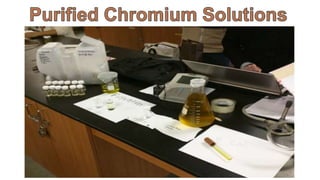
  • #14 Method is use only for low concentration of Cr -- 1.0 ppm or 0.1 mg/L or less must dilute sample before using test machine measures the absorbance of green light and gives reading in ppb Only measures Cr(VI); if want to measure Cr(III) in sample, must convert to Cr(VI) first. 1,5-Diphenylcarbazide reacts with Cr(VI) ions under acidic condition to create a pink solution Diphenylcarbazide is oxidized to Diphenylcarbazone, while Cr(VI) is reduced to Cr (III) the intensity of color is dependent on the concentration of Cr Source: google book formula
  • #15 Describe what Titration is Redox reaction Dichromate reacts with iodide in acidic solution to form elemental iodine Solution becomes more yellow after reaction sulfamicacid, KI, Dichromate: https://answers.yahoo.com/question/index?qid=20080815061454AAF0vsr Also see “Production and Use” section of : http://www.britannica.com/science/iodine Compared to clock experiment reaction
  • #16 The iodine from the previous reaction reacts with excess iodide ions to form triiodide 2 drops of starch indicator is added to the mixture A black-blue complex is formed from triiodide and the starch indicator https://en.wikipedia.org/wiki/Starch_indicator https://en.wikipedia.org/wiki/Iodine_test
  • #17 A thiosulfate solution is added drop by drop The thiosulfate reacts with the triiodide in the black-blue complex to form the iodide ion There is no more triiode to create the black-blue complex, making the mixture clear The amount of Chromium is figured in relation to the amount of triiode, which is figured out by the known amount of thiosulfate added. http://chemed.chem.purdue.edu/genchem/topicreview/bp/ch19/oxred_2.php
  • #18  UV-Vis instructions: https://www.bioassaysys.com/Datasheet/DCRM.pdf