1
GRINDING
COMPILED BY
M.BALASUBRAMANIAN
2
Abrasive Machining
• Material removal by the action of hard,
abrasive particles usually in a form of a bonded
wheel.
• Grinding is the most important abrasive
machining. Cutting occurs at either the
periphery or the face of the grinding wheel.
• Cutting occurs by the abrasive grains that are
much smaller, numerous and random. Self-
sharpening as each abrasive falls off
• Generally a finishing operation achieving the
surface finish of up to 0.025μm and extremely
close tolerance.
3
GRINDING
Definition: Another material removal
process, in which abrasive particles are
contained in bonded grinding wheel, that
operates at very high surface speed.
The grinding wheel is usually in
disk shaped and is precisely balanced for
high rotational speeds.
4
Grinding may be classified as
• Non-Precision
• Precision
according to purpose and procedure.
5
Non-precision grinding
The common forms are called,
snagging and off-hand grinding. Both are
done primarily to remove stock that can
not be taken off as conveniently by other
methods. The work is pressed hard against
the wheel or vice versa. The accuracy and
surface finish are of secondary
importance.
6
Rough Grinders
• Bench Grinder
• Swing frame grinder
• Abrasive belt grinder
7
Precision grinding
Precision grinding is concerned with
producing good surface finishes and
accurate dimensions.
3 types of precision grinding exists
–External cylindrical grinding
–Internal cylindrical grinding
–Surface grinding
8
9
Grinding wheel
• Consists of abrasive material and bonding
material. Abrasive particles accomplish cutting
• Bonding material holds particles in place and
establishes shape and structure of wheel.
• Parameters
– Abrasive materials
– Grain size
– Bonding material
– Wheel grade and Wheel structure
10
Grinding Wheel Surface
11
Abrasive Materials Properties
• High hardness
• Wear resistance
• Toughness
• Friability - Capacity to fracture when
cutting edge dulls, so a new sharp
edge is exposed.
12
Common abrasive materials
1. Aluminum Oxide (Al2O3)
Various substances may be added to
enhance hardness, toughness, etc. Plain
Al2O3 is white, and used to grind: steel,
ferrous, high strength alloys.
2. Silicon Carbide (SiC) known in trade
as Carborundum. Harder than Al2O3 but
not as tough. Used to grind: aluminum,
brass, stainless steel, cast irons, certain
brittle ceramics
13
Abrasive materials (cont)
3. Boron Nitride in the forms of single-
crystal cubic boron nitride (CBN)
Used for hard materials such as
hardened tool steels and aerospace
alloys.
4. Diamond, both natural and artificial.
Used on hard materials such as
ceramics, cemented carbides and glass.
14
Grain size
Important parameter in determining
surface finish and material removal rate. Small
grit sizes produce better finishes, larger grit
sizes permit larger material removal rates.
Also, harder materials need smaller grain sizes
to cut effectively, while softer materials require
larger grit size.
Grain sizes used in grinding changes
between 8-250, while 8 is very coarse, but 250
is very fine.
15
Bonding materials
To get wide range of properties needed in
grinding wheels, abrasive materials bonded by
using organic or ingorganic materials.
Inorganic bonds
1. Vitrified bond: Clay bond melted to a
porcelain or glass like consistency. It
can be made strong and rigid for heavy
grinding and not effected by water, oil,
acids. Most grinding wheels have
vitrified bonds.
16
Inorganic bonds (continue)
2. Silicate bond is essentially hardened by
baking. It holds grains more loosely than a
vitrified bond. Large wheels can be made
more easily with slicate bond. Usually used
in situation where heat generation must be
minimized.
3. Metallic bond: Cubic boron nitride and
diamond abrassives are usually (but not
always) embeded in metallic bonds, for
utmost in strength and tendency to hold the
costly long-wearing grains.
17
Organic bonds
1. Rubber bond is a flexible bond, used in
cutoff wheels.
2. Resinoid bond is a high strength bond,
used for rough grinding and cutoff
operations.
3. Shellac bond is relatively strong but not
rigid, used in applications that requires
good finishing.
18
Wheel grade and wheel structure
The grade of a grinding wheel is a
measure of how strongly the grains are
held by the bond. Typical structure of a
grinding wheel contains abrasive grains,
bond material and pores (air gaps)
19
STRUCTURE
• This indicates the amount of bond
present between the individual abrasive
grains, and the closeness of the
individual grain to each other.
20
Wheel grade and wheel structure
Volumetric proportions can be expressed
as
Vg + Vb+ Vp = 1
If Vp relatively large and Vg relatively
small, it is called open structure.
If Vg relatively large and Vp relatively
small, it is called dense structure.
21
Wheel structure (cont)
Open structures are recommended in
situations where the clearance for chips must
be provided. Dense structures are used to
obtain better surface finish and dimensional
control.
22
Specification of the Grinding Wheel
• Diameter of the wheel
• Bore diameter of the wheel
• Thickness of the wheel
• Type of the wheel
23
GRADE
• Grade indicates the strength of the bond
and, therefore, the `hardness` of the wheel.
In a hard wheel the bond is strong and it
securely anchors the grit in place, and
therefore, reduces the rate of wear. In a soft
wheel, the bond is weak and the grit is easily
detached resulting in a high rate of wear.
24
American National Standard Institute’s marking
system for standard wheels(specification)
Prefix-Abbrasive type-Abrasive grain size-Grade-
Structure-Bond type-Manufacturer record
Ex: 51-A-36-L-5-V-23
Prefix:Manufacturer symbol indicating exact kind of
abrasive (use optional)
Abrassive type: A:Aluminum oxide
C:Silicon Carbide B: Boron Nitride D:Diamond
Grain size: coarse:8-24, medium:30-60, fine:70-180,
very fine: >220
25
American National Standard Institude’s
marking system for standard wheels (cont)
Grade:Ranges from A-Z, where A represents
soft, Z represents hard wheel grade.
Structure: Scale is numerical. 1: very dense and
15:very open.
Bond type: B : Resinoid
E : Shellac R : Rubber
S : Silicate V : Vitrified
Manufacturer record: Manufacturer’s private
marking to identify the wheel.
SELECTION OF GRINDING WHEEL
The selection of a grinding wheel will depend on the
following factors.
• Material to be ground
• Amount of stock to be removed
• Finish required
• Area of contact
• Wheel speed
• Method of cooling
27
Wheel shape and sizes
•Straight cylinders
•Tapered two sides
•Straight cup
•Flaring cup
•Dish
•Saucer
28
29
Applications
• Tapered face straight wheel – Grinding threads and
gear teeth
• Cylinder wheel - Producing flat surfaces
• Flaring Cup Wheel - Tool room work
Simultaneously grinds the
face and root of the gear teeth
• Dish wheel - Thinness of the wheel
permits it grind the
surface at narrow places
30
Wheel Wear
The overall wear of bonded abrasive is
caused by 3 distinct mechanism
Attritious wear: Sharp edges of an
abrasive grain become dull by attrition,
developing flat areas.
Fracture of the grains: Portion of the
grain breaks off. The fractured area
becomes new cutting area.
Fracture of the bond: Part of the grains
fall out.
31
Wheel Dressing
32
Dressing and Truing
• Dressing
Removes loading and breaks away the
glazed surface so that sharp abrasive
particles are again presented to work
• Truing
It is the process of changing the shape of
the grinding wheel as it becomes worn
from an original shape owing to the
breaking away of the bond.
33
Grain action
There are 3 types of grain action in grinding
1. Cutting: Grit can penetrate to the surface
and actually performs chip removing.
2. Plowing: Grit can penetrate to the
surface(not far enough to cut) but can not
perform cutting. The work surface
deformes.
3. Rubbing: Grits contacts(rubs) to the
surface, energy consumed witout cutting.
34
35
SPECIFICATION OF GRINDING MACHINE
•Distance between table & the middle of spindle 400 mm
•Grinding wheel max. D x W x d 225 x 25 x 51 mm
•Size of magnet 400 x 150 mm
•Size of table 400 x 150 mm
•motor power 2 Kw
SURFACE GRINDERS
Types
• Horizonal spindle reciprocating table
• Horizontal spindle rotary table
• Vertical spindle reciprocating table
• Vertical spindle rotary table
This machine may be similar to a milling
machine used mainly to grind flat surface.
However, some types of surface grinders are
also capable of producing contour surface
with formed grinding wheel.
37
Surface Grinding
38
39
Surface Grinding Operations
(a) Traverse grinding with a horizontal-spindle surface grinder.
(b) Plunge grinding, producing a groove in the workpiece.
CYLINDRICAL GRINDING
40
This machine is used to produce external cylindrical surface. The
surfaces may be straight, tapered, steps or profiled. Broadly there are
three different types of cylindrical grinding machine as follows:
•Plain centre type cylindrical grinder
•Universal cylindrical surface grinder -
swiveling wheel head , swiveling wheel head slide, swiveling head
stock
•Centreless cylindrical surface grinder
41
Centreless Grinding
• It is undesirable to fix the workpiece every
time between centres
• Work is not supported between centres
• Work is supported on a work rest blade and
the regulating wheel holds the work piece
42
ADVANTAGES
• Rate of production is more than cylindrical
grinding
• Work is supported rigidly along the whole
length
• Suitable for long jobs
• Due to floating conditions, Centering is
eliminated and time is not wasted in centering
• Does not require centre holes, drivers and other
work holding fixtures
43
44
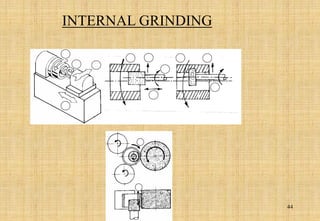
INTERNAL GRINDING
What is abrasive jet machining
It is the material removal process where the
material is removed by high velocity stream of
air/gas or water and abrasive mixture .
An abrasive is small, hard particle having sharp
edges and an irregular shape .
High velocity jet is aimed at a surface under
controller condition .
components of abrasive jet
machining
Abrasive delivery system
Control system
Pump
Nozzle
Mixing tube
working process
High velocity gas(up to 300m/min) is delivered to
the nozzle .
At the nozzle , abrasive is introduced & as the
abrasive/gas mixture exits , cutting is performed .
The metal is removed due to the erosion caused by the
abrasive particles on the work surface.
Different types of abrasive used in abrasive jet
machining are aluminum oxide, sodium bicarbonate ,
silicon carbide ,Dolomite,etc
schematic diagram of ajm
Advantages
It can cut hard materials and thin sections
No start hole required
There is only one tool
Low capital cost
Less vibration
No heat generated in work piece
No mechanical contact between the workpiece
and tool
Disadvantages
Low metal removal rate
Additional cleaning on softer material may be
required.
High nozzle wear rate
Machining accuracy is poor
APPLICATIONS
• To cut slots
• To cut intricate shapes
• To cut contours
52

GRINDING

  • 1.
  • 2.
    2 Abrasive Machining • Materialremoval by the action of hard, abrasive particles usually in a form of a bonded wheel. • Grinding is the most important abrasive machining. Cutting occurs at either the periphery or the face of the grinding wheel. • Cutting occurs by the abrasive grains that are much smaller, numerous and random. Self- sharpening as each abrasive falls off • Generally a finishing operation achieving the surface finish of up to 0.025μm and extremely close tolerance.
  • 3.
    3 GRINDING Definition: Another materialremoval process, in which abrasive particles are contained in bonded grinding wheel, that operates at very high surface speed. The grinding wheel is usually in disk shaped and is precisely balanced for high rotational speeds.
  • 4.
    4 Grinding may beclassified as • Non-Precision • Precision according to purpose and procedure.
  • 5.
    5 Non-precision grinding The commonforms are called, snagging and off-hand grinding. Both are done primarily to remove stock that can not be taken off as conveniently by other methods. The work is pressed hard against the wheel or vice versa. The accuracy and surface finish are of secondary importance.
  • 6.
    6 Rough Grinders • BenchGrinder • Swing frame grinder • Abrasive belt grinder
  • 7.
    7 Precision grinding Precision grindingis concerned with producing good surface finishes and accurate dimensions. 3 types of precision grinding exists –External cylindrical grinding –Internal cylindrical grinding –Surface grinding
  • 8.
  • 9.
    9 Grinding wheel • Consistsof abrasive material and bonding material. Abrasive particles accomplish cutting • Bonding material holds particles in place and establishes shape and structure of wheel. • Parameters – Abrasive materials – Grain size – Bonding material – Wheel grade and Wheel structure
  • 10.
  • 11.
    11 Abrasive Materials Properties •High hardness • Wear resistance • Toughness • Friability - Capacity to fracture when cutting edge dulls, so a new sharp edge is exposed.
  • 12.
    12 Common abrasive materials 1.Aluminum Oxide (Al2O3) Various substances may be added to enhance hardness, toughness, etc. Plain Al2O3 is white, and used to grind: steel, ferrous, high strength alloys. 2. Silicon Carbide (SiC) known in trade as Carborundum. Harder than Al2O3 but not as tough. Used to grind: aluminum, brass, stainless steel, cast irons, certain brittle ceramics
  • 13.
    13 Abrasive materials (cont) 3.Boron Nitride in the forms of single- crystal cubic boron nitride (CBN) Used for hard materials such as hardened tool steels and aerospace alloys. 4. Diamond, both natural and artificial. Used on hard materials such as ceramics, cemented carbides and glass.
  • 14.
    14 Grain size Important parameterin determining surface finish and material removal rate. Small grit sizes produce better finishes, larger grit sizes permit larger material removal rates. Also, harder materials need smaller grain sizes to cut effectively, while softer materials require larger grit size. Grain sizes used in grinding changes between 8-250, while 8 is very coarse, but 250 is very fine.
  • 15.
    15 Bonding materials To getwide range of properties needed in grinding wheels, abrasive materials bonded by using organic or ingorganic materials. Inorganic bonds 1. Vitrified bond: Clay bond melted to a porcelain or glass like consistency. It can be made strong and rigid for heavy grinding and not effected by water, oil, acids. Most grinding wheels have vitrified bonds.
  • 16.
    16 Inorganic bonds (continue) 2.Silicate bond is essentially hardened by baking. It holds grains more loosely than a vitrified bond. Large wheels can be made more easily with slicate bond. Usually used in situation where heat generation must be minimized. 3. Metallic bond: Cubic boron nitride and diamond abrassives are usually (but not always) embeded in metallic bonds, for utmost in strength and tendency to hold the costly long-wearing grains.
  • 17.
    17 Organic bonds 1. Rubberbond is a flexible bond, used in cutoff wheels. 2. Resinoid bond is a high strength bond, used for rough grinding and cutoff operations. 3. Shellac bond is relatively strong but not rigid, used in applications that requires good finishing.
  • 18.
    18 Wheel grade andwheel structure The grade of a grinding wheel is a measure of how strongly the grains are held by the bond. Typical structure of a grinding wheel contains abrasive grains, bond material and pores (air gaps)
  • 19.
    19 STRUCTURE • This indicatesthe amount of bond present between the individual abrasive grains, and the closeness of the individual grain to each other.
  • 20.
    20 Wheel grade andwheel structure Volumetric proportions can be expressed as Vg + Vb+ Vp = 1 If Vp relatively large and Vg relatively small, it is called open structure. If Vg relatively large and Vp relatively small, it is called dense structure.
  • 21.
    21 Wheel structure (cont) Openstructures are recommended in situations where the clearance for chips must be provided. Dense structures are used to obtain better surface finish and dimensional control.
  • 22.
    22 Specification of theGrinding Wheel • Diameter of the wheel • Bore diameter of the wheel • Thickness of the wheel • Type of the wheel
  • 23.
    23 GRADE • Grade indicatesthe strength of the bond and, therefore, the `hardness` of the wheel. In a hard wheel the bond is strong and it securely anchors the grit in place, and therefore, reduces the rate of wear. In a soft wheel, the bond is weak and the grit is easily detached resulting in a high rate of wear.
  • 24.
    24 American National StandardInstitute’s marking system for standard wheels(specification) Prefix-Abbrasive type-Abrasive grain size-Grade- Structure-Bond type-Manufacturer record Ex: 51-A-36-L-5-V-23 Prefix:Manufacturer symbol indicating exact kind of abrasive (use optional) Abrassive type: A:Aluminum oxide C:Silicon Carbide B: Boron Nitride D:Diamond Grain size: coarse:8-24, medium:30-60, fine:70-180, very fine: >220
  • 25.
    25 American National StandardInstitude’s marking system for standard wheels (cont) Grade:Ranges from A-Z, where A represents soft, Z represents hard wheel grade. Structure: Scale is numerical. 1: very dense and 15:very open. Bond type: B : Resinoid E : Shellac R : Rubber S : Silicate V : Vitrified Manufacturer record: Manufacturer’s private marking to identify the wheel.
  • 26.
    SELECTION OF GRINDINGWHEEL The selection of a grinding wheel will depend on the following factors. • Material to be ground • Amount of stock to be removed • Finish required • Area of contact • Wheel speed • Method of cooling
  • 27.
    27 Wheel shape andsizes •Straight cylinders •Tapered two sides •Straight cup •Flaring cup •Dish •Saucer
  • 28.
  • 29.
    29 Applications • Tapered facestraight wheel – Grinding threads and gear teeth • Cylinder wheel - Producing flat surfaces • Flaring Cup Wheel - Tool room work Simultaneously grinds the face and root of the gear teeth • Dish wheel - Thinness of the wheel permits it grind the surface at narrow places
  • 30.
    30 Wheel Wear The overallwear of bonded abrasive is caused by 3 distinct mechanism Attritious wear: Sharp edges of an abrasive grain become dull by attrition, developing flat areas. Fracture of the grains: Portion of the grain breaks off. The fractured area becomes new cutting area. Fracture of the bond: Part of the grains fall out.
  • 31.
  • 32.
    32 Dressing and Truing •Dressing Removes loading and breaks away the glazed surface so that sharp abrasive particles are again presented to work • Truing It is the process of changing the shape of the grinding wheel as it becomes worn from an original shape owing to the breaking away of the bond.
  • 33.
    33 Grain action There are3 types of grain action in grinding 1. Cutting: Grit can penetrate to the surface and actually performs chip removing. 2. Plowing: Grit can penetrate to the surface(not far enough to cut) but can not perform cutting. The work surface deformes. 3. Rubbing: Grits contacts(rubs) to the surface, energy consumed witout cutting.
  • 34.
  • 35.
    35 SPECIFICATION OF GRINDINGMACHINE •Distance between table & the middle of spindle 400 mm •Grinding wheel max. D x W x d 225 x 25 x 51 mm •Size of magnet 400 x 150 mm •Size of table 400 x 150 mm •motor power 2 Kw
  • 36.
    SURFACE GRINDERS Types • Horizonalspindle reciprocating table • Horizontal spindle rotary table • Vertical spindle reciprocating table • Vertical spindle rotary table This machine may be similar to a milling machine used mainly to grind flat surface. However, some types of surface grinders are also capable of producing contour surface with formed grinding wheel.
  • 37.
  • 38.
  • 39.
    39 Surface Grinding Operations (a)Traverse grinding with a horizontal-spindle surface grinder. (b) Plunge grinding, producing a groove in the workpiece.
  • 40.
    CYLINDRICAL GRINDING 40 This machineis used to produce external cylindrical surface. The surfaces may be straight, tapered, steps or profiled. Broadly there are three different types of cylindrical grinding machine as follows: •Plain centre type cylindrical grinder •Universal cylindrical surface grinder - swiveling wheel head , swiveling wheel head slide, swiveling head stock •Centreless cylindrical surface grinder
  • 41.
    41 Centreless Grinding • Itis undesirable to fix the workpiece every time between centres • Work is not supported between centres • Work is supported on a work rest blade and the regulating wheel holds the work piece
  • 42.
    42 ADVANTAGES • Rate ofproduction is more than cylindrical grinding • Work is supported rigidly along the whole length • Suitable for long jobs • Due to floating conditions, Centering is eliminated and time is not wasted in centering • Does not require centre holes, drivers and other work holding fixtures
  • 43.
  • 44.
  • 46.
    What is abrasivejet machining It is the material removal process where the material is removed by high velocity stream of air/gas or water and abrasive mixture . An abrasive is small, hard particle having sharp edges and an irregular shape . High velocity jet is aimed at a surface under controller condition .
  • 47.
    components of abrasivejet machining Abrasive delivery system Control system Pump Nozzle Mixing tube
  • 48.
    working process High velocitygas(up to 300m/min) is delivered to the nozzle . At the nozzle , abrasive is introduced & as the abrasive/gas mixture exits , cutting is performed . The metal is removed due to the erosion caused by the abrasive particles on the work surface. Different types of abrasive used in abrasive jet machining are aluminum oxide, sodium bicarbonate , silicon carbide ,Dolomite,etc
  • 49.
  • 50.
    Advantages It can cuthard materials and thin sections No start hole required There is only one tool Low capital cost Less vibration No heat generated in work piece No mechanical contact between the workpiece and tool
  • 51.
    Disadvantages Low metal removalrate Additional cleaning on softer material may be required. High nozzle wear rate Machining accuracy is poor
  • 52.
    APPLICATIONS • To cutslots • To cut intricate shapes • To cut contours 52