PRESENTATION ON 
SURFACE FINISHING 
PRESENTED BY : 
• BHANU PRATAP SINGH 
• ROLL NO.-1214340052 
• BRANCH-M.E.-1(THIRD 
YEAR) 
SUBMITTED TO : 
• MR. DEEPAK SHARMA
OBJECTIVE 
• THIS PRESENTATION AIMS TO 
PROVIDE A PIECE OF 
KNOWLEDGE ABOUT SURFACE 
FINISING AND DIFFERENT TYPES 
OF SURFACE FINISHING 
PROCESSES SUCH AS HONING, 
LAPPING AND SUPER FINISHING
CONTENTS 
• SURFACE FINISHING 
• COMMON METHODS OF SURFACE FINISHING 
• HONING 
• LAPPING 
• SUPER FINISHING
Surface finishing 
Surface finishing may be defined as any process 
that alters the surface of a material for asthetic and 
functional purposes 
It improve appearance and sales value of product 
Used to resist wear, electrolytic decomposition, 
and corrosive wear 
Treatment process (chemical or electrical) 
produces oxide of original metal on surface
Common methods for surface 
finishing process 
• Honing 
• Lapping 
• Polishing 
• Super finishing
HONING 
• Honing is an abrasive machining process that produces a 
precision surface on a metal workpiece by scrubbing 
an abrasive stone against it along a controlled path. Honing is 
primarily used to improve the geometric form of a surface, but 
may also improve the surface texture. 
The surface of a honed workpiece
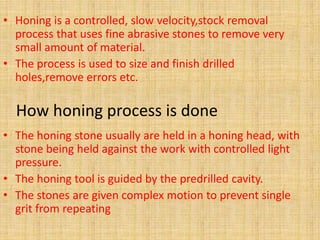
• Honing is a controlled, slow velocity,stock removal 
process that uses fine abrasive stones to remove very 
small amount of material. 
• The process is used to size and finish drilled 
holes,remove errors etc. 
How honing process is done 
• The honing stone usually are held in a honing head, with 
stone being held against the work with controlled light 
pressure. 
• The honing tool is guided by the predrilled cavity. 
• The stones are given complex motion to prevent single 
grit from repeating
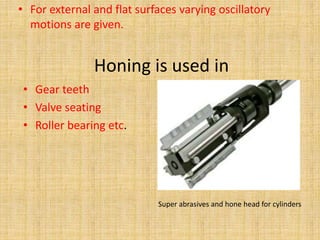
• For external and flat surfaces varying oscillatory 
motions are given. 
Honing is used in 
• Gear teeth 
• Valve seating 
• Roller bearing etc. 
Super abrasives and hone head for cylinders
Honing tools 
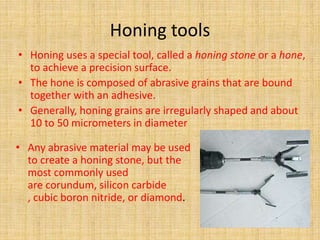
• Honing uses a special tool, called a honing stone or a hone, 
to achieve a precision surface. 
• The hone is composed of abrasive grains that are bound 
together with an adhesive. 
• Generally, honing grains are irregularly shaped and about 
10 to 50 micrometers in diameter 
• Any abrasive material may be used 
to create a honing stone, but the 
most commonly used 
are corundum, silicon carbide 
, cubic boron nitride, or diamond.
Some commonly used honing tools
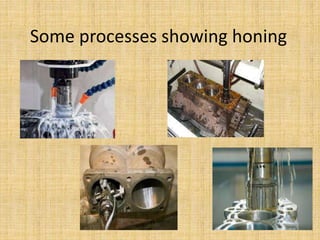
Some processes showing honing
Types of honing machines 
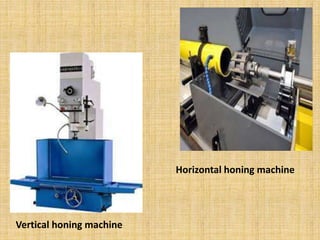
• There are two types of honing machines that are 
commonly used. They are as follows: 
1. Horizontal honing machine 
2. Vertical honing machine 
• The classification is done on the basis of the motion 
of the workpiece and tool. 
• If machine carry a horizontal spindle and workpiece is 
mounted on a table that can reciprocate to and fro 
then the honing process is called horizontal honing 
and if tool is mounted in a vertical spindle and moves 
up and down then it is called vertical honing process.
Vertical honing machine 
Horizontal honing machine
Advantages and disadvantages of 
honing 
Advantages 
• Highly accurate holes are 
produced. 
• Very little heat is generated. 
• Tolerances can be easily 
maintained. 
• Surface finish produced is 
very smooth. 
• Hole of any dimensions can 
be honed. 
• High productivity at low 
cost can be obtained. 
Disadvantages 
• Impossible to improve lack 
of straightness in holes. 
• Difficult to hone tough non 
ferrous metals due to 
clogging of the pores of 
abrasive. 
• Amount of stock removal is 
less.
Lapping 
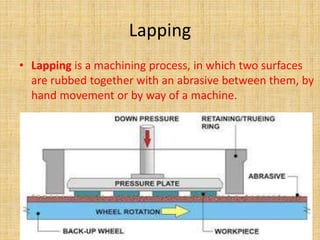
• Lapping is a machining process, in which two surfaces 
are rubbed together with an abrasive between them, by 
hand movement or by way of a machine.
• Lapping is an ancient machining technique 
• It is a precision process or combination of processes 
used to provide flatness , parallelism, size and surface 
finishes to extremely demanding tolerances. 
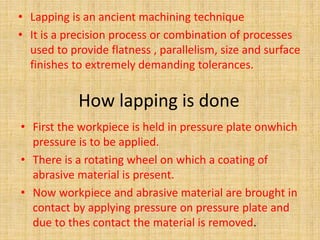
How lapping is done 
• First the workpiece is held in pressure plate onwhich 
pressure is to be applied. 
• There is a rotating wheel on which a coating of 
abrasive material is present. 
• Now workpiece and abrasive material are brought in 
contact by applying pressure on pressure plate and 
due to thes contact the material is removed.
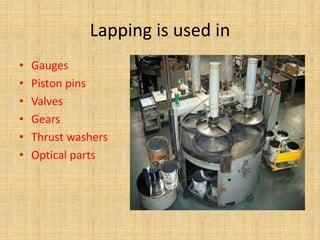
Lapping is used in 
• Gauges 
• Piston pins 
• Valves 
• Gears 
• Thrust washers 
• Optical parts
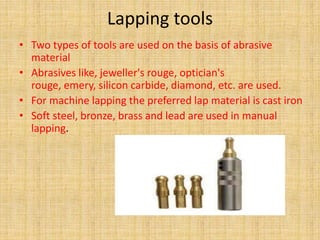
Lapping tools 
• Two types of tools are used on the basis of abrasive 
material 
• Abrasives like, jeweller's rouge, optician's 
rouge, emery, silicon carbide, diamond, etc. are used. 
• For machine lapping the preferred lap material is cast iron 
• Soft steel, bronze, brass and lead are used in manual 
lapping.
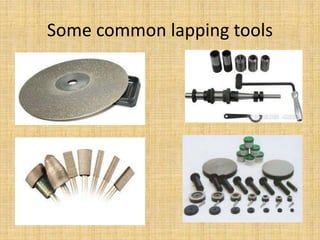
Some common lapping tools
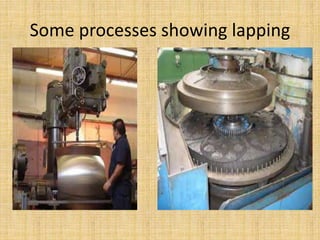
Some processes showing lapping
Types of lapping 
Lapping is done by following methods 
1. Hand lapping 
2. Machine lapping 
• Hand lapping is done by using hand held tools for 
both flat and external cylinder work 
• Machine lapping is done to obtain highly finished 
surface on many articles such as worm and worm 
gears, camshafts, automobile engine parts etc.
Types of lapping machine 
There are five types of lapping machines and 
they are discussed below: 
1. Vertical lapping machine 
2. Flat machine lapping 
3. Centreless roll lapping machine 
4. Centreless lapping machine 
5. Lapping spherical surfaces
Advantages and disadvantages of 
lapping 
Advantages 
• Extreme accuracy in both 
tolerances and geometry. 
• Fast stock removal. 
• No clamping or heat 
distortion. 
• No expensive tooling 
required. 
• Very thin and non magnetic 
parts can be processed. 
• Irregular shaped parts can 
be easily processed. 
Disadvantages 
• Since lapping is a finishing 
operation, parts should not 
be far from the expected 
size and geometry before 
lapping. 
• Reside of compound left on 
the part after lapping must 
be removed 
• Trail and error still may be 
needed to get the optimum 
results.
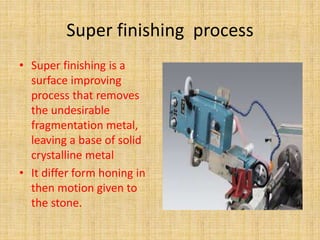
Super finishing process 
• Super finishing is a 
surface improving 
process that removes 
the undesirable 
fragmentation metal, 
leaving a base of solid 
crystalline metal 
• It differ form honing in 
then motion given to 
the stone.
Types of super finishing 
• It is of two types: 
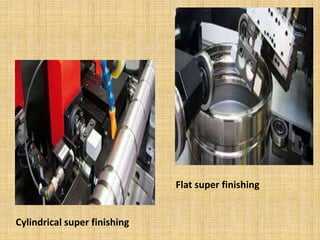
1. Cylindrical super finishing 
2. Flat super finishing 
• In cylindrical super finishing a bonded form abrasive stone 
having a width of about two third of diameter of part to be 
finished and the same length is operated at low speed and 
pressure. 
• The motion given to the stone is oscillating with an amplitude 
of 1.6 to 64 mm at about 450 cycles. 
• The work is rotated at the speed of0.25m/s. 
• In flat super finishing flat surface may be super finished. 
• The upper spindle is spring loaded quill on which stone is 
mounted 
• The lower spindle carries the work. 
• Both spindles are parallel so that when they rotate the result is 
a flat smooth surface
Cylindrical super finishing 
Flat super finishing
Super finishing tools 
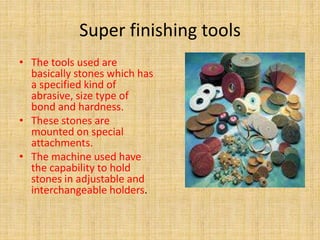
• The tools used are 
basically stones which has 
a specified kind of 
abrasive, size type of 
bond and hardness. 
• These stones are 
mounted on special 
attachments. 
• The machine used have 
the capability to hold 
stones in adjustable and 
interchangeable holders.
Advantages and disadvantages of 
super finishing 
Advantages 
• Produce excellent surface 
finish in a minimum time. 
• Type of surface finish may 
be preselected. 
• Process is easy adapted to 
high volume productions . 
Disadvantages 
• Super finishing cannot be 
used to correct feature 
location such as 
concentricity.
Super finishing is used in 
• Automobile component such as gudgeon pins. 
• Aircraft components. 
• Heavy earth moving equipments.
0052 surface finishing

0052 surface finishing

  • 1.
    PRESENTATION ON SURFACEFINISHING PRESENTED BY : • BHANU PRATAP SINGH • ROLL NO.-1214340052 • BRANCH-M.E.-1(THIRD YEAR) SUBMITTED TO : • MR. DEEPAK SHARMA
  • 2.
    OBJECTIVE • THISPRESENTATION AIMS TO PROVIDE A PIECE OF KNOWLEDGE ABOUT SURFACE FINISING AND DIFFERENT TYPES OF SURFACE FINISHING PROCESSES SUCH AS HONING, LAPPING AND SUPER FINISHING
  • 3.
    CONTENTS • SURFACEFINISHING • COMMON METHODS OF SURFACE FINISHING • HONING • LAPPING • SUPER FINISHING
  • 4.
    Surface finishing Surfacefinishing may be defined as any process that alters the surface of a material for asthetic and functional purposes It improve appearance and sales value of product Used to resist wear, electrolytic decomposition, and corrosive wear Treatment process (chemical or electrical) produces oxide of original metal on surface
  • 5.
    Common methods forsurface finishing process • Honing • Lapping • Polishing • Super finishing
  • 6.
    HONING • Honingis an abrasive machining process that produces a precision surface on a metal workpiece by scrubbing an abrasive stone against it along a controlled path. Honing is primarily used to improve the geometric form of a surface, but may also improve the surface texture. The surface of a honed workpiece
  • 7.
    • Honing isa controlled, slow velocity,stock removal process that uses fine abrasive stones to remove very small amount of material. • The process is used to size and finish drilled holes,remove errors etc. How honing process is done • The honing stone usually are held in a honing head, with stone being held against the work with controlled light pressure. • The honing tool is guided by the predrilled cavity. • The stones are given complex motion to prevent single grit from repeating
  • 8.
    • For externaland flat surfaces varying oscillatory motions are given. Honing is used in • Gear teeth • Valve seating • Roller bearing etc. Super abrasives and hone head for cylinders
  • 9.
    Honing tools •Honing uses a special tool, called a honing stone or a hone, to achieve a precision surface. • The hone is composed of abrasive grains that are bound together with an adhesive. • Generally, honing grains are irregularly shaped and about 10 to 50 micrometers in diameter • Any abrasive material may be used to create a honing stone, but the most commonly used are corundum, silicon carbide , cubic boron nitride, or diamond.
  • 10.
    Some commonly usedhoning tools
  • 11.
  • 12.
    Types of honingmachines • There are two types of honing machines that are commonly used. They are as follows: 1. Horizontal honing machine 2. Vertical honing machine • The classification is done on the basis of the motion of the workpiece and tool. • If machine carry a horizontal spindle and workpiece is mounted on a table that can reciprocate to and fro then the honing process is called horizontal honing and if tool is mounted in a vertical spindle and moves up and down then it is called vertical honing process.
  • 13.
    Vertical honing machine Horizontal honing machine
  • 14.
    Advantages and disadvantagesof honing Advantages • Highly accurate holes are produced. • Very little heat is generated. • Tolerances can be easily maintained. • Surface finish produced is very smooth. • Hole of any dimensions can be honed. • High productivity at low cost can be obtained. Disadvantages • Impossible to improve lack of straightness in holes. • Difficult to hone tough non ferrous metals due to clogging of the pores of abrasive. • Amount of stock removal is less.
  • 15.
    Lapping • Lappingis a machining process, in which two surfaces are rubbed together with an abrasive between them, by hand movement or by way of a machine.
  • 16.
    • Lapping isan ancient machining technique • It is a precision process or combination of processes used to provide flatness , parallelism, size and surface finishes to extremely demanding tolerances. How lapping is done • First the workpiece is held in pressure plate onwhich pressure is to be applied. • There is a rotating wheel on which a coating of abrasive material is present. • Now workpiece and abrasive material are brought in contact by applying pressure on pressure plate and due to thes contact the material is removed.
  • 17.
    Lapping is usedin • Gauges • Piston pins • Valves • Gears • Thrust washers • Optical parts
  • 18.
    Lapping tools •Two types of tools are used on the basis of abrasive material • Abrasives like, jeweller's rouge, optician's rouge, emery, silicon carbide, diamond, etc. are used. • For machine lapping the preferred lap material is cast iron • Soft steel, bronze, brass and lead are used in manual lapping.
  • 19.
  • 20.
  • 21.
    Types of lapping Lapping is done by following methods 1. Hand lapping 2. Machine lapping • Hand lapping is done by using hand held tools for both flat and external cylinder work • Machine lapping is done to obtain highly finished surface on many articles such as worm and worm gears, camshafts, automobile engine parts etc.
  • 22.
    Types of lappingmachine There are five types of lapping machines and they are discussed below: 1. Vertical lapping machine 2. Flat machine lapping 3. Centreless roll lapping machine 4. Centreless lapping machine 5. Lapping spherical surfaces
  • 23.
    Advantages and disadvantagesof lapping Advantages • Extreme accuracy in both tolerances and geometry. • Fast stock removal. • No clamping or heat distortion. • No expensive tooling required. • Very thin and non magnetic parts can be processed. • Irregular shaped parts can be easily processed. Disadvantages • Since lapping is a finishing operation, parts should not be far from the expected size and geometry before lapping. • Reside of compound left on the part after lapping must be removed • Trail and error still may be needed to get the optimum results.
  • 24.
    Super finishing process • Super finishing is a surface improving process that removes the undesirable fragmentation metal, leaving a base of solid crystalline metal • It differ form honing in then motion given to the stone.
  • 25.
    Types of superfinishing • It is of two types: 1. Cylindrical super finishing 2. Flat super finishing • In cylindrical super finishing a bonded form abrasive stone having a width of about two third of diameter of part to be finished and the same length is operated at low speed and pressure. • The motion given to the stone is oscillating with an amplitude of 1.6 to 64 mm at about 450 cycles. • The work is rotated at the speed of0.25m/s. • In flat super finishing flat surface may be super finished. • The upper spindle is spring loaded quill on which stone is mounted • The lower spindle carries the work. • Both spindles are parallel so that when they rotate the result is a flat smooth surface
  • 26.
    Cylindrical super finishing Flat super finishing
  • 27.
    Super finishing tools • The tools used are basically stones which has a specified kind of abrasive, size type of bond and hardness. • These stones are mounted on special attachments. • The machine used have the capability to hold stones in adjustable and interchangeable holders.
  • 28.
    Advantages and disadvantagesof super finishing Advantages • Produce excellent surface finish in a minimum time. • Type of surface finish may be preselected. • Process is easy adapted to high volume productions . Disadvantages • Super finishing cannot be used to correct feature location such as concentricity.
  • 29.
    Super finishing isused in • Automobile component such as gudgeon pins. • Aircraft components. • Heavy earth moving equipments.