Kundan Samal
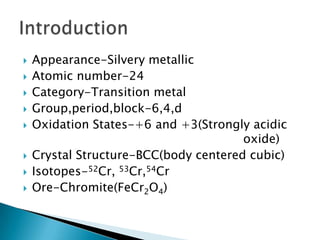
   Appearance-Silvery metallic
   Atomic number-24
   Category-Transition metal
   Group,period,block-6,4,d
   Oxidation States-+6 and +3(Strongly acidic
                                       oxide)
   Crystal Structure-BCC(body centered cubic)
   Isotopes-52Cr, 53Cr,54Cr
   Ore-Chromite(FeCr2O4)
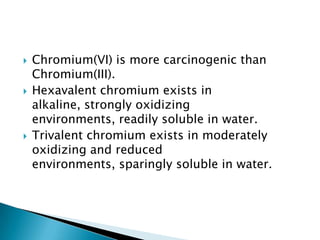
   Chromium(VI) is more carcinogenic than
    Chromium(III).
   Hexavalent chromium exists in
    alkaline, strongly oxidizing
    environments, readily soluble in water.
   Trivalent chromium exists in moderately
    oxidizing and reduced
    environments, sparingly soluble in water.
   Used on a large scale in the metallurgical and
    chemical industries.
   The metallurgical industry: production of
    stainless steels, alloy cast iron and
    nonferrous alloys, plating steel.
   The chemical industry: pigments and dyes(Cr
    VI and Cr III), metal finishing and
    electroplating, wood preservatives (Cr VI only)
    and leather tanning (Cr III only), Glass
    manufacturing.
   Stainless steel: Fe+Cr(11%)
   Ni alloy: Used in jet engine and gas turbine due
    to protective and decorative property.
   Chrome plating: immersing the metal parts to be
    plated in a bath of chromium trioxide (CrO3). A
    direct current is passed through the solution.
   Wood preservative: Chromate(VI) copper
    arsenate(CCA) used in timber treatment.
   Tanning: Chrome alum and Chromium(III) sulfate
    used to stabilize by cross linking collagen fibers.
   Colorimetric, Ion Chromatography, co-
    precipitation(Ni2+).
   Cr(VI) uses diphenylcarbohydrazide (DPC) to
    form an intensely colored complex with
    Cr(VI). The complex is measured
    quantitatively by its visible absorption at 520
    nm.
   Dynamic Reaction Cell (DRC) ICP-MS:
    Overcome mass interference(mass/charge).
    Use gases like N2O, SF6, CS2, CO2 etc.
  An essential elements in human.
 High concentration of this can lead to DNA
  damage.
 Essential to normal glucose, protein, and fat
  metabolism.
 Body has several systems for reducing
  chromium (VI) to chromium (III) in blood
  before entering to the cell.
 Dietary supplements: Cr(III)picolinate and
  Cr(III) polynicotinate.
   It is xenotoxic carcinogenic.
   The respiratory tract is the major target organ
    for chromium (VI) toxicity, for acute (short-
    term) and chronic (long-term) inhalation
    exposures.
   Kidney damage, liver failure,blood cell
    damage happens due to it’s oxidation
    property.
   pneumonia, asthma, ulcerations of the
    skin(chrome ulcers), bronchitis.
   Hexavalent chromium is transported into cells
    via the sulfate and phosphate transport
    mechanism.
   Inside the cell, Cr(VI) is reduced first to
    metastable pentavalent chromium Cr(V), then
    to trivalent chromium Cr(III).
   Vitamin C and combine with chromate to give
    Cr(III) products inside the cell.
 Chromate salts contain the chromate
  anion, CrO42−. Dichromate salts contain the
  dichromate anion, Cr2O72−. They are
  oxoanions of Cr in the oxidation state +6.
  2[CrO4]2- + 2H+ ⇌ [Cr2O7]2- + H2O
 The chromate ion is the predominant species
  in alkaline solutions, but dichromate can
  become the predominant ion in acidic
  solution
   Chrome plating :Thermal spraying using a
    tungsten carbide substitute as an alternative
    to chrome baths.
   Nickel and tungsten at the atomic level to
    create a more environmentally friendly
    alternative to hexavalent chromium.
   Metals in general composed of many crystal
    grains, controlling the size of these grains
    and doing nanoscale manipulation to
    duplicate the properties of Cr6+.
   Trivalent chromium plating baths use a very
    similar process to that used in hexavalent
    plating.
   Low Temperature Arc Vapor Deposition (LTAVD)
    is a process in which parts to be coated are
    exposed to a vaporized metal that condenses on
    the parts, depositing a thin, solid film.
   Heat treatments and plasma nitriding methods
    use heat to diffuse elements into the top surface
    of a substrate metal to form an alloy or layer with
    desired properties.
   Nanocrystalline coatings use
    electrodeposition, vapor deposition, or spray
    conversion processing to deposit very small
    grains of crystalline alloys on a metal
    substrate.
   Thermal sprays include high velocity oxy-fuel
    (HVOF) and plasma sprays. Thermal spray is a
    coating process in which wire or metallic
    powder is melted by a high temperature
    flame and sprayed as particles or droplets
    onto a substrate.
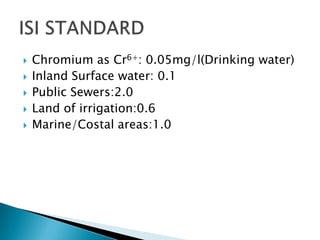
   Chromium as Cr6+: 0.05mg/l(Drinking water)
   Inland Surface water: 0.1
   Public Sewers:2.0
   Land of irrigation:0.6
   Marine/Costal areas:1.0

Chromium ppt

  • 1.
  • 2.
    Appearance-Silvery metallic  Atomic number-24  Category-Transition metal  Group,period,block-6,4,d  Oxidation States-+6 and +3(Strongly acidic oxide)  Crystal Structure-BCC(body centered cubic)  Isotopes-52Cr, 53Cr,54Cr  Ore-Chromite(FeCr2O4)
  • 3.
    Chromium(VI) is more carcinogenic than Chromium(III).  Hexavalent chromium exists in alkaline, strongly oxidizing environments, readily soluble in water.  Trivalent chromium exists in moderately oxidizing and reduced environments, sparingly soluble in water.
  • 4.
    Used on a large scale in the metallurgical and chemical industries.  The metallurgical industry: production of stainless steels, alloy cast iron and nonferrous alloys, plating steel.  The chemical industry: pigments and dyes(Cr VI and Cr III), metal finishing and electroplating, wood preservatives (Cr VI only) and leather tanning (Cr III only), Glass manufacturing.
  • 5.
    Stainless steel: Fe+Cr(11%)  Ni alloy: Used in jet engine and gas turbine due to protective and decorative property.  Chrome plating: immersing the metal parts to be plated in a bath of chromium trioxide (CrO3). A direct current is passed through the solution.  Wood preservative: Chromate(VI) copper arsenate(CCA) used in timber treatment.  Tanning: Chrome alum and Chromium(III) sulfate used to stabilize by cross linking collagen fibers.
  • 6.
    Colorimetric, Ion Chromatography, co- precipitation(Ni2+).  Cr(VI) uses diphenylcarbohydrazide (DPC) to form an intensely colored complex with Cr(VI). The complex is measured quantitatively by its visible absorption at 520 nm.  Dynamic Reaction Cell (DRC) ICP-MS: Overcome mass interference(mass/charge). Use gases like N2O, SF6, CS2, CO2 etc.
  • 7.
     Anessential elements in human.  High concentration of this can lead to DNA damage.  Essential to normal glucose, protein, and fat metabolism.  Body has several systems for reducing chromium (VI) to chromium (III) in blood before entering to the cell.  Dietary supplements: Cr(III)picolinate and Cr(III) polynicotinate.
  • 8.
    It is xenotoxic carcinogenic.  The respiratory tract is the major target organ for chromium (VI) toxicity, for acute (short- term) and chronic (long-term) inhalation exposures.  Kidney damage, liver failure,blood cell damage happens due to it’s oxidation property.  pneumonia, asthma, ulcerations of the skin(chrome ulcers), bronchitis.
  • 9.
    Hexavalent chromium is transported into cells via the sulfate and phosphate transport mechanism.  Inside the cell, Cr(VI) is reduced first to metastable pentavalent chromium Cr(V), then to trivalent chromium Cr(III).  Vitamin C and combine with chromate to give Cr(III) products inside the cell.
  • 10.
     Chromate saltscontain the chromate anion, CrO42−. Dichromate salts contain the dichromate anion, Cr2O72−. They are oxoanions of Cr in the oxidation state +6. 2[CrO4]2- + 2H+ ⇌ [Cr2O7]2- + H2O  The chromate ion is the predominant species in alkaline solutions, but dichromate can become the predominant ion in acidic solution
  • 11.
    Chrome plating :Thermal spraying using a tungsten carbide substitute as an alternative to chrome baths.  Nickel and tungsten at the atomic level to create a more environmentally friendly alternative to hexavalent chromium.  Metals in general composed of many crystal grains, controlling the size of these grains and doing nanoscale manipulation to duplicate the properties of Cr6+.
  • 12.
    Trivalent chromium plating baths use a very similar process to that used in hexavalent plating.  Low Temperature Arc Vapor Deposition (LTAVD) is a process in which parts to be coated are exposed to a vaporized metal that condenses on the parts, depositing a thin, solid film.  Heat treatments and plasma nitriding methods use heat to diffuse elements into the top surface of a substrate metal to form an alloy or layer with desired properties.
  • 13.
    Nanocrystalline coatings use electrodeposition, vapor deposition, or spray conversion processing to deposit very small grains of crystalline alloys on a metal substrate.  Thermal sprays include high velocity oxy-fuel (HVOF) and plasma sprays. Thermal spray is a coating process in which wire or metallic powder is melted by a high temperature flame and sprayed as particles or droplets onto a substrate.
  • 14.
    Chromium as Cr6+: 0.05mg/l(Drinking water)  Inland Surface water: 0.1  Public Sewers:2.0  Land of irrigation:0.6  Marine/Costal areas:1.0