Standard/ Class/ Grade XI Chemistry
Chapter 1 Basic Concepts
Gurudatta K Wagh, gkwagh@gmail.com
Isotopes, Atomic mass, Molecular mass
Isotopes
Atoms of the same elements having same atomic number
containing same number of protons and electrons but
different number of neutrons
Have different mass numbers
Hydrogen – Three isotopes, H-1 (protium 1H, 1 proton and
no neutron, 99.98 %), H-2 (1 proton and 1 neutron)
(deuterium 2H), H-3 (tritium 3H) (1 proton and 2 neutrons),
observed atomic mass 1.008 u
Neon-20 (19.9924 u), Ne-22 (21.9914 u), Ne-21 (20.9940
u). Average atomic mass of Ne = 20.1707 u
Observed atomic mass is the average atomic mass taking
into consideration the natural abundance (per cent
occurrence) of the isotopes
Atomic mass
Masses of atoms of elements is determined relative to mass
of a standard
Carbon-12 is chosen as standard
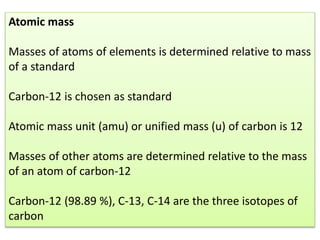
Atomic mass unit (amu) or unified mass (u) of carbon is 12
Masses of other atoms are determined relative to the mass
of an atom of carbon-12
Carbon-12 (98.89 %), C-13, C-14 are the three isotopes of
carbon
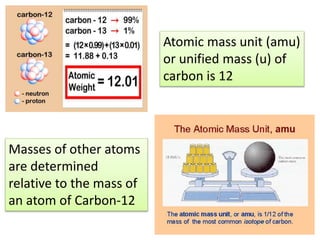
Atomic mass unit (amu)
or unified mass (u) of
carbon is 12
Masses of other atoms
are determined
relative to the mass of
an atom of Carbon-12
Molecular/ molar mass
Relative mass compared to mass of standard atom of
Carbon-12
Ratio of mass of one molecule of a substance to 1/12th of
mass of one atom of Carbon-12
Algebraic sum of atomic masses of constituent atoms
Unitless quantity
Molar mass expressed in gram is gram molar mass
1 gram molar mass = 1 gram molecule = 1 mole = 1 gram
atom
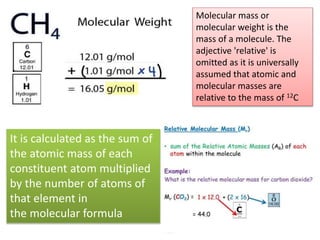
It is calculated as the sum of
the atomic mass of each
constituent atom multiplied
by the number of atoms of
that element in
the molecular formula
Molecular mass or
molecular weight is the
mass of a molecule. The
adjective 'relative' is
omitted as it is universally
assumed that atomic and
molecular masses are
relative to the mass of 12C

Std XI-Chem-Ch1-Concepts-Isotopes-Atomic-mass-Molecular-mass

  • 1.
    Standard/ Class/ GradeXI Chemistry Chapter 1 Basic Concepts Gurudatta K Wagh, gkwagh@gmail.com Isotopes, Atomic mass, Molecular mass Isotopes Atoms of the same elements having same atomic number containing same number of protons and electrons but different number of neutrons Have different mass numbers Hydrogen – Three isotopes, H-1 (protium 1H, 1 proton and no neutron, 99.98 %), H-2 (1 proton and 1 neutron) (deuterium 2H), H-3 (tritium 3H) (1 proton and 2 neutrons), observed atomic mass 1.008 u
  • 2.
    Neon-20 (19.9924 u),Ne-22 (21.9914 u), Ne-21 (20.9940 u). Average atomic mass of Ne = 20.1707 u Observed atomic mass is the average atomic mass taking into consideration the natural abundance (per cent occurrence) of the isotopes
  • 3.
    Atomic mass Masses ofatoms of elements is determined relative to mass of a standard Carbon-12 is chosen as standard Atomic mass unit (amu) or unified mass (u) of carbon is 12 Masses of other atoms are determined relative to the mass of an atom of carbon-12 Carbon-12 (98.89 %), C-13, C-14 are the three isotopes of carbon
  • 4.
    Atomic mass unit(amu) or unified mass (u) of carbon is 12 Masses of other atoms are determined relative to the mass of an atom of Carbon-12
  • 5.
    Molecular/ molar mass Relativemass compared to mass of standard atom of Carbon-12 Ratio of mass of one molecule of a substance to 1/12th of mass of one atom of Carbon-12 Algebraic sum of atomic masses of constituent atoms Unitless quantity Molar mass expressed in gram is gram molar mass 1 gram molar mass = 1 gram molecule = 1 mole = 1 gram atom
  • 6.
    It is calculatedas the sum of the atomic mass of each constituent atom multiplied by the number of atoms of that element in the molecular formula Molecular mass or molecular weight is the mass of a molecule. The adjective 'relative' is omitted as it is universally assumed that atomic and molecular masses are relative to the mass of 12C