STOICHIOMETRY:
   CALCULATIONS WITH
   CHEMICAL FORMULAS
      AND EQUATION


QBA Miguel A. Castro Ramírez
CHEMICAL EQUATIONS

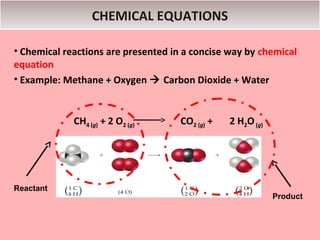
• Chemical reactions are presented in a concise way by chemical
equation
• Example: Methane + Oxygen  Carbon Dioxide + Water


             CH4 (g) + 2 O2 (g)      CO2 (g) +   2 H2O (g)


Reactant
                                                             Product
CHEMICAL EQUATIONS
CHEMICAL EQUATIONS
      Balancing Equation
• Balance the equation by determine the coefficients that provide
equal numbers of each type of atom on each side of the equation.
• Balance equation must contain the smallest possible whole
number coefficient.
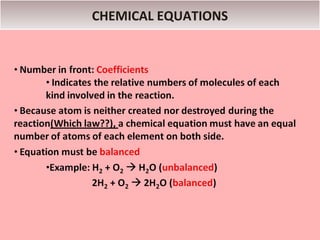
• Need to understand the coefficient in front of the formula and
subscript inside the formula.

• Two steps in balancing equation:
    1. Write the unbalanced equation
    2. Adjust the coefficients to get the equal number of each
       kind of atom on both sides of the arrow.
CHEMICAL EQUATIONS
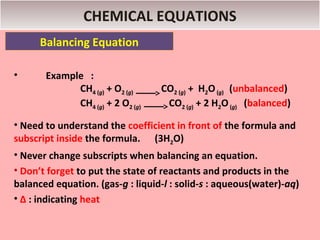
      Balancing Equation

•      Example :
             CH4 (g) + O2 (g)     CO2 (g) + H2O (g) (unbalanced)
             CH4 (g) + 2 O2 (g)    CO2 (g) + 2 H2O (g) (balanced)

• Need to understand the coefficient in front of the formula and
subscript inside the formula. (3H2O)
• Never change subscripts when balancing an equation.
• Don’t forget to put the state of reactants and products in the
balanced equation. (gas-g : liquid-l : solid-s : aqueous(water)-aq)
• Δ : indicating heat
CHEMICAL EQUATIONS

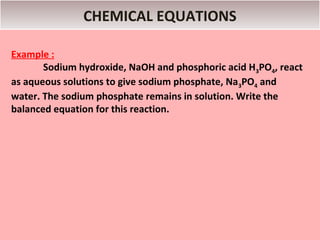
Example :
       Sodium hydroxide, NaOH and phosphoric acid H3PO4, react
as aqueous solutions to give sodium phosphate, Na3PO4 and
water. The sodium phosphate remains in solution. Write the
balanced equation for this reaction.
CHEMICAL EQUATIONS
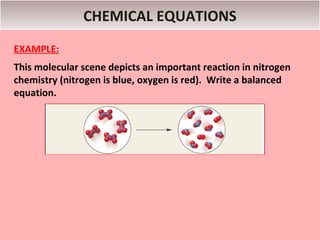
EXAMPLE:
This molecular scene depicts an important reaction in nitrogen
chemistry (nitrogen is blue, oxygen is red). Write a balanced
equation.
CHEMICAL EQUATIONS

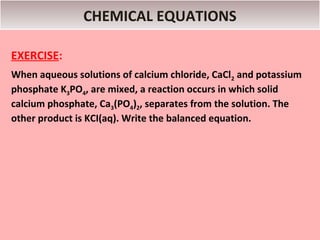
EXERCISE:
When aqueous solutions of calcium chloride, CaCl2 and potassium
phosphate K3PO4, are mixed, a reaction occurs in which solid
calcium phosphate, Ca3(PO4)2, separates from the solution. The
other product is KCI(aq). Write the balanced equation.
SOME SIMPLE PATTERNS OF CHEMICAL
               REACTIVITY
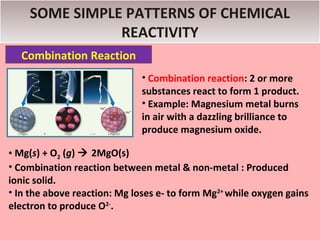
  Combination Reaction
                              • Combination reaction: 2 or more
                              substances react to form 1 product.
                              • Example: Magnesium metal burns
                              in air with a dazzling brilliance to
                              produce magnesium oxide.

• Mg(s) + O2 (g)  2MgO(s)
• Combination reaction between metal & non-metal : Produced
ionic solid.
• In the above reaction: Mg loses e- to form Mg2+ while oxygen gains
electron to produce O2-.
SOME SIMPLE PATTERNS OF CHEMICAL
           REACTIVITY
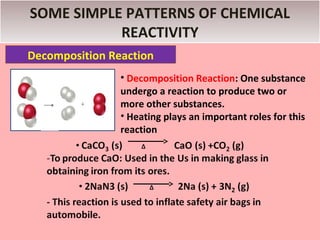
Decomposition Reaction
                • Decomposition Reaction: One substance
                undergo a reaction to produce two or
                more other substances.
                • Heating plays an important roles for this
                reaction
SOME SIMPLE PATTERNS OF CHEMICAL
             REACTIVITY
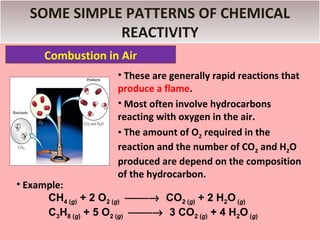
     Combustion in Air
                     • These are generally rapid reactions that
                     produce a flame.
                     • Most often involve hydrocarbons
                     reacting with oxygen in the air.
                     • The amount of O2 required in the
                     reaction and the number of CO2 and H2O
                     produced are depend on the composition
                     of the hydrocarbon.
• Example:
      CH4 (g) + 2 O2 (g) → CO2 (g) + 2 H2O (g)
      C3H8 (g) + 5 O2 (g) → 3 CO2 (g) + 4 H2O (g)
FORMULA WEIGHT
Formula and Molecular Weight
• Formula weight of a substance: Sum of the atomic weights of
each atom in its chemical formula.
    Example: FW of H2SO4 = 2(AW of H) + (AW of S) + 4(AW of O)
                            2(1 amu) + 32.1 amu + 4(16 amu)
                            98.1 amu.
    • Formula weights are generally reported for ionic
    compounds.
   • Molecular weight: Sum of the atomic weights of the atoms
   in a molecule.
       Example: MW of C12H22O11 = 12(AW of C) + 22(AW of H) +
   11(AW                                   of O)
                                   = 342.0 amu
FORMULA WEIGHT
Percentage Composition from Formulas
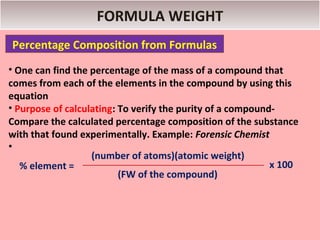
• One can find the percentage of the mass of a compound that
comes from each of the elements in the compound by using this
equation
• Purpose of calculating: To verify the purity of a compound-
Compare the calculated percentage composition of the substance
with that found experimentally. Example: Forensic Chemist
•
                   (number of atoms)(atomic weight)
   % element =                                              x 100
                          (FW of the compound)
FORMULA WEIGHT
EXAMPLE
A sample of a liquid with a mass of 8.657 g was decomposed into
its elements and gave 5.217 g of carbon, 0.9620 g of hydrogen
and 2.478g of oxygen. What is the percentage composition of this
compound?
AVOGADRO’S NUMBER AND THE MOLE

•The unit for dealing with the number of atom , ions or molecules
in a common-sized sample is the mole, abbreviated mol.
• 1 mole of atoms is the Avogadro number of the atoms.
• No Avogadro: 6.02 x 10²³ : Defined as wide variety of ways. But
it is simply understand as the conversion factor between amu and
gram.
• A mole of atoms, a mole of molecules or a mole of anything else
all contain Avogadro’s number of these objects:
              1 mol 12C atoms = 6.02 x 10²³ 12C atoms
              1 mol H2O molecules = 6.02 x 10²³ H2O molecules
AVOGADRO’S NUMBER AND THE MOLE
      Molar Mass
• Molar mass is the mass of 1 mol of a substance in gram
        - Thus, the mass of a substance (atom, element, molecule
or ions) in amu is numerically equal to the mass in gram of 1 mol of
that particular substance.


1 atom of 12C has a mass of 12 amu - 1 mol 12C has a mass of 12g
1 NO3- ion has a mass of 62 amu – 1 mol NO3- has a mass of 62 g
1 NaCl unit has a mass of 58.5 amu – 1 mol of NaCl has a mass of
58.5 g
AVOGADRO’S NUMBER AND THE MOLE
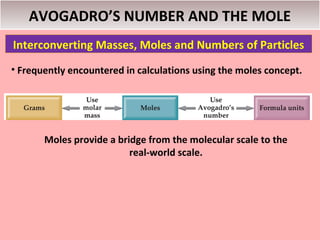
Interconverting Masses, Moles and Numbers of Particles
• Frequently encountered in calculations using the moles concept.


       Moles provide a bridge from the molecular scale to the
                          real-world scale.
AVOGADRO’S NUMBER AND THE MOLE


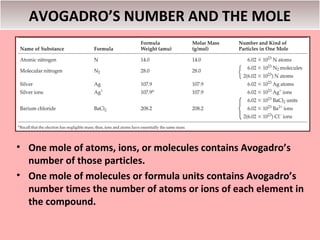
• One mole of atoms, ions, or molecules contains Avogadro’s
  number of those particles.
• One mole of molecules or formula units contains Avogadro’s
  number times the number of atoms or ions of each element in
  the compound.
AVOGADRO’S NUMBER AND THE MOLE
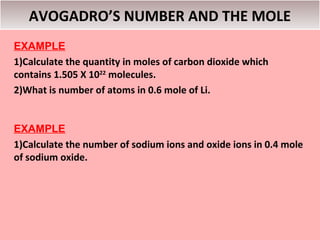
EXAMPLE
1)Calculate the quantity in moles of carbon dioxide which
contains 1.505 X 10²² molecules.
2)What is number of atoms in 0.6 mole of Li.


EXAMPLE
1)Calculate the number of sodium ions and oxide ions in 0.4 mole
of sodium oxide.
AVOGADRO’S NUMBER AND THE MOLE

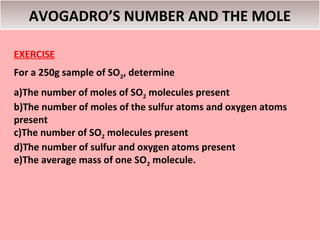
EXERCISE
For a 250g sample of SO2, determine
a)The number of moles of SO2 molecules present
b)The number of moles of the sulfur atoms and oxygen atoms
present
c)The number of SO2 molecules present
d)The number of sulfur and oxygen atoms present
e)The average mass of one SO2 molecule.
EMPIRICAL FORMULA FROM ANALYSES
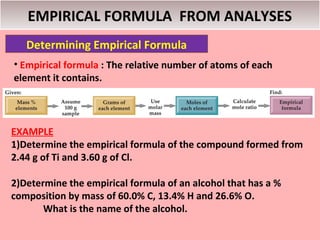
   Determining Empirical Formula
• Empirical formula : The relative number of atoms of each
element it contains.


EXAMPLE
1)Determine the empirical formula of the compound formed from
2.44 g of Ti and 3.60 g of Cl.

2)Determine the empirical formula of an alcohol that has a %
composition by mass of 60.0% C, 13.4% H and 26.6% O.
       What is the name of the alcohol.
EMPIRICAL FORMULA FROM ANALYSES
 Molecular Formula from Empirical Formula

• Formula obtained from percentage composition: Empirical
Formula
• Can obtain the molecular formula from the empirical formula if
we know the molecular weight.
• The subscripts in the molecular formula of a substance are always
a whole-number multiple of the corresponding subscripts in its
empirical formula.
• The multiple is found by comparing the formula weight of the
empirical formula with the molecular weight.
EMPIRICAL FORMULA FROM ANALYSES

EXAMPLE

Ascorbic acid (vitamin C), found in citrus fruits, tomatoes and
green vegetables is composed of 40.9% C, 4.6% H and 54.5% O.
Determine:
a) The empirical formula of ascorbic acid
b) The molecular formula if the experimentally determined
molar mass of an ascorbic acid molecule is 176.13 g/mole.
EMPIRICAL FORMULA FROM ANALYSES
EXERCISE
Elemental analysis of a sample of an ionic compound showed
2.82 g of Na, 4.35 g of Cl, and 7.83 g of O. What is the empirical
formula and name of the compound?
EMPIRICAL FORMULA FROM ANALYSES
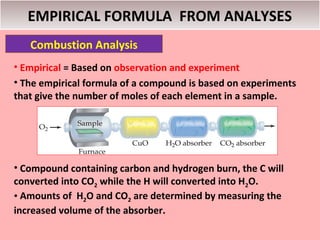
   Combustion Analysis
• Empirical = Based on observation and experiment
• The empirical formula of a compound is based on experiments
that give the number of moles of each element in a sample.


• Compound containing carbon and hydrogen burn, the C will
converted into CO2 while the H will converted into H2O.
• Amounts of H2O and CO2 are determined by measuring the
increased volume of the absorber.
EMPIRICAL FORMULA FROM ANALYSES

• From mass, we can calculate the number of moles of each
element.
•3rd element’s mass : Can be determine by subtracting the masses
of C and H from the compound's original mass.
EMPIRICAL FORMULA FROM ANALYSES

EXAMPLE

Acetic acid contains only C,H and O. A 4.24 mg sample of acetic
acid is completely burned. It gives 6.21 mg of carbon dioxide
and 2.54 mg of water. What is the mass percentage of each
element in acetic acid with 3 sig. fig?
EMPIRICAL FORMULA FROM ANALYSES

 EXERCISE
  When a 1.000 g sample of vitamin C (M = 176.12 g/mol) is placed
in a combustion chamber and burned, the following data are
obtained:
       mass of CO2 absorber after combustion     = 85.35 g
       mass of CO2 absorber before combustion    = 83.85 g
       mass of H2O absorber after combustion     = 37.96 g
       mass of H2O absorber before combustion = 37.55 g
 What is the molecular formula of vitamin C?
QUANTITATIVE INFORMATION FROM
        BALANCED EQUATION
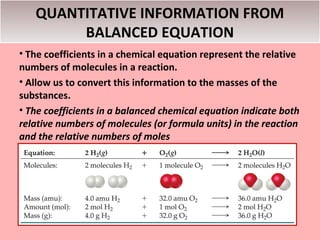
• The coefficients in a chemical equation represent the relative
numbers of molecules in a reaction.
• Allow us to convert this information to the masses of the
substances.
• The coefficients in a balanced chemical equation indicate both
relative numbers of molecules (or formula units) in the reaction
and the relative numbers of moles
QUANTITATIVE INFORMATION FROM
          BALANCED EQUATION

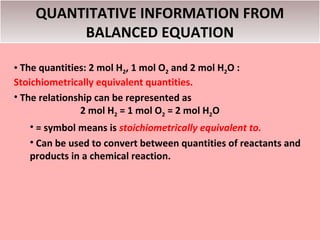
• The quantities: 2 mol H2, 1 mol O2 and 2 mol H2O :
Stoichiometrically equivalent quantities.
• The relationship can be represented as
               2 mol H2 = 1 mol O2 = 2 mol H2O
   • = symbol means is stoichiometrically equivalent to.
   • Can be used to convert between quantities of reactants and
   products in a chemical reaction.
QUANTITATIVE INFORMATION FROM
        BALANCED EQUATION
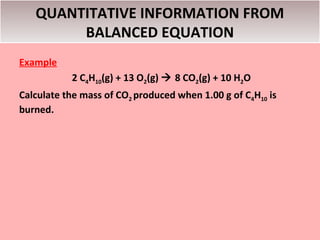
Example
           2 C4H10(g) + 13 O2(g)  8 CO2(g) + 10 H2O
Calculate the mass of CO2 produced when 1.00 g of C4H10 is
burned.
LIMITING REACTANTS


• Limiting reactant: The reactant that is entirely consumed
when a reaction goes to completion.
• Excess reactant: Reactant that is not completely consumed.
LIMITING REACTANTS

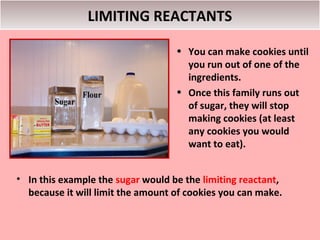
                                   • You can make cookies until
                                     you run out of one of the
                                     ingredients.
                                   • Once this family runs out
                                     of sugar, they will stop
                                     making cookies (at least
                                     any cookies you would
                                     want to eat).


• In this example the sugar would be the limiting reactant,
  because it will limit the amount of cookies you can make.
LIMITING REACTANTS

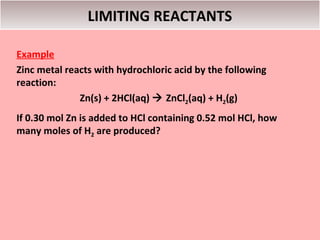
Example
Zinc metal reacts with hydrochloric acid by the following
reaction:
              Zn(s) + 2HCl(aq)  ZnCl2(aq) + H2(g)
If 0.30 mol Zn is added to HCl containing 0.52 mol HCl, how
many moles of H2 are produced?
LIMITING REACTANTS

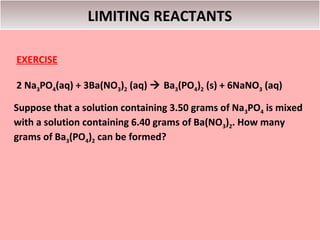
EXERCISE

2 Na3PO4(aq) + 3Ba(NO3)2 (aq)  Ba3(PO4)2 (s) + 6NaNO3 (aq)

Suppose that a solution containing 3.50 grams of Na3PO4 is mixed
with a solution containing 6.40 grams of Ba(NO3)2. How many
grams of Ba3(PO4)2 can be formed?
LIMITING REACTANTS
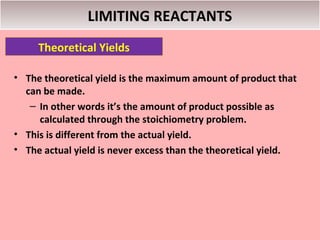
     Theoretical Yields

• The theoretical yield is the maximum amount of product that
  can be made.
   – In other words it’s the amount of product possible as
     calculated through the stoichiometry problem.
• This is different from the actual yield.
• The actual yield is never excess than the theoretical yield.
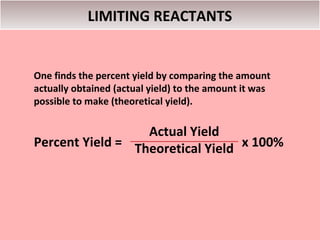
LIMITING REACTANTS


One finds the percent yield by comparing the amount
actually obtained (actual yield) to the amount it was
possible to make (theoretical yield).

                  Actual Yield
Percent Yield = Theoretical Yield x 100%
LIMITING REACTANTS

EXERCISE
Adipic acid, H2C6H8O4, is used to produce nylon. The acid is made
commercially by a controlled reaction between cyclohexane
(C6H12) and O2:

              2 C6H12(l) + 5 O2(g) → 2 H2C6H8O4(l) + 2 H2O(g)

(a) Assume that you carry out this reaction starting with 25.0 g of
cyclohexane and that cyclohexane is the limiting reactant. What
is the theoretical yield of adipic acid?
(b) If you obtain 33.5 g of adipic acid from your reaction, what is
the percent yield of adipic acid?
CALCULATIONS WITH CHEMICAL FORMULAS AND EQUATION

CALCULATIONS WITH CHEMICAL FORMULAS AND EQUATION

  • 1.
    STOICHIOMETRY: CALCULATIONS WITH CHEMICAL FORMULAS AND EQUATION QBA Miguel A. Castro Ramírez
  • 2.
    CHEMICAL EQUATIONS • Chemicalreactions are presented in a concise way by chemical equation • Example: Methane + Oxygen  Carbon Dioxide + Water CH4 (g) + 2 O2 (g) CO2 (g) + 2 H2O (g) Reactant Product
  • 3.
  • 4.
    CHEMICAL EQUATIONS Balancing Equation • Balance the equation by determine the coefficients that provide equal numbers of each type of atom on each side of the equation. • Balance equation must contain the smallest possible whole number coefficient. • Need to understand the coefficient in front of the formula and subscript inside the formula. • Two steps in balancing equation: 1. Write the unbalanced equation 2. Adjust the coefficients to get the equal number of each kind of atom on both sides of the arrow.
  • 5.
    CHEMICAL EQUATIONS Balancing Equation • Example : CH4 (g) + O2 (g) CO2 (g) + H2O (g) (unbalanced) CH4 (g) + 2 O2 (g) CO2 (g) + 2 H2O (g) (balanced) • Need to understand the coefficient in front of the formula and subscript inside the formula. (3H2O) • Never change subscripts when balancing an equation. • Don’t forget to put the state of reactants and products in the balanced equation. (gas-g : liquid-l : solid-s : aqueous(water)-aq) • Δ : indicating heat
  • 6.
    CHEMICAL EQUATIONS Example : Sodium hydroxide, NaOH and phosphoric acid H3PO4, react as aqueous solutions to give sodium phosphate, Na3PO4 and water. The sodium phosphate remains in solution. Write the balanced equation for this reaction.
  • 7.
    CHEMICAL EQUATIONS EXAMPLE: This molecularscene depicts an important reaction in nitrogen chemistry (nitrogen is blue, oxygen is red). Write a balanced equation.
  • 8.
    CHEMICAL EQUATIONS EXERCISE: When aqueoussolutions of calcium chloride, CaCl2 and potassium phosphate K3PO4, are mixed, a reaction occurs in which solid calcium phosphate, Ca3(PO4)2, separates from the solution. The other product is KCI(aq). Write the balanced equation.
  • 9.
    SOME SIMPLE PATTERNSOF CHEMICAL REACTIVITY Combination Reaction • Combination reaction: 2 or more substances react to form 1 product. • Example: Magnesium metal burns in air with a dazzling brilliance to produce magnesium oxide. • Mg(s) + O2 (g)  2MgO(s) • Combination reaction between metal & non-metal : Produced ionic solid. • In the above reaction: Mg loses e- to form Mg2+ while oxygen gains electron to produce O2-.
  • 10.
    SOME SIMPLE PATTERNSOF CHEMICAL REACTIVITY Decomposition Reaction • Decomposition Reaction: One substance undergo a reaction to produce two or more other substances. • Heating plays an important roles for this reaction
  • 11.
    SOME SIMPLE PATTERNSOF CHEMICAL REACTIVITY Combustion in Air • These are generally rapid reactions that produce a flame. • Most often involve hydrocarbons reacting with oxygen in the air. • The amount of O2 required in the reaction and the number of CO2 and H2O produced are depend on the composition of the hydrocarbon. • Example: CH4 (g) + 2 O2 (g) → CO2 (g) + 2 H2O (g) C3H8 (g) + 5 O2 (g) → 3 CO2 (g) + 4 H2O (g)
  • 12.
    FORMULA WEIGHT Formula andMolecular Weight • Formula weight of a substance: Sum of the atomic weights of each atom in its chemical formula. Example: FW of H2SO4 = 2(AW of H) + (AW of S) + 4(AW of O) 2(1 amu) + 32.1 amu + 4(16 amu) 98.1 amu. • Formula weights are generally reported for ionic compounds. • Molecular weight: Sum of the atomic weights of the atoms in a molecule. Example: MW of C12H22O11 = 12(AW of C) + 22(AW of H) + 11(AW of O) = 342.0 amu
  • 13.
    FORMULA WEIGHT Percentage Compositionfrom Formulas • One can find the percentage of the mass of a compound that comes from each of the elements in the compound by using this equation • Purpose of calculating: To verify the purity of a compound- Compare the calculated percentage composition of the substance with that found experimentally. Example: Forensic Chemist • (number of atoms)(atomic weight) % element = x 100 (FW of the compound)
  • 14.
    FORMULA WEIGHT EXAMPLE A sampleof a liquid with a mass of 8.657 g was decomposed into its elements and gave 5.217 g of carbon, 0.9620 g of hydrogen and 2.478g of oxygen. What is the percentage composition of this compound?
  • 15.
    AVOGADRO’S NUMBER ANDTHE MOLE •The unit for dealing with the number of atom , ions or molecules in a common-sized sample is the mole, abbreviated mol. • 1 mole of atoms is the Avogadro number of the atoms. • No Avogadro: 6.02 x 10²³ : Defined as wide variety of ways. But it is simply understand as the conversion factor between amu and gram. • A mole of atoms, a mole of molecules or a mole of anything else all contain Avogadro’s number of these objects: 1 mol 12C atoms = 6.02 x 10²³ 12C atoms 1 mol H2O molecules = 6.02 x 10²³ H2O molecules
  • 16.
    AVOGADRO’S NUMBER ANDTHE MOLE Molar Mass • Molar mass is the mass of 1 mol of a substance in gram - Thus, the mass of a substance (atom, element, molecule or ions) in amu is numerically equal to the mass in gram of 1 mol of that particular substance. 1 atom of 12C has a mass of 12 amu - 1 mol 12C has a mass of 12g 1 NO3- ion has a mass of 62 amu – 1 mol NO3- has a mass of 62 g 1 NaCl unit has a mass of 58.5 amu – 1 mol of NaCl has a mass of 58.5 g
  • 17.
    AVOGADRO’S NUMBER ANDTHE MOLE Interconverting Masses, Moles and Numbers of Particles • Frequently encountered in calculations using the moles concept. Moles provide a bridge from the molecular scale to the real-world scale.
  • 18.
    AVOGADRO’S NUMBER ANDTHE MOLE • One mole of atoms, ions, or molecules contains Avogadro’s number of those particles. • One mole of molecules or formula units contains Avogadro’s number times the number of atoms or ions of each element in the compound.
  • 19.
    AVOGADRO’S NUMBER ANDTHE MOLE EXAMPLE 1)Calculate the quantity in moles of carbon dioxide which contains 1.505 X 10²² molecules. 2)What is number of atoms in 0.6 mole of Li. EXAMPLE 1)Calculate the number of sodium ions and oxide ions in 0.4 mole of sodium oxide.
  • 20.
    AVOGADRO’S NUMBER ANDTHE MOLE EXERCISE For a 250g sample of SO2, determine a)The number of moles of SO2 molecules present b)The number of moles of the sulfur atoms and oxygen atoms present c)The number of SO2 molecules present d)The number of sulfur and oxygen atoms present e)The average mass of one SO2 molecule.
  • 21.
    EMPIRICAL FORMULA FROMANALYSES Determining Empirical Formula • Empirical formula : The relative number of atoms of each element it contains. EXAMPLE 1)Determine the empirical formula of the compound formed from 2.44 g of Ti and 3.60 g of Cl. 2)Determine the empirical formula of an alcohol that has a % composition by mass of 60.0% C, 13.4% H and 26.6% O. What is the name of the alcohol.
  • 22.
    EMPIRICAL FORMULA FROMANALYSES Molecular Formula from Empirical Formula • Formula obtained from percentage composition: Empirical Formula • Can obtain the molecular formula from the empirical formula if we know the molecular weight. • The subscripts in the molecular formula of a substance are always a whole-number multiple of the corresponding subscripts in its empirical formula. • The multiple is found by comparing the formula weight of the empirical formula with the molecular weight.
  • 23.
    EMPIRICAL FORMULA FROMANALYSES EXAMPLE Ascorbic acid (vitamin C), found in citrus fruits, tomatoes and green vegetables is composed of 40.9% C, 4.6% H and 54.5% O. Determine: a) The empirical formula of ascorbic acid b) The molecular formula if the experimentally determined molar mass of an ascorbic acid molecule is 176.13 g/mole.
  • 24.
    EMPIRICAL FORMULA FROMANALYSES EXERCISE Elemental analysis of a sample of an ionic compound showed 2.82 g of Na, 4.35 g of Cl, and 7.83 g of O. What is the empirical formula and name of the compound?
  • 25.
    EMPIRICAL FORMULA FROMANALYSES Combustion Analysis • Empirical = Based on observation and experiment • The empirical formula of a compound is based on experiments that give the number of moles of each element in a sample. • Compound containing carbon and hydrogen burn, the C will converted into CO2 while the H will converted into H2O. • Amounts of H2O and CO2 are determined by measuring the increased volume of the absorber.
  • 26.
    EMPIRICAL FORMULA FROMANALYSES • From mass, we can calculate the number of moles of each element. •3rd element’s mass : Can be determine by subtracting the masses of C and H from the compound's original mass.
  • 27.
    EMPIRICAL FORMULA FROMANALYSES EXAMPLE Acetic acid contains only C,H and O. A 4.24 mg sample of acetic acid is completely burned. It gives 6.21 mg of carbon dioxide and 2.54 mg of water. What is the mass percentage of each element in acetic acid with 3 sig. fig?
  • 28.
    EMPIRICAL FORMULA FROMANALYSES EXERCISE When a 1.000 g sample of vitamin C (M = 176.12 g/mol) is placed in a combustion chamber and burned, the following data are obtained: mass of CO2 absorber after combustion = 85.35 g mass of CO2 absorber before combustion = 83.85 g mass of H2O absorber after combustion = 37.96 g mass of H2O absorber before combustion = 37.55 g What is the molecular formula of vitamin C?
  • 29.
    QUANTITATIVE INFORMATION FROM BALANCED EQUATION • The coefficients in a chemical equation represent the relative numbers of molecules in a reaction. • Allow us to convert this information to the masses of the substances. • The coefficients in a balanced chemical equation indicate both relative numbers of molecules (or formula units) in the reaction and the relative numbers of moles
  • 30.
    QUANTITATIVE INFORMATION FROM BALANCED EQUATION • The quantities: 2 mol H2, 1 mol O2 and 2 mol H2O : Stoichiometrically equivalent quantities. • The relationship can be represented as 2 mol H2 = 1 mol O2 = 2 mol H2O • = symbol means is stoichiometrically equivalent to. • Can be used to convert between quantities of reactants and products in a chemical reaction.
  • 31.
    QUANTITATIVE INFORMATION FROM BALANCED EQUATION Example 2 C4H10(g) + 13 O2(g)  8 CO2(g) + 10 H2O Calculate the mass of CO2 produced when 1.00 g of C4H10 is burned.
  • 32.
    LIMITING REACTANTS • Limitingreactant: The reactant that is entirely consumed when a reaction goes to completion. • Excess reactant: Reactant that is not completely consumed.
  • 33.
    LIMITING REACTANTS • You can make cookies until you run out of one of the ingredients. • Once this family runs out of sugar, they will stop making cookies (at least any cookies you would want to eat). • In this example the sugar would be the limiting reactant, because it will limit the amount of cookies you can make.
  • 34.
    LIMITING REACTANTS Example Zinc metalreacts with hydrochloric acid by the following reaction: Zn(s) + 2HCl(aq)  ZnCl2(aq) + H2(g) If 0.30 mol Zn is added to HCl containing 0.52 mol HCl, how many moles of H2 are produced?
  • 35.
    LIMITING REACTANTS EXERCISE 2 Na3PO4(aq)+ 3Ba(NO3)2 (aq)  Ba3(PO4)2 (s) + 6NaNO3 (aq) Suppose that a solution containing 3.50 grams of Na3PO4 is mixed with a solution containing 6.40 grams of Ba(NO3)2. How many grams of Ba3(PO4)2 can be formed?
  • 36.
    LIMITING REACTANTS Theoretical Yields • The theoretical yield is the maximum amount of product that can be made. – In other words it’s the amount of product possible as calculated through the stoichiometry problem. • This is different from the actual yield. • The actual yield is never excess than the theoretical yield.
  • 37.
    LIMITING REACTANTS One findsthe percent yield by comparing the amount actually obtained (actual yield) to the amount it was possible to make (theoretical yield). Actual Yield Percent Yield = Theoretical Yield x 100%
  • 38.
    LIMITING REACTANTS EXERCISE Adipic acid,H2C6H8O4, is used to produce nylon. The acid is made commercially by a controlled reaction between cyclohexane (C6H12) and O2: 2 C6H12(l) + 5 O2(g) → 2 H2C6H8O4(l) + 2 H2O(g) (a) Assume that you carry out this reaction starting with 25.0 g of cyclohexane and that cyclohexane is the limiting reactant. What is the theoretical yield of adipic acid? (b) If you obtain 33.5 g of adipic acid from your reaction, what is the percent yield of adipic acid?