JPN Pahang                                                                Physics Module Form 4
                                                                                  Chapter 5 Light
CHAPTER 5: LIGHT
In each of the following sentences, fill in the bracket the appropriate word or words given below.

           solid, liquid, gas, vacuum, electromagnetic wave, energy

1. Light is a form of (            ).
2. It travels in the form of (                      )
3. In can travel through (                                    )
4. It travels fastest in the medium of (                )
5. Light of different colours travels at the same speed in the medium of (              )

Light allows us to see objects.
Light can be reflected or refracted.

5.1 UNDERSTANDING REFLECTION OF LIGHT

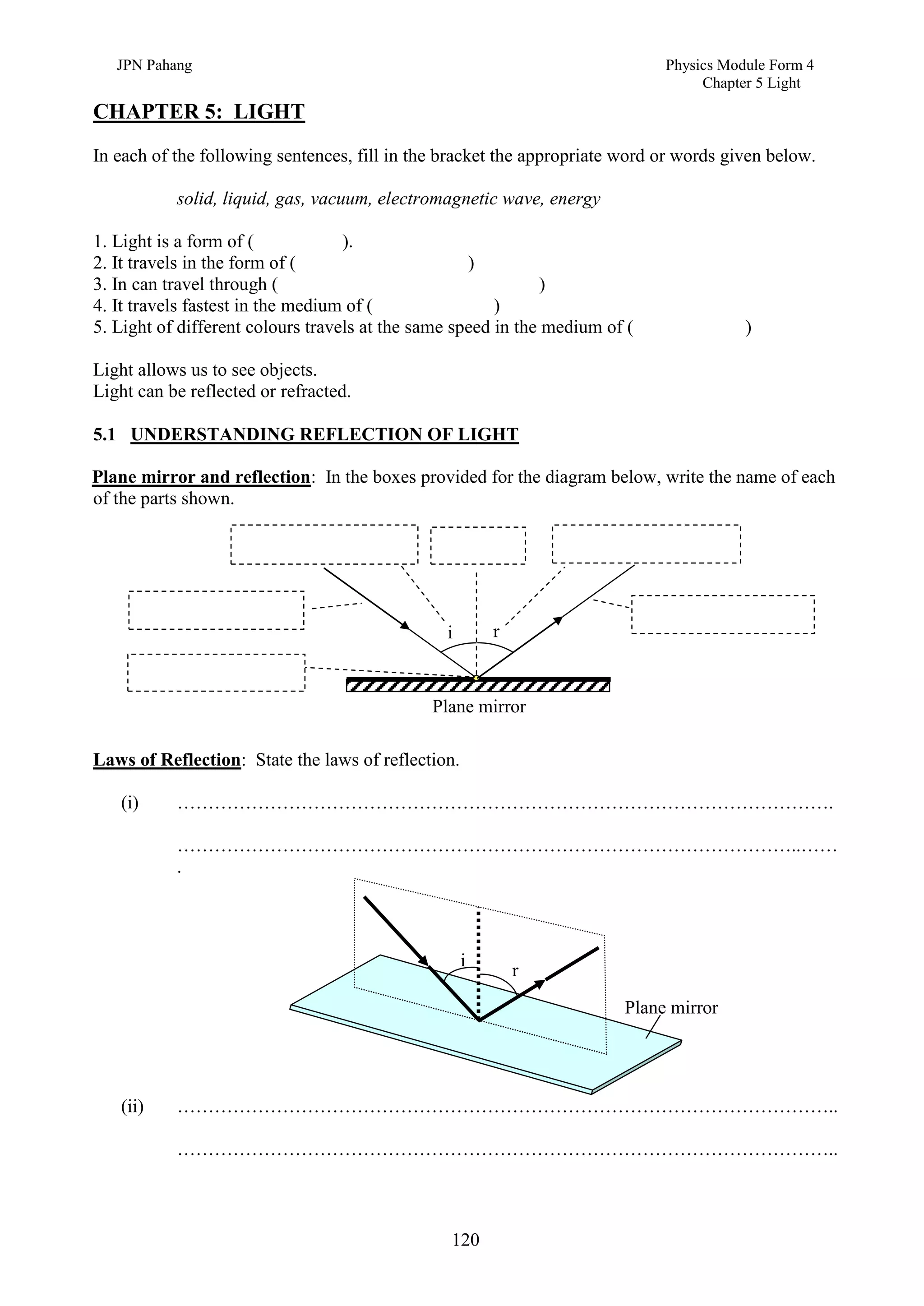
Plane mirror and reflection: In the boxes provided for the diagram below, write the name of each
of the parts shown.


                                                i       r


                                              Plane mirror

Laws of Reflection: State the laws of reflection.

   (i)     …………………………………………………………………………………………….

           ………………………………………………………………………………………..……
           .


                                                    i
                                                            r

                                                                        Plane mirror


   (ii)    ……………………………………………………………………………………………..

           ……………………………………………………………………………………………..


                                                 120
JPN Pahang                                                                                          Physics Module Form 4
                                                                                                            Chapter 5 Light
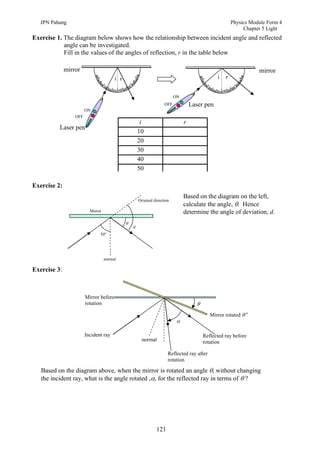
Exercise 1. The diagram below shows how the relationship between incident angle and reflected
            angle can be investigated.
            Fill in the values of the angles of reflection, r in the table below

              mirror                                                                                               mirror
                                        i r                                                      i r

                                                                           ON
                                                                     OFF            Laser pen
                        ON
                  OFF
                                                       i                        r
          Laser pen
                                                      10
                                                      20
                                                      30
                                                      40
                                                      50

Exercise 2:
                                                                                Based on the diagram on the left,
                                                      Original direction
                                                                                calculate the angle, . Hence
                          Mirror                                                determine the angle of deviation, d.
                                              
                                                  d
                                              o
                               50o


                                   normal

Exercise 3:


                        Mirror before
                        rotation                                                       
                                                                                              Mirror rotated  o
                                                                            

                        Incident ray                                                       Reflected ray before
                                                        normal                             rotation

                                                                       Reflected ray after
                                                                       rotation

   Based on the diagram above, when the mirror is rotated an angle , without changing
   the incident ray, what is the angle rotated ,, for the reflected ray in terms of  ?


                                                                121
JPN Pahang                                                                   Physics Module Form 4
                                                                                     Chapter 5 Light


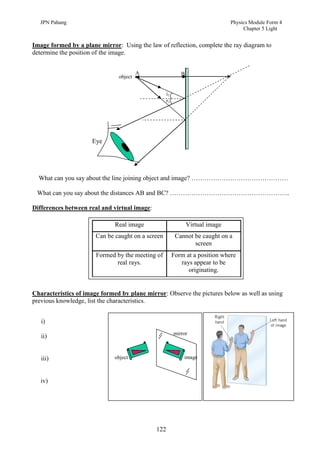
Image formed by a plane mirror: Using the law of reflection, complete the ray diagram to
determine the position of the image.


                                        A                   B
                               object


                                                    i1
                                                    r1


                      Eye


  What can you say about the line joining object and image? ………………………………………

 What can you say about the distances AB and BC? ………………………………………………..

Differences between real and virtual image:

                              Real image                        Virtual image
                       Can be caught on a screen          Cannot be caught on a
                                                                 screen
                       Formed by the meeting of          Form at a position where
                              real rays.                    rays appear to be
                                                               originating.


Characteristics of image formed by plane mirror: Observe the pictures below as well as using
previous knowledge, list the characteristics.


   i)
                                                         mirror
   ii)


   iii)                       object                         image


   iv)


                                              122
JPN Pahang                                                               Physics Module Form 4
                                                                                 Chapter 5 Light


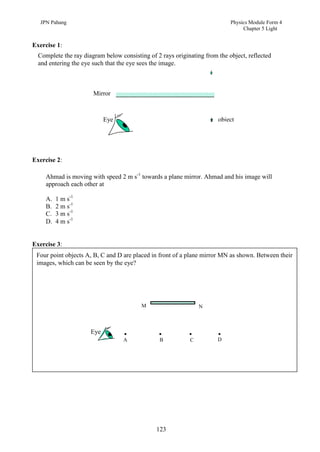
Exercise 1:
  Complete the ray diagram below consisting of 2 rays originating from the object, reflected
  and entering the eye such that the eye sees the image.


                       Mirror


                            Eye                                        object


Exercise 2:

     Ahmad is moving with speed 2 m s-1 towards a plane mirror. Ahmad and his image will
     approach each other at

     A.   1 m s-1
     B.   2 m s-1
     C.   3 m s-1
     D.   4 m s-1


Exercise 3:
 Four point objects A, B, C and D are placed in front of a plane mirror MN as shown. Between their
 images, which can be seen by the eye?


                                         M                      N


                      Eye
                                  A             B           C          D


                                               123
JPN Pahang                                                                 Physics Module Form 4
                                                                                  Chapter 5 Light


ACTIVITY:      Find out some of the uses of plane mirrors (application of reflection).


                                                124
JPN Pahang                                                                  Physics Module Form 4
                                                                                    Chapter 5 Light
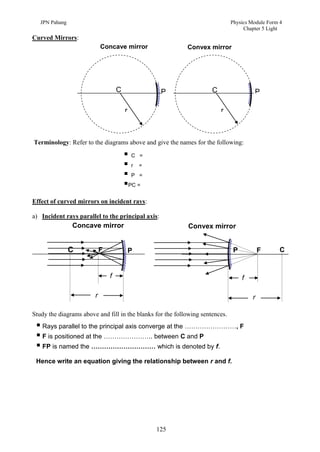
Curved Mirrors:
                            Concave mirror                  Convex mirror


                                    C              P                  C                 P

                                        r                                 r


Terminology: Refer to the diagrams above and give the names for the following:
                                        C =
                                        r =
                                        P =
                                        PC =
Effect of curved mirrors on incident rays:

a) Incident rays parallel to the principal axis:
                Concave mirror                              Convex mirror


                C           F               P                                   P           F      C


                                f                                                   f

                        r                                                               r

Study the diagrams above and fill in the blanks for the following sentences.
  Rays parallel to the principal axis converge at the ……………………, F
  F is positioned at the ………………….. between C and P
  FP is named the ………………………… which is denoted by f.
 Hence write an equation giving the relationship between r and f.


                                                125
JPN Pahang                                                                 Physics Module Form 4
                                                                                   Chapter 5 Light
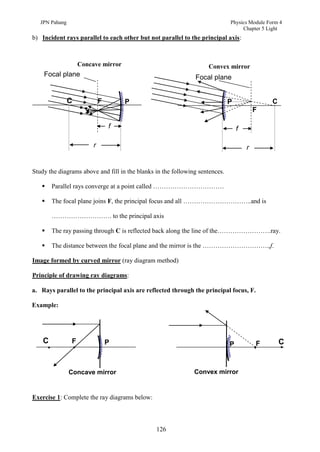
b) Incident rays parallel to each other but not parallel to the principal axis:


                    Concave mirror                                  Convex mirror
    Focal plane                                                Focal plane


                C            F       P                                        P                C
                                                                                          F

                                 f                                                f

                         r                                                            r


Study the diagrams above and fill in the blanks in the following sentences.

       Parallel rays converge at a point called ……………………………

       The focal plane joins F, the principal focus and all …………………………..and is

        ………………………. to the principal axis

       The ray passing through C is reflected back along the line of the…………………….ray.

       The distance between the focal plane and the mirror is the ………………………….,f.

Image formed by curved mirror (ray diagram method)

Principle of drawing ray diagrams:

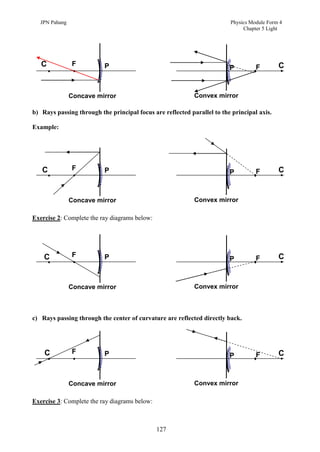
a. Rays parallel to the principal axis are reflected through the principal focus, F.

Example:


    C           F                P                                            P           F        C


                Concave mirror                                 Convex mirror


Exercise 1: Complete the ray diagrams below:


                                                126
JPN Pahang                                                            Physics Module Form 4
                                                                              Chapter 5 Light


   C            F         P                                              P         F        C


                Concave mirror                              Convex mirror

b) Rays passing through the principal focus are reflected parallel to the principal axis.

Example:


   C            F         P                                                                 C
                                                                         P         F


                Concave mirror                              Convex mirror

Exercise 2: Complete the ray diagrams below:


    C           F         P                                                                 C
                                                                         P         F


                Concave mirror                              Convex mirror


c) Rays passing through the center of curvature are reflected directly back.


    C           F         P                                                                 C
                                                                         P         F


                Concave mirror                              Convex mirror

Exercise 3: Complete the ray diagrams below:


                                               127
JPN Pahang                                                               Physics Module Form 4
                                                                                   Chapter 5 Light


      C           F         P                                                                    C
                                                                             P          F


                  Concave mirror                                  Convex mirror


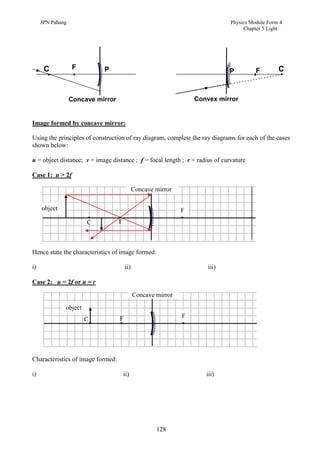
Image formed by concave mirror:

Using the principles of construction of ray diagram, complete the ray diagrams for each of the cases
shown below:

u = object distance; v = image distance ; f = focal length ; r = radius of curvature

Case 1: u > 2f

                                             Concave mirror

     object                                                   F
                       C           F


Hence state the characteristics of image formed:

i)                                     ii)                            iii)

Case 2: u = 2f or u = r

                                             Concave mirror
              object
                                   F                          F
                       C


Characteristics of image formed:

i)                                     ii)                           iii)


                                                     128
JPN Pahang                                                       Physics Module Form 4
                                                                           Chapter 5 Light
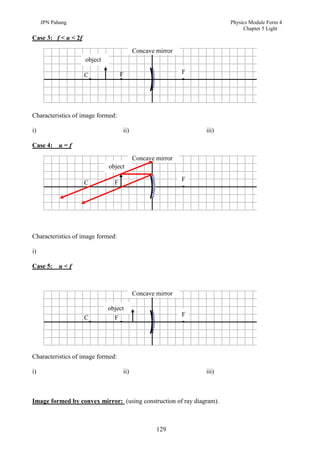
Case 3: f < u < 2f

                                          Concave mirror
                     object

                                    F                      F
                     C


Characteristics of image formed:

i)                                  ii)                        iii)

Case 4: u = f

                                          Concave mirror
                              object
                                                           F
                     C          F


Characteristics of image formed:

i)

Case 5: u < f


                                          Concave mirror

                              object
                                                           F
                     C          F


Characteristics of image formed:

i)                                  ii)                        iii)


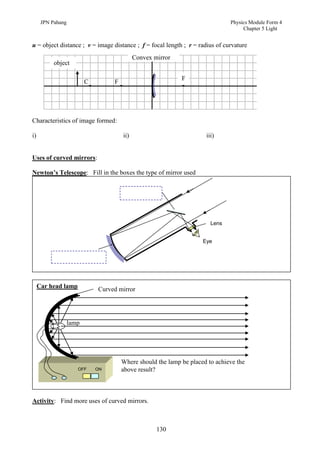
Image formed by convex mirror: (using construction of ray diagram).


                                                  129
JPN Pahang                                                               Physics Module Form 4
                                                                                    Chapter 5 Light


u = object distance ; v = image distance ; f = focal length ; r = radius of curvature
                                             Convex mirror
           object

                                                             F
                          C        F


Characteristics of image formed:

i)                                     ii)                            iii)


Uses of curved mirrors:

Newton’s Telescope: Fill in the boxes the type of mirror used


                                                                        Lens


                                                                     Eye


     Car head lamp            Curved mirror


                   lamp


                                       Where should the lamp be placed to achieve the
                      OFF     ON       above result?


Activity: Find more uses of curved mirrors.


                                                     130
JPN Pahang         Physics Module Form 4
                        Chapter 5 Light


             131
JPN Pahang                                                                Physics Module Form 4
                                                                                  Chapter 5 Light
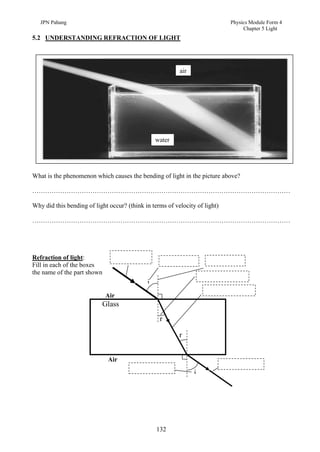
5.2 UNDERSTANDING REFRACTION OF LIGHT


                                                          air


                                                 water


What is the phenomenon which causes the bending of light in the picture above?

…………………………………………………………………………………………………………

Why did this bending of light occur? (think in terms of velocity of light)

…………………………………………………………………………………………………………


Refraction of light:
Fill in each of the boxes
the name of the part shown
                                             i
                             Air
                           Glass
                                                  r

                                                          r


                              Air

                                                                i


                                                 132
JPN Pahang                                                                  Physics Module Form 4
                                                                                    Chapter 5 Light
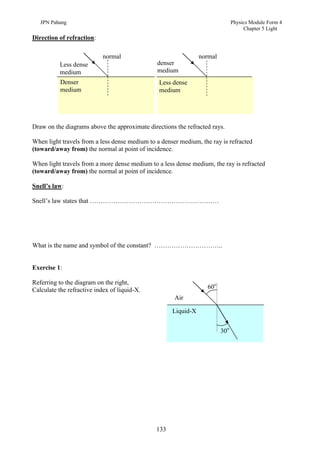
Direction of refraction:

                            normal                              normal
          Less dense                           denser
          medium                               medium
           Denser                               Less dense
           medium                               medium


Draw on the diagrams above the approximate directions the refracted rays.

When light travels from a less dense medium to a denser medium, the ray is refracted
(toward/away from) the normal at point of incidence.

When light travels from a more dense medium to a less dense medium, the ray is refracted
(toward/away from) the normal at point of incidence.

Snell’s law:

Snell’s law states that ……………………………………………………


What is the name and symbol of the constant? …………………………..


Exercise 1:

Referring to the diagram on the right,
Calculate the refractive index of liquid-X.                       60o
                                                      Air

                                                     Liquid-X


                                                                         30o


                                               133
JPN Pahang                                                                   Physics Module Form 4
                                                                                     Chapter 5 Light
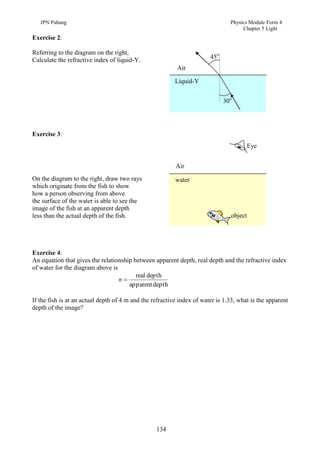
Exercise 2:

Referring to the diagram on the right,
Calculate the refractive index of liquid-Y.                             45o
                                                          Air

                                                          Liquid-Y


                                                                              30o


Exercise 3:
                                                                                         Eye


                                                          Air
On the diagram to the right, draw two rays                water
which originate from the fish to show
how a person observing from above
the surface of the water is able to see the
image of the fish at an apparent depth
less than the actual depth of the fish.                                         object


Exercise 4:
An equation that gives the relationship between apparent depth, real depth and the refractive index
of water for the diagram above is
                                         real depth
                                  n
                                      apparent depth

If the fish is at an actual depth of 4 m and the refractive index of water is 1.33, what is the apparent
depth of the image?


                                                  134
JPN Pahang                                                               Physics Module Form 4
                                                                                     Chapter 5 Light


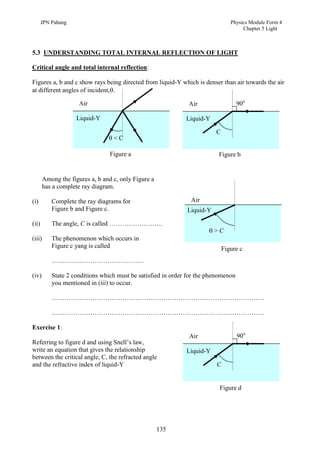
5.3 UNDERSTANDING TOTAL INTERNAL REFLECTION OF LIGHT

Critical angle and total internal reflection:

Figures a, b and c show rays being directed from liquid-Y which is denser than air towards the air
at different angles of incident,.

                      Air                                      Air                  90o

                     Liquid-Y                                 Liquid-Y

                                                                         C
                                 <C

                                  Figure a                                Figure b


        Among the figures a, b and c, only Figure a
        has a complete ray diagram.

(i)        Complete the ray diagrams for                        Air
           Figure b and Figure c.                             Liquid-Y

(ii)       The angle, C is called …………………….
                                                                       >C
(iii)      The phenomenon which occurs in
           Figure c yang is called                                           Figure c
           …………………………………….

(iv)       State 2 conditions which must be satisfied in order for the phenomenon
           you mentioned in (iii) to occur.

           ………………………………………………………………………………………

           ………………………………………………………………………………………

Exercise 1:
                                                               Air                  90o
Referring to figure d and using Snell’s law,
write an equation that gives the relationship                 Liquid-Y
between the critical angle, C, the refracted angle
and the refractive index of liquid-Y                                     C


                                                                           Figure d


                                                      135
JPN Pahang                                                                Physics Module Form 4
                                                                                  Chapter 5 Light


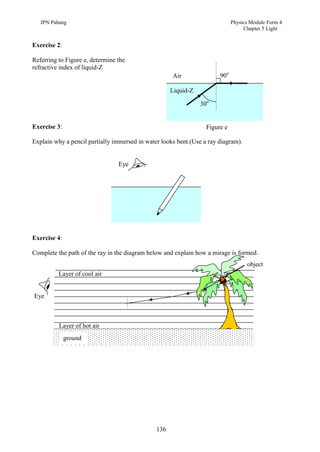
Exercise 2:

Referring to Figure e, determine the
refractive index of liquid-Z
                                                     Air               90o

                                                     Liquid-Z

                                                                30o


Exercise 3:                                                       Figure e

Explain why a pencil partially immersed in water looks bent.(Use a ray diagram).


                                 Eye


Exercise 4:

Complete the path of the ray in the diagram below and explain how a mirage is formed.
                                                                                   object
          Layer of cool air


Eye


          Layer of hot air
              ground


                                               136
JPN Pahang                                                              Physics Module Form 4
                                                                                Chapter 5 Light
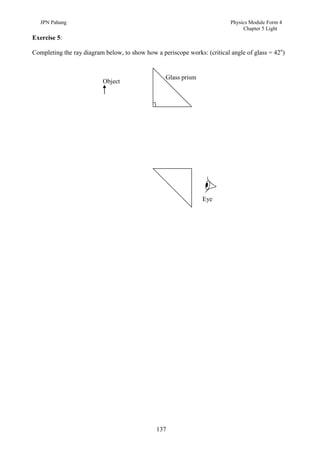
Exercise 5:

Completing the ray diagram below, to show how a periscope works: (critical angle of glass = 42o)


                                                  Glass prism
                          Object


                                                                Eye


                                               137
JPN Pahang                                                   Physics Module Form 4
                                                                         Chapter 5 Light
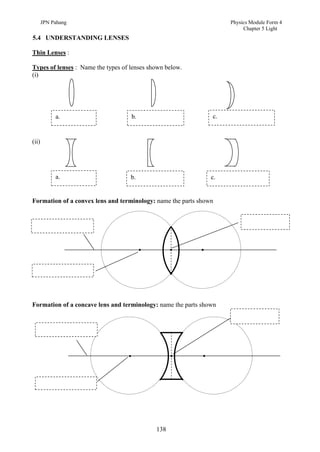
5.4 UNDERSTANDING LENSES

Thin Lenses :

Types of lenses : Name the types of lenses shown below.
(i)


            a.                      b.                         c.


(ii)


            a.                      b.                         c.


Formation of a convex lens and terminology: name the parts shown


Formation of a concave lens and terminology: name the parts shown


                                             138
JPN Pahang                                                               Physics Module Form 4
                                                                                     Chapter 5 Light
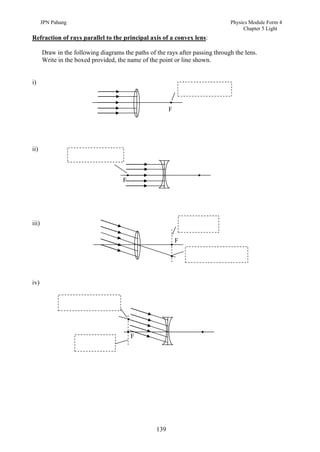
Refraction of rays parallel to the principal axis of a convex lens:

       Draw in the following diagrams the paths of the rays after passing through the lens.
       Write in the boxed provided, the name of the point or line shown.


i)


                                                         F


ii)


                                      F


iii)

                                                             F


iv)


                                          F


                                                   139
JPN Pahang                                                             Physics Module Form 4
                                                                                  Chapter 5 Light


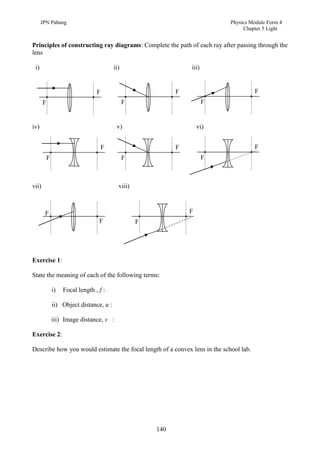
Principles of constructing ray diagrams: Complete the path of each ray after passing through the
lens

 i)                                       ii)                     iii)


                                  F                           F                        F
       F                                        F                        F


iv)                                        v)                         vi)


                                      F                       F                        F
           F                                    F                        F


vii)                                        viii)


       F                                                          F
                                   F                F


Exercise 1:

State the meaning of each of the following terms:

               i)   Focal length , f :

               ii) Object distance, u :

               iii) Image distance, v :

Exercise 2:

Describe how you would estimate the focal length of a convex lens in the school lab.


                                                        140
JPN Pahang                                                                  Physics Module Form 4
                                                                                 Chapter 5 Light
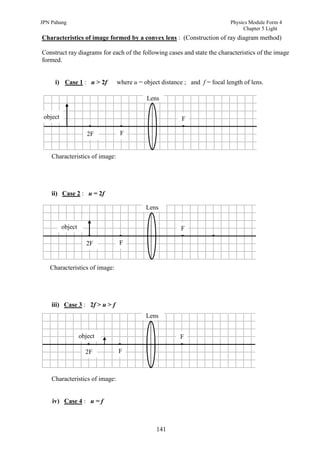
Characteristics of image formed by a convex lens : (Construction of ray diagram method)

Construct ray diagrams for each of the following cases and state the characteristics of the image
formed.


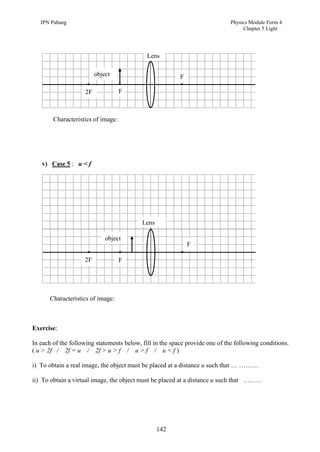
     i) Case 1 : u > 2f         where u = object distance ; and f = focal length of lens.

                                           Lens

 object                                                  F

                      2F         F


    Characteristics of image:


    ii) Case 2 : u = 2f

                                           Lens


          object                                        F

                     2F          F


   Characteristics of image:


    iii) Case 3 : 2f > u > f
                                           Lens


                   object                               F

                     2F         F


    Characteristics of image:


    iv) Case 4 : u = f


                                               141
JPN Pahang                                                                 Physics Module Form 4
                                                                                   Chapter 5 Light


                                             Lens

                         object                           F

                    2F              F


        Characteristics of image:


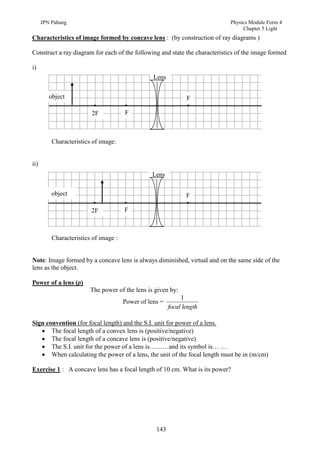
   v) Case 5 : u < f


                                           Lens

                             object
                                                              F

                    2F              F


      Characteristics of image:


Exercise:

In each of the following statements below, fill in the space provide one of the following conditions.
( u > 2f / 2f = u / 2f > u > f / u > f / u < f )

i) To obtain a real image, the object must be placed at a distance u such that … ………

ii) To obtain a virtual image, the object must be placed at a distance u such that ………


                                                  142
JPN Pahang                                                             Physics Module Form 4
                                                                                  Chapter 5 Light
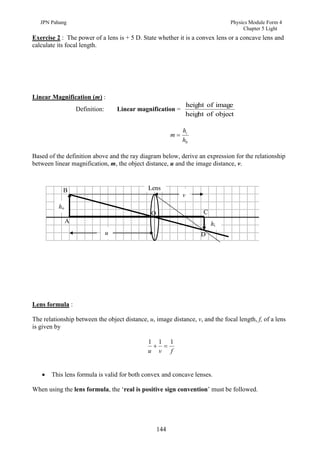
Characteristics of image formed by concave lens : (by construction of ray diagrams )

Construct a ray diagram for each of the following and state the characteristics of the image formed

i)
                                                  Lens


         object                                                 F

                         2F            F


          Characteristics of image:


ii)
                                                 Lens

          object                                                F

                         2F            F


          Characteristics of image :


Note: Image formed by a concave lens is always diminished, virtual and on the same side of the
lens as the object.

Power of a lens (p)
                         The power of the lens is given by:
                                                              1
                                       Power of lens =
                                                         focal length

Sign convention (for focal length) and the S.I. unit for power of a lens.
    The focal length of a convex lens is (positive/negative)
    The focal length of a concave lens is (positive/negative)
    The S.I. unit for the power of a lens is…....…and its symbol is… …
    When calculating the power of a lens, the unit of the focal length must be in (m/cm)

Exercise 1 : A concave lens has a focal length of 10 cm. What is its power?


                                                   143
JPN Pahang                                                                    Physics Module Form 4
                                                                                      Chapter 5 Light
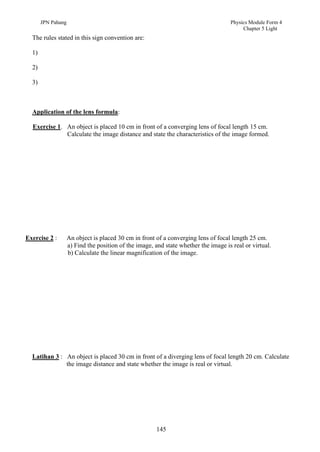
Exercise 2 : The power of a lens is + 5 D. State whether it is a convex lens or a concave lens and
calculate its focal length.


Linear Magnification (m) :
                                                                   height of image
                   Definition:       Linear magnification =
                                                                   height of object

                                                               hi
                                                          m
                                                               h0

Based of the definition above and the ray diagram below, derive an expression for the relationship
between linear magnification, m, the object distance, u and the image distance, v.


            B                                  Lens
                                                               v
          ho
                                                O                       C
               A                                                            hi
                                 u                                      D


Lens formula :

The relationship between the object distance, u, image distance, v, and the focal length, f, of a lens
is given by

                                               1 1 1
                                                 
                                               u v f


      This lens formula is valid for both convex and concave lenses.

When using the lens formula, the ‘real is positive sign convention’ must be followed.


                                                    144
JPN Pahang                                                                    Physics Module Form 4
                                                                                          Chapter 5 Light
  The rules stated in this sign convention are:

  1)

  2)

  3)


  Application of the lens formula:

  Exercise 1. An object is placed 10 cm in front of a converging lens of focal length 15 cm.
              Calculate the image distance and state the characteristics of the image formed.


Exercise 2 :        An object is placed 30 cm in front of a converging lens of focal length 25 cm.
                    a) Find the position of the image, and state whether the image is real or virtual.
                    b) Calculate the linear magnification of the image.


  Latihan 3 : An object is placed 30 cm in front of a diverging lens of focal length 20 cm. Calculate
              the image distance and state whether the image is real or virtual.


                                                        145
JPN Pahang                                                                Physics Module Form 4
                                                                                  Chapter 5 Light
Lenses and optical instruments :

1. Magnifying glass (simple microscope ):

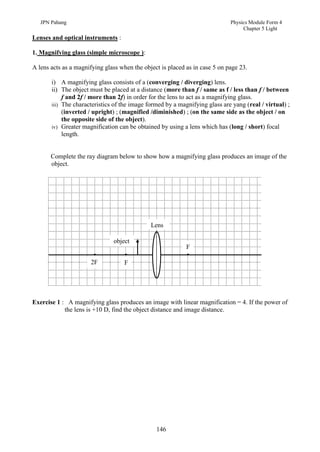
A lens acts as a magnifying glass when the object is placed as in case 5 on page 23.

       i) A magnifying glass consists of a (converging / diverging) lens.
       ii) The object must be placed at a distance (more than f / same as f / less than f / between
            f and 2f / more than 2f) in order for the lens to act as a magnifying glass.
       iii) The characteristics of the image formed by a magnifying glass are yang (real / virtual) ;
            (inverted / upright) ; (magnified /diminished) ; (on the same side as the object / on
            the opposite side of the object).
       iv) Greater magnification can be obtained by using a lens which has (long / short) focal
            length.


       Complete the ray diagram below to show how a magnifying glass produces an image of the
       object.


                                              Lens

                               object
                                                            F

                      2F           F


Exercise 1 : A magnifying glass produces an image with linear magnification = 4. If the power of
            the lens is +10 D, find the object distance and image distance.


                                                146
JPN Pahang                                                              Physics Module Form 4
                                                                                Chapter 5 Light
Exercise 2: Which of the following lenses with their powers given below makes the magnifying
            glass with the highest power of magnification?

             A. – 5 D         B. –25 D          C. +5 D        D. +25 D.

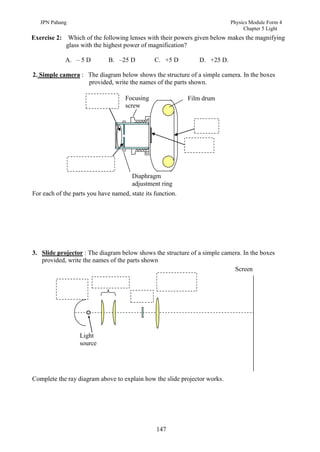
2. Simple camera : The diagram below shows the structure of a simple camera. In the boxes
                   provided, write the names of the parts shown.

                                    Focusing                Film drum
                                    screw


                                       Diaphragm
                                       adjustment ring
For each of the parts you have named, state its function.


3. Slide projector : The diagram below shows the structure of a simple camera. In the boxes
   provided, write the names of the parts shown
                                                                           Screen


                  Light
                  source


Complete the ray diagram above to explain how the slide projector works.


                                                 147
JPN Pahang                                                                    Physics Module Form 4
                                                                                      Chapter 5 Light
4. Astronomical telescope :

   Making of the astronomical telescope.

           The astronomical telescope consists of 2 (converging / diverging) lenses.
           The objective lens has focal length, fo and the eye lens has focal length, fe where ( fo < fe
            / fo > fe ).
           The lenses are arranged such that the distance between the objective lens and the eye
            lens is (fo – fe / fo + fe / fo x fe / fo/fe).


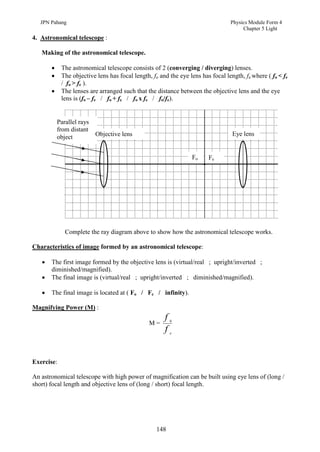
           Parallel rays
           from distant
           object          Objective lens                                         Eye lens


                                                                 Fo     Fe


              Complete the ray diagram above to show how the astronomical telescope works.

Characteristics of image formed by an astronomical telescope:

      The first image formed by the objective lens is (virtual/real ; upright/inverted ;
       diminished/magnified).
      The final image is (virtual/real ; upright/inverted ; diminished/magnified).

      The final image is located at ( Fo / Fe / infinity).

Magnifying Power (M) :
                                                      f   0
                                                M=
                                                      f   e


Exercise:

An astronomical telescope with high power of magnification can be built using eye lens of (long /
short) focal length and objective lens of (long / short) focal length.


                                                   148
JPN Pahang                                                                   Physics Module Form 4
                                                                                     Chapter 5 Light
5. The compound microscope :

   Structure of the compound microscope:

      A compound microscope consists of 2 (converging / diverging) lenses
      The focal length of the eye lens is (long / short) and the focal length of the objective lens is
       (long / short).
      The objective lens is arranged such that the object distance, u is (u = fo / fo < u < 2 fo / u
       =2fo).
      The eye lens is used as a (magnifying / diverging / projector) lens.
      The total length, s, between both lenses is ( s = fo + fe ; s > fo+fe )


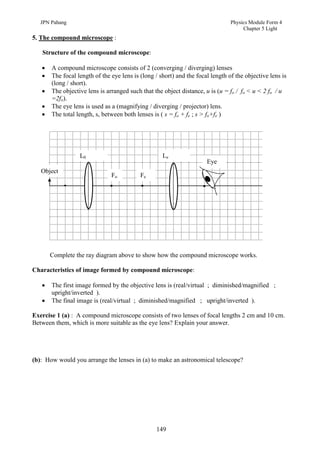
                  L0                                Le
                                                                      Eye
   Object
                               Fo          Fe


       Complete the ray diagram above to show how the compound microscope works.

Characteristics of image formed by compound microscope:

      The first image formed by the objective lens is (real/virtual ; diminished/magnified ;
       upright/inverted ).
      The final image is (real/virtual ; diminished/magnified ; upright/inverted ).

Exercise 1 (a) : A compound microscope consists of two lenses of focal lengths 2 cm and 10 cm.
Between them, which is more suitable as the eye lens? Explain your answer.


(b): How would you arrange the lenses in (a) to make an astronomical telescope?


                                                 149
JPN Pahang                                                                  Physics Module Form 4
                                                                                    Chapter 5 Light
Reinforcement:

Part A:

1. Between the following statements about reflection of light, which is not true?

    A. All light energy incident on a plane mirror is reflected.
    B. The angle of incidence is always the same as the angle of reflection.
    C. The incident ray, the reflected ray and the normal to the point of incidence, all lie on the
       same plane.
    D. The speed of the reflected ray is the same as the speed of the incident ray.

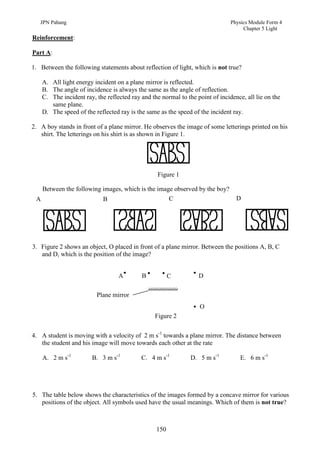
2. A boy stands in front of a plane mirror. He observes the image of some letterings printed on his
   shirt. The letterings on his shirt is as shown in Figure 1.


                                                  Figure 1

   Between the following images, which is the image observed by the boy?
 A                       B                        C                              D


3. Figure 2 shows an object, O placed in front of a plane mirror. Between the positions A, B, C
   and D, which is the position of the image?


                                  A        B           C          D

                         Plane mirror
                                                                  O
                                                 Figure 2


4. A student is moving with a velocity of 2 m s-1 towards a plane mirror. The distance between
   the student and his image will move towards each other at the rate

    A. 2 m s-1         B. 3 m s-1          C. 4 m s-1          D. 5 m s-1          E. 6 m s-1


5. The table below shows the characteristics of the images formed by a concave mirror for various
   positions of the object. All symbols used have the usual meanings. Which of them is not true?


                                                 150
JPN Pahang                                                                     Physics Module Form 4
                                                                                       Chapter 5 Light


                       Position of object                   Characteristics of image
           A                 u > 2f                         Diminished, inverted, real
           B               f < u < 2f                       Magnified, inverted, real
           C                  u=f                           Same size, inverted, real
           D                  u<f                           Maginfied, upright, virtual


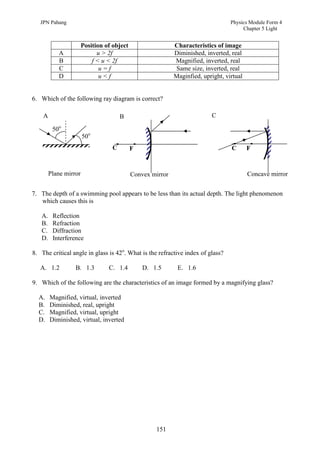
6. Which of the following ray diagram is correct?

    A                                  B                                  C

         50o
                       50o
                                   C        F                                     C       F


        Plane mirror                        Convex mirror                                 Concave mirror


7. The depth of a swimming pool appears to be less than its actual depth. The light phenomenon
   which causes this is

   A.    Reflection
   B.    Refraction
   C.    Diffraction
   D.    Interference

8. The critical angle in glass is 42o. What is the refractive index of glass?

   A. 1.2         B. 1.3         C. 1.4         D. 1.5       E. 1.6

9. Which of the following are the characteristics of an image formed by a magnifying glass?

  A.    Magnified, virtual, inverted
  B.    Diminished, real, upright
  C.    Magnified, virtual, upright
  D.    Diminished, virtual, inverted


                                                    151
JPN Pahang                                                                    Physics Module Form 4
                                                                                        Chapter 5 Light
10. A student is given three convex lenses of focal lengths 2 cm, 10 cm and 50 cm. He wishes to
construct a powerful astronomical telescope. Which of the following arrangements should he
choose?

                  Focal length of objective lens / cm          Focal length of eye lens / cm
         A                        50                                         2
         B                        10                                        10
         C                         2                                        50
         D                        50                                        10


Part B

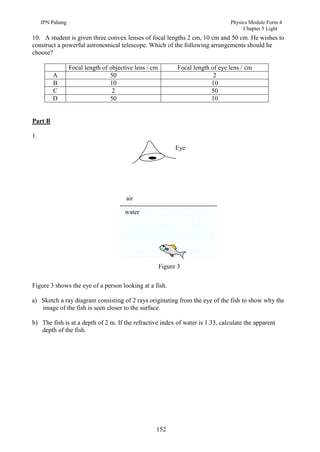
1.
                                                              Eye


                                        air

                                        water


                                                        Figure 3

Figure 3 shows the eye of a person looking at a fish.

a) Sketch a ray diagram consisting of 2 rays originating from the eye of the fish to show why the
   image of the fish is seen closer to the surface.

b) The fish is at a depth of 2 m. If the refractive index of water is 1.33, calculate the apparent
   depth of the fish.


                                                    152
JPN Pahang                                                                 Physics Module Form 4
                                                                                     Chapter 5 Light


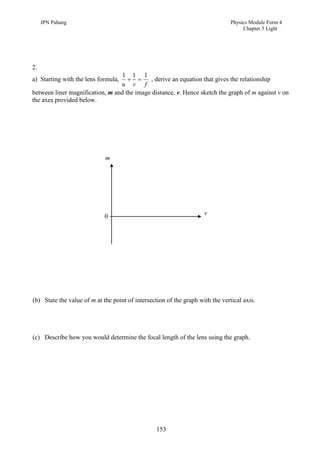
2.
                                 1 1 1
a) Starting with the lens formula,        , derive an equation that gives the relationship
                                 u v f
between liner magnification, m and the image distance, v. Hence sketch the graph of m against v on
the axes provided below.


                             m


                                                                     v
                             0


(b) State the value of m at the point of intersection of the graph with the vertical axis.


(c) Describe how you would determine the focal length of the lens using the graph.


                                                  153
JPN Pahang                                                               Physics Module Form 4
                                                                                   Chapter 5 Light


Part C

1.

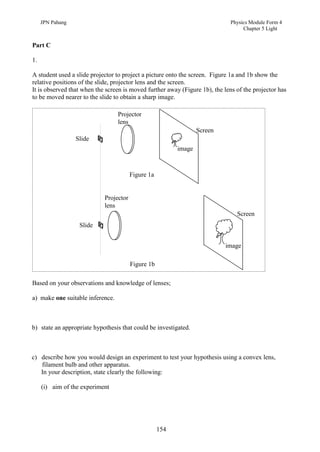
A student used a slide projector to project a picture onto the screen. Figure 1a and 1b show the
relative positions of the slide, projector lens and the screen.
It is observed that when the screen is moved further away (Figure 1b), the lens of the projector has
to be moved nearer to the slide to obtain a sharp image.

                                  Projector
                                  lens
                                                                  Screen
                  Slide
                                                          image


                                        Figure 1a


                            Projector
                            lens
                                                                                Screen
                   Slide


                                                                            image

                                        Figure 1b

Based on your observations and knowledge of lenses;

a) make one suitable inference.


b) state an appropriate hypothesis that could be investigated.


c) describe how you would design an experiment to test your hypothesis using a convex lens,
   filament bulb and other apparatus.
   In your description, state clearly the following:

     (i) aim of the experiment


                                                    154
JPN Pahang                                                            Physics Module Form 4
                                                                           Chapter 5 Light


(ii) variables in the experiment


(iii) List of apparatus and materials


(iv) Arrangement of the apparatus


(v) The procedure of the experiment, which includes the method of controlling the
      manipulated variable and the method of measuring the responding variable


(vi) The way you tabulate the data


                                           155
JPN Pahang                                                              Physics Module Form 4
                                                                                     Chapter 5 Light
        (vii) The way you would analyse the data


  2.
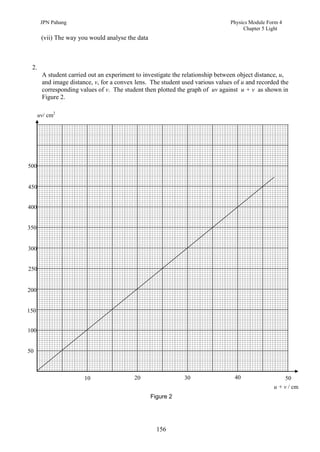
        A student carried out an experiment to investigate the relationship between object distance, u,
        and image distance, v, for a convex lens. The student used various values of u and recorded the
        corresponding values of v. The student then plotted the graph of uv against u + v as shown in
        Figure 2.

       uv/ cm2


500


500
 450


400


350
55

300
0

250


200
0

150


100


50


                        10                 20                 30                  40                  50
                                                                                                 u + v / cm
                                                   Figure 2


                                                     156
JPN Pahang                                                               Physics Module Form 4
                                                                                   Chapter 5 Light


a)    Based on the graph in Figure 2,

      (i) state the relationship between uv and u + v

          …………………………………………………………………………………………
                                                                                        [1 mark]
      (ii) determine the value of u + v when the value of uv = 400 cm2. Show on the graph how
           you obtained the value of u + v.


           From the value of u + v obtained, calculate the image distance, v when u = 20 cm.


                                                                                           [3 marks]
      (iii) calculate the gradient of the graph. Show clearly on the graph how you obtained the
           values needed for the calculation.


                                                                                              [3 marks]

b) Given that the relationship between u, v and focal length, f of the convex lens used, is
   represented by the equation
                        1    + 1        = 1
                        u         v          f
   Derive an equation which gives the relationship between uv and (u + v ).


                                                                                             [2 marks]
c) Using the equation derived in (b), and the value of gradient calculated in (a)(iii), determine the
   focal length of the lens used in the experiment.


                                                                                              [2 marks]

d) State one precaution taken to ensure the accuracy of the experiment.

       ……………………………………………………………………………………                                                       [1 mark]


                                                 157

SPM PHYSICS FORM 4 light

  • 1.
    JPN Pahang Physics Module Form 4 Chapter 5 Light CHAPTER 5: LIGHT In each of the following sentences, fill in the bracket the appropriate word or words given below. solid, liquid, gas, vacuum, electromagnetic wave, energy 1. Light is a form of ( ). 2. It travels in the form of ( ) 3. In can travel through ( ) 4. It travels fastest in the medium of ( ) 5. Light of different colours travels at the same speed in the medium of ( ) Light allows us to see objects. Light can be reflected or refracted. 5.1 UNDERSTANDING REFLECTION OF LIGHT Plane mirror and reflection: In the boxes provided for the diagram below, write the name of each of the parts shown. i r Plane mirror Laws of Reflection: State the laws of reflection. (i) ……………………………………………………………………………………………. ………………………………………………………………………………………..…… . i r Plane mirror (ii) …………………………………………………………………………………………….. …………………………………………………………………………………………….. 120
  • 2.
    JPN Pahang Physics Module Form 4 Chapter 5 Light Exercise 1. The diagram below shows how the relationship between incident angle and reflected angle can be investigated. Fill in the values of the angles of reflection, r in the table below mirror mirror i r i r ON OFF Laser pen ON OFF i r Laser pen 10 20 30 40 50 Exercise 2: Based on the diagram on the left, Original direction calculate the angle, . Hence Mirror determine the angle of deviation, d.  d o 50o normal Exercise 3: Mirror before rotation  Mirror rotated  o  Incident ray Reflected ray before normal rotation Reflected ray after rotation Based on the diagram above, when the mirror is rotated an angle , without changing the incident ray, what is the angle rotated ,, for the reflected ray in terms of  ? 121
  • 3.
    JPN Pahang Physics Module Form 4 Chapter 5 Light Image formed by a plane mirror: Using the law of reflection, complete the ray diagram to determine the position of the image. A B object i1 r1 Eye What can you say about the line joining object and image? ……………………………………… What can you say about the distances AB and BC? ……………………………………………….. Differences between real and virtual image: Real image Virtual image Can be caught on a screen Cannot be caught on a screen Formed by the meeting of Form at a position where real rays. rays appear to be originating. Characteristics of image formed by plane mirror: Observe the pictures below as well as using previous knowledge, list the characteristics. i) mirror ii) iii) object image iv) 122
  • 4.
    JPN Pahang Physics Module Form 4 Chapter 5 Light Exercise 1: Complete the ray diagram below consisting of 2 rays originating from the object, reflected and entering the eye such that the eye sees the image. Mirror Eye object Exercise 2: Ahmad is moving with speed 2 m s-1 towards a plane mirror. Ahmad and his image will approach each other at A. 1 m s-1 B. 2 m s-1 C. 3 m s-1 D. 4 m s-1 Exercise 3: Four point objects A, B, C and D are placed in front of a plane mirror MN as shown. Between their images, which can be seen by the eye? M N Eye A B C D 123
  • 5.
    JPN Pahang Physics Module Form 4 Chapter 5 Light ACTIVITY: Find out some of the uses of plane mirrors (application of reflection). 124
  • 6.
    JPN Pahang Physics Module Form 4 Chapter 5 Light Curved Mirrors: Concave mirror Convex mirror C P C P r r Terminology: Refer to the diagrams above and give the names for the following: C = r = P = PC = Effect of curved mirrors on incident rays: a) Incident rays parallel to the principal axis: Concave mirror Convex mirror C F P P F C f f r r Study the diagrams above and fill in the blanks for the following sentences.  Rays parallel to the principal axis converge at the ……………………, F  F is positioned at the ………………….. between C and P  FP is named the ………………………… which is denoted by f. Hence write an equation giving the relationship between r and f. 125
  • 7.
    JPN Pahang Physics Module Form 4 Chapter 5 Light b) Incident rays parallel to each other but not parallel to the principal axis: Concave mirror Convex mirror Focal plane Focal plane C F P P C F f f r r Study the diagrams above and fill in the blanks in the following sentences.  Parallel rays converge at a point called ……………………………  The focal plane joins F, the principal focus and all …………………………..and is ………………………. to the principal axis  The ray passing through C is reflected back along the line of the…………………….ray.  The distance between the focal plane and the mirror is the ………………………….,f. Image formed by curved mirror (ray diagram method) Principle of drawing ray diagrams: a. Rays parallel to the principal axis are reflected through the principal focus, F. Example: C F P P F C Concave mirror Convex mirror Exercise 1: Complete the ray diagrams below: 126
  • 8.
    JPN Pahang Physics Module Form 4 Chapter 5 Light C F P P F C Concave mirror Convex mirror b) Rays passing through the principal focus are reflected parallel to the principal axis. Example: C F P C P F Concave mirror Convex mirror Exercise 2: Complete the ray diagrams below: C F P C P F Concave mirror Convex mirror c) Rays passing through the center of curvature are reflected directly back. C F P C P F Concave mirror Convex mirror Exercise 3: Complete the ray diagrams below: 127
  • 9.
    JPN Pahang Physics Module Form 4 Chapter 5 Light C F P C P F Concave mirror Convex mirror Image formed by concave mirror: Using the principles of construction of ray diagram, complete the ray diagrams for each of the cases shown below: u = object distance; v = image distance ; f = focal length ; r = radius of curvature Case 1: u > 2f Concave mirror object F C F Hence state the characteristics of image formed: i) ii) iii) Case 2: u = 2f or u = r Concave mirror object F F C Characteristics of image formed: i) ii) iii) 128
  • 10.
    JPN Pahang Physics Module Form 4 Chapter 5 Light Case 3: f < u < 2f Concave mirror object F F C Characteristics of image formed: i) ii) iii) Case 4: u = f Concave mirror object F C F Characteristics of image formed: i) Case 5: u < f Concave mirror object F C F Characteristics of image formed: i) ii) iii) Image formed by convex mirror: (using construction of ray diagram). 129
  • 11.
    JPN Pahang Physics Module Form 4 Chapter 5 Light u = object distance ; v = image distance ; f = focal length ; r = radius of curvature Convex mirror object F C F Characteristics of image formed: i) ii) iii) Uses of curved mirrors: Newton’s Telescope: Fill in the boxes the type of mirror used Lens Eye Car head lamp Curved mirror lamp Where should the lamp be placed to achieve the OFF ON above result? Activity: Find more uses of curved mirrors. 130
  • 12.
    JPN Pahang Physics Module Form 4 Chapter 5 Light 131
  • 13.
    JPN Pahang Physics Module Form 4 Chapter 5 Light 5.2 UNDERSTANDING REFRACTION OF LIGHT air water What is the phenomenon which causes the bending of light in the picture above? ………………………………………………………………………………………………………… Why did this bending of light occur? (think in terms of velocity of light) ………………………………………………………………………………………………………… Refraction of light: Fill in each of the boxes the name of the part shown i Air Glass r r Air i 132
  • 14.
    JPN Pahang Physics Module Form 4 Chapter 5 Light Direction of refraction: normal normal Less dense denser medium medium Denser Less dense medium medium Draw on the diagrams above the approximate directions the refracted rays. When light travels from a less dense medium to a denser medium, the ray is refracted (toward/away from) the normal at point of incidence. When light travels from a more dense medium to a less dense medium, the ray is refracted (toward/away from) the normal at point of incidence. Snell’s law: Snell’s law states that …………………………………………………… What is the name and symbol of the constant? ………………………….. Exercise 1: Referring to the diagram on the right, Calculate the refractive index of liquid-X. 60o Air Liquid-X 30o 133
  • 15.
    JPN Pahang Physics Module Form 4 Chapter 5 Light Exercise 2: Referring to the diagram on the right, Calculate the refractive index of liquid-Y. 45o Air Liquid-Y 30o Exercise 3: Eye Air On the diagram to the right, draw two rays water which originate from the fish to show how a person observing from above the surface of the water is able to see the image of the fish at an apparent depth less than the actual depth of the fish. object Exercise 4: An equation that gives the relationship between apparent depth, real depth and the refractive index of water for the diagram above is real depth n apparent depth If the fish is at an actual depth of 4 m and the refractive index of water is 1.33, what is the apparent depth of the image? 134
  • 16.
    JPN Pahang Physics Module Form 4 Chapter 5 Light 5.3 UNDERSTANDING TOTAL INTERNAL REFLECTION OF LIGHT Critical angle and total internal reflection: Figures a, b and c show rays being directed from liquid-Y which is denser than air towards the air at different angles of incident,. Air Air 90o Liquid-Y Liquid-Y C <C Figure a Figure b Among the figures a, b and c, only Figure a has a complete ray diagram. (i) Complete the ray diagrams for Air Figure b and Figure c. Liquid-Y (ii) The angle, C is called ……………………. >C (iii) The phenomenon which occurs in Figure c yang is called Figure c ……………………………………. (iv) State 2 conditions which must be satisfied in order for the phenomenon you mentioned in (iii) to occur. ……………………………………………………………………………………… ……………………………………………………………………………………… Exercise 1: Air 90o Referring to figure d and using Snell’s law, write an equation that gives the relationship Liquid-Y between the critical angle, C, the refracted angle and the refractive index of liquid-Y C Figure d 135
  • 17.
    JPN Pahang Physics Module Form 4 Chapter 5 Light Exercise 2: Referring to Figure e, determine the refractive index of liquid-Z Air 90o Liquid-Z 30o Exercise 3: Figure e Explain why a pencil partially immersed in water looks bent.(Use a ray diagram). Eye Exercise 4: Complete the path of the ray in the diagram below and explain how a mirage is formed. object Layer of cool air Eye Layer of hot air ground 136
  • 18.
    JPN Pahang Physics Module Form 4 Chapter 5 Light Exercise 5: Completing the ray diagram below, to show how a periscope works: (critical angle of glass = 42o) Glass prism Object Eye 137
  • 19.
    JPN Pahang Physics Module Form 4 Chapter 5 Light 5.4 UNDERSTANDING LENSES Thin Lenses : Types of lenses : Name the types of lenses shown below. (i) a. b. c. (ii) a. b. c. Formation of a convex lens and terminology: name the parts shown Formation of a concave lens and terminology: name the parts shown 138
  • 20.
    JPN Pahang Physics Module Form 4 Chapter 5 Light Refraction of rays parallel to the principal axis of a convex lens: Draw in the following diagrams the paths of the rays after passing through the lens. Write in the boxed provided, the name of the point or line shown. i) F ii) F iii) F iv) F 139
  • 21.
    JPN Pahang Physics Module Form 4 Chapter 5 Light Principles of constructing ray diagrams: Complete the path of each ray after passing through the lens i) ii) iii) F F F F F F iv) v) vi) F F F F F F vii) viii) F F F F Exercise 1: State the meaning of each of the following terms: i) Focal length , f : ii) Object distance, u : iii) Image distance, v : Exercise 2: Describe how you would estimate the focal length of a convex lens in the school lab. 140
  • 22.
    JPN Pahang Physics Module Form 4 Chapter 5 Light Characteristics of image formed by a convex lens : (Construction of ray diagram method) Construct ray diagrams for each of the following cases and state the characteristics of the image formed. i) Case 1 : u > 2f where u = object distance ; and f = focal length of lens. Lens object F 2F F Characteristics of image: ii) Case 2 : u = 2f Lens object F 2F F Characteristics of image: iii) Case 3 : 2f > u > f Lens object F 2F F Characteristics of image: iv) Case 4 : u = f 141
  • 23.
    JPN Pahang Physics Module Form 4 Chapter 5 Light Lens object F 2F F Characteristics of image: v) Case 5 : u < f Lens object F 2F F Characteristics of image: Exercise: In each of the following statements below, fill in the space provide one of the following conditions. ( u > 2f / 2f = u / 2f > u > f / u > f / u < f ) i) To obtain a real image, the object must be placed at a distance u such that … ……… ii) To obtain a virtual image, the object must be placed at a distance u such that ……… 142
  • 24.
    JPN Pahang Physics Module Form 4 Chapter 5 Light Characteristics of image formed by concave lens : (by construction of ray diagrams ) Construct a ray diagram for each of the following and state the characteristics of the image formed i) Lens object F 2F F Characteristics of image: ii) Lens object F 2F F Characteristics of image : Note: Image formed by a concave lens is always diminished, virtual and on the same side of the lens as the object. Power of a lens (p) The power of the lens is given by: 1 Power of lens = focal length Sign convention (for focal length) and the S.I. unit for power of a lens.  The focal length of a convex lens is (positive/negative)  The focal length of a concave lens is (positive/negative)  The S.I. unit for the power of a lens is…....…and its symbol is… …  When calculating the power of a lens, the unit of the focal length must be in (m/cm) Exercise 1 : A concave lens has a focal length of 10 cm. What is its power? 143
  • 25.
    JPN Pahang Physics Module Form 4 Chapter 5 Light Exercise 2 : The power of a lens is + 5 D. State whether it is a convex lens or a concave lens and calculate its focal length. Linear Magnification (m) : height of image Definition: Linear magnification = height of object hi m h0 Based of the definition above and the ray diagram below, derive an expression for the relationship between linear magnification, m, the object distance, u and the image distance, v. B Lens v ho O C A hi u D Lens formula : The relationship between the object distance, u, image distance, v, and the focal length, f, of a lens is given by 1 1 1   u v f  This lens formula is valid for both convex and concave lenses. When using the lens formula, the ‘real is positive sign convention’ must be followed. 144
  • 26.
    JPN Pahang Physics Module Form 4 Chapter 5 Light The rules stated in this sign convention are: 1) 2) 3) Application of the lens formula: Exercise 1. An object is placed 10 cm in front of a converging lens of focal length 15 cm. Calculate the image distance and state the characteristics of the image formed. Exercise 2 : An object is placed 30 cm in front of a converging lens of focal length 25 cm. a) Find the position of the image, and state whether the image is real or virtual. b) Calculate the linear magnification of the image. Latihan 3 : An object is placed 30 cm in front of a diverging lens of focal length 20 cm. Calculate the image distance and state whether the image is real or virtual. 145
  • 27.
    JPN Pahang Physics Module Form 4 Chapter 5 Light Lenses and optical instruments : 1. Magnifying glass (simple microscope ): A lens acts as a magnifying glass when the object is placed as in case 5 on page 23. i) A magnifying glass consists of a (converging / diverging) lens. ii) The object must be placed at a distance (more than f / same as f / less than f / between f and 2f / more than 2f) in order for the lens to act as a magnifying glass. iii) The characteristics of the image formed by a magnifying glass are yang (real / virtual) ; (inverted / upright) ; (magnified /diminished) ; (on the same side as the object / on the opposite side of the object). iv) Greater magnification can be obtained by using a lens which has (long / short) focal length. Complete the ray diagram below to show how a magnifying glass produces an image of the object. Lens object F 2F F Exercise 1 : A magnifying glass produces an image with linear magnification = 4. If the power of the lens is +10 D, find the object distance and image distance. 146
  • 28.
    JPN Pahang Physics Module Form 4 Chapter 5 Light Exercise 2: Which of the following lenses with their powers given below makes the magnifying glass with the highest power of magnification? A. – 5 D B. –25 D C. +5 D D. +25 D. 2. Simple camera : The diagram below shows the structure of a simple camera. In the boxes provided, write the names of the parts shown. Focusing Film drum screw Diaphragm adjustment ring For each of the parts you have named, state its function. 3. Slide projector : The diagram below shows the structure of a simple camera. In the boxes provided, write the names of the parts shown Screen Light source Complete the ray diagram above to explain how the slide projector works. 147
  • 29.
    JPN Pahang Physics Module Form 4 Chapter 5 Light 4. Astronomical telescope : Making of the astronomical telescope.  The astronomical telescope consists of 2 (converging / diverging) lenses.  The objective lens has focal length, fo and the eye lens has focal length, fe where ( fo < fe / fo > fe ).  The lenses are arranged such that the distance between the objective lens and the eye lens is (fo – fe / fo + fe / fo x fe / fo/fe). Parallel rays from distant object Objective lens Eye lens Fo Fe Complete the ray diagram above to show how the astronomical telescope works. Characteristics of image formed by an astronomical telescope:  The first image formed by the objective lens is (virtual/real ; upright/inverted ; diminished/magnified).  The final image is (virtual/real ; upright/inverted ; diminished/magnified).  The final image is located at ( Fo / Fe / infinity). Magnifying Power (M) : f 0 M= f e Exercise: An astronomical telescope with high power of magnification can be built using eye lens of (long / short) focal length and objective lens of (long / short) focal length. 148
  • 30.
    JPN Pahang Physics Module Form 4 Chapter 5 Light 5. The compound microscope : Structure of the compound microscope:  A compound microscope consists of 2 (converging / diverging) lenses  The focal length of the eye lens is (long / short) and the focal length of the objective lens is (long / short).  The objective lens is arranged such that the object distance, u is (u = fo / fo < u < 2 fo / u =2fo).  The eye lens is used as a (magnifying / diverging / projector) lens.  The total length, s, between both lenses is ( s = fo + fe ; s > fo+fe ) L0 Le Eye Object Fo Fe Complete the ray diagram above to show how the compound microscope works. Characteristics of image formed by compound microscope:  The first image formed by the objective lens is (real/virtual ; diminished/magnified ; upright/inverted ).  The final image is (real/virtual ; diminished/magnified ; upright/inverted ). Exercise 1 (a) : A compound microscope consists of two lenses of focal lengths 2 cm and 10 cm. Between them, which is more suitable as the eye lens? Explain your answer. (b): How would you arrange the lenses in (a) to make an astronomical telescope? 149
  • 31.
    JPN Pahang Physics Module Form 4 Chapter 5 Light Reinforcement: Part A: 1. Between the following statements about reflection of light, which is not true? A. All light energy incident on a plane mirror is reflected. B. The angle of incidence is always the same as the angle of reflection. C. The incident ray, the reflected ray and the normal to the point of incidence, all lie on the same plane. D. The speed of the reflected ray is the same as the speed of the incident ray. 2. A boy stands in front of a plane mirror. He observes the image of some letterings printed on his shirt. The letterings on his shirt is as shown in Figure 1. Figure 1 Between the following images, which is the image observed by the boy? A B C D 3. Figure 2 shows an object, O placed in front of a plane mirror. Between the positions A, B, C and D, which is the position of the image? A B C D Plane mirror O Figure 2 4. A student is moving with a velocity of 2 m s-1 towards a plane mirror. The distance between the student and his image will move towards each other at the rate A. 2 m s-1 B. 3 m s-1 C. 4 m s-1 D. 5 m s-1 E. 6 m s-1 5. The table below shows the characteristics of the images formed by a concave mirror for various positions of the object. All symbols used have the usual meanings. Which of them is not true? 150
  • 32.
    JPN Pahang Physics Module Form 4 Chapter 5 Light Position of object Characteristics of image A u > 2f Diminished, inverted, real B f < u < 2f Magnified, inverted, real C u=f Same size, inverted, real D u<f Maginfied, upright, virtual 6. Which of the following ray diagram is correct? A B C 50o 50o C F C F Plane mirror Convex mirror Concave mirror 7. The depth of a swimming pool appears to be less than its actual depth. The light phenomenon which causes this is A. Reflection B. Refraction C. Diffraction D. Interference 8. The critical angle in glass is 42o. What is the refractive index of glass? A. 1.2 B. 1.3 C. 1.4 D. 1.5 E. 1.6 9. Which of the following are the characteristics of an image formed by a magnifying glass? A. Magnified, virtual, inverted B. Diminished, real, upright C. Magnified, virtual, upright D. Diminished, virtual, inverted 151
  • 33.
    JPN Pahang Physics Module Form 4 Chapter 5 Light 10. A student is given three convex lenses of focal lengths 2 cm, 10 cm and 50 cm. He wishes to construct a powerful astronomical telescope. Which of the following arrangements should he choose? Focal length of objective lens / cm Focal length of eye lens / cm A 50 2 B 10 10 C 2 50 D 50 10 Part B 1. Eye air water Figure 3 Figure 3 shows the eye of a person looking at a fish. a) Sketch a ray diagram consisting of 2 rays originating from the eye of the fish to show why the image of the fish is seen closer to the surface. b) The fish is at a depth of 2 m. If the refractive index of water is 1.33, calculate the apparent depth of the fish. 152
  • 34.
    JPN Pahang Physics Module Form 4 Chapter 5 Light 2. 1 1 1 a) Starting with the lens formula,   , derive an equation that gives the relationship u v f between liner magnification, m and the image distance, v. Hence sketch the graph of m against v on the axes provided below. m v 0 (b) State the value of m at the point of intersection of the graph with the vertical axis. (c) Describe how you would determine the focal length of the lens using the graph. 153
  • 35.
    JPN Pahang Physics Module Form 4 Chapter 5 Light Part C 1. A student used a slide projector to project a picture onto the screen. Figure 1a and 1b show the relative positions of the slide, projector lens and the screen. It is observed that when the screen is moved further away (Figure 1b), the lens of the projector has to be moved nearer to the slide to obtain a sharp image. Projector lens Screen Slide image Figure 1a Projector lens Screen Slide image Figure 1b Based on your observations and knowledge of lenses; a) make one suitable inference. b) state an appropriate hypothesis that could be investigated. c) describe how you would design an experiment to test your hypothesis using a convex lens, filament bulb and other apparatus. In your description, state clearly the following: (i) aim of the experiment 154
  • 36.
    JPN Pahang Physics Module Form 4 Chapter 5 Light (ii) variables in the experiment (iii) List of apparatus and materials (iv) Arrangement of the apparatus (v) The procedure of the experiment, which includes the method of controlling the manipulated variable and the method of measuring the responding variable (vi) The way you tabulate the data 155
  • 37.
    JPN Pahang Physics Module Form 4 Chapter 5 Light (vii) The way you would analyse the data 2. A student carried out an experiment to investigate the relationship between object distance, u, and image distance, v, for a convex lens. The student used various values of u and recorded the corresponding values of v. The student then plotted the graph of uv against u + v as shown in Figure 2. uv/ cm2 500 500 450 400 350 55 300 0 250 200 0 150 100 50 10 20 30 40 50 u + v / cm Figure 2 156
  • 38.
    JPN Pahang Physics Module Form 4 Chapter 5 Light a) Based on the graph in Figure 2, (i) state the relationship between uv and u + v ………………………………………………………………………………………… [1 mark] (ii) determine the value of u + v when the value of uv = 400 cm2. Show on the graph how you obtained the value of u + v. From the value of u + v obtained, calculate the image distance, v when u = 20 cm. [3 marks] (iii) calculate the gradient of the graph. Show clearly on the graph how you obtained the values needed for the calculation. [3 marks] b) Given that the relationship between u, v and focal length, f of the convex lens used, is represented by the equation 1 + 1 = 1 u v f Derive an equation which gives the relationship between uv and (u + v ). [2 marks] c) Using the equation derived in (b), and the value of gradient calculated in (a)(iii), determine the focal length of the lens used in the experiment. [2 marks] d) State one precaution taken to ensure the accuracy of the experiment. …………………………………………………………………………………… [1 mark] 157