1
Mendel’s Experiments
Monohybrid
and
Dihybrid Crosses
Gurudatta K Wagh
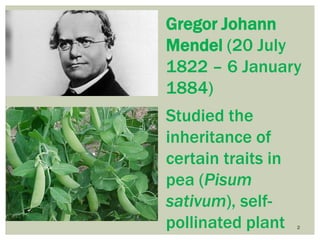
Gregor Johann
Mendel (20 July
1822 – 6 January
1884)
Studied the
inheritance of
certain traits in
pea (Pisum
sativum), self-
pollinated plant 2
3
Mendel's laws
Law of segregation: During the production of
gametes the two copies of each hereditary
factors segregate so that offspring acquire one
factor from each parent
Law of independent assortment: The laws of
chance govern which particular characteristics of
the parental pairs will occur in each individual
offspring
Law of dominance: One factor in a pair of traits
dominates the other in inheritance unless both
factors in the pair are recessive
4
Mendel's laws for inheritance of traits
Both the mother and father contribute
equal quantity of genetic material to
the child
What traits will be seen in the child?
5
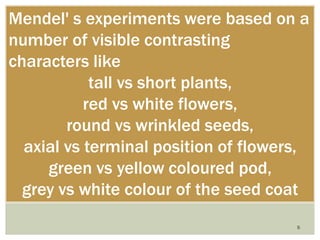
Mendel' s experiments were based on a
number of visible contrasting
characters like
tall vs short plants,
red vs white flowers,
round vs wrinkled seeds,
axial vs terminal position of flowers,
green vs yellow coloured pod,
grey vs white colour of the seed coat
6
Factors (genes) responsible for
these traits are present in pairs
The pair factors or genes separate
(segregate) out during the formation
of gametes
Mendel's Monohybrid Cross
Hybrid - of mixed character
Monohybrid crosses of pea plants
involved only one pair of contrasting
characters or traits
7
The Parental Generation (P1)
In the P1 generation all the plants
were with red flowers
Red-flowered – Dominant - hides its
recessive partner
White-flowered – Recessive - not
exhibited in the next generation
8
9
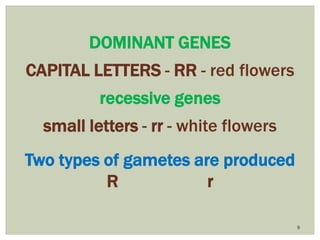
DOMINANT GENES
CAPITAL LETTERS - RR - red flowers
recessive genes
small letters - rr - white flowers
Two types of gametes are produced
R r
10
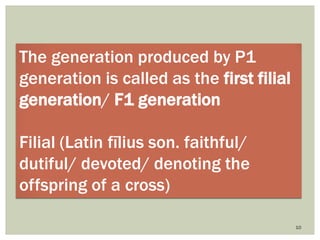
The generation produced by P1
generation is called as the first filial
generation/ F1 generation
Filial (Latin fīlius son. faithful/
dutiful/ devoted/ denoting the
offspring of a cross)
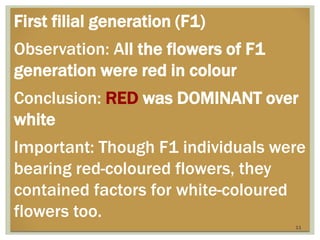
First filial generation (F1)
Observation: All the flowers of F1
generation were red in colour
Conclusion: RED was DOMINANT over
white
Important: Though F1 individuals were
bearing red-coloured flowers, they
contained factors for white-coloured
flowers too.
11
12
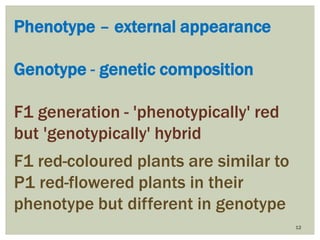
Phenotype – external appearance
Genotype - genetic composition
F1 generation - 'phenotypically' red
but 'genotypically' hybrid
F1 red-coloured plants are similar to
P1 red-flowered plants in their
phenotype but different in genotype
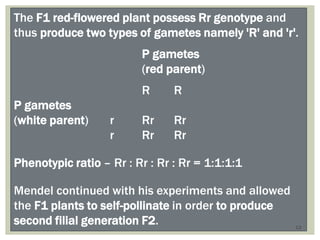
The F1 red-flowered plant possess Rr genotype and
thus produce two types of gametes namely 'R' and 'r'.
P gametes
(red parent)
R R
P gametes
(white parent) r Rr Rr
r Rr Rr
Phenotypic ratio – Rr : Rr : Rr : Rr = 1:1:1:1
Mendel continued with his experiments and allowed
the F1 plants to self-pollinate in order to produce
second filial generation F2. 13
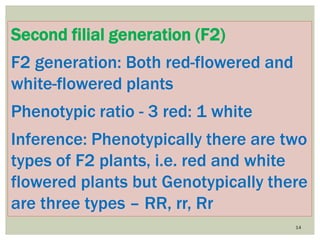
Second filial generation (F2)
F2 generation: Both red-flowered and
white-flowered plants
Phenotypic ratio - 3 red: 1 white
Inference: Phenotypically there are two
types of F2 plants, i.e. red and white
flowered plants but Genotypically there
are three types – RR, rr, Rr
14
15
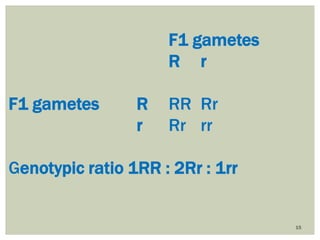
F1 gametes
R r
F1 gametes R RR Rr
r Rr rr
Genotypic ratio 1RR : 2Rr : 1rr
16
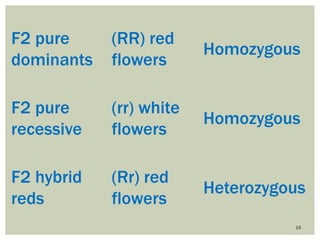
F2 pure
dominants
(RR) red
flowers
Homozygous
F2 pure
recessive
(rr) white
flowers
Homozygous
F2 hybrid
reds
(Rr) red
flowers
Heterozygous
Mendel's Dihybrid Cross
A dihybrid cross involves two pairs of
contrasting characters (traits)
17
18
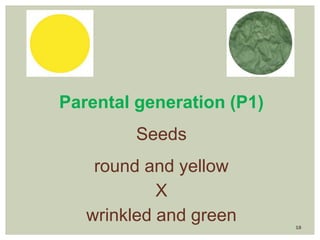
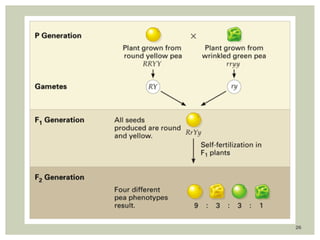
Parental generation (P1)
Seeds
round and yellow
X
wrinkled and green
19
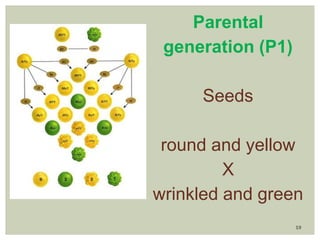
Parental
generation (P1)
Seeds
round and yellow
X
wrinkled and green
20
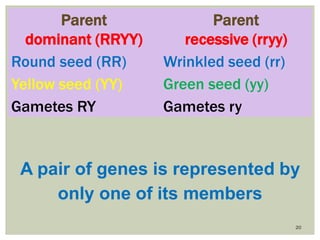
Parent
dominant (RRYY)
Parent
recessive (rryy)
Round seed (RR) Wrinkled seed (rr)
Yellow seed (YY) Green seed (yy)
Gametes RY Gametes ry
A pair of genes is represented by
only one of its members
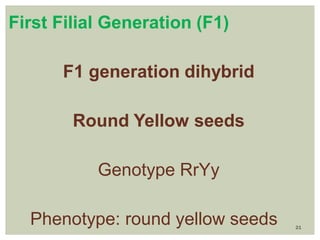
First Filial Generation (F1)
F1 generation dihybrid
Round Yellow seeds
Genotype RrYy
Phenotype: round yellow seeds 21
22
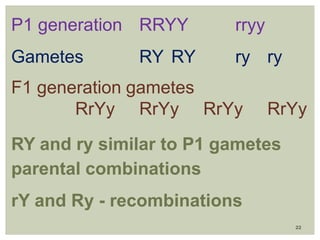
P1 generation RRYY rryy
Gametes RY RY ry ry
F1 generation gametes
RrYy RrYy RrYy RrYy
RY and ry similar to P1 gametes
parental combinations
rY and Ry - recombinations
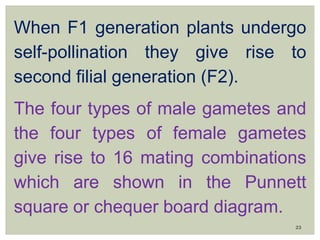
When F1 generation plants undergo
self-pollination they give rise to
second filial generation (F2).
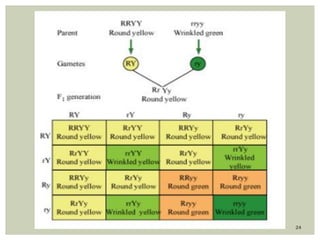
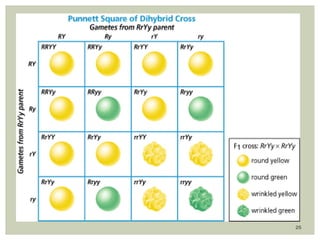
The four types of male gametes and
the four types of female gametes
give rise to 16 mating combinations
which are shown in the Punnett
square or chequer board diagram.
23
24
25
26
Second filial generation (F2)
27
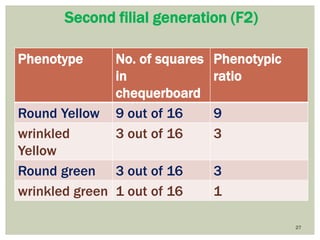
Phenotype No. of squares
in
chequerboard
Phenotypic
ratio
Round Yellow 9 out of 16 9
wrinkled
Yellow
3 out of 16 3
Round green 3 out of 16 3
wrinkled green 1 out of 16 1
28
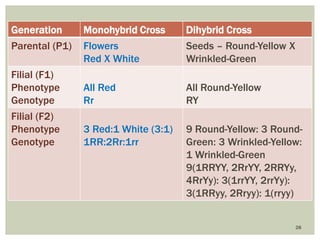
Generation Monohybrid Cross Dihybrid Cross
Parental (P1) Flowers
Red X White
Seeds – Round-Yellow X
Wrinkled-Green
Filial (F1)
Phenotype
Genotype
All Red
Rr
All Round-Yellow
RY
Filial (F2)
Phenotype
Genotype
3 Red:1 White (3:1)
1RR:2Rr:1rr
9 Round-Yellow: 3 Round-
Green: 3 Wrinkled-Yellow:
1 Wrinkled-Green
9(1RRYY, 2RrYY, 2RRYy,
4RrYy): 3(1rrYY, 2rrYy):
3(1RRyy, 2Rryy): 1(rryy)
29
Please click the links in the next
slide/s
Monohybrid Cross
https://www.youtube.com/watch?v=L
sj-Ij53CkA--
Dihybrid Cross
https://www.youtube.com/watch?v=U
U7a9XFqIP0
30
Thank you
• Viewers
• Std X text book MSBSHE
Government of Maharashtra
• Google Images
• YouTube
• Wikipedia
Suggestions and appreciations welcome
gkwagh@gmail.com

Mendelian Genetics

  • 1.
  • 2.
    Gregor Johann Mendel (20July 1822 – 6 January 1884) Studied the inheritance of certain traits in pea (Pisum sativum), self- pollinated plant 2
  • 3.
    3 Mendel's laws Law ofsegregation: During the production of gametes the two copies of each hereditary factors segregate so that offspring acquire one factor from each parent Law of independent assortment: The laws of chance govern which particular characteristics of the parental pairs will occur in each individual offspring Law of dominance: One factor in a pair of traits dominates the other in inheritance unless both factors in the pair are recessive
  • 4.
    4 Mendel's laws forinheritance of traits Both the mother and father contribute equal quantity of genetic material to the child What traits will be seen in the child?
  • 5.
    5 Mendel' s experimentswere based on a number of visible contrasting characters like tall vs short plants, red vs white flowers, round vs wrinkled seeds, axial vs terminal position of flowers, green vs yellow coloured pod, grey vs white colour of the seed coat
  • 6.
    6 Factors (genes) responsiblefor these traits are present in pairs The pair factors or genes separate (segregate) out during the formation of gametes
  • 7.
    Mendel's Monohybrid Cross Hybrid- of mixed character Monohybrid crosses of pea plants involved only one pair of contrasting characters or traits 7
  • 8.
    The Parental Generation(P1) In the P1 generation all the plants were with red flowers Red-flowered – Dominant - hides its recessive partner White-flowered – Recessive - not exhibited in the next generation 8
  • 9.
    9 DOMINANT GENES CAPITAL LETTERS- RR - red flowers recessive genes small letters - rr - white flowers Two types of gametes are produced R r
  • 10.
    10 The generation producedby P1 generation is called as the first filial generation/ F1 generation Filial (Latin fīlius son. faithful/ dutiful/ devoted/ denoting the offspring of a cross)
  • 11.
    First filial generation(F1) Observation: All the flowers of F1 generation were red in colour Conclusion: RED was DOMINANT over white Important: Though F1 individuals were bearing red-coloured flowers, they contained factors for white-coloured flowers too. 11
  • 12.
    12 Phenotype – externalappearance Genotype - genetic composition F1 generation - 'phenotypically' red but 'genotypically' hybrid F1 red-coloured plants are similar to P1 red-flowered plants in their phenotype but different in genotype
  • 13.
    The F1 red-floweredplant possess Rr genotype and thus produce two types of gametes namely 'R' and 'r'. P gametes (red parent) R R P gametes (white parent) r Rr Rr r Rr Rr Phenotypic ratio – Rr : Rr : Rr : Rr = 1:1:1:1 Mendel continued with his experiments and allowed the F1 plants to self-pollinate in order to produce second filial generation F2. 13
  • 14.
    Second filial generation(F2) F2 generation: Both red-flowered and white-flowered plants Phenotypic ratio - 3 red: 1 white Inference: Phenotypically there are two types of F2 plants, i.e. red and white flowered plants but Genotypically there are three types – RR, rr, Rr 14
  • 15.
    15 F1 gametes R r F1gametes R RR Rr r Rr rr Genotypic ratio 1RR : 2Rr : 1rr
  • 16.
    16 F2 pure dominants (RR) red flowers Homozygous F2pure recessive (rr) white flowers Homozygous F2 hybrid reds (Rr) red flowers Heterozygous
  • 17.
    Mendel's Dihybrid Cross Adihybrid cross involves two pairs of contrasting characters (traits) 17
  • 18.
    18 Parental generation (P1) Seeds roundand yellow X wrinkled and green
  • 19.
  • 20.
    20 Parent dominant (RRYY) Parent recessive (rryy) Roundseed (RR) Wrinkled seed (rr) Yellow seed (YY) Green seed (yy) Gametes RY Gametes ry A pair of genes is represented by only one of its members
  • 21.
    First Filial Generation(F1) F1 generation dihybrid Round Yellow seeds Genotype RrYy Phenotype: round yellow seeds 21
  • 22.
    22 P1 generation RRYYrryy Gametes RY RY ry ry F1 generation gametes RrYy RrYy RrYy RrYy RY and ry similar to P1 gametes parental combinations rY and Ry - recombinations
  • 23.
    When F1 generationplants undergo self-pollination they give rise to second filial generation (F2). The four types of male gametes and the four types of female gametes give rise to 16 mating combinations which are shown in the Punnett square or chequer board diagram. 23
  • 24.
  • 25.
  • 26.
  • 27.
    Second filial generation(F2) 27 Phenotype No. of squares in chequerboard Phenotypic ratio Round Yellow 9 out of 16 9 wrinkled Yellow 3 out of 16 3 Round green 3 out of 16 3 wrinkled green 1 out of 16 1
  • 28.
    28 Generation Monohybrid CrossDihybrid Cross Parental (P1) Flowers Red X White Seeds – Round-Yellow X Wrinkled-Green Filial (F1) Phenotype Genotype All Red Rr All Round-Yellow RY Filial (F2) Phenotype Genotype 3 Red:1 White (3:1) 1RR:2Rr:1rr 9 Round-Yellow: 3 Round- Green: 3 Wrinkled-Yellow: 1 Wrinkled-Green 9(1RRYY, 2RrYY, 2RRYy, 4RrYy): 3(1rrYY, 2rrYy): 3(1RRyy, 2Rryy): 1(rryy)
  • 29.
    29 Please click thelinks in the next slide/s Monohybrid Cross https://www.youtube.com/watch?v=L sj-Ij53CkA-- Dihybrid Cross https://www.youtube.com/watch?v=U U7a9XFqIP0
  • 30.
    30 Thank you • Viewers •Std X text book MSBSHE Government of Maharashtra • Google Images • YouTube • Wikipedia Suggestions and appreciations welcome gkwagh@gmail.com