CHEMICAL EQUATIONS &
REACTIONS
ORGANIZE YOUR THOUGHTS
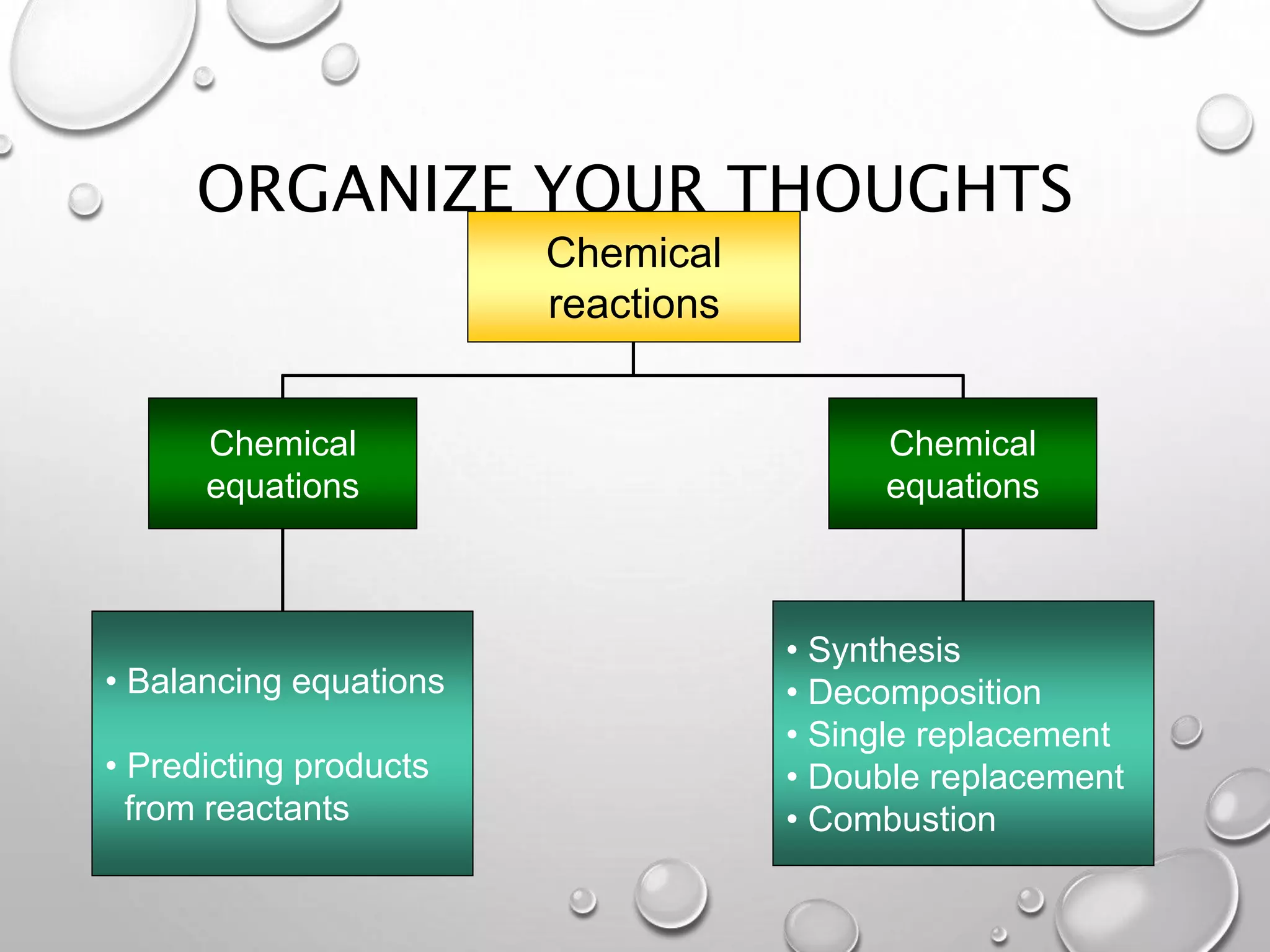
Chemical
reactions
Chemical
equations
Chemical
equations
• Balancing equations
• Predicting products
from reactants
• Synthesis
• Decomposition
• Single replacement
• Double replacement
• Combustion
DESCRIBING A CHEMICAL
REACTION
INDICATIONS OF A CHEMICAL REACTION
• EVOLUTION OF HEAT, LIGHT, AND/OR SOUND
• PRODUCTION OF A GAS
• FORMATION OF A PRECIPITATE
• COLOR CHANGE
SIGNS OF CHEMICAL REACTIONS
There are five main signs that indicate a chemical reaction has taken place:
change in color change in odor production of new
gases or vapor
input or release
of energy
difficult to reverse
release
input
CHEMICAL EQUATIONS
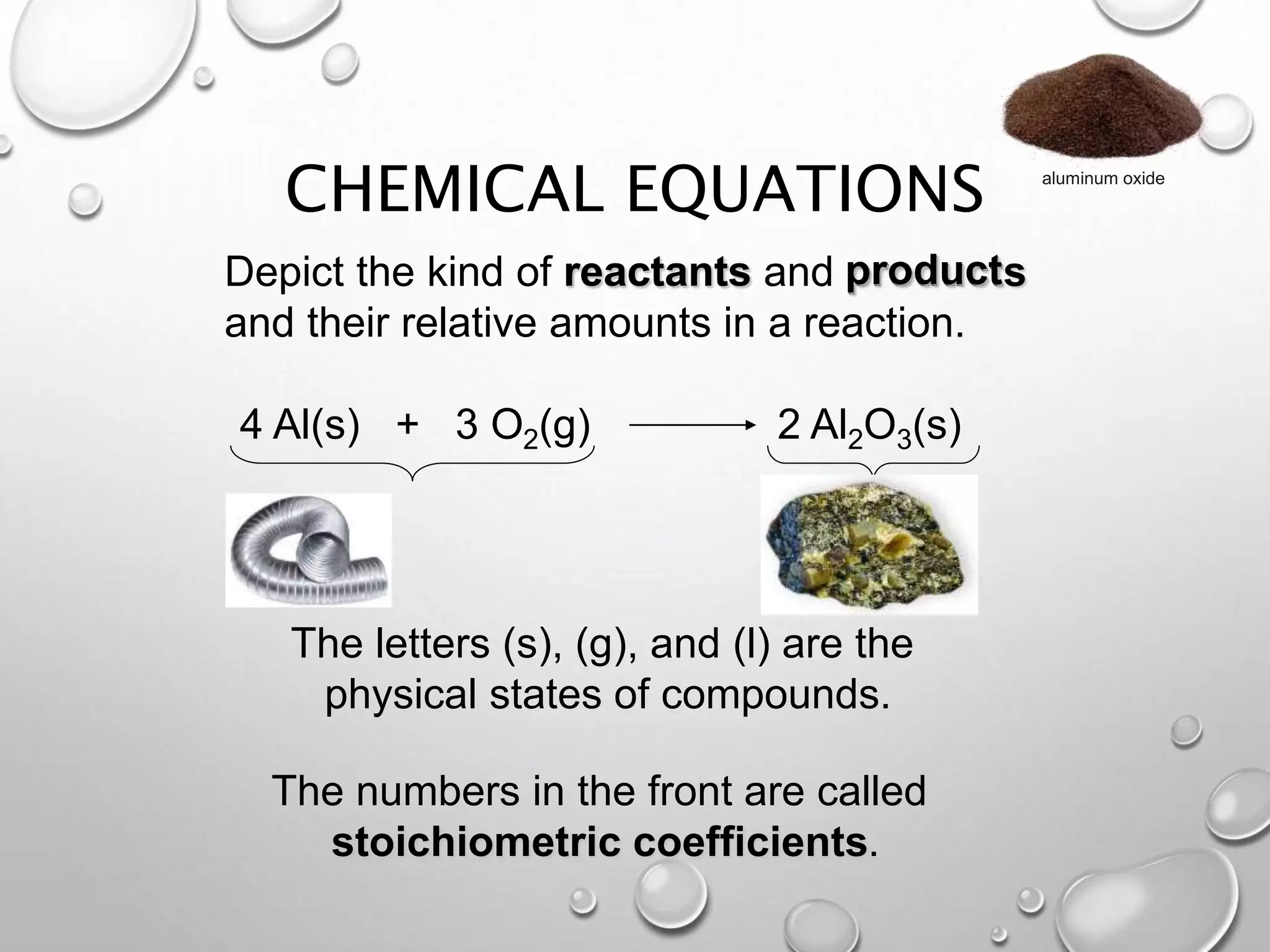
Depict the kind of reactants and products
and their relative amounts in a reaction.
4 Al(s) + 3 O2(g) 2 Al2O3(s)
The numbers in the front are called
stoichiometric coefficients.
The letters (s), (g), and (l) are the
physical states of compounds.
reactants product
aluminum oxide
CHEMICAL EQUATIONS
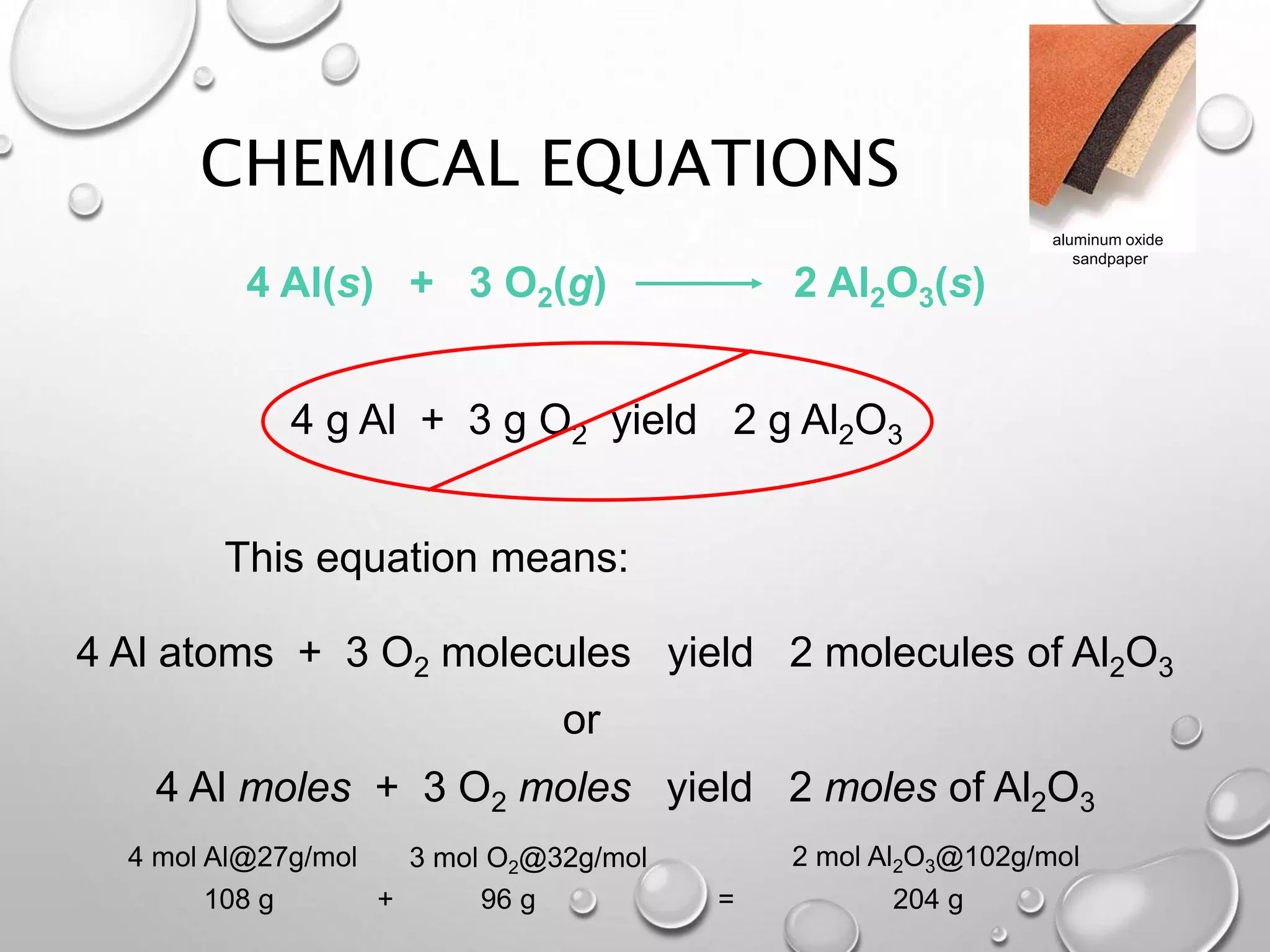
This equation means:
4 Al(s) + 3 O2(g) 2 Al2O3(s)
4 Al atoms + 3 O2 molecules yield 2 molecules of Al2O3
4 Al moles + 3 O2 moles yield 2 moles of Al2O3
or
4 g Al + 3 g O2 yield 2 g Al2O3
4 mol Al@27g/mol 3 mol O2@32g/mol 2 mol Al2O3@102g/mol
108 g + 96 g = 204 g
aluminum oxide
sandpaper
CHEMICAL EQUATIONS
Because the same atoms are present
in a reaction at the beginning (reactants)
and at the end (products), the amount
of matter in a system does not change.
The Law of Conservation of Matter
Chemical
Factory
100% 100%
80%
20%
CHEMICAL EQUATIONS
Because of the principle of the conservation of matter,
An equation must be balanced.
It must have the same number of atoms
of the same kind on both sides.
Lavoisier, 1788
CHARACTERISTICS OF CHEMICAL
EQUATIONS
• THE EQUATION MUST REPRESENT KNOWN FACTS.
• THE EQUATION MUST CONTAIN THE CORRECT FORMULAS
FOR THE REACTANTS AND PRODUCTS.
• THE LAW OF CONSERVATION OF MASS MUST BE SATISFIED.
CHEMICAL EQUATIONS
• REACTANTS – THE SUBSTANCES THAT EXIST BEFORE A
CHEMICAL CHANGE (OR REACTION) TAKES PLACE.
• PRODUCTS – THE NEW SUBSTANCE(S) THAT ARE
FORMED DURING THE CHEMICAL CHANGES.
• CHEMICAL EQUATION INDICATES THE REACTANTS
AND PRODUCTS OF A REACTION.
REACTANTS  PRODUCTS
WORD EQUATIONS
• A WORD EQUATION DESCRIBES CHEMICAL CHANGE
USING THE NAMES OF THE REACTANTS AND
PRODUCTS.
Write the word equation for the reaction of methane gas
with oxygen gas to form carbon dioxide and water.
methane + oxygen
Reactant Product
CH4 O2 CO2 H2O+ + 22
carbon dioxide + water
Cl
Cl
Cl
H
H
H
ClClCl
Cl HH
H
H
H2 + Cl2  HCl H2 + Cl2  2 HCl
reactants products
H
Cl
reactants products
H
Cl
2
2
2 2
2 2
1
1
(unbalanced) (balanced)
Unbalanced and Balanced Equations
?
VISUALIZING A CHEMICAL
REACTION
Na + Cl2 NaCl
___ mole Cl2 ___ mole NaCl___ mole Na
2
10 5 10
2
10 5 10
VISUALIZING A CHEMICAL
REACTION
Na + Cl2 NaCl2 2
MEANING OF CHEMICAL
FORMULA
Chemical
Symbol Meaning Composition
H2O One molecule
of water:
Two H atoms and one O atom
2 H2O Two molecules
of water:
Four H atoms and two O atoms
H2O2 One molecule
of hydrogen
peroxide:
Two H atoms and two O atoms
BALANCING CHEMICAL
EQUATIONS
BALANCED EQUATION – ONE IN WHICH THE NUMBER OF
ATOMS OF EACH ELEMENT AS A REACTANT IS EQUAL
TO THE NUMBER OF ATOMS OF THAT ELEMENT AS A
PRODUCT
What is the relationship between conservation of mass and
the fact that a balanced equation will always have the same
number of atoms of each element on both sides of an equation?
Determine whether the following equation is balanced.
2 Na + H2O  2 NaOH + H2
2 Na + 2 H2O  2 NaOH + H2
BALANCING CHEMICAL
EQUATIONS
AN IMPORTANT POINT TO REMEMBER
2 NO(g) + O2(g)  2NO2(g)
The 2 to the left of NO(g) and NO2(g) refers to the number
of molecules present in the balanced equation.
It is a “multiplier” for every atom in the molecule.
The subscript 2 in O2 (g) and NO2(g) refers to the number
of atoms of this type that are present in each molecules
(or ionic compound).
Guidelines for Balancing Chemical Equations
1) polyatomic ions first
2) even / odd (make all even)
3) H2O Mg(OH)22
4) single elements last
Example: need 13 oxygen atoms
Multiply by O2 = 1313
2
“ ”
3X + O2 2Y + Z13
2
3X + O2 2Y + Z13
22
6X + 13 O2 4Y + 2Z
H-OH vs.
?
(NH4)3PO4 + Mg(OH)2  Mg3(PO4)2 NH4OH?
ammonium phosphate magnesium hydroxide magnesium phosphate ammonium hydroxide
NH4
1+ OH1-
+ 62 3
Now you try…
AlCl3 + Li2CO3  Al2(CO3)3 + LiCl32 6
CH4 + 2 O2  CO2 + 2 H2O
Reactants Products
1 C atom 1 C atom
4 H atoms 4 H atoms
4 O atoms 4 O atoms
H2(g) + O2(g) H2O (l)
hydrogen oxygen water
REACTANTS  PRODUCTS
balanced
catalyst – speeds up reaction
C(s) + O2(g) CO2(g)
carbon oxygen carbon dioxide
Reactants Product
1 carbon atom 1 carbon atom
2 oxygen atoms 2 oxygen atoms
Reactants Product
2 hydrogen atoms 2 hydrogen atoms
2 oxygen atoms 1 oxygen atoms
Pt
Pt
+
+
2 2
Un
Reactants Product
2 hydrogen atoms 4 hydrogen atoms
2 oxygen atoms 2 oxygen atoms
Reactants Product
4 hydrogen atoms 4 hydrogen atoms
2 oxygen atoms 2 oxygen atoms
REACTANTS  PRODUCTS
Unbalanced
2 2
catalyst – speeds up reaction
SHOWING PHASES IN
CHEMICAL EQUATIONS
SOLID PHASE – THE SUBSTANCE IS RELATIVELY RIGID AND HAS
A DEFINITE VOLUME AND SHAPE. NACL(S)
LIQUID PHASE – THE SUBSTANCE HAS A DEFINITE VOLUME,
BUT IS ABLE TO CHANGE SHAPE BY FLOWING. H2O(L)
GASEOUS PHASE – THE SUBSTANCE HAS NO DEFINITE VOLUME
OR SHAPE, AND IT SHOWS LITTLE RESPONSE TO GRAVITY.
H2O(s) H2O(l) H2O(g)
ADDITIONAL SYMBOLS USED IN CHEMICAL
EQUATIONS
“YIELDS”; INDICATES RESULT OF REACTION
USED TO INDICATE A REVERSIBLE REACTION
A REACTANT OR PRODUCT IN THE SOLID STATE;
ALSO USED TO INDICATE A PRECIPITATE
ALTERNATIVE TO (S), BUT USED ONLY TO INDICATE A PRECIPITATE
A REACTANT OR PRODUCT IN THE LIQUID STATE
A REACTANT OR PRODUCT IN AN AQUEOUS SOLUTION
(DISSOLVED IN WATER)
A REACTANT OR PRODUCT IN THE GASEOUS STATE
(s)
(l)
(aq)
(g)
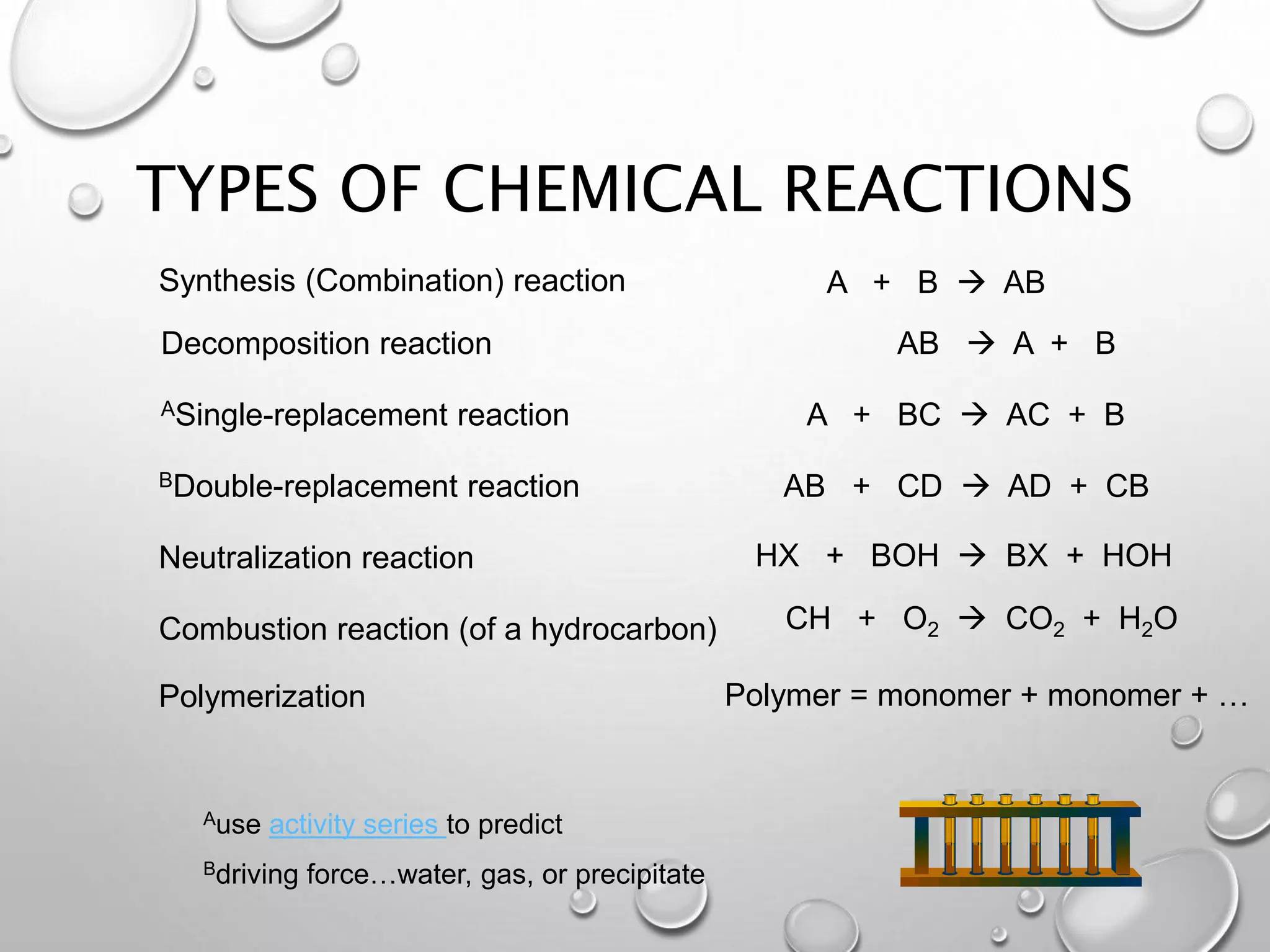
TYPES OF CHEMICAL REACTIONS
Synthesis (Combination) reaction
Decomposition reaction
ASingle-replacement reaction
BDouble-replacement reaction
Neutralization reaction
Combustion reaction (of a hydrocarbon)
A + B  AB
AB  A + B
A + BC  AC + B
AB + CD  AD + CB
HX + BOH  BX + HOH
CH + O2  CO2 + H2O
Ause activity series to predict
Bdriving force…water, gas, or precipitate
Polymerization Polymer = monomer + monomer + …
element compound elementcompound
compound compound compound compound
acid base salt water
TYPES OF CHEMICAL REACTIONS
Synthesis (Combination) reaction
Decomposition reaction
ASingle-replacement reaction
BDouble-replacement reaction
Neutralization reaction
Combustion reaction (of a hydrocarbon)
A + B  AB
AB  A + B
A + BC  AC + B
AB + CD  AD + CB
HX + BOH  BX + HOH
CH + O2  CO2 + H2O
Ause activity series to predict
Bdriving force…water, gas, or precipitate
Polymerization Polymer = monomer + monomer + …
CHEMICAL EQUATIONS
1 molecule N2 3 molecules H2 2 molecules NH3+
+
+
+
+
1 mol N2 3 mol H2 2 mol NH3
N2 (g) 3 H2 (g) 2 NH3 (g)
“Microscopic recipe”
“Macroscopic recipe”
Experimental Conditions Reactants Products
Chemical Equations
2 molecules N2 3 molecules H2 0 molecules NH3
1 molecules N2 0 molecules H2 2 molecules NH3
Before reaction
After reaction
Nitrogen is in excess – or hydrogen is limiting reagent.
FORMATION OF A SOLID: AGCL
AgNO3(aq) + KCl(aq)  KNO3 (aq) + AgCl(s)
.
PbI2
K1+Pb2+
lead (II) chloride + potassium iodide
Cl2 I
Pb2+
Pb
K1+
K
Cl1- I1-
Cl1- I1-
KCl
potassium chloride lead (II) iodide+
(aq) (ppt)+ +
.
PbI2
K1+Pb2+
lead (II) chloride + potassium iodide
Cl2 I
Pb2+
Pb
K1+
K
Cl1- I1-
Cl1- I1-
KCl
potassium chloride lead (II) iodide+
(aq) (ppt)+ +
H
H
H
H
DECOMPOSITION REACTION
H
H
H
H
O
Decomposition reaction
2 H2O 2 H2 O2
General form: AB A B
+
+
+
compound two or more elements
or compounds
OO
O
SINGLE AND DOUBLE
REPLACEMENT REACTIONS
Double-replacement reaction
CaCO3 + 2 HCl  CaCl2 + H2CO3
General form:
AB + CD  AD + CB
Single-replacement reaction
Mg + CuSO4  MgSO4 + Cu
General form:
A + BC  AC + B
Ca
ACTIVITY SERIES
Foiled again –
Aluminum loses to Calcium
Element Reactivity
Li
Rb
K
Ba
Ca
Na
Mg
Al
Mn
Zn
Cr
Fe
Ni
Sn
Pb
H2
Cu
Hg
Ag
Pt
Au
Halogen Reactivity
F2
Cl2
Br2
I2
Printable
Version
of
Activity
Series
POTASSIUM REACTS WITH WATER
P O W !
DOUBLE REPLACEMENT REACTION
K2CO3 (aq)
Potassium carbonate
BaCl2 (aq)
Barium chloride
2 KCl (aq)
Potassium chloride
BaCO3 (s)
Barium carbonate
+ +
SYNTHESIS REACTIONS
CO2 + H2O C6H12O6 + O2
H2 + O2 H2O
Na + Cl2 NaCl
6 6 6
Photosynthesis
Formation of water
2 2
2 2
Formation of salt
A + B C
General Form
H2O H2 + O2
electricity
DECOMPOSITION
REACTIONS
H2O2 H2O + O2
NI3 N2 + I2
2 2
Hydrogen Peroxide
Electrolysis of water
2 2
Nitrogen triiodide
AB A + B
General Form
2 3
Mg + AlCl3
Al + MgCl2
PREDICT IF THESE
REACTIONS WILL OCCUR
Al + MgCl2
Can magnesium replace aluminum?
Activity Series
YES, magnesium is more reactive than aluminum.
2 23 3
Can aluminum replace magnesium?
Activity Series
NO, aluminum is less reactive than magnesium.
Therefore, no reaction will occur.
No reaction
MgCl2 + Al No reaction
The question we must ask is can the single element replace its counterpart?
metal replaces metal or nonmetal replaces nonmetal.
Order of reactants
DOES NOT
determine how
they react.
SINGLE-REPLACEMENT
REACTIONS
FeCl2 + Cu
MgBr2 + Cl2
“Magic blue-earth”
Zinc in nitric acid
2
A + BC AC + B
General Form
Zn(NO3)2 + H2
Can Fe replace Cu? Yes
Li
Rb
K
Ba
Ca
Na
Mg
Al
Mn
Zn
Cr
Fe
Ni
Sn
Pb
H2
Cu
Hg
Ag
Pt
Au
F2
Cl2
Br2
I2
Can Zn replace H? Yes
Can Br replace Cl? No
NO REACTION
Fe + CuCl2
Zn + HNO3
MgCl2 + Br2
Activity Series
H2O
KOH + HNO3 KNO3 + H2OHK NO3OH HK
How would you prepare potassium nitrate
(using a double replacement reaction)?
KNO3_________+ _________+
Ca(NO3)2
Both potassium nitrate and
calcium chloride are soluble
(no driving force – no reaction!)
H2O
formation of water
is a driving force.
potassium nitrate
Combine a potassium hydroxide solution with nitric acid
to yield soluble potassium nitrate.
The water could then be removed by distillation to recover solid potassium nitrate.
_________
Ca(NO3)2 KNO3 Ca(OH)2KOH + +2 2
KOH(aq) + HNO3(aq) KNO3(aq) + ?
FeCO3
Na1+Fe2+
iron (II) chloride + sodium carbonate
Cl2
Using a SOLUBILITY TABLE:
sodium chloride is soluble
iron (II) carbonate is insoluble
CO3
Fe2+
Fe
Na1+
Na2
Cl1- CO3
2-
Cl1- CO3
2-
NaCl
sodium chloride iron (II) carbonate+
(aq) (ppt)
2FeCl2 Na2CO3 NaCl FeCO3(aq) (ppt)+ +
Predict if a reaction will occur when you combine aqueous solutions
of iron (II) chloride with aqueous sodium carbonate solution.
If the reaction does occur, write a balanced chemical equation showing it.
(be sure to include phase notation)
(aq) (aq)
Balanced chemical equation
Complete Ionic Equation
Fe2+(aq) + 2Cl1-(aq) + 2Na1+(aq) + CO3
2-(aq) 2Na1+(aq) + 2Cl1-(aq) + FeCO3(s)
?
VISUALIZING A CHEMICAL
REACTION
Na + Cl2 NaCl
___ mole Cl2 ___ mole NaCl___ mole Na
2
10 5 10
2
10 5 10
FORMATION OF AMMONIA
2 atoms N 6 atoms H
6 atoms H
2 atoms N and
+
+
+
+
+
+
+
+
+
1 molecule N2 3 molecules H2 2 molecules NH3
10 molecule N2 30 molecules H2 20 molecules NH3
1 mol N2 3 mol H2 2 mol NH3
28 g N2 3 x 2 g H2 2 x 17 g NH3
34 g reactants 34 g products
N2 (g) 3 H2 (g) 2 NH3 (g)
22.4 L N2 67.2 L H2 44.8 L NH3
22.4
L
22.4
L
22.4
L
22.4
L
22.4
L
22.4
L
Assume
STP
1 x 3 x 2 x
6.02 x 1023
molecules N2
6.02 x 10²³
molecules H2
6.02 x 10²³
molecules NH3
PROPORTIONAL RELATIONSHIPS
• STOICHIOMETRY
• MASS RELATIONSHIPS BETWEEN SUBSTANCES IN A
CHEMICAL REACTION
• BASED ON THE MOLE RATIO
• MOLE RATIO
• INDICATED BY COEFFICIENTS IN A BALANCED
EQUATION
2 Mg + O2  2 MgO
Courtesy Christy Johannesson www.nisd.net/communicationsarts/pages/chem
CLASSES OF REACTIONS
Chemical reactions
Precipitation
reactions
Acid-Base
Reactions
Oxidation-Reduction
Reactions
Combustion
Reactions
THANK YOU
PRESENTATION BY-
MR. BIBHUTI BHUSHAN
CLASS-10 B
ROLLNO. 11
SMART STUDENT

Chemical equations & reactions

  • 1.
  • 2.
    ORGANIZE YOUR THOUGHTS Chemical reactions Chemical equations Chemical equations •Balancing equations • Predicting products from reactants • Synthesis • Decomposition • Single replacement • Double replacement • Combustion
  • 3.
    DESCRIBING A CHEMICAL REACTION INDICATIONSOF A CHEMICAL REACTION • EVOLUTION OF HEAT, LIGHT, AND/OR SOUND • PRODUCTION OF A GAS • FORMATION OF A PRECIPITATE • COLOR CHANGE
  • 4.
    SIGNS OF CHEMICALREACTIONS There are five main signs that indicate a chemical reaction has taken place: change in color change in odor production of new gases or vapor input or release of energy difficult to reverse release input
  • 5.
    CHEMICAL EQUATIONS Depict thekind of reactants and products and their relative amounts in a reaction. 4 Al(s) + 3 O2(g) 2 Al2O3(s) The numbers in the front are called stoichiometric coefficients. The letters (s), (g), and (l) are the physical states of compounds. reactants product aluminum oxide
  • 6.
    CHEMICAL EQUATIONS This equationmeans: 4 Al(s) + 3 O2(g) 2 Al2O3(s) 4 Al atoms + 3 O2 molecules yield 2 molecules of Al2O3 4 Al moles + 3 O2 moles yield 2 moles of Al2O3 or 4 g Al + 3 g O2 yield 2 g Al2O3 4 mol Al@27g/mol 3 mol O2@32g/mol 2 mol Al2O3@102g/mol 108 g + 96 g = 204 g aluminum oxide sandpaper
  • 7.
    CHEMICAL EQUATIONS Because thesame atoms are present in a reaction at the beginning (reactants) and at the end (products), the amount of matter in a system does not change. The Law of Conservation of Matter Chemical Factory 100% 100% 80% 20%
  • 8.
    CHEMICAL EQUATIONS Because ofthe principle of the conservation of matter, An equation must be balanced. It must have the same number of atoms of the same kind on both sides. Lavoisier, 1788
  • 9.
    CHARACTERISTICS OF CHEMICAL EQUATIONS •THE EQUATION MUST REPRESENT KNOWN FACTS. • THE EQUATION MUST CONTAIN THE CORRECT FORMULAS FOR THE REACTANTS AND PRODUCTS. • THE LAW OF CONSERVATION OF MASS MUST BE SATISFIED.
  • 10.
    CHEMICAL EQUATIONS • REACTANTS– THE SUBSTANCES THAT EXIST BEFORE A CHEMICAL CHANGE (OR REACTION) TAKES PLACE. • PRODUCTS – THE NEW SUBSTANCE(S) THAT ARE FORMED DURING THE CHEMICAL CHANGES. • CHEMICAL EQUATION INDICATES THE REACTANTS AND PRODUCTS OF A REACTION. REACTANTS  PRODUCTS
  • 11.
    WORD EQUATIONS • AWORD EQUATION DESCRIBES CHEMICAL CHANGE USING THE NAMES OF THE REACTANTS AND PRODUCTS. Write the word equation for the reaction of methane gas with oxygen gas to form carbon dioxide and water. methane + oxygen Reactant Product CH4 O2 CO2 H2O+ + 22 carbon dioxide + water
  • 12.
    Cl Cl Cl H H H ClClCl Cl HH H H H2 +Cl2  HCl H2 + Cl2  2 HCl reactants products H Cl reactants products H Cl 2 2 2 2 2 2 1 1 (unbalanced) (balanced) Unbalanced and Balanced Equations
  • 13.
    ? VISUALIZING A CHEMICAL REACTION Na+ Cl2 NaCl ___ mole Cl2 ___ mole NaCl___ mole Na 2 10 5 10 2 10 5 10
  • 14.
  • 15.
    MEANING OF CHEMICAL FORMULA Chemical SymbolMeaning Composition H2O One molecule of water: Two H atoms and one O atom 2 H2O Two molecules of water: Four H atoms and two O atoms H2O2 One molecule of hydrogen peroxide: Two H atoms and two O atoms
  • 16.
    BALANCING CHEMICAL EQUATIONS BALANCED EQUATION– ONE IN WHICH THE NUMBER OF ATOMS OF EACH ELEMENT AS A REACTANT IS EQUAL TO THE NUMBER OF ATOMS OF THAT ELEMENT AS A PRODUCT What is the relationship between conservation of mass and the fact that a balanced equation will always have the same number of atoms of each element on both sides of an equation? Determine whether the following equation is balanced. 2 Na + H2O  2 NaOH + H2 2 Na + 2 H2O  2 NaOH + H2
  • 17.
    BALANCING CHEMICAL EQUATIONS AN IMPORTANTPOINT TO REMEMBER 2 NO(g) + O2(g)  2NO2(g) The 2 to the left of NO(g) and NO2(g) refers to the number of molecules present in the balanced equation. It is a “multiplier” for every atom in the molecule. The subscript 2 in O2 (g) and NO2(g) refers to the number of atoms of this type that are present in each molecules (or ionic compound).
  • 18.
    Guidelines for BalancingChemical Equations 1) polyatomic ions first 2) even / odd (make all even) 3) H2O Mg(OH)22 4) single elements last Example: need 13 oxygen atoms Multiply by O2 = 1313 2 “ ” 3X + O2 2Y + Z13 2 3X + O2 2Y + Z13 22 6X + 13 O2 4Y + 2Z H-OH vs. ?
  • 19.
    (NH4)3PO4 + Mg(OH)2 Mg3(PO4)2 NH4OH? ammonium phosphate magnesium hydroxide magnesium phosphate ammonium hydroxide NH4 1+ OH1- + 62 3 Now you try… AlCl3 + Li2CO3  Al2(CO3)3 + LiCl32 6
  • 20.
    CH4 + 2O2  CO2 + 2 H2O Reactants Products 1 C atom 1 C atom 4 H atoms 4 H atoms 4 O atoms 4 O atoms
  • 21.
    H2(g) + O2(g)H2O (l) hydrogen oxygen water REACTANTS  PRODUCTS balanced catalyst – speeds up reaction C(s) + O2(g) CO2(g) carbon oxygen carbon dioxide Reactants Product 1 carbon atom 1 carbon atom 2 oxygen atoms 2 oxygen atoms Reactants Product 2 hydrogen atoms 2 hydrogen atoms 2 oxygen atoms 1 oxygen atoms Pt Pt + + 2 2 Un Reactants Product 2 hydrogen atoms 4 hydrogen atoms 2 oxygen atoms 2 oxygen atoms Reactants Product 4 hydrogen atoms 4 hydrogen atoms 2 oxygen atoms 2 oxygen atoms
  • 22.
    REACTANTS  PRODUCTS Unbalanced 22 catalyst – speeds up reaction
  • 23.
    SHOWING PHASES IN CHEMICALEQUATIONS SOLID PHASE – THE SUBSTANCE IS RELATIVELY RIGID AND HAS A DEFINITE VOLUME AND SHAPE. NACL(S) LIQUID PHASE – THE SUBSTANCE HAS A DEFINITE VOLUME, BUT IS ABLE TO CHANGE SHAPE BY FLOWING. H2O(L) GASEOUS PHASE – THE SUBSTANCE HAS NO DEFINITE VOLUME OR SHAPE, AND IT SHOWS LITTLE RESPONSE TO GRAVITY. H2O(s) H2O(l) H2O(g)
  • 24.
    ADDITIONAL SYMBOLS USEDIN CHEMICAL EQUATIONS “YIELDS”; INDICATES RESULT OF REACTION USED TO INDICATE A REVERSIBLE REACTION A REACTANT OR PRODUCT IN THE SOLID STATE; ALSO USED TO INDICATE A PRECIPITATE ALTERNATIVE TO (S), BUT USED ONLY TO INDICATE A PRECIPITATE A REACTANT OR PRODUCT IN THE LIQUID STATE A REACTANT OR PRODUCT IN AN AQUEOUS SOLUTION (DISSOLVED IN WATER) A REACTANT OR PRODUCT IN THE GASEOUS STATE (s) (l) (aq) (g)
  • 25.
    TYPES OF CHEMICALREACTIONS Synthesis (Combination) reaction Decomposition reaction ASingle-replacement reaction BDouble-replacement reaction Neutralization reaction Combustion reaction (of a hydrocarbon) A + B  AB AB  A + B A + BC  AC + B AB + CD  AD + CB HX + BOH  BX + HOH CH + O2  CO2 + H2O Ause activity series to predict Bdriving force…water, gas, or precipitate Polymerization Polymer = monomer + monomer + … element compound elementcompound compound compound compound compound acid base salt water
  • 26.
    TYPES OF CHEMICALREACTIONS Synthesis (Combination) reaction Decomposition reaction ASingle-replacement reaction BDouble-replacement reaction Neutralization reaction Combustion reaction (of a hydrocarbon) A + B  AB AB  A + B A + BC  AC + B AB + CD  AD + CB HX + BOH  BX + HOH CH + O2  CO2 + H2O Ause activity series to predict Bdriving force…water, gas, or precipitate Polymerization Polymer = monomer + monomer + …
  • 27.
    CHEMICAL EQUATIONS 1 moleculeN2 3 molecules H2 2 molecules NH3+ + + + + 1 mol N2 3 mol H2 2 mol NH3 1 mol N2 3 mol H2 2 mol NH3 N2 (g) 3 H2 (g) 2 NH3 (g) “Microscopic recipe” “Macroscopic recipe” Experimental Conditions Reactants Products Chemical Equations 2 molecules N2 3 molecules H2 0 molecules NH3 1 molecules N2 0 molecules H2 2 molecules NH3 Before reaction After reaction Nitrogen is in excess – or hydrogen is limiting reagent.
  • 28.
    FORMATION OF ASOLID: AGCL AgNO3(aq) + KCl(aq)  KNO3 (aq) + AgCl(s)
  • 29.
    . PbI2 K1+Pb2+ lead (II) chloride+ potassium iodide Cl2 I Pb2+ Pb K1+ K Cl1- I1- Cl1- I1- KCl potassium chloride lead (II) iodide+ (aq) (ppt)+ +
  • 30.
    . PbI2 K1+Pb2+ lead (II) chloride+ potassium iodide Cl2 I Pb2+ Pb K1+ K Cl1- I1- Cl1- I1- KCl potassium chloride lead (II) iodide+ (aq) (ppt)+ +
  • 31.
    H H H H DECOMPOSITION REACTION H H H H O Decomposition reaction 2H2O 2 H2 O2 General form: AB A B + + + compound two or more elements or compounds OO O
  • 32.
    SINGLE AND DOUBLE REPLACEMENTREACTIONS Double-replacement reaction CaCO3 + 2 HCl  CaCl2 + H2CO3 General form: AB + CD  AD + CB Single-replacement reaction Mg + CuSO4  MgSO4 + Cu General form: A + BC  AC + B
  • 33.
    Ca ACTIVITY SERIES Foiled again– Aluminum loses to Calcium Element Reactivity Li Rb K Ba Ca Na Mg Al Mn Zn Cr Fe Ni Sn Pb H2 Cu Hg Ag Pt Au Halogen Reactivity F2 Cl2 Br2 I2 Printable Version of Activity Series
  • 34.
    POTASSIUM REACTS WITHWATER P O W !
  • 35.
    DOUBLE REPLACEMENT REACTION K2CO3(aq) Potassium carbonate BaCl2 (aq) Barium chloride 2 KCl (aq) Potassium chloride BaCO3 (s) Barium carbonate + +
  • 36.
    SYNTHESIS REACTIONS CO2 +H2O C6H12O6 + O2 H2 + O2 H2O Na + Cl2 NaCl 6 6 6 Photosynthesis Formation of water 2 2 2 2 Formation of salt A + B C General Form
  • 37.
    H2O H2 +O2 electricity DECOMPOSITION REACTIONS H2O2 H2O + O2 NI3 N2 + I2 2 2 Hydrogen Peroxide Electrolysis of water 2 2 Nitrogen triiodide AB A + B General Form 2 3
  • 38.
    Mg + AlCl3 Al+ MgCl2 PREDICT IF THESE REACTIONS WILL OCCUR Al + MgCl2 Can magnesium replace aluminum? Activity Series YES, magnesium is more reactive than aluminum. 2 23 3 Can aluminum replace magnesium? Activity Series NO, aluminum is less reactive than magnesium. Therefore, no reaction will occur. No reaction MgCl2 + Al No reaction The question we must ask is can the single element replace its counterpart? metal replaces metal or nonmetal replaces nonmetal. Order of reactants DOES NOT determine how they react.
  • 39.
    SINGLE-REPLACEMENT REACTIONS FeCl2 + Cu MgBr2+ Cl2 “Magic blue-earth” Zinc in nitric acid 2 A + BC AC + B General Form Zn(NO3)2 + H2 Can Fe replace Cu? Yes Li Rb K Ba Ca Na Mg Al Mn Zn Cr Fe Ni Sn Pb H2 Cu Hg Ag Pt Au F2 Cl2 Br2 I2 Can Zn replace H? Yes Can Br replace Cl? No NO REACTION Fe + CuCl2 Zn + HNO3 MgCl2 + Br2 Activity Series
  • 40.
    H2O KOH + HNO3KNO3 + H2OHK NO3OH HK How would you prepare potassium nitrate (using a double replacement reaction)? KNO3_________+ _________+ Ca(NO3)2 Both potassium nitrate and calcium chloride are soluble (no driving force – no reaction!) H2O formation of water is a driving force. potassium nitrate Combine a potassium hydroxide solution with nitric acid to yield soluble potassium nitrate. The water could then be removed by distillation to recover solid potassium nitrate. _________ Ca(NO3)2 KNO3 Ca(OH)2KOH + +2 2 KOH(aq) + HNO3(aq) KNO3(aq) + ?
  • 41.
    FeCO3 Na1+Fe2+ iron (II) chloride+ sodium carbonate Cl2 Using a SOLUBILITY TABLE: sodium chloride is soluble iron (II) carbonate is insoluble CO3 Fe2+ Fe Na1+ Na2 Cl1- CO3 2- Cl1- CO3 2- NaCl sodium chloride iron (II) carbonate+ (aq) (ppt) 2FeCl2 Na2CO3 NaCl FeCO3(aq) (ppt)+ + Predict if a reaction will occur when you combine aqueous solutions of iron (II) chloride with aqueous sodium carbonate solution. If the reaction does occur, write a balanced chemical equation showing it. (be sure to include phase notation) (aq) (aq) Balanced chemical equation Complete Ionic Equation Fe2+(aq) + 2Cl1-(aq) + 2Na1+(aq) + CO3 2-(aq) 2Na1+(aq) + 2Cl1-(aq) + FeCO3(s)
  • 42.
    ? VISUALIZING A CHEMICAL REACTION Na+ Cl2 NaCl ___ mole Cl2 ___ mole NaCl___ mole Na 2 10 5 10 2 10 5 10
  • 43.
    FORMATION OF AMMONIA 2atoms N 6 atoms H 6 atoms H 2 atoms N and + + + + + + + + + 1 molecule N2 3 molecules H2 2 molecules NH3 10 molecule N2 30 molecules H2 20 molecules NH3 1 mol N2 3 mol H2 2 mol NH3 28 g N2 3 x 2 g H2 2 x 17 g NH3 34 g reactants 34 g products N2 (g) 3 H2 (g) 2 NH3 (g) 22.4 L N2 67.2 L H2 44.8 L NH3 22.4 L 22.4 L 22.4 L 22.4 L 22.4 L 22.4 L Assume STP 1 x 3 x 2 x 6.02 x 1023 molecules N2 6.02 x 10²³ molecules H2 6.02 x 10²³ molecules NH3
  • 44.
    PROPORTIONAL RELATIONSHIPS • STOICHIOMETRY •MASS RELATIONSHIPS BETWEEN SUBSTANCES IN A CHEMICAL REACTION • BASED ON THE MOLE RATIO • MOLE RATIO • INDICATED BY COEFFICIENTS IN A BALANCED EQUATION 2 Mg + O2  2 MgO Courtesy Christy Johannesson www.nisd.net/communicationsarts/pages/chem
  • 45.
    CLASSES OF REACTIONS Chemicalreactions Precipitation reactions Acid-Base Reactions Oxidation-Reduction Reactions Combustion Reactions
  • 46.
    THANK YOU PRESENTATION BY- MR.BIBHUTI BHUSHAN CLASS-10 B ROLLNO. 11 SMART STUDENT