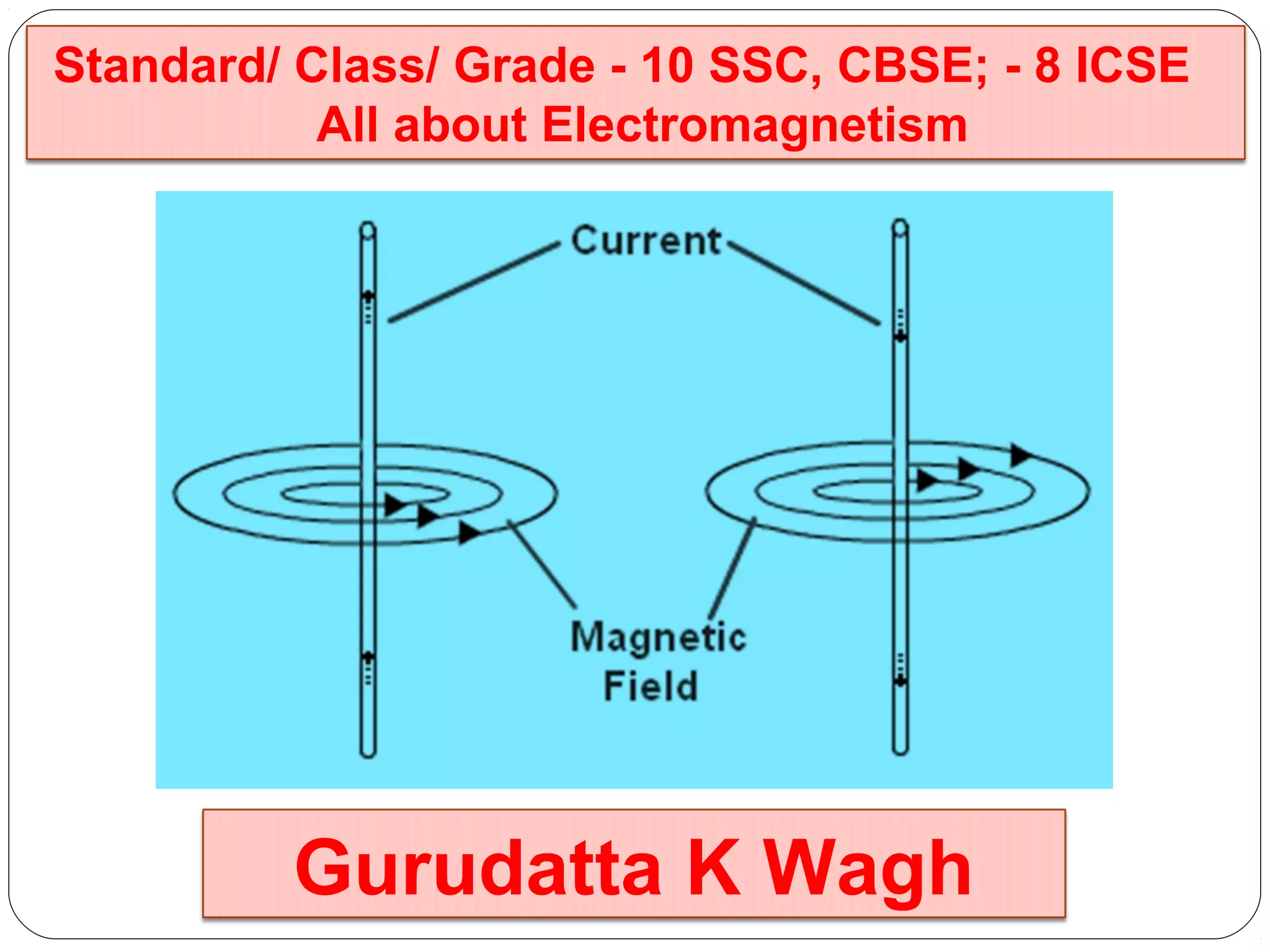
Standard/ Class/ Grade - 10 SSC, CBSE; - 8 ICSE
All about Electromagnetism
Gurudatta K Wagh
Standard 10, Chapter 5, All about Electromagnetism
5.1 Magnetic lines of force
5.2 Magnetic field due to current carrying conductor
5.2.1 Right – Hand Thumb Rule
5.2.2 Magnetic field due to a current through a circular loop
5.2.3 Magnetic field due to current in a solenoid
5.3 Force on a current carrying conductor in a magnetic field
5.4 Electric motor
5.5 Electromagnetic induction
5.5.1 Fleming’s Right – Hand Rule (for generators)
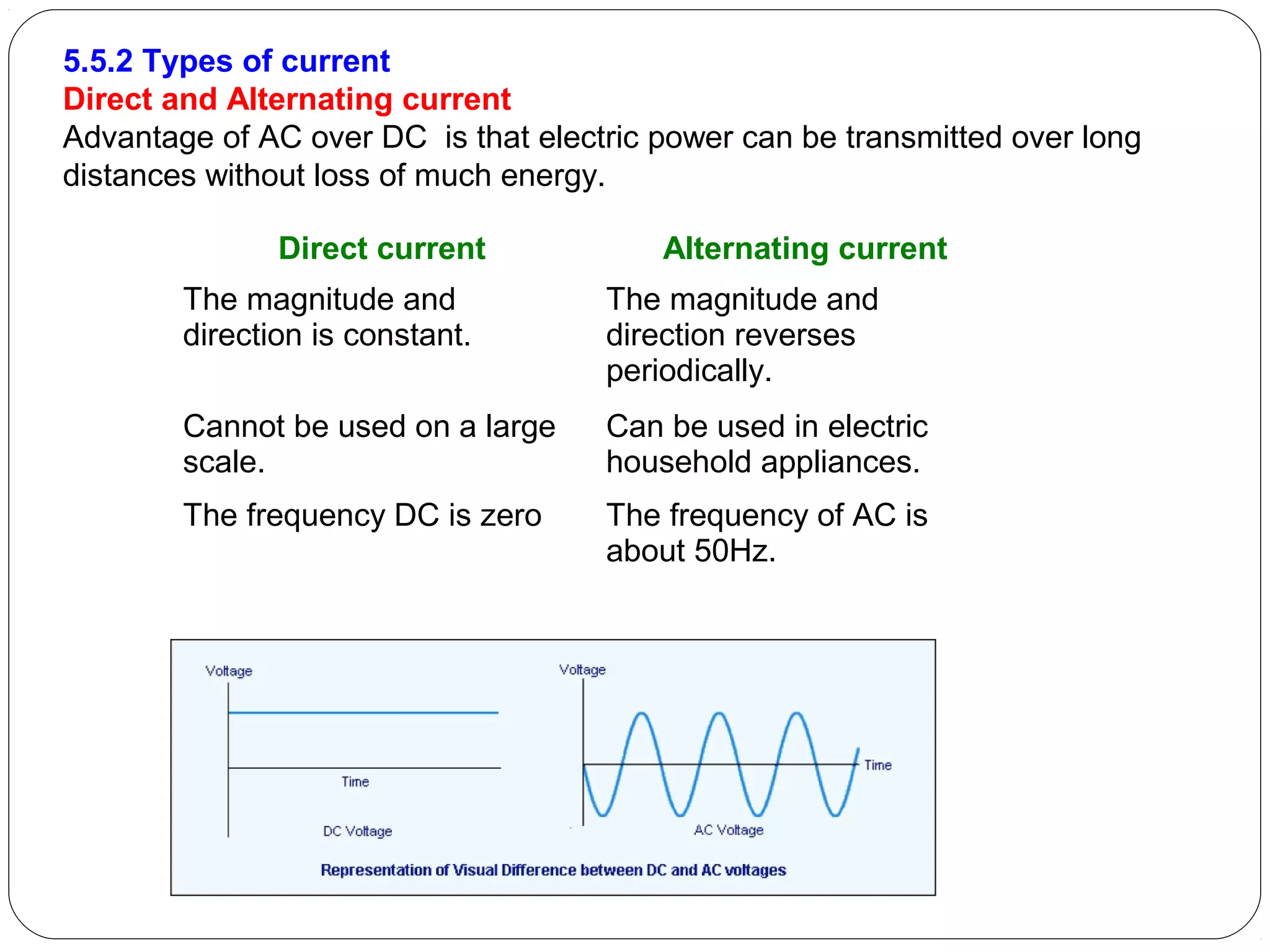
5.5.2 Types of current – Direct and Alternating current
5.6 Electric Generator
5.7 Domestic electric circuit
5.7.1 Safety measures in using electricity
5.7.2 Short circuiting and overloading
Standard 10 Chapter 5 All about Electromagnetism
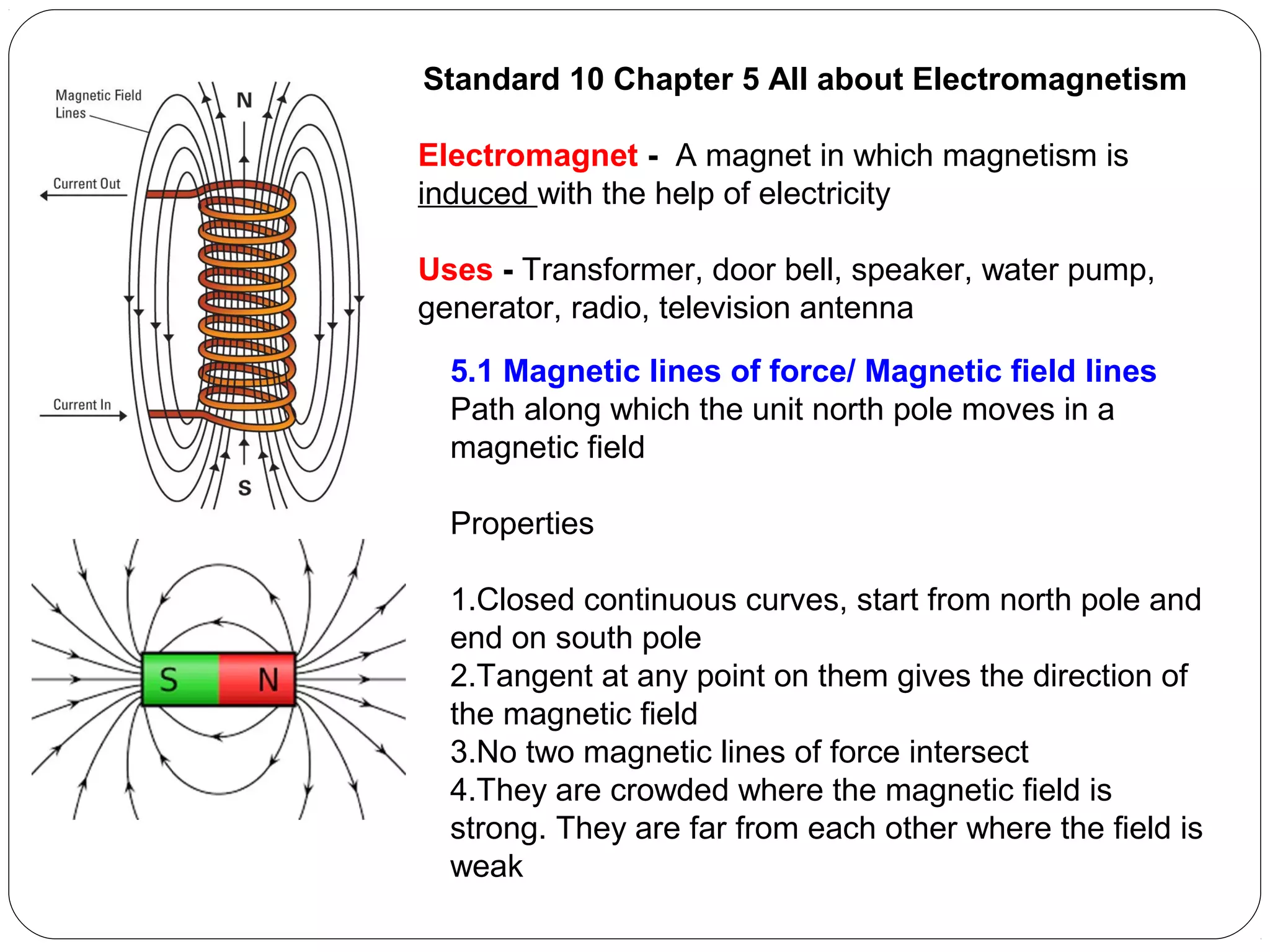
Electromagnet - A magnet in which magnetism is
induced with the help of electricity
Uses - Transformer, door bell, speaker, water pump,
generator, radio, television antenna
5.1 Magnetic lines of force/ Magnetic field lines
Path along which the unit north pole moves in a
magnetic field
Properties
1.Closed continuous curves, start from north pole and
end on south pole
2.Tangent at any point on them gives the direction of
the magnetic field
3.No two magnetic lines of force intersect
4.They are crowded where the magnetic field is
strong. They are far from each other where the field is
weak
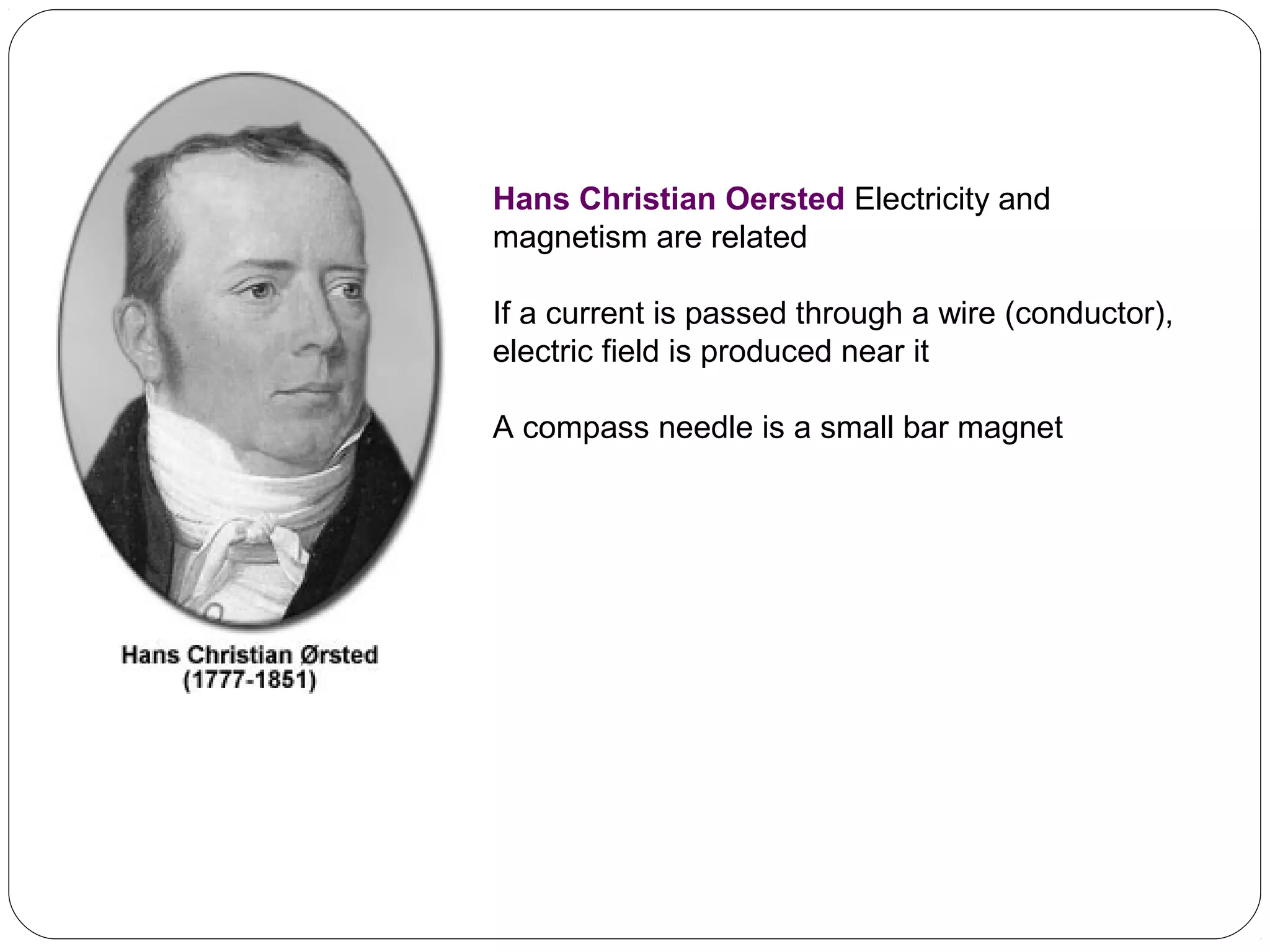
Hans Christian Oersted Electricity and
magnetism are related
If a current is passed through a wire (conductor),
electric field is produced near it
A compass needle is a small bar magnet
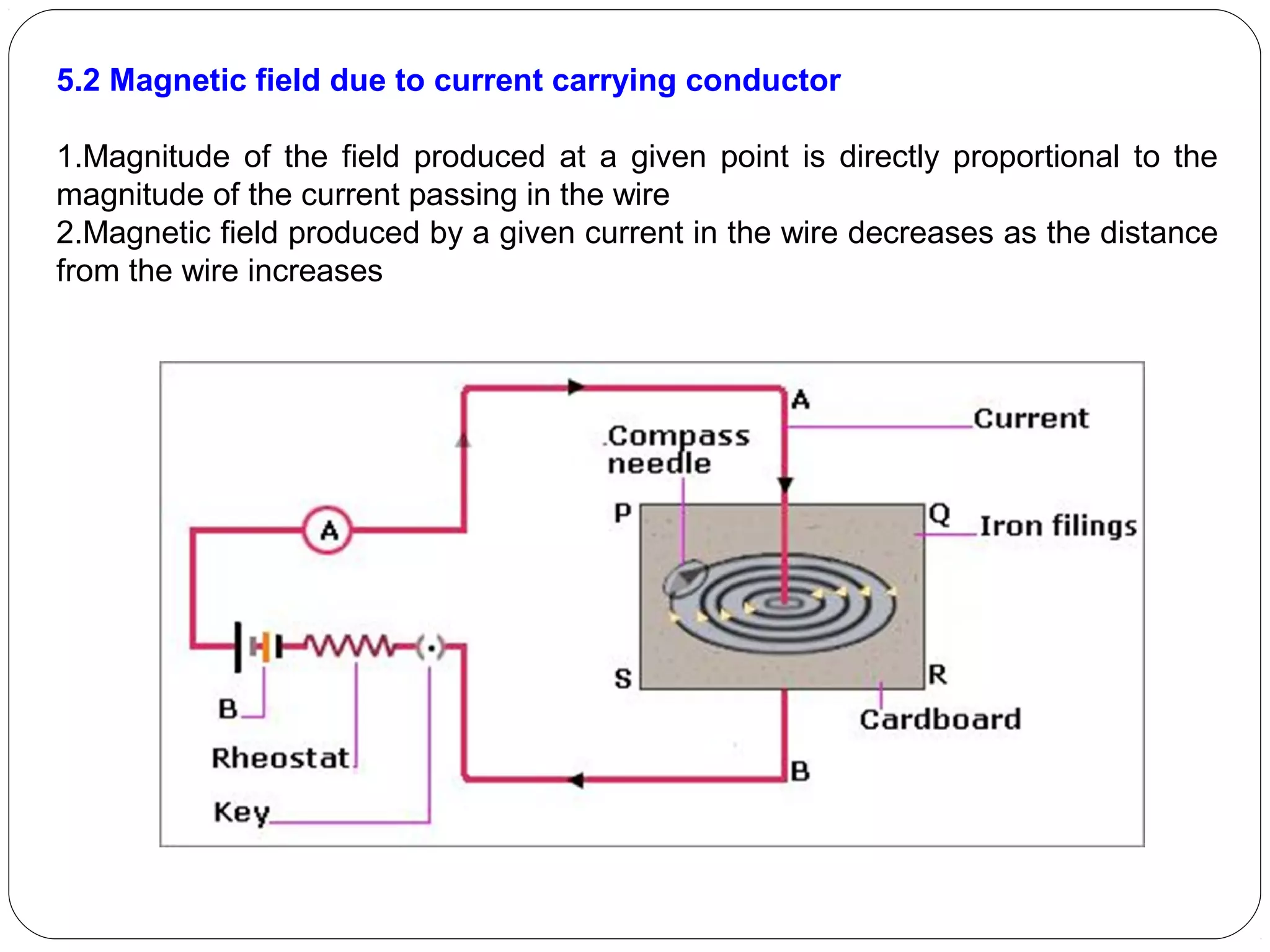
5.2 Magnetic field due to current carrying conductor
1.Magnitude of the field produced at a given point is directly proportional to the
magnitude of the current passing in the wire
2.Magnetic field produced by a given current in the wire decreases as the distance
from the wire increases
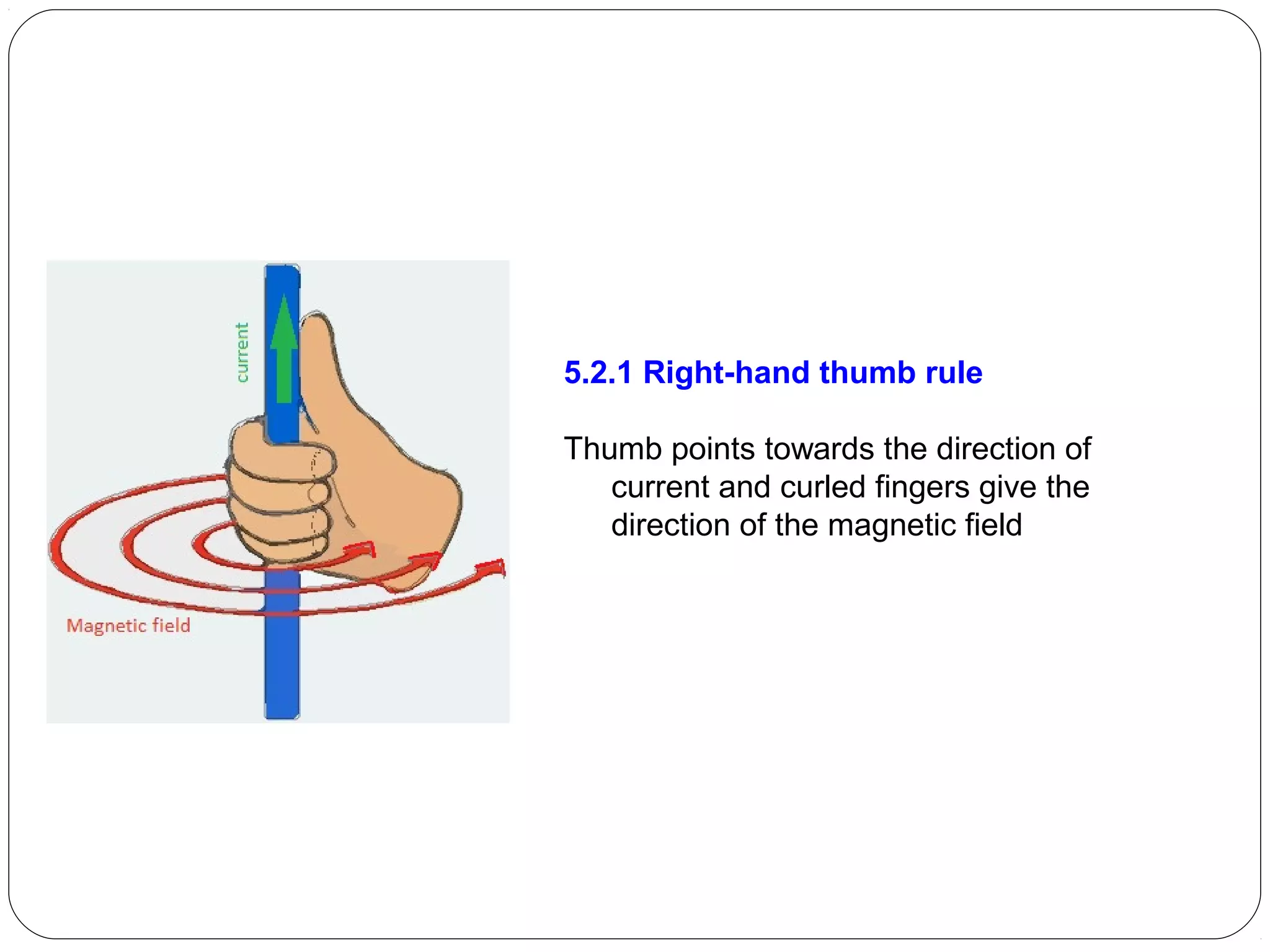
5.2.1 Right-hand thumb rule
Thumb points towards the direction of
current and curled fingers give the
direction of the magnetic field
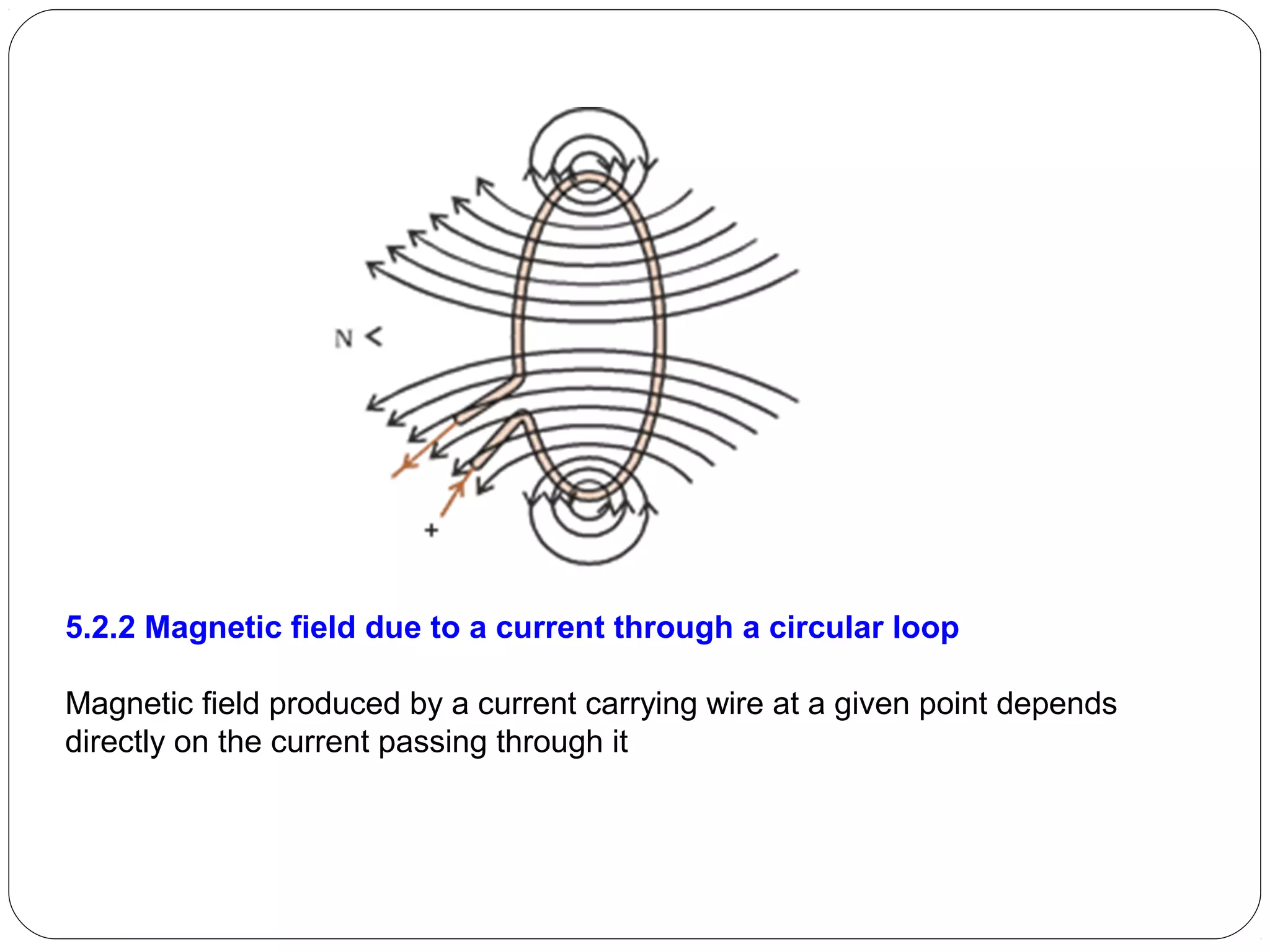
5.2.2 Magnetic field due to a current through a circular loop
Magnetic field produced by a current carrying wire at a given point depends
directly on the current passing through it
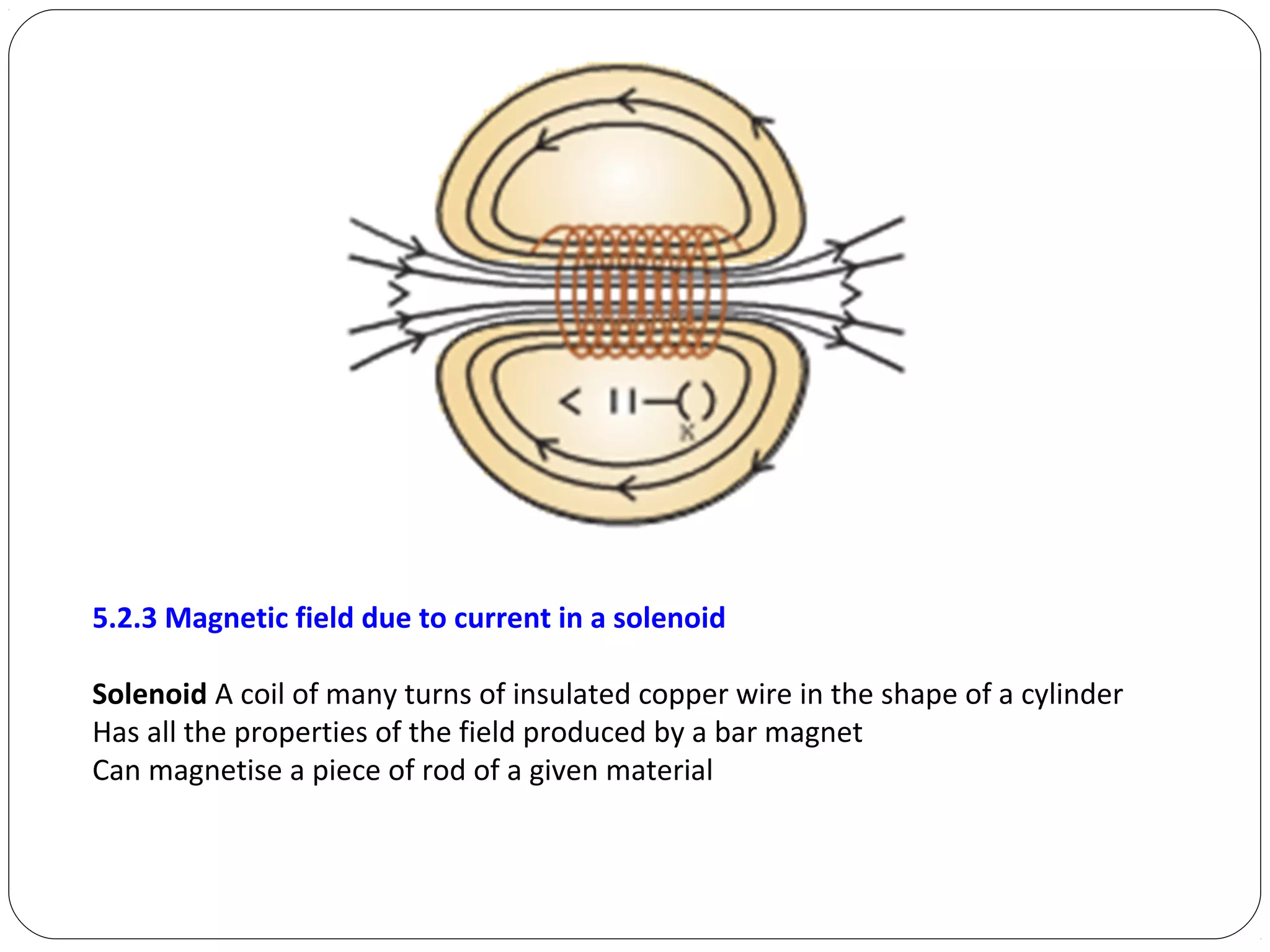
5.2.3 Magnetic field due to current in a solenoid
Solenoid A coil of many turns of insulated copper wire in the shape of a cylinder
Has all the properties of the field produced by a bar magnet
Can magnetise a piece of rod of a given material
5.3 Force on a current carrying conductor in a
magnetic field
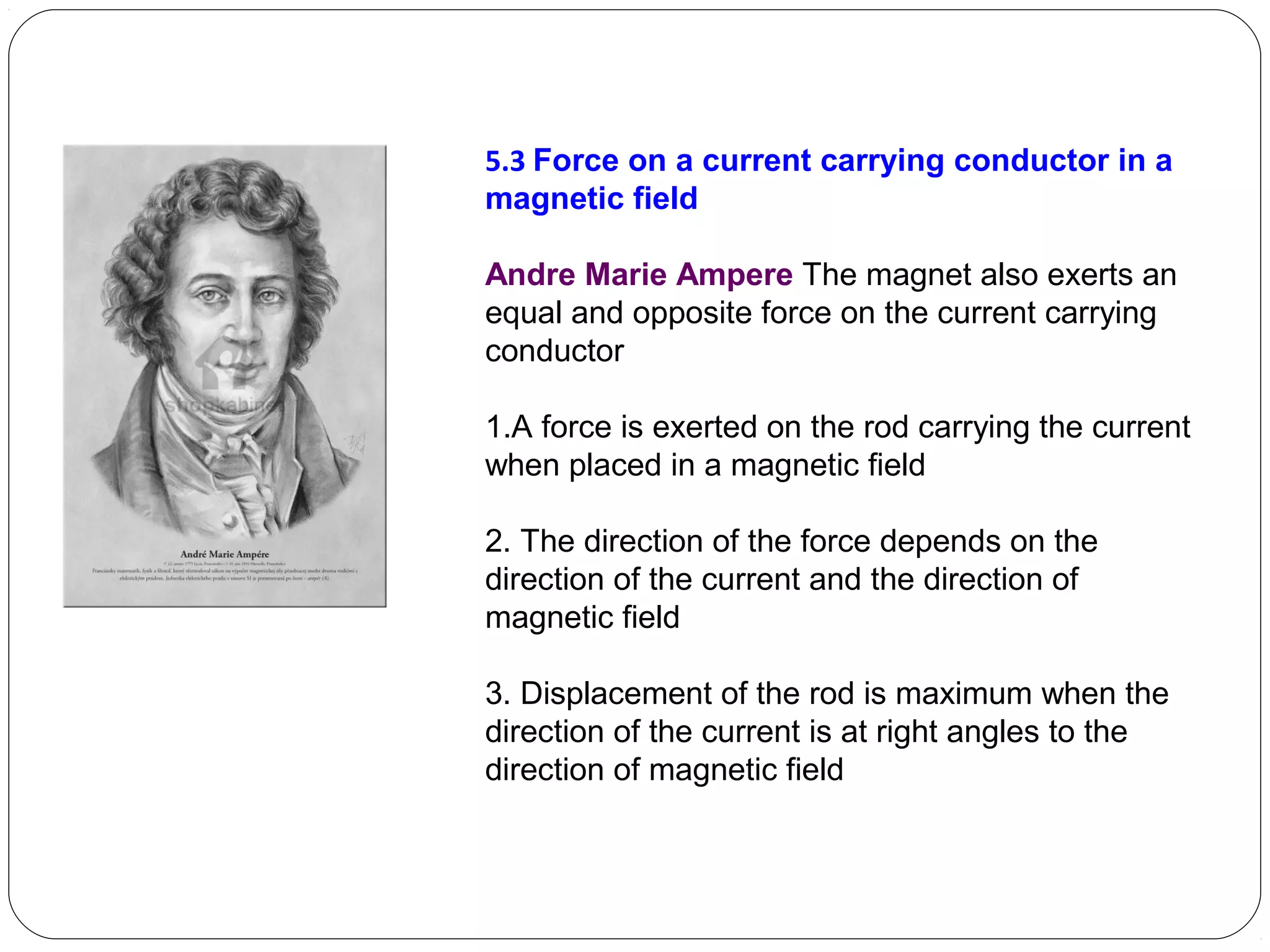
Andre Marie Ampere The magnet also exerts an
equal and opposite force on the current carrying
conductor
1.A force is exerted on the rod carrying the current
when placed in a magnetic field
2. The direction of the force depends on the
direction of the current and the direction of
magnetic field
3. Displacement of the rod is maximum when the
direction of the current is at right angles to the
direction of magnetic field
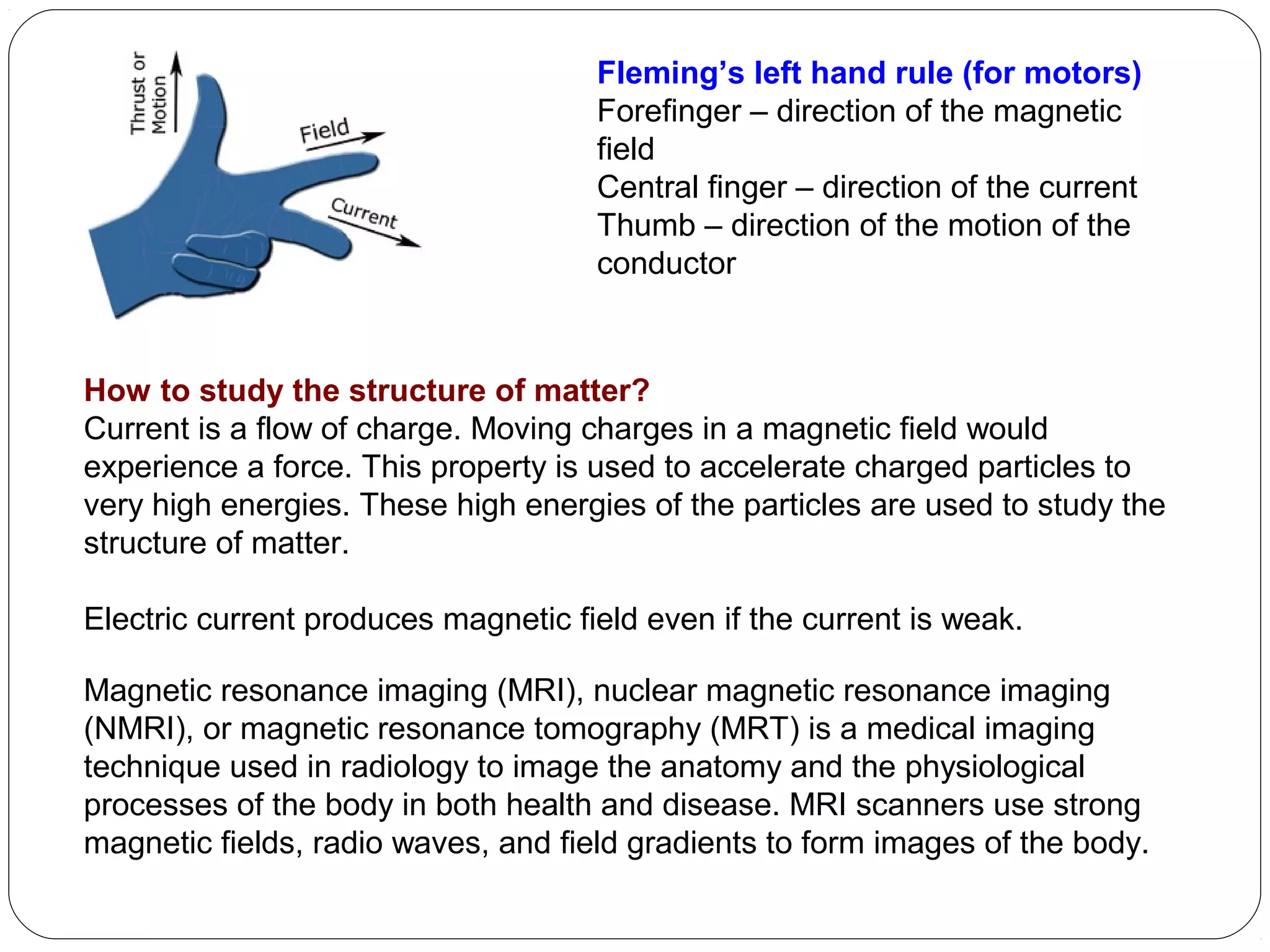
Fleming’s left hand rule (for motors)
Forefinger – direction of the magnetic
field
Central finger – direction of the current
Thumb – direction of the motion of the
conductor
How to study the structure of matter?
Current is a flow of charge. Moving charges in a magnetic field would
experience a force. This property is used to accelerate charged particles to
very high energies. These high energies of the particles are used to study the
structure of matter.
Electric current produces magnetic field even if the current is weak.
Magnetic resonance imaging (MRI), nuclear magnetic resonance imaging
(NMRI), or magnetic resonance tomography (MRT) is a medical imaging
technique used in radiology to image the anatomy and the physiological
processes of the body in both health and disease. MRI scanners use strong
magnetic fields, radio waves, and field gradients to form images of the body.
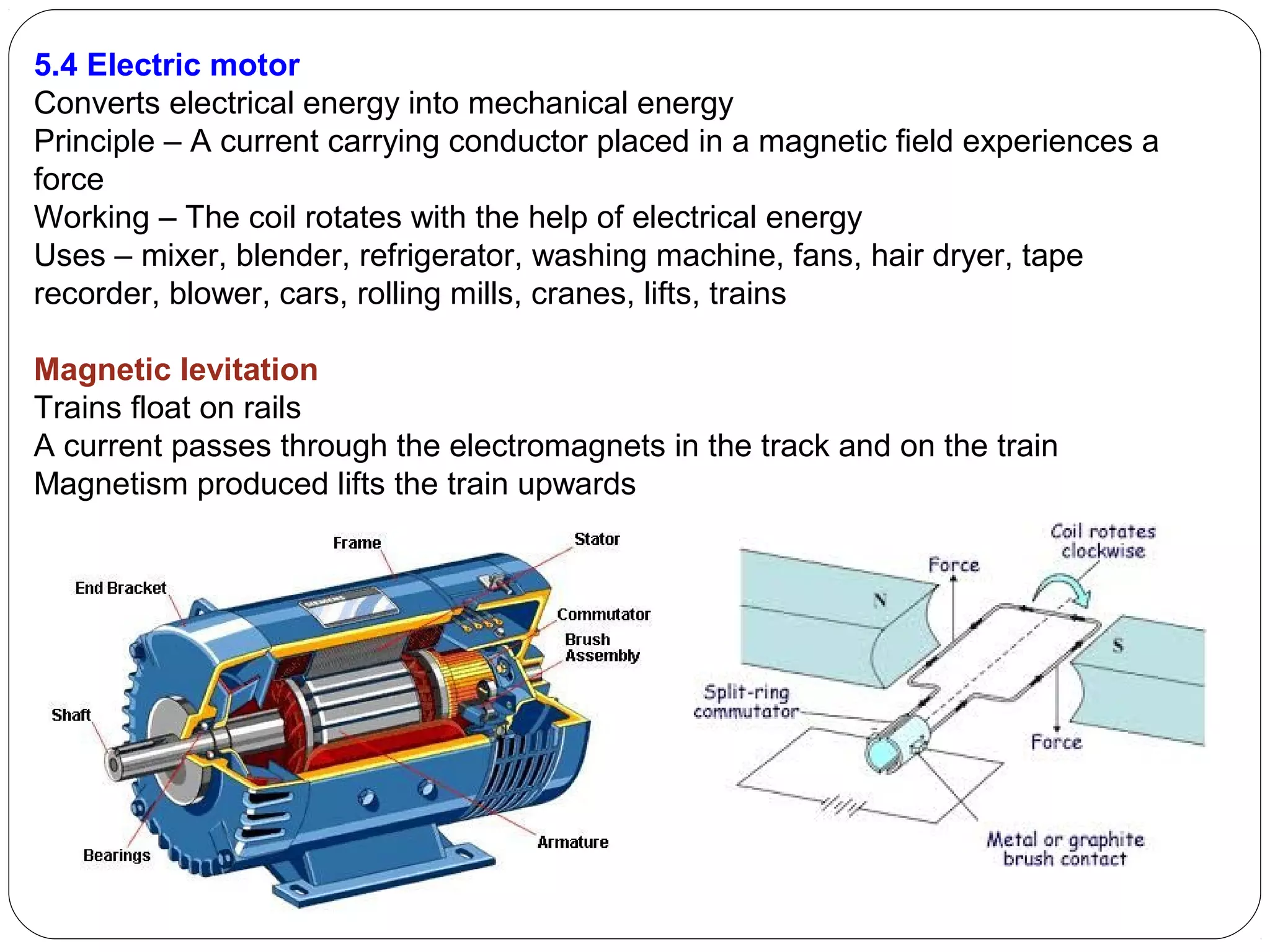
5.4 Electric motor
Converts electrical energy into mechanical energy
Principle – A current carrying conductor placed in a magnetic field experiences a
force
Working – The coil rotates with the help of electrical energy
Uses – mixer, blender, refrigerator, washing machine, fans, hair dryer, tape
recorder, blower, cars, rolling mills, cranes, lifts, trains
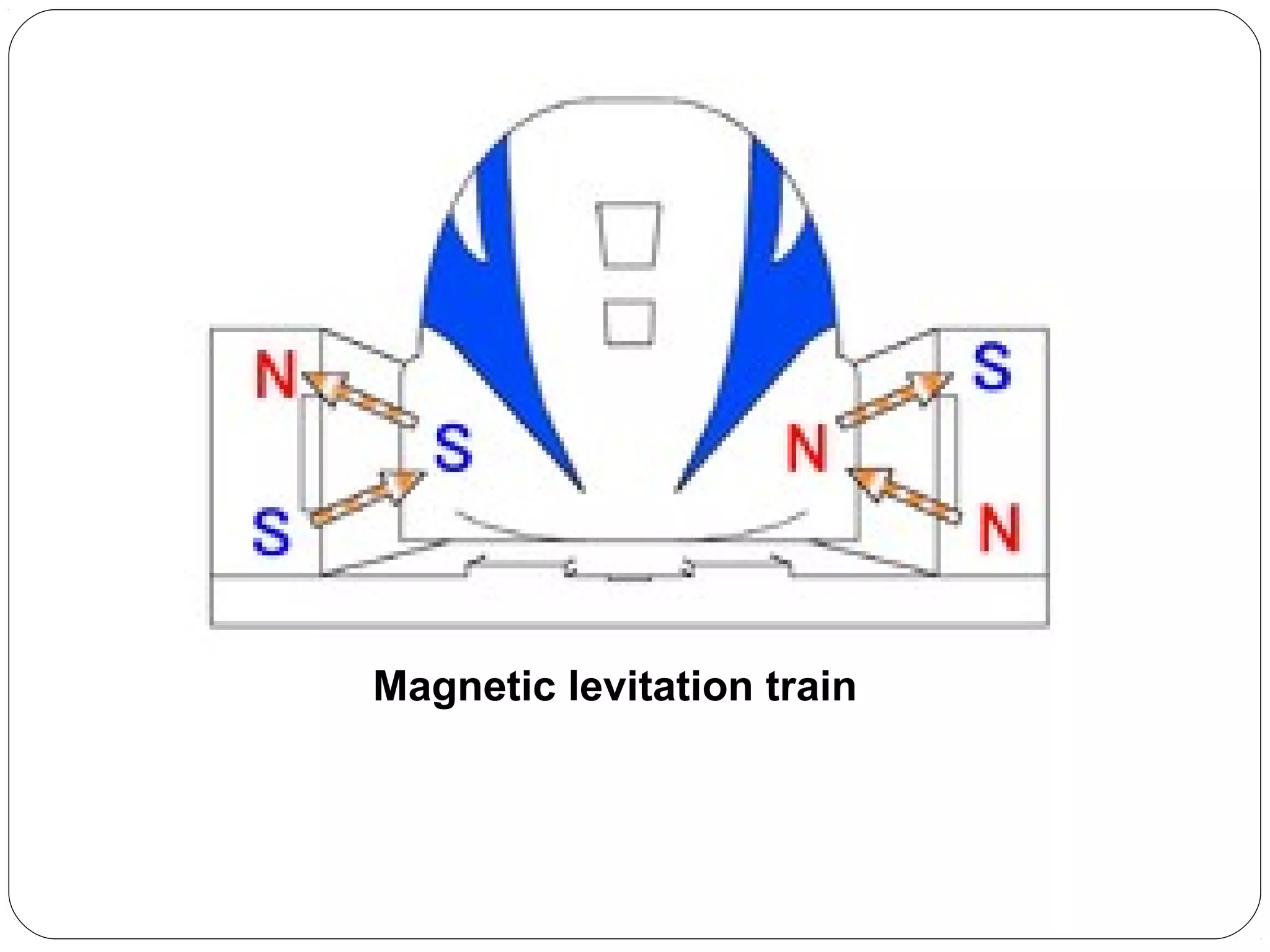
Magnetic levitation
Trains float on rails
A current passes through the electromagnets in the track and on the train
Magnetism produced lifts the train upwards
Magnetic levitation train
5.5 Electromagnetic induction
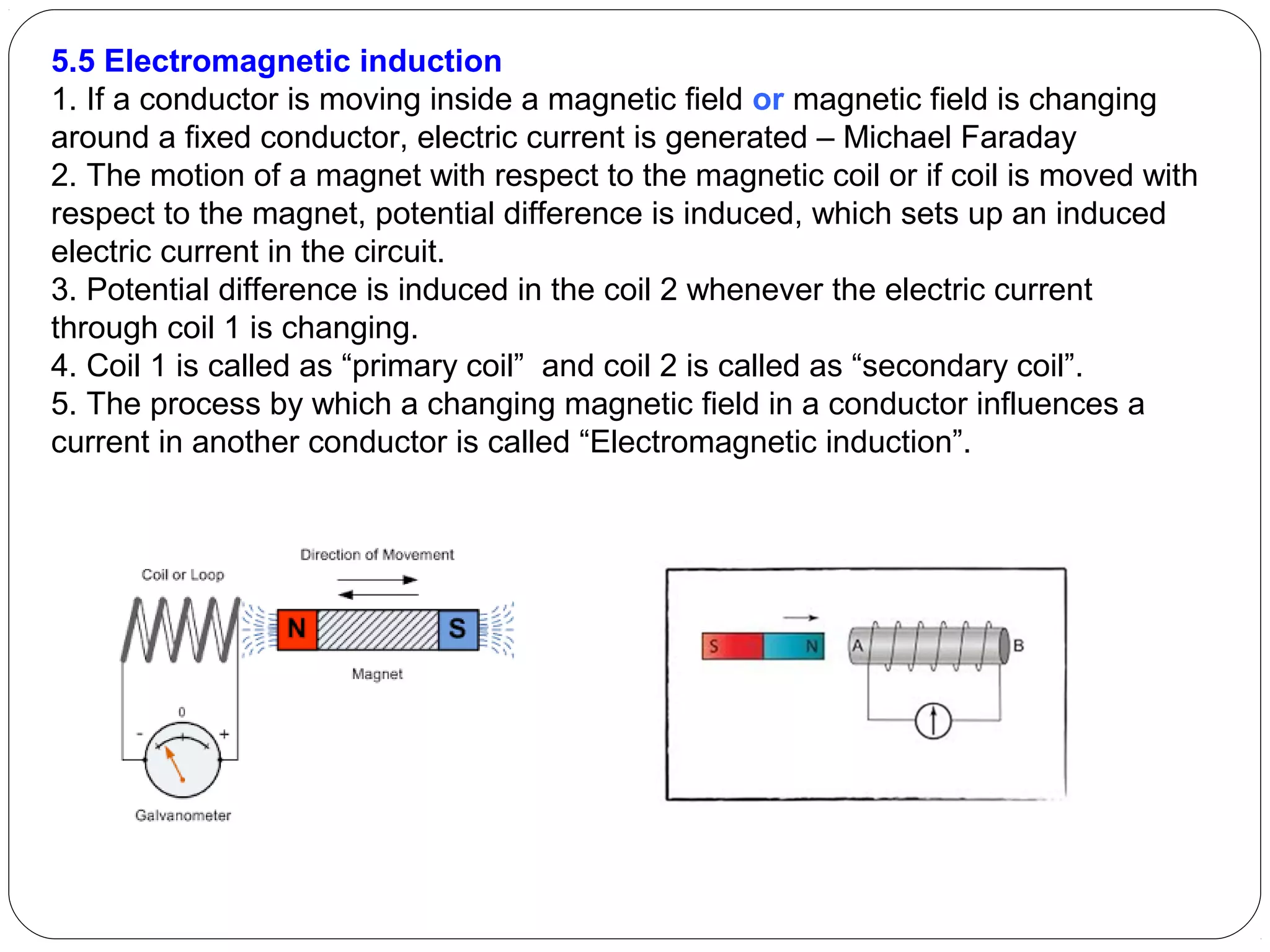
1. If a conductor is moving inside a magnetic field or magnetic field is changing
around a fixed conductor, electric current is generated – Michael Faraday
2. The motion of a magnet with respect to the magnetic coil or if coil is moved with
respect to the magnet, potential difference is induced, which sets up an induced
electric current in the circuit.
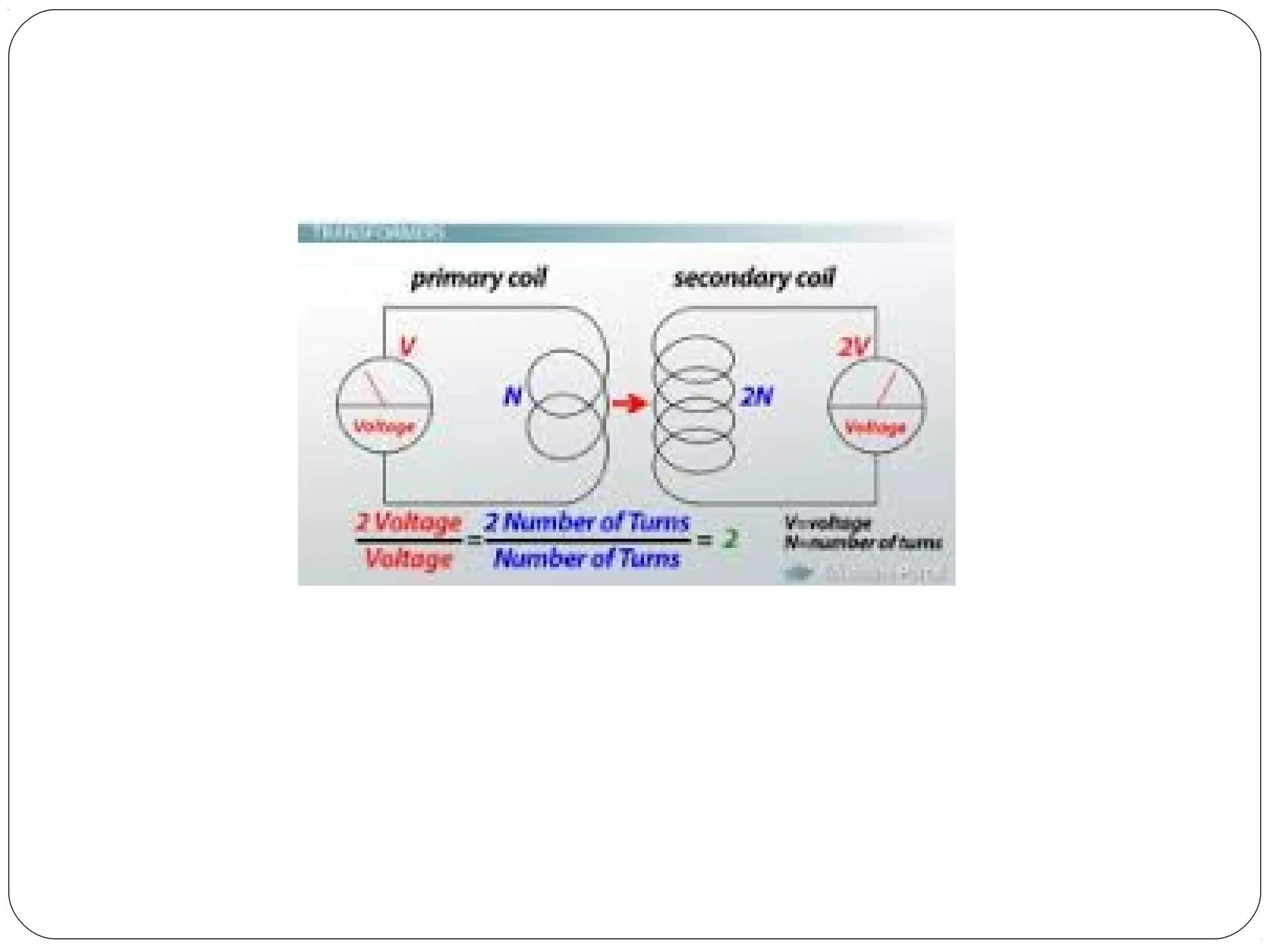
3. Potential difference is induced in the coil 2 whenever the electric current
through coil 1 is changing.
4. Coil 1 is called as “primary coil” and coil 2 is called as “secondary coil”.
5. The process by which a changing magnetic field in a conductor influences a
current in another conductor is called “Electromagnetic induction”.
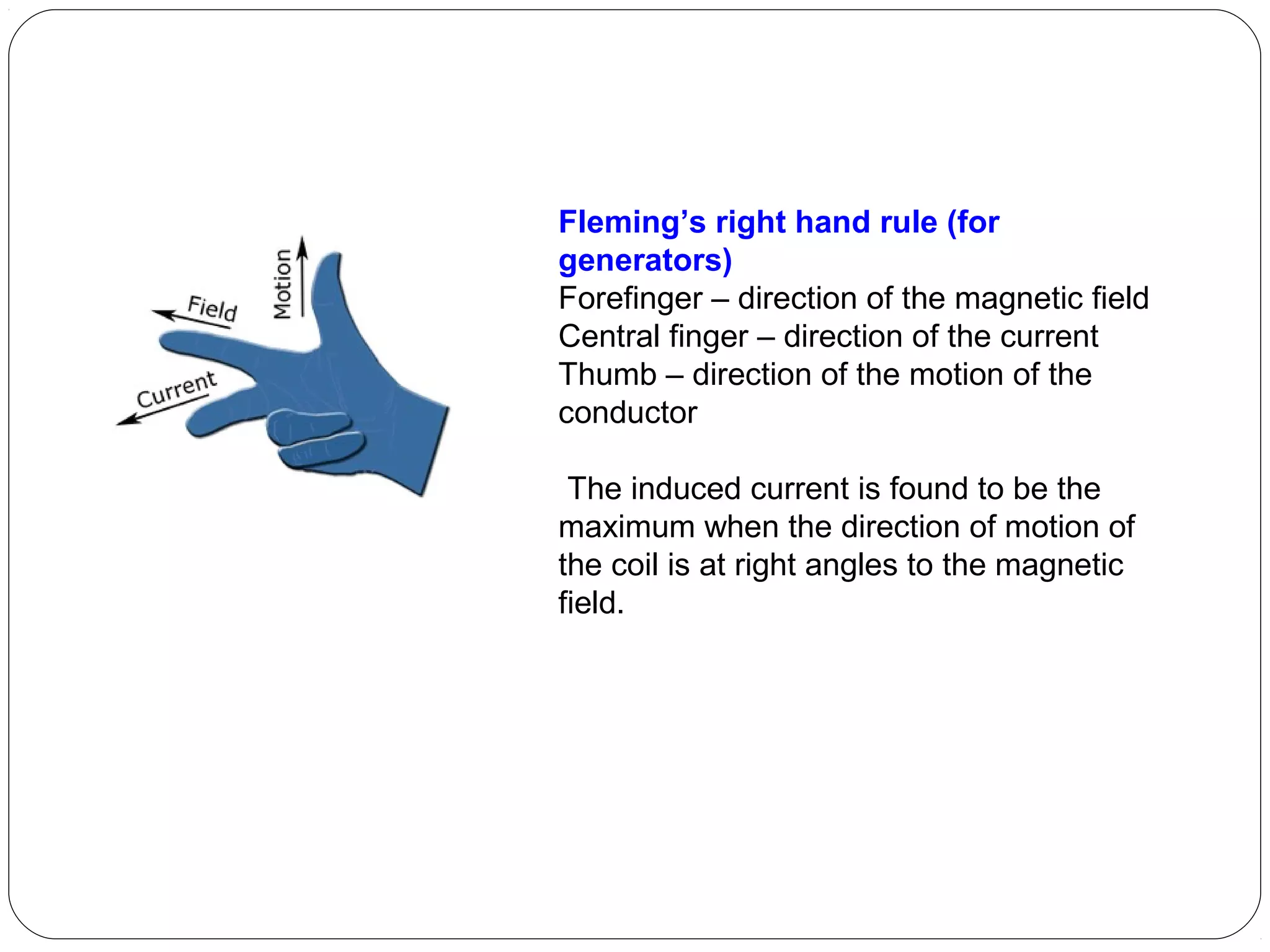
Fleming’s right hand rule (for
generators)
Forefinger – direction of the magnetic field
Central finger – direction of the current
Thumb – direction of the motion of the
conductor
The induced current is found to be the
maximum when the direction of motion of
the coil is at right angles to the magnetic
field.
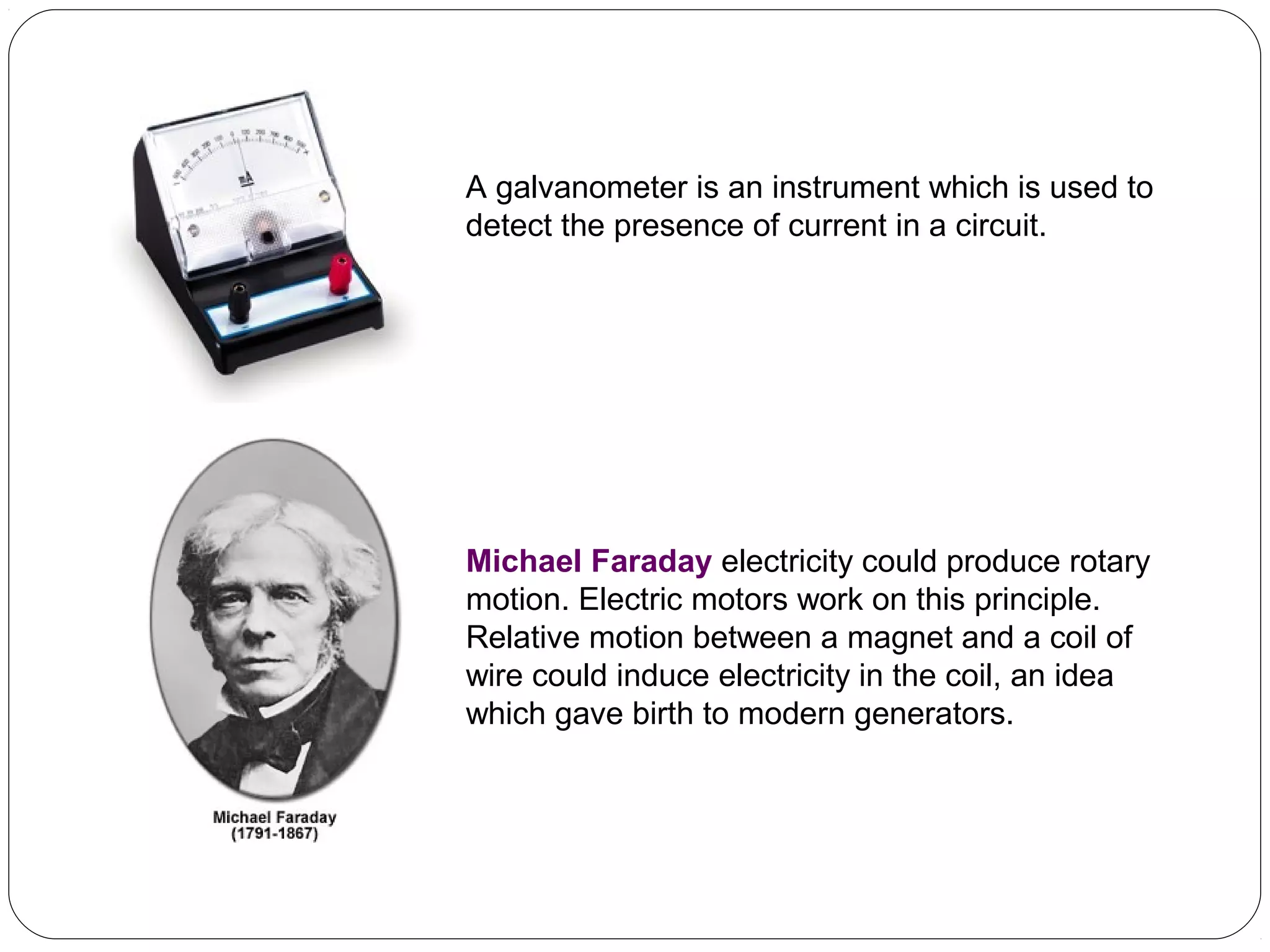
A galvanometer is an instrument which is used to
detect the presence of current in a circuit.
Michael Faraday electricity could produce rotary
motion. Electric motors work on this principle.
Relative motion between a magnet and a coil of
wire could induce electricity in the coil, an idea
which gave birth to modern generators.
5.5.2 Types of current
Direct and Alternating current
Advantage of AC over DC is that electric power can be transmitted over long
distances without loss of much energy.
Direct current Alternating current
The magnitude and
direction is constant.
The magnitude and
direction reverses
periodically.
Cannot be used on a large
scale.
Can be used in electric
household appliances.
The frequency DC is zero The frequency of AC is
about 50Hz.
5.6 Electric Generator
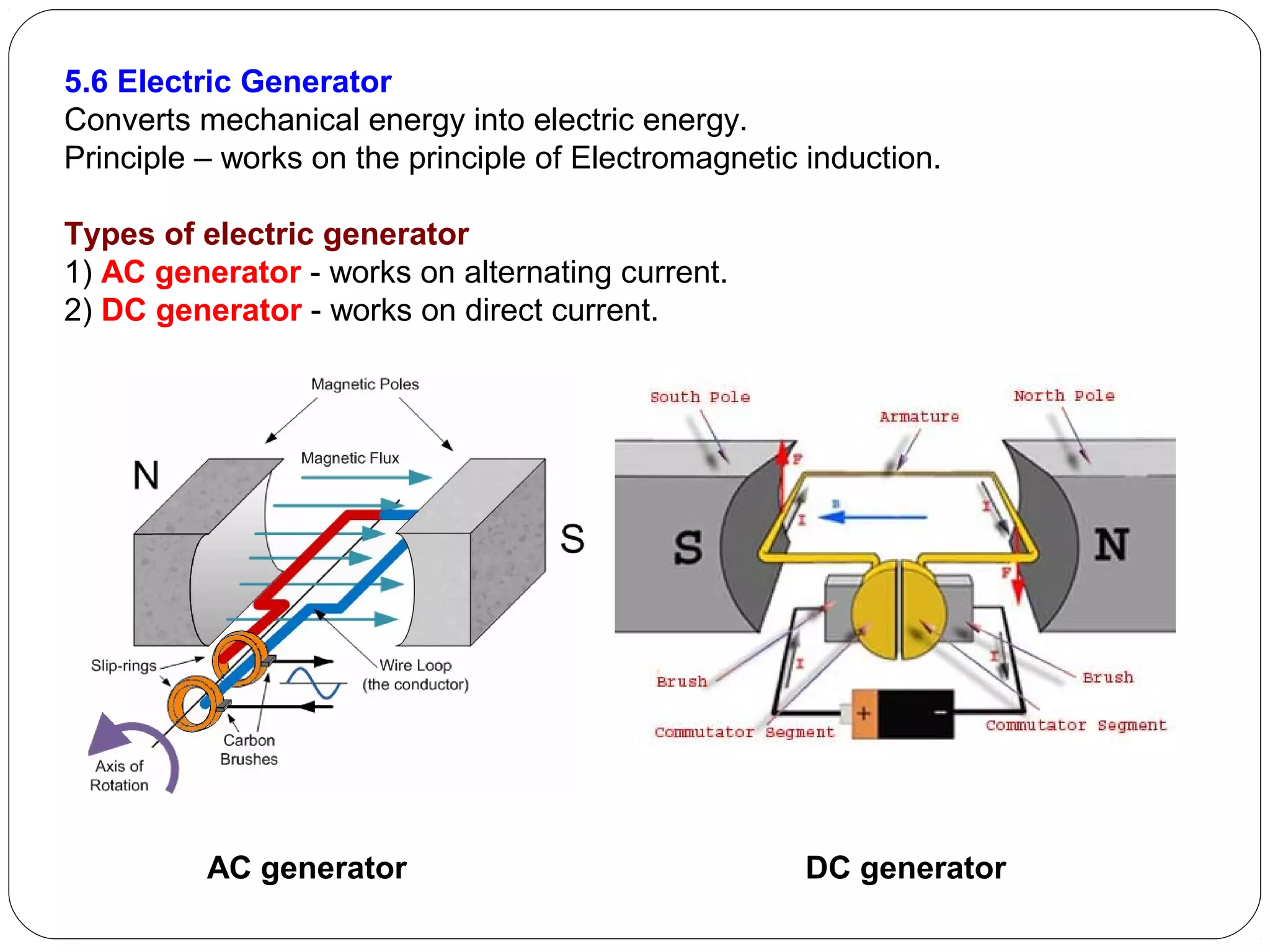
Converts mechanical energy into electric energy.
Principle – works on the principle of Electromagnetic induction.
Types of electric generator
1) AC generator - works on alternating current.
2) DC generator - works on direct current.
AC generator DC generator
5.7 Domestic electric circuit
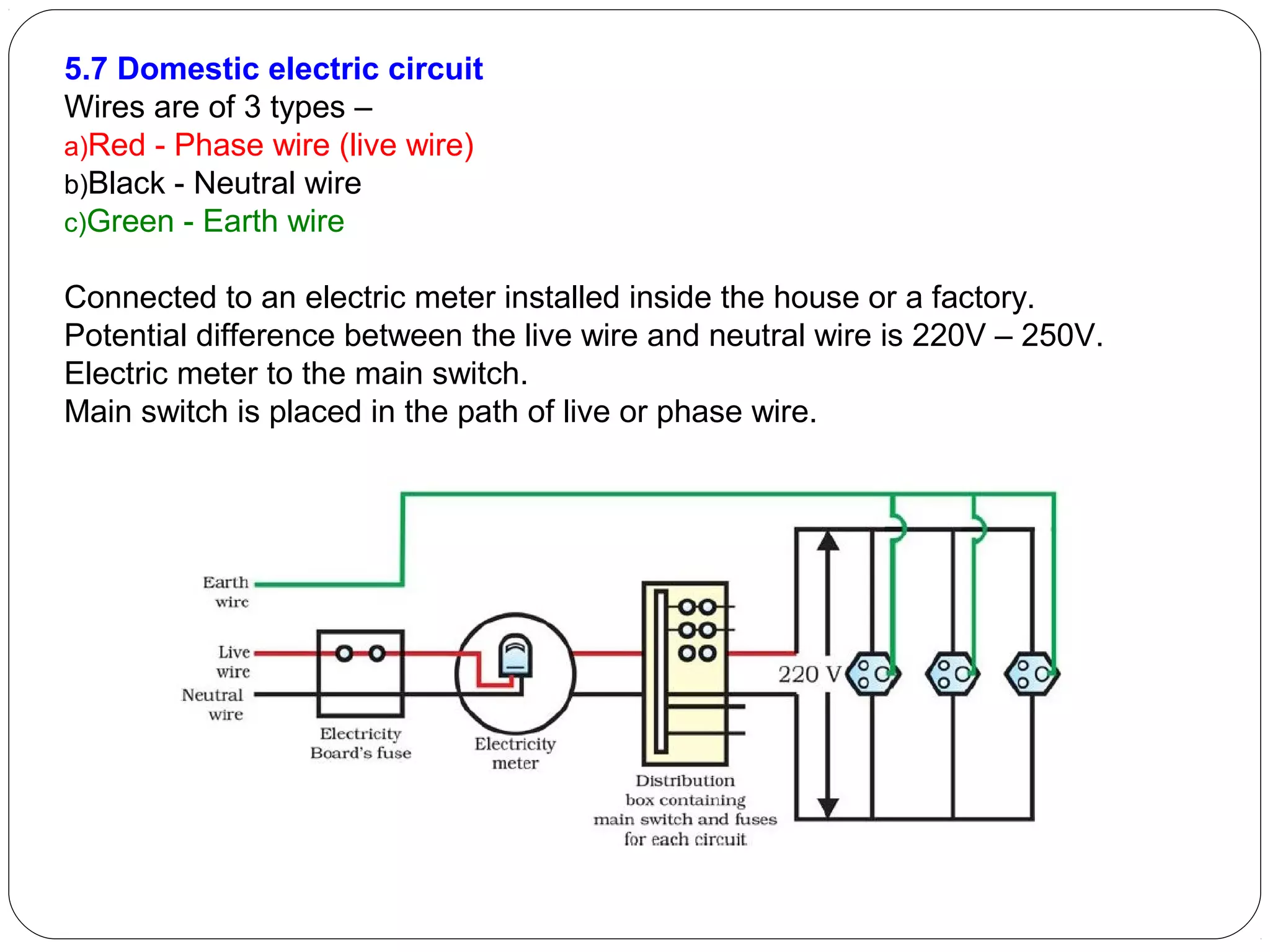
Wires are of 3 types –
a)Red - Phase wire (live wire)
b)Black - Neutral wire
c)Green - Earth wire
Connected to an electric meter installed inside the house or a factory.
Potential difference between the live wire and neutral wire is 220V – 250V.
Electric meter to the main switch.
Main switch is placed in the path of live or phase wire.
5.7.1 Safety measures in using electricity
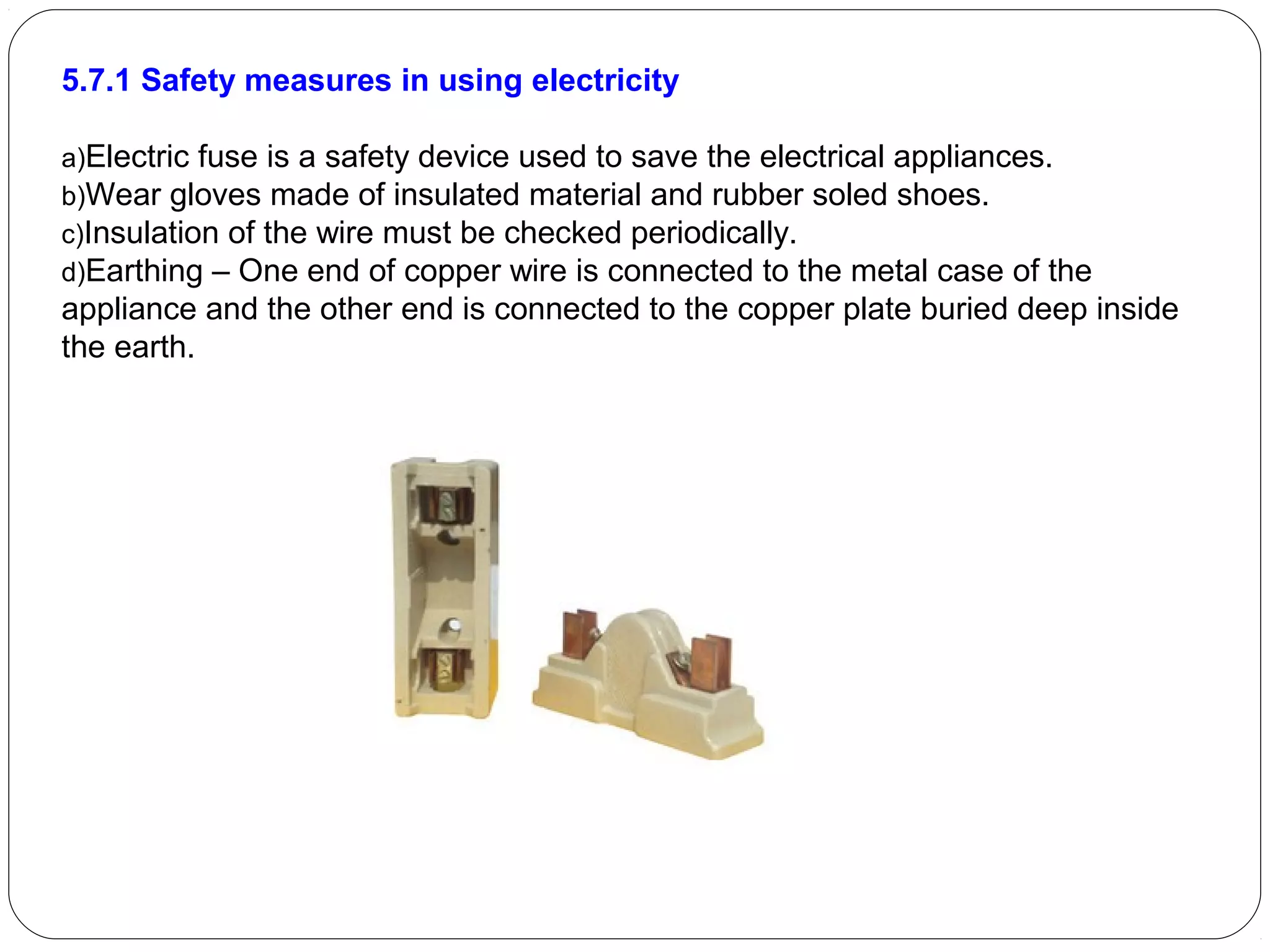
a)Electric fuse is a safety device used to save the electrical appliances.
b)Wear gloves made of insulated material and rubber soled shoes.
c)Insulation of the wire must be checked periodically.
d)Earthing – One end of copper wire is connected to the metal case of the
appliance and the other end is connected to the copper plate buried deep inside
the earth.
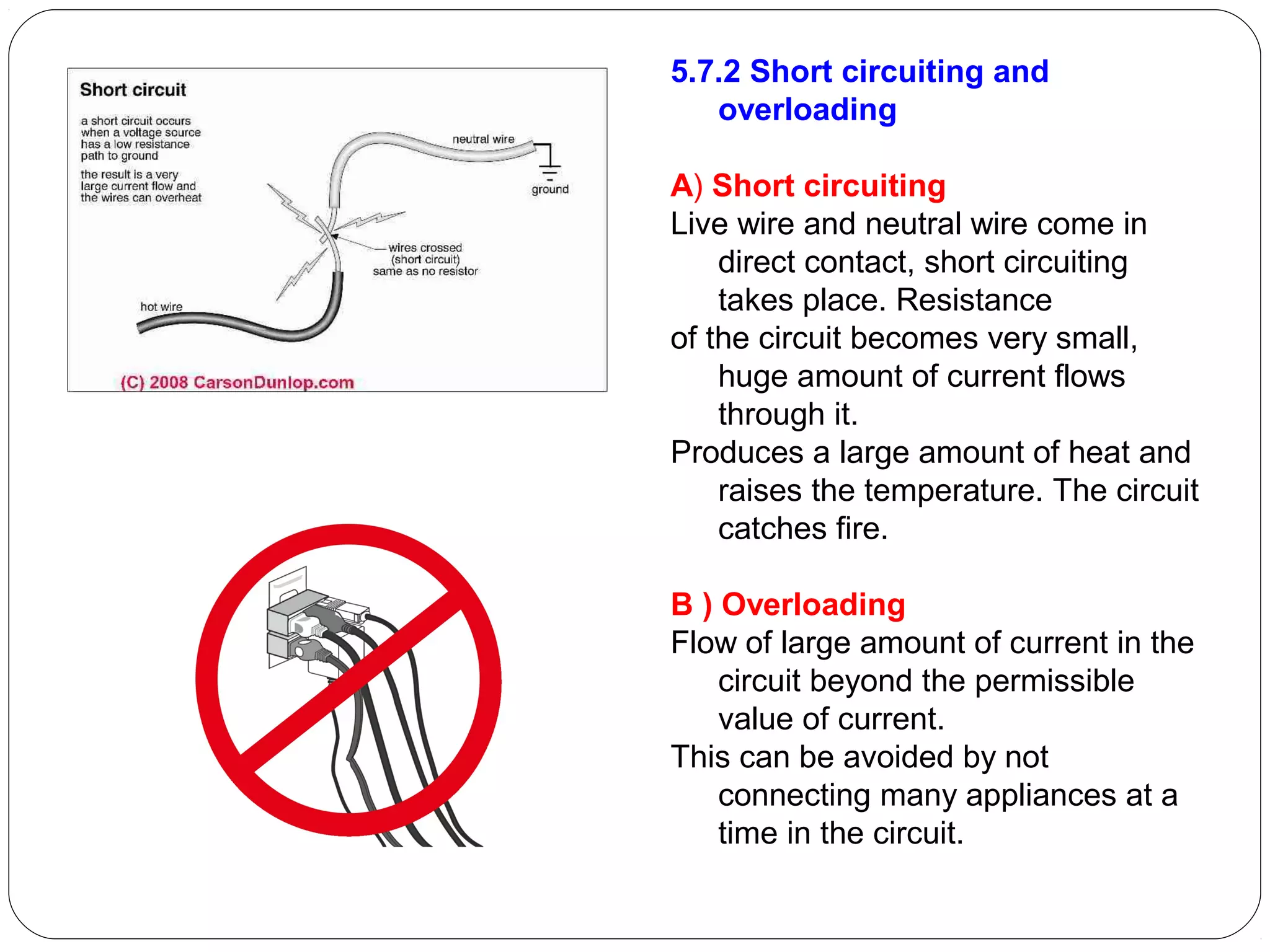
5.7.2 Short circuiting and
overloading
A) Short circuiting
Live wire and neutral wire come in
direct contact, short circuiting
takes place. Resistance
of the circuit becomes very small,
huge amount of current flows
through it.
Produces a large amount of heat and
raises the temperature. The circuit
catches fire.
B ) Overloading
Flow of large amount of current in the
circuit beyond the permissible
value of current.
This can be avoided by not
connecting many appliances at a
time in the circuit.
THANK YOU
SSC Std 10th
Textbook
CBSE Std 10th
Textbook
YouTube
Google
Wikipedia
Suggestions and Appreciations welcome
gkwagh@gmail.com

Std 10 - Electromagnetism

  • 1.
    Standard/ Class/ Grade- 10 SSC, CBSE; - 8 ICSE All about Electromagnetism Gurudatta K Wagh
  • 2.
    Standard 10, Chapter5, All about Electromagnetism 5.1 Magnetic lines of force 5.2 Magnetic field due to current carrying conductor 5.2.1 Right – Hand Thumb Rule 5.2.2 Magnetic field due to a current through a circular loop 5.2.3 Magnetic field due to current in a solenoid 5.3 Force on a current carrying conductor in a magnetic field 5.4 Electric motor 5.5 Electromagnetic induction 5.5.1 Fleming’s Right – Hand Rule (for generators) 5.5.2 Types of current – Direct and Alternating current 5.6 Electric Generator 5.7 Domestic electric circuit 5.7.1 Safety measures in using electricity 5.7.2 Short circuiting and overloading
  • 3.
    Standard 10 Chapter5 All about Electromagnetism Electromagnet - A magnet in which magnetism is induced with the help of electricity Uses - Transformer, door bell, speaker, water pump, generator, radio, television antenna 5.1 Magnetic lines of force/ Magnetic field lines Path along which the unit north pole moves in a magnetic field Properties 1.Closed continuous curves, start from north pole and end on south pole 2.Tangent at any point on them gives the direction of the magnetic field 3.No two magnetic lines of force intersect 4.They are crowded where the magnetic field is strong. They are far from each other where the field is weak
  • 4.
    Hans Christian OerstedElectricity and magnetism are related If a current is passed through a wire (conductor), electric field is produced near it A compass needle is a small bar magnet
  • 5.
    5.2 Magnetic fielddue to current carrying conductor 1.Magnitude of the field produced at a given point is directly proportional to the magnitude of the current passing in the wire 2.Magnetic field produced by a given current in the wire decreases as the distance from the wire increases
  • 6.
    5.2.1 Right-hand thumbrule Thumb points towards the direction of current and curled fingers give the direction of the magnetic field
  • 7.
    5.2.2 Magnetic fielddue to a current through a circular loop Magnetic field produced by a current carrying wire at a given point depends directly on the current passing through it
  • 8.
    5.2.3 Magnetic fielddue to current in a solenoid Solenoid A coil of many turns of insulated copper wire in the shape of a cylinder Has all the properties of the field produced by a bar magnet Can magnetise a piece of rod of a given material
  • 9.
    5.3 Force ona current carrying conductor in a magnetic field Andre Marie Ampere The magnet also exerts an equal and opposite force on the current carrying conductor 1.A force is exerted on the rod carrying the current when placed in a magnetic field 2. The direction of the force depends on the direction of the current and the direction of magnetic field 3. Displacement of the rod is maximum when the direction of the current is at right angles to the direction of magnetic field
  • 10.
    Fleming’s left handrule (for motors) Forefinger – direction of the magnetic field Central finger – direction of the current Thumb – direction of the motion of the conductor How to study the structure of matter? Current is a flow of charge. Moving charges in a magnetic field would experience a force. This property is used to accelerate charged particles to very high energies. These high energies of the particles are used to study the structure of matter. Electric current produces magnetic field even if the current is weak. Magnetic resonance imaging (MRI), nuclear magnetic resonance imaging (NMRI), or magnetic resonance tomography (MRT) is a medical imaging technique used in radiology to image the anatomy and the physiological processes of the body in both health and disease. MRI scanners use strong magnetic fields, radio waves, and field gradients to form images of the body.
  • 11.
    5.4 Electric motor Convertselectrical energy into mechanical energy Principle – A current carrying conductor placed in a magnetic field experiences a force Working – The coil rotates with the help of electrical energy Uses – mixer, blender, refrigerator, washing machine, fans, hair dryer, tape recorder, blower, cars, rolling mills, cranes, lifts, trains Magnetic levitation Trains float on rails A current passes through the electromagnets in the track and on the train Magnetism produced lifts the train upwards
  • 12.
  • 13.
    5.5 Electromagnetic induction 1.If a conductor is moving inside a magnetic field or magnetic field is changing around a fixed conductor, electric current is generated – Michael Faraday 2. The motion of a magnet with respect to the magnetic coil or if coil is moved with respect to the magnet, potential difference is induced, which sets up an induced electric current in the circuit. 3. Potential difference is induced in the coil 2 whenever the electric current through coil 1 is changing. 4. Coil 1 is called as “primary coil” and coil 2 is called as “secondary coil”. 5. The process by which a changing magnetic field in a conductor influences a current in another conductor is called “Electromagnetic induction”.
  • 15.
    Fleming’s right handrule (for generators) Forefinger – direction of the magnetic field Central finger – direction of the current Thumb – direction of the motion of the conductor The induced current is found to be the maximum when the direction of motion of the coil is at right angles to the magnetic field.
  • 16.
    A galvanometer isan instrument which is used to detect the presence of current in a circuit. Michael Faraday electricity could produce rotary motion. Electric motors work on this principle. Relative motion between a magnet and a coil of wire could induce electricity in the coil, an idea which gave birth to modern generators.
  • 17.
    5.5.2 Types ofcurrent Direct and Alternating current Advantage of AC over DC is that electric power can be transmitted over long distances without loss of much energy. Direct current Alternating current The magnitude and direction is constant. The magnitude and direction reverses periodically. Cannot be used on a large scale. Can be used in electric household appliances. The frequency DC is zero The frequency of AC is about 50Hz.
  • 18.
    5.6 Electric Generator Convertsmechanical energy into electric energy. Principle – works on the principle of Electromagnetic induction. Types of electric generator 1) AC generator - works on alternating current. 2) DC generator - works on direct current. AC generator DC generator
  • 19.
    5.7 Domestic electriccircuit Wires are of 3 types – a)Red - Phase wire (live wire) b)Black - Neutral wire c)Green - Earth wire Connected to an electric meter installed inside the house or a factory. Potential difference between the live wire and neutral wire is 220V – 250V. Electric meter to the main switch. Main switch is placed in the path of live or phase wire.
  • 20.
    5.7.1 Safety measuresin using electricity a)Electric fuse is a safety device used to save the electrical appliances. b)Wear gloves made of insulated material and rubber soled shoes. c)Insulation of the wire must be checked periodically. d)Earthing – One end of copper wire is connected to the metal case of the appliance and the other end is connected to the copper plate buried deep inside the earth.
  • 21.
    5.7.2 Short circuitingand overloading A) Short circuiting Live wire and neutral wire come in direct contact, short circuiting takes place. Resistance of the circuit becomes very small, huge amount of current flows through it. Produces a large amount of heat and raises the temperature. The circuit catches fire. B ) Overloading Flow of large amount of current in the circuit beyond the permissible value of current. This can be avoided by not connecting many appliances at a time in the circuit.
  • 22.
    THANK YOU SSC Std10th Textbook CBSE Std 10th Textbook YouTube Google Wikipedia Suggestions and Appreciations welcome gkwagh@gmail.com