Chemistry 30S Unit 3 – Chemical Reactions
CHEMICAL REACTIONS The Mole  A Chemical Measure Video
Formula and molecular mass deal with individual atoms and molecules. Chemists do not work with amounts of individual atoms or molecules. These particles are far too small to see or mass. Balances or scales do not measure mass in terms of atomic mass units. Chemists need a practical unit that relates mass, in grams, with the number of particles. We will use the word particle as a generic term meaning atoms, molecules ions, or any other entity. CHEMICAL REACTIONS Avogadro’s Number
The  mole  (abbreviated  mol ) is the unit that relates number of particles and mass. The mole is defined as the number of particles in 12.0000 g of carbon containing 6 protons and 6 neutrons. In one mole of carbon, there are 6.022136736 x 10 23  atoms; we will round this to 6.02 x 10 23 .  The number of particles in a mole after is 6.02 x 10 23  ( Avogadro's Number )  and has the symbol N A . CHEMICAL REACTIONS Avogadro’s Number
6.02 x 10 23  is a very large number. It is 602 followed by 21 zeros or  602 000 000 000 000 000 000 000 If we were to name the number, we would say it as  " six hundred and two sextillion ."  One mole contains 6.02 x 10 23  of anything! 6.02 x 10 23  donuts is one mole of donuts 6.02 x 10 23  pencils is one mole of pencils 6.02 x 10 23  pennies is one mole of pennies 6.02 x 10 23  students is one mole of students 6.02 x 10 23  carbon atoms is one mole of carbon atoms 6.02 x 10 23  water molecules is one mole of water molecules CHEMICAL REACTIONS Avogadro’s Number
Now remember, in chemistry, a mole is not a small furry burrowing animal or a dark mark on the skin; it is Avogadro’s Number of particles.  CHEMICAL REACTIONS The Mole  How much would a mole of Smarties be?
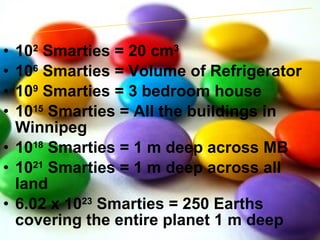
10 2  Smarties = 20 cm 3 10 6  Smarties = Volume of Refrigerator 10 9  Smarties = 3 bedroom house 10 15  Smarties = All the buildings in Winnipeg 10 18  Smarties = 1 m deep across MB 10 21  Smarties = 1 m deep across all land 6.02 x 10 23  Smarties = 250 Earths covering the entire planet 1 m deep SMARTY ANALOGY
Recall, Avogadro’s Number relates the number of particles to mass. If the mass of one mole of any atom is its atomic mass in grams, then  one mole of aluminum atoms has a mass of 27.0 g one mole of silver atoms has a mass of 107.9 g One mole of any compound has a mass equal to its formula mass, in grams. For example the formula mass of water is 18.0 amu.  The mass of one mole of water molecules is 18.0 g. The mass of one mole of a substance is called the  molar mass  ( M ).  The units for molar mass are grams per mole (g/mol), so the molar mass of water is 18.0 g/mol. CHEMICAL REACTIONS Molar Mass
Example 1  What is the molar mass of Ca 3 (PO 4 ) 2 ? Solution. We determined in an earlier lesson that the formula mass of calcium phosphate is 310.3 amu. Since the mass of one mole of Ca 3 (PO4) 2  is equal to its formula mass in grams, the molar mass of Ca 3 (PO 4 ) 2  is  310.3 g/mol . CHEMICAL REACTIONS Molar Mass
Example 2  What is the molar mass of lead (II) chloride, PbCl 2 ? Solution. Calculate the formula mass. PbCl 2  = 1 Pb + 2 Cl PbCl 2  = 207.2µ + 2(35.5µ) PbCl 2  = 278.2µThe molar mass is the formula mass in g/mol, so the molar mass of lead (II) chloride is  278.2 g/mol CHEMICAL REACTIONS Molar Mass
Example 3  What is the molar mass of ammonium dichromate? Solution. Write the formula.(NH 4 ) 2 Cr 2 O 7 Determine the formula mass.(NH 4 ) 2 Cr 2 O 7  = 2 N + 8 H + 2 Cr + 7 O (NH 4 ) 2 Cr 2 O 7  = 2(14.0µ) + 8(1.0µ) + 2(52.0µ) + 7(16.0µ) (NH 4 ) 2 Cr 2 O 7  = 28.0µ + 8.0µ + 104.0µ + 112.0µ (NH 4 ) 2 Cr 2 O 7  = 252.0µ Convert to g/mol.(NH 4 ) 2 Cr 2 O 7  =  252.0 g/mol . CHEMICAL REACTIONS Molar Mass
CHEMICAL REACTIONS Avagadro’s Number and Molar Mass
The units for molar mass,  M , are g/mol. This means the mass, in grams, of one mole of a substance or mathematically,  Where: M  is molar mass in g/mol m is mass in grams n  represents the number of moles CHEMICAL REACTIONS Calculating Moles, Given Sample Mass
We can rearrange this relationship to determine the number of moles in any sample of a substance if we know the mass of that substance: or To find the number of moles, given the sample mass: Step 1: Find the molar mass. Step 2: Use the molar mass to calculate the number of moles. CHEMICAL REACTIONS Calculating Moles, Given Sample Mass
Example 1  How many moles of carbon atoms in 24.0 g of carbon?  Solution. Step 1: Find the molar mass.  C = 12.0 g/mol Step 2: Substitute into  the equation.   Solving this problem using factor label would be as follows: Step 1: Find the molar mass. C = 12.0 g/mol Step 2: Determine the equation. CHEMICAL REACTIONS Calculating Moles, Given Sample Mass
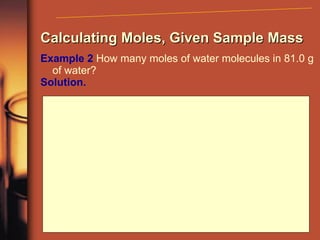
Example 2  How many moles of water molecules in 81.0 g of water? Solution. CHEMICAL REACTIONS Calculating Moles, Given Sample Mass
Example 3  How many moles in 50.0 g of lead (II) chloride, PbCl 2 ? Solution. CHEMICAL REACTIONS Calculating Moles, Given Sample Mass
If we need a certain number of moles of a substance we can calculate the mass of the substance by multiplying the number of moles of that substance by its molar mass. The formula would look like this:  m =  n  x  M or sample mass in grams = (number of moles)(molar mass) Where: M  is molar mass in g/mol m is mass in grams n  represents the number of moles CHEMICAL REACTIONS Calculate the Mass of a Given Number of Moles
When converting from moles to mass, Step 1: Determine the molar mass of the substance. Step 2: Substitute into the equation, m =  n  x  M  or multiply so units cancel to yield grams. CHEMICAL REACTIONS Calculate the Mass of a Given Number of Moles
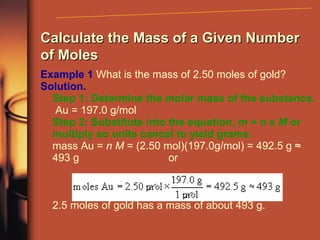
Example 1  What is the mass of 2.50 moles of gold? Solution. Step 1: Determine the molar mass of the substance.  Au = 197.0 g/mol Step 2: Substitute into the equation, m =  n  x  M  or multiply so units cancel to yield grams. mass Au =  n M  = (2.50 mol)(197.0g/mol) = 492.5 g ≈ 493 g or 2.5 moles of gold has a mass of about 493 g.  CHEMICAL REACTIONS Calculate the Mass of a Given Number of Moles
Example 2  What is the mass of 1.20 x 10 –5  moles of carbon tetrachloride, CCl 4 ? Solution. CHEMICAL REACTIONS Calculate the Mass of a Given Number of Moles
Example 3  Calculate the mass of 5.00 moles of aluminum atoms. Solution. CHEMICAL REACTIONS Calculate the Mass of a Given Number of Moles
One mole of anything contains 6.02 x 10 23  individual entities, or Avogadro's Number, N A , of that substance. In other words,  number of particles = (number of moles)(Avogadro's Number) or particles = n x N A To find the number of particles in a sample, multiply the number of moles by Avogadro's Number. CHEMICAL REACTIONS Calculating the Number of Particles, Given Number of Moles
Example 1  How many atoms in 25.0 moles of copper atoms? Solution. The type of atom, molecule, ion, etc. is not significant in this calculation.Substitute moles into the equation,  particles = n x N A Number of particles = n N A  = (25.0 mol)(6.02 x 10 23  particles/mol) = 1.505 x 10 25 There are about 1.51 x 10 25  copper atoms in 25.0 moles of copper. CHEMICAL REACTIONS Calculating the Number of Particles, Given Number of Moles
Example 2  How many molecules of water in 1.50 x 10 –5  moles of water? Solution. CHEMICAL REACTIONS Calculating the Number of Particles, Given Number of Moles
If the number of particles is calculated by particles =  n  x N A  ,   then we can determine the number of moles in a certain number of particles by dividing the number of particles by Avogadro's Number  CHEMICAL REACTIONS Calculating the Number of Moles in a Given Number of Particles
Example 1  How many moles are there in 5.00 x 10 25  particles? Solution . Substitute values into the equation  or, Use the Factor Label Method to cancel units and leave moles remaining. CHEMICAL REACTIONS Calculating the Number of Moles in a Given Number of Particles
Example 2  How many moles of atoms is 5 atoms of zinc? Solution. CHEMICAL REACTIONS Calculating the Number of Moles in a Given Number of Particles
The mole allows the conversion between mass and number of particles. To convert mass to the number of particles: Step 1: Convert mass to moles by dividing mass by molar mass. Step 2: Convert moles to number of particles by multiplying moles by Avogadro's Number CHEMICAL REACTIONS Converting Mass to Particles
CHEMICAL REACTIONS Converting Mass to Particles
Example 1  How many molecules of water in a 10.0 g sample of water? Solution. Step 1: Convert mass to moles by dividing mass by molar mass. H 2 O = 18.0 g/mol Do not round at this point. Keep the number in your calculator. CHEMICAL REACTIONS Converting Mass to Particles
Solution. Step 2: Convert moles to number of particles by multiplying moles by Avogadro's Number. molecules of H 2 O = (0.5556 mol)(6.02 x 10 23  molecules/mol) = 3.34 x 10 23  molecules or, use the Factor Label Method. Be sure to arrange the values so the units cancel to leave molecules or particles. There are 3.34 x 10 23  molecules in 10.0 g of water. CHEMICAL REACTIONS
Example 2  How many atoms in 25.0 g of sodium chloride, NaCl? Solution. CHEMICAL REACTIONS Converting Mass to Particles
From the flowchart  we can determine the mass of a certain number of particles of a substance. To find the mass of a given number of particles: Step 1: Determine the number of moles by dividing by Avogadro’s Number. Step 2: Multiply the number of moles by the molar mass of the substance CHEMICAL REACTIONS Converting Particles to Mass  o
Example 1  What is the mass of 3.01 x 10 23  molecules of water? Solution. Step 1: Determine the number of moles by dividing by Avogadro’s Number.   CHEMICAL REACTIONS Converting Particles to Mass
Step 2: Multiply the number of moles by the molar mass of the substance. H 2 O = 18.0 g/mol m = n M  = (0.500 mol)(18.0 g/mol) = 9.00 g or, using the factor label method: The mass of 3.01 x 10 23  water molecules is 9.00 g. CHEMICAL REACTIONS Converting Particles to Mass
Example 2  What is the mass of a single atom of carbon? Solution. CHEMICAL REACTIONS Converting Particles to Mass
Example  How many atoms of each element are in 37.5 g of copper (II) nitrate?  Solution. We are given 37.5 g and must find atoms. The unit  g  is mass, so we must convert mass to moles then moles to particles. Step 1: Determine the chemical formula. Cu(NO 3 ) 2 Step 2: Find molar mass and moles of copper (II) nitrate. Cu(NO 3 ) 2  = 187.5 g/mol CHEMICAL REACTIONS Final Example
Solution. Step 3: Find the number of moles of Cu(NO 3 ) 2 .  recall you take the mass divided by the molar mass n = 37.5 g / 187.5 g n - .200 moles CHEMICAL REACTIONS Final Example
Solution. Step 4: Find the number of Cu(NO 3 ) 2  particles.  particles = n N A  = (0.200 mol)(6.02 x 10 23  particles/mol) = 1.204 x 10 23  particles This is the number of Cu(NO 3 ) 2  particles, not the number of atoms of each element. By examining the subscripts in the formula, each particle of copper (II) nitrate contains : 1 atom of copper, 2 atoms of nitrogen and 3 x 2 = 6 atoms of oxygen. We use these factors to determine the total number of atoms of each kind. CHEMICAL REACTIONS Final Example
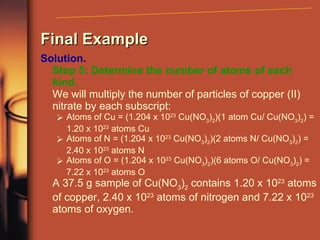
Solution. Step 5: Determine the number of atoms of each kind. We will multiply the number of particles of copper (II) nitrate by each subscript: Atoms of Cu = (1.204 x 10 23  Cu(NO 3 ) 2 )(1 atom Cu/ Cu(NO 3 ) 2 ) = 1.20 x 10 23  atoms Cu Atoms of N = (1.204 x 10 23  Cu(NO 3 ) 2 )(2 atoms N/ Cu(NO 3 ) 2 ) = 2.40 x 10 23  atoms N Atoms of O = (1.204 x 10 23  Cu(NO 3 ) 2 )(6 atoms O/ Cu(NO 3 ) 2 ) = 7.22 x 10 23  atoms O A 37.5 g sample of Cu(NO 3 ) 2  contains 1.20 x 10 23  atoms of copper, 2.40 x 10 23  atoms of nitrogen and 7.22 x 10 23  atoms of oxygen. CHEMICAL REACTIONS Final Example
CHEMICAL REACTIONS Online Summary
Concept Map Moles Particles Mass
Chemists use a  standard temperature and pressure ,  STP , to measure gas volumes.  The standard temperature is 0°C and the standard pressure is 101.3 kPa, 760 mm Hg, or 1.00 atmosphere.  At standard temperature and pressure, the volume of one mole of any gas is 22.4 L. 22.4 L/mol is known as  molar volume  of a gas at STP.  CHEMICAL REACTIONS Molar Volume
CHEMICAL REACTIONS Molar Volume
Since the units for molar volume are L/mol, we can calculate the number of moles in a sample of gas if we are given its volume ate STP. The number of moles can be determined by or CHEMICAL REACTIONS Calculating the Number of Moles of a Gas, Given Its Volume
Example 1  How many moles are in 50.0 L of oxygen gas at STP? Solution. According to Avogadro's Hypothesis, the identity of the gas does not matter when calculating volume. Substitute into the equation. or,  using the factor label method CHEMICAL REACTIONS Calculating the Number of Moles of a Gas, Given Its Volume
Example 2  How many moles in 10.0 mL of carbon dioxide gas at STP? Solution. CHEMICAL REACTIONS Calculating the Number of Moles of a Gas, Given Its Volume
If one mole of a gas at STP has a volume of 22.4 L, then 2 moles of a gas at STP will have a volume of 2 mol x 22.4 L/mol = 44.8 L. To calculate the volume form the number of moles, multiply by molar volume.  CHEMICAL REACTIONS Calculate Volume, Given Moles
Example 1  What is the volume, in Litres, of 2.50 moles of methane, CH 4 , at STP? Solution. Once again, the identity of the gas is unimportant, according to Avogadro's Hypothesis, in this calculation. Substitute into the equation. V =  n  x 22.4 L/mol  = (2.50 mol)(22.4 L/mol) = 56.0 L CHEMICAL REACTIONS Calculate Volume, Given Moles
To calculate the number of particles from mass or vice versa, we needed to calculate the number of moles first. The same holds true if we want to calculate the volume of a gas given the mass or number of molecules of the gas at STP. CHEMICAL REACTIONS Calculating Volume, Given Mass or Particles.
When doing conversions, Step 1: Convert quantity to moles. Step 2: Convert moles to desired quantity (mass, particles, or volume). CHEMICAL REACTIONS Calculating Volume, Given Mass or Particles.
Example 1  What is the volume of 10.0 g of oxygen gas at STP? Solution. Step 1: Find the molar mass of oxygen gas and convert quantity to moles. oxygen gas = O 2  = 32.0 g/mol Step 2: Convert moles to volume. Do not round the previous value. V = n x 22.4 L/mol = (0.3125 mol)(22.4 L/mol) = 7.00 L CHEMICAL REACTIONS Calculating Volume, Given Mass or Particles.
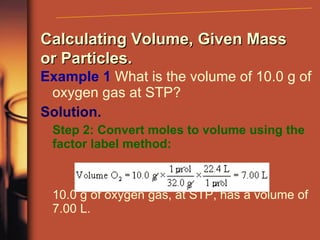
Example 1  What is the volume of 10.0 g of oxygen gas at STP? Solution. Step 2: Convert moles to volume using the factor label method: 10.0 g of oxygen gas, at STP, has a volume of 7.00 L. CHEMICAL REACTIONS Calculating Volume, Given Mass or Particles.
Example 2  What volume will one million (1 x 10 6 ) molecules of natural gas, methane (CH 4 ), occupy at STP? Solution. CHEMICAL REACTIONS Calculating Volume, Given Mass or Particles.
Similarly, we can calculate the mass or number of particles in a given volume of gas at STP by calculating moles first.  Step 1: Convert volume to moles. Step 2: Convert moles to mass or number of particles. CHEMICAL REACTIONS Calculating Mass and Number of Particles, Given the Volume of a Gas
CHEMICAL REACTIONS Calculating Mass and Number of Particles, Given the Volume of a Gas
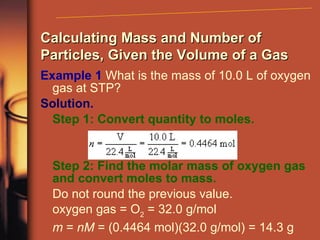
Example 1  What is the mass of 10.0 L of oxygen gas at STP? Solution. Step 1: Convert quantity to moles. Step 2: Find the molar mass of oxygen gas and convert moles to mass. Do not round the previous value. oxygen gas = O 2  = 32.0 g/mol m  =  nM  = (0.4464 mol)(32.0 g/mol) = 14.3 g CHEMICAL REACTIONS Calculating Mass and Number of Particles, Given the Volume of a Gas
Example 1  What is the mass of 10.0 L of oxygen gas at STP? Solution. Step 2: Find the molar mass of oxygen gas and convert moles to mass using the factor label method: 10.0 L of oxygen gas, at STP, has a mass of 14.3 g. CHEMICAL REACTIONS Calculating Mass and Number of Particles, Given the Volume of a Gas
Example 2  How many molecules in 5.00 L of natural gas, methane (CH 4 ), at STP? Solution. CHEMICAL REACTIONS Calculating Mass and Number of Particles, Given the Volume of a Gas

Moles

  • 1.
    Chemistry 30S Unit3 – Chemical Reactions
  • 2.
    CHEMICAL REACTIONS TheMole A Chemical Measure Video
  • 3.
    Formula and molecularmass deal with individual atoms and molecules. Chemists do not work with amounts of individual atoms or molecules. These particles are far too small to see or mass. Balances or scales do not measure mass in terms of atomic mass units. Chemists need a practical unit that relates mass, in grams, with the number of particles. We will use the word particle as a generic term meaning atoms, molecules ions, or any other entity. CHEMICAL REACTIONS Avogadro’s Number
  • 4.
    The mole (abbreviated mol ) is the unit that relates number of particles and mass. The mole is defined as the number of particles in 12.0000 g of carbon containing 6 protons and 6 neutrons. In one mole of carbon, there are 6.022136736 x 10 23 atoms; we will round this to 6.02 x 10 23 . The number of particles in a mole after is 6.02 x 10 23 ( Avogadro's Number ) and has the symbol N A . CHEMICAL REACTIONS Avogadro’s Number
  • 5.
    6.02 x 10²³ is a very large number. It is 602 followed by 21 zeros or 602 000 000 000 000 000 000 000 If we were to name the number, we would say it as " six hundred and two sextillion ." One mole contains 6.02 x 10 23 of anything! 6.02 x 10 23 donuts is one mole of donuts 6.02 x 10 23 pencils is one mole of pencils 6.02 x 10 23 pennies is one mole of pennies 6.02 x 10 23 students is one mole of students 6.02 x 10 23 carbon atoms is one mole of carbon atoms 6.02 x 10 23 water molecules is one mole of water molecules CHEMICAL REACTIONS Avogadro’s Number
  • 6.
    Now remember, inchemistry, a mole is not a small furry burrowing animal or a dark mark on the skin; it is Avogadro’s Number of particles. CHEMICAL REACTIONS The Mole How much would a mole of Smarties be?
  • 7.
    10 2 Smarties = 20 cm 3 10 6 Smarties = Volume of Refrigerator 10 9 Smarties = 3 bedroom house 10 15 Smarties = All the buildings in Winnipeg 10 18 Smarties = 1 m deep across MB 10 21 Smarties = 1 m deep across all land 6.02 x 10 23 Smarties = 250 Earths covering the entire planet 1 m deep SMARTY ANALOGY
  • 8.
    Recall, Avogadro’s Numberrelates the number of particles to mass. If the mass of one mole of any atom is its atomic mass in grams, then one mole of aluminum atoms has a mass of 27.0 g one mole of silver atoms has a mass of 107.9 g One mole of any compound has a mass equal to its formula mass, in grams. For example the formula mass of water is 18.0 amu. The mass of one mole of water molecules is 18.0 g. The mass of one mole of a substance is called the molar mass ( M ). The units for molar mass are grams per mole (g/mol), so the molar mass of water is 18.0 g/mol. CHEMICAL REACTIONS Molar Mass
  • 9.
    Example 1 What is the molar mass of Ca 3 (PO 4 ) 2 ? Solution. We determined in an earlier lesson that the formula mass of calcium phosphate is 310.3 amu. Since the mass of one mole of Ca 3 (PO4) 2 is equal to its formula mass in grams, the molar mass of Ca 3 (PO 4 ) 2 is 310.3 g/mol . CHEMICAL REACTIONS Molar Mass
  • 10.
    Example 2 What is the molar mass of lead (II) chloride, PbCl 2 ? Solution. Calculate the formula mass. PbCl 2 = 1 Pb + 2 Cl PbCl 2 = 207.2µ + 2(35.5µ) PbCl 2 = 278.2µThe molar mass is the formula mass in g/mol, so the molar mass of lead (II) chloride is 278.2 g/mol CHEMICAL REACTIONS Molar Mass
  • 11.
    Example 3 What is the molar mass of ammonium dichromate? Solution. Write the formula.(NH 4 ) 2 Cr 2 O 7 Determine the formula mass.(NH 4 ) 2 Cr 2 O 7 = 2 N + 8 H + 2 Cr + 7 O (NH 4 ) 2 Cr 2 O 7 = 2(14.0µ) + 8(1.0µ) + 2(52.0µ) + 7(16.0µ) (NH 4 ) 2 Cr 2 O 7 = 28.0µ + 8.0µ + 104.0µ + 112.0µ (NH 4 ) 2 Cr 2 O 7 = 252.0µ Convert to g/mol.(NH 4 ) 2 Cr 2 O 7 = 252.0 g/mol . CHEMICAL REACTIONS Molar Mass
  • 12.
    CHEMICAL REACTIONS Avagadro’sNumber and Molar Mass
  • 13.
    The units formolar mass, M , are g/mol. This means the mass, in grams, of one mole of a substance or mathematically, Where: M is molar mass in g/mol m is mass in grams n represents the number of moles CHEMICAL REACTIONS Calculating Moles, Given Sample Mass
  • 14.
    We can rearrangethis relationship to determine the number of moles in any sample of a substance if we know the mass of that substance: or To find the number of moles, given the sample mass: Step 1: Find the molar mass. Step 2: Use the molar mass to calculate the number of moles. CHEMICAL REACTIONS Calculating Moles, Given Sample Mass
  • 15.
    Example 1 How many moles of carbon atoms in 24.0 g of carbon? Solution. Step 1: Find the molar mass. C = 12.0 g/mol Step 2: Substitute into the equation. Solving this problem using factor label would be as follows: Step 1: Find the molar mass. C = 12.0 g/mol Step 2: Determine the equation. CHEMICAL REACTIONS Calculating Moles, Given Sample Mass
  • 16.
    Example 2 How many moles of water molecules in 81.0 g of water? Solution. CHEMICAL REACTIONS Calculating Moles, Given Sample Mass
  • 17.
    Example 3 How many moles in 50.0 g of lead (II) chloride, PbCl 2 ? Solution. CHEMICAL REACTIONS Calculating Moles, Given Sample Mass
  • 18.
    If we needa certain number of moles of a substance we can calculate the mass of the substance by multiplying the number of moles of that substance by its molar mass. The formula would look like this: m = n x M or sample mass in grams = (number of moles)(molar mass) Where: M is molar mass in g/mol m is mass in grams n represents the number of moles CHEMICAL REACTIONS Calculate the Mass of a Given Number of Moles
  • 19.
    When converting frommoles to mass, Step 1: Determine the molar mass of the substance. Step 2: Substitute into the equation, m = n x M or multiply so units cancel to yield grams. CHEMICAL REACTIONS Calculate the Mass of a Given Number of Moles
  • 20.
    Example 1 What is the mass of 2.50 moles of gold? Solution. Step 1: Determine the molar mass of the substance. Au = 197.0 g/mol Step 2: Substitute into the equation, m = n x M or multiply so units cancel to yield grams. mass Au = n M = (2.50 mol)(197.0g/mol) = 492.5 g ≈ 493 g or 2.5 moles of gold has a mass of about 493 g. CHEMICAL REACTIONS Calculate the Mass of a Given Number of Moles
  • 21.
    Example 2 What is the mass of 1.20 x 10 –5 moles of carbon tetrachloride, CCl 4 ? Solution. CHEMICAL REACTIONS Calculate the Mass of a Given Number of Moles
  • 22.
    Example 3 Calculate the mass of 5.00 moles of aluminum atoms. Solution. CHEMICAL REACTIONS Calculate the Mass of a Given Number of Moles
  • 23.
    One mole ofanything contains 6.02 x 10 23 individual entities, or Avogadro's Number, N A , of that substance. In other words, number of particles = (number of moles)(Avogadro's Number) or particles = n x N A To find the number of particles in a sample, multiply the number of moles by Avogadro's Number. CHEMICAL REACTIONS Calculating the Number of Particles, Given Number of Moles
  • 24.
    Example 1 How many atoms in 25.0 moles of copper atoms? Solution. The type of atom, molecule, ion, etc. is not significant in this calculation.Substitute moles into the equation, particles = n x N A Number of particles = n N A = (25.0 mol)(6.02 x 10 23 particles/mol) = 1.505 x 10 25 There are about 1.51 x 10 25 copper atoms in 25.0 moles of copper. CHEMICAL REACTIONS Calculating the Number of Particles, Given Number of Moles
  • 25.
    Example 2 How many molecules of water in 1.50 x 10 –5 moles of water? Solution. CHEMICAL REACTIONS Calculating the Number of Particles, Given Number of Moles
  • 26.
    If the numberof particles is calculated by particles = n x N A , then we can determine the number of moles in a certain number of particles by dividing the number of particles by Avogadro's Number CHEMICAL REACTIONS Calculating the Number of Moles in a Given Number of Particles
  • 27.
    Example 1 How many moles are there in 5.00 x 10 25 particles? Solution . Substitute values into the equation or, Use the Factor Label Method to cancel units and leave moles remaining. CHEMICAL REACTIONS Calculating the Number of Moles in a Given Number of Particles
  • 28.
    Example 2 How many moles of atoms is 5 atoms of zinc? Solution. CHEMICAL REACTIONS Calculating the Number of Moles in a Given Number of Particles
  • 29.
    The mole allowsthe conversion between mass and number of particles. To convert mass to the number of particles: Step 1: Convert mass to moles by dividing mass by molar mass. Step 2: Convert moles to number of particles by multiplying moles by Avogadro's Number CHEMICAL REACTIONS Converting Mass to Particles
  • 30.
  • 31.
    Example 1 How many molecules of water in a 10.0 g sample of water? Solution. Step 1: Convert mass to moles by dividing mass by molar mass. H 2 O = 18.0 g/mol Do not round at this point. Keep the number in your calculator. CHEMICAL REACTIONS Converting Mass to Particles
  • 32.
    Solution. Step 2:Convert moles to number of particles by multiplying moles by Avogadro's Number. molecules of H 2 O = (0.5556 mol)(6.02 x 10 23 molecules/mol) = 3.34 x 10 23 molecules or, use the Factor Label Method. Be sure to arrange the values so the units cancel to leave molecules or particles. There are 3.34 x 10 23 molecules in 10.0 g of water. CHEMICAL REACTIONS
  • 33.
    Example 2 How many atoms in 25.0 g of sodium chloride, NaCl? Solution. CHEMICAL REACTIONS Converting Mass to Particles
  • 34.
    From the flowchart we can determine the mass of a certain number of particles of a substance. To find the mass of a given number of particles: Step 1: Determine the number of moles by dividing by Avogadro’s Number. Step 2: Multiply the number of moles by the molar mass of the substance CHEMICAL REACTIONS Converting Particles to Mass o
  • 35.
    Example 1 What is the mass of 3.01 x 10 23 molecules of water? Solution. Step 1: Determine the number of moles by dividing by Avogadro’s Number. CHEMICAL REACTIONS Converting Particles to Mass
  • 36.
    Step 2: Multiplythe number of moles by the molar mass of the substance. H 2 O = 18.0 g/mol m = n M = (0.500 mol)(18.0 g/mol) = 9.00 g or, using the factor label method: The mass of 3.01 x 10 23 water molecules is 9.00 g. CHEMICAL REACTIONS Converting Particles to Mass
  • 37.
    Example 2 What is the mass of a single atom of carbon? Solution. CHEMICAL REACTIONS Converting Particles to Mass
  • 38.
    Example Howmany atoms of each element are in 37.5 g of copper (II) nitrate? Solution. We are given 37.5 g and must find atoms. The unit g is mass, so we must convert mass to moles then moles to particles. Step 1: Determine the chemical formula. Cu(NO 3 ) 2 Step 2: Find molar mass and moles of copper (II) nitrate. Cu(NO 3 ) 2 = 187.5 g/mol CHEMICAL REACTIONS Final Example
  • 39.
    Solution. Step 3:Find the number of moles of Cu(NO 3 ) 2 . recall you take the mass divided by the molar mass n = 37.5 g / 187.5 g n - .200 moles CHEMICAL REACTIONS Final Example
  • 40.
    Solution. Step 4:Find the number of Cu(NO 3 ) 2 particles. particles = n N A = (0.200 mol)(6.02 x 10 23 particles/mol) = 1.204 x 10 23 particles This is the number of Cu(NO 3 ) 2 particles, not the number of atoms of each element. By examining the subscripts in the formula, each particle of copper (II) nitrate contains : 1 atom of copper, 2 atoms of nitrogen and 3 x 2 = 6 atoms of oxygen. We use these factors to determine the total number of atoms of each kind. CHEMICAL REACTIONS Final Example
  • 41.
    Solution. Step 5:Determine the number of atoms of each kind. We will multiply the number of particles of copper (II) nitrate by each subscript: Atoms of Cu = (1.204 x 10 23 Cu(NO 3 ) 2 )(1 atom Cu/ Cu(NO 3 ) 2 ) = 1.20 x 10 23 atoms Cu Atoms of N = (1.204 x 10 23 Cu(NO 3 ) 2 )(2 atoms N/ Cu(NO 3 ) 2 ) = 2.40 x 10 23 atoms N Atoms of O = (1.204 x 10 23 Cu(NO 3 ) 2 )(6 atoms O/ Cu(NO 3 ) 2 ) = 7.22 x 10 23 atoms O A 37.5 g sample of Cu(NO 3 ) 2 contains 1.20 x 10 23 atoms of copper, 2.40 x 10 23 atoms of nitrogen and 7.22 x 10 23 atoms of oxygen. CHEMICAL REACTIONS Final Example
  • 42.
  • 43.
    Concept Map MolesParticles Mass
  • 44.
    Chemists use a standard temperature and pressure , STP , to measure gas volumes. The standard temperature is 0°C and the standard pressure is 101.3 kPa, 760 mm Hg, or 1.00 atmosphere. At standard temperature and pressure, the volume of one mole of any gas is 22.4 L. 22.4 L/mol is known as molar volume of a gas at STP. CHEMICAL REACTIONS Molar Volume
  • 45.
  • 46.
    Since the unitsfor molar volume are L/mol, we can calculate the number of moles in a sample of gas if we are given its volume ate STP. The number of moles can be determined by or CHEMICAL REACTIONS Calculating the Number of Moles of a Gas, Given Its Volume
  • 47.
    Example 1 How many moles are in 50.0 L of oxygen gas at STP? Solution. According to Avogadro's Hypothesis, the identity of the gas does not matter when calculating volume. Substitute into the equation. or, using the factor label method CHEMICAL REACTIONS Calculating the Number of Moles of a Gas, Given Its Volume
  • 48.
    Example 2 How many moles in 10.0 mL of carbon dioxide gas at STP? Solution. CHEMICAL REACTIONS Calculating the Number of Moles of a Gas, Given Its Volume
  • 49.
    If one moleof a gas at STP has a volume of 22.4 L, then 2 moles of a gas at STP will have a volume of 2 mol x 22.4 L/mol = 44.8 L. To calculate the volume form the number of moles, multiply by molar volume. CHEMICAL REACTIONS Calculate Volume, Given Moles
  • 50.
    Example 1 What is the volume, in Litres, of 2.50 moles of methane, CH 4 , at STP? Solution. Once again, the identity of the gas is unimportant, according to Avogadro's Hypothesis, in this calculation. Substitute into the equation. V = n x 22.4 L/mol = (2.50 mol)(22.4 L/mol) = 56.0 L CHEMICAL REACTIONS Calculate Volume, Given Moles
  • 51.
    To calculate thenumber of particles from mass or vice versa, we needed to calculate the number of moles first. The same holds true if we want to calculate the volume of a gas given the mass or number of molecules of the gas at STP. CHEMICAL REACTIONS Calculating Volume, Given Mass or Particles.
  • 52.
    When doing conversions,Step 1: Convert quantity to moles. Step 2: Convert moles to desired quantity (mass, particles, or volume). CHEMICAL REACTIONS Calculating Volume, Given Mass or Particles.
  • 53.
    Example 1 What is the volume of 10.0 g of oxygen gas at STP? Solution. Step 1: Find the molar mass of oxygen gas and convert quantity to moles. oxygen gas = O 2 = 32.0 g/mol Step 2: Convert moles to volume. Do not round the previous value. V = n x 22.4 L/mol = (0.3125 mol)(22.4 L/mol) = 7.00 L CHEMICAL REACTIONS Calculating Volume, Given Mass or Particles.
  • 54.
    Example 1 What is the volume of 10.0 g of oxygen gas at STP? Solution. Step 2: Convert moles to volume using the factor label method: 10.0 g of oxygen gas, at STP, has a volume of 7.00 L. CHEMICAL REACTIONS Calculating Volume, Given Mass or Particles.
  • 55.
    Example 2 What volume will one million (1 x 10 6 ) molecules of natural gas, methane (CH 4 ), occupy at STP? Solution. CHEMICAL REACTIONS Calculating Volume, Given Mass or Particles.
  • 56.
    Similarly, we cancalculate the mass or number of particles in a given volume of gas at STP by calculating moles first. Step 1: Convert volume to moles. Step 2: Convert moles to mass or number of particles. CHEMICAL REACTIONS Calculating Mass and Number of Particles, Given the Volume of a Gas
  • 57.
    CHEMICAL REACTIONS CalculatingMass and Number of Particles, Given the Volume of a Gas
  • 58.
    Example 1 What is the mass of 10.0 L of oxygen gas at STP? Solution. Step 1: Convert quantity to moles. Step 2: Find the molar mass of oxygen gas and convert moles to mass. Do not round the previous value. oxygen gas = O 2 = 32.0 g/mol m = nM = (0.4464 mol)(32.0 g/mol) = 14.3 g CHEMICAL REACTIONS Calculating Mass and Number of Particles, Given the Volume of a Gas
  • 59.
    Example 1 What is the mass of 10.0 L of oxygen gas at STP? Solution. Step 2: Find the molar mass of oxygen gas and convert moles to mass using the factor label method: 10.0 L of oxygen gas, at STP, has a mass of 14.3 g. CHEMICAL REACTIONS Calculating Mass and Number of Particles, Given the Volume of a Gas
  • 60.
    Example 2 How many molecules in 5.00 L of natural gas, methane (CH 4 ), at STP? Solution. CHEMICAL REACTIONS Calculating Mass and Number of Particles, Given the Volume of a Gas