India is a picture of diversity. Its physical
features are:
1. The Northern Mountains
2. The Northern Plains
3. The Great Indian Desert
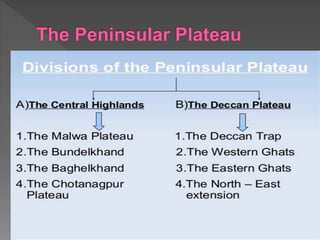
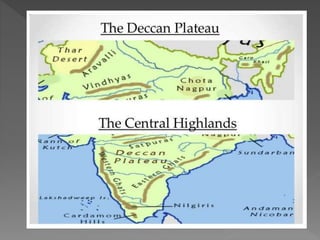
4. The Peninsular Plateau
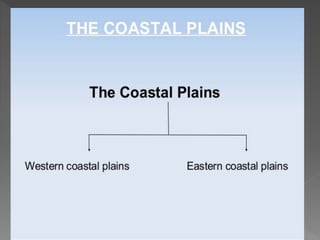
5. The Coastal Plains
6. The Islands
The Himalayas start from Kashmir in the north
& end in Arunachal Pradesh in the East.
Himalayas are also known as young fold
mountains . Three parallel ranges of
Himalayas:
 The Greater Himalayas or the Himadri
 The Lesser Himalayas or the Himachal
 The Outer Himalayas or the Shiwalik Range
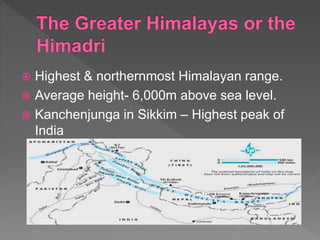
 Highest & northernmost Himalayan range.
 Average height- 6,000m above sea level.
 Kanchenjunga in Sikkim – Highest peak of
India
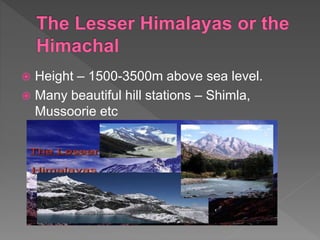
 Height – 1500-3500m above sea level.
 Many beautiful hill stations – Shimla,
Mussoorie etc
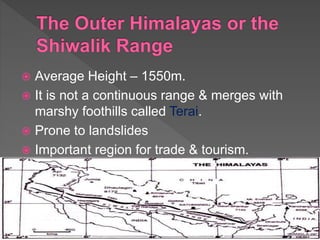
 Average Height – 1550m.
 It is not a continuous range & merges with
marshy foothills called Terai.
 Prone to landslides
 Important region for trade & tourism.
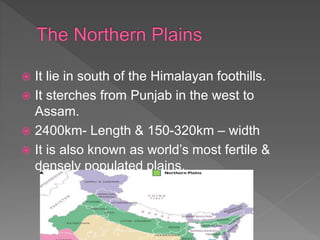
 It lie in south of the Himalayan foothills.
 It sterches from Punjab in the west to
Assam.
 2400km- Length & 150-320km – width
 It is also known as world’s most fertile &
densely populated plains.
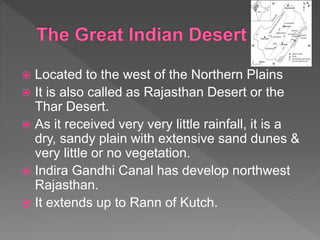
 Located to the west of the Northern Plains
 It is also called as Rajasthan Desert or the
Thar Desert.
 As it received very very little rainfall, it is a
dry, sandy plain with extensive sand dunes &
very little or no vegetation.
 Indira Gandhi Canal has develop northwest
Rajasthan.
 It extends up to Rann of Kutch.
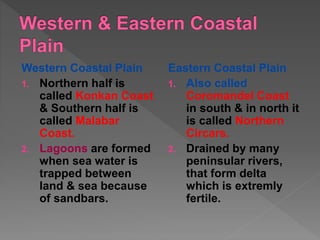
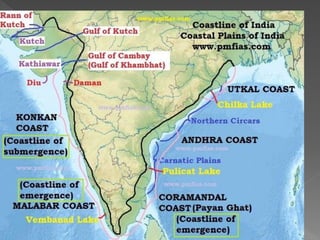
Western Coastal Plain
1. Northern half is
called Konkan Coast
& Southern half is
called Malabar
Coast.
2. Lagoons are formed
when sea water is
trapped between
land & sea because
of sandbars.
Eastern Coastal Plain
1. Also called
Coromandel Coast
in south & in north it
is called Northern
Circars.
2. Drained by many
peninsular rivers,
that form delta
which is extremly
fertile.
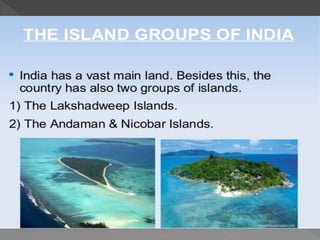
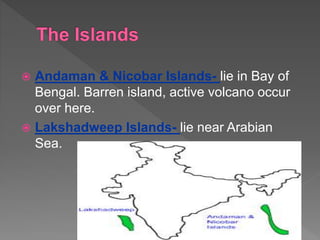
 Andaman & Nicobar Islands- lie in Bay of
Bengal. Barren island, active volcano occur
over here.
 Lakshadweep Islands- lie near Arabian
Sea.
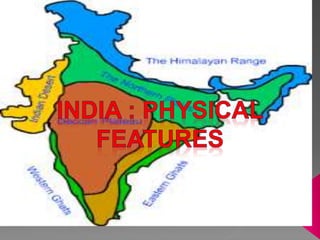
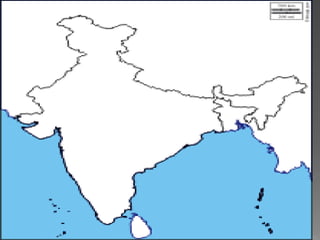
On an outline map of India , locate each of the
following:
1. The Western Coastal Plain & the Eastern
Coastal Plain
2. The Western Ghats & The Eastern Ghats
3. The Great Himalayas & the Outer
Himalayas
Footprints..Our Past, Planet & Society- Class
6th Social Science Book.

Physical features

  • 2.
    India is apicture of diversity. Its physical features are: 1. The Northern Mountains 2. The Northern Plains 3. The Great Indian Desert 4. The Peninsular Plateau 5. The Coastal Plains 6. The Islands
  • 3.
    The Himalayas startfrom Kashmir in the north & end in Arunachal Pradesh in the East. Himalayas are also known as young fold mountains . Three parallel ranges of Himalayas:  The Greater Himalayas or the Himadri  The Lesser Himalayas or the Himachal  The Outer Himalayas or the Shiwalik Range
  • 4.
     Highest &northernmost Himalayan range.  Average height- 6,000m above sea level.  Kanchenjunga in Sikkim – Highest peak of India
  • 5.
     Height –1500-3500m above sea level.  Many beautiful hill stations – Shimla, Mussoorie etc
  • 6.
     Average Height– 1550m.  It is not a continuous range & merges with marshy foothills called Terai.  Prone to landslides  Important region for trade & tourism.
  • 7.
     It liein south of the Himalayan foothills.  It sterches from Punjab in the west to Assam.  2400km- Length & 150-320km – width  It is also known as world’s most fertile & densely populated plains.
  • 8.
     Located tothe west of the Northern Plains  It is also called as Rajasthan Desert or the Thar Desert.  As it received very very little rainfall, it is a dry, sandy plain with extensive sand dunes & very little or no vegetation.  Indira Gandhi Canal has develop northwest Rajasthan.  It extends up to Rann of Kutch.
  • 12.
    Western Coastal Plain 1.Northern half is called Konkan Coast & Southern half is called Malabar Coast. 2. Lagoons are formed when sea water is trapped between land & sea because of sandbars. Eastern Coastal Plain 1. Also called Coromandel Coast in south & in north it is called Northern Circars. 2. Drained by many peninsular rivers, that form delta which is extremly fertile.
  • 15.
     Andaman &Nicobar Islands- lie in Bay of Bengal. Barren island, active volcano occur over here.  Lakshadweep Islands- lie near Arabian Sea.
  • 16.
    On an outlinemap of India , locate each of the following: 1. The Western Coastal Plain & the Eastern Coastal Plain 2. The Western Ghats & The Eastern Ghats 3. The Great Himalayas & the Outer Himalayas
  • 18.
    Footprints..Our Past, Planet& Society- Class 6th Social Science Book.