SPM Physics 2009.

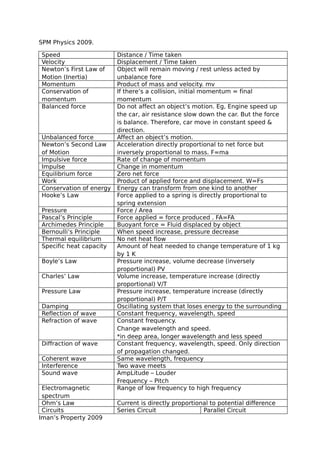
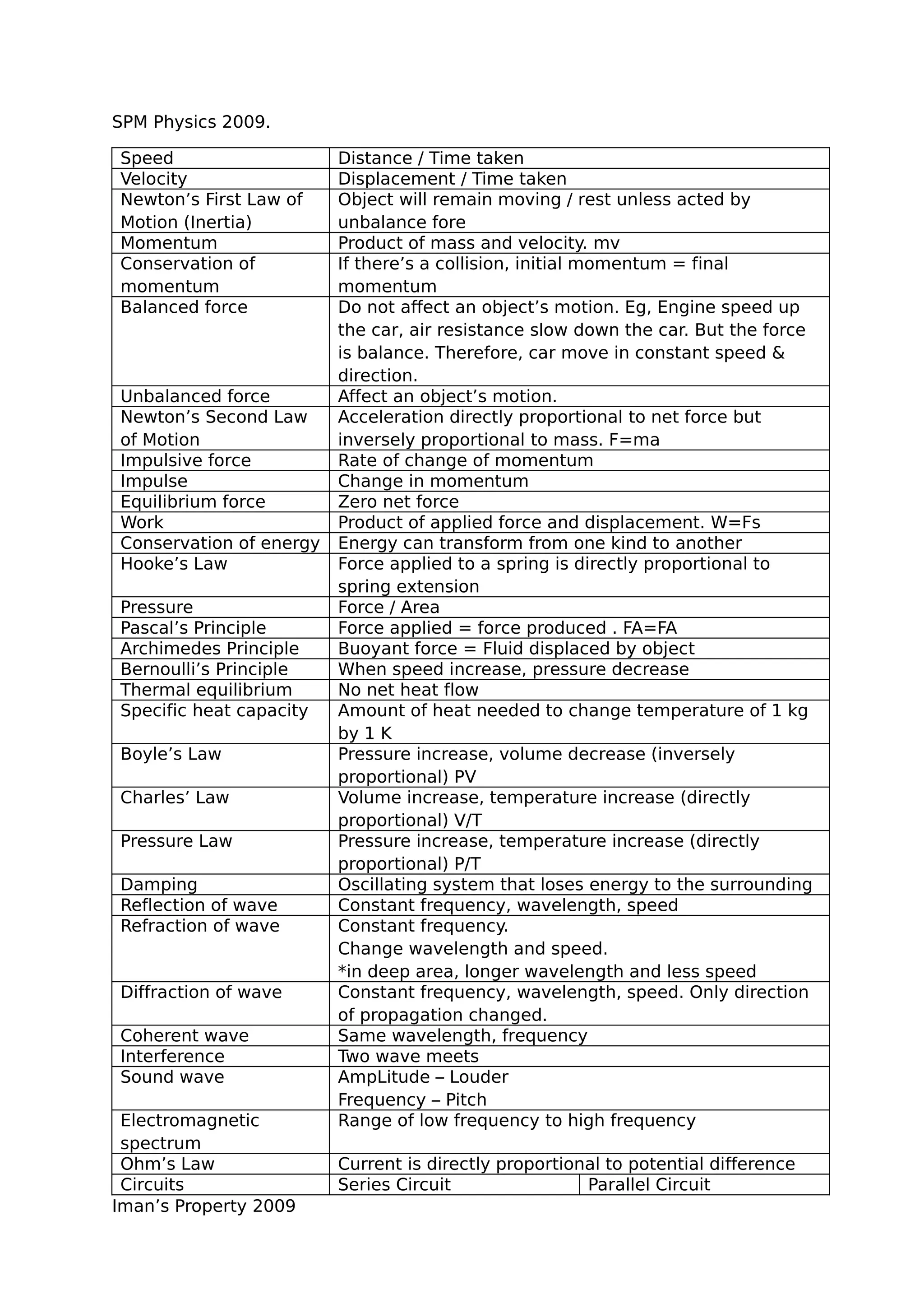
Speed                    Distance / Time taken
Velocity                 Displacement / Time taken
Newton’s First Law of    Object will remain moving / rest unless acted by
Motion (Inertia)         unbalance fore
Momentum                 Product of mass and velocity. mv
Conservation of          If there’s a collision, initial momentum = final
momentum                 momentum
Balanced force           Do not affect an object’s motion. Eg, Engine speed up
                         the car, air resistance slow down the car. But the force
                         is balance. Therefore, car move in constant speed &
                         direction.
Unbalanced force         Affect an object’s motion.
Newton’s Second Law      Acceleration directly proportional to net force but
of Motion                inversely proportional to mass. F=ma
Impulsive force          Rate of change of momentum
Impulse                  Change in momentum
Equilibrium force        Zero net force
Work                     Product of applied force and displacement. W=Fs
Conservation of energy   Energy can transform from one kind to another
Hooke’s Law              Force applied to a spring is directly proportional to
                         spring extension
Pressure                 Force / Area
Pascal’s Principle       Force applied = force produced . FA=FA
Archimedes Principle     Buoyant force = Fluid displaced by object
Bernoulli’s Principle    When speed increase, pressure decrease
Thermal equilibrium      No net heat flow
Specific heat capacity   Amount of heat needed to change temperature of 1 kg
                         by 1 K
Boyle’s Law              Pressure increase, volume decrease (inversely
                         proportional) PV
Charles’ Law             Volume increase, temperature increase (directly
                         proportional) V/T
Pressure Law             Pressure increase, temperature increase (directly
                         proportional) P/T
Damping                  Oscillating system that loses energy to the surrounding
Reflection of wave       Constant frequency, wavelength, speed
Refraction of wave       Constant frequency.
                         Change wavelength and speed.
                         *in deep area, longer wavelength and less speed
Diffraction of wave      Constant frequency, wavelength, speed. Only direction
                         of propagation changed.
Coherent wave            Same wavelength, frequency
Interference             Two wave meets
Sound wave               AmpLitude – Louder
                         Frequency – Pitch
 Electromagnetic         Range of low frequency to high frequency
 spectrum
 Ohm’s Law               Current is directly proportional to potential difference
 Circuits                Series Circuit                Parallel Circuit
Iman’s Property 2009
I=I=I                          I=I+I
                          V=V+V                          V=V=V
                          R=R+R                          1/R=1/R+1/R
Electromotive force (V)   Work done by cell
Electromagnet             Magnet made by winding a coil round a soft iron core.
                          Magnetic force is produced when current passed thru
                          the coil.
Induced current           When a wire cuts magnetic flux
Lenz’s Law                Direction of induced current will opposed
Faraday’s Law             Magnitude of induced current is directly proportional to
                          the rate of cutting the magnetic flux
Direct current            Current which flow in one direction
Alternating current       Current that flows to and fro in two opposite direction
Thermionic emission       Emission of electron when a metal surface is heated
Doping                    Adding impurities to semiconductor to increase their
                          conductivity
Rectification             Using diode to convert alternating current into direct
                          current
Capacitor                 To maintain a steady output voltage. (smoothing the
                          capacitor)
Transistor                Amplify small current
Logic gate                Digital circuit that design to make decision
Nucleon number            Total proton & neutrons. Known as mass number.
Isotopes                  Same proton, different nucleon
Radioactivity             Natural disintegration of unstable nucleus
Radioisotopes             Unstable isotopes that give out radioactivity emissions
Nuclear fission           Splitting a heavy nucleus into two lighter nuclei
Nuclear fusion            Combining of two lighter nuclei to form heavier nucleus


Iman’s Property 2009

SPM PHYSICS DEFINITION FORMULA

  • 1.
    SPM Physics 2009. Speed Distance / Time taken Velocity Displacement / Time taken Newton’s First Law of Object will remain moving / rest unless acted by Motion (Inertia) unbalance fore Momentum Product of mass and velocity. mv Conservation of If there’s a collision, initial momentum = final momentum momentum Balanced force Do not affect an object’s motion. Eg, Engine speed up the car, air resistance slow down the car. But the force is balance. Therefore, car move in constant speed & direction. Unbalanced force Affect an object’s motion. Newton’s Second Law Acceleration directly proportional to net force but of Motion inversely proportional to mass. F=ma Impulsive force Rate of change of momentum Impulse Change in momentum Equilibrium force Zero net force Work Product of applied force and displacement. W=Fs Conservation of energy Energy can transform from one kind to another Hooke’s Law Force applied to a spring is directly proportional to spring extension Pressure Force / Area Pascal’s Principle Force applied = force produced . FA=FA Archimedes Principle Buoyant force = Fluid displaced by object Bernoulli’s Principle When speed increase, pressure decrease Thermal equilibrium No net heat flow Specific heat capacity Amount of heat needed to change temperature of 1 kg by 1 K Boyle’s Law Pressure increase, volume decrease (inversely proportional) PV Charles’ Law Volume increase, temperature increase (directly proportional) V/T Pressure Law Pressure increase, temperature increase (directly proportional) P/T Damping Oscillating system that loses energy to the surrounding Reflection of wave Constant frequency, wavelength, speed Refraction of wave Constant frequency. Change wavelength and speed. *in deep area, longer wavelength and less speed Diffraction of wave Constant frequency, wavelength, speed. Only direction of propagation changed. Coherent wave Same wavelength, frequency Interference Two wave meets Sound wave AmpLitude – Louder Frequency – Pitch Electromagnetic Range of low frequency to high frequency spectrum Ohm’s Law Current is directly proportional to potential difference Circuits Series Circuit Parallel Circuit Iman’s Property 2009
  • 2.
    I=I=I I=I+I V=V+V V=V=V R=R+R 1/R=1/R+1/R Electromotive force (V) Work done by cell Electromagnet Magnet made by winding a coil round a soft iron core. Magnetic force is produced when current passed thru the coil. Induced current When a wire cuts magnetic flux Lenz’s Law Direction of induced current will opposed Faraday’s Law Magnitude of induced current is directly proportional to the rate of cutting the magnetic flux Direct current Current which flow in one direction Alternating current Current that flows to and fro in two opposite direction Thermionic emission Emission of electron when a metal surface is heated Doping Adding impurities to semiconductor to increase their conductivity Rectification Using diode to convert alternating current into direct current Capacitor To maintain a steady output voltage. (smoothing the capacitor) Transistor Amplify small current Logic gate Digital circuit that design to make decision Nucleon number Total proton & neutrons. Known as mass number. Isotopes Same proton, different nucleon Radioactivity Natural disintegration of unstable nucleus Radioisotopes Unstable isotopes that give out radioactivity emissions Nuclear fission Splitting a heavy nucleus into two lighter nuclei Nuclear fusion Combining of two lighter nuclei to form heavier nucleus Iman’s Property 2009