Laws of Chemical
    Combination
        Chem1 SY 10-11
             -kaaferrer
What makes compounds different?
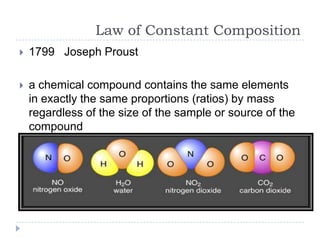
Law of Constant Composition
   1799 Joseph Proust

   a chemical compound contains the same elements
    in exactly the same proportions (ratios) by mass
    regardless of the size of the sample or source of the
    compound
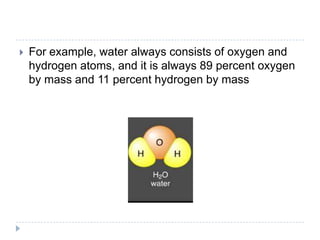
   For example, water always consists of oxygen and
    hydrogen atoms, and it is always 89 percent oxygen
    by mass and 11 percent hydrogen by mass
Does mass change during a chemical
reaction?
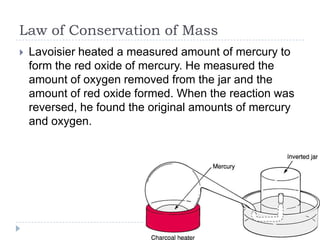
Law of Conservation of Mass
   Lavoisier heated a measured amount of mercury to
    form the red oxide of mercury. He measured the
    amount of oxygen removed from the jar and the
    amount of red oxide formed. When the reaction was
    reversed, he found the original amounts of mercury
    and oxygen.
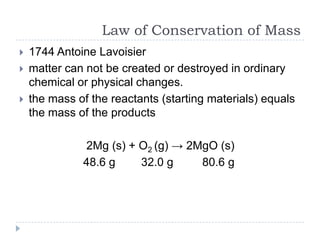
Law of Conservation of Mass
   1744 Antoine Lavoisier
   matter can not be created or destroyed in ordinary
    chemical or physical changes.
   the mass of the reactants (starting materials) equals
    the mass of the products

              2Mg (s) + O2 (g) → 2MgO (s)
              48.6 g    32.0 g     80.6 g
Example

   10 grams of CaCO3 on heating gave 4.4g of CO2
    and 5.6 of CaO. Show that these observations are in
    agreement with the law of conservation
Law of Multiple Proportions
   1803 John Dalton

   States that when two elements combine to form
    more than one compound, the masses of one
    element which combine with a fixed mass of the
    other element are in ratios of small whole
    numbers
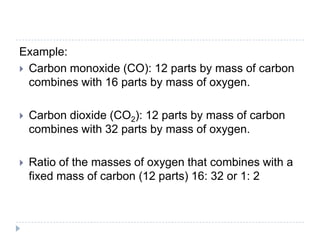
Example:
 Carbon monoxide (CO): 12 parts by mass of carbon
  combines with 16 parts by mass of oxygen.

   Carbon dioxide (CO2): 12 parts by mass of carbon
    combines with 32 parts by mass of oxygen.

   Ratio of the masses of oxygen that combines with a
    fixed mass of carbon (12 parts) 16: 32 or 1: 2
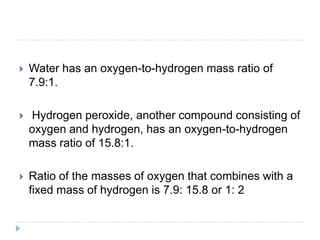
   Water has an oxygen-to-hydrogen mass ratio of
    7.9:1.

   Hydrogen peroxide, another compound consisting of
    oxygen and hydrogen, has an oxygen-to-hydrogen
    mass ratio of 15.8:1.

   Ratio of the masses of oxygen that combines with a
    fixed mass of hydrogen is 7.9: 15.8 or 1: 2
Chemical Formula Relationships
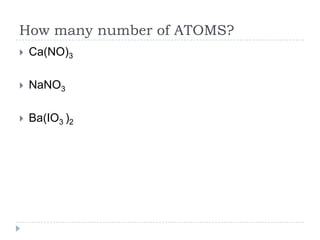
How many number of ATOMS?
   Ca(NO)3

   NaNO3

   Ba(IO3 )2
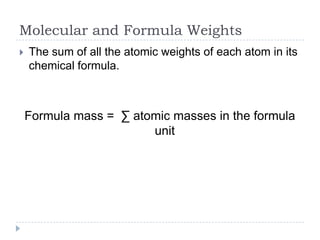
Molecular and Formula Weights
   The sum of all the atomic weights of each atom in its
    chemical formula.


    Formula mass = ∑ atomic masses in the formula
                        unit
SEATWORK!
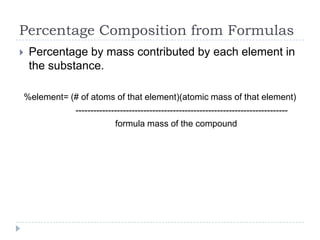
Percentage Composition from Formulas
   Percentage by mass contributed by each element in
    the substance.

%element= (# of atoms of that element)(atomic mass of that element)
           ------------------------------------------------------------------------
                        formula mass of the compound
Stoichiometry

   The quantitative relationships between the
    substances involved in a chemical
    reaction, established by the equation for
    the reaction
Terminologies
     ATOM
      ◦ Smallest particle of an element

     MOLECULE
      ◦ Smallest unit particle of a pure substance

     ION
      ◦ An atom or group of bonded atoms with electrical charge
        because of an excess or deficiency of electrons

     ELEMENT
      ◦ Pure substance; CANNOT be broken down into 2 or more
        pure substances by chemical means

     COMPOUND
      ◦ Pure substance; CAN be broken down into 2 or more pure
        substances by chemical means
Atomic Mass
   Atomic Mass = used to numerically indicate the mass of
    an atom in its ground state, it is expressed in the non SI
    unit of u

    u = refers to unified atomic mass unit (formerly known as
    atomic mass unit or amu)
          1 amu = 1/12 the mass of carbon-12 atom,
   therefore the mass of C-12 atom is made EQUAL to 12
    amu

       Carbon-12 atom is an isotope of carbon

                    1 amu = 1.66 x 10⁻²⁴ g
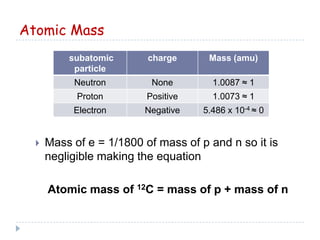
Atomic Mass
          subatomic       charge      Mass (amu)
           particle
           Neutron         None        1.0087 ≈ 1
            Proton        Positive     1.0073 ≈ 1
           Electron      Negative    5.486 x 10⁻⁴ ≈ 0


     Mass of e = 1/1800 of mass of p and n so it is
      negligible making the equation

      Atomic mass of 12C = mass of p + mass of n
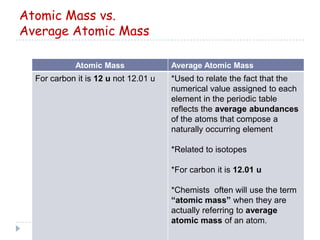
Atomic Mass vs.
Average Atomic Mass

             Atomic Mass              Average Atomic Mass
  For carbon it is 12 u not 12.01 u   *Used to relate the fact that the
                                      numerical value assigned to each
                                      element in the periodic table
                                      reflects the average abundances
                                      of the atoms that compose a
                                      naturally occurring element

                                      *Related to isotopes

                                      *For carbon it is 12.01 u

                                      *Chemists often will use the term
                                      “atomic mass” when they are
                                      actually referring to average
                                      atomic mass of an atom.
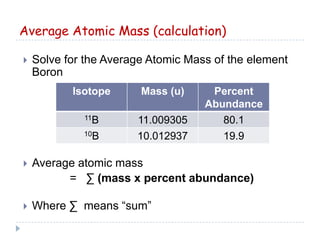
Average Atomic Mass (calculation)

   Solve for the Average Atomic Mass of the element
    Boron
           Isotope      Mass (u)     Percent
                                    Abundance
             11B       11.009305       80.1
             10B       10.012937       19.9

   Average atomic mass
          = ∑ (mass x percent abundance)

   Where ∑ means “sum”
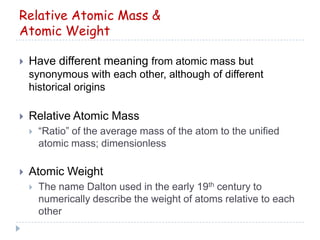
Relative Atomic Mass &
Atomic Weight

   Have different meaning from atomic mass but
    synonymous with each other, although of different
    historical origins

   Relative Atomic Mass
       “Ratio” of the average mass of the atom to the unified
        atomic mass; dimensionless

   Atomic Weight
       The name Dalton used in the early 19th century to
        numerically describe the weight of atoms relative to each
        other
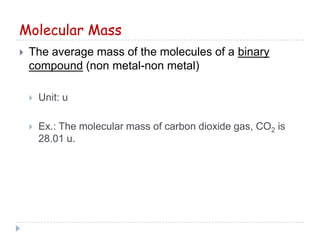
Molecular Mass
   The average mass of the molecules of a binary
    compound (non metal-non metal)

       Unit: u

       Ex.: The molecular mass of carbon dioxide gas, CO2 is
        28.01 u.
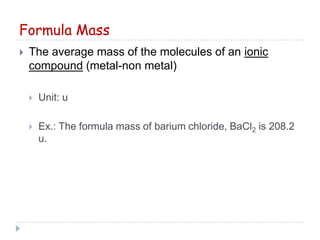
Formula Mass
   The average mass of the molecules of an ionic
    compound (metal-non metal)

       Unit: u

       Ex.: The formula mass of barium chloride, BaCl2 is 208.2
        u.
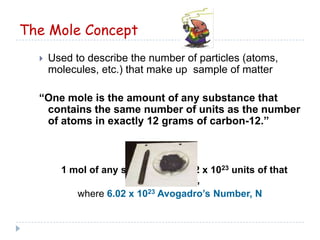
The Mole Concept
     Used to describe the number of particles (atoms,
      molecules, etc.) that make up sample of matter

  “One mole is the amount of any substance that
   contains the same number of units as the number
   of atoms in exactly 12 grams of carbon-12.”


        1 mol of any substance = 6.02 x 10²³ units of that
                          substance,
           where 6.02 x 10²³ Avogadro’s Number, N
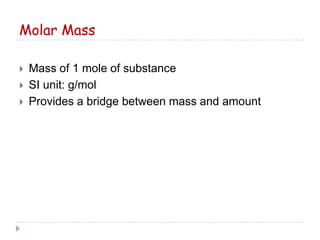
Molar Mass

   Mass of 1 mole of substance
   SI unit: g/mol
   Provides a bridge between mass and amount
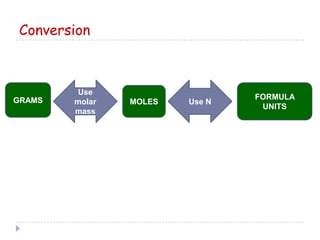
Conversion


         Use
GRAMS                           FORMULA
        molar   MOLES   Use N
                                 UNITS
        mass
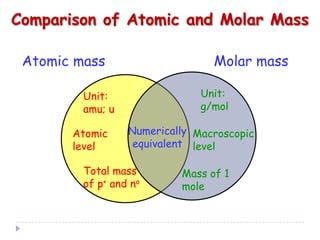
Comparison of Atomic and Molar Mass

 Atomic mass                     Molar mass

         Unit:                 Unit:
         amu; u                g/mol

       Atomic     Numerically Macroscopic
       level       equivalent level

         Total mass        Mass of 1
         of p+ and no      mole
Empirical Formula
              and
        Molecular
          Formula
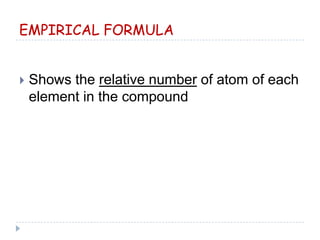
EMPIRICAL FORMULA


   Shows the relative number of atom of each
    element in the compound
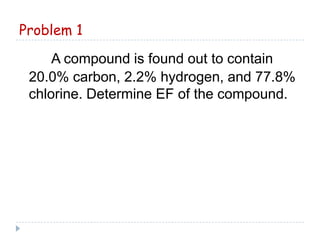
Problem 1
     A compound is found out to contain
 20.0% carbon, 2.2% hydrogen, and 77.8%
 chlorine. Determine EF of the compound.
MOLECULAR FORMULA


   Shows the actual number of atom of each
    element in the compound
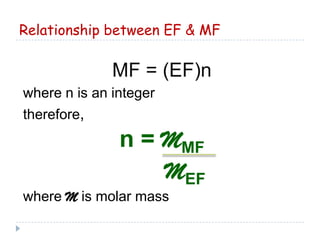
Relationship between EF & MF

              MF = (EF)n
where n is an integer
therefore,
               n = MMF
                   MEF
where M is molar mass
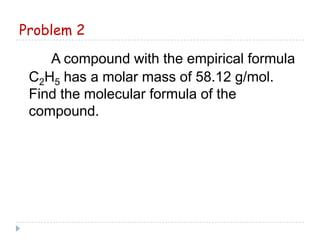
Problem 2
    A compound with the empirical formula
 C2H5 has a molar mass of 58.12 g/mol.
 Find the molecular formula of the
 compound.
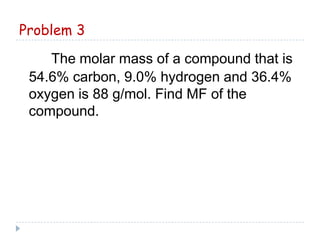
Problem 3
    The molar mass of a compound that is
 54.6% carbon, 9.0% hydrogen and 36.4%
 oxygen is 88 g/mol. Find MF of the
 compound.
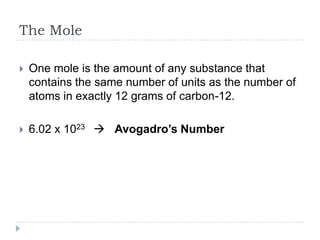
The Mole

   One mole is the amount of any substance that
    contains the same number of units as the number of
    atoms in exactly 12 grams of carbon-12.

   6.02 x 10²³  Avogadro’s Number
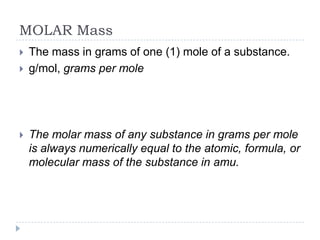
MOLAR Mass
   The mass in grams of one (1) mole of a substance.
   g/mol, grams per mole


   The molar mass of any substance in grams per mole
    is always numerically equal to the atomic, formula, or
    molecular mass of the substance in amu.
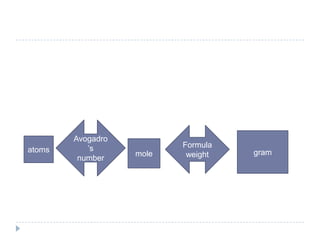
Avogadro
           ’s             Formula
atoms                               gram
                   mole    weight
         number