Periodic Table Metals, Non-Metals, Groups and Periods
 
Metals Metals are located left of the black line on the periodic table. Metals become cations, they lose electrons.  Positive charge. Metals are maleable and ductile and they are also conductors of heat and electricity.
Non-Metals Located right of the black line on the periodic table. Non-Metals gain electrons and become negatively charged. Not conductors, brittle (if solid), not ductile.
Metaloids Located along the line on the periodic table. Share properties of metals and non-metals. Typically used in electronics.
Groups Group IA has a +1 charge, lose 1 electron.  Also known as the Alkali Metals. Soft and white and highly reactive. Group IIA has a +2 charge, lose 2 electrons.  Also known as the Alkaline Earth Metals.  React easily with the halogens to form salts.
More Groups Group VIIA has a -1 charge.  They gain one electron.  This group is known as the halogens.  Highly reactive, fluorine is one of the most reactive elements in existence. Group VIIIA are known as the Noble Gases.  Full valence electron shell.  Non-reactive.  Important for use in welding, lighting, and space exploration.
Oxidation-Reduction Oxidation is the losing of an electron in a reaction.  Original meaning was combining with oxygen. Reduction is the gaining of an electron in a reaction.  Original meaning was removing oxygen. LEO says GER or OIL RIG
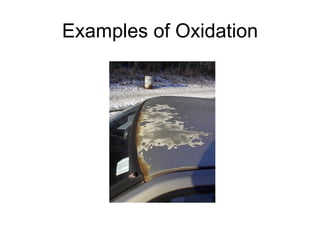
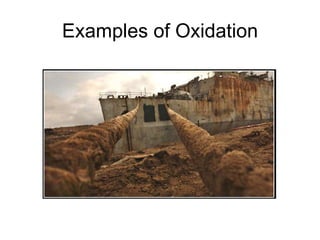
Examples of Oxidation
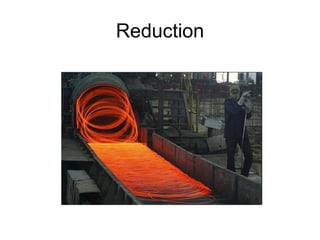
Reduction
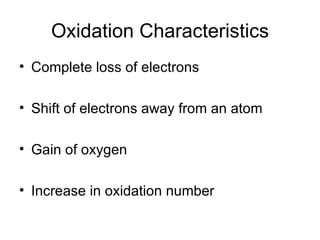
Oxidation Characteristics Complete loss of electrons Shift of electrons away from an atom Gain of oxygen Increase in oxidation number
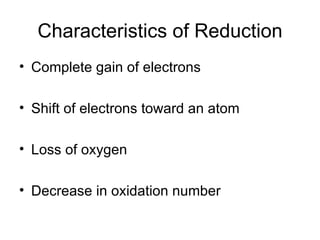
Characteristics of Reduction Complete gain of electrons Shift of electrons toward an atom Loss of oxygen Decrease in oxidation number
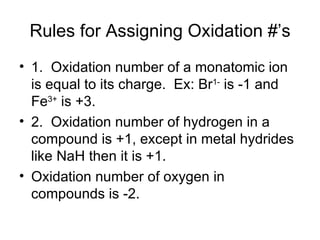
Rules for Assigning Oxidation #’s 1.  Oxidation number of a monatomic ion is equal to its charge.  Ex: Br 1-  is -1 and Fe 3+  is +3. 2.  Oxidation number of hydrogen in a compound is +1, except in metal hydrides like NaH then it is +1. Oxidation number of oxygen in compounds is -2.
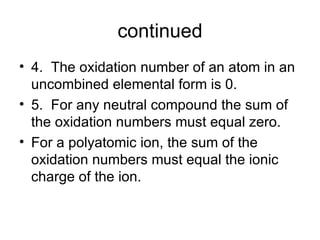
continued 4.  The oxidation number of an atom in an uncombined elemental form is 0.  5.  For any neutral compound the sum of the oxidation numbers must equal zero. For a polyatomic ion, the sum of the oxidation numbers must equal the ionic charge of the ion.
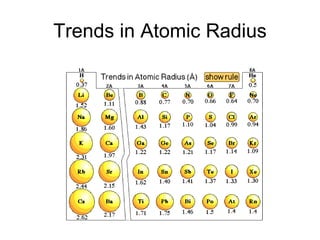
Trends in Atomic Radius
Octet Rule Atoms, gain or lose electrons so they have 8 electrons in their outer shell. Think in terms of the Noble Gases. Electron configurations will be extremely important to understand here. The s and p sublevels must be full!!!
Octet Rule Na is in Group IA.  It becomes Na + . Na has 11 electrons, 1 valence electron.  Valence electrons are in the outer most shell. If Na +  has one less electron, it now has 10.  Which element has 10 e? Neon
Octet Rule Magnesium has 12 electrons.  It is in group IIA.  Its oxidation number is +2. Mg becomes Mg 2+ It loses 2 e- and now has 10 electrons, it has 8 valence electrons, just like neon. Mg 2+  electron configuration is: 1s 2  2s 2  2p 6 Neon’s configuration is 1s 2  2s 2  2p 6
Octet Rule Fluorine becomes F - Fluorine has 7 electrons in the valence shell.  Gaining one electron gives it 8. It now has 10 total e-, just like neon. What is the electron configuration for this ion?
Octet Rule The “A” Group numbers refer to the number of valence electrons. Group IA has 1. Group IIA has 2. Group IIIA has 3. All the way to group VIIIA which has 8. You cannot go higher than VIIIA.
Oxidation Numbers For each e- the atom loses, your number is +1.  For example, Group IA is +1, Group IIA is +2. For each e- the atom gains, your number is -1.  For example, Group VIA is -2, Group VIIA is -1.
Oxidation Numbers The oxidation numbers of a neutral compound must equal 0. For example, Na +  must combine with something that will have a -1 charge.  Na +  + Cl -     NaCl (+1) + (-1) =0 Mg 2+  + S 2-     MgS (+2) + (-2) = 0
People Dmitiri Mendeleev—developed the modern periodic table. John Newlands—first to discover that elements fall into categories by increasing atomic mass.  First to assign atomic mass to elements. Henry Moseley—discovered atomic mass had a physical significance and helped prove isotopes.
Terms Organic Chemistry—study of carbon compounds. Ore—material in which minerals can be removed—ex: iron-ore. Alloy—mixture of two or more elements with one being a metal. Inorganic Chemistry—deals with non-organic compunds.
Terms Actinide Series—group of radioactive elements in Group 3. Lanthanide Series—very rare, first row of the inner transition elements.  Located in period 7. Inner Transition—the “f” grouping, located at the bottom of the periodic chart. Diagonal relationships—relationships between elements in neighboring groups.
Terms Allotrope—elements with the same elements, but different forms.  Ex: O 2  and O 3 , oxygen vs. ozone. Metallurgy—the ability to extract metal from ore. Ferromagnetism—substance whose ions align in the direction of a magnetic field. Mineral—something found in nature as solid crystals.
Types of Bonds Ionic Bonds Anions and cations have opposite charges (negative and positive, respectively). The positive and negative charges are attracted by electrostatic forces.
Types of Bonds Covalent Bonds Two atoms share electrons in order to complete their octet. Only between non-metals.
Ionic Bonding Ionic bonding occurs between a cation and anion. The opposite charges cause the attraction and the bond. Understanding how to balance the charges is extremely important.
Understanding Charges All non metals have a negative charge.  When the non-metal gains an electron, it acquires a net negative charge (more electrons than protons). Take Cl for example.  It is group VIIA or Group 17.  It needs one more electron to complete its valence shell.
Understanding Charges Na is located in IA or Group 1.  It can lose 1 electron to achieve the octet rule.  If it is 3s 1  then it drops to 2s 2 2p 6 . Therefore the positive of Na is attracted to the negative of F.
The Ionic Bond Na +  + F -  --> NaF Na is +1 F is -1, when you add the charges together you get “0”. You will always want a net “0” charge for a neutral compound.  Remember, we are trying to achieve stability.
More Examples Mg 2+  + Cl -     ??? When writing a chemical formula, you need to cross multiply. If you have +2 and -1, what is your net charge?  How will you get “0”.
Writing the formula Mg 2+  + Cl -     MgCl 2 Cross multiply and drop the charges. You have 1(+2) and 2(-1) the net charge “0”.
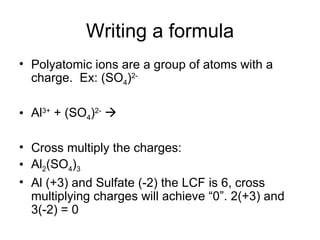
Writing a formula Polyatomic ions are a group of atoms with a charge.  Ex: (SO 4 ) 2- Al 3+  + (SO 4 ) 2-    Cross multiply the charges: Al 2 (SO 4 ) 3 Al (+3) and Sulfate (-2) the LCF is 6, cross multiplying charges will achieve “0”. 2(+3) and 3(-2) = 0
Review Ionic Compounds are a metal and non-metal (cation and anion). Covalent Compounds are 2 or more non-metals that share electrons. Oxidation numbers are the charges of the ions. Remember to find the LCF of the charges and cross multiply when creating an ionic compound.
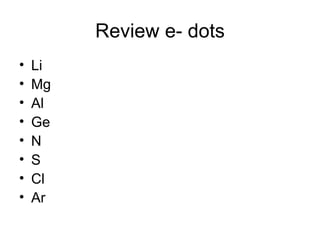
Review The electron dots only represent the valence electrons.  The electrons go around the symbol for the element and then after you have 4 lone electrons, begin pairing.
Review e- dots Li Mg Al Ge N S Cl Ar
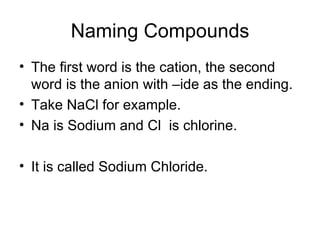
Naming Compounds The first word is the cation, the second word is the anion with –ide as the ending. Take NaCl for example. Na is Sodium and Cl  is chlorine. It is called Sodium Chloride.
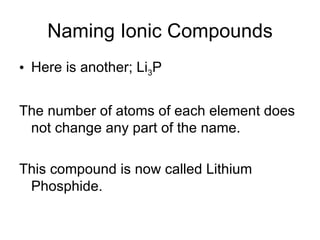
Naming Ionic Compounds Here is another; Li 3 P The number of atoms of each element does not change any part of the name. This compound is now called Lithium Phosphide.
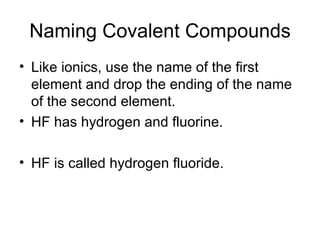
Naming Covalent Compounds Like ionics, use the name of the first element and drop the ending of the name of the second element. HF has hydrogen and fluorine. HF is called hydrogen fluoride.
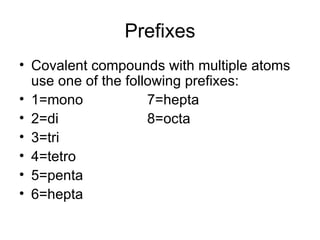
Prefixes Covalent compounds with multiple atoms use one of the following prefixes: 1=mono 7=hepta 2=di 8=octa 3=tri 4=tetro 5=penta 6=hepta
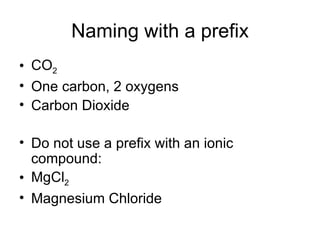
Naming with a prefix CO 2 One carbon, 2 oxygens Carbon Dioxide Do not use a prefix with an ionic compound: MgCl 2 Magnesium Chloride
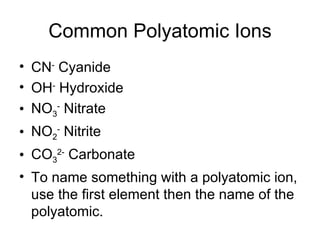
Common Polyatomic Ions CN -  Cyanide OH -  Hydroxide NO 3 -  Nitrate NO 2 -  Nitrite CO 3 2-  Carbonate To name something with a polyatomic ion, use the first element then the name of the polyatomic.
Covalent Bonding Covalent bonds occur when atoms share electrons in order to complete their octet. Covalent bonds are much weaker when compared to an ionic bond.
Examples Fluorine has 7 valence electrons and needs 1 more to complete it’s octet. Hydrogen has 1 valence electron and needs 1 more to complete its “s” sublevel.
Carbon Tetra Chloride Carbon has 4 valence electrons and needs 4 more. Chlorine has 7 valence and needs 1 more.
Diatomic Molecules Some of the non-metals form what are called diatomic molecules. A diatomic molecule is two atoms of the same element bonding together. All of the Halogens are diatomic, as well as nitrogen, and oxygen.
Halogens Each halogen forms a single bond, sharing one electron. Let’s take a look at fluorine.
Polar Molecules In a polar molecule, one end is slightly more negative than the other end. Hydrogen Chloride is polar.  The Chlorine is more negative than the hydrogen. Diatomic Fluorine is not polar.  Each fluorine pulls equally.

Metals, Non Metals And Oxidation

  • 1.
    Periodic Table Metals,Non-Metals, Groups and Periods
  • 2.
  • 3.
    Metals Metals arelocated left of the black line on the periodic table. Metals become cations, they lose electrons. Positive charge. Metals are maleable and ductile and they are also conductors of heat and electricity.
  • 4.
    Non-Metals Located rightof the black line on the periodic table. Non-Metals gain electrons and become negatively charged. Not conductors, brittle (if solid), not ductile.
  • 5.
    Metaloids Located alongthe line on the periodic table. Share properties of metals and non-metals. Typically used in electronics.
  • 6.
    Groups Group IAhas a +1 charge, lose 1 electron. Also known as the Alkali Metals. Soft and white and highly reactive. Group IIA has a +2 charge, lose 2 electrons. Also known as the Alkaline Earth Metals. React easily with the halogens to form salts.
  • 7.
    More Groups GroupVIIA has a -1 charge. They gain one electron. This group is known as the halogens. Highly reactive, fluorine is one of the most reactive elements in existence. Group VIIIA are known as the Noble Gases. Full valence electron shell. Non-reactive. Important for use in welding, lighting, and space exploration.
  • 8.
    Oxidation-Reduction Oxidation isthe losing of an electron in a reaction. Original meaning was combining with oxygen. Reduction is the gaining of an electron in a reaction. Original meaning was removing oxygen. LEO says GER or OIL RIG
  • 9.
  • 10.
  • 11.
  • 12.
    Oxidation Characteristics Completeloss of electrons Shift of electrons away from an atom Gain of oxygen Increase in oxidation number
  • 13.
    Characteristics of ReductionComplete gain of electrons Shift of electrons toward an atom Loss of oxygen Decrease in oxidation number
  • 14.
    Rules for AssigningOxidation #’s 1. Oxidation number of a monatomic ion is equal to its charge. Ex: Br 1- is -1 and Fe 3+ is +3. 2. Oxidation number of hydrogen in a compound is +1, except in metal hydrides like NaH then it is +1. Oxidation number of oxygen in compounds is -2.
  • 15.
    continued 4. The oxidation number of an atom in an uncombined elemental form is 0. 5. For any neutral compound the sum of the oxidation numbers must equal zero. For a polyatomic ion, the sum of the oxidation numbers must equal the ionic charge of the ion.
  • 16.
  • 17.
    Octet Rule Atoms,gain or lose electrons so they have 8 electrons in their outer shell. Think in terms of the Noble Gases. Electron configurations will be extremely important to understand here. The s and p sublevels must be full!!!
  • 18.
    Octet Rule Nais in Group IA. It becomes Na + . Na has 11 electrons, 1 valence electron. Valence electrons are in the outer most shell. If Na + has one less electron, it now has 10. Which element has 10 e? Neon
  • 19.
    Octet Rule Magnesiumhas 12 electrons. It is in group IIA. Its oxidation number is +2. Mg becomes Mg 2+ It loses 2 e- and now has 10 electrons, it has 8 valence electrons, just like neon. Mg 2+ electron configuration is: 1s 2 2s 2 2p 6 Neon’s configuration is 1s 2 2s 2 2p 6
  • 20.
    Octet Rule Fluorinebecomes F - Fluorine has 7 electrons in the valence shell. Gaining one electron gives it 8. It now has 10 total e-, just like neon. What is the electron configuration for this ion?
  • 21.
    Octet Rule The“A” Group numbers refer to the number of valence electrons. Group IA has 1. Group IIA has 2. Group IIIA has 3. All the way to group VIIIA which has 8. You cannot go higher than VIIIA.
  • 22.
    Oxidation Numbers Foreach e- the atom loses, your number is +1. For example, Group IA is +1, Group IIA is +2. For each e- the atom gains, your number is -1. For example, Group VIA is -2, Group VIIA is -1.
  • 23.
    Oxidation Numbers Theoxidation numbers of a neutral compound must equal 0. For example, Na + must combine with something that will have a -1 charge. Na + + Cl -  NaCl (+1) + (-1) =0 Mg 2+ + S 2-  MgS (+2) + (-2) = 0
  • 24.
    People Dmitiri Mendeleev—developedthe modern periodic table. John Newlands—first to discover that elements fall into categories by increasing atomic mass. First to assign atomic mass to elements. Henry Moseley—discovered atomic mass had a physical significance and helped prove isotopes.
  • 25.
    Terms Organic Chemistry—studyof carbon compounds. Ore—material in which minerals can be removed—ex: iron-ore. Alloy—mixture of two or more elements with one being a metal. Inorganic Chemistry—deals with non-organic compunds.
  • 26.
    Terms Actinide Series—groupof radioactive elements in Group 3. Lanthanide Series—very rare, first row of the inner transition elements. Located in period 7. Inner Transition—the “f” grouping, located at the bottom of the periodic chart. Diagonal relationships—relationships between elements in neighboring groups.
  • 27.
    Terms Allotrope—elements withthe same elements, but different forms. Ex: O 2 and O 3 , oxygen vs. ozone. Metallurgy—the ability to extract metal from ore. Ferromagnetism—substance whose ions align in the direction of a magnetic field. Mineral—something found in nature as solid crystals.
  • 28.
    Types of BondsIonic Bonds Anions and cations have opposite charges (negative and positive, respectively). The positive and negative charges are attracted by electrostatic forces.
  • 29.
    Types of BondsCovalent Bonds Two atoms share electrons in order to complete their octet. Only between non-metals.
  • 30.
    Ionic Bonding Ionicbonding occurs between a cation and anion. The opposite charges cause the attraction and the bond. Understanding how to balance the charges is extremely important.
  • 31.
    Understanding Charges Allnon metals have a negative charge. When the non-metal gains an electron, it acquires a net negative charge (more electrons than protons). Take Cl for example. It is group VIIA or Group 17. It needs one more electron to complete its valence shell.
  • 32.
    Understanding Charges Nais located in IA or Group 1. It can lose 1 electron to achieve the octet rule. If it is 3s 1 then it drops to 2s 2 2p 6 . Therefore the positive of Na is attracted to the negative of F.
  • 33.
    The Ionic BondNa + + F - --> NaF Na is +1 F is -1, when you add the charges together you get “0”. You will always want a net “0” charge for a neutral compound. Remember, we are trying to achieve stability.
  • 34.
    More Examples Mg2+ + Cl -  ??? When writing a chemical formula, you need to cross multiply. If you have +2 and -1, what is your net charge? How will you get “0”.
  • 35.
    Writing the formulaMg 2+ + Cl -  MgCl 2 Cross multiply and drop the charges. You have 1(+2) and 2(-1) the net charge “0”.
  • 36.
    Writing a formulaPolyatomic ions are a group of atoms with a charge. Ex: (SO 4 ) 2- Al 3+ + (SO 4 ) 2-  Cross multiply the charges: Al 2 (SO 4 ) 3 Al (+3) and Sulfate (-2) the LCF is 6, cross multiplying charges will achieve “0”. 2(+3) and 3(-2) = 0
  • 37.
    Review Ionic Compoundsare a metal and non-metal (cation and anion). Covalent Compounds are 2 or more non-metals that share electrons. Oxidation numbers are the charges of the ions. Remember to find the LCF of the charges and cross multiply when creating an ionic compound.
  • 38.
    Review The electrondots only represent the valence electrons. The electrons go around the symbol for the element and then after you have 4 lone electrons, begin pairing.
  • 39.
    Review e- dotsLi Mg Al Ge N S Cl Ar
  • 40.
    Naming Compounds Thefirst word is the cation, the second word is the anion with –ide as the ending. Take NaCl for example. Na is Sodium and Cl is chlorine. It is called Sodium Chloride.
  • 41.
    Naming Ionic CompoundsHere is another; Li 3 P The number of atoms of each element does not change any part of the name. This compound is now called Lithium Phosphide.
  • 42.
    Naming Covalent CompoundsLike ionics, use the name of the first element and drop the ending of the name of the second element. HF has hydrogen and fluorine. HF is called hydrogen fluoride.
  • 43.
    Prefixes Covalent compoundswith multiple atoms use one of the following prefixes: 1=mono 7=hepta 2=di 8=octa 3=tri 4=tetro 5=penta 6=hepta
  • 44.
    Naming with aprefix CO 2 One carbon, 2 oxygens Carbon Dioxide Do not use a prefix with an ionic compound: MgCl 2 Magnesium Chloride
  • 45.
    Common Polyatomic IonsCN - Cyanide OH - Hydroxide NO 3 - Nitrate NO 2 - Nitrite CO 3 2- Carbonate To name something with a polyatomic ion, use the first element then the name of the polyatomic.
  • 46.
    Covalent Bonding Covalentbonds occur when atoms share electrons in order to complete their octet. Covalent bonds are much weaker when compared to an ionic bond.
  • 47.
    Examples Fluorine has7 valence electrons and needs 1 more to complete it’s octet. Hydrogen has 1 valence electron and needs 1 more to complete its “s” sublevel.
  • 48.
    Carbon Tetra ChlorideCarbon has 4 valence electrons and needs 4 more. Chlorine has 7 valence and needs 1 more.
  • 49.
    Diatomic Molecules Someof the non-metals form what are called diatomic molecules. A diatomic molecule is two atoms of the same element bonding together. All of the Halogens are diatomic, as well as nitrogen, and oxygen.
  • 50.
    Halogens Each halogenforms a single bond, sharing one electron. Let’s take a look at fluorine.
  • 51.
    Polar Molecules Ina polar molecule, one end is slightly more negative than the other end. Hydrogen Chloride is polar. The Chlorine is more negative than the hydrogen. Diatomic Fluorine is not polar. Each fluorine pulls equally.