Presentation on
Stagesof Test Construction
Presented by :
Irshad Narejo
Stage1
Planning for theTest:
Outline subject-matter content to be
considered asthebasisfor thetest.
Identify learning outcomes to be measured by
thetest.
Preparetableof specifications.
Choose appropriate type(s) of test items for
evaluation of learning outcomes as
summarized in thetableof specifications.
Stage2
Preparing theTest
Write test items according to rules of
construction for thetype(s) chosen.
Select the items to be included in the test
according to tableof specifications.
Review and edit items according to
guidelines.
Arrange items: decide on a) grouping of
items, b) sequenceof itemswithin groups, c)
sequenceof groupings.
Prepare directions for the test; if
necessary, prepare directions for
individual items (e.g., matching type) or
for sections (e.g., negative form of one-
best responsetype).
Decideon method of scoring.
Stage3
Validity of theTest
Valid tests measure what they actually were
designed to measure.
Testsof validity:
1. Content
2 . Criterion - related
3. Construct
Stage4
Reliability of theTest
Reliable tests measure what they were
designed to measureconsistently.
Methodsof determining reliability:
1. Test - retest method.
2. Equivalent - formsmethod.
3. Test - retest with equivalent forms.
4. Internal consistency method.
(A) objectivity
It means that if the test is marked by different
people, thescoreswill bethesame.
(B) Comprehensiveness
A good test should include items from different
areas of material assigned for the test: e.g.
( Dialogue, composition, comprehension,
grammar, vocabulary, dictation ).
( C) Simplicity
Simplicity means that the test should be
written in a clear , correct and simple
language, it is important to keep the
method of testing as simple as possible
while still testing the skill you intend to
test ( avoid ambiguous questions and
ambiguousinstructions.)
(D) Scorability
Scorability means that each item in the test has
its own mark related to the distribution of marks
given by theministry of education or ateacher.
(E) Practicality
It is the relationship between the resources that
will berequired in the design , development and
use of the test and the resources that will be
availablefor theseactivities.
Stage5
Arranging Items
The items should be arranged so that all
items of the same type are grouped
together.
The items should be arranged in order of
increasing difficulty.
For some purposes, it may be desirable to
group together items which measure the
same learning outcomes or the same
subject-matter content.
Stage6
Writing Directions
The directions for test should be simple and
concise and yet contain information
concerning each of thefollowing:
1. Purposeof thetest.
2. Timeallowed to completethetest.
3. How to record theanswers.
4. Whether to guess when in doubt about the
answer.
Stage7
Analyzing and Revising theTest
Retain, edit as necessary, or discard items on
basisof analysisoutcomes.
Revisethetest asawholeif necessary.
Thedifficulty of theitem.
Thediscriminating power of theitem.
Theeffectivenessof each alternative.
Stage8
Reproducing theTest
Decisions need to be made regarding page
size, type size, page layout (length of line,
placing of items on page, provision for
response, page numbers, arrangement of
alternatives in multiple choice items),
preparation of copy, proofreading.
Stage9
Administering and Scoring theTest
Decisions need to be made regarding setting of
timelimits, observation of timelimits, physical
set-up, proctors (Someone who supervises an
examination ) distribution of test, scoring sheets,
scoring method (by hand/machine).
Decisions need to be made regarding weighting
of itemsaccording to tableof specifications.
Administering Tests
When it is time to have students take the test, there
are several things you should keep in mind to make
theexperiencerun assmoothly aspossible:
Have extra copies of the test on hand, in case you
have miscounted or in the event of some other
problem;
Minimize interruptions during the exam by reading
thedirections briefly at the start and refraining from
commenting during the exam unless you discover a
problem;
Periodically write the time remaining on the
board;
Be alert for cheating but do not hover over
thestudentsand causeadistraction.
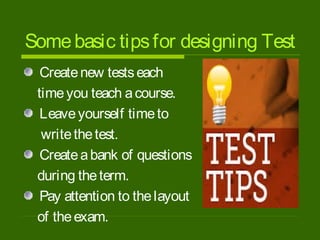
Somebasic tipsfor designing Test
Createnew testseach
timeyou teach acourse.
Leaveyourself timeto
writethetest.
Createabank of questions
during theterm.
Pay attention to thelayout
of theexam.
Consider the following rules of thumb for how long
students typically need to answer different forms of
questions(McKeachie, 1999):
Oneminuteper objective-typequestion.
Two minutesfor ashort answer
requiring onesentence.
Fiveto ten minutesfor alonger
short answer.
Ten minutesfor aproblem that
would takeyou two minutesto
answer.
Fifteen minutesfor ashort, focused essay.
Thirty minutesfor an essay of morethan oneto two pages.
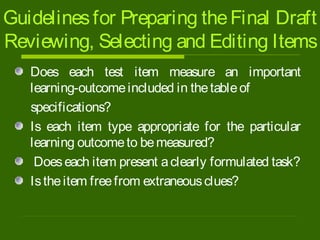
Guidelinesfor Preparing theFinal Draft
Reviewing, Selecting and Editing Items
Does each test item measure an important
learning-outcomeincluded in thetableof
specifications?
Is each item type appropriate for the particular
learning outcometo bemeasured?
Doeseach item present aclearly formulated task?
Istheitem freefrom extraneousclues?
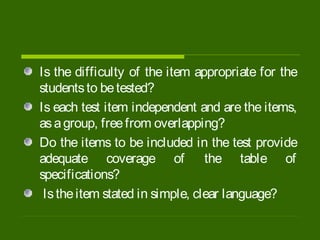
Is the difficulty of the item appropriate for the
studentsto betested?
Is each test item independent and are the items,
asagroup, freefrom overlapping?
Do the items to be included in the test provide
adequate coverage of the table of
specifications?
Istheitem stated in simple, clear language?
stages of test construction

stages of test construction

  • 1.
    Presentation on Stagesof TestConstruction Presented by : Irshad Narejo
  • 2.
    Stage1 Planning for theTest: Outlinesubject-matter content to be considered asthebasisfor thetest. Identify learning outcomes to be measured by thetest. Preparetableof specifications. Choose appropriate type(s) of test items for evaluation of learning outcomes as summarized in thetableof specifications.
  • 3.
    Stage2 Preparing theTest Write testitems according to rules of construction for thetype(s) chosen. Select the items to be included in the test according to tableof specifications. Review and edit items according to guidelines. Arrange items: decide on a) grouping of items, b) sequenceof itemswithin groups, c) sequenceof groupings.
  • 4.
    Prepare directions forthe test; if necessary, prepare directions for individual items (e.g., matching type) or for sections (e.g., negative form of one- best responsetype). Decideon method of scoring.
  • 5.
    Stage3 Validity of theTest Validtests measure what they actually were designed to measure. Testsof validity: 1. Content 2 . Criterion - related 3. Construct
  • 6.
    Stage4 Reliability of theTest Reliabletests measure what they were designed to measureconsistently. Methodsof determining reliability: 1. Test - retest method. 2. Equivalent - formsmethod. 3. Test - retest with equivalent forms. 4. Internal consistency method.
  • 7.
    (A) objectivity It meansthat if the test is marked by different people, thescoreswill bethesame. (B) Comprehensiveness A good test should include items from different areas of material assigned for the test: e.g. ( Dialogue, composition, comprehension, grammar, vocabulary, dictation ).
  • 8.
    ( C) Simplicity Simplicitymeans that the test should be written in a clear , correct and simple language, it is important to keep the method of testing as simple as possible while still testing the skill you intend to test ( avoid ambiguous questions and ambiguousinstructions.)
  • 9.
    (D) Scorability Scorability meansthat each item in the test has its own mark related to the distribution of marks given by theministry of education or ateacher. (E) Practicality It is the relationship between the resources that will berequired in the design , development and use of the test and the resources that will be availablefor theseactivities.
  • 10.
    Stage5 Arranging Items The itemsshould be arranged so that all items of the same type are grouped together. The items should be arranged in order of increasing difficulty. For some purposes, it may be desirable to group together items which measure the same learning outcomes or the same subject-matter content.
  • 11.
    Stage6 Writing Directions The directionsfor test should be simple and concise and yet contain information concerning each of thefollowing: 1. Purposeof thetest. 2. Timeallowed to completethetest. 3. How to record theanswers. 4. Whether to guess when in doubt about the answer.
  • 12.
    Stage7 Analyzing and RevisingtheTest Retain, edit as necessary, or discard items on basisof analysisoutcomes. Revisethetest asawholeif necessary. Thedifficulty of theitem. Thediscriminating power of theitem. Theeffectivenessof each alternative.
  • 13.
    Stage8 Reproducing theTest Decisions needto be made regarding page size, type size, page layout (length of line, placing of items on page, provision for response, page numbers, arrangement of alternatives in multiple choice items), preparation of copy, proofreading.
  • 14.
    Stage9 Administering and ScoringtheTest Decisions need to be made regarding setting of timelimits, observation of timelimits, physical set-up, proctors (Someone who supervises an examination ) distribution of test, scoring sheets, scoring method (by hand/machine). Decisions need to be made regarding weighting of itemsaccording to tableof specifications.
  • 15.
    Administering Tests When itis time to have students take the test, there are several things you should keep in mind to make theexperiencerun assmoothly aspossible: Have extra copies of the test on hand, in case you have miscounted or in the event of some other problem; Minimize interruptions during the exam by reading thedirections briefly at the start and refraining from commenting during the exam unless you discover a problem;
  • 16.
    Periodically write thetime remaining on the board; Be alert for cheating but do not hover over thestudentsand causeadistraction.
  • 17.
    Somebasic tipsfor designingTest Createnew testseach timeyou teach acourse. Leaveyourself timeto writethetest. Createabank of questions during theterm. Pay attention to thelayout of theexam.
  • 18.
    Consider the followingrules of thumb for how long students typically need to answer different forms of questions(McKeachie, 1999): Oneminuteper objective-typequestion. Two minutesfor ashort answer requiring onesentence. Fiveto ten minutesfor alonger short answer. Ten minutesfor aproblem that would takeyou two minutesto answer. Fifteen minutesfor ashort, focused essay. Thirty minutesfor an essay of morethan oneto two pages.
  • 19.
    Guidelinesfor Preparing theFinalDraft Reviewing, Selecting and Editing Items Does each test item measure an important learning-outcomeincluded in thetableof specifications? Is each item type appropriate for the particular learning outcometo bemeasured? Doeseach item present aclearly formulated task? Istheitem freefrom extraneousclues?
  • 20.
    Is the difficultyof the item appropriate for the studentsto betested? Is each test item independent and are the items, asagroup, freefrom overlapping? Do the items to be included in the test provide adequate coverage of the table of specifications? Istheitem stated in simple, clear language?

Editor's Notes

  • #5 NOTES FOR PRESENTERS: This presentation covers the background to the guidance, what the guidance covers, the key recommendations, and actions for prevention for key audiences or settings – that is, local authorities and their partners in the community, early years’ providers, schools, workplaces, the NHS and the public; and for the NHS, the key recommendations for assessment and management. There is information about the costs and savings that are likely to be incurred in implementing the guidance. Finally, the practical support tools available from NICE to support the implementation process are described.
  • #13 NOTES FOR PRESENTERS: This guidance includes recommendations for public health audiences and for the public. NICE public health guidance provides guidance on the promotion of good health and the prevention of ill health. The Care Quality Commission assesses the performance of NHS organisations. Other organisations will want to use the guidance to implement best practice. Recommendations can be delivered through local strategic partnerships and community strategy implementation, including the Health, Social Care and Well-being strategies in Wales, as appropriate. They can also be included in local area agreements. Full implementation of this guideline is likely to take a number of years.