By Irshad nAREJO
Motivation in the
classroom
 Motivation is a crucial element to the
learning process. Classroom motivation
is useful for for teaching all students to
learn. strategies can help teachers
actively engage students and
encourage them to learn and interact
positively with other students in the
learning process.
Strategies of Motivation
 Develop a personal relationship with your
students feel at ease in the classroom and like
their teacher. Teacher should a positive
relationship with students which should be on
academic as well as personal level.
 Create a pleasant and supportive
atmosphere in the classroom
 Accept mistakes as a natural part of learning.
 Encourage positive self-evaluation
 Learning is a collaborative effort. Allow
students to work on a project with a partner
or a team.
 Make learning stimulating and enjoyable for
the learner by making the tasks more
interesting Discuss the topics that are
challenging, have interesting and relevant
content, engage the learner’s fantasy .
 Cooperation and collaboration with strong
and week learners must be encouraged
 Must avoid labeling learners as ‘slow’
’weak’ or ’better’ than others
 Make the curriculum and teaching materials
relevant to students
 Relate the subjects to everyday experiences
 Learning a collaborative effort. Allow students to
work on a project with a partner or a team.
 Create excitement when introducing new ideas
and concepts. Allow students to see how the
new lesson relates to their lives. Provide real
world examples when possible. Involve students
in teaching whenever you can.
 Use rewards and grades in a motivating
manner
 Rewards and grades can do a great deal of
damage.
 Grades should reflect learner effort and
improvement and not just achievement levels
Continuous assessment and self and peer
evaluation procedures should be encouraged.
 Rewards and grades can do a great deal of
damage.
 Remove or reduce anxiety-provoking
environment.
 Teachers must avoid competition, with
successful and unsuccessful learners .
 The teacher should plan class time for
students to prove and give feedback on
the work of peers. This is one way to
improve the quality student-generated
work encourages confidence in producing
this level of work .
 If teachers assign homework but do not
review it or use it, students will stop doing it.
Quality homework assignments facilitate the
learning necessary to attain required
knowledge.
 Provide learners with regular experiences of
success Building self-esteem and self-
confidence is an important aspect of classroom
motivation.
 Creating multiple opportunities for students to
experience success is also very vital academic
achievement.
 Make the effort to take an interest in your
students as individuals. Knowing about them,
their interests, and what they are doing outside
of your class can have a powerful effect.
 Realize that each student is an individual
and, as such, no two students will be
motivated in exactly the same way. Some
need more encouragement and different
techniques than others.
 Along with the use of diagrams, graphs
and charts, visual aids require that the
students actively engage their senses in
order to comprehend the lessons being
taught.
 The teacher should motivate students to
develop interest for participate in the extra
curricular activities.
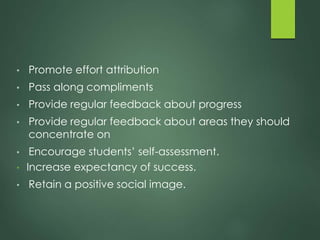
• Promote effort attribution
• Pass along compliments
• Provide regular feedback about progress
• Provide regular feedback about areas they should
concentrate on
• Encourage students’ self-assessment.
• Increase expectancy of success.
• Retain a positive social image.
Thank you

Teaching strategies

  • 1.
  • 2.
    Motivation in the classroom Motivation is a crucial element to the learning process. Classroom motivation is useful for for teaching all students to learn. strategies can help teachers actively engage students and encourage them to learn and interact positively with other students in the learning process.
  • 3.
    Strategies of Motivation Develop a personal relationship with your students feel at ease in the classroom and like their teacher. Teacher should a positive relationship with students which should be on academic as well as personal level.  Create a pleasant and supportive atmosphere in the classroom  Accept mistakes as a natural part of learning.  Encourage positive self-evaluation
  • 4.
     Learning isa collaborative effort. Allow students to work on a project with a partner or a team.  Make learning stimulating and enjoyable for the learner by making the tasks more interesting Discuss the topics that are challenging, have interesting and relevant content, engage the learner’s fantasy .  Cooperation and collaboration with strong and week learners must be encouraged  Must avoid labeling learners as ‘slow’ ’weak’ or ’better’ than others
  • 5.
     Make thecurriculum and teaching materials relevant to students  Relate the subjects to everyday experiences  Learning a collaborative effort. Allow students to work on a project with a partner or a team.  Create excitement when introducing new ideas and concepts. Allow students to see how the new lesson relates to their lives. Provide real world examples when possible. Involve students in teaching whenever you can.
  • 6.
     Use rewardsand grades in a motivating manner  Rewards and grades can do a great deal of damage.  Grades should reflect learner effort and improvement and not just achievement levels Continuous assessment and self and peer evaluation procedures should be encouraged.  Rewards and grades can do a great deal of damage.  Remove or reduce anxiety-provoking environment.  Teachers must avoid competition, with successful and unsuccessful learners .
  • 7.
     The teachershould plan class time for students to prove and give feedback on the work of peers. This is one way to improve the quality student-generated work encourages confidence in producing this level of work .  If teachers assign homework but do not review it or use it, students will stop doing it. Quality homework assignments facilitate the learning necessary to attain required knowledge.
  • 8.
     Provide learnerswith regular experiences of success Building self-esteem and self- confidence is an important aspect of classroom motivation.  Creating multiple opportunities for students to experience success is also very vital academic achievement.  Make the effort to take an interest in your students as individuals. Knowing about them, their interests, and what they are doing outside of your class can have a powerful effect.
  • 9.
     Realize thateach student is an individual and, as such, no two students will be motivated in exactly the same way. Some need more encouragement and different techniques than others.  Along with the use of diagrams, graphs and charts, visual aids require that the students actively engage their senses in order to comprehend the lessons being taught.  The teacher should motivate students to develop interest for participate in the extra curricular activities.
  • 10.
    • Promote effortattribution • Pass along compliments • Provide regular feedback about progress • Provide regular feedback about areas they should concentrate on • Encourage students’ self-assessment. • Increase expectancy of success. • Retain a positive social image.
  • 11.