The document discusses best practices for constructing tests and writing test questions. It provides guidelines for developing multiple choice, true/false, matching, and essay questions. Key aspects addressed include writing clear questions, avoiding negatives, ensuring answer options are similar in length and structure, and using distractors that could plausibly be chosen. The document emphasizes the importance of validity, reliability, and usability in test design.
Are you thekind of teacher who ask the following questions?
2.
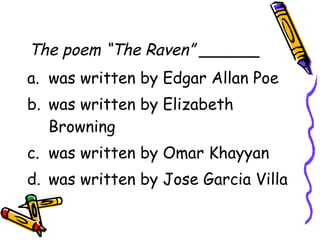
The poem “TheRaven” ______ was written by Edgar Allan Poe was written by Elizabeth Browning was written by Omar Khayyan was written by Jose Garcia Villa
3.
Is it NOTtrue that Magellan discovered the Philippines?
4.
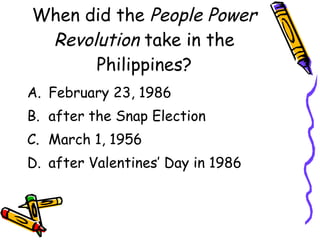
When did the People Power Revolution take in the Philippines? February 23, 1986 after the Snap Election March 1, 1956 after Valentines’ Day in 1986
5.
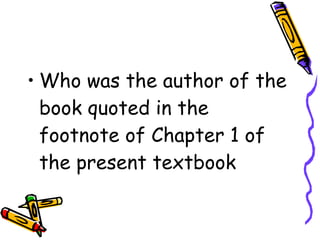
Who was theauthor of the book quoted in the footnote of Chapter 1 of the present textbook
6.
If you answered“ YES ” to any of the choices presented then you have a BIG PROBLEM !
“ 13% ofstudents who fail in class are caused by faulty test questions” WORLDWATCH The Philadelphia Trumpet August 2005
9.
It is estimatedthat 90% of all test questions asked in the US are of “Low level” - knowledge and comprehension (Wilen, W.W., 1992)
10.
“Low level” doesn’tmean easy: Write an essay explaining the decline and fall of the Roman Empire incorporating at least five of the seven causes discussed in class from the writings of Gibbon and Toynbee “High level” doesn’t mean hard: Which movie did you like more, WALL-E or Cars ? Why?
Outline: Part IPrinciples in Test Construction Steps in Preparing Test Questions Preparing Multiple Choice Questions Preparing True or False Questions Part II Review of Part I Preparing Matching Type Questions Preparing Sentence Completion Questions Preparing Essay Questions Other types of Test Questions Wrap-up/Things to Remember
13.
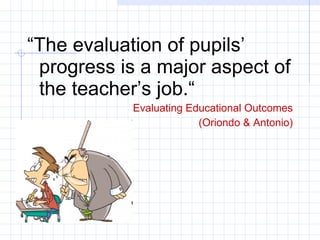
“ The evaluationof pupils’ progress is a major aspect of the teacher’s job.“ Evaluating Educational Outcomes (Oriondo & Antonio)

The Purpose ofTesting To provide a record for assigning grades. To provide a learning experience for students. To motivate students to learn. To serve as a guide for further study.
16.
The Purpose ofTesting To assess how well students are achieving the stated goals of the lesson. To provide the instructor with an opportunity to reinforce the stated objectives and highlight what is important for students to remember.
17.
Characteristics of GoodTests Validity – the extent to which the test measures what it intends to measure Reliability – the consistency with which a test measures what it is supposed to measure Usability – the test can be administered with ease, clarity and uniformity
18.
Scorability – easy to score Interpretability – test results can be properly interpreted and is a major basis in making sound educational decisions Economical – the test can be reused without compromising the validity and reliability Other Things to Consider
19.
“ To beable to prepare a good test, one has to have a mastery of the subject matter, knowledge of the pupils to be tested, skill in verbal expression and the use of the different test format ” Evaluating Educational Outcomes (Oriondo & Antonio)
20.
Multiple Choice Trueor False Matching Type Fill-in the blanks (Sentence Completion) Essay 5 Most Commonly used Test Format Source: Turn-out of Test Questions in SSI (2003-2007)
21.
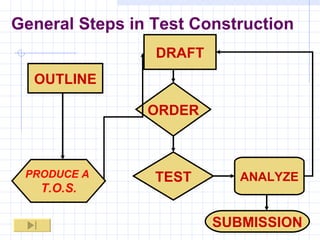
General Steps inTest Construction OUTLINE DRAFT ORDER TEST ANALYZE SUBMISSION PRODUCE A T.O.S.
22.
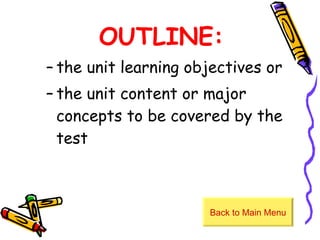
OUTLINE: the unitlearning objectives or the unit content or major concepts to be covered by the test Back to Main Menu
23.
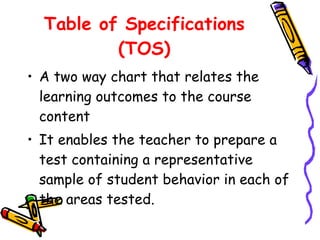
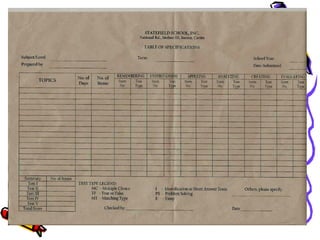
Table of Specifications(TOS) A two way chart that relates the learning outcomes to the course content It enables the teacher to prepare a test containing a representative sample of student behavior in each of the areas tested.
24.
25.
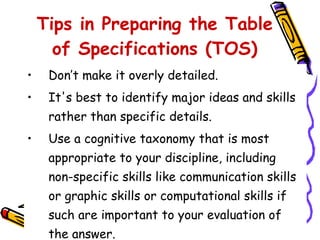
Don’t make itoverly detailed. It's best to identify major ideas and skills rather than specific details. Use a cognitive taxonomy that is most appropriate to your discipline, including non-specific skills like communication skills or graphic skills or computational skills if such are important to your evaluation of the answer. Tips in Preparing the Table of Specifications (TOS)
26.
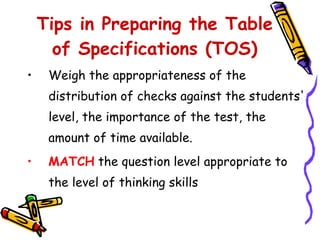
Weigh the appropriatenessof the distribution of checks against the students' level, the importance of the test, the amount of time available. MATCH the question level appropriate to the level of thinking skills Tips in Preparing the Table of Specifications (TOS)
27.
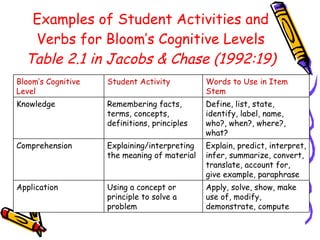
Examples of StudentActivities and Verbs for Bloom’s Cognitive Levels Table 2.1 in Jacobs & Chase (1992:19) Apply, solve, show, make use of, modify, demonstrate, compute Using a concept or principle to solve a problem Application Explain, predict, interpret, infer, summarize, convert, translate, account for, give example, paraphrase Explaining/interpreting the meaning of material Comprehension Define, list, state, identify, label, name, who?, when?, where?, what? Remembering facts, terms, concepts, definitions, principles Knowledge Words to Use in Item Stem Student Activity Bloom’s Cognitive Level
28.
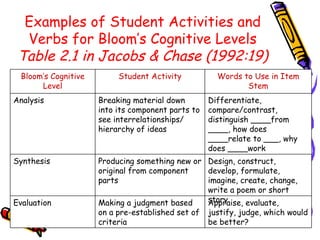
Examples of StudentActivities and Verbs for Bloom’s Cognitive Levels Table 2.1 in Jacobs & Chase (1992:19) Appraise, evaluate, justify, judge, which would be better? Making a judgment based on a pre-established set of criteria Evaluation Design, construct, develop, formulate, imagine, create, change, write a poem or short story Producing something new or original from component parts Synthesis Differentiate, compare/contrast, distinguish ____from ____, how does ____relate to ___, why does ____work Breaking material down into its component parts to see interrelationships/ hierarchy of ideas Analysis Words to Use in Item Stem Student Activity Bloom’s Cognitive Level
29.
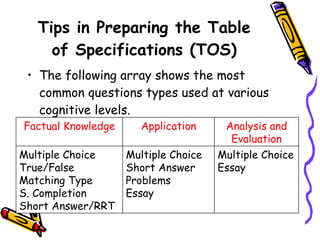
Tips in Preparingthe Table of Specifications (TOS) The following array shows the most common questions types used at various cognitive levels. Multiple Choice Essay Multiple Choice Short Answer Problems Essay Multiple Choice True/False Matching Type S. Completion Short Answer/RRT Analysis and Evaluation Application Factual Knowledge
30.
Activity: Prepare ashort TOS using the selection in your activity sheet. Back to Main Menu
31.
DRAFT thequestions covering the content in the outline Back to Main Menu
32.
ORDER the selected questions logically. Place simpler items at the beginning to ease students into the exam. Group item types together under common instructions. If desirable, order the questions logically from a content standpoint (e.g. chronologically or by conceptual groups, etc.) Back to Main Menu
33.
Test PUT thequestions away for one or two days before rereading them or have someone else review them for clarity. TEST the questions by actually taking the test. Back to Main Menu
34.
ANALYZE the items to give you an idea whether the questions were well-written or poorly written as well as if there were problems in understanding instruction. Back to Main Menu
35.
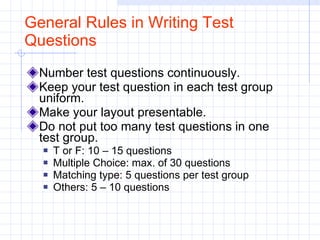
General Rules inWriting Test Questions Number test questions continuously. Keep your test question in each test group uniform. Make your layout presentable. Do not put too many test questions in one test group. T or F: 10 – 15 questions Multiple Choice: max. of 30 questions Matching type: 5 questions per test group Others: 5 – 10 questions
36.
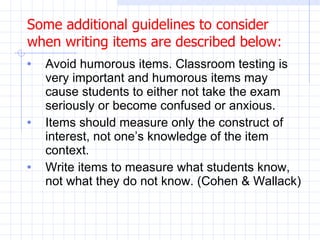
Some additional guidelinesto consider when writing items are described below: Avoid humorous items. Classroom testing is very important and humorous items may cause students to either not take the exam seriously or become confused or anxious. Items should measure only the construct of interest, not one’s knowledge of the item context. Write items to measure what students know, not what they do not know. (Cohen & Wallack)
When checking thestems for correctness: Ensure that the stem asks a clear question. Reading level is appropriate to the students The stem is grammatically correct . Negatively stated stems are discouraged. What to Look for on Multiple Choice Tests
39.
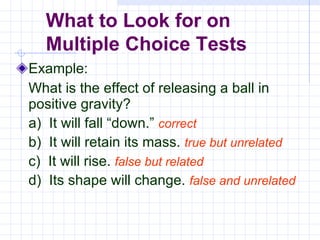
Example: What isthe effect of releasing a ball in positive gravity? a) It will fall “down.” correct b) It will retain its mass. true but unrelated c) It will rise. false but related d) Its shape will change. false and unrelated What to Look for on Multiple Choice Tests
40.
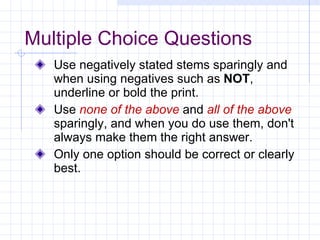
Multiple Choice QuestionsUse negatively stated stems sparingly and when using negatives such as NOT , underline or bold the print. Use none of the above and all of the above sparingly, and when you do use them, don't always make them the right answer. Only one option should be correct or clearly best.
41.
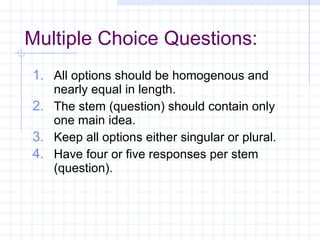
Multiple Choice Questions:All options should be homogenous and nearly equal in length. The stem (question) should contain only one main idea. Keep all options either singular or plural. Have four or five responses per stem (question).
42.
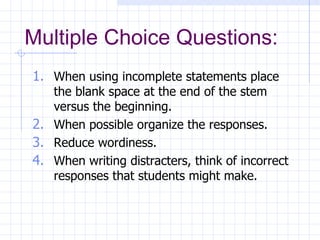
Multiple Choice Questions:When using incomplete statements place the blank space at the end of the stem versus the beginning. When possible organize the responses. Reduce wordiness. When writing distracters, think of incorrect responses that students might make.
43.
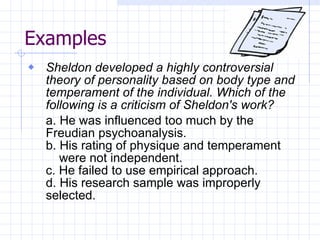
Examples Sheldon developeda highly controversial theory of personality based on body type and temperament of the individual. Which of the following is a criticism of Sheldon's work? a. He was influenced too much by the Freudian psychoanalysis. b. His rating of physique and temperament were not independent. c. He failed to use empirical approach. d. His research sample was improperly selected.
44.
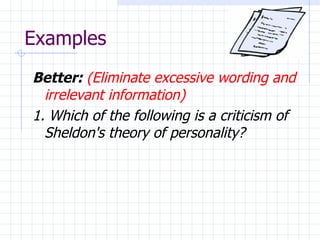
Examples Better: (Eliminate excessive wording and irrelevant information) 1. Which of the following is a criticism of Sheldon's theory of personality?
45.
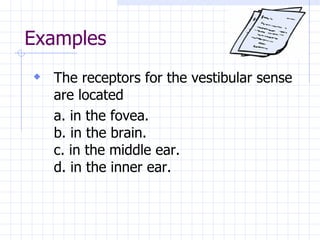
Examples The receptorsfor the vestibular sense are located a. in the fovea. b. in the brain. c. in the middle ear. d. in the inner ear.
46.
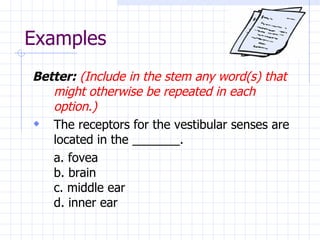
Examples Better: (Include in the stem any word(s) that might otherwise be repeated in each option.) The receptors for the vestibular senses are located in the _______. a. fovea b. brain c. middle ear d. inner ear
47.
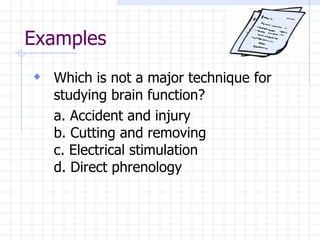
Examples Which isnot a major technique for studying brain function? a. Accident and injury b. Cutting and removing c. Electrical stimulation d. Direct phrenology
48.
Examples Better: (Use negatively stated stems sparingly. When used, underline and/or capitalize the negative word.) Which is NOT a major technique for studying brain function?
49.
Examples 4. ________________is the least form of behavior disorder. a. Psychosis b. Panic disorder c. Neurasthenia d. Neurosis
50.
Examples Better: (When using incomplete statements avoid beginning with the blank space.) The least severe form of behavior disorder is __________________.
51.
Examples The numberof photoreceptors in the retina of each human is about a. 115 million b. 5 million c. 65 million d. 35 billion
52.
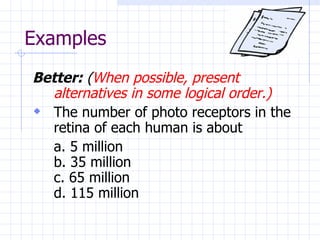
Examples Better: ( When possible, present alternatives in some logical order.) The number of photo receptors in the retina of each human is about a. 5 million b. 35 million c. 65 million d. 115 million
53.
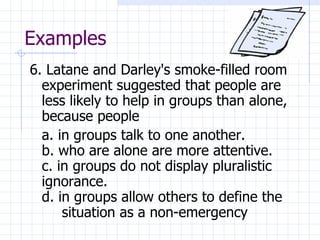
Examples 6. Lataneand Darley's smoke-filled room experiment suggested that people are less likely to help in groups than alone, because people a. in groups talk to one another. b. who are alone are more attentive. c. in groups do not display pluralistic ignorance. d. in groups allow others to define the situation as a non-emergency
54.
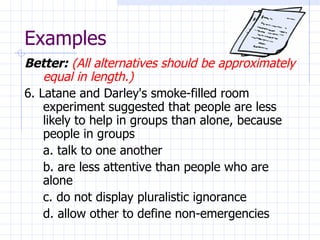
Examples Better: (All alternatives should be approximately equal in length.) 6. Latane and Darley's smoke-filled room experiment suggested that people are less likely to help in groups than alone, because people in groups a. talk to one another b. are less attentive than people who are alone c. do not display pluralistic ignorance d. allow other to define non-emergencies
55.
Activity: Prepare two multiple choice questions based on the selection in your activity sheet.
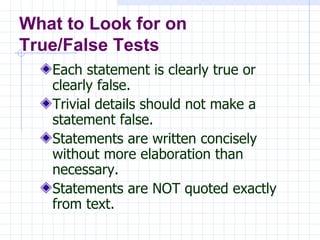
Each statement isclearly true or clearly false. Trivial details should not make a statement false. Statements are written concisely without more elaboration than necessary. Statements are NOT quoted exactly from text. What to Look for on True/False Tests
58.
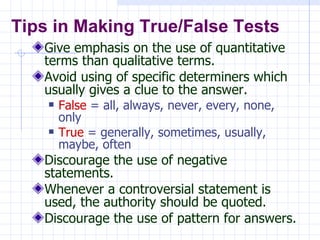
Give emphasis onthe use of quantitative terms than qualitative terms. Avoid using of specific determiners which usually gives a clue to the answer. False = all, always, never, every, none, only True = generally, sometimes, usually, maybe, often Discourage the use of negative statements. Whenever a controversial statement is used, the authority should be quoted. Discourage the use of pattern for answers. Tips in Making True/False Tests
59.
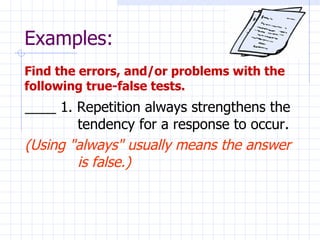
Examples: ____ 1.Repetition always strengthens the tendency for a response to occur. (Using "always" usually means the answer is false.) Find the errors, and/or problems with the following true-false tests.
60.
Examples: _____ 2.The process of extinction is seldom immediate but extends over a number of trials. ( Words like "seldom" usually indicate a true statement.)
61.
Examples: _____ 3.The mean, median, and mode are measures of central tendency, whereas the standard deviation and range are measures of variability. (Express a single idea in each statement.) e.g.“The mean and standard deviation are measures of central tendency.”
62.
Activity: Prepare two true or false questions based on the selection in your activity sheet.