The Stages in Test Design,
Construction and
Administration
CRMEF Souss Massa
Module: Testing &
Assessment
Trainer: Prof. Ayad Chraa
Presented by: Kaoutar El
Assri & Hamza Bellahammou
Academic year: 2024/2025
Outline
1.Preparing and Planning a Test
2.Stages of Test Design
3.Test Administration
Before jumping into item writing,
it's important to remember that
writing test items is not the starting
point of test design. As Fulcher
(2009) emphasizes, effective test
development begins with a clear
test purpose, not with tasks.
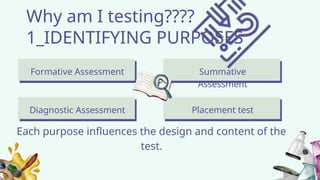
Why am I testing????
1_IDENTIFYING PURPOSES
Formative Assessment
Diagnostic Assessment
Summative
Assessment
Placement test
Each purpose influences the design and content of the
test.
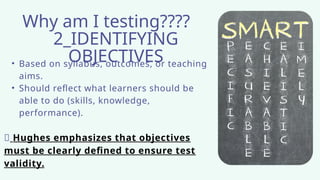
Why am I testing????
2_IDENTIFYING
OBJECTIVES
• Based on syllabus, outcomes, or teaching
aims.
• Should reflect what learners should be
able to do (skills, knowledge,
performance).
🔹 Hughes emphasizes that objectives
must be clearly defined to ensure test
validity.
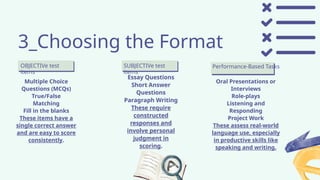
3_Choosing the Format
OBJECTIVe test
items
SUBJECTIVe test
items
Essay Questions
Short Answer
Questions
Paragraph Writing
These require
constructed
responses and
involve personal
judgment in
scoring.
Performance-Based Tasks
Oral Presentations or
Interviews
Role-plays
Listening and
Responding
Project Work
These assess real-world
language use, especially
in productive skills like
speaking and writing.
Multiple Choice
Questions (MCQs)
True/False
Matching
Fill in the blanks
These items have a
single correct answer
and are easy to score
consistently.
4_Selecting Content Areas and
Skills to be Assessed
• Choose topics and language functions already
taught.
• Ensure balance in the skills covered: listening,
speaking, reading, writing.
• Example: If the unit is about travel, test
vocabulary, grammar (e.g., past tense), and
speaking about past trips.
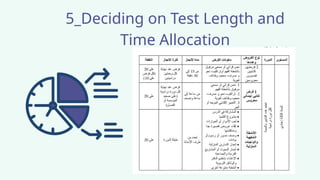
5_Deciding on Test Length and
Time Allocation
STAGES OF TEST
DESIGN
Writing Test Items
1_Ensuring Clarity and
Appropriateness
Use simple, clear
instructions.
Avoid confusing or
misleading language.
Writing Test Items
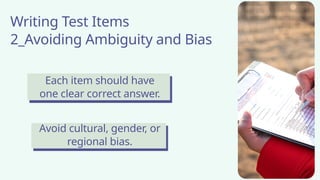
2_Avoiding Ambiguity and Bias
Each item should have
one clear correct answer.
Avoid cultural, gender, or
regional bias.
Reviewing and Revising Test Items
• Check for alignment with
objectives.
• Revise for clarity, balance,
and fairness.
• Ask a peer or a colleague
to help you.
Pre-testing and Piloting
If possible, try the test with a small group
of students from the same level or class.
If that's not feasible, pilot it yourself:
Read the test aloud and answer each
item as if you were a student.
Check timing: Is it too long? Too short?
Verify clarity: Are the instructions and
questions understandable?
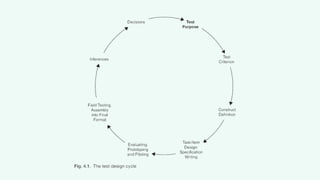
Stages to follow when designing
a TEST.
By Henry douglas
Brown
Stages to follow when designing a TEST.
D. Analyzing Item
Performance
Stages to follow when designing a TEST.
This step involves checking how well each test question worked. You
analyze:
• Difficulty level – How many students answered each item correctly.
• Discrimination index – How well an item distinguishes between high-
and low-performing students.
Example:
If 90% of students get a question right, it might be too easy. If top-
performing students mostly got one question right while low
performers didn’t, that item has good discrimination.
vocabulary, and task completion.
Stages to follow when designing a TEST.
E. Finalizing the
Test
Stages to follow when designing a TEST.
Once analysis is done, revise or remove weak items, check for clarity,
layout, and ensure scoring rubrics are ready.
Example:
After reviewing, you find that two vocabulary questions confuse many
students due to unclear wording. You revise them for clarity and
ensure that all tasks are aligned with the learning goals.
Stages to follow when designing a TEST.
F. Ensuring Validity and
Reliability
Stages to follow when designing a TEST.
• Validity: The test measures what it’s supposed to measure (e.g.,
grammar if that’s the goal).
• Reliability: The test gives consistent results across time or raters.
Example:
To ensure validity, include questions only on taught content like the
Present Simple. To improve reliability, use a consistent rubric for writing
tasks with clear scoring categories like grammar, vocabulary, and task
completion.
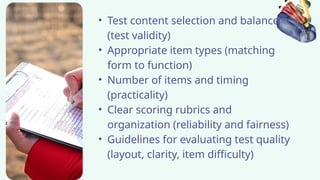
• Test content selection and balance
(test validity)
• Appropriate item types (matching
form to function)
• Number of items and timing
(practicality)
• Clear scoring rubrics and
organization (reliability and fairness)
• Guidelines for evaluating test quality
(layout, clarity, item difficulty)
TEST Administration.
Before the Test:
• Tell students what the test
covers, key topics, and its length.
• Encourage a quick review: skim
notes, highlight main ideas.
• Offer practice questions if
possible.
• Remind them to arrive early and
be prepared.
During the Test:
• Ask students to quickly scan the
test before starting.
• Remind them to stay focused.
• Give a time warning near the end
for checking answers.
• Monitor the room to ensure
fairness and prevent cheating.
After the Test:
• Give feedback on strengths and
areas to improve.
• Discuss the results in class and
invite questions.
• Encourage students to focus on
weak points moving forward.
• Brown, H. D. (2004). Language assessment: Principles and
classroom practices. Pearson Education.
• Hughes, A. (2003). Testing for language teachers (2nd ed.).
Cambridge University Press.
• Harmer, J. (2007). The practice of English language teaching
(4th ed.). Pearson Longman.
• Moroccan Guidelines for Middle School Teaching
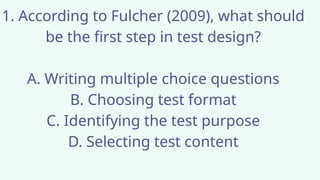
1. According to Fulcher (2009), what should
be the first step in test design?
A. Writing multiple choice questions
B. Choosing test format
C. Identifying the test purpose
D. Selecting test content
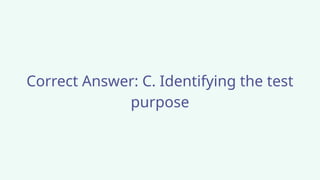
Correct Answer: C. Identifying the test
purpose
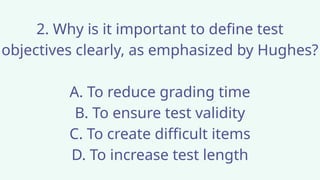
2. Why is it important to define test
objectives clearly, as emphasized by Hughes?
A. To reduce grading time
B. To ensure test validity
C. To create difficult items
D. To increase test length
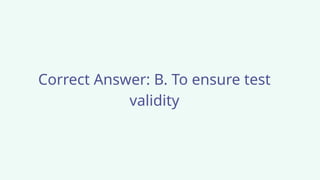
Correct Answer: B. To ensure test
validity
3. Which of the following is considered a
subjective test item?
A. Multiple Choice Question
B. True/False Item
C. Paragraph Writing
D. Matching Exercise
Correct Answer: C. Paragraph
Writing
4. What is one way to improve a test’s clarity
and fairness before finalizing it?
A. Add more complex vocabulary
B. Test it on a different level group
C. Avoid peer review
D. Pre-test or pilot the test
Correct Answer: D. Pre-test or pilot the
test
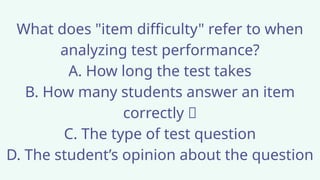
What does "item difficulty" refer to when
analyzing test performance?
A. How long the test takes
B. How many students answer an item
correctly ✅
C. The type of test question
D. The student’s opinion about the question
What is the purpose of the "discrimination
index"?
A. To rank students by age
B. To adjust scores
C. To show if a question separates high and
low performers ✅
D. To test vocabulary knowledge
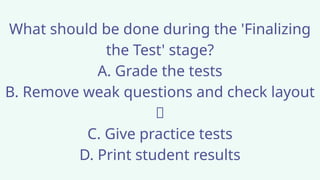
What should be done during the 'Finalizing
the Test' stage?
A. Grade the tests
B. Remove weak questions and check layout
✅
C. Give practice tests
D. Print student results
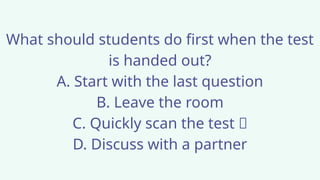
What should students do first when the test
is handed out?
A. Start with the last question
B. Leave the room
C. Quickly scan the test ✅
D. Discuss with a partner
test design ,construction and administration.pptx

test design ,construction and administration.pptx

  • 1.
    The Stages inTest Design, Construction and Administration CRMEF Souss Massa Module: Testing & Assessment Trainer: Prof. Ayad Chraa Presented by: Kaoutar El Assri & Hamza Bellahammou Academic year: 2024/2025
  • 2.
    Outline 1.Preparing and Planninga Test 2.Stages of Test Design 3.Test Administration
  • 3.
    Before jumping intoitem writing, it's important to remember that writing test items is not the starting point of test design. As Fulcher (2009) emphasizes, effective test development begins with a clear test purpose, not with tasks.
  • 4.
    Why am Itesting???? 1_IDENTIFYING PURPOSES Formative Assessment Diagnostic Assessment Summative Assessment Placement test Each purpose influences the design and content of the test.
  • 5.
    Why am Itesting???? 2_IDENTIFYING OBJECTIVES • Based on syllabus, outcomes, or teaching aims. • Should reflect what learners should be able to do (skills, knowledge, performance). 🔹 Hughes emphasizes that objectives must be clearly defined to ensure test validity.
  • 6.
    3_Choosing the Format OBJECTIVetest items SUBJECTIVe test items Essay Questions Short Answer Questions Paragraph Writing These require constructed responses and involve personal judgment in scoring. Performance-Based Tasks Oral Presentations or Interviews Role-plays Listening and Responding Project Work These assess real-world language use, especially in productive skills like speaking and writing. Multiple Choice Questions (MCQs) True/False Matching Fill in the blanks These items have a single correct answer and are easy to score consistently.
  • 7.
    4_Selecting Content Areasand Skills to be Assessed • Choose topics and language functions already taught. • Ensure balance in the skills covered: listening, speaking, reading, writing. • Example: If the unit is about travel, test vocabulary, grammar (e.g., past tense), and speaking about past trips.
  • 8.
    5_Deciding on TestLength and Time Allocation
  • 9.
  • 10.
    Writing Test Items 1_EnsuringClarity and Appropriateness Use simple, clear instructions. Avoid confusing or misleading language.
  • 11.
    Writing Test Items 2_AvoidingAmbiguity and Bias Each item should have one clear correct answer. Avoid cultural, gender, or regional bias.
  • 12.
    Reviewing and RevisingTest Items • Check for alignment with objectives. • Revise for clarity, balance, and fairness. • Ask a peer or a colleague to help you.
  • 13.
    Pre-testing and Piloting Ifpossible, try the test with a small group of students from the same level or class. If that's not feasible, pilot it yourself: Read the test aloud and answer each item as if you were a student. Check timing: Is it too long? Too short? Verify clarity: Are the instructions and questions understandable?
  • 14.
    Stages to followwhen designing a TEST. By Henry douglas Brown
  • 15.
    Stages to followwhen designing a TEST. D. Analyzing Item Performance
  • 16.
    Stages to followwhen designing a TEST. This step involves checking how well each test question worked. You analyze: • Difficulty level – How many students answered each item correctly. • Discrimination index – How well an item distinguishes between high- and low-performing students. Example: If 90% of students get a question right, it might be too easy. If top- performing students mostly got one question right while low performers didn’t, that item has good discrimination. vocabulary, and task completion.
  • 17.
    Stages to followwhen designing a TEST. E. Finalizing the Test
  • 18.
    Stages to followwhen designing a TEST. Once analysis is done, revise or remove weak items, check for clarity, layout, and ensure scoring rubrics are ready. Example: After reviewing, you find that two vocabulary questions confuse many students due to unclear wording. You revise them for clarity and ensure that all tasks are aligned with the learning goals.
  • 19.
    Stages to followwhen designing a TEST. F. Ensuring Validity and Reliability
  • 20.
    Stages to followwhen designing a TEST. • Validity: The test measures what it’s supposed to measure (e.g., grammar if that’s the goal). • Reliability: The test gives consistent results across time or raters. Example: To ensure validity, include questions only on taught content like the Present Simple. To improve reliability, use a consistent rubric for writing tasks with clear scoring categories like grammar, vocabulary, and task completion.
  • 21.
    • Test contentselection and balance (test validity) • Appropriate item types (matching form to function) • Number of items and timing (practicality) • Clear scoring rubrics and organization (reliability and fairness) • Guidelines for evaluating test quality (layout, clarity, item difficulty)
  • 23.
  • 24.
    Before the Test: •Tell students what the test covers, key topics, and its length. • Encourage a quick review: skim notes, highlight main ideas. • Offer practice questions if possible. • Remind them to arrive early and be prepared.
  • 25.
    During the Test: •Ask students to quickly scan the test before starting. • Remind them to stay focused. • Give a time warning near the end for checking answers. • Monitor the room to ensure fairness and prevent cheating.
  • 26.
    After the Test: •Give feedback on strengths and areas to improve. • Discuss the results in class and invite questions. • Encourage students to focus on weak points moving forward.
  • 27.
    • Brown, H.D. (2004). Language assessment: Principles and classroom practices. Pearson Education. • Hughes, A. (2003). Testing for language teachers (2nd ed.). Cambridge University Press. • Harmer, J. (2007). The practice of English language teaching (4th ed.). Pearson Longman. • Moroccan Guidelines for Middle School Teaching
  • 30.
    1. According toFulcher (2009), what should be the first step in test design? A. Writing multiple choice questions B. Choosing test format C. Identifying the test purpose D. Selecting test content
  • 31.
    Correct Answer: C.Identifying the test purpose
  • 32.
    2. Why isit important to define test objectives clearly, as emphasized by Hughes? A. To reduce grading time B. To ensure test validity C. To create difficult items D. To increase test length
  • 33.
    Correct Answer: B.To ensure test validity
  • 34.
    3. Which ofthe following is considered a subjective test item? A. Multiple Choice Question B. True/False Item C. Paragraph Writing D. Matching Exercise
  • 35.
    Correct Answer: C.Paragraph Writing
  • 36.
    4. What isone way to improve a test’s clarity and fairness before finalizing it? A. Add more complex vocabulary B. Test it on a different level group C. Avoid peer review D. Pre-test or pilot the test
  • 37.
    Correct Answer: D.Pre-test or pilot the test
  • 38.
    What does "itemdifficulty" refer to when analyzing test performance? A. How long the test takes B. How many students answer an item correctly ✅ C. The type of test question D. The student’s opinion about the question
  • 39.
    What is thepurpose of the "discrimination index"? A. To rank students by age B. To adjust scores C. To show if a question separates high and low performers ✅ D. To test vocabulary knowledge
  • 40.
    What should bedone during the 'Finalizing the Test' stage? A. Grade the tests B. Remove weak questions and check layout ✅ C. Give practice tests D. Print student results
  • 41.
    What should studentsdo first when the test is handed out? A. Start with the last question B. Leave the room C. Quickly scan the test ✅ D. Discuss with a partner