Presentation on
Stages of T
e
st
Construction
Presented
by : Irshad
Narejo
Stage 1
Planning for the T
est:
Outline subject-matter content to be
considered as the basis for the test.
Identify learning outcomes to be measured
by the test.
Prepare table of specifications.
Choose appropriate type(s) of test items for
evaluation of learning outcomes as
summarized in the table of specifications.
Stage 2
Preparingthe
T
est
Write test items according to rules of
construction for the type(s) chosen.
Select the items to be included in the test
according to table of specifications.
Review and edit items according to
guidelines.
Arrange items: decide on a) grouping of
items, b) sequence of items within groups,
c) sequenceof groupings.
Prepar
e
direction
s
for
the
test;
if
necessary
, prepare directions for
individual items (e.g., matching type) or
for sections (e.g., negative form of
one- bestresponse type).
Decideon method of scoring.
Stage 3
Validity of the T
est
Valid tests measure wha
tthey actually
were designed to measure.
T
ests of validity:
1. Content
2 . Criterion - related
3. Construct
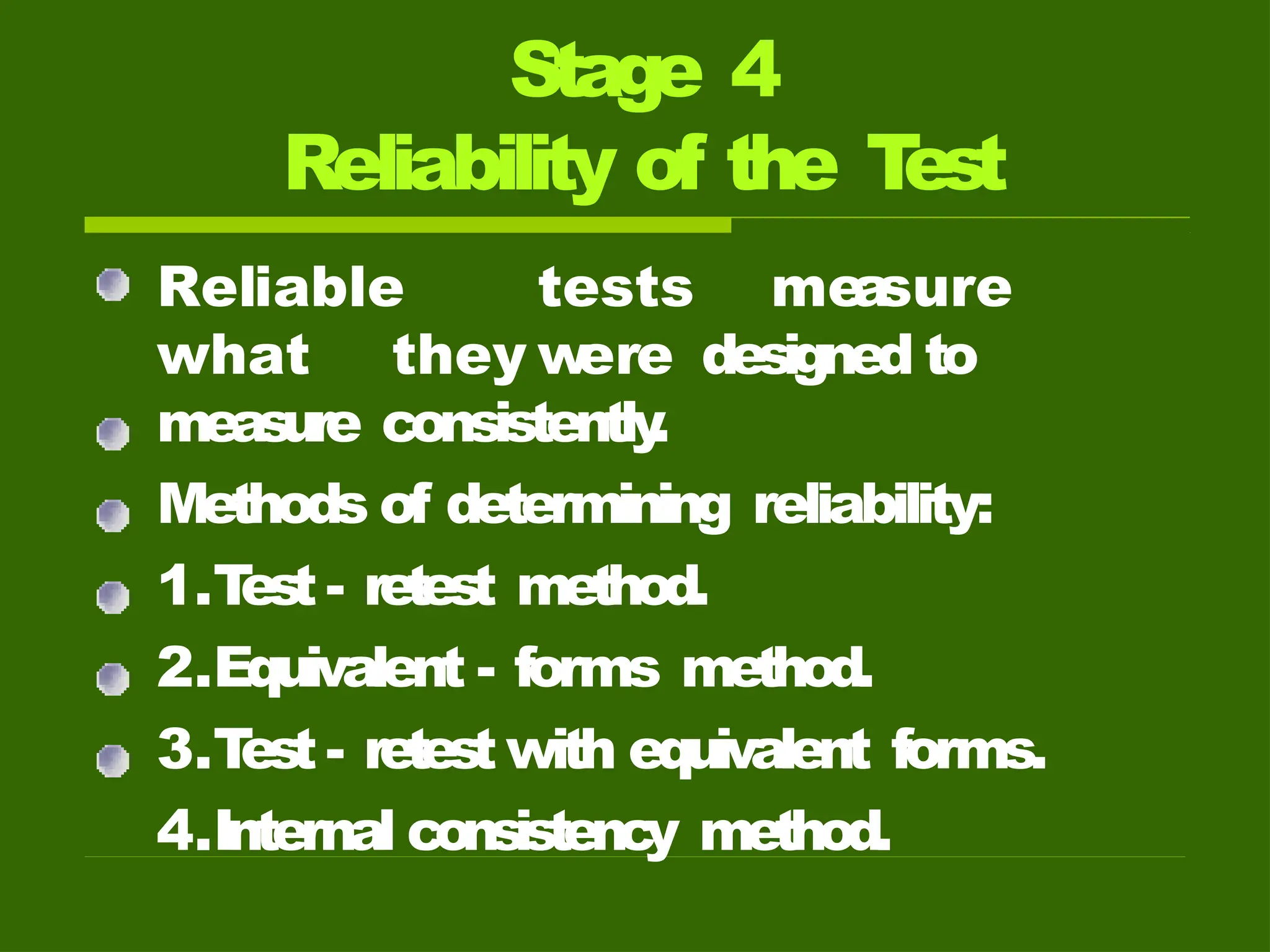
Stage 4
Reliability of the T
est
Reliable tests me
a
sure
what they w
ere designed to
measure consistently
.
Methods of determining reliability:
1.T
est - retest method.
2.Equivalent - forms method.
3.T
est - retest with equivalent forms.
4.Internal consistency method.
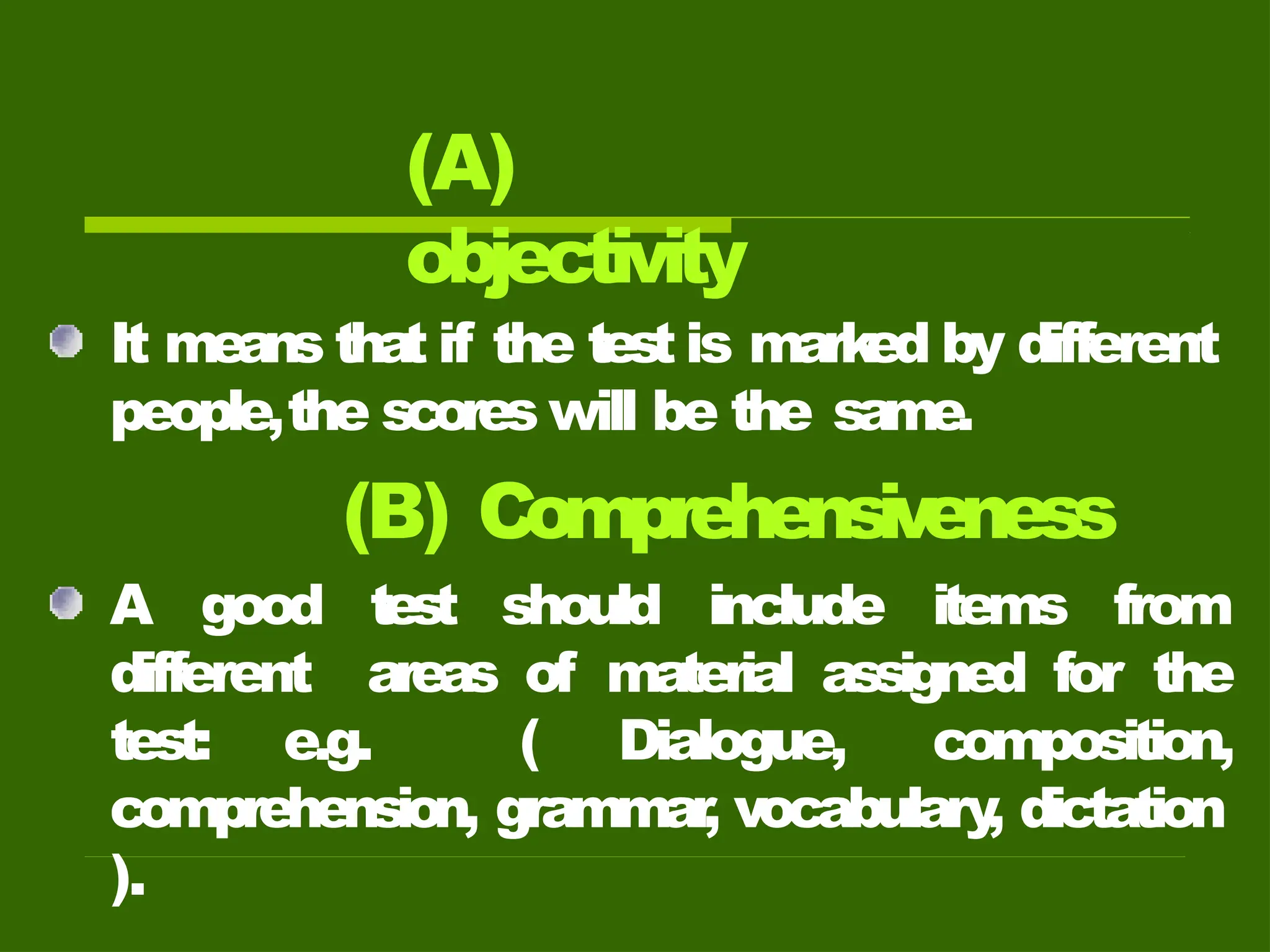
(A)
objectivity
It means that if the test is mark
ed by different
people,the scores will be the same.
(B) Comprehensiveness
A good test should include items from
different areas of material assigned for the
test: e.g. ( Dialogue, composition,
comprehension, grammar
, vocabulary
, dictation
).
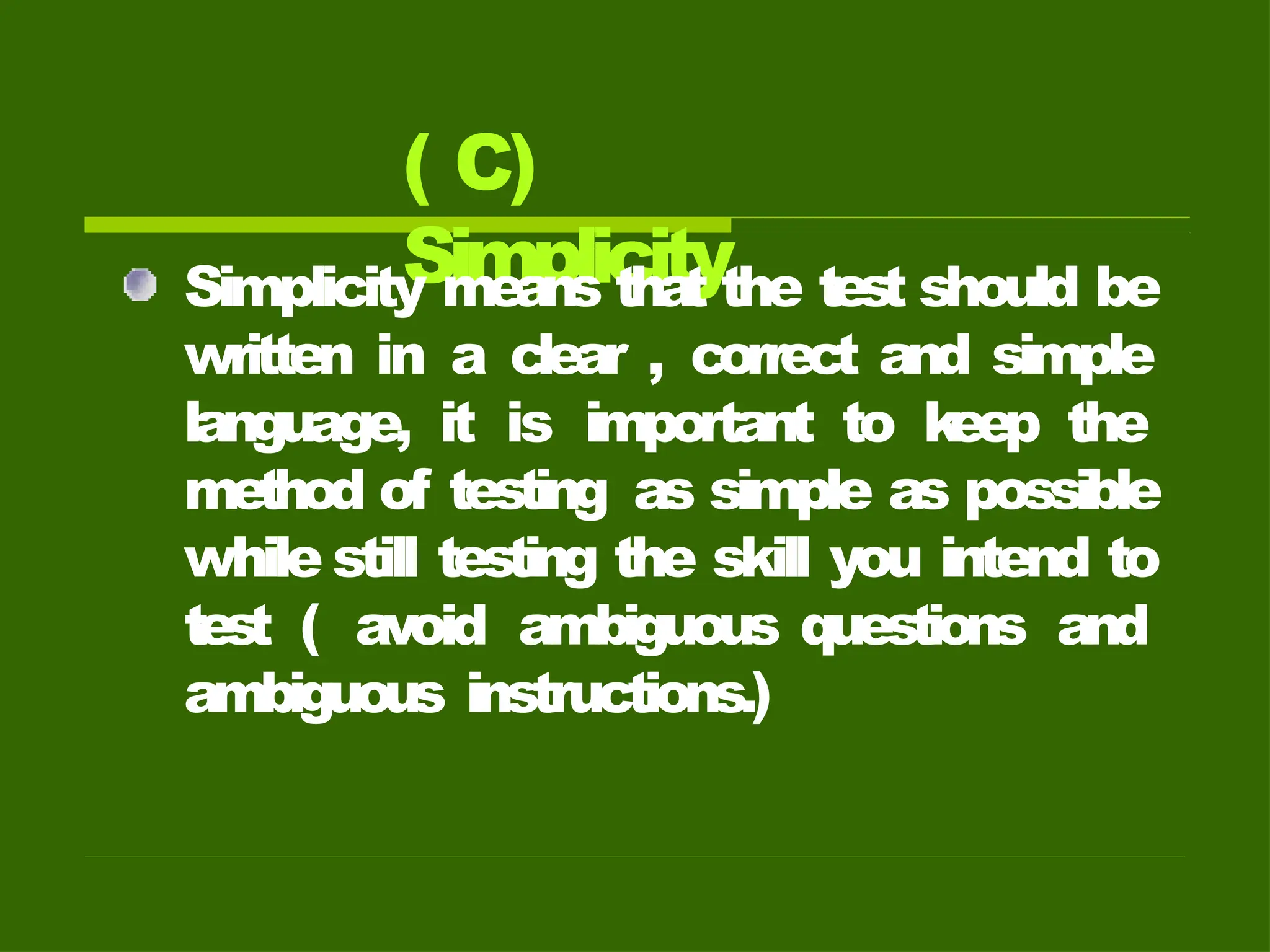
( C)
Simplicity
Simplicity means that the test should be
written in a clear , correct and simple
language, it is important to k
eep the
method of testing as simple as possible
while still testing the skill you intend to
test ( avoid ambiguous questions and
ambiguous instructions.)
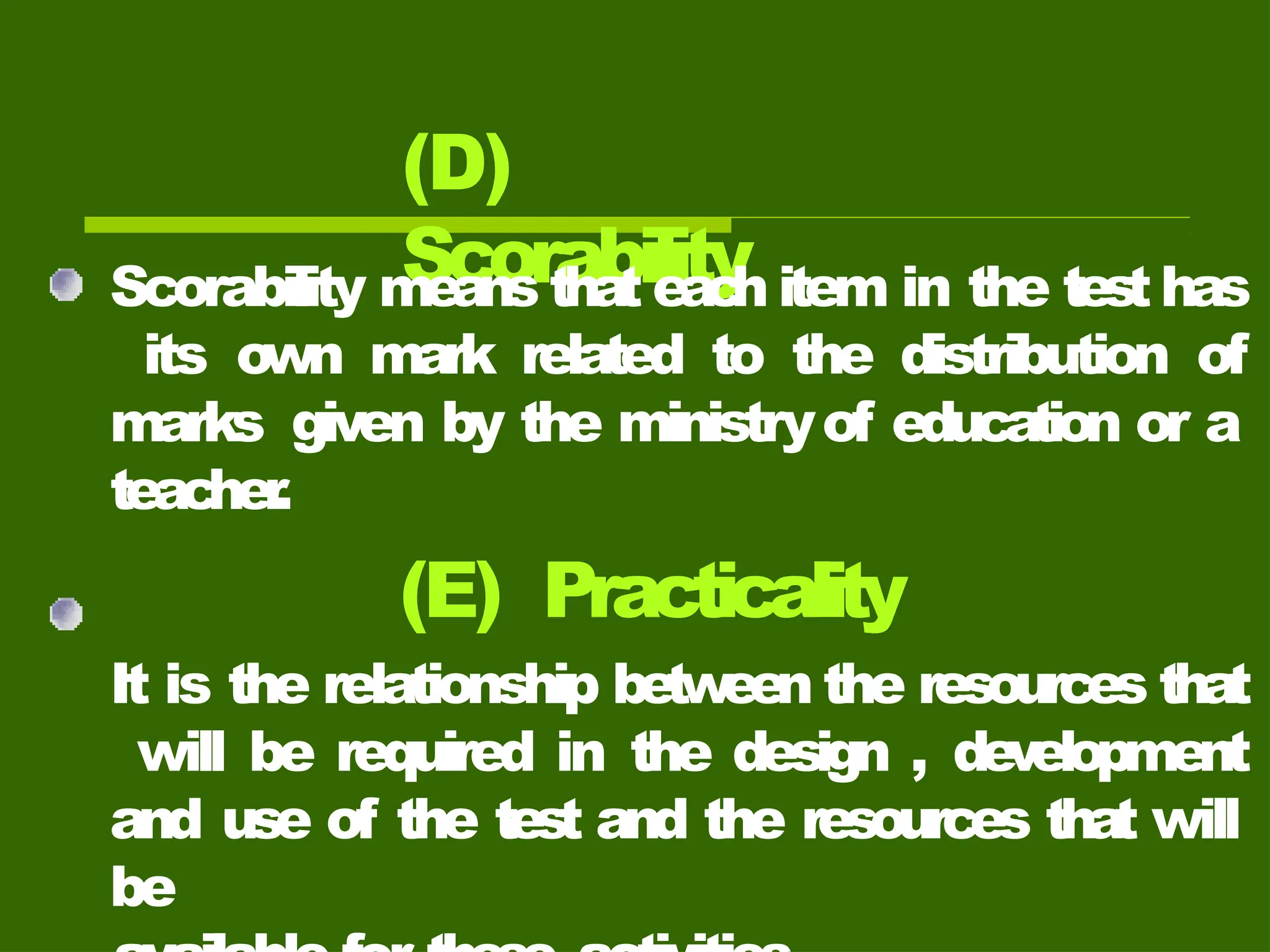
(D)
Scorability
Scorability means that eac
h item in the test has
its own mark related to the distribution of
marks given by the ministryof education or a
teacher
.
(E) Practicality
It is the relationship betw
een the resources that
will be required in the design , development
and use of the test and the resources that will
be
Stage 5
Arranging
Items
The items should be arranged so that all
items of the same type are grouped
together
.
The items should be arranged in order
of increasing difficulty
.
For some purposes, it may be desirable
to group together itemswhich measure
the same learning outcomes or the
same
subject-matter content.
Stage 6
Writing Directions
The directions for test should be simple
and concise and yet contain information
concerning eac
hof the following:
1.Purpose of the test.
2.Time allowed to complete the test.
3.How to record the ans
wers.
4.Whether to guess when in doubt about
the ans
wer
.
Stage 7
Analyzing and Revising the T
est
Retain, edit as necessary
, or discard items
on basis of analysis outcomes.
Revise the testas a whole if
necessary
. The difficulty of the
item.
The discriminating power of the
item. The effectiveness of eac
h
alternative.
Stage 8
Reproducing the
T
est
Decisions need to be made regarding page
size, type size, page layout (length of line,
placing of items on page, provision for
response, page numbers, arrangement of
alternatives in multiple choice items),
preparation of copy
, proofreading.
Stage 9
Administering and Scoring the T
est
Decisions need to be made regarding setting
of time limits, observation of time limits,
physical
set-up, proctors (Someone who supervises
an examination ) distribution of test, scoring
sheets, scoring method (by hand/machine).
Decisions need to be made regarding
weighting of items according to table of
specifications.
Administering Tests
When it is time to have students tak
e the test,
there are se
v
eral things you should k
eep in mind
to mak
e the experience run as smoothly as
possible:
Have extra copies of the test on hand, in case
you have miscounted or in the e
v
ent of some
other problem;
Minimize interruptions during the e
xam by
reading the directions briefly a
t the start and
refraining from commenting during the e
xam
Periodicallywrite the time remaining on
the board;
Be alert for cheating but do not
hover
over the students and causea
distraction.
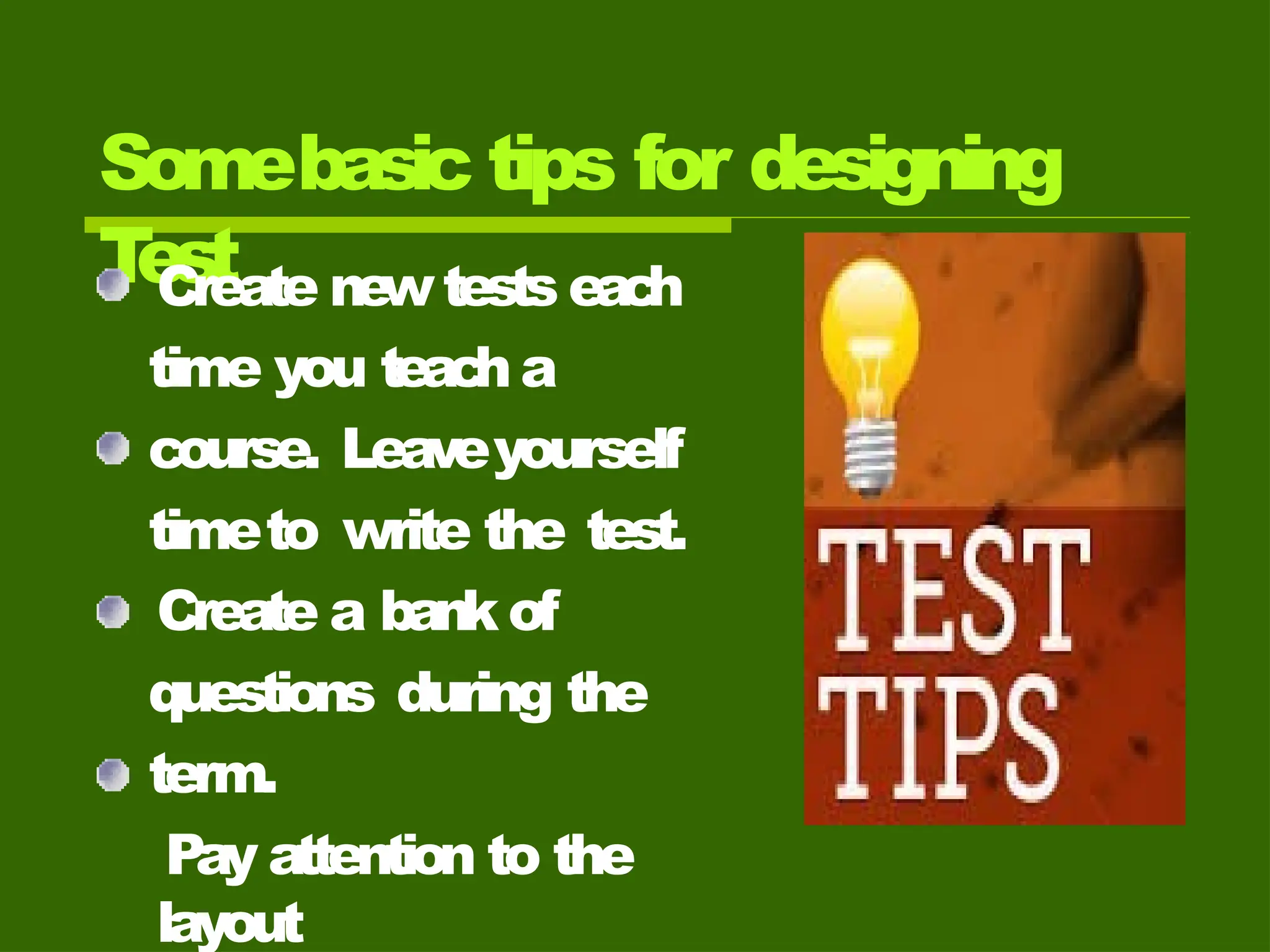
Somebasic tips for designing
T
est
Create ne
wtests eac
h
time you teac
h a
course. Leaveyourself
timeto write the test.
Create a bank of
questions during the
term.
Pay attention to the
layout
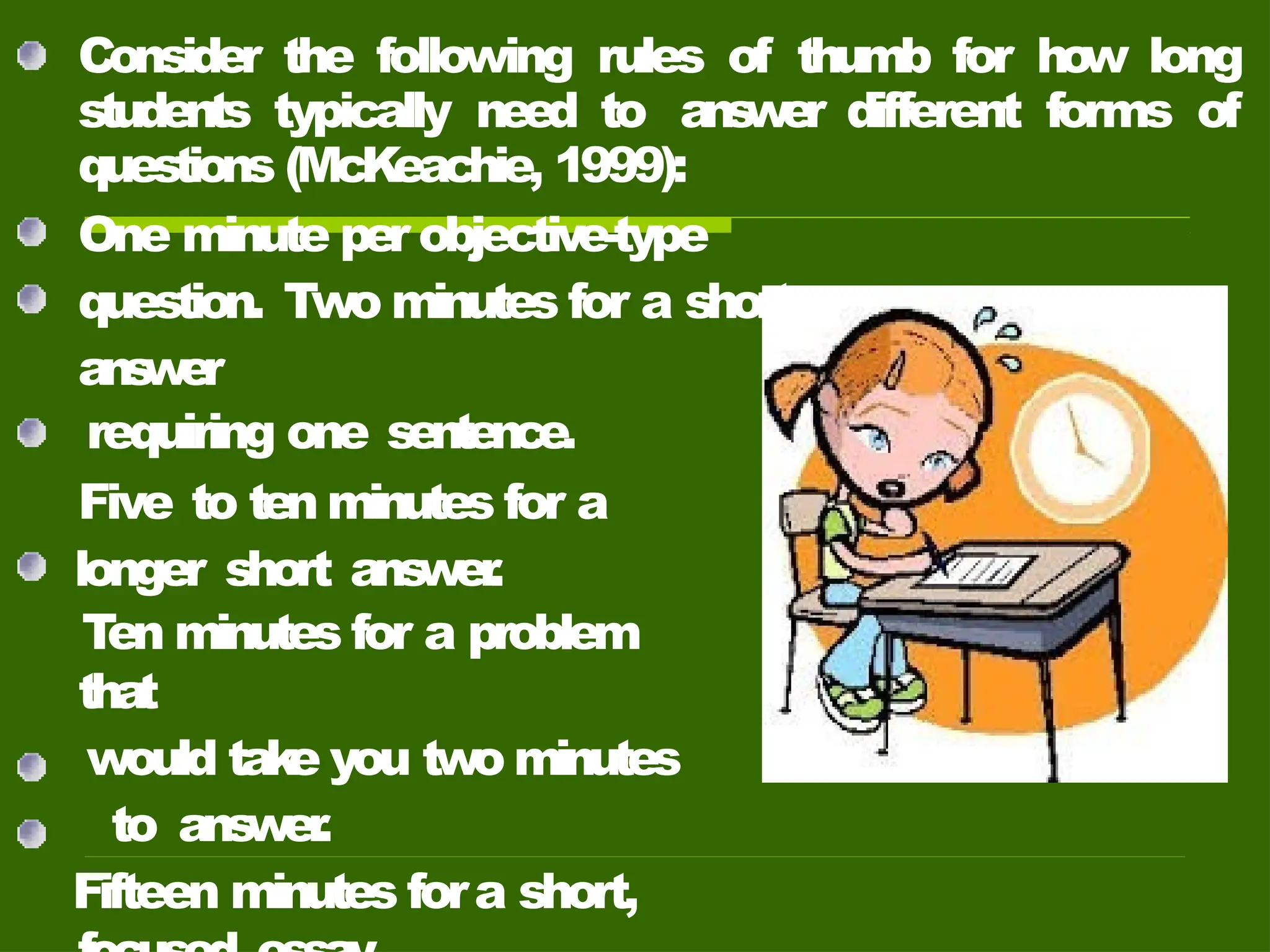
Consider the following rules of thumb for ho
w long
students typically need to a
ns
w
er different forms of
questions (McKeachie, 1999):
One minute per objective-type
question. Two minutes for a short
ans
w
er
requiring one sentence.
Five to ten minutes for a
longer short ans
wer
.
T
en minutes for a problem
that
would tak
e you two minutes
to ans
wer
.
Fifteen minutes fora short,
Guidelines for Preparing the Final
Draft Reviewing, Selecting and
Editing Items
Does e
ach testitem measure an
important learning-outcome included in the
table of
specifications?
Is eac
hitem type appropriate for the particular
learning outcome to be measured?
Does eac
hitem presenta clearly formulated
task? Is the item free from extraneous
clues?
Is the difficulty of the item appropriate for
the students to be tested?
Is eac
h test item independent and are the
items, as a group, free from overlapping?
Do the items to be included in the test
provide adequate co
verage of the table of
specifications?
Is the item statedin simple, clear language?
Test planning in the curriuclum teaching

Test planning in the curriuclum teaching

  • 1.
    Presentation on Stages ofT e st Construction Presented by : Irshad Narejo
  • 2.
    Stage 1 Planning forthe T est: Outline subject-matter content to be considered as the basis for the test. Identify learning outcomes to be measured by the test. Prepare table of specifications. Choose appropriate type(s) of test items for evaluation of learning outcomes as summarized in the table of specifications.
  • 3.
    Stage 2 Preparingthe T est Write testitems according to rules of construction for the type(s) chosen. Select the items to be included in the test according to table of specifications. Review and edit items according to guidelines. Arrange items: decide on a) grouping of items, b) sequence of items within groups, c) sequenceof groupings.
  • 4.
    Prepar e direction s for the test; if necessary , prepare directionsfor individual items (e.g., matching type) or for sections (e.g., negative form of one- bestresponse type). Decideon method of scoring.
  • 5.
    Stage 3 Validity ofthe T est Valid tests measure wha tthey actually were designed to measure. T ests of validity: 1. Content 2 . Criterion - related 3. Construct
  • 6.
    Stage 4 Reliability ofthe T est Reliable tests me a sure what they w ere designed to measure consistently . Methods of determining reliability: 1.T est - retest method. 2.Equivalent - forms method. 3.T est - retest with equivalent forms. 4.Internal consistency method.
  • 7.
    (A) objectivity It means thatif the test is mark ed by different people,the scores will be the same. (B) Comprehensiveness A good test should include items from different areas of material assigned for the test: e.g. ( Dialogue, composition, comprehension, grammar , vocabulary , dictation ).
  • 8.
    ( C) Simplicity Simplicity meansthat the test should be written in a clear , correct and simple language, it is important to k eep the method of testing as simple as possible while still testing the skill you intend to test ( avoid ambiguous questions and ambiguous instructions.)
  • 9.
    (D) Scorability Scorability means thateac h item in the test has its own mark related to the distribution of marks given by the ministryof education or a teacher . (E) Practicality It is the relationship betw een the resources that will be required in the design , development and use of the test and the resources that will be
  • 10.
    Stage 5 Arranging Items The itemsshould be arranged so that all items of the same type are grouped together . The items should be arranged in order of increasing difficulty . For some purposes, it may be desirable to group together itemswhich measure the same learning outcomes or the same subject-matter content.
  • 11.
    Stage 6 Writing Directions Thedirections for test should be simple and concise and yet contain information concerning eac hof the following: 1.Purpose of the test. 2.Time allowed to complete the test. 3.How to record the ans wers. 4.Whether to guess when in doubt about the ans wer .
  • 12.
    Stage 7 Analyzing andRevising the T est Retain, edit as necessary , or discard items on basis of analysis outcomes. Revise the testas a whole if necessary . The difficulty of the item. The discriminating power of the item. The effectiveness of eac h alternative.
  • 13.
    Stage 8 Reproducing the T est Decisionsneed to be made regarding page size, type size, page layout (length of line, placing of items on page, provision for response, page numbers, arrangement of alternatives in multiple choice items), preparation of copy , proofreading.
  • 14.
    Stage 9 Administering andScoring the T est Decisions need to be made regarding setting of time limits, observation of time limits, physical set-up, proctors (Someone who supervises an examination ) distribution of test, scoring sheets, scoring method (by hand/machine). Decisions need to be made regarding weighting of items according to table of specifications.
  • 15.
    Administering Tests When itis time to have students tak e the test, there are se v eral things you should k eep in mind to mak e the experience run as smoothly as possible: Have extra copies of the test on hand, in case you have miscounted or in the e v ent of some other problem; Minimize interruptions during the e xam by reading the directions briefly a t the start and refraining from commenting during the e xam
  • 16.
    Periodicallywrite the timeremaining on the board; Be alert for cheating but do not hover over the students and causea distraction.
  • 17.
    Somebasic tips fordesigning T est Create ne wtests eac h time you teac h a course. Leaveyourself timeto write the test. Create a bank of questions during the term. Pay attention to the layout
  • 18.
    Consider the followingrules of thumb for ho w long students typically need to a ns w er different forms of questions (McKeachie, 1999): One minute per objective-type question. Two minutes for a short ans w er requiring one sentence. Five to ten minutes for a longer short ans wer . T en minutes for a problem that would tak e you two minutes to ans wer . Fifteen minutes fora short,
  • 19.
    Guidelines for Preparingthe Final Draft Reviewing, Selecting and Editing Items Does e ach testitem measure an important learning-outcome included in the table of specifications? Is eac hitem type appropriate for the particular learning outcome to be measured? Does eac hitem presenta clearly formulated task? Is the item free from extraneous clues?
  • 20.
    Is the difficultyof the item appropriate for the students to be tested? Is eac h test item independent and are the items, as a group, free from overlapping? Do the items to be included in the test provide adequate co verage of the table of specifications? Is the item statedin simple, clear language?