Test Design, Construction
and administration
Trainee: Supervised by:
■ NESSI El Houcine ■ Mr. Ayad CHRAA
Training year: 2020-2021
Department of English
Module: Testing & Assessment
Centre Regional des Metiers
d’Education et de Formation
CRMEF . Inzegane, Morocco
Outline: 7 stages
I. Identifying the precise testing need
II. Writing Test Specifications
III.Test construction
IV.Test administration
V. Test Scoring / marking
VI.Test evaluation
I. Identifying the precise testing need
• why am I testing? which specify the test type/
purpose, abilities to be tested
example:
am I testing for: to identify areas of weaknesses and
strengths to elicit information about what SS need to
work on in the future.
Diagnostic Test
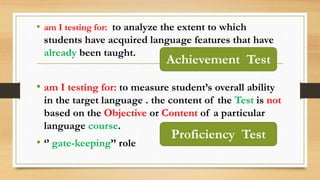
• am I testing for: to analyze the extent to which
students have acquired language features that have
already been taught.
• am I testing for: to measure student’s overall ability
in the target language . the content of the Test is not
based on the Objective or Content of a particular
language course.
• ‘’ gate-keeping’’ role
Achievement Test
Proficiency Test
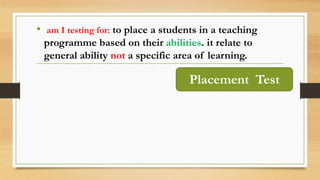
• am I testing for: to place a students in a teaching
programme based on their abilities. it relate to
general ability not a specific area of learning.
Placement Test
why am I testing?
• to specify the test type/ purpose, abilities to be
tested
Identify the objectives
• know what you want to test
• list everything student need to know or able to do
• objective: can be
• a list of grammatical structures and communication
skills in the unit that you have taught.
II. Writing Test Specifications
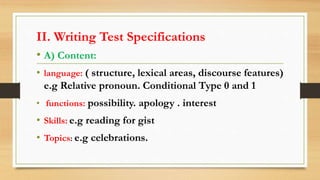
• A) Content:
• language: ( structure, lexical areas, discourse features)
e.g Relative pronoun. Conditional Type 0 and 1
• functions: possibility. apology . interest
• Skills: e.g reading for gist
• Topics: e.g celebrations.
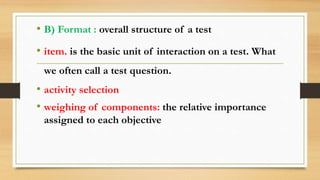
• B) Format : overall structure of a test
• item. is the basic unit of interaction on a test. What
we often call a test question.
• activity selection
• weighing of components: the relative importance
assigned to each objective
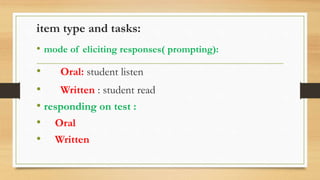
item type and tasks:
• mode of eliciting responses( prompting):
• Oral: student listen
• Written : student read
• responding on test :
• Oral
• Written
•
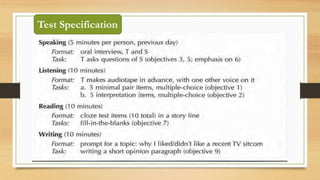
Test Specification
this specification give indication of :
• the topics ( objectives) you will cover.
• the implied elicitation and response formats for items.
• the number of items in each section.
• the time allocated for each
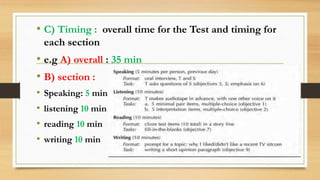
• C) Timing : overall time for the Test and timing for
each section
• e.g A) overall : 35 min
• B) section :
• Speaking: 5 min
• listening 10 min
• reading 10 min
• writing 10 min
• D) Scoring procedure :
Scoring plan: reflect the relative weight that you place on each
section and item in each section
III. Test construction
• A) Sampling for potential content :
• select form the ‘’content specification’’ a sampling that represent the
lessons taught. achieve
• ‘’content validity’’ & ‘’ backwash’’ : need to choose widely from whole
area of content.
• B) Item Writing & moderation:
• when writing items we need to keep in mind that some items need to
be deleted, change. improved through team work .
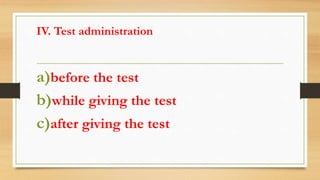
IV. Test administration
a)before the test
b)while giving the test
c)after giving the test
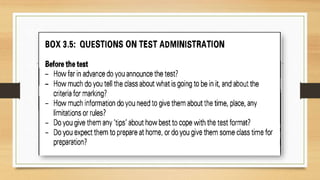
a
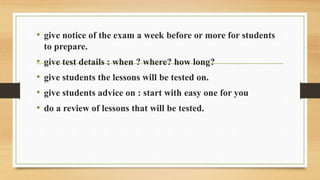
• give notice of the exam a week before or more for students
to prepare.
• give test details : when ? where? how long?
• give students the lessons will be tested on.
• give students advice on : start with easy one for you
• do a review of lessons that will be tested.
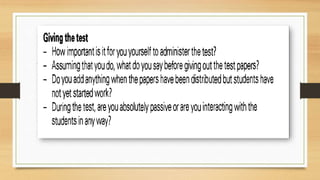
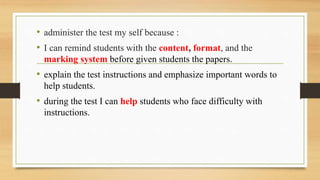
• administer the test my self because :
• I can remind students with the content, format, and the
marking system before given students the papers.
• explain the test instructions and emphasize important words to
help students.
• during the test I can help students who face difficulty with
instructions.
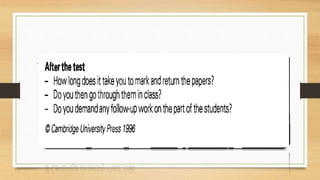
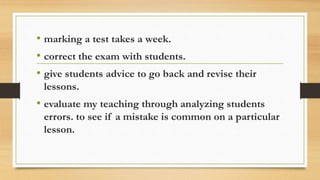
• marking a test takes a week.
• correct the exam with students.
• give students advice to go back and revise their
lessons.
• evaluate my teaching through analyzing students
errors. to see if a mistake is common on a particular
lesson.
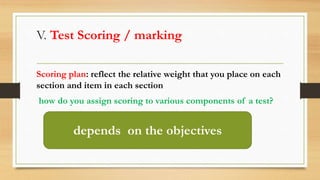
V. Test Scoring / marking
Scoring plan: reflect the relative weight that you place on each
section and item in each section
how do you assign scoring to various components of a test?
depends on the objectives
VI. Test evaluation
• Is there sufficient context?
• Does the item test what it is supposed to test (as
specified)?
• Is the task clear? Could a student capable of
performing the task misunderstand it?
• Is the item uneconomical (too much space/time for too
little information)?
• . Is there more than one correct response. Is this
acceptable?
• will scoring be reliable?
references
• Marion, W. & Tony, W. (2009)A Course in English language teaching: Practice and
theory. Penny Ur
• Douglas, H. B. language Assessment Principles and classroom practice. Longman.
• Arthur, H. Testing for English language Teachers (1992). Cambridge University
Press.

Test Design Construction and Adminstration

  • 1.
    Test Design, Construction andadministration Trainee: Supervised by: ■ NESSI El Houcine ■ Mr. Ayad CHRAA Training year: 2020-2021 Department of English Module: Testing & Assessment Centre Regional des Metiers d’Education et de Formation CRMEF . Inzegane, Morocco
  • 2.
    Outline: 7 stages I.Identifying the precise testing need II. Writing Test Specifications III.Test construction IV.Test administration V. Test Scoring / marking VI.Test evaluation
  • 3.
    I. Identifying theprecise testing need • why am I testing? which specify the test type/ purpose, abilities to be tested example: am I testing for: to identify areas of weaknesses and strengths to elicit information about what SS need to work on in the future. Diagnostic Test
  • 4.
    • am Itesting for: to analyze the extent to which students have acquired language features that have already been taught. • am I testing for: to measure student’s overall ability in the target language . the content of the Test is not based on the Objective or Content of a particular language course. • ‘’ gate-keeping’’ role Achievement Test Proficiency Test
  • 5.
    • am Itesting for: to place a students in a teaching programme based on their abilities. it relate to general ability not a specific area of learning. Placement Test
  • 6.
    why am Itesting? • to specify the test type/ purpose, abilities to be tested
  • 7.
    Identify the objectives •know what you want to test • list everything student need to know or able to do • objective: can be • a list of grammatical structures and communication skills in the unit that you have taught.
  • 8.
    II. Writing TestSpecifications • A) Content: • language: ( structure, lexical areas, discourse features) e.g Relative pronoun. Conditional Type 0 and 1 • functions: possibility. apology . interest • Skills: e.g reading for gist • Topics: e.g celebrations.
  • 9.
    • B) Format: overall structure of a test • item. is the basic unit of interaction on a test. What we often call a test question. • activity selection • weighing of components: the relative importance assigned to each objective
  • 10.
    item type andtasks: • mode of eliciting responses( prompting): • Oral: student listen • Written : student read • responding on test : • Oral • Written
  • 11.
  • 12.
    this specification giveindication of : • the topics ( objectives) you will cover. • the implied elicitation and response formats for items. • the number of items in each section. • the time allocated for each
  • 13.
    • C) Timing: overall time for the Test and timing for each section • e.g A) overall : 35 min • B) section : • Speaking: 5 min • listening 10 min • reading 10 min • writing 10 min
  • 14.
    • D) Scoringprocedure : Scoring plan: reflect the relative weight that you place on each section and item in each section
  • 15.
    III. Test construction •A) Sampling for potential content : • select form the ‘’content specification’’ a sampling that represent the lessons taught. achieve • ‘’content validity’’ & ‘’ backwash’’ : need to choose widely from whole area of content. • B) Item Writing & moderation: • when writing items we need to keep in mind that some items need to be deleted, change. improved through team work .
  • 16.
    IV. Test administration a)beforethe test b)while giving the test c)after giving the test
  • 17.
  • 18.
    • give noticeof the exam a week before or more for students to prepare. • give test details : when ? where? how long? • give students the lessons will be tested on. • give students advice on : start with easy one for you • do a review of lessons that will be tested.
  • 20.
    • administer thetest my self because : • I can remind students with the content, format, and the marking system before given students the papers. • explain the test instructions and emphasize important words to help students. • during the test I can help students who face difficulty with instructions.
  • 22.
    • marking atest takes a week. • correct the exam with students. • give students advice to go back and revise their lessons. • evaluate my teaching through analyzing students errors. to see if a mistake is common on a particular lesson.
  • 23.
    V. Test Scoring/ marking Scoring plan: reflect the relative weight that you place on each section and item in each section how do you assign scoring to various components of a test? depends on the objectives
  • 24.
    VI. Test evaluation •Is there sufficient context? • Does the item test what it is supposed to test (as specified)? • Is the task clear? Could a student capable of performing the task misunderstand it?
  • 25.
    • Is theitem uneconomical (too much space/time for too little information)? • . Is there more than one correct response. Is this acceptable? • will scoring be reliable?
  • 26.
    references • Marion, W.& Tony, W. (2009)A Course in English language teaching: Practice and theory. Penny Ur • Douglas, H. B. language Assessment Principles and classroom practice. Longman. • Arthur, H. Testing for English language Teachers (1992). Cambridge University Press.