



CONSTRUCTING TEST ITEMS
DEBABRATA GIRI
TEACHER EDUCATOR,
DIET,MAYURBHANJ,ODISHA
General Principle
A test in order to be good must follow certain principles
 Planning
 Preparing
 Try Out
 Evaluation
1.Planning
 What content is to be covered ?
 What type of test item to be asked ?
 What are the objective that are going to be assessed ?
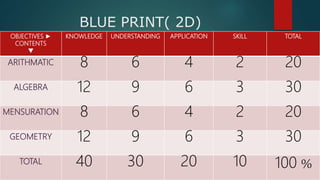
BLUE PRINT( 2D)
OBJECTIVES ►
CONTENTS
▼
KNOWLEDGE UNDERSTANDING APPLICATION SKILL TOTAL
ARITHMATIC 8 6 4 2 20
ALGEBRA 12 9 6 3 30
MENSURATION 8 6 4 2 20
GEOMETRY 12 9 6 3 30
TOTAL 40 30 20 10 100 %
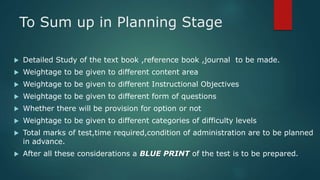
To Sum up in Planning Stage
 Detailed Study of the text book ,reference book ,journal to be made.
 Weightage to be given to different content area
 Weightage to be given to different Instructional Objectives
 Weightage to be given to different form of questions
 Whether there will be provision for option or not
 Weightage to be given to different categories of difficulty levels
 Total marks of test,time required,condition of administration are to be planned
in advance.
 After all these considerations a BLUE PRINT of the test is to be prepared.
2.Preparing the Test
We have to Prepare :
A. the Test Items
B. the direction to the test items
C. the direction for administration
D. the direction for scoring
E. a question wise analysis chart
A.Preparation of Test Items
 Items must be prepared in accordance with the Blue Print
 We have to choose appropriate items in accordance with the instructional
objectives
 We have to follow separate guidelines and rules for construction of essay
type,short answer type,objective type items.
 For different form of objective type specific guidelines must be followed
 The test items must be clear,comprehensive and free from ambiguity.
 Different form of test items should be grouped formwise.
 Preferably items should be assembled from easy to average and difficult
B.Preparation of Direction of Test Items
 The direction must be clear and concise
 Lack of clarity of direction may affect the respond of students
and there by lower the reliability of test.
 If necessary a demonstration for responding an item be given.
C . Preparation of Direction for
Administration
 When the test is to be administered
 Within what time limit
 If the test has separate sections, time limits to cover each
section be mentioned.
 The material required to the test (if any)
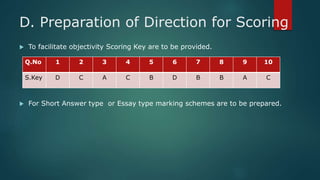
D. Preparation of Direction for Scoring
 To facilitate objectivity Scoring Key are to be provided.
 For Short Answer type or Essay type marking schemes are to be prepared.
Q.No 1 2 3 4 5 6 7 8 9 10
S.Key D C A C B D B B A C
E . Preparation of Question-wise
Analysis Chart
This chart Shows:
 The content area
 Test types
 Marks allotted
 Objectives
 Different difficulty level
 Total time to be taken for takin the test
 It helps to check whether test has been prepared as per the Blue
Print or not
 It helps at the time of editing the final form of the test
3.Try-Out of the Test
 Preparation of preliminary form of test items
1.Preliminary Try out
 At this stage 10 to 15 students of diff abilities are selected and
test is administered.
 Aim is to detect any mistake or omosion
 Whether time allotted is sufficient or not
 After due correctionthe test is addited.
2. Final Try Out
 The test is administered on a representative sample (200-300)
Purpose of Try Out
 To identify the defective or ambiguous items
 To discover the weakness in mechanism of test administration
 To identify the non functioning distracters in MC questions
 To provide data for determining the difficulty level of items
 To provide data for determining Discriminating value of items
 To determine the no of items to be included in the final form
 To determine the time limit for final form
3.Scoring
 After try out the answer sheets are scored as per scoring key and scores will
be useful at the evaluation stage for item analysis
4.Evaluating the Test
A. Item Analysis
B. Determining Validity of the Test
C. Determining Reliability of the Test
D. Assessing the Usability of the Test
A. Item Analysis
The worth of an Item is judged from three main angles viz.
i. Difficulty Index of Item
ii. Discriminating Power of Index
iii. Internal Consistency with the whole Test
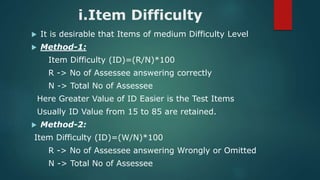
i.Item Difficulty
 It is desirable that Items of medium Difficulty Level
 Method-1:
Item Difficulty (ID)=(R/N)*100
R -> No of Assessee answering correctly
N -> Total No of Assessee
Here Greater Value of ID Easier is the Test Items
Usually ID Value from 15 to 85 are retained.
 Method-2:
Item Difficulty (ID)=(W/N)*100
R -> No of Assessee answering Wrongly or Omitted
N -> Total No of Assessee
ii. Discriminating Index
Constructing test Items

Constructing test Items

  • 1.
    CONSTRUCTING TEST ITEMS DEBABRATAGIRI TEACHER EDUCATOR, DIET,MAYURBHANJ,ODISHA
  • 2.
    General Principle A testin order to be good must follow certain principles  Planning  Preparing  Try Out  Evaluation
  • 3.
    1.Planning  What contentis to be covered ?  What type of test item to be asked ?  What are the objective that are going to be assessed ?
  • 4.
    BLUE PRINT( 2D) OBJECTIVES► CONTENTS ▼ KNOWLEDGE UNDERSTANDING APPLICATION SKILL TOTAL ARITHMATIC 8 6 4 2 20 ALGEBRA 12 9 6 3 30 MENSURATION 8 6 4 2 20 GEOMETRY 12 9 6 3 30 TOTAL 40 30 20 10 100 %
  • 5.
    To Sum upin Planning Stage  Detailed Study of the text book ,reference book ,journal to be made.  Weightage to be given to different content area  Weightage to be given to different Instructional Objectives  Weightage to be given to different form of questions  Whether there will be provision for option or not  Weightage to be given to different categories of difficulty levels  Total marks of test,time required,condition of administration are to be planned in advance.  After all these considerations a BLUE PRINT of the test is to be prepared.
  • 6.
    2.Preparing the Test Wehave to Prepare : A. the Test Items B. the direction to the test items C. the direction for administration D. the direction for scoring E. a question wise analysis chart
  • 7.
    A.Preparation of TestItems  Items must be prepared in accordance with the Blue Print  We have to choose appropriate items in accordance with the instructional objectives  We have to follow separate guidelines and rules for construction of essay type,short answer type,objective type items.  For different form of objective type specific guidelines must be followed  The test items must be clear,comprehensive and free from ambiguity.  Different form of test items should be grouped formwise.  Preferably items should be assembled from easy to average and difficult
  • 8.
    B.Preparation of Directionof Test Items  The direction must be clear and concise  Lack of clarity of direction may affect the respond of students and there by lower the reliability of test.  If necessary a demonstration for responding an item be given.
  • 9.
    C . Preparationof Direction for Administration  When the test is to be administered  Within what time limit  If the test has separate sections, time limits to cover each section be mentioned.  The material required to the test (if any)
  • 10.
    D. Preparation ofDirection for Scoring  To facilitate objectivity Scoring Key are to be provided.  For Short Answer type or Essay type marking schemes are to be prepared. Q.No 1 2 3 4 5 6 7 8 9 10 S.Key D C A C B D B B A C
  • 11.
    E . Preparationof Question-wise Analysis Chart This chart Shows:  The content area  Test types  Marks allotted  Objectives  Different difficulty level  Total time to be taken for takin the test  It helps to check whether test has been prepared as per the Blue Print or not  It helps at the time of editing the final form of the test
  • 12.
    3.Try-Out of theTest  Preparation of preliminary form of test items 1.Preliminary Try out  At this stage 10 to 15 students of diff abilities are selected and test is administered.  Aim is to detect any mistake or omosion  Whether time allotted is sufficient or not  After due correctionthe test is addited. 2. Final Try Out  The test is administered on a representative sample (200-300)
  • 13.
    Purpose of TryOut  To identify the defective or ambiguous items  To discover the weakness in mechanism of test administration  To identify the non functioning distracters in MC questions  To provide data for determining the difficulty level of items  To provide data for determining Discriminating value of items  To determine the no of items to be included in the final form  To determine the time limit for final form 3.Scoring  After try out the answer sheets are scored as per scoring key and scores will be useful at the evaluation stage for item analysis
  • 14.
    4.Evaluating the Test A.Item Analysis B. Determining Validity of the Test C. Determining Reliability of the Test D. Assessing the Usability of the Test
  • 15.
    A. Item Analysis Theworth of an Item is judged from three main angles viz. i. Difficulty Index of Item ii. Discriminating Power of Index iii. Internal Consistency with the whole Test
  • 16.
    i.Item Difficulty  Itis desirable that Items of medium Difficulty Level  Method-1: Item Difficulty (ID)=(R/N)*100 R -> No of Assessee answering correctly N -> Total No of Assessee Here Greater Value of ID Easier is the Test Items Usually ID Value from 15 to 85 are retained.  Method-2: Item Difficulty (ID)=(W/N)*100 R -> No of Assessee answering Wrongly or Omitted N -> Total No of Assessee
  • 17.

Editor's Notes

  • #4 Content-Arithmatics,Geometry,Mensuration,Algebra,Construction etc :Algebra-diff chapter::TEST Item-Essay Type,Short Answer Type ,Diff objective type::IO-Knowledge-Recall,Reccognition,Understanding,Application,Skill:Easy or Averae or Difficult-15,70,15,:Provision for Option or not,Time,
  • #5 If we introduce form of questions then it would be another dimension and then it would be 3D Blue Print
  • #8 Construction of test items is not so easy, it is the task of test specialists or experts,an experienced tr who is sufficiently trained in test construction can prepare appropriate test items
  • #9 Whether to put a tick mark or write tick or mark the response in appropriate place or in separate answer sheets etc
  • #10 1-whether at middle of the session or end of the session, 4-graph paper,log table,trigonometric table,level of significance,
  • #11 MS-Marks allotted to diff important Points or Steps in solving problems.
  • #13 The question may be carefully constructed ,but there is no guarantee that they will operate in the same manner as planned.So before the final form it is necessary to have a try out of it. 1-More no of items than actually required. Generally double the no. as at the stage of item analysis many will be discarded.
  • #15 After scoring the test must be evaluated to examine whether the test items are good and reliable and valid
  • #16 IA is a procedure by which we analyse the items to judge their suitability or unsuitability for inclusion in test. The merit of a test depends on the individual items which constitute it.So only those items which suits our purpose are to be retained.
  • #17 When an item is too easy all answer and when too difficult nobody would answer.What is the use of having such item.If all pupils get equal score the very purpose of test is defeated.So it is apparent that too easy and too difficult items are discsrded.
  • #18 To be considered as a good ,an item must have discriminating power.Too easy or too difficult cant discriminate.Logically it is expected that majority of students of better standard and a few students of lower standard answer an item correctly.Thus an item must discriminate between high and low achiever.