OBJECTIVE AND
ESSAY TESTS(Concepts, weaknesses, and strengths)
OBJECTIVE AND
ESSAY TESTS
OBJECTIVE TESTS
THE CONCEPTS
THE STRENGHTS
THE WEAKNESSES
OBJECTIVE TESTS
CONCEPTS
Definitions
TYPES
Objective test items are
items that can be
objectively scored items
on which person select a
response from the list of
options.
DEFINITIONS
An objective test is a test
that has right or wrong
answers and so can be
marked objectively.
A test consisting of factual
questions requiring
extremely short answers
that can be quickly and
unambiguously scored by
anyone with an answer
key, thus minimizing
subjective judgments by
both the person taking the
test and the person scoring
it.
K E Y W O R D S:
- List of options -
- Has right AND wrong answers -
- Short answers -
- Quickly and unambiguously
scored –
- ANSWER KEY -
TYPES
1. TRUE OR FALSE
2. MATCHING TYPE
3. MULTIPLE CHOICE
4. LABELING
5. COMPLETION TYPE
6. SIMPLE RECALL
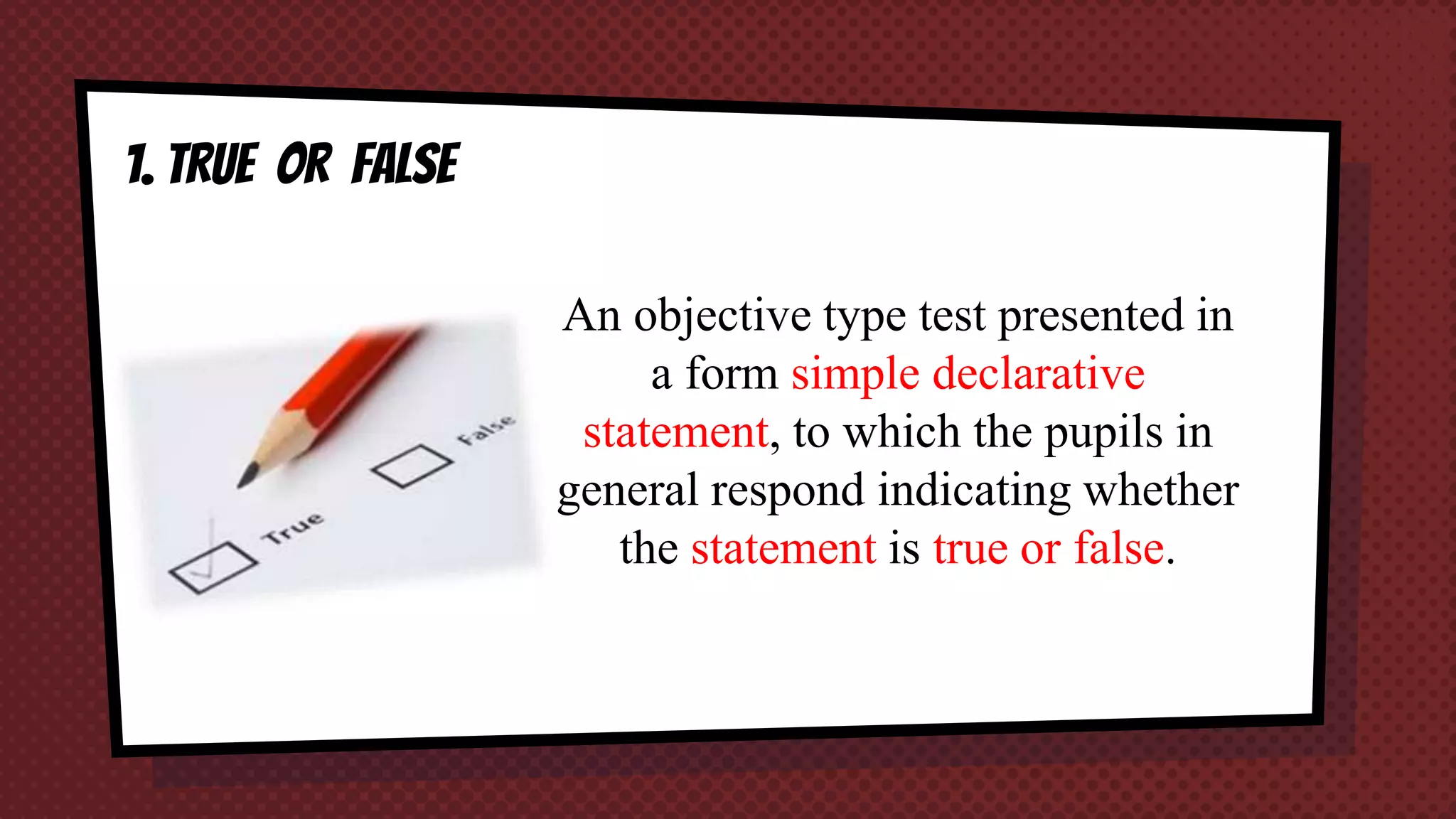
1. TRUE OR FALSE
An objective type test presented in
a form simple declarative
statement, to which the pupils in
general respond indicating whether
the statement is true or false.
The classifications of TRUE OR FALSE
1. MEASURING THE ABILITY TO IDENTIFY THE
CORRECTNESS OF STATEMENTS OF FACTS AND
DEFINITION OF TERMS
ONLY TWO OPTIONS, TRUE AND FALSE
T/F
T/F
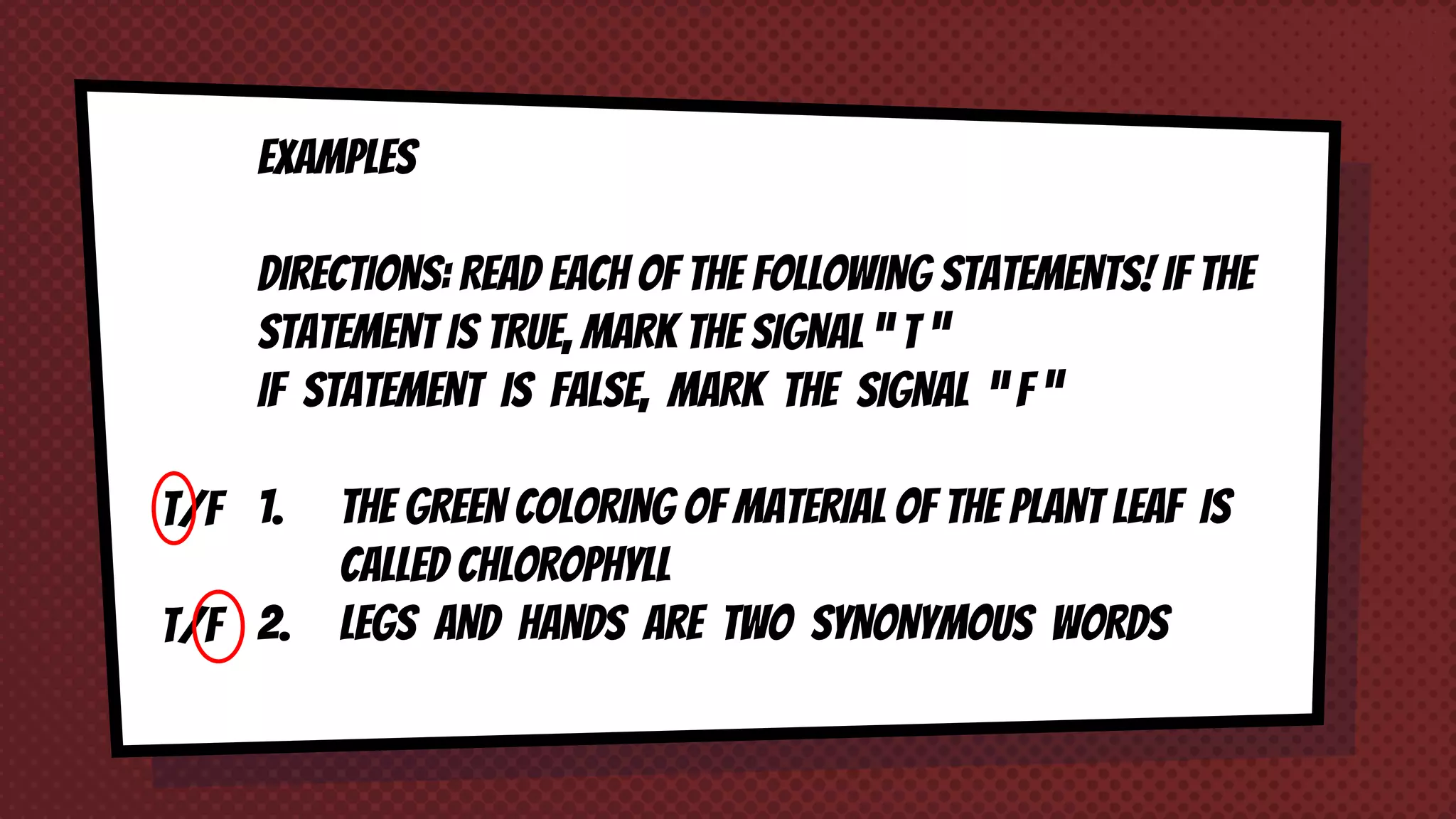
EXAMPLES
DIRECTIONS: READ EACH OF THE FOLLOWING STATEMENTS! IF THE
STATEMENT IS TRUE, MARK THE SIGNAL “ T ”
IF STATEMENT IS FALSE, MARK THE SIGNAL “ F ”
1. THE GREEN COLORING OF MATERIAL OF THE PLANT LEAF IS
CALLED CHLOROPHYLL
2. LEGS AND HANDS ARE TWO SYNONYMOUS WORDS
The classifications of TRUE OR FALSE
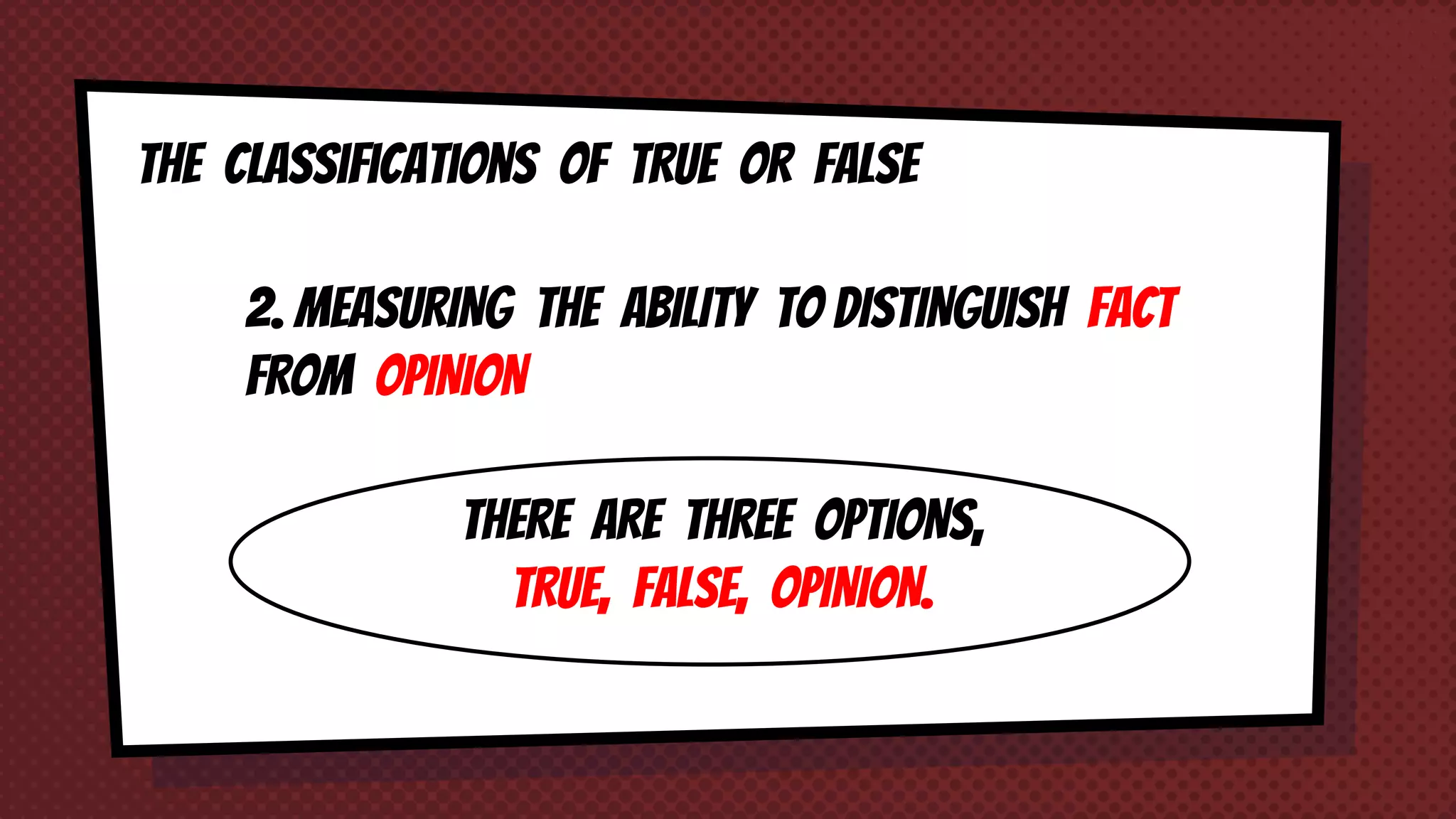
2. MEASURING THE ABILITY TO DISTINGUISH FACT
FROM OPINION
THERE ARE THREE OPTIONS,
TRUE, FALSE, OPINION.
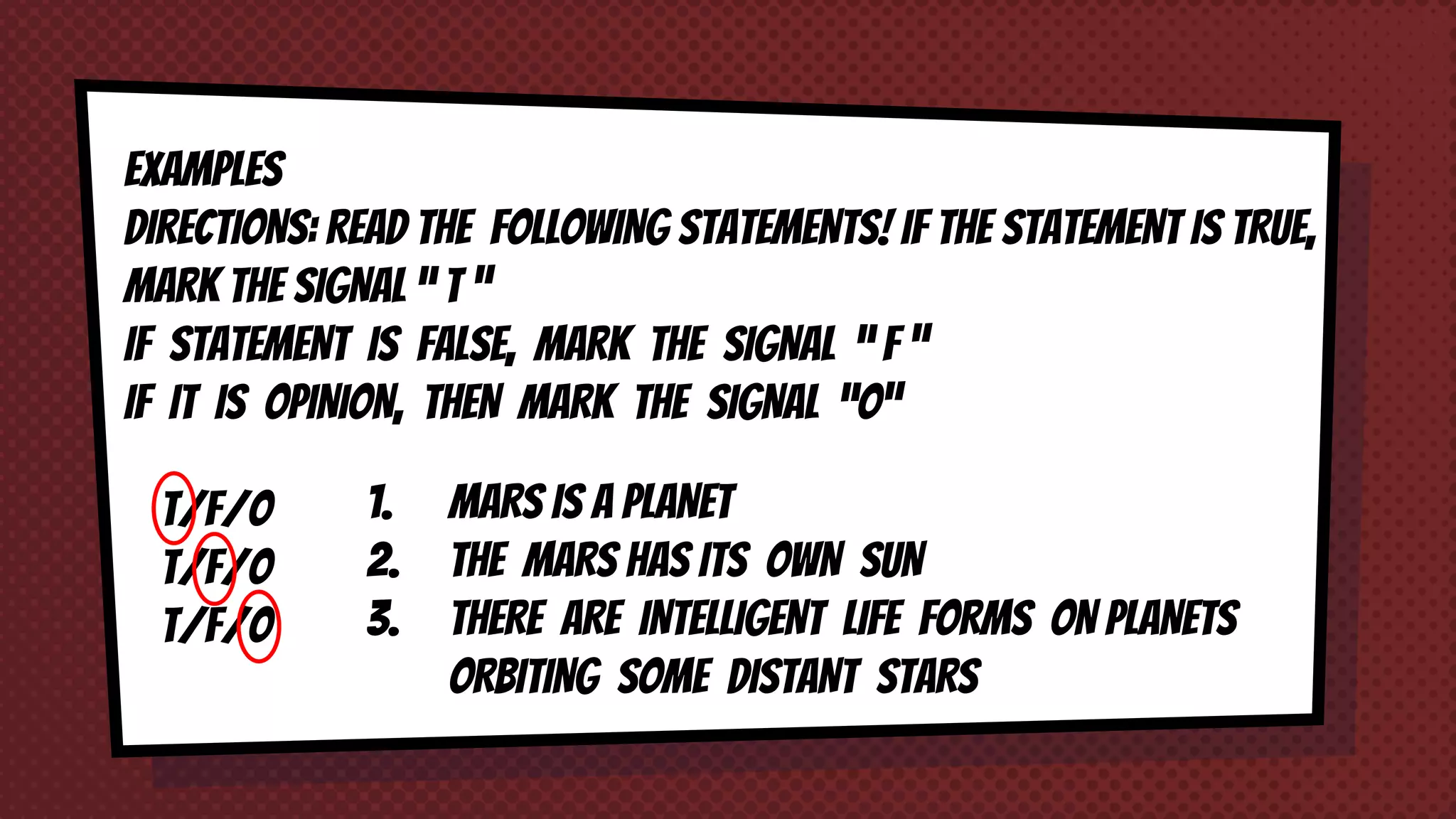
EXAMPLES
DIRECTIONS: READ THE FOLLOWING STATEMENTS! IF THE STATEMENT IS TRUE,
MARK THE SIGNAL “ T ”
IF STATEMENT IS FALSE, MARK THE SIGNAL “ F ”
IF IT IS OPINION, THEN MARK THE SIGNAL “O”
1. MARS IS A PLANET
2. THE MARS HAS ITS OWN SUN
3. THERE ARE INTELLIGENT LIFE FORMS ON PLANETS
ORBITING SOME DISTANT STARS
T/F/O
T/F/O
T/F/O
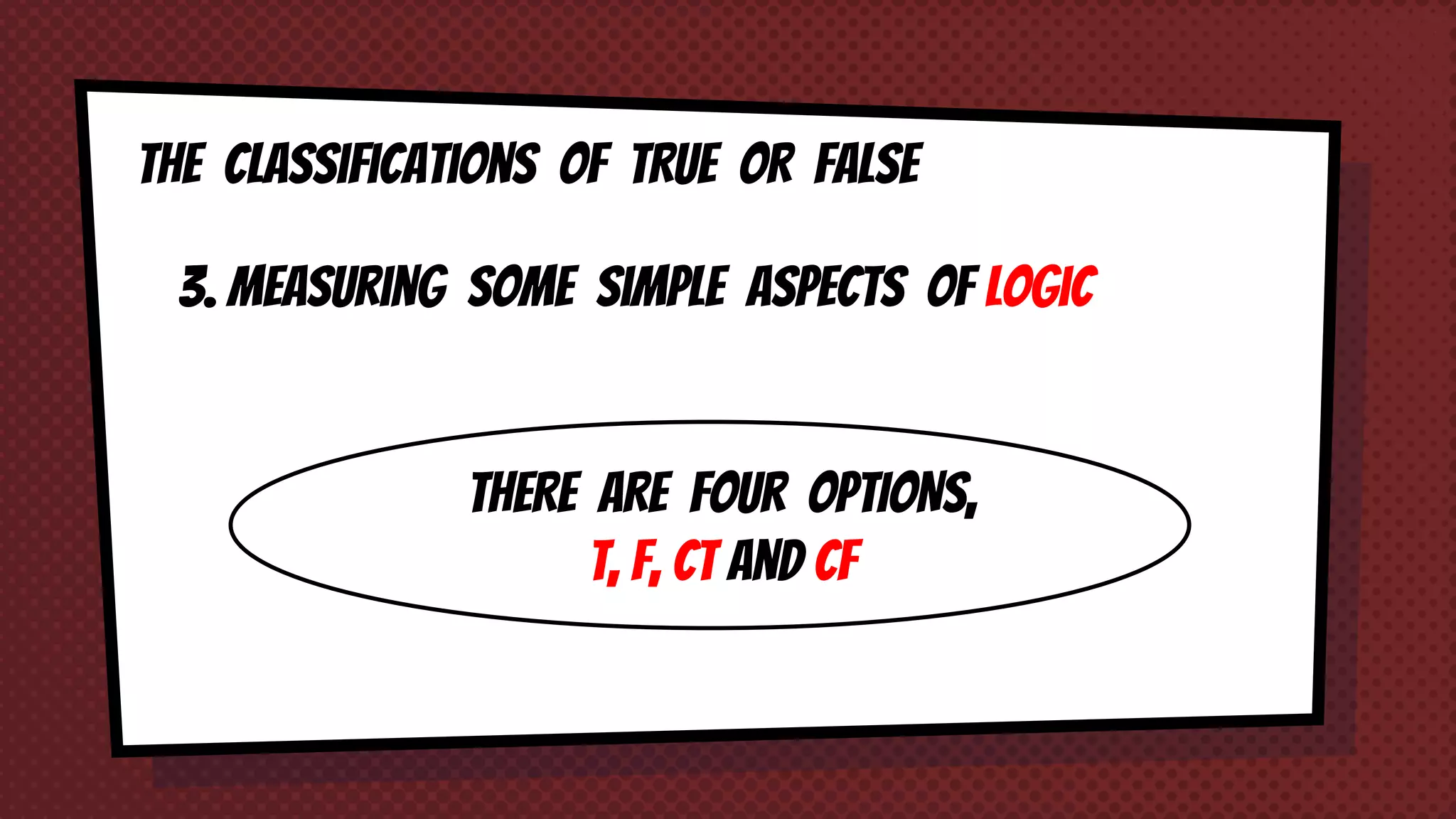
3. Measuring some simple aspects of logic
THERE ARE four OPTIONS,
T, f, ct and cf
The classifications of TRUE OR FALSE
EXAMPLES
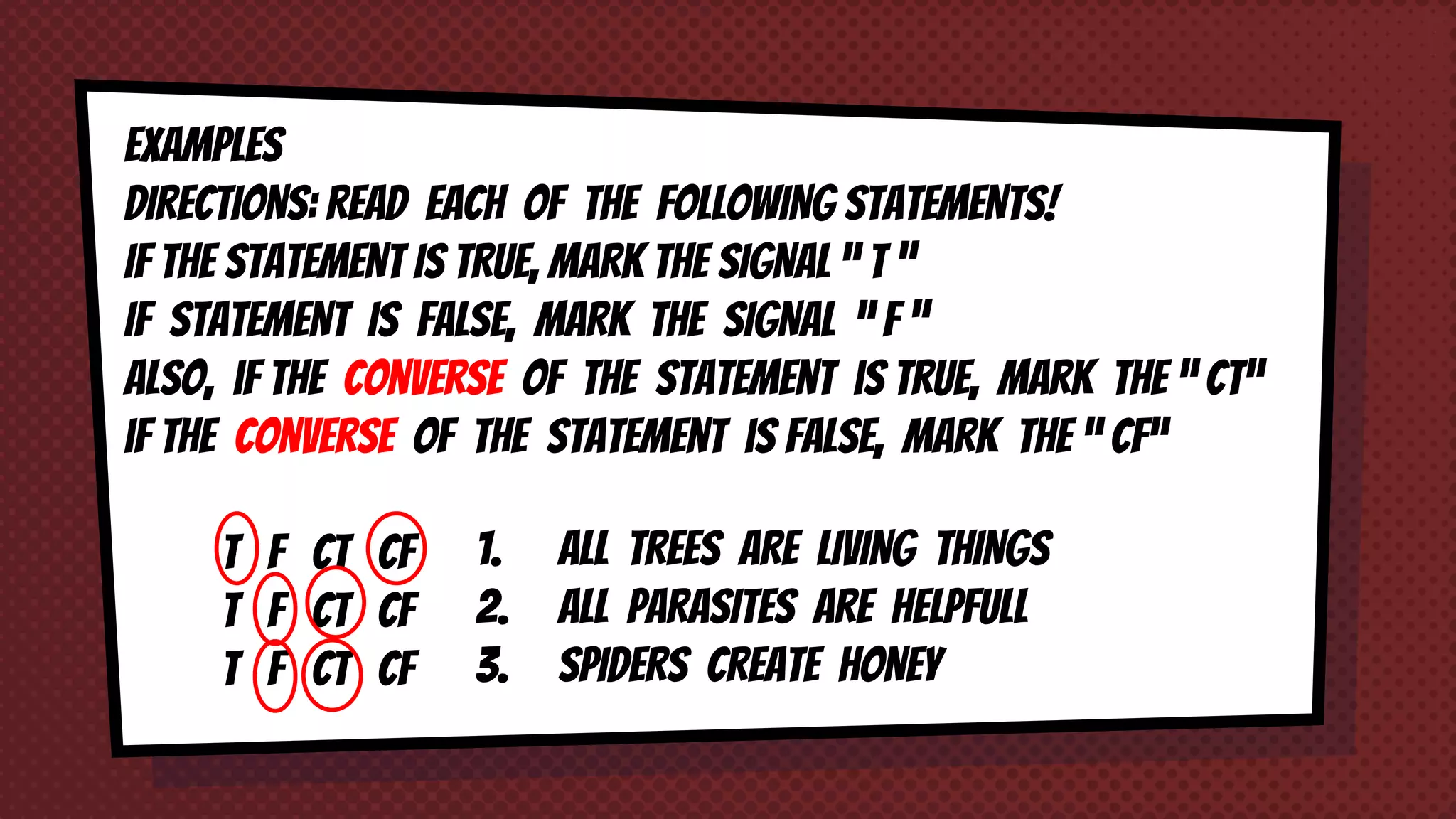
DIRECTIONS: READ each of THE FOLLOWING STATEMENTS!
IF THE STATEMENT IS TRUE, MARK THE SIGNAL “ T ”
IF STATEMENT IS FALSE, MARK THE SIGNAL “ F ”
Also, iF the converse of the statement is true, mark the “ CT“
iF the converse of the statement is FALSE, mark the “ CF“
1. ALL TREES ARE LIVING THINGS
2. ALL PARASITES ARE HELPFULL
3. SPIDERS CREATE HONEY
T F CT CF
T F CT CF
T F CT CF
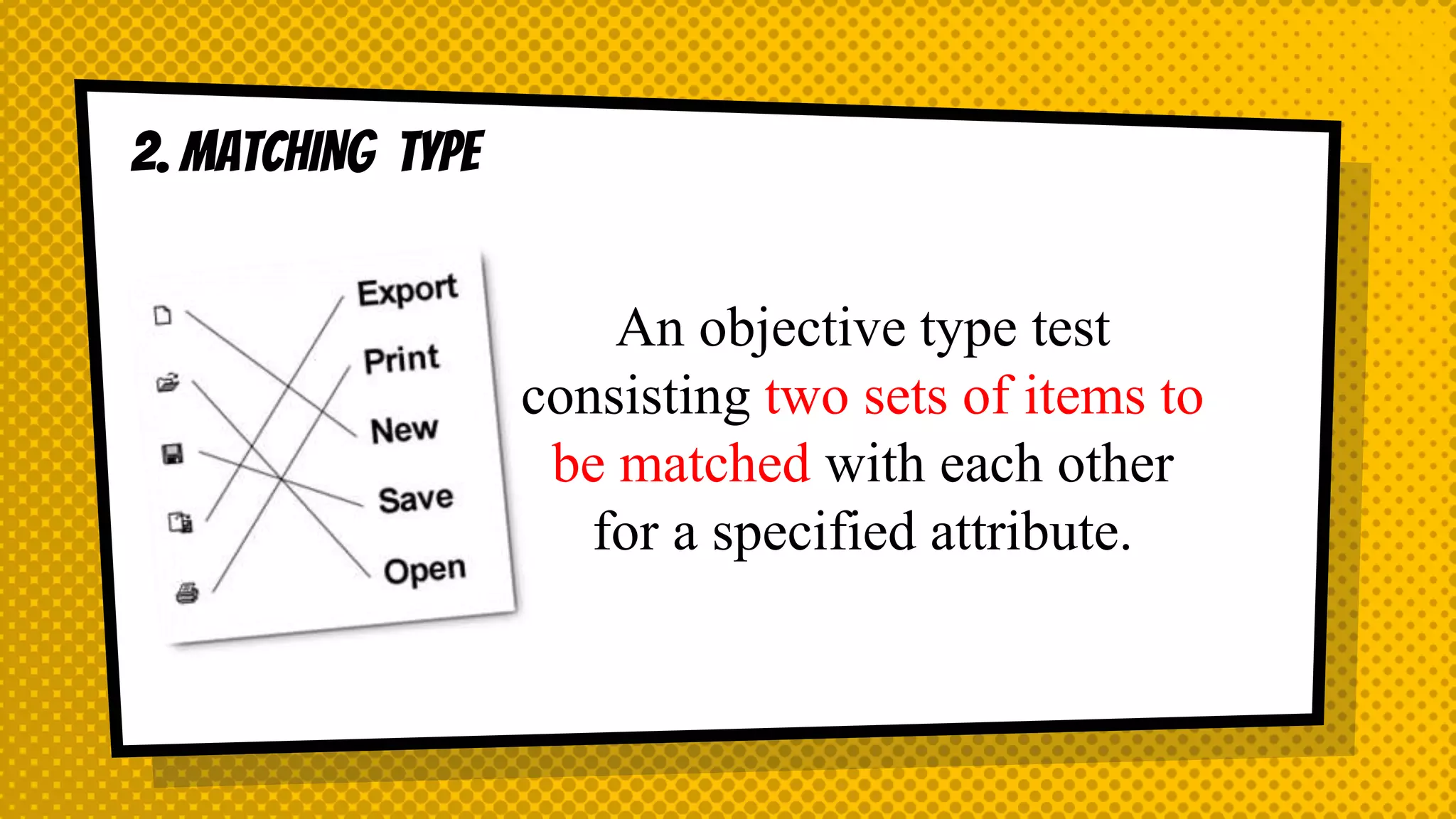
2. MATCHING TYPE
An objective type test
consisting two sets of items to
be matched with each other
for a specified attribute.
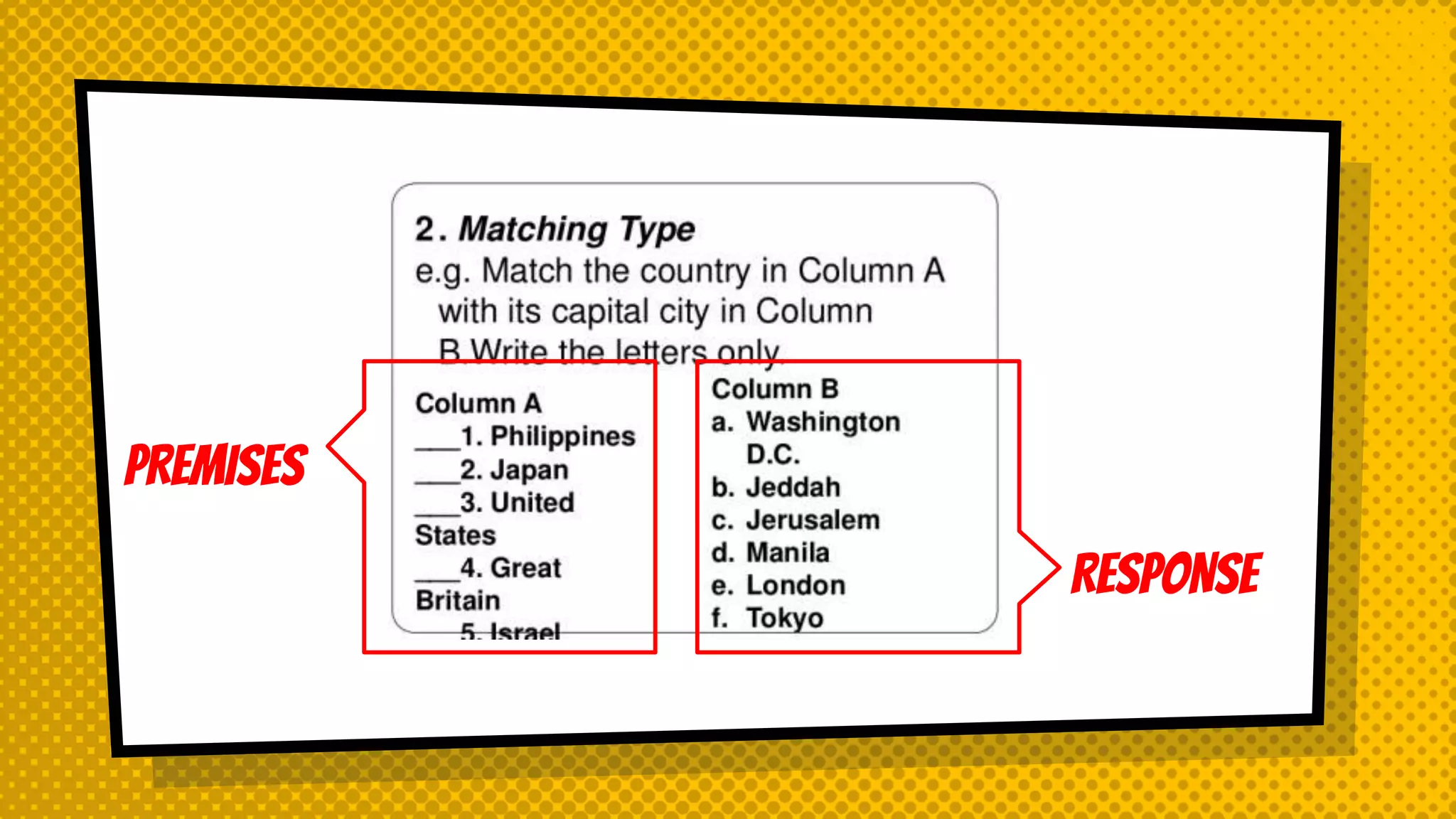
PREMISES
RESPONSE
The classifications of Matching types
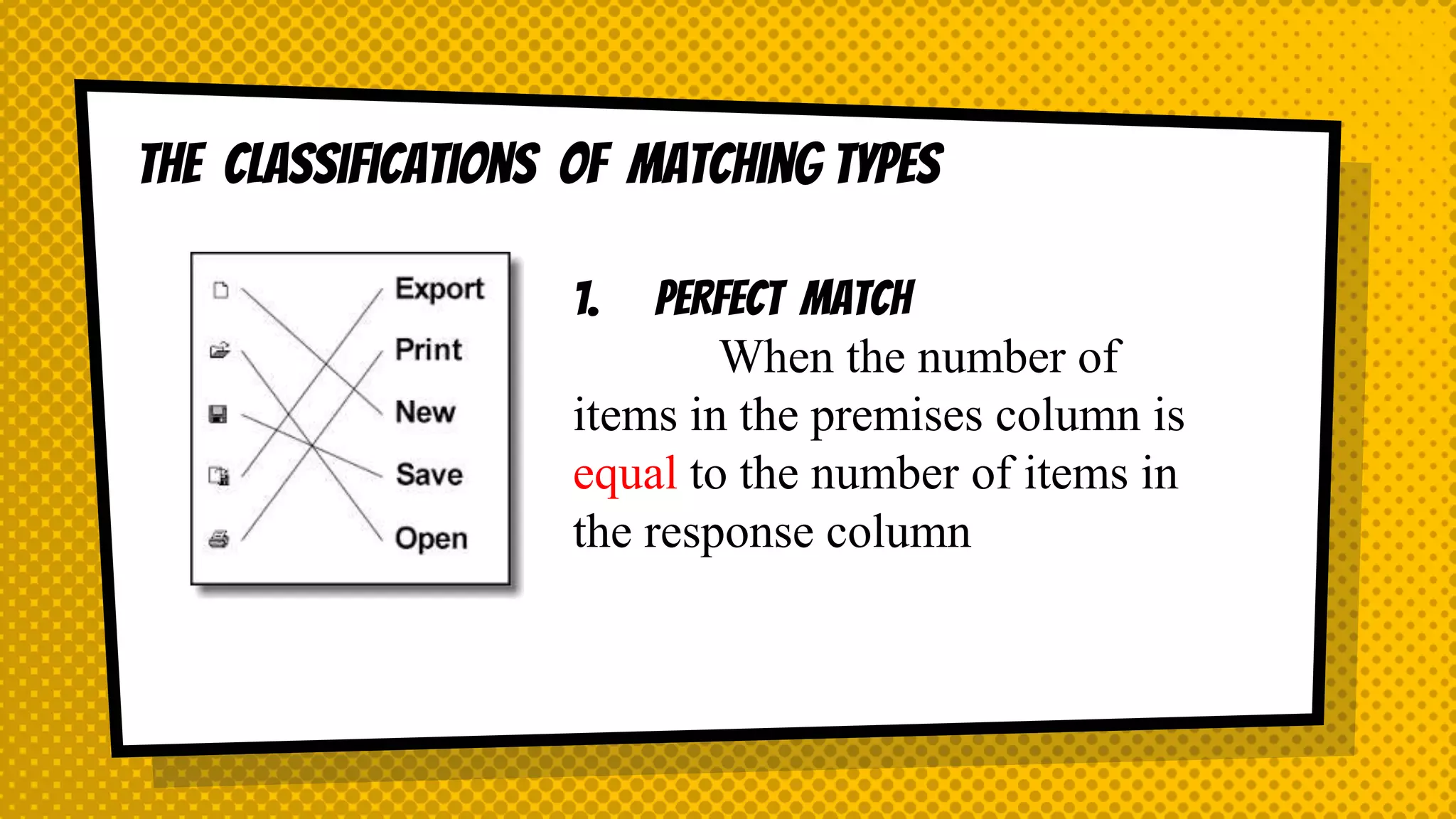
1. PERFECT MATCH
When the number of
items in the premises column is
equal to the number of items in
the response column
The classifications of TRUE OR FALSE
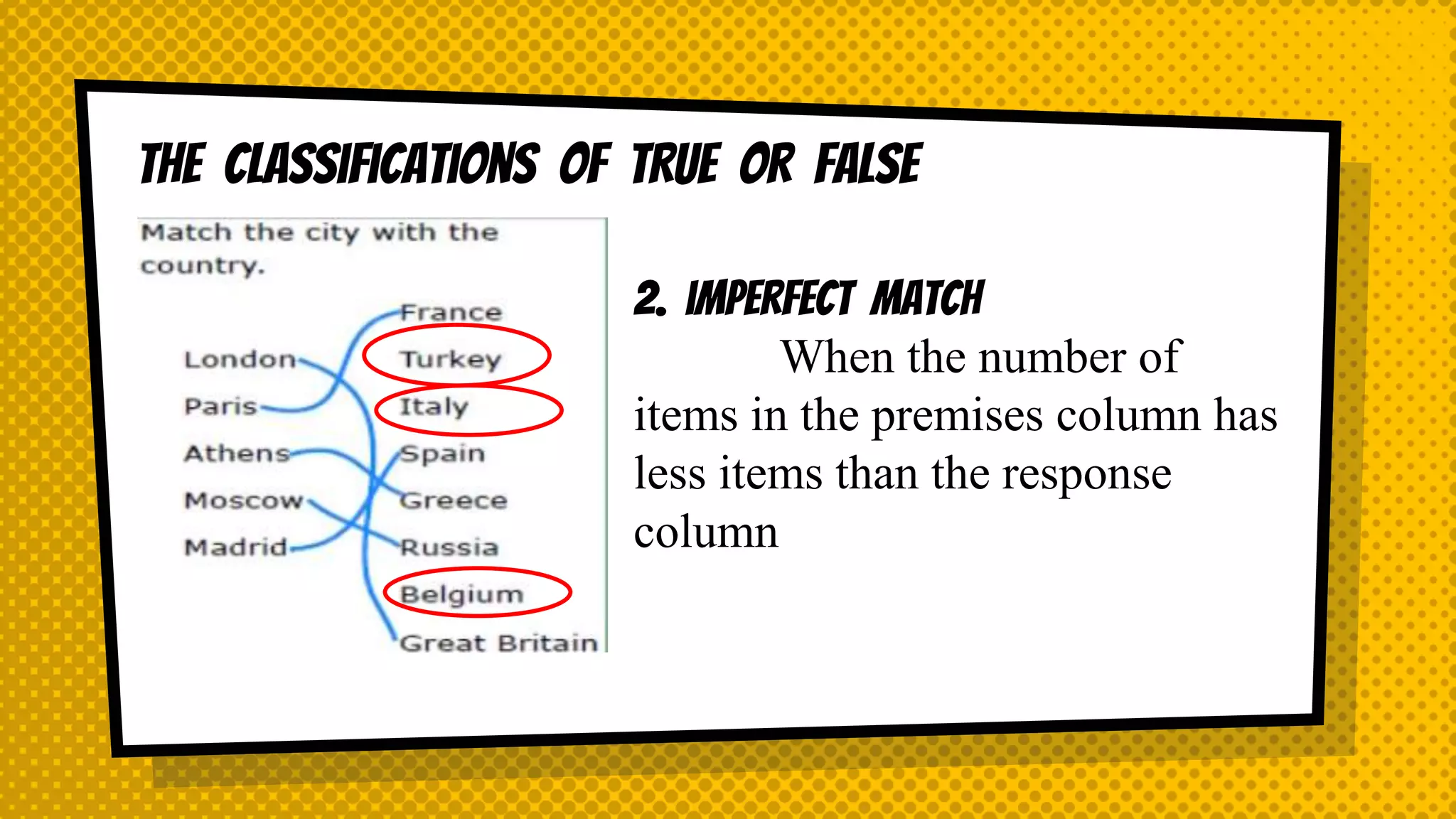
2. imperfect MATCH
When the number of
items in the premises column has
less items than the response
column
3. MULTIPLE CHOICE
Multiple choice is a form of
an objective assessment in
which respondents are asked
to select only correct answers
out of the choices from a list.
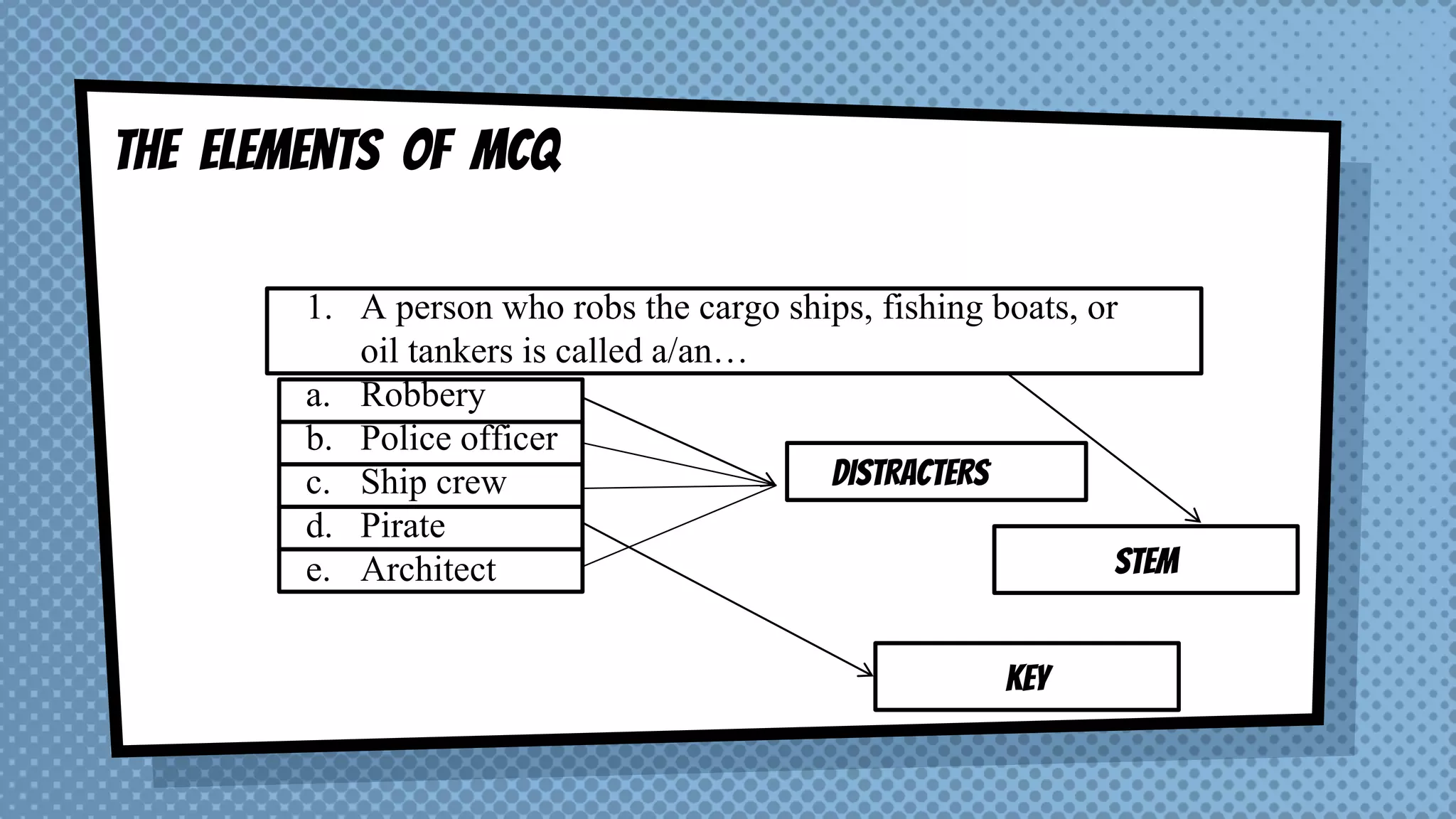
The elements of MCQ
1. A person who robs the cargo ships, fishing boats, or
oil tankers is called a/an…
a. Robbery
b. Police officer
c. Ship crew
d. Pirate
e. Architect STEM
SDISTRACTERSTEM
KEY
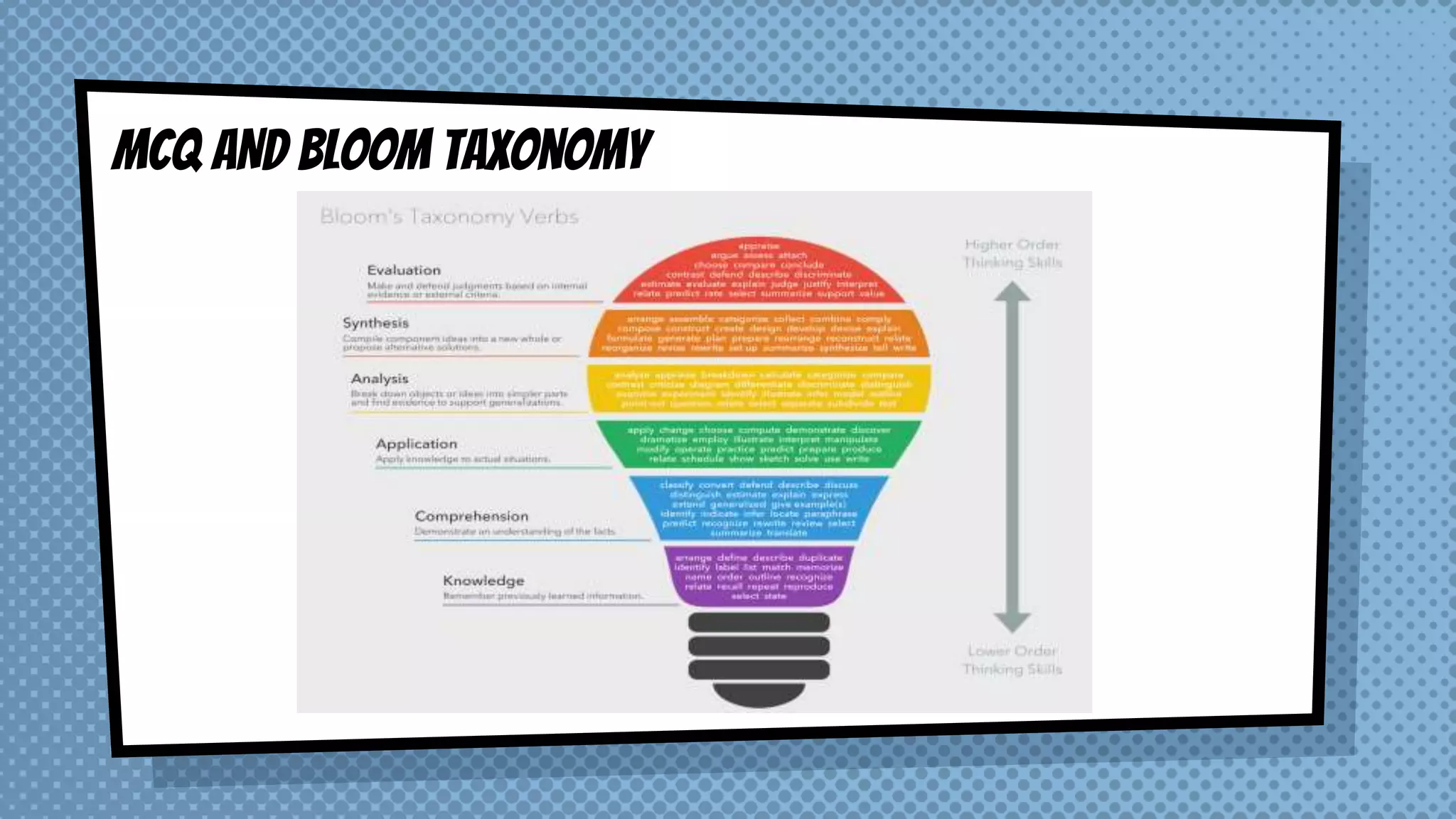
MCQ AND BLOOM taxonomy
1. KNOWLEDGE
STUDENTS ACTIVITY:
Remembering
- facts,
- terms,
- concepts, AND
- Definitions.
EXAMPLE:
Which one of the following persons is
the author of “Frankenstein"?
a) Jane Austen
b) Marry Shelley
c) Alexandre Dumas
d) Charles Dickens
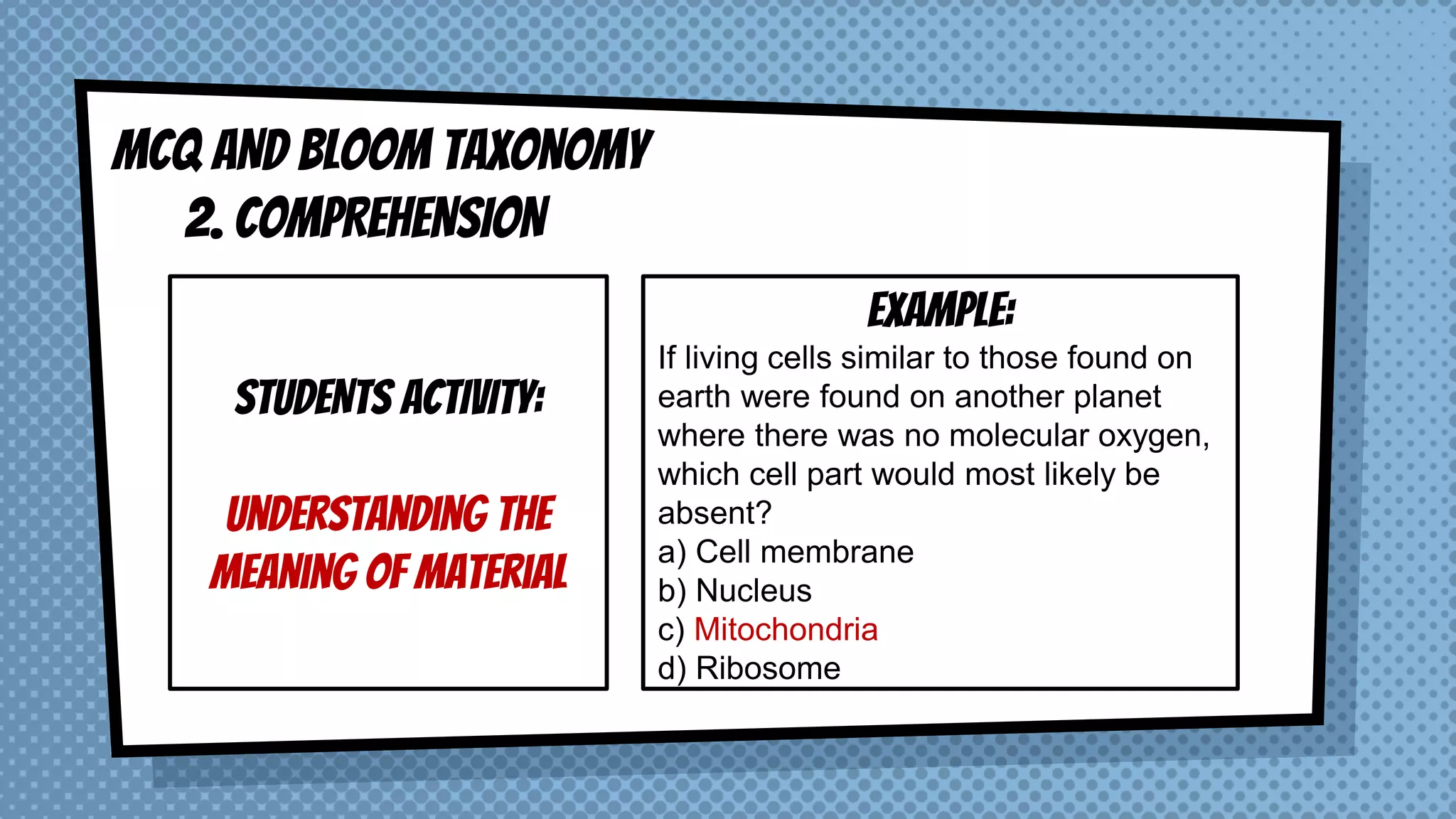
MCQ AND BLOOM taxonomy
2. COMPREHENSION
STUDENTS ACTIVITY:
Understanding the
meaning of material
EXAMPLE:
If living cells similar to those found on
earth were found on another planet
where there was no molecular oxygen,
which cell part would most likely be
absent?
a) Cell membrane
b) Nucleus
c) Mitochondria
d) Ribosome
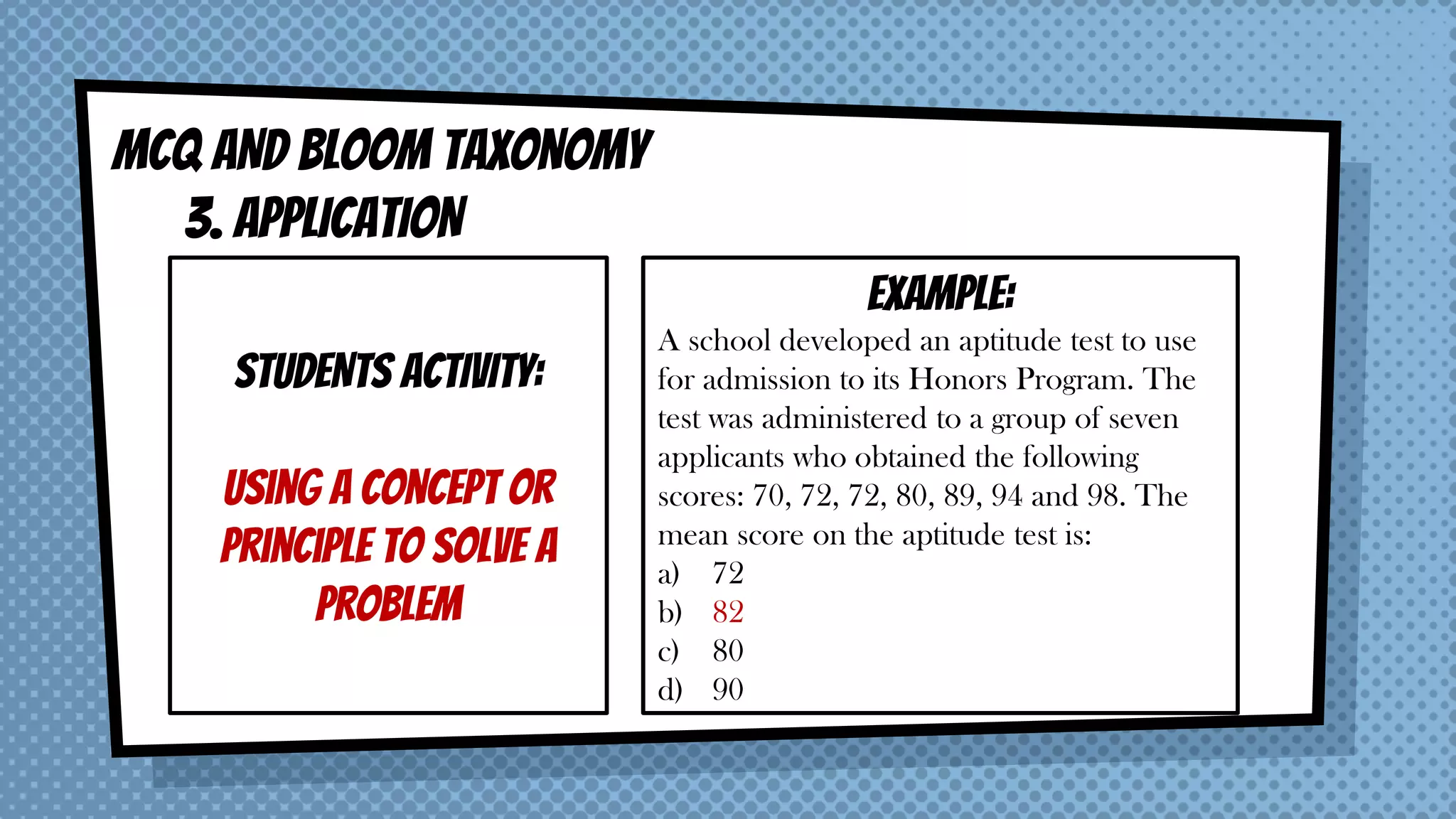
MCQ AND BLOOM taxonomy
3. APPLICATION
STUDENTS ACTIVITY:
Using a concept or
principle to solve a
problem
EXAMPLE:
A school developed an aptitude test to use
for admission to its Honors Program. The
test was administered to a group of seven
applicants who obtained the following
scores: 70, 72, 72, 80, 89, 94 and 98. The
mean score on the aptitude test is:
a) 72
b) 82
c) 80
d) 90
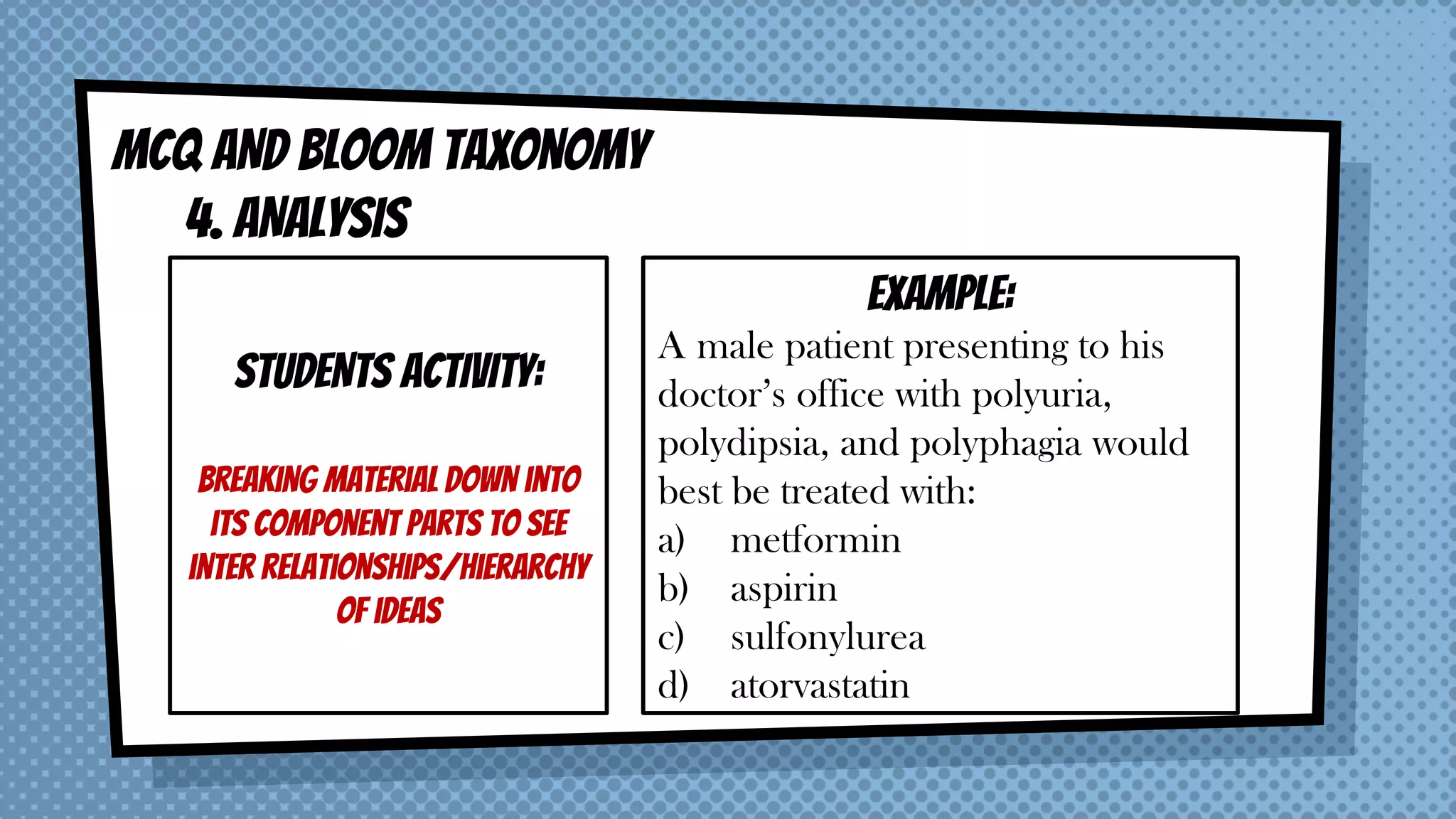
MCQ AND BLOOM taxonomy
4. ANALYSIS
STUDENTS ACTIVITY:
Breaking material down into
its component parts to see
inter relationships/hierarchy
of ideas
EXAMPLE:
A male patient presenting to his
doctor’s office with polyuria,
polydipsia, and polyphagia would
best be treated with:
a) metformin
b) aspirin
c) sulfonylurea
d) atorvastatin
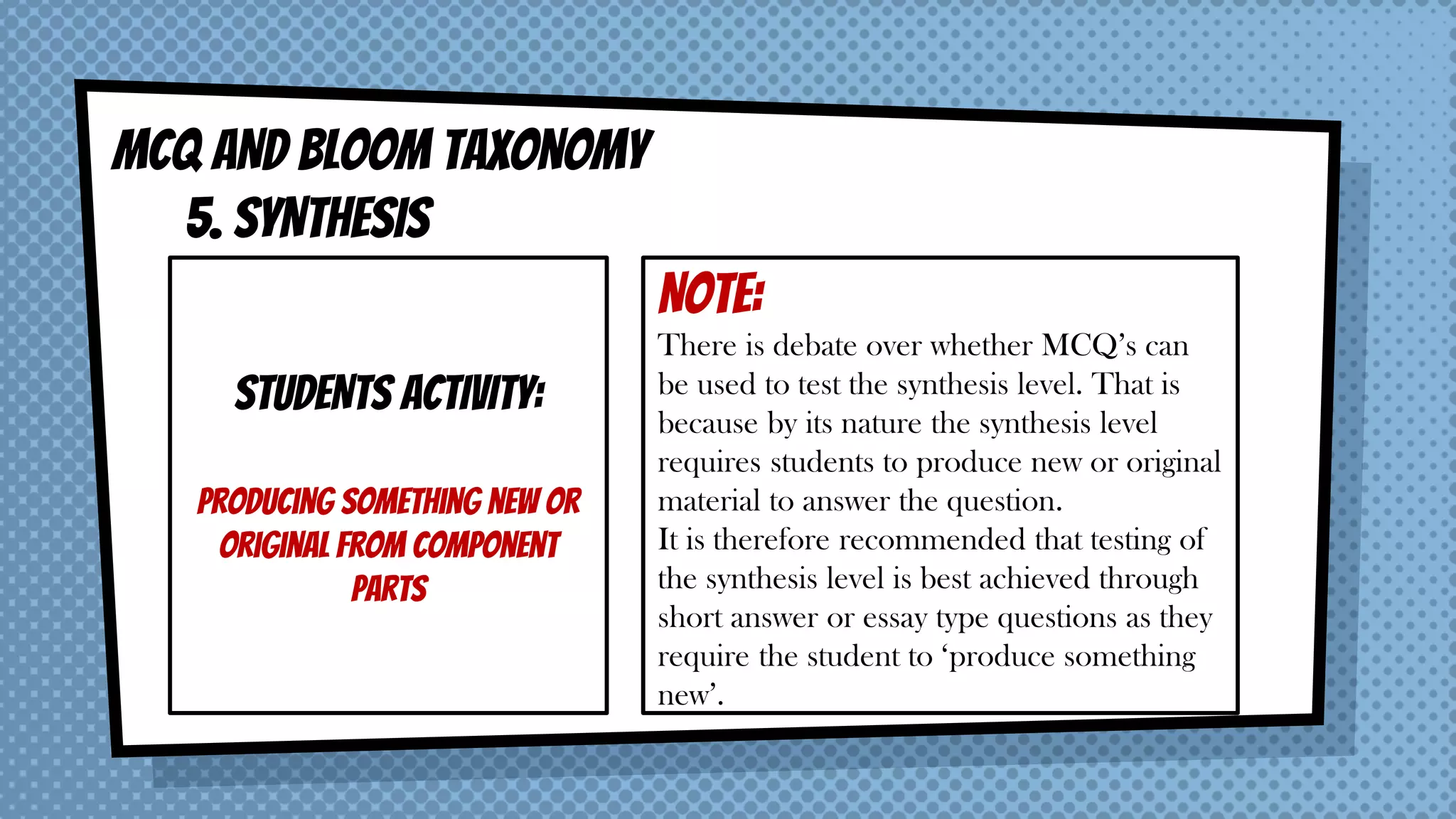
MCQ AND BLOOM taxonomy
5. SYNTHESIS
STUDENTS ACTIVITY:
Producing something new or
original from component
parts
NOTE:
There is debate over whether MCQ’s can
be used to test the synthesis level. That is
because by its nature the synthesis level
requires students to produce new or original
material to answer the question.
It is therefore recommended that testing of
the synthesis level is best achieved through
short answer or essay type questions as they
require the student to ‘produce something
new’.
MCQ AND BLOOM taxonomy
6. EVALUATION
STUDENTS ACTIVITY:
Making a judgment based on a
pre-established set of criteria
NOTE:
There is debate over whether MCQ’s can
be used to test the analysis level.
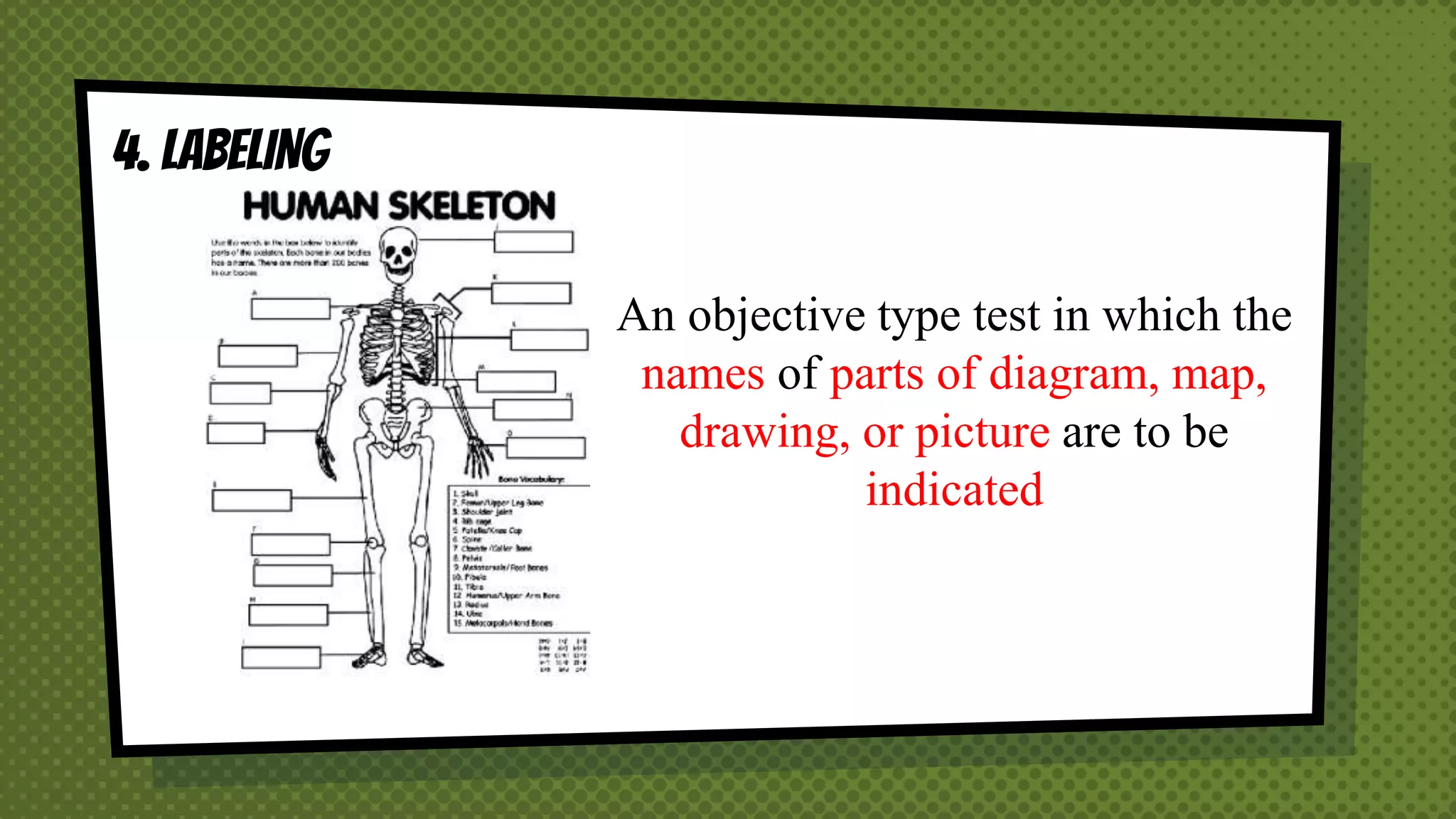
4. LABELING
An objective type test in which the
names of parts of diagram, map,
drawing, or picture are to be
indicated
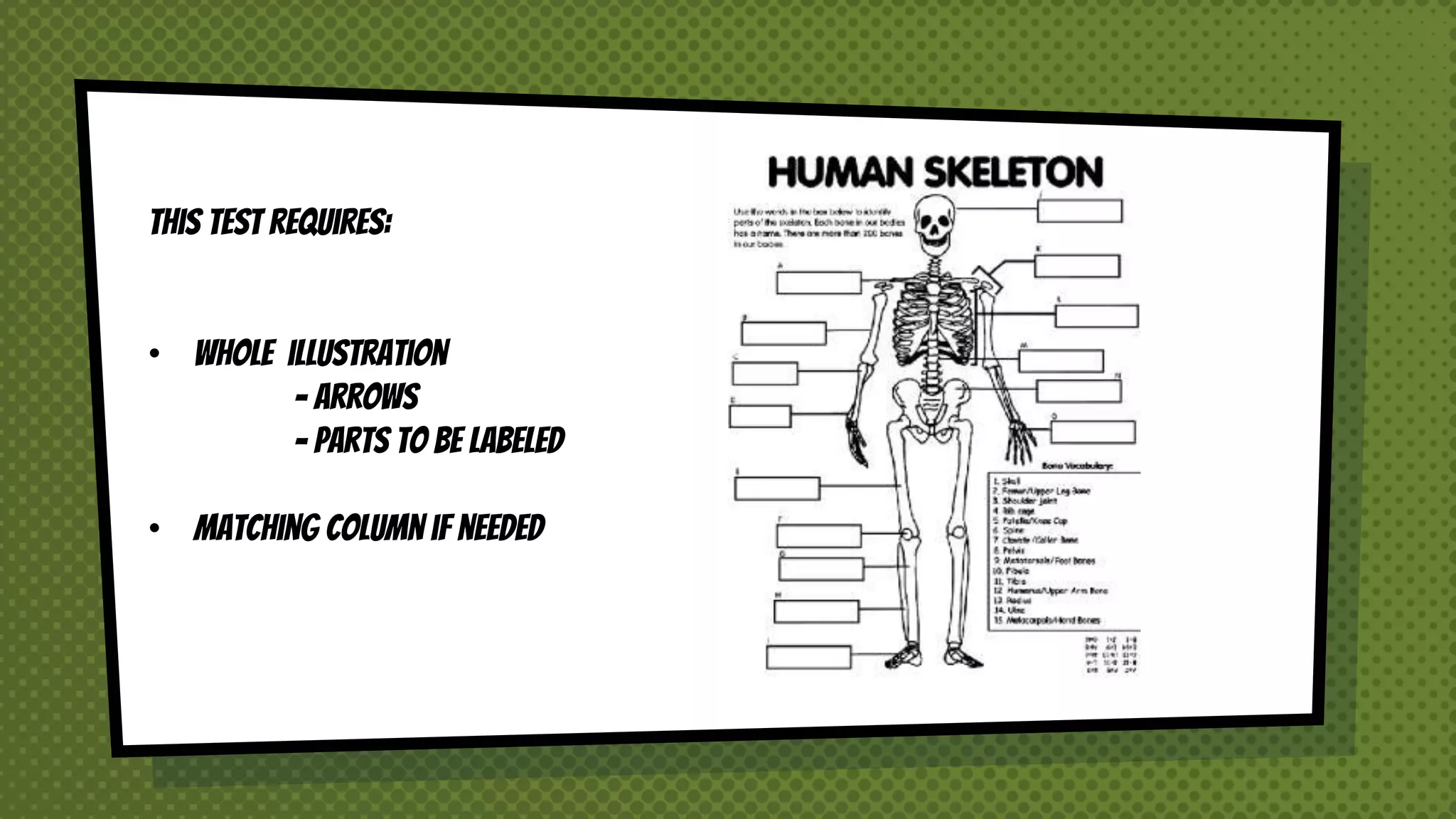
This test requires:
• whole illustration
- Arrows
- parts to be labeled
• Matching column if needed
5. COMPLETION TYPE
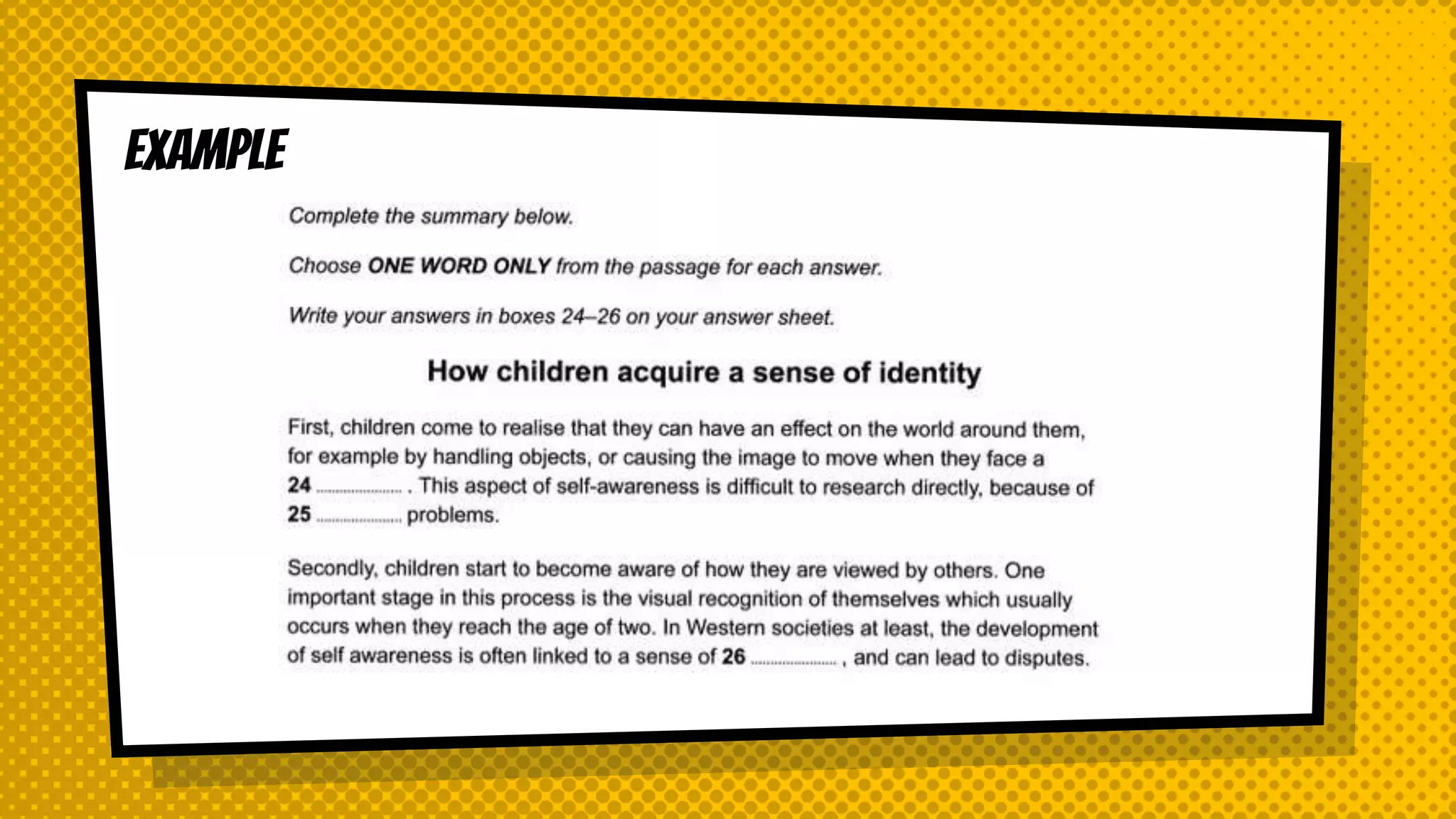
An objective type test that includes
series of sentences which certain
important words of phrase has been
omitted for the students to fill in a
sentence may contain one or more
blanks and the sentences may be
disconnected or organized into a
paragraph. Each blanks counts one
point
example
CONSTRUCTING COMPLETION TYPE
• Omit only words that are essential to the
meaning of the statement or sentence
• Make the blanks equal in length to avoid
clues. Long blanks suggest long answers,
short blanks suggest short answers.
6. SIMPLE RECALL
The simple-recall test is here somewhat arbitrarily
defined as one in which each item appears as a direct
question, a stimulus word or phrase, or a specific
direction. The response must be recalled by the
students from his past experiences rather than merely
identified from a list of suggested answers supplied by
the teacher. The typical response to the simple-recall
item is short, preferably a single word or phrase.
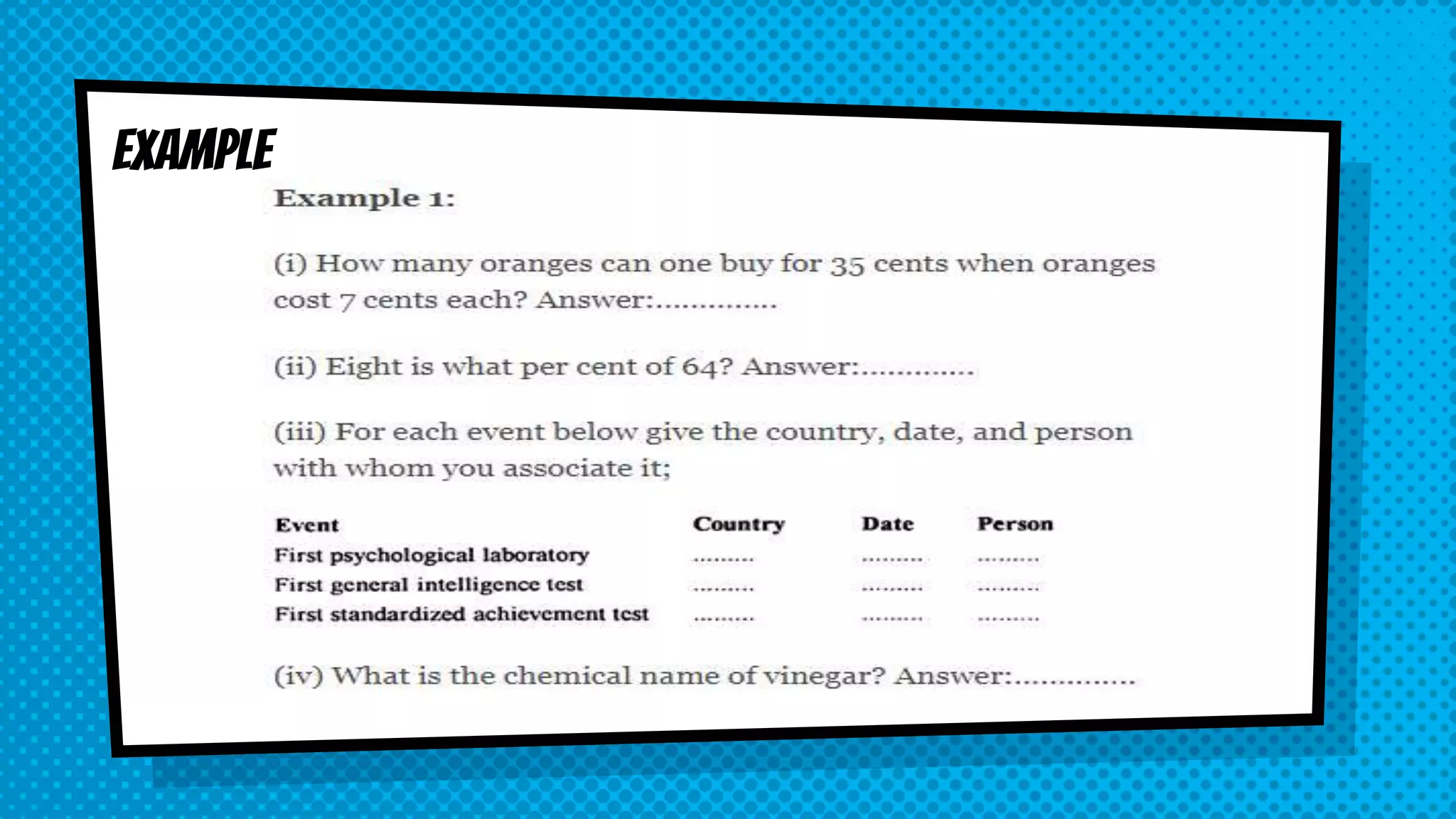
example
Constructing simple recall
• Do not lift statement from the book verbatim,
• Frame the questions so that one correct
answer is possible,
• Design the test items so that the blank comes
at the end of the statement.
THE STRENGHTS
• It can be assessed objectively by everyone.
• Easier and faster to check the answer.
• It covers a wide range of issues.
• The answer is certain for evaluation students' ability.
• The validity is better than subjective test.
THE WEAKNESSES
• To construct the question items is more difficult.
• It tends to guess or cheat.
• It doesn't make the students to give more creative
answer.
• The students can't express their own opinion.
ESSAY TESTS
THE CONCEPTS
THE STRENGHTS
THE WEAKNESSES
ESSAY TESTS
SCORING
CONCEPTS
Definitions
TYPES
DEFINITIONS
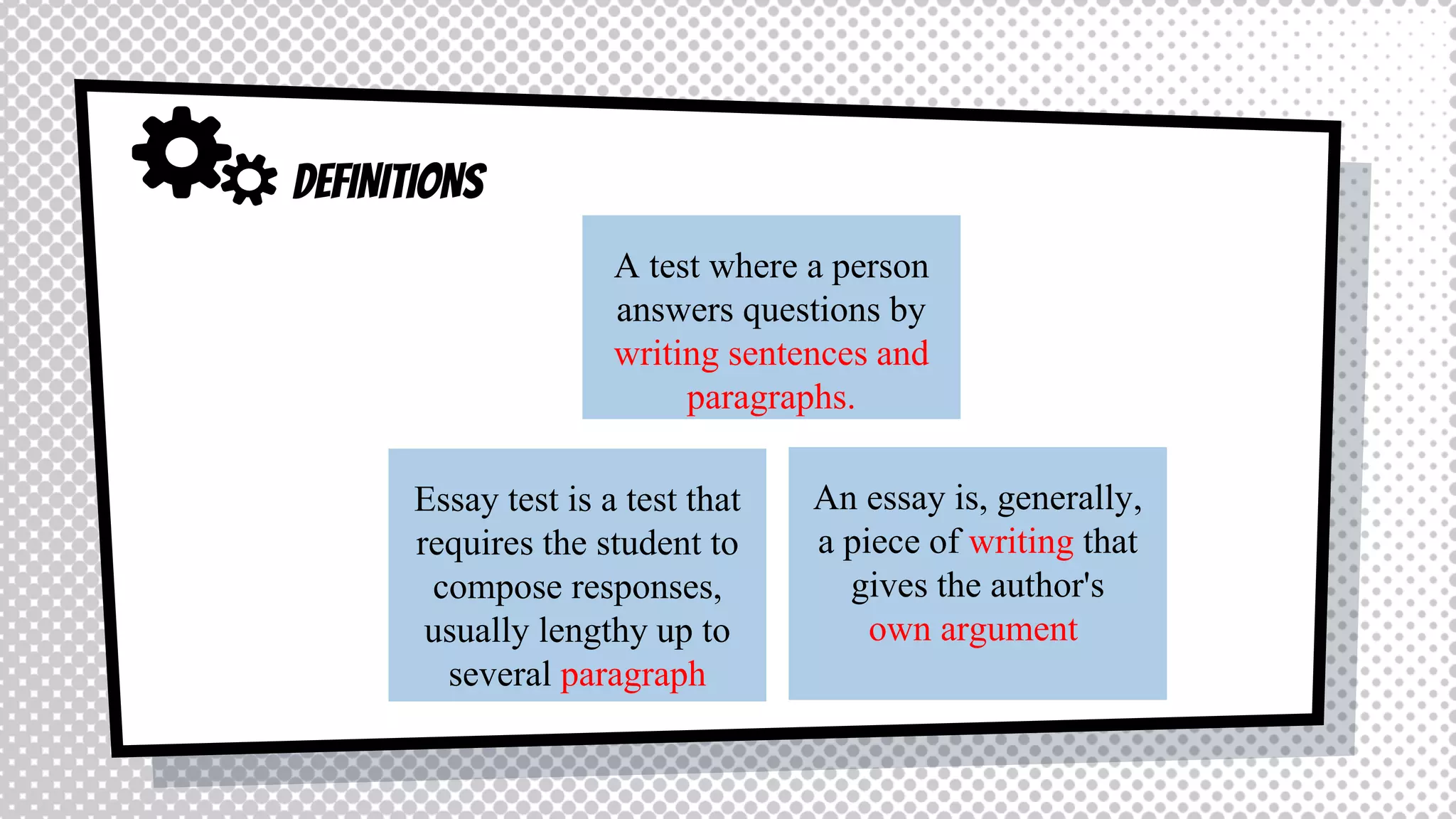
An essay is, generally,
a piece of writing that
gives the author's
own argument
Essay test is a test that
requires the student to
compose responses,
usually lengthy up to
several paragraph
A test where a person
answers questions by
writing sentences and
paragraphs.
K E Y W O R D S:
- WRITING SENTENCE AND PARAGRAPH
- WRITING
- OWN ARGUMENT
TYPES
2. EXTENDED RESPONSE QUESTIONS
1. RESTRICTED RESPONSE QUESTIONS
Limit the ways in which you will permit the students to
answer
CHARACTERISTICS
• THERE ARE CORRECT ANSWERS
• WE ALLOW STUDENTS TO EXPRESS THE ANSWER IN
THEIR OWN WORDS
EXAMPLE
Why is the barometer one of the most
useful instruments for forecasting
weather? Answer in a brief paragraph!
2. EXTENDED RESPONSE QUESTIONS
Allow students to express their own ideas and
interrelationships among ideas and use their own
strategy for organization
CHARACTERISTICS
• NO CORRECT ANSWERS BUT REASONABLE. BECAUSE
THE FOCUS IS ON REASONEd ANSWERING.
• WE ALLOW STUDENTS TO EXPRESS THE ANSWER IN
THEIR OWN WORDS
Look at the family photo attached.
Describe the mood or feeling in the photo
as well as the body language of the people.
Use metaphors or similes to make these
descriptions!
EXAMPLE
Look at the family photo attached.
Describe the mood or feeling in the photo
as well as the body language of the people.
Use metaphors or similes to make these
descriptions!
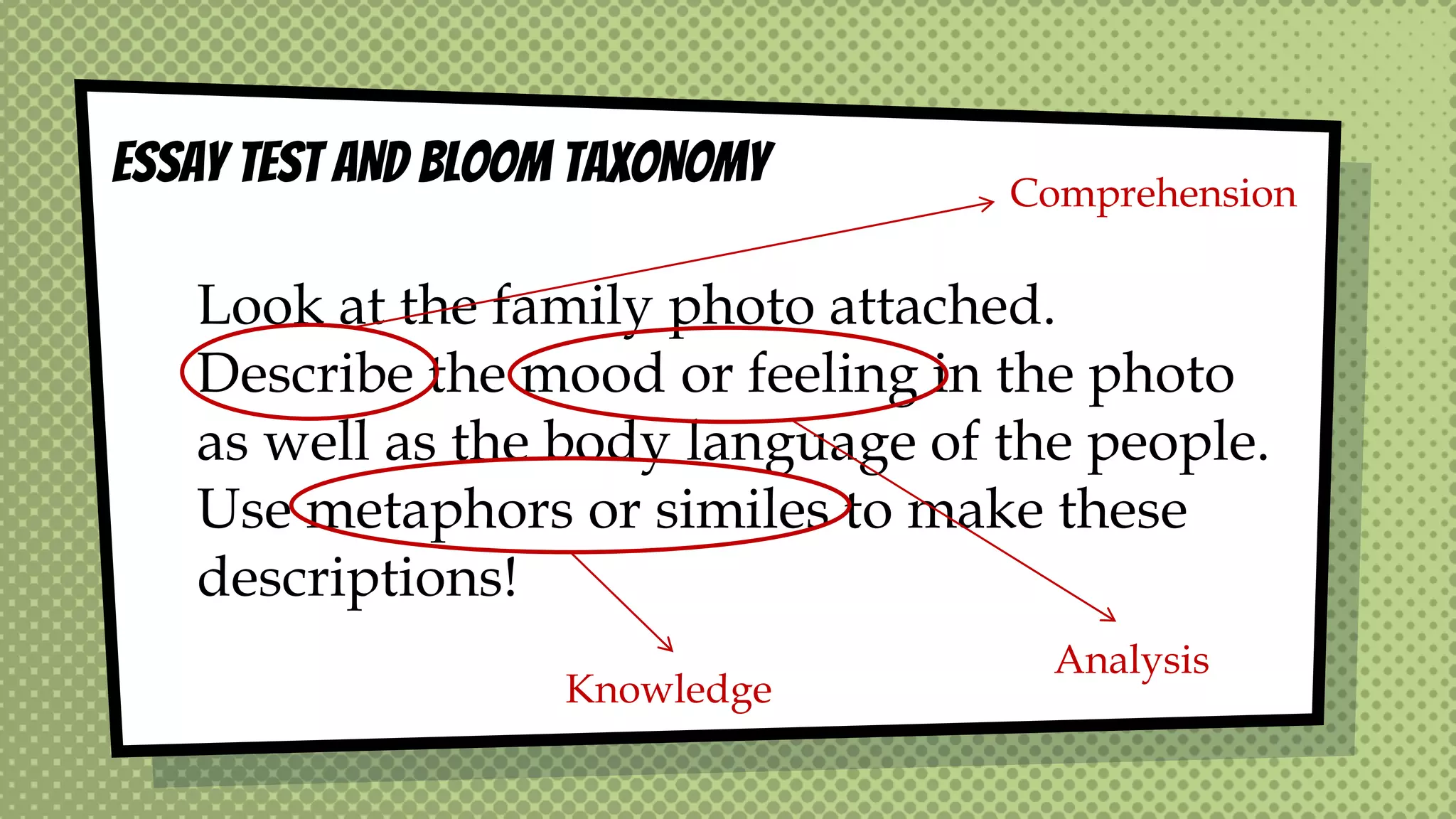
ESSAY TEST AND BLOOM TAXONOMY Comprehension
Analysis
Knowledge
SCORING
HOLISTIC
ANALYTIC
HOLISTIC
BEST USED FOR EXTENDED RESPONSE ESSAYS
GRADING ESSAYS ON HOW WELL THE
ARGUMENT/ESSAY IS WRITTEN IN GENERAL.
HOLISTIC
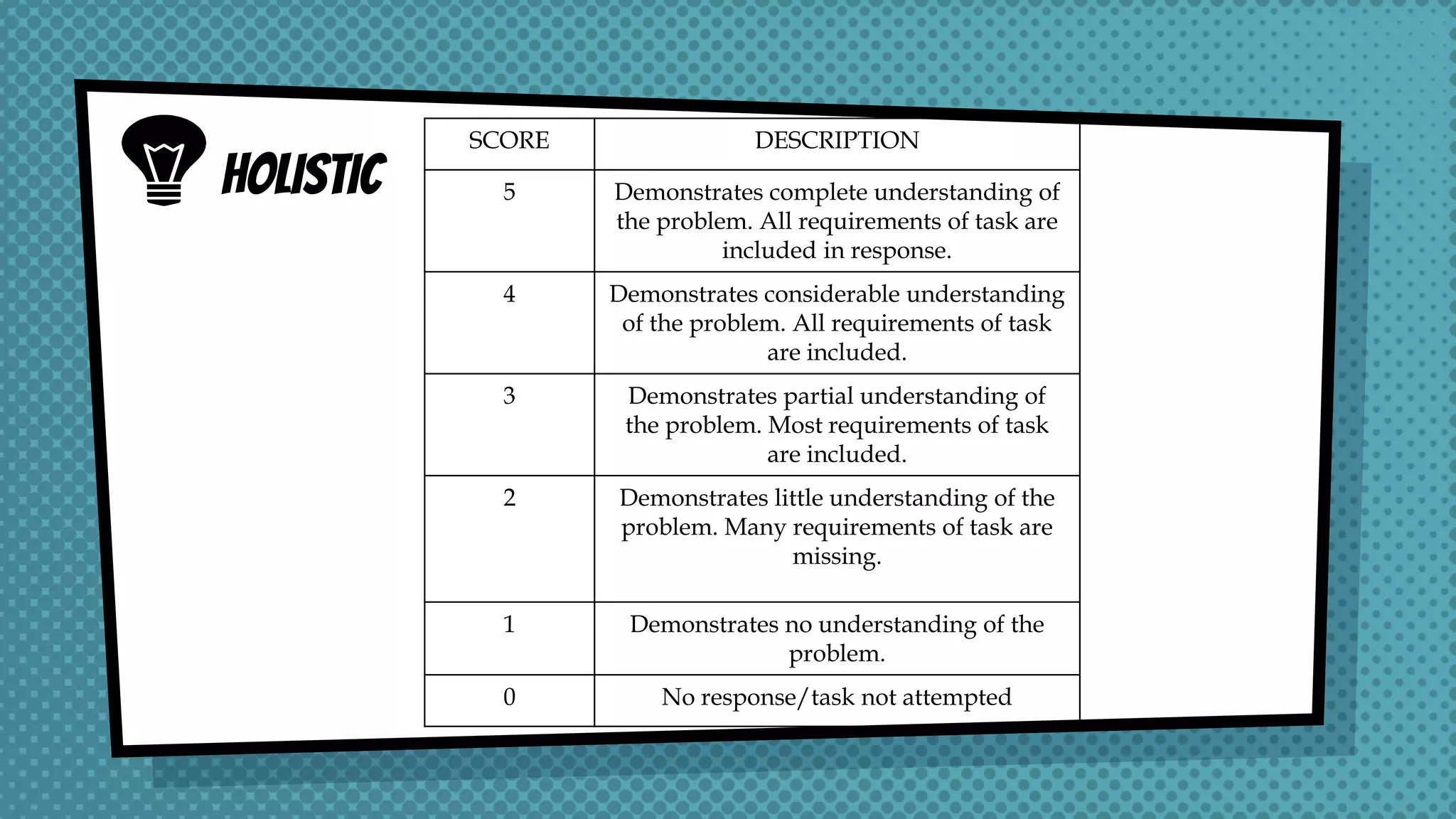
SCORE DESCRIPTION
5 Demonstrates complete understanding of
the problem. All requirements of task are
included in response.
4 Demonstrates considerable understanding
of the problem. All requirements of task
are included.
3 Demonstrates partial understanding of
the problem. Most requirements of task
are included.
2 Demonstrates little understanding of the
problem. Many requirements of task are
missing.
1 Demonstrates no understanding of the
problem.
0 No response/task not attempted
BEST USED FOR RESTRICTED RESPONSE ESSAYS
GRADING ESSAYS ON WHETHER OR NOT
STUDENTS HAS PROVIDED THE CORRECT ANSWER.
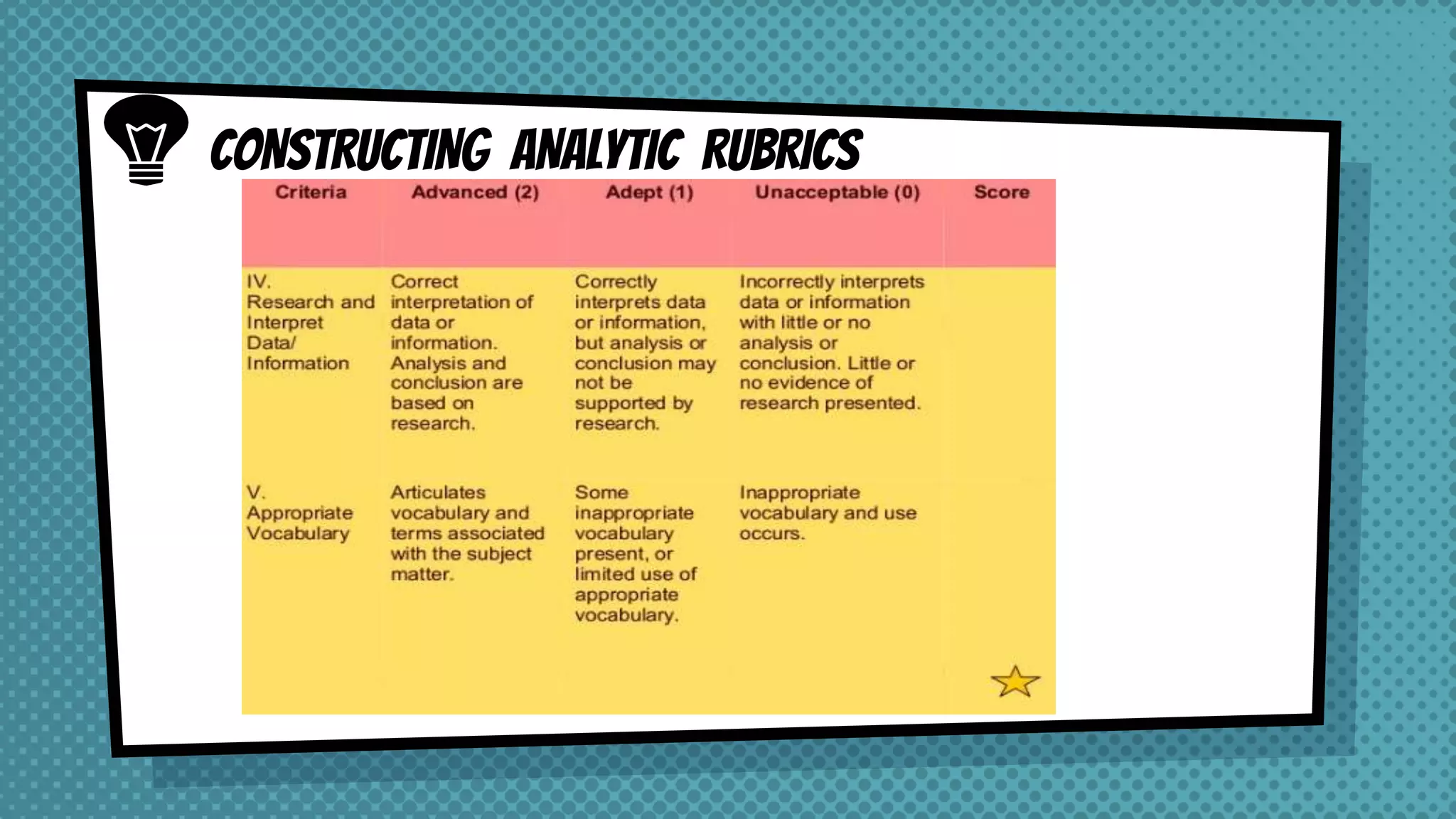
ANALYTIC
ANALYTIC NEEDS RUBRICS WHICH REQUIRE THE
STUDENTS TO PROVIDE SPECIFIC INFORMATION IN
THEIR ANSWER IN ORDER TO RECEIVE CREDIT
ANALYTIC
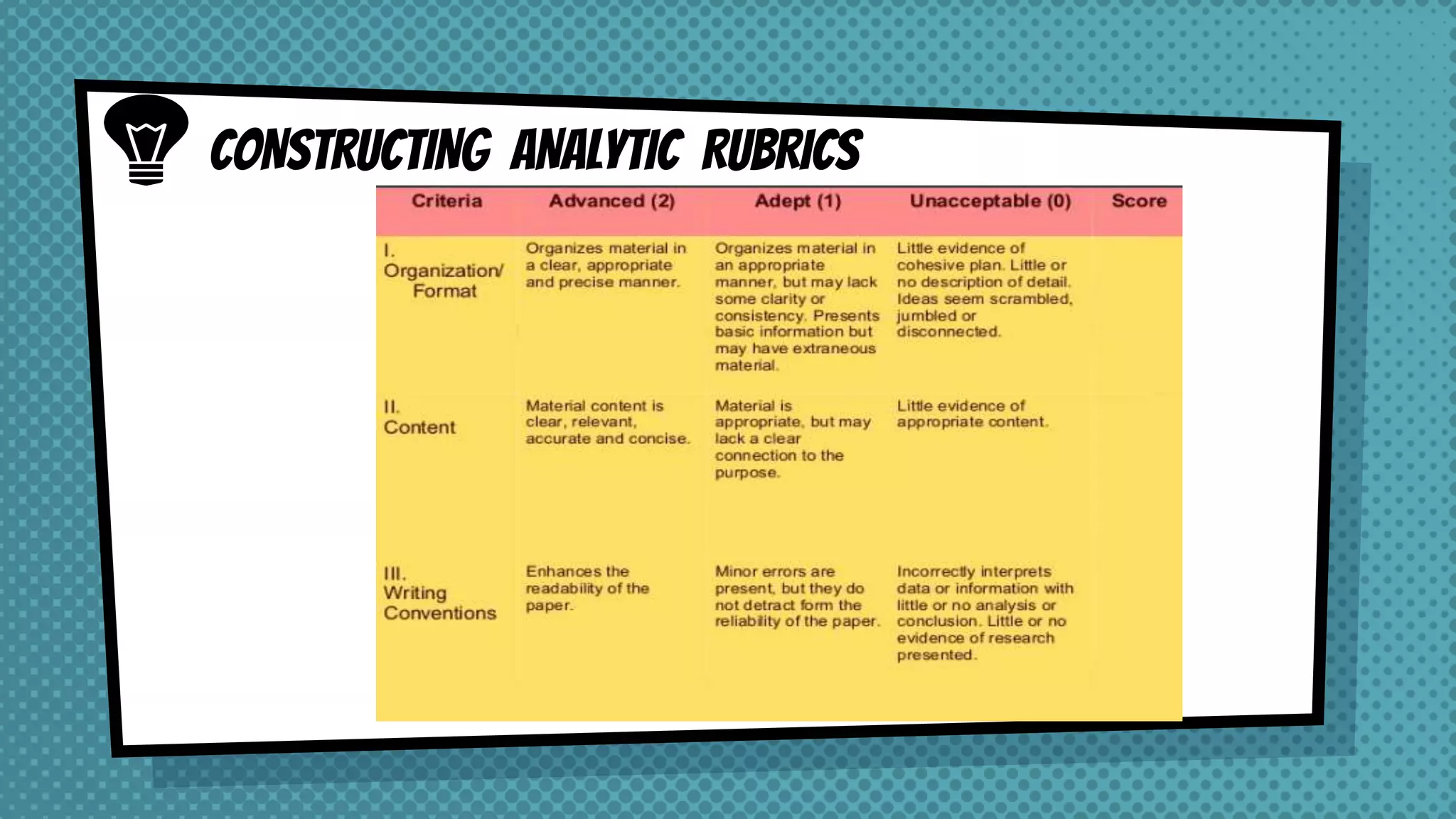
CONSTRUCTING ANALYTIC RUBRICS
strengths
• The freedom of response allows the students to express
himself in his own words.
• It measures complex learning outcomes that cannot be
measured by other means.
• Essay test promotes the development of problem-
solving skills.
• It encourage good study habit in students.
• It helps students to improve their writing skills such as
writing speed.
• It encourages creativity by allowing their own unique
way.
• It can be used to measure students’ higher order
thinking level.
• It does not encourage guessing and cheating during
testing.
WEAKNESSES
• Scoring is not reliable because different examiners can
grade the score answer differently.in fact, the same
examiner can grade the same question differently at
different times.
• Grading of essay tests is time-consuming.
• Improper and ambiguous wording handicaps both the
students and examiner.
• Mood of the examiner affects the scoring of answer
scripts.
THANKS! Any questions?

Objective and Essay Test

  • 1.
    OBJECTIVE AND ESSAY TESTS(Concepts,weaknesses, and strengths) OBJECTIVE AND ESSAY TESTS
  • 2.
    OBJECTIVE TESTS THE CONCEPTS THESTRENGHTS THE WEAKNESSES OBJECTIVE TESTS
  • 3.
  • 4.
    Objective test itemsare items that can be objectively scored items on which person select a response from the list of options. DEFINITIONS An objective test is a test that has right or wrong answers and so can be marked objectively. A test consisting of factual questions requiring extremely short answers that can be quickly and unambiguously scored by anyone with an answer key, thus minimizing subjective judgments by both the person taking the test and the person scoring it.
  • 5.
    K E YW O R D S: - List of options - - Has right AND wrong answers - - Short answers - - Quickly and unambiguously scored – - ANSWER KEY -
  • 6.
    TYPES 1. TRUE ORFALSE 2. MATCHING TYPE 3. MULTIPLE CHOICE 4. LABELING 5. COMPLETION TYPE 6. SIMPLE RECALL
  • 7.
    1. TRUE ORFALSE An objective type test presented in a form simple declarative statement, to which the pupils in general respond indicating whether the statement is true or false.
  • 8.
    The classifications ofTRUE OR FALSE 1. MEASURING THE ABILITY TO IDENTIFY THE CORRECTNESS OF STATEMENTS OF FACTS AND DEFINITION OF TERMS ONLY TWO OPTIONS, TRUE AND FALSE
  • 9.
    T/F T/F EXAMPLES DIRECTIONS: READ EACHOF THE FOLLOWING STATEMENTS! IF THE STATEMENT IS TRUE, MARK THE SIGNAL “ T ” IF STATEMENT IS FALSE, MARK THE SIGNAL “ F ” 1. THE GREEN COLORING OF MATERIAL OF THE PLANT LEAF IS CALLED CHLOROPHYLL 2. LEGS AND HANDS ARE TWO SYNONYMOUS WORDS
  • 10.
    The classifications ofTRUE OR FALSE 2. MEASURING THE ABILITY TO DISTINGUISH FACT FROM OPINION THERE ARE THREE OPTIONS, TRUE, FALSE, OPINION.
  • 11.
    EXAMPLES DIRECTIONS: READ THEFOLLOWING STATEMENTS! IF THE STATEMENT IS TRUE, MARK THE SIGNAL “ T ” IF STATEMENT IS FALSE, MARK THE SIGNAL “ F ” IF IT IS OPINION, THEN MARK THE SIGNAL “O” 1. MARS IS A PLANET 2. THE MARS HAS ITS OWN SUN 3. THERE ARE INTELLIGENT LIFE FORMS ON PLANETS ORBITING SOME DISTANT STARS T/F/O T/F/O T/F/O
  • 12.
    3. Measuring somesimple aspects of logic THERE ARE four OPTIONS, T, f, ct and cf The classifications of TRUE OR FALSE
  • 13.
    EXAMPLES DIRECTIONS: READ eachof THE FOLLOWING STATEMENTS! IF THE STATEMENT IS TRUE, MARK THE SIGNAL “ T ” IF STATEMENT IS FALSE, MARK THE SIGNAL “ F ” Also, iF the converse of the statement is true, mark the “ CT“ iF the converse of the statement is FALSE, mark the “ CF“ 1. ALL TREES ARE LIVING THINGS 2. ALL PARASITES ARE HELPFULL 3. SPIDERS CREATE HONEY T F CT CF T F CT CF T F CT CF
  • 14.
    2. MATCHING TYPE Anobjective type test consisting two sets of items to be matched with each other for a specified attribute.
  • 15.
  • 16.
    The classifications ofMatching types 1. PERFECT MATCH When the number of items in the premises column is equal to the number of items in the response column
  • 17.
    The classifications ofTRUE OR FALSE 2. imperfect MATCH When the number of items in the premises column has less items than the response column
  • 18.
    3. MULTIPLE CHOICE Multiplechoice is a form of an objective assessment in which respondents are asked to select only correct answers out of the choices from a list.
  • 19.
    The elements ofMCQ 1. A person who robs the cargo ships, fishing boats, or oil tankers is called a/an… a. Robbery b. Police officer c. Ship crew d. Pirate e. Architect STEM SDISTRACTERSTEM KEY
  • 20.
    MCQ AND BLOOMtaxonomy
  • 21.
    MCQ AND BLOOMtaxonomy 1. KNOWLEDGE STUDENTS ACTIVITY: Remembering - facts, - terms, - concepts, AND - Definitions. EXAMPLE: Which one of the following persons is the author of “Frankenstein"? a) Jane Austen b) Marry Shelley c) Alexandre Dumas d) Charles Dickens
  • 22.
    MCQ AND BLOOMtaxonomy 2. COMPREHENSION STUDENTS ACTIVITY: Understanding the meaning of material EXAMPLE: If living cells similar to those found on earth were found on another planet where there was no molecular oxygen, which cell part would most likely be absent? a) Cell membrane b) Nucleus c) Mitochondria d) Ribosome
  • 23.
    MCQ AND BLOOMtaxonomy 3. APPLICATION STUDENTS ACTIVITY: Using a concept or principle to solve a problem EXAMPLE: A school developed an aptitude test to use for admission to its Honors Program. The test was administered to a group of seven applicants who obtained the following scores: 70, 72, 72, 80, 89, 94 and 98. The mean score on the aptitude test is: a) 72 b) 82 c) 80 d) 90
  • 24.
    MCQ AND BLOOMtaxonomy 4. ANALYSIS STUDENTS ACTIVITY: Breaking material down into its component parts to see inter relationships/hierarchy of ideas EXAMPLE: A male patient presenting to his doctor’s office with polyuria, polydipsia, and polyphagia would best be treated with: a) metformin b) aspirin c) sulfonylurea d) atorvastatin
  • 25.
    MCQ AND BLOOMtaxonomy 5. SYNTHESIS STUDENTS ACTIVITY: Producing something new or original from component parts NOTE: There is debate over whether MCQ’s can be used to test the synthesis level. That is because by its nature the synthesis level requires students to produce new or original material to answer the question. It is therefore recommended that testing of the synthesis level is best achieved through short answer or essay type questions as they require the student to ‘produce something new’.
  • 26.
    MCQ AND BLOOMtaxonomy 6. EVALUATION STUDENTS ACTIVITY: Making a judgment based on a pre-established set of criteria NOTE: There is debate over whether MCQ’s can be used to test the analysis level.
  • 27.
    4. LABELING An objectivetype test in which the names of parts of diagram, map, drawing, or picture are to be indicated
  • 28.
    This test requires: •whole illustration - Arrows - parts to be labeled • Matching column if needed
  • 29.
    5. COMPLETION TYPE Anobjective type test that includes series of sentences which certain important words of phrase has been omitted for the students to fill in a sentence may contain one or more blanks and the sentences may be disconnected or organized into a paragraph. Each blanks counts one point
  • 30.
  • 31.
    CONSTRUCTING COMPLETION TYPE •Omit only words that are essential to the meaning of the statement or sentence • Make the blanks equal in length to avoid clues. Long blanks suggest long answers, short blanks suggest short answers.
  • 32.
    6. SIMPLE RECALL Thesimple-recall test is here somewhat arbitrarily defined as one in which each item appears as a direct question, a stimulus word or phrase, or a specific direction. The response must be recalled by the students from his past experiences rather than merely identified from a list of suggested answers supplied by the teacher. The typical response to the simple-recall item is short, preferably a single word or phrase.
  • 33.
  • 34.
    Constructing simple recall •Do not lift statement from the book verbatim, • Frame the questions so that one correct answer is possible, • Design the test items so that the blank comes at the end of the statement.
  • 35.
    THE STRENGHTS • Itcan be assessed objectively by everyone. • Easier and faster to check the answer. • It covers a wide range of issues. • The answer is certain for evaluation students' ability. • The validity is better than subjective test.
  • 36.
    THE WEAKNESSES • Toconstruct the question items is more difficult. • It tends to guess or cheat. • It doesn't make the students to give more creative answer. • The students can't express their own opinion.
  • 37.
    ESSAY TESTS THE CONCEPTS THESTRENGHTS THE WEAKNESSES ESSAY TESTS SCORING
  • 38.
  • 39.
    DEFINITIONS An essay is,generally, a piece of writing that gives the author's own argument Essay test is a test that requires the student to compose responses, usually lengthy up to several paragraph A test where a person answers questions by writing sentences and paragraphs.
  • 40.
    K E YW O R D S: - WRITING SENTENCE AND PARAGRAPH - WRITING - OWN ARGUMENT
  • 41.
    TYPES 2. EXTENDED RESPONSEQUESTIONS 1. RESTRICTED RESPONSE QUESTIONS
  • 42.
    1. RESTRICTED RESPONSEQUESTIONS Limit the ways in which you will permit the students to answer
  • 43.
    CHARACTERISTICS • THERE ARECORRECT ANSWERS • WE ALLOW STUDENTS TO EXPRESS THE ANSWER IN THEIR OWN WORDS
  • 44.
    EXAMPLE Why is thebarometer one of the most useful instruments for forecasting weather? Answer in a brief paragraph!
  • 45.
    2. EXTENDED RESPONSEQUESTIONS Allow students to express their own ideas and interrelationships among ideas and use their own strategy for organization
  • 46.
    CHARACTERISTICS • NO CORRECTANSWERS BUT REASONABLE. BECAUSE THE FOCUS IS ON REASONEd ANSWERING. • WE ALLOW STUDENTS TO EXPRESS THE ANSWER IN THEIR OWN WORDS
  • 47.
    Look at thefamily photo attached. Describe the mood or feeling in the photo as well as the body language of the people. Use metaphors or similes to make these descriptions! EXAMPLE
  • 48.
    Look at thefamily photo attached. Describe the mood or feeling in the photo as well as the body language of the people. Use metaphors or similes to make these descriptions! ESSAY TEST AND BLOOM TAXONOMY Comprehension Analysis Knowledge
  • 49.
  • 50.
    HOLISTIC BEST USED FOREXTENDED RESPONSE ESSAYS GRADING ESSAYS ON HOW WELL THE ARGUMENT/ESSAY IS WRITTEN IN GENERAL.
  • 51.
    HOLISTIC SCORE DESCRIPTION 5 Demonstratescomplete understanding of the problem. All requirements of task are included in response. 4 Demonstrates considerable understanding of the problem. All requirements of task are included. 3 Demonstrates partial understanding of the problem. Most requirements of task are included. 2 Demonstrates little understanding of the problem. Many requirements of task are missing. 1 Demonstrates no understanding of the problem. 0 No response/task not attempted
  • 52.
    BEST USED FORRESTRICTED RESPONSE ESSAYS GRADING ESSAYS ON WHETHER OR NOT STUDENTS HAS PROVIDED THE CORRECT ANSWER. ANALYTIC
  • 53.
    ANALYTIC NEEDS RUBRICSWHICH REQUIRE THE STUDENTS TO PROVIDE SPECIFIC INFORMATION IN THEIR ANSWER IN ORDER TO RECEIVE CREDIT ANALYTIC
  • 54.
  • 55.
  • 56.
  • 57.
    • The freedomof response allows the students to express himself in his own words. • It measures complex learning outcomes that cannot be measured by other means. • Essay test promotes the development of problem- solving skills. • It encourage good study habit in students.
  • 58.
    • It helpsstudents to improve their writing skills such as writing speed. • It encourages creativity by allowing their own unique way. • It can be used to measure students’ higher order thinking level. • It does not encourage guessing and cheating during testing.
  • 59.
  • 60.
    • Scoring isnot reliable because different examiners can grade the score answer differently.in fact, the same examiner can grade the same question differently at different times. • Grading of essay tests is time-consuming. • Improper and ambiguous wording handicaps both the students and examiner. • Mood of the examiner affects the scoring of answer scripts.
  • 61.